THE MOTIVATION OF THE LIBYAN SECONDARY
SCHOOL STUDENTS IN LEARNING ENGLISH
A Thesis
in Partial Fulfillment of the Requirements
for Master’s Degree in Linguistics
Abdualaziz Ibrahim Lawej
13020210409002
POSTGRADUATE PROGRAM
DIPONEGORO UNIVERSITY
SEMARANG
A THESIS
THE MOTIVATION OF SECONDARY SCHOOL
STUDENTS IN LEARNING ENGLISHIN LIBYA
SUBMITTED BY:
Abdualaziz Ibrahim Lawej 13020210409002
Advisor by:
Advisor,
Dr. Anggani Linggar Baharati, M.Pd
Master’s program in linguistics
head,
Prof. Dr. Sudaryono, S.U
STATEMENT OF ORGINALITY
I hereby declare that this submission is my own work and that, to the best
of my knowledge and belief, this study contain no material previously published
or written by another person or material which to a substantial extent has been
accepted for the award of any other degree or diploma of a university or other
institutes of higher learning, except where due acknowledgement is made in the
text of the thesis.
Semarang, 24 December 2011
ACKNOEDGEMENT
First and foremost I offer my sincerest gratitude to my supervisors,
Dr. Deli Nirmala, M.Hum, and Dr. DwiAnggani Linggar Baharati, who have
supported me throughout my thesis with their patience and knowledge whilst
allowing me the room to work in my own way. I attribute the level of my Masters
degree to their encouragement and effort and without them this thesis, too, would
not have been completed or written. One simply could not wish for a better or
friendlier supervisors. Deepest gratitude are also due to the members of the
supervisory committee, Assoc.
Lastly, I offer my regards and blessings to all of those who supported me in any respect during the completion of the project.
Semarang, 24 December 2011
DEDICATION
Ali Ibrahim Al-awaj
My old brother, who has never failed to stand beside me by
financial and moral support,
My Wonderful Family
Whom my life is difficult without
My Dear Best Friends
Special thanks to Moftah Ghashout, Abdulfattah Abu Azzah,
Mohannad El-mahmodi (wewe), and my dear comrade Mohammed
Al-ghazali
Mohammed Al-bu’azizi
The godfather of the Arabic uprisings
Libyan Freedom Fighters
Those real men who paid their lives for the sake our freedom
Table of Content
Page
Cover ………. i
Approval ………. ii Validation……….………….. iii
Certification of Originality……….……… iv
Acknowledgement ……….. v
Dedication……….………. vi
Table of Content ………...……. ix
List of Tables ………..…….. xi
Abstract……….………...… xii
Intisari ……….…… xiii
CHAPTER I: INTRODUCTION 1.1 Introduction ………. 1
1.2 Background of the study ………. 1
1.4 The Scope of the Study ………... 5
1.5 Purpose of the Study ………... 6
1.6 Significance of the Study ………. 6
1.7 Organization of the Study ………. 7
CHAPTER II: LITERATURE REVIEW 2. Literature Review ……….…. 8
2.1 previous Studies ……… 11
2.2 Underlying Theories ……….... 13
CHAPTER III: RESEARCH METHOD 3.0 Research Method ………. 19
3.1 Procedure ……….19
3.2 Population of the Study ………..……… 20
3.3 Techniques of Collecting Data ………..… 20
3.4 Data Analysis ……….… 21
CHAPTER IV: FINDING AND DISCUSSION 4.1 Finding and Discussion ……….…. 22
CHAPTER V: CONCLUSION
5.0 Conclusion ………...……… 73
5.1 Suggestion ………..……….……... 74
6. References ……….……… 75
Appendix ………..……….. 77
A Questionnaire in English ……… 78
B Questionnaire in Arabic ………...…….. 81
Table 1 The Importance of Motivation 23
Table 2 Assessment about Learning English 25
Table 3 Expectation about Student’s Level in Learning the Language 27
Table 4 Getting Along with English Language in the Classes 29
Table 5 Students Opinion about the Future Usage of English 31
Table 6 Student Expectation about Speaking English in Future 33
Table 7 The Importance of Teacher Motivations 35
Table 8 Concentration with the Teacher Inside the Class 36
Table 9 Self Confidence 38
Table 10 Progress in English this Semester 40
Table 11 Confidence when Speaking English In front of the Class 42
Table 12 Practice on English Lessons at School 44
Table 13 Teachers’s motivation 46
Table 14 The Importance of Learning English in terms of Communication’ 47
Table 15 Perception on English for future career students’ 49
Table 16 Connection between English and Knowledgeable Person 51
Table 17 Perception on English’ Usefulness in Getting a Good Job 53
Table 18 Perception on Students’ Concentration 55
Table 19 Perception on Teachers’ Different Kind of Motivations 56
Table 20 Perception on students’ ability to do well in English 58
Table 22 Perception on high number of students 61
Table 23 Perception on angry teachers 62
Table 24 Perception on working hard in English lessons 64
Table 25 Perception on students’ fear to be laughed at 65
Table 26 Perception on the importance of studying English 67
Table 27 Perception on students’ modern technological aids 68
Table 28 Perception on English students’ textbook 69
Table 29 Perception on teacher motivations 71
Secondary schools considered as the first real step for Libyan students in learning English language process, they are in need of motivations to help them carry on to acquire and learn English in the easiest possible way. Teachers and institutions must motivate their students to accomplish their goals. If students are not motivated, they might fail in their learning process and they will lose the desire to learn the language. Since the secondary school students are young and they need someone to give them motivation and urge them, the writer would like to pay attention to this matter and try to find out what are the interesting ways that secondary school students are interested in and the ways that can make them motivated.
The research design applied in this study is descriptive quantitative. Technique of data collection is conducted by applying questionnaires. The participants in the present study are the students (males and females between 15-18 years old selected by stratified random sampling from the total population of English secondary school students of Al-khoms city.
Motivation is still major problem among the learners of English in Lybian secondary school in that they reveal some answers indicating low motivation in relation to the importance of English, technological aids, inferiority, boredom etc. Based on the research, the writer has come to a conclusion that the teachers should explore more on their way of delivery to better teach with learners in a more amusing and interesting manner, use more visual aids and digital media and Combine both textbook and technological aids and tell them the importance of English for further knowledge and self achievement in the future
Key Words: motivation, secondary school, textbook, technological aids
Sekolah menengah adalah pintu masuk bagi para pelajar Lybia dalam mempelajari bahasa Inggris, dan mereka membutuhkan motivasi agar mudah dalam proses pembelajaran bahasa. Guru dan lembaga bersangkutan harus memacu anak didik agar terus belajar mencapai yang terbaik. Apabila anak didik tidak termotivasi, akibatnya akan fatal dalam proses pembelajaran dan kehilangan semangat belajar bahasa. Atas dasar fakta tersebut, penulis berkeinginan mengangkat masalah ini dan mencoba mencari cara yang tepat guna menarik minat belajar siswa sehingga terus termotivasi.
Penelitian ini menggunakan metode deskriptif kuantitatif. Teknik penjarinan data melibatkan penyebaran kuesioner. Responden adalalah pelajar putra dan putri Al-khoms City berusia 15-18 tahun yang digolongkan menurut strata dengan teknik sampling.
Motivasi masih merupakan masalah utama bagi pelajar bahasa Inggris sekolah menengah di Lybia yang ditemukan dari jawaban kuesioner yang menunjukkan rendahnya motivasi dalam kaitannya dengan urgensi bahasa inggris, media digital, inferioritas, kebosanan dan lain-lain. Dari hasil penelitian dapat disimpulkan bahwa guru sebaiknya menerapkan cara mengajar yang menarik bagi pelajar serta menggunakan media digital dan dikombinasikan dengan buku paket dan menamamkan pentingnya bahasa inggris bagi pengetahuan dan kesuksesan mereka di masa depan.
Kata kunci: motivasi, sekolah menengah, buku paket, media digital
INTRODUCTION
1.1 Background of the Study
In every field of our life we need a motive to help us to reach our goals,
especially in the field of the study. Secondary schools considered as the first real
step for Libyan students in learning English language process, they are in need of
motivations to help them carry on to acquire and learn English in the easiest
possible way. Teachers and institutions must motivate their students to accomplish
their goals. If students are not motivated, they might fail in their learning process
and they will lose the desire to learn the language. Since the secondary school
students are young and they need someone to give them motivation and urge
them, I would like to pay attention to this matter and try to find out what are the
interesting ways that secondary school students are interested in and what ways
can make them be motivated. I choose this topic because in my point of view
learning a new language needs long time and needs concentration, so if there are
not motivations either from the family, friends, teachers or any other factor;
student may not be able to learn the language in the most appropriate way.
Hopefully, I may add some touch on this topic in how to motivate secondary
school students in learning English language.
The word "motivation" appears to be simple and easy but it's so difficult
to define. It seems to be impossible for theorists to reach consensus on a single
definition. Martin Covington (1998:1) states that "motivation, like the concept of
to define. Of course, this has not stopped people from trying it.". According to the
Macmillan's dictionary (1979), to motivate means to provide with a motive; move
to effort or action, while Gardner (1985) states that motivation involves four
aspects: a- a goal b- an effort c- a desire to attain the goal. d - a favorable attitude
toward the activity.
Motivation is defined as the impetus to create and sustain intentions and goal
seeking acts (Ames& Ames, 1989).
Oxford and Shearin (1994) motivation as a desire to achieve a goal combined with
the energy to work toward that goal.
- Keller (1983) states that motivation is the degree of the choices people make and
the degree of effort they will exert. Furthermore, when we read or hear the word
"motivation", many words and expressions are triggered in our minds:
Goal - desire - will - effort - ambition - energy - persistence -achieve- inspire reward. Indeed, motivational issues take up large part of our daily life. When we talk about likes and dislikes, interests, or wishes we are in fact concerning
ourselves with main motivational determinants of human being. When we
complain about long working hours, poor salaries, tough colleagues, or
alternatively when we are pleased by the recognition of our achievements,
promotions and generous incentives, we are addressing issues at the heart of the
motivational psychology. Yet, Kanfer (1998:12) states that motivation is
"psychological mechanisms governing the direction, intensity, and persistence of
environmental demands that coerce or force action". In short, "the concept of
motivation is very much part of our everyday personal and professional life and
few would ignore its importance in human affairs in general" Dornyei (2001:1).
In fact learning and teaching English as a second/ foreign language is no
exception in this respect. When we think of how to encourage slow learners to
work harder, how to create an attractive learning atmosphere or how to reward the
hard-working students we indeed deal with motivation. Because motivation is one
of the most significant factors in language learning, it is difficult for the low
motivated students to learn English as a foreign language, simply because they
lose the desire of learning as they feel boring and they star that they feel learning
the language is very difficult that they cannot learn it and they need long time to
acquire it, Dornyei (1994) unequivocally states that motivation is one of the main
determinants of second/ foreign language learning. Interestingly, motivation is
perceived by Dornyei (2001) as cyclic, going up and down, affecting language
achievement and being affected by it. He also claimed that a demotivated person
is someone who initially has had motivation to fulfill a goal or to engage in an
activity and has lost the motivation to do so because of negative external factors
which related to the environment in which learning takes place such as the
classroom and school. Nikolov (1999, in Dornyei, 2001) found that the most
important demotivating factors for all the age groups were related to the learning
situations such as materials, the teacher or teaching methods and he added that
these factors had great effect on language acquisition and achievement. Thus,
in addition to what are the demotivating factors help the teachers, educational
policy makers and curriculum planners to improve the students' proficiency. Many
studies (Krusdenier, 1985, Dornyei, 1994) have demonstrated that measures of
proficiency in the second/foreign language are related to motivational
characteristics of students. In this respect, Corria (1999) claims that a full
understanding of students' motivation is necessary to maximize the English
language results and positive outcomes. To emphasize the importance of
identifying the students' needs and orientations, he cites an example of students at
the school of nursing in Holguin who rejected learning English because they did
not find any relation between English and their own career and learning some
irrelevant and unpleasant material wouldn't satisfy their needs.
Realizing the vital role of motivation in learning English, in addition to
the desire of school administrations and teachers to know what affects the
students' motivation towards learning English and the shortage of studies about
motivation in Libya secondary schools urged me to conduct this study. Therefore,
the main aim of this study is to how to make the Libyan students highly motivated
toward learning English as a foreign language. It also aims at exploring the
students' integrative and instrumental motivation for learning English.
The study will first provide information on motivation toward learning foreign
language through literature review in two relevant areas:
In 1959, Gardner and Lambert divided the motivation to learn a language into two
is ( positive attitudes toward the target language group and a willingness to
integrate into the target language community, while instrumental motivation is
practical reasons for learning a language, such as to gain social recognition or to
get a better job, motivation and the demotivating factors influencing the
motivation of foreign language learners.
1.2 Research Questions
Throughout this research the researcher will try to answer the
following questions:
1. To what extent are Libyan students motivated in learning English
language?
2. How high are the students integratively motivated? 3. How high are the students instrumentally motivated?
4. Just in case they had low motivation level, why do they have this level of
motivation?
1.3 The Scope of the Study
This Study is limited to the investigation on the motivation among
secondary school students in Libya, the sample used in this study takes place in
four different secondary schools in Al-khums city in Libya. Two secondary
schools are public and the rest are private.
1.4 Purpose of the study
The purposes of this study are:
2. If the students have low motivation in what ways they can be highly motivated
to learn English Language.
3. The study aims to recognize the factors affecting the students' motivation.
4. Throughout this study, will try to find out how to motivate the students to learn
English language as an international language.
1.5 Significance of the Study
Theoretically, this study will contribute to prove the theory of motivation
pedagogically, the writer hopes that the research will be beneficial for the writer
himself and the reader generally. This study focuses on how to motivate English
secondary school students in learning English. This study can also be used as a
guide to some types of problems that some Libyan teachers of English encounter
when teaching English. The outcomes of this study can mainly be useful for those
who are engaged in teaching English to Libyan students. These findings are also
helpful to various people involved in English language teaching such as syllabus
designers, curriculum planners, translators, and test designers.
1.6 Organization of the Study
Chapter one discusses the general summery of research objectives, and
related researches related to the aims and objectives of this research. Chapter three
contains the research adopted methodology adopted, and the full serial process
taken for the objective completion of the study. Chapter four reveals the analysis,
coding, and interpretation of the data collected for this research. Chapter five,
being the last chapter, conclusively discusses, summarizes, the achievement of the
study, and presents recommendations for future related research and discussions.
CHAPTER II
LITERATURE REVIEW
Motivation and needs are closely related. On the one hand, motivation is
seen as the fulfillment of needs, and on the other, human needs serve as drives or
incentives which move one to a particular action. The best known theory of
human needs is Maslow’s (1970) hierarchy of need. Maslow formulates a fivefold
hierarchy of human needs which begins with biological needs and progresses
upward to psychological ones: physiological needs, including the need for food
and water; the need for safety; social needs, including belongingness and love;
esteem needs, e.g. the feelings of self-respect and positive recognition from
others; and actualization, which means the need for a sense of
self-fulfillment. In terms of the foreign or second language learning, the need for
safety indicates that the L2 learner needs to be secure that learning the target
language and culture doesn't affect negatively his/her own culture or language.
Additionally, learning in general and learning languages in particular needs a safe
and an unstressful atmosphere to facilitate language acquisition. Esteem and
social needs also indicate that the learner needs to be a knowledgeable person who
is able to communicate and integrate with others by learning their language.
Failure to satisfy students’ needs is likely to hinder their risk-taking and
motivation. Psychologically insecure L2 learners can be very anxious (Macintyre
& Gardner, 1991) and if this happens, L2 learners regress in their
needs, motivation, and performance in the classroom.
Motivation for learning a second/foreign language is defined as the learner's
Schmidt, 1991). To investigate and realize the effect of motivation on second
language acquisition, the two basic types of motivation (integrative and
instrumental) should be identified. Integrative motivation is characterized by the
learners' positive attitudes towards the target language group and the desire to
integrate into the target language community. Instrumental motivation underlies
the goal to gain some social or economic reward through L2 achievement, thus,
referring to a more functional reason for language learning (Gardner & Lambert,
1972). Gardner (1985) established a model of motivation in second language
learning called the socio- educational model. As a result of long studies and
research, he concluded that the learner's attitude toward the target language and
the culture of the target – language speaking community has great impact on
language learning motivation. The model is concerned with the role of various
Individual differences in the learning of an L2. In the model, two classes of
variables, integrativeness and attitudes toward the learning situation are said
to contribute to the learner’s level of motivation.
Gardner states that learning a foreign language is unlike any other subject taught
in a classroom because it involves the acquisition of skills and behavior patterns
which are characteristics of another community. He also claimed that motivation
is a dynamic process where many other variables play a part, and that this model
can accommodate broader views. To assess various individual differences
variables based on socio-educational model, Gardner developed the Attitude/
Motivation Test Battery (AMTB) which consists of these five categories:
learning situations. Gardner's model has been used in many motivational studies
(e.g. Tremblay & Gardner, 1995, Masgoret, 2001).
It can be said that Gardner's model put too much emphasis on the integrativeness
and the role of learners' attitudes towards L2 group in learningthe second
language. Despite the fact that both kinds of motivation are essential elements of
success in learning the second/foreign language, much debate and controversy
among researchers and educators have been taking place about which kind of
motivation is more important for the second language learners. Lambert (1974)
viewed integrative motivation as being of more importance in formal learning
environment than the instrumental one and it was a more powerful predictor of
linguistic achievement. Falk (1978) agreed with Lambert's claim by pointing out
that students who are most successful when learning a target language are those
who like the people that speak the language, admire their culture and have a desire
to become familiar with the society in which the language is used. On the other
hand, Lukmani (1972) found that an instrumental motivation was more important
than an integrative one among the non- Westernized female learners of L2
(English) in Bombay.
2.1 Previous Studies
There is a plethora of research that has been carried out internationally to
investigate learners’ motivation and attitudes towards the English language. In
investigated the students’ motivation for learning English in University Putra
Malaysia (UPM). Based on Gardner and Lambert’s research (1972), the
researchers developed a questionnaire to elicit the data required. The
questionnaire was administered on approximately a thousand students from all the
different faculties in UPM. The findings revealed that UPM students are both
integratively and instrumentally oriented towards learning the English language.
Another study was conducted by Sarjit (1993) it attempted to explore the language
needs of consultants at a company. The name of the organisation was not
mentioned as the consultants did not allow the researcher to expose their
identities. Learners’ motivation was of concern in the study. The research sample
consisted of 26 consultants, 4 directors and one instructor. In her study, Sarjit
(1993) employed different techniques to gather information, such as
questionnaire, interviews and field observation. For the subjects’ motivation, the
study found that instrumental motivation was the main reason for learning the
language followed by personal motivation.
In Japan, learners’ motivation and attitudes towards the English language were
also of concern for many researchers. One of the most relevant studies was that of
Benson (1991) who surveyed over 300 freshmen to assess their motivation
towards learning English. The results demonstrated the importance of integrative
and personal goals as factors in motivation among Japanese college students as he
stated, “integrative and personal reasons for learning English were preferred over
In Papua New Guinea (PNG), a related study was undertaken by Buschenhofen
(1998). He sought to assess the attitudes towards English among year 12 and
final-year University students. To collect the data, he administered a questionnaire
on approximately 50 % of year 12 and first-year university students in PNG. Both
groups were contrasted in terms of their tolerance towards the use of English in a
variety of contexts. The results indicated (1) a generally positive attitude by both
groups towards English and (2) some significant attitudinal differences in relation
to specific English language contexts. Buschenhofen attributed such differences to
the changing social, educational, and linguistic conditions which characterize the
transition from year 12 to university education. To sum up, the following may be
said about the past studies discussed in this section:
All the above-mentioned studies reconfirmed the importance of increasing
learners’ motivation towards the English language.
Some studies have been carried out to investigate second/foreign language
learners’ motivation. These studies help the researchers to understand how to
identify learners’ motivation. As a result, to assess petroleum engineering
students’ motivation, some questions were adapted from Benson (1991), Sarjit
Kaur (1993) and Qashoa (2006).
Other studies focused on learners’ attitudes (Buschenhofen, 1998; Al-Quyadi,
2000; Karahan, 2007). Besides adapting questions to investigate the students’
attitudes, these studies help the researchers to build their idea on how to identify
36 the petroleum engineering students’ attitudes towards the English language.
That is, the term attitudes in the present study includes four main categories:
attitudes toward the use of English in the Yemeni educational context, attitudes
toward the use of English in the Yemeni social context, attitudes toward the
English language and attitudes toward the culture of the English Speaking World.
The issues of learners’ motivation and attitudes have not been sufficiently
discussed with regard to Arab engineering students. In other words, no study has
been conducted to explore the types of motivation and attitudes that engineering
students in the Arab World might have toward learning the English language.
Therefore, this study would help to understand these important issues with regard
to Yemeni petroleum engineering students in the Arabic context.
Given the situation that highlighted the gap in the literature with regard to
engineering students’ motivation and attitudes in the Arab World.
2.2 Underlying Theories
There has been a shift of emphasis from instructional techniques to
developing learning techniques. Facilitation of learning is highly related to
students’ motivation. Motivation is as significant as field knowledge. To motivate
students is up to the teacher of target language. The teachers of English play
crucial role in boosting students’ motivation towards English lessons. In this
study, what the teachers of English do to arouse students’ interest towards English
lessons recently, why it is difficult to motivate them, what the teachers should do
teachers affect the students’ motivation?, all are analyzed under the light of the
data obtained from the interview with the teachers of English. Modern motivation
theories deal with the relationship between beliefs, values, and action, (Eccles &
Wigfield, 2002). Gardner (2001a) claims that a motivated individual puts forward
effort to achieve the goal, is persistent and attentive to the task at hand, enjoys
striving through the goal, regards success as positive reinforcement, and makes
use of strategies to achieve the goal. Hence, motivation is goal directed behavior.
The term motivation is rather controversial, and researchers have been confronted
with some challenges that have prevented a consensus in motivation research
(Dörnyei 2001). Dörnyei also states that despite all the controversies, most
researchers agree that motivation “concerns the direction and magnitude of human
behavior,” which refers to “the choice of a particular action, the persistence with
it, and the effort expended on it”. As it is specified in Dörnyei’s words,
motivation is directly related to what people prefer to do, their patience to
continue the behavior and their tryings on it. Gardner maintains that three
elements, effort, desire, and positive affect, are necessary to distinguish between
students who are more motivated and students who are less motivated. Each
element is insufficient to reflect motivation on its own, and a motivated student
exhibits many other qualities in addition to effort, desire and affect, but these three
attributes adequately assess motivation. As Gardner remarks, there is no doubt
that seeing these three elements in students’ behaviors, the teacher can see which
Motivation is perhaps the major characteristic that is required in order to
achieve anything in life; in its absence failure will follow the first sign of
adversity. Its presence will inspire, instigate and encourage the subject to do his
best. Motivation will compel the individual to reason, "If I must, then I can", and
will push him to do whatever it takes to become successful. If you have
motivation it can change your life. You will be inspired to get what you want
regardless of what people tell you that you cannot do. I have personally seen
examples of people applying the principle of motivation in life to get from
poverty to a life filled with abundance, (Velez, 2010), (Schunk et al., 2008: 376).
Schunk, Pintric and Meece maintain that motivation is a process whereby
goal-directed activity which is instigated and sustained. They assert that
motivation is a process and starting toward a goal is important and difficult
because it involves commitment. Lundgren & Lökholm (2006) maintain that
motivation is affected positively by the praise if it contains important information;
the type of information they mention emphasizes how students can improve
certain tasks and also on what the students should canalize.
Teachers’ role in student motivation was emphasized in Dörnyei’ studies.
Dörnyei (1994) suggests that teachers could increase students interest and‟
involvement in the tasks by implementing varied and challenging activities and
make sure that each activity is new and different, perhaps by including game-like
features. This implies that lessons are varied and non-monotonous. He remarks on
what teachers can do to motivate the students. Dörnyei states three significant
are basic teacher characteristics. Empathy refers to the teacher being sensitive to
students needs, feelings and perspectives. Congruence refers to a teacher being‟
able to be true to oneself and not hide behind facades i.e. a teacher should be true
and authentic. The final feature is acceptance, The final feature is acceptance,
which means that a teacher should be “nonjudgmental, have positive regard,
acknowledging each student as a complex human being with both virtues and
faults”, Dörnyei (1944: 282). D. Cock and H. Halvari (Efklides, A, 2001), states
that the teacher in particular is an important figure for most pupils and has a
unique position in the classroom environment. Therefore, one could claim that,
“the emotional tone characterizing the interaction between the teacher and the
pupils should be of significance for the pupils motivation at school”, Dörnyei‟
(1944: 69).
İsmail Hakkı Baltacıoğlu, one of the distinguished Turkish pegagogist, asserts
that the teacher shouldn’t make students memorize the subjects, but create new
situation and implement dramatization in the class well. He emphasizes the
importance of using theatre plays in the lesson. “The pedagogy ı am looking for is
neither Tanzimat, constitutional monarchy nor Republic pedagogy. The pedagogy
ı am looking for is a pedagogy which aims to produce creative Turks, creative
human beings.
Teachers used to be considered only serious, knowledgeable instructors
capable of presenting their subject and asking and answering questions on their
subjects. Fortunately, this mentality has undergone change and a more
professional. What has so far been lacking is that a teacher should also be a good
motivator. Dörnyei (2001b), defines teachers as powerful motivational socializers
and his claim that “teachers should aim to become good motivators” (2001a, p.
136) implies that teachers’ motivational behavior in the classroom does have an
effect on students’ level of motivation
One of the studies investigated teachers’ nonverbal immediacy behaviors in
relation to students’ motivation for learning English. Samples of 303 participants
were drawn from a technology institution in central Taiwan. The participants were
asked to respond to instruments designed to measure the frequency of teachers’
nonverbal immediacy behaviors influencing students’ motivation for learning
English. The results of the Pearson correlation indicated that teachers’ nonverbal
immediacy behaviors were correlated positively and significantly with students’
motivation for learning English. In addition, multiple regression analyses reveal
that five nonverbal behaviors are significant predictors to students’ motivation for
learning English.
Findings of this study suggest that students’ motivation for learning English is
likely enhanced when the teacher utilizes the following behaviors: smile, gesture,
has a relaxed body position, uses a variety of vocal expression, and uses a
monotone voice while teaching. Finally, limitations, implications, and suggestions
CHAPTER III
RESEARCH METHOD
level who learn English as a foreign language. The students (males and females)
whose age is between 15-18 years old were selected by stratified random
sampling from the total population of English secondary school students of
Al-khoms city. The reason for selecting those is that they are the most popular
secondary schools in there, one secondary school is public and the other is private.
The participants will be asked to answer a questionnaire to get precise results
about the causes of student motivation in Libyan secondary schools. This
questionnaire will be conducted in order to find out whether the students are
satisfied with the amount of the motivation they get to learn. Regarding to the
result, this research will try to find out a solution to those problems in case there is
any.
3.1 Procedure
Each participant should answer the questionnaire individually. The
questionnaire will show the students opinions about the motivation they get, such
as teacher motivation and institutions as well. The Importance of Motivation,
assessment about Learning English Their answers, and many other topics that
related to the motivation. Their answers of course could help the researcher to
discover and make out the weakness points in the motivation process and how to
handle them.
3.2 Population of the Study
This study will apply a questionnaire on the English secondary school
of the students number of the class, there are 8 classes in each school in different
grades, the grades are from first grade till fourth grade, each class contains
around 20 students mixed males and females.
3.3 Techniques of collecting data
This research will make use of one method of collecting data which is a
questionnaire. It is expected that throughout this questionnaire the writer can
assess whether the students in highly motivated or not. As well as to get the
needed data for this study. By the questionnaire, the participants will give their
opinion about the motivation they get and whether they are satisfied or they need
more motivation.
This research is a descriptive and quantitative study. It will focus whether the
students are motivated or de-motivated and the causes of them as well as how to
increase the motivation of learning English.
After all the above necessary steps, this researcher then went for the main
data collections. This was done by the physical distribution of the instrument.
With a cover letter to authenticate the originality of this study. The researcher
distributed the study instrument to four different English secondary schools in
Al-khoms city in Libya. The researcher managed to retrieve 158 of the distributed
questionnaires. Two were missing. The students were chosen randomly by the
researcher and not by the teacher in order not the teacher pressure the student and
The study employed SPSS 14 for the data analysis. A series of analytical tools of
the software such as regression and correlation were adopted to examine the
relationship between the variables.
CHAPTER IV
FINDING AND DISCUSSION
This section will be presenting and discussing the gathered data in the
forms of the table together with its interpretation. Here, the data are all questions
have been given such encouraging motivation by the teachers involved in this
research.
The questionnaires were distributed after class and collected during the
period of one week. It contains 30 questions which are divided into two categories
namely interrogative and instrumental. Interrogatives are aimed at finding out
student’s motivation in terms of positive attitude and willingness to integrate into
the target language community while instrumentals will determine student’s
practical reason for better development in their future life.
The researcher tried to interpret the answers of the students and analyze their
responds to the answers of the questionnaire.
4. Findings of learning
4.1. Perception on Students’ Continuation without Motivation
Motivation is somewhat important for some people in search of self
advancement in their future life. It will certainly add to their spiritual in order to
have a guidance enough to make them feel happy about the upcoming challenges
ahead. A wise word craved on the wall or hanged over the door will give
additional fuel to its readers to be the best he could. As such, a motivator will have
his words heard by the seekers of motivating spirit into their activities However,
not every man needs to have such motivation due to several reasons.
No Answers Frequency Percentage
1. Not at all -
-2. Not true 14 35.0%
3. Not really -
-4. Somewhat true 5 12.5%
5. True 11 27.5 %
6. Very True 10 25.0%
Total 40 100%
The above result gives a description that an average of 35.0% chooses not true when asked if they could continue without motivation from the teachers. 11
students out of 40 said true about it while 10 student or 25.0 % of total percentage are likely to give the same answers. That is very true. Only 5 students or 12.5 % are in grey area which means somewhat true.
The results thus give an impression of how students turn out to not
consider motivation very highly. Anyway. they can continue studying even
without any motivation encouraged by the teachers. It is surprising to note that
they have lower scale of motivation amidst strong expectation on them to have
better initiative toward studying language skill. To see this fact, there should be
some improvement on teaching method properly to be designed to avoid the same
low motivation in the future.
Thinking about oneself capability is a common thing. People may predict
what can be done later especially after knowing their current condition. Today’s
situation will have significant effect on tomorrow’s well being. For students who
learn foreign language as secondary use, it will be very crucial to work hard on his
skill in reflection of his strong motivation toward studying since it can be an
indication of his success. Otherwise, they may not be able to master their English
to the upper level that needs certain criteria to be considered able to master
English like in TOEFL test.
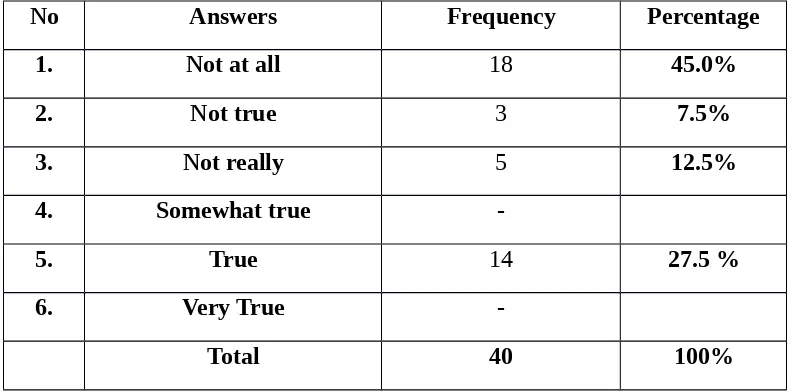
Table 2: Assessment about Learning English
No Answers Frequency Percentage
1. Not at all 18 45.0%
2. Not true 3 7.5%
3. Not really 5 12.5%
4. Somewhat true
-5. True 14 27.5 %
6. Very True
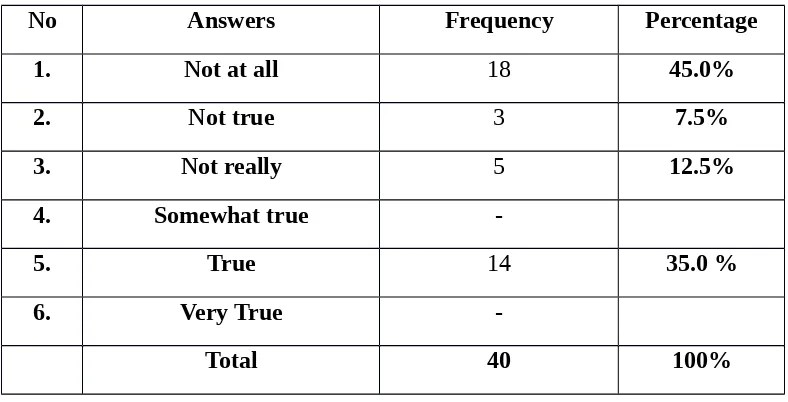
Table 4.2 above describes how capable the student will be when asked
about their perception toward future learning. Out of 14 students give relieving
answers for being good at learning English this semester. They said true for the question no 2. However, 18 students feel they are not good enough about this
semester by putting check on not al alI while a number of 5 students think of not really. Only 3 of them said not true.
This description is somehow better in which it shows some motivation
uttered by the students for their English mastery this semester period. Though they
have a little motivation but it is not enough compared to the whole findings that a
majority of them do not come up with somewhat satisfactorily outcomes. A total
of 26 students think that they are not motivated.
4.1.3 Perception on Students’ Expectation to Do well than other Student in Learning English.
An expectation may indicate one’s hope for what he wishes to get and
accomplish in actualizing his dreams into real work. It can also represent a set of
competition among people who want to be best of all. A competition may help an
expectation come true. Students who like to compete with others might be having
higher motivation the teachers would likely to expect. This way, they could
develop their own type of learning apart from motivation they get from their
teachers. Surely, in this era of information, anyone can motivate themselves in
learning language through the use of digital media without necessarily being
sources of learning in order to have better improvement than his fellow students.
Apparently, this may lead to parents supports if they happen to have children like
this. However, parents should accompany and thus control them in their efforts.
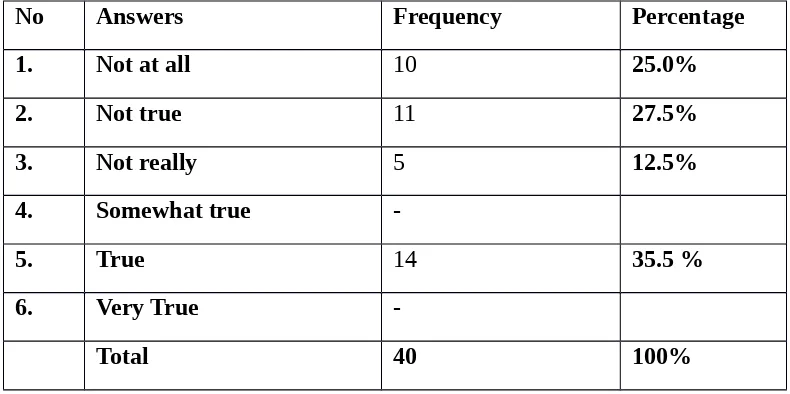
Table 3: Expectation about Student’s Level in Learning the Language
No Answers Frequency Percentage
1. Not at all 10 25.0%
2. Not true 11 27.5%
3. Not really 5 12.5%
4. Somewhat true
-5. True 14 35.5 %
6. Very True
-Total 40 100%
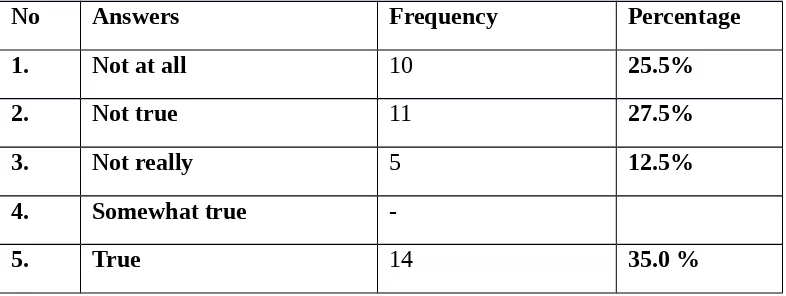
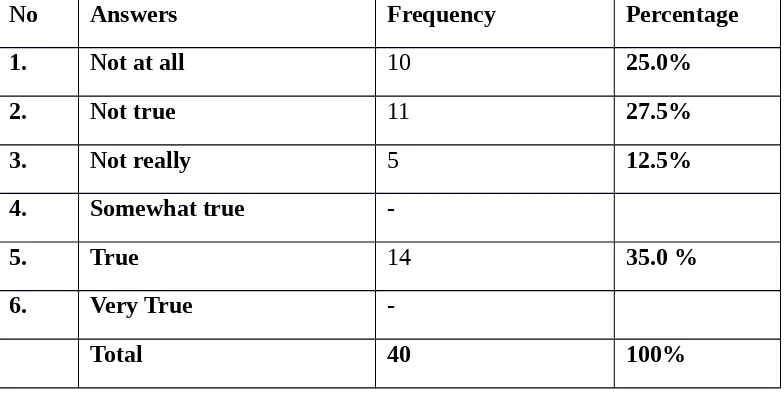
This motivation factor seems to get the same result as previous question in
This would represent the low motivation for question number 2. This also
means that they seem not to care much about competition especially in learning
foreign language. However, an expectation is still there. 14 out of 40 students will
likely wish to compete with others in an effort of showing best performances they
could be. As for other students, they need to have better learning method for the
mastery of foreign language. In this case, both teachers and students should find a
formula in a way that they could motivate each other to create a lively class.
Nevertheless, the teachers are the ones who will be more responsible for this case.
4.1.4 Perception on Students’ wishing to Continue English Lessons
Sometimes when something you like most is over then you can not help
thinking to do it again. If you are in this phase then you may be motivated on a
particular thing. The same applies when students wish to continue lessons they
just had. They feel that something is missing without knowing why. This could
lead to further interpretation that motivation is being felt by them. In precise, what
they have just had stimulates energy to do more before it fades away. If they truly
feel this way then it is a good step to move forward with other stimulation the
teachers might be implementing. Otherwise, the teachers should think of a
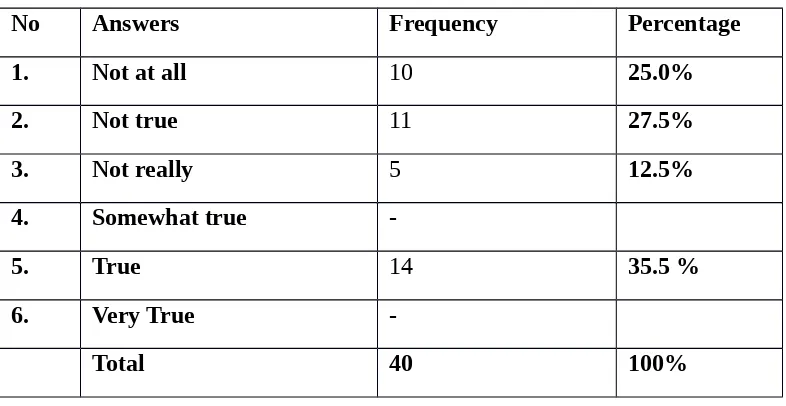
Table 4: Getting Along with English Language in the Classes
No Answers Frequency Percentage
1. Not at all 10 25.0%
2. Not true 11 27.5%
3. Not really 5 12.5%
4. Somewhat true
-5. True 14 35.5 %
6. Very True
-Total 40 100%
A majority of students wish not to continue the lessons. It is indicated by
around 11 of them or 27.5% of total percentage choose not to continue studying
English when the lesson ends. That is not true option. 10 students or 25.0% vote for not at all while only 5 of them or 12.5% of total respondents pick out not really.
Overall, the students are still unmotivated to learn English eventhough
some of them have shown their willingness to study English more seriously. It
seems that class should be made more enjoyable in order to draw students’
teaching more intensely than before in the face of students to generate more
activity and create a sense of excitement to further develop their fearlessness to be
active in front of class.
4.1.5 Perception on Students’ Opinion in Learning Things Useful in the Future
An opinion is something pure from the heart of the speaker who say it out
loud without any intervention from any other parties. It is like a personal belief or
judgment that is not founded on proof or certainty. In another sense, it is merely a
message expressing a belief about something; the expression of a belief that is
held with confidence but not substantiated by positive knowledge or proof. Some
say that opinion is a belief or sentiment shared by most people or the voice of the
people. Eventhough it is not based on the scientific approach but those who dare
to say it may determine the matter lingering them. From people opinion, a certain
conclusion can be drawn to describe the exact problem still going on in the current
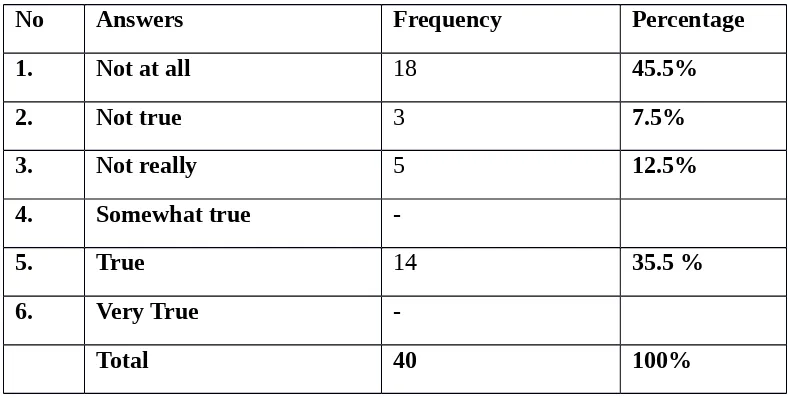
Table 5: Students Opinion about the Future Usage of English
No Answers Frequency Percentage
1. Not at all 18 45.5%
2. Not true 3 7.5%
3. Not really 5 12.5%
4. Somewhat true
-5. True 14 35.5 %
6. Very True
-Total 40 100%
The data above detail the respondents answers successfully collected by
the researcher in which 18 (45.5%) students said not at all and 5 (12.5%) of them
explain their thought on not really. The rest is 14 (35.5%) students representing
their opinion on true. It is apparent that almost three thirds of the respondents take
the side of unmotivated.
This type of question tries to know about students’ opinion whether they have got
some valuable insights and new knowledge. Unfortunately, they do not seem to
grasp anything good from class. It can happen when the class fails to be an
interesting medium for them to do what they are supposed to. Conversely, it can
also happen when the students are not able to follow the lessons very well that
they may easily get bored and not benefit from it. Somehow, a minority of whom
been comfortable with the teachers the way the lessons are delivered so that
something is reaped to enrich their knowledge.
4.1.6 Perception on Students’ Certainty to be able to Speak English Oneday
Certainty is something people want most in their lives since it assures
things that will come true and save them from getting any trouble. When someone
is certain then he will feel confident to do things happily. If not, he will have
restless state in his feeling. Certainty means that doing a thing for future gain is
not a burden since a kind of belief is accompanying him. This also means that
someone’s interest is surely to be channeled through a medium that will determine
his success ahead.
Table 6: Student Expectation about Speaking English in Future
No Answers Frequency Percentage
2. Not true 11 27.5%
3. Not really 5 12.5%
4. Somewhat true
-5. True 14 35.0 %
6. Very True
-Total 40 100%
The answers for all questions turn out to be un satisfactorily in term of
certainty and belief in ability to speak English. The figures tell us that a majority
of whom are determined to be unable to speak English even in the next time. In
particular. 11 students said not true while 10 of them would prefer not at all. 5 of the respondents choose not really.
A total of 26 students are still unable to improve their English for
following days. This would raise a question on whether the teaching method is not
right for them or indeed they just can not follow the lesson. However, there are
about 14 students who show their interest in learning. These young students may
stimulate their classmates in support of learning spirit. The teacher’s task is now
to make these interested student to be a stimulus for those who do no have any
interests in learning English as a concept of coexistence.
4.1.7 Perception on Teachers’ Participation to Stimulate Student
People must be glad to have someone by their side in times of critical
from anyone who cares about us. Even in every aspect of life we all need to be
motivated by renowned motivator. In facing the world with no compromise, we
often look for someone else’s participation to awaken our spirit. Participation may
be defined as the act of sharing in the activities of a group or simply the condition
of sharing in common with others as fellows or partners etc. even in the case of
management, a beloved leader is the one who can be involved in his men’s
activities. Therefore, in class, a teacher should be directly emerged into his
students’ activities in order to stimulate them more actively. Later on, it is hoped
that students will perform well
Table 7: The Importance of Teacher Motivations
No Answers Frequency Percentage
1. Not at all 10 25.5%
2. Not true 11 27.5%
3. Not really 5 12.5%
4. Somewhat true
6. Very True
-Total 40 100%
A majority of whom involved in the activities prefer to take the side of
unmotivated. This is shown by student’s choosing not true for as many as 11 and not at all for 10 answers. This is backed up by 5 students voting for not really. 14 students are convinced to keep up with option true.
To motivate people, especially students, is not an easy task though. It will
employ some of various approaches to deal with. Teachers may feel that they have
poured a lot of sufficient knowledge to make their students understand all the
materials. However, each of them has different competency to absorb all that is
being taught. Hence, teachers must comprehend physiological factor of the
students that they have to be treated with more patience and encouragement.
4.1.8 Perception on Students’ Avoiding any Distraction
People are usually more sensitive to any distraction that may come into his
sense in any given time. A glance of eye on moving objects around them will ruin
his attention to the main object being observed. At the time of childhood and
schooling are the times when a child wants to seek pleasure and will not pay much
attention to the lessons. In this phase, teachers must be very careful and take
necessary step to cope with class and try to keep it intact that no distraction comes
over in between.
No Answers Frequency Percentage
1. Not at all 10 25.5%
2. Not true 11 27.5%
3. Not really 5 12.5%
4. Somewhat true
-5. True 14 35.0 %
6. Very True
-Total 40 100%
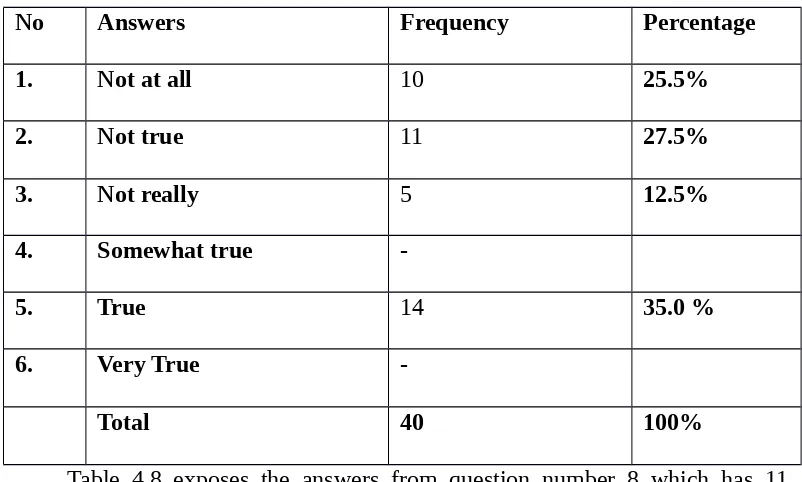
Table 4.8 exposes the answers from question number 8 which has 11
respondents for not true and 10 respondents for not at all. The rest is 5 respondents for not really while there are 14 respondents who claim true for the question. The result puts distraction as a moderating variable for student to behave
reluctantly toward the teaching.
These students still will not get away from any distraction coming by into
their focus. Such a problem generally may be seen in any class even in higher
education like college. It is inevitably happening many times in class so that
teacher profession is considered tough due to this fact. However, it is what
challenges many young teachers to give their dedication and come up with ideas
that may tackle this kind of situation.
Confidence will set men free from any doubt that surrounds his sprit and
change into a more courageous attitude to do what he thought can never be done
but in the end it turns out to be worth trying and fighting for. A man with
confidence will never be afraid to face the world even he declares to conquer it
despite any obstacle that will block his way. This kind of spirit is needed for the
development of a nation and for the betterment of character building. A young
student must posses this spirit in a basic form like working hard on his study and
never stop learning something new for his own sake. Only by doing so will then
the concept of creating better education in Libya come into being. Hopefully, a
chains of struggle can be maintained by next generation of Libya who have better
education and proper qualification to be the next leader of Libya.
Table 4.9 Self Confidence
No Answers Frequency Percentage
1. Not at all 18 45.0%
2. Not true 3 7.5%
3. Not really 5 12.5%
4. Somewhat true
-5. True 14 35.0 %
6. Very True
-Total 40 100%
Table 4.9 above indicates ignorance on confidence in general in which 18
true. There is a little hope that 14 respondents put a check on true. It seems that
confidence is a problem for the students.
Apart from being ignorant, there is still a chance for them to be motivated
since there are 14 students who are undoubtedly confident to be active in putting
forward their arguments in a session of question and answer performed by both
parties of communicators. These 14 students may become an incentive for other
student to keep up with the class.
4.1.10 Perception on Students’ Progress in English this Semester
Progress brings about good news to both motivators and students. Progress
is a gradual improvement, growth or development on one particular subject or
person who is involved in the activities that demands any improvement in its
process. It can be a basis for an authority to further assess the strength of the main
subject for another measurement. In measuring the progress of student capability
in acquisition of a language, there is a special step or assessment to the extent of
advancement. This can be done through an interview and a test. Interview is
aimed at getting qualitative input while a test could be used to give an attribute to
Table 10: Progress in English this Semester
No Answers Frequency Percentage
1. Not at all 18 45.0%
2. Not true 3 7.5%
3. Not really 5 12.5%
4. Somewhat true
-5. True 14 35.0 %
6. Very True
-Total 40 100%
Table 4.10 summarizes that not at all option has 18 followers which in
percentage is around 45.0 % while not really has around 5 voters or 12.5 %. Only
3 respondent would appear to check on not true. Those who single out very true
option are about 14 respondents or around 35.0 %.
Seeing this numbers, we can understand that there is a chance to make
progress a little more in this period of time due to the fact that there are still 14
shadowing over the students capability but making progress in the future is not
impossible to achieve.
4.1.11 Perception on Students’ Feeling Good to Speak English
A state of feeling good is a sign of ability to do something and a power to
make things better. Once you get this feeling good then everything seems alright
that no boundaries could block in the way. Moreover, it is like a groovy mood
when you can have it. It is good for students to have this kind of feeling since it
will enhance his chemistry in learning English. Without any mood then it is
impossible to make progress on English skill. The point is when there is love for
something so that one can do things happily without any burden. This is in line
with the concept of interest where someone is fond of a particular thing that he
would try his best effort to achieve it no matter what happens. He will always
want to practice it everyday to make perfect. The ability to do something, in a
broader sense, could be a source of displaying self actualization. This is a type of
need that must be fulfilled by human being in his social life. To be able to speak
English gives a prestige to its speaker that he could be branded as a modern man
Table 11: Confidence when Speaking English In front of the Class
No Answers Frequency Percentage
1. Not at all 10 25.0%
2. Not true 11 27.5%
3. Not really 5 12.5%
4. Somewhat true
-5. True 14 35.0 %
6. Very True
-Total 40 100%
Based on table 4.11 above, we can understand that there is typically 14
students who feel good to speak English in which they choose true option. 11 students votes for not true while 10 of them prefers not at all. Only 5 respondents
would rather pick out not really.
The result shows that feeling good is rarely felt by participants. However,
it is not disappointing at all since there is 14 students who feel great to speak in
English as a medium of self actualization and a tool of continuing higher
education. This fact needs to be evaluated by teachers in that they must maintain
the groovy atmosphere in class.
Wishing more practice on English lesson is a good move toward
successful language acquisition. It is an indication that there is a need for
experiencing the same event all over again. In other words, they look forward to
doing it one or two more times. Motivation could be generated through this desire
that may lead to the sustainable practice of foreign language. Hence, a student’s
wish might have significant impact on his desire to learn English in a more serious
practice.
No Answers Frequency Percentage
1. Not at all 18 45.0%
2. Not true 3 7.5%
3. Not really 5 12.5%
4. Somewhat true -
-5. True 14 35.0 %
6. Very True -
-Total 40 100%
Table 4.12 elaborates final result of students’ answer on whether they wish
to practice more on English lessons this semester. 18 students said not at all and 5
students have to check on not really while 3 students prefer not true. At last, 14
students decide to opt true.
This description gives us an understanding of how less the students wish to
practice English. The main problem could stem from the lack of media that may
be used to help master their English or they can not find appropriate partner to
practice with. These days, it is common that students do not put more efforts on
his study owing to a lot of other interesting factors than merely focusing on
lessons. This may be reduced if teachers can formulate an effective way of form
of studying English in a more interactive activity.
We cann’t blame teachers when they lack of teaching technique to attract
students to be actively involved in class. The number of student is one specific
problem. There should be a limit of number to make efficient and effective class.
It is difficult to motivate them when the class is full as secondary school
constitutes many children to teach. However, teachers should not stop motivating
despite any difficulties. Indeed, it is a challenge for teachers to make great
contribution in promoting English as a language of science.
Table 13: Teachers’s Motivation
No Answers Frequency Percentage
1. Not at all 10 25.0%
2. Not true 11 27.5%
4. Somewhat true
-5. True 14 35.0 %
6. Very True
-Total 40 100%
From table 4.13 above, we can conclude that 11 respondents vote for not
true as their answer and 10 of whom prefer not at all while only 5 students said
not really. 14 of them would rather say true. Overall, teachers are not considered
as motivating factor.
Motivating is a complex matter that not every person has the ability to
influence others to do what he wanted. Another factor that plays a key role in
motivating is that of a culture. Besides, psychological condition helps shape
personality of a person. The Arab has unique character. They do not want Arabic
to be in confrontation with foreign language. Moreover, Arabic has special
function as language of religion. Some fear that using English may be seen as pro
western countries.
4.1.14 Perception on the Importance of English for Himself
As we already know, English is in international language spoken by many
people in different countries for various purpose. In a more global era, we cann’t
escape the use of English. Hence, many scientific books are written in this
language so that it is becoming more important if we want to get knowledge and
follow technological advance. At this point, a mastery of English is a must.
Therefore, we have to interact with other people from different nation as the world
Table 14: The Importance of Learning English Language in Terms of Communication’
No Answers Frequency Percentage
1. Not at all 18 45.0%
2. Not true 3 7.5%
3. Not really 5 12.5%
4. Somewhat true
-5. True 14 35.0 %
6. Very True
-Total 40 100%
Table 4.14 explains the samples of respondents who said not at all around
18 and 5 of whom prefer not really. There are 3 more respondents who seem not
to consider English as important. However, 14 students seem to care about the
importance of English as a tool to communicate with English speakers.
The students do not think it so important for the time being as they do not
encounter any foreigners in their country so often. That is the reason why they
lack of motivation to boost themselves into studying language. Others might think
that mathematics is more crucial for them since it can not be taken lightly.
However, those who are motivated think that English is important in case they
meet someone from another corner of the world in order to be able to
communicate.