605
Directive Illocutionary Acts by Mario Teguh in
‘Super Show’
Talk Show: A Pragmatics Study
*
Jessica Angela Aziz, Sutiono Mahdi and Rosaria Mita Amalia
Department of Linguistics, Faculty of Cultural Sciences, Padjadjaran University, Kabupaten Sumedang, Jawa Barat 445363, Indonesia;
*
Corresponding author: [email protected]
Abstract
Mario Teguh is a well known motivator in Indonesia. He has attracted Massive public attention for several years through his talkshow programs in several Indonesian television channels like Golden Ways and Super Show Talkshow. The utterances of Mario Teguh in his motivational speeches can be analyzed through a pragmatics study. This research aims to describe and analyze the types of directive illocutionary acts and illocutionary function uttered by Mario Teguh in some videos of Super Show talk show by referring to a main theory by Searle’s, Leech theories, McManis and Yule theories. By observing the frequentative utterance of directive illocutionary acts in Mario Teguh speech, we will be able to analyze what type and function of directive illocutionary acts used by Mario Teguh. The result shows that Mario Teguh tends to use four directive illocutionary acts; they are commanding, requesting, inviting, and suggesting. The functions of directive illocutionary acts used by Mario Teguh are competitive and convivial and the contexts used in the utterances are physical, linguistic, epistemic, and social contexts.
Keywords: directive illocutionary acts, direct speech acts, function of illocution, indirect speech acts, pragmatics.
Introduction
606 Illocutionary act in communication or utterance should be highly considered. This is justified by Rohmadi (2004, p. 31) that the illocutionary act gives a challenge in linguistic research because the speaker expects the hearer to do something the speaker wants to do, so that it is difficult to identify it in directive illocutionary acts. Thus, the speakers’ response then will be negative if it is against the social aim, or it will be positive if it supports the social aim. This is the reason of the author chose to analyze the directive illocutionary acts by using Searle in Cutting (2002) theory to analyze types of directive illocutionary acts found in Mario Teguh utterances, and using Leech (1993) theory to analyze the illocutionary functions of the utterances. Thus, the objective of the research is to describe and analyze the types and functions of directive illocutionary acts uttered by Mario Teguh in Super Show Talkshow.
This research uses a pragmatic study. The formulation of study in the research is what type of directive illocutionary acts uttered by Mario Teguh in Super Show Talk Show? And what functions of illocutionary acts found in Mario Teguh Utterances? Based on the explanation above, the authors decided to conduct research entitled "Directive Illocutionary Acts by Mario Teguh in Super Show Talk Show: A Pragmatics Study".
Literature Review
Types of Directive Illocutionary Acts
Directives are illocutionary acts used by the speaker to get something done. These acts is a highest rank frequency because in classroom discourse, the English teachers use a lot of instructions for the students to do a particular thing, such as asking the students to do the task, to collect the assignment, to open the textbook, or to erase the whiteboard. There are eight kinds of directive illocutionary acts according to Searle (2002):
1. Commanding
According to Searle and Vanderveken (1985, p. 51), command is to direct someone by invoking a position of authority or power commits the speaker to not giving him option of refusal. This type of directive illocutionary acts includes: big, charge, command, demand, dictate, instruct, order, prescribe, and require (Allan, 1986, p. 199).
2. Requesting
Searle and Vanderveken (1985, p. 198) defined request as a directive illocution that allows for the possibility of refusal. Requesting performatives include: ask, beg, implore, insist, invite, petition, plead, pray, solicit, summon, tell, and urge (Allan, 1986, p. 199).
3. Suggesting
Searle and Vanderveken (1985, p. 66) stated that suggesting usually saying something that is good for him/her. Suggesting performatives include: admonish, advice, caution, counsel, propose, recommend, suggest, urge, warn (Allan, 1986, p. 199).
4. Forbidding
Searle and Vanderveken (1985, p. 198) stated that forbid and prohibit is the propositional negation of ordering. If the occasion is general and formal, it is common to use “no”. For example: “No Entry!”. While, if the occasion is special and informal, it is common to use “don’t”. Forbidding performatives include: enjoin, forbid, prohibit, proscribe, and restrict (Allan, 1986, p. 199).
5. Questioning
607 inquire, query, question, and quiz (Allan, 1986, p. 199).
6. Permitting
Searle and Vanderveken (1985:112) stated that permit is the denegation of forbid or prohibit. Permitting performatives include: agree to, allow, authorize, bless, consent to, dismiss, excuse, exempt, forgive, grant leave or permission, license, pardon, permit, release, and sanction (Allan, 1986, p. 199).
7. Encouraging
Searle and Vanderveken (1985, p. 112) stated that encouraging is an illocutionary function used by the speaker to give the listener support or courage to do something.
8. Wishing
When wishing, the speaker hopes something good to happen in future. The act of pray refers to the future act. The hearer will do or avoid something as the speaker's pray (Vanderveken, 1990). For example: “I pray this child turn out good”.
Function of Illocutionary Acts
Leech (1983, p. 104) classified functions of illocutionary acts into four, they are; First, Competitive function that basically have no manners and its function is not aligned with social goals. For example: commanding, requesting, asking, begging and demanding. Second, Convival function is a function that basically has manners and its purpose is in line with social goals. Examples: apologize, congratulate, thank and greet. Third, Collaborative function basically ignores social purposes, for example, declare something, report and announce. Last, Conflictive function, basically aims to cause anger. For example, threaten, accuse, scolding, cursing.
Context
The context consists of four aspects according to McManis, et al (1987, p. 197); First, Physical context is the background of speakers who are involved in a conversation concerning the physical state, such as venue for the conversation, objects around, and events that occur. Second, Epistemic context is the background knowledge of the speaker and hearer about the topic being discussed. Third, Linguistic context is the relationship of utterance with utterance expressed earlier or later that can be a thoughtful utterance. Last, Social context is social relationships and setting between speaker and hearer.
Research Method
The research method used here is a qualitative research with descriptive analysis. According to Djadjasudarma (1993, p. 1), descriptive analysis method is a method that can descriptively provide characteristics, properties and image data through data selection, after the data is collected. In this research, there are three stages to be done; data provision, data analysis, and presentation or formulation of the analysis result. Researchers will use a variety of literature related to the research topic.
Results and Discussion
Table 1. Commanding utterance of directive illocutionary acts as competitive function.
Number Commanding Utterances
1 “Bayangkan wajah orang yang tidak anda sukai!”
"Imagine the face of someone you do not like!"
2 “Kalau begitu anda harus belajar tampil seperti laki-laki!” "Then you must learn to look like a man!"
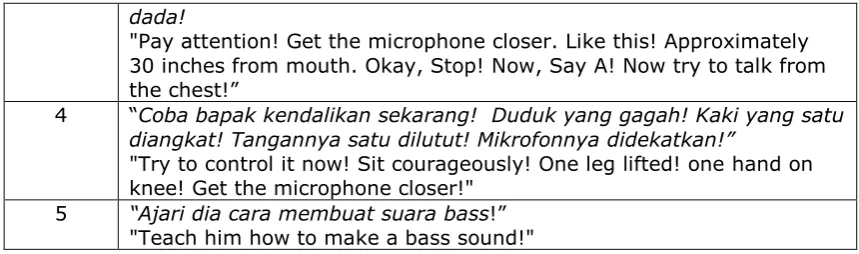
3 “Perhatikan! Ini mikrofonnya lebih dekat. Beginikan pak! Kira kira 30
608 dada!
"Pay attention! Get the microphone closer. Like this! Approximately 30 inches from mouth. Okay, Stop! Now, Say A! Now try to talk from the chest!”
4 “Coba bapak kendalikan sekarang! Duduk yang gagah! Kaki yang satu
diangkat! Tangannya satu dilutut! Mikrofonnya didekatkan!”
"Try to control it now! Sit courageously! One leg lifted! one hand on knee! Get the microphone closer!"
5 “Ajari dia cara membuat suara bass!”
"Teach him how to make a bass sound!"
Table 1 shows five utterances of directive illocutionary acts in type of commanding in Bahasa and translated into English.
Context:
In the question and answer segment, Mario is listening to a complaint from an audience named Miki. Miki tells about his luck of confidence of his looks and voice. Miki is a man who looks less gentle than a man in general, and Miki also has a small and soft voice like a woman. So, this makes him less confident and prestigious. Miki sometime feels anger to those who make fun of him.
Analysis:
The data (1) say "Imagine the face of someone you do not like!". Mario Teguh utterance is a directive illocutionary acts. Mario Teguh commands Miki to imagine the faces of those who had made fun of him. This is one of Mario’s ways to make Miki confident again. Then, Mario Teguh asks Miki to imagine again the face of those people and then insert the positive thoughts about Wiki himself. The verb of “imagine” in initial sentence shows the imperative form of directive illocutionary acts. This means that the audience cannot refuse of what the speaker said. The hearer must do as what it is said.
The structure of utterance on data (1) is a sentence that functions to command. In data (1), Mario Teguh command Miki to do something, which is to imagine the face of those who disturbing him. Thus, the utterance "imagine the face of someone you do not like!" is a direct speech act because the function of the utterance and the intention of the speaker are match, which is command the hearer to imagining. The utterance "Imagine the face of someone you do not like!" has a competitive function because it reduces synchronization between speaker and hearers thus its purpose is not in line with the social goals. The speaker gives a burden to the hearer to do something the speaker wants. The sama case also occurs to data (2), (3), (4), and (5).
Table 2. Suggesting utterance of directive illocutionary acts as convivial function.
Number Suggesting Utterances
1 “Sebaiknya kita hidup yang santai, tidak tegang, tetapi rezekinya
resmi.”
"We should be relaxed, not tense, but the sustenance must be legal."
2 “Tetaplah menjadi pribadi kecintaan Tuhan, patuhlah pada yang baik,
jauhi yang buruk.
"Be a person the God love, stay with the good, away from the bad." 3 “Yang merasa hidupnya menyimpang dari yang lain, ingat ya, anda
hidup di masyarakat yang nge-judge.”
609 4 “Karena hidup ini pilihan, pilih jalur jalur yang menjadikan
kebersamaan anda dengan wanita yang anda memuliakan
“Because life is choice, choose the path that makes you stay together with the lady who adore you”
Table 2 shows that there are four example of directive illocutionary acts in type of suggesting utterance in Bahasa and translated into English.
Context:
The utterances are spoken by Mario Teguh when he is about to close the question and answer segment with the audience. At that time, there are some audiences who get onto the stage and ask for advice from Mario Teguh regarding the grieve feeling they have. After listening to the audience's explanation, Mario Teguh gives answers and helps to solve their problems. Then, Mario Teguh ends his explanation with the utterances.
Analysis:
In the data (1) the utterance "We should be relaxed, not tense, but the sustenance must be legal." as told by Mario Teguh is a directive illocutionary acts. At the time, Mario Teguh is explaining and answering questions from the audience about life and sustenance issue that they earn. Mario Teguh responded by giving advice to live relaxed with legal sustenance. Legal here means halal. Those audiences who ask mostly felt that they have worked hard for a living; however the sustenance they got is not worth the effort. Here, Mario Teguh always gives words of advice and suggestions to the audience so that they are satisfied and feel relieved for the answer given by Mario Teguh.
The structure of utterance in "We should be relaxed, not tense, but the sustenance must be legal” is a declarative sentence. Mario Teguh gives advice to the audience to have a better live with halal sustenance. The function of the utterance implies the advantage for the speaker because the actions that the hearer do will be useful for the speakers. The existence of a match between the structure and function in the utterance make it categorised as direct speech act.
The illocutionary function in the utterance is convivial. The audience feels lucky and satisfied because of the suggestions from Mario Teguh regarding their life problems. The utterance gives a positive effect on the social aim between the speaker and the hearer. Thus, it is identified as convivial function because its purpose is in line with the social goals. The sama case also occurs to data (2), (3), and (4).
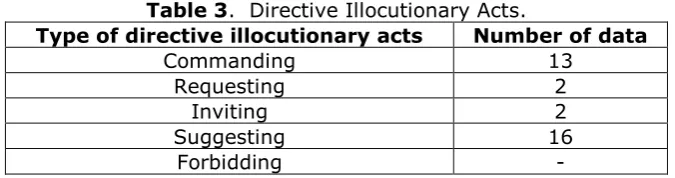
Table 3. Directive Illocutionary Acts.
Type of directive illocutionary acts Number of data
Commanding 13
Requesting 2
Inviting 2
Suggesting 16
Forbidding -
610 Conclusions
After analyzing 33 data from Mario Teguh speeches that contained directive illocutionary act in Super Show Talk Show, the authors write down the following conclusion:
1. There are four types of directive illocutionary acts conducted by Mario Teguh, i.e. Commanding, Requesting, Inviting, and Suggesting. There are 13 data categorized as Commanding. There are two data found as Requesting. There are also two data identified as inviting. The last, there are 16 data of suggesting in directive illocutionary acts. There is no data found regarding Forbidding in directive illocutionary acts.
2. There are two types of illocutionary acts functions found in Mario Teguh speeches; Competitive function and Convivial function. From the 33 data, there are 15 data indicating the Competitive function and 18 data indicate the Convivial function. There is no data found as Collaborative and Conflictive function.
In conclusion, the directive illocutionary acts in Mario Teguh's speech at Super Show Talk Show mostly used suggesting utterance, because Mario Teguh's figure as a motivator tends to give motivation and suggestion as the answer to problems and complaints experienced by the audience. Directive illocutionary acts in form of Forbidding is not found in his utterance, because when the audience seems like having trouble and making mistakes or doing something that is not supposed to do, Mario Teguh prefers to approach and get into the audience’s mind through the words of inspiration, thus the suggestions delivered by the motivator is accepted by the audience.
The function of illocutionary acts by Mario Teguh is dominated by Convival function, because in reality either on-air or off-air talk show, the enthusiastic of the society is always raging. The purpose of the talkshow is in line with social goals. This proven by testimonial video from the audience after attending and watching the Super Show Talk Show program by Mario Teguh. Most of them is satisfied after attending the talkshow.
This research only focuses on directive illocutionary acts and its functions by using pragmatic approach. The next researcher can observe other types of illocutionary acts, for example representative illocutionary acts or expressive illocutionary acts in some talkshow, speech, movies, or classroom activity. The next researcher can also relate the pragmatic approach with sociolinguistics which involve social dimension of the interlocutors.
References
Allan, K. (1986). Linguistic meaning (Volume Two). London: Routledge & Kegan Paul plc.
Cutting, J. (2002). Pragmatics and discourse. London: Routledge.
Djajasudarma, F. (1993). Metode linguistik ancangan metode penelitian dan kajian. Bandung: PT Eresco.
Djajasudarma, F. (2012). Wacana dan pragmatik. Bandung: PT Refika Aditama. Leech, G. (1993). Principles of pragmatics. New York: Longman Inc.
McManis, C., Stollenwerk, D., & Zheng-Sheng, Z. (1987). Language Files: Materials for an introduction to language. Reynoldsburg: Advocate Publishing Group. Rohmadi, M. (2004). Pragmatik teori dan analisis. Surakarta: Yuma Pustaka.
Searle, J. (1969). Speech acts: An essay in the philosophy of language. London: Cambridge University Press.
Searle, J., & Vanderveken, D. (1985). Foundation of illocutionary logic. Cambridge: Cambridge University Press.