Understanding Poverty from
the Perspectives of People
Living in Poverty: Indonesia
Reality Check Approach Sub-report 1
Indonesia
The mission of the National Team for the Acceleration of Poverty Reduction (Tim Nasional Percepatan Penanggulangan Kemiskinan or TNP2K) is to coordinate poverty alleviation policies in Indonesia. As part of its tasks, TNP2K conducts and commissions research reports and studies with the objective of facilitating and informing evidence based policy planning (http://www.tnp2k.go.id).
This is a report of only part of the findings of the Reality Check Approach study carried out in June and July 2014. It provides the findings on poor people’s perspectives on poverty. Sub-report 2 provides findings on poor people’s perspectives on social assistance programmes.
This work is the product of the staff of the Reality Check Approach Plus Project. The findings, interpretations and conclusions are those of the authors and do not necessarily reflect the views of the National Team for the Acceleration of Poverty Reduction, the Government of Indonesia or the Government of Australia.
Suggested citation: The Reality Check Plus project team. 2015. ‘Reality Check Approach Sub-report 1: Understanding poverty from the perspective of people living in poverty’. Jakarta: Effective Development Group in collaboration with Tim Nasional Percepatan Penanggulangan Kemiskinan (TNP2K)
Support for this publication was provided by the Australian Government through the Poverty Reduction Support Facility (PRSF)
You are free to copy, distribute and transmit this work for non-commercial purposes.
To request copies of the report or for more information, please contact the TNP2K Knowledge Management Unit ([email protected]). The report is also available on the TNP2K website.
TNP2K
Grand Kebon Sirih Lt.4, Jl.Kebon Sirih Raya No.35, Jakarta Pusat, 10110
Tel: +62 (0) 21 3912812 Fax: +62 (0) 21 3912513 www.tnp2k.go.id
Cover Image: The Reality Check Approach Team (Indonesia)
Understanding Poverty from
the Perspective of People
Living in Poverty: Indonesia
Reality Check Approach Sub-Report 1
Indonesia
Understanding Poverty from the Perspectives of People Living in Poverty: Indonesia
ii
Contents
Acknowledgements ... vi
Terms, Abbreviations and Acronyms ... vii
Executive Summary ... ix
Introduction ...1
Background ...2
Poverty indicators and the Unified Database for Social Protection Programmes ...2
Research Methodology ...5
Reality Check Approach ...6
Selection of locations ...8
Selection of households ...9
Timing ...10
Reality Check Approach (RCA) methodological considerations: offsetting bias ...11
Bias from being researched ...11
Bias from location ...11
Researcher bias ...11
Evaluation framework bias ...11
Triangulation ...12
Confidentiality, anonymity and continuing non-bias in project activities ...12
Study limitations ...12
People’s Perspectives on Poverty ...15
Who is poor? ...16
Those who need help ...17
Access to cash ...17
What you do for work ...19
Whether you can work ...20
Whether you have things ...21
Where you live: accommodation ...21
Where you live: position ...23
Where you live: community ...23
Where you live: public amenities ...23
What you eat ...24
Who you marry ...25
If you never travel ...25
Contents
iii
Experiences of poverty change over time ...26
Poverty means different things in different places ...28
Aspirations and expectations ...31
What it means to be poor ...33
Discussion on Findings: People’s Perspectives of Poverty ...35
Policy Implications ...39
Policy implication 1: ...40
Policy implication 2: ...40
Policy implication 3: ...41
Annexes ...43
Annex 1: Team members ...44
Annex 2: Areas of Enquiry ...45
Annex 3: Host households ...47
Annex 4: Host household information ...50
Annex 5: List of People Met ...53
Annex 6 : Overview of the Reality Check Approach Plus project, Indonesia ...54
Understanding Poverty from the Perspectives of People Living in Poverty: Indonesia
iv
List of Tables
Table 1: Study locations in relation to purposive selection criteria ...8
List of Boxes
v
List of Boxes
Box 1: Uncontested ‘families in need’ ...16
Box 2: Multiple ways of earning “instant cash” near the town ...18
Box 3: Working together – social cohesion means we are less poor ...23
Box 4: “Our choice to miss meals” ...24
Box 5: Marrying an outsider ...25
Box 6: Poverty is dynamic – the unexpected “sacrifice” of looking after grandchildren ...27
Box 7: Urban vs. rural ...28
Box 8: Being a religious minority ...29
Box 9: Marginalised tribal pocket ...29
Box 10: State-owned plantation workers ...30
Box 11: Plantation workers (private) ...30
Understanding Poverty from the Perspectives of People Living in Poverty: Indonesia
vi
Acknowledgements
This Reality Check Approach (RCA) study was achieved through the commitment, enthusiasm and teamwork of a number of people. The Reality Check Approach is an initiative of the Swedish Embassy in Bangladesh where it was first commissioned in 2007. The National Team for the Acceleration of Poverty Reduction (Tim Nasional Percepatan Penanggulangan Kemiskinan – TNP2K) Monitoring and Evaluation Unit commissioned this study to gain an insight into the process of introducing and operating social assistance programmes in the eastern provinces of Indonesia. The study was undertaken by a mixed team of Indonesian and international researchers and led by an international team leader (see annex 1). This was the first time that many of the team (particularly members from the National Team for the Acceleration of Poverty Reduction) had undertaken a study of this kind and had experienced the kinds of challenges that these studies pose. Their commitment, enthusiasm and efforts are acknowledged and greatly appreciated.
The study was only possible thanks to the many families who opened their doors to the study team. We thank these families in all seven locations for contributing their valuable time and allowing the team members to live with them and share their everyday experiences. We hope that this report accurately reflects the views of the families, their neighbours and others within the communities.
Terms, Abbreviations and Acronyms
vii
Terms, Abbreviations and Acronyms
Agar-agar gelatinous substance extracted from algae
Bajo indigenous tribe in South Sulawesi, distinguished as sailors
BOS Bantuan Operational Sekolah (School Operational Grants)
BLSM Bantuan Langsung Sementara Masyarakat (Temporary Unconditional Cash Transfers)
BPS Badan Pusat Statistik (Statistics Indonesia)
BSM Bantuan Siswa Miskin (Cash Transfers for Poor Students)
Desa village
Dusun sub-village
DFAT Department of Foreign Affairs and Trade, Government of Australia
FHH focal households (neighbours of the host households)
GOI Government of Indonesia
HHH host households; where members of the study team stayed with families
ID identification
IDR Indonesian rupiah
Jamkesmas Jaminan Kesehatan Masyarakat (Public Health Insurance)
Kartu keluarga family card
Kecamatan sub-district
Kepala desa village chief
Kepala dusun sub-village chief
KMS Kartu Menuju Sehat (baby record card)
Understanding Poverty from the Perspectives of People Living in Poverty: Indonesia
viii
Liya tribe of former tree dwellers
Madrasah Islamic religious school
MONEV Monitoring and Evaluation Working Group
Ojek informal motorbike taxi
OSIS Organisasi Siswa Intra Sekolah (Internal Student Organisation at Junior and Senior Secondary School)
PKH Program Keluarga Harapan (Conditional Cash Transfer Programme for Poor Families)
Polindes pondok bersalin desa (village maternity home)
Puskesmas (PK) pusat kesehatan masyarakat (people’s health centre)
Posyandu (PY) pos pelayanan terpadu (integrated health post)
PMT proxy means test
PNPM Generasi Program Nasional Pemberdayaan Masyarakat Generasi (National Programme for
Community Empowerment – to assist with healthcare for pregnant women and infants and students’ education needs)
PPLS Pendataan Program Perlindungan Sosial (Data collection for social protection programmes)
Raskin Program Subsidi Beras Bagi Masyarakat Berpendapatan Rendah (Rice for Poor Households)
RCA Reality Check Approach
SD sekolah dasar (primary school)
SMA sekolah menengah atas (senior secondary school)
SMP sekolah menengah pertama (junior secondary school)
TNP2K Tim Nasional Percepatan Penanggulangan Kemiskinan (National Team for the Acceleration of Poverty Reduction)
Exchange rate:
Executive Summary
ix
Executive Summary
This study was funded through the Reality Check Approach Plus (RCA+) project support provided by the Department of Foreign Affairs and Trade, Government of Australia. It was commissioned by the Monitoring and Evaluation working group of the National Team for the Acceleration of Poverty Reduction. The study aimed to gather people’s perspectives regarding the uptake and experiences of two of the current social assistance programmes, Cash Transfers for Poor Students (Bantuan Siswa Miskin – BSM)(with recent modifications) and the 2014 roll out of the Conditional Cash Transfer Programme for Poor Families (Program Keluarga Harapan
– PKH) in the eastern provinces of Indonesia. Part of this study gathered insights and perspectives on poverty from people themselves.
The Reality Check Approach is an internationally-recognised qualitative research approach that requires the study team to live with people living in poverty in their own homes for periods of time and to use this opportunity to have informal conversations with all members of the households, their neighbours and with the frontline services with whom they interact. The emphasis on informality and being in people’s own spaces enables the best possible conditions for openness and for the study team members to triangulate the conversations with their first-hand experience and observations.
The study was undertaken in June and July 2014 in three locations in Southeast Sulawesi and four locations in Maluku. Locations were selected purposively and took into consideration a number of important contextual variables (remoteness, rural/urban, ethnicity/religion, availability of health and education facilities). Locations where there were high concentrations of social assistance recipients were selected on the assumption that these were poorer villages. Study team members lived with people living in poverty in their own homes for four days and four nights. A total of 22 host households, selected as being poorer households in their villages, participated in the study and more than 1,300 others were engaged in conversations during the course of the study (conversation time amounted to more than 1,200 hours, equivalent to more than 200 focus group discussions).
The findings on poor people’s perspectives on poverty are covered in sub-report 1 and the findings on their perspectives on social assistance programmes are covered in sub-report 2. Both reports document people’s own views that emerged from conversations based on the loose areas of enquiry developed specifically for the study (annex 2). Authorial voice is confined to the discussion section of the report (section 4).
Understanding Poverty from the Perspectives of People Living in Poverty: Indonesia
x
Other determinants of poverty were listed (and are recorded in the report in order of frequency). These included: “not having cash in the house”; type of livelihood (those in unskilled day waged work were considered most vulnerable); ability to work; certain assets (especially access to metered electricity); location within the village and nature of the village (level of social cohesion); and “what you eat” (not how often). People expressed some caution about the “certain assets” determinant as many people receive gifts or buy on credit. People also noted that incomers, especially men marrying local women, are often poorer because the family does not have access to land. People who have travelled less and “not had exposure to other places” were considered poor and in Maluku the sentiment was shared that “only lazy people are poor” as farming and fishing are considered accessible to all.
People noted that poverty was dynamic and people move in and out of poverty depending on external causes (for example, conflicts or natural disasters) as well as on family life cycles (care/work dynamic, costs of education, number of family members able to work and family crises, for example, bereavement, accidents, divorce, chronic illness and chronic indebtedness).
Importantly, people noted that where you live had a significant influence on the experience of poverty. Families with similar configurations, assets and reported main livelihoods could experience poverty vastly differently depending on whether they lived in an area offering numerous opportunities to earn informal cash or not. Resource-rich communities and/or those with active local economies support a range of casual ways to earn cash and make the experience of poverty less extreme. Similarly, the experience of poverty was much worse in areas with high public poverty (areas with poor access to health facilities, schools and administration and poor roads). Being a religious or ethnic minority has significant potential to worsen the experience of poverty. Temporary migrant workers as well as those employed in state-owned plantations are disconnected from government poverty programmes.
Throughout the study, people indicated strong motivation for their children to “do better than we have” and were willing to invest in education to try to achieve this. People in these locations are disenchanted with farming and fishing and aspire to having government salaried work with the attendant security of tenure and access to credit that ensues.
Overall, people saw being poor as:
• Not having enough cash to cover increasingly cash-based transactions; • Not having enough options to raise “instant cash”;
• Not having the time (usually because of caring duties) or health status to benefit from instant
cash-earning opportunities;
• Being dependent on single livelihoods, seasons and middlemen;
• Not being employed on a permanent basis, so unable to plan or think about the future or gain access
to credit;
• Living as a minority, with limited access to local decision-making structures and facilities; • Living in fear (due to ethnic tensions, lack of documentation, illiteracy); and
Executive Summary
xi
The discussion section suggests that determining the undisputed category of “families in need of help” is a priority from people’s perspective. While this could theoretically be largely informed by existing data, especially around age, chronic illness and numbers of household members unable to work (either physically or due to caring roles), it is not currently done. It also suggests that surveys that ask people’s main occupation inadequately capture the diverse nature of people’s livelihood strategies, especially with the increase in cash demands. The means of collecting consumption data could be revisited and based on actual cash expenditures that people can recall rather than on monetised consumption, especially where people do not know quantities of items consumed but do know the cost. The discussion also notes that some assets used to determine poverty have limited applicability in the current context.
The report concludes with a number of policy implications and considerations with regard to improving targeting and recommends the following processes that make sense to people living in poverty themselves:
• Identify “families in need” through differently prioritised survey questions and ensure that the social
assistance programmes are designed to reach them as a priority;
• Provide community facilitators to help families specifically to access their entitlements as these families
are often the least able to do this themselves;
• Update the indicators used to determine poverty so they are more consistent with contemporary
experiences;
• Weight household poverty indicator data with public poverty assessment (availability of a range of
Chapter I
Understanding Poverty from the Perspectives of People Living in Poverty: Indonesia
2
This report presents the main findings of the Reality Check Approach study which was conducted in June and July, 2014. The study was commissioned by the National Team for the Acceleration of Poverty Reduction Monitoring and Evaluation Working Group. It sought to gather people’s perspectives regarding the uptake and experiences of two of the current social assistance programmes, Cash Transfers for Poor Students (Bantuan Siswa Miskin – BSM) and the 2014 roll out of the Conditional Cash Transfer Programme for Poor Families (Program Keluarga Harapan – PKH) in the eastern provinces. The study also provided an opportunity to learn how people themselves define and experience poverty and these findings feature in this sub-report.
The Reality Check Approach (RCA) study was undertaken by a team of 21 researchers under the guidance of the international team leader who also undertook some field research directly (see annex 1). Overall management of the team, training of new researchers in the approach and logistic arrangements were undertaken by the Reality Check Approach Plus (RCA+) Project (see annex 5). Nineteen families participated as host households from six different locations (three in Southeast Sulawesi and three in Maluku), with a further three host households on a commercial plantation where team members stayed for one night. Over 1,300 people from the villages where host households were situated participated in the study (equivalent in numbers to 100 focus groups discussions) involving over 1,200 hours of interaction (equivalent in time terms to 200 focus group discussions).
Background
The study was designed to gather insights about people living in poverty and their perceptions, experiences and use of the two social assistance programmes. Since both these programmes are targeted using the Unified Database for Social Protection Programmes (Basis Data Terpadu Untuk Program Perlindungan Sosial – UDB), understanding people’s perceptions and experiences of poverty and the relevance of the database formed a key part of the study. The database (as a basis for targeting) is described in the next section.
Poverty indicators and the Unified Database for Social Protection Programmes
The Unified Database for Social Protection Programmes is managed by the National Team for the Acceleration of Poverty Reduction and is intended to improve the accuracy and accessibility of data on poor households. It is used to target social programmes, especially the following: Public Health Insurance (Jaminan Kesehatan Masyarakat – Jamkesmas), Cash Transfers for Poor Students, the Conditional Cash Transfer Programme for Poor Families and Rice for Poor Households (Program Subsidi Beras Bagi Masyarakat Berpendapatan Rendah, popularly known as the Raskin programme). Research has shown that the various targeting approaches used previously failed to accurately and effectively identify intended beneficiaries and there was, in particular, unacceptable leakage to the non-poor. The database uses proxy means testing1 to rank “prosperity” which, in turn, uses data
extracted from the 2011 National Social and Economic Survey (Survei Sosial dan Ekonomi Nasional, known as Susenas) and the 2012 Data Collection for Social Protection Programmes (Pendataan Program Perlindungan Sosial – PPLS).2 The computation results in a poverty-ranking index by (named) households within the bottom
four deciles (poorest 40 percent of households in Indonesia).
1 Proxy means testing uses multivariate regression to correlate certain proxies, such as assets and household characteristics, with poverty and income. In Indonesia the correlation is made with consumption.
Introduction
3
The household index is adjusted by location using inclusion/exclusion of certain key survey questions and weighting of others to allow for rural/urban and location-specific variations in the determinants of poverty. Field verification of the validity of some indicators was undertaken during the course of refining the database and some indicators were dropped because of inaccuracies or practical difficulties faced in collecting accurate data.3
The automated targeting was supplemented by consultations at community level and “sweeping” which means adding or deleting households according to these local consultations. Introducing this database was intended to improve targeting effectiveness.
SMERU Research Institute (2012) noted in their rapid assessment of the Data Collection for Social Protection Programmes that it provided a number of improvements over previous systems. These included, firstly, that the data collection (the survey) was not linked to any specific programmes and, secondly, that it requested more detailed information from households. However, it was still criticised for being too generalised in that it uses poverty indicators without sufficiently taking into account local socio-economic characteristics. SMERU also pointed to some evidence of under-coverage. Furthermore, the data collection was conducted with households pre-listed as poor from the 2008 census so the accuracy of this base information was questioned. The Australian Department of Foreign Affairs and Trade – DFAT commissioned study (2011) notes that the proxy means test (PMT) has many built-in errors:
“Part of the reason for this is the imperfect correlation between multiple proxies and household consumption. Additionally, the PMT methodology is based on national household survey data that represent ‘reality’ at one point in time and are inherently inaccurate to varying degrees. Other issues are sampling errors in household surveys and assumptions made in applying the PMT, which increase the arbitrary nature of the methodology yet affect whether individual households receive social protection benefits.”
Chapter II
Understanding Poverty from the Perspectives of People Living in Poverty: Indonesia
6
Reality Check Approach
The Reality Check Approach (RCA) extends the tradition of listening studies (see Salmen 1998 and Anderson, Brown and Jean 2012) and beneficiary assessments (see SDC 2013) by combining elements of these approaches with the researchers actually living with people whose views are being sought, usually those who are directly experiencing poverty. It could be likened to “light touch” participant observation. Participant observation involves entering the lives of the subjects of research and both participating in and observing their normal everyday activities and interactions. It usually entails extensive and detailed research into behaviour with a view to understanding peoples’ perceptions and their actions over long periods of time. The Reality Check Approach is similar in that it requires participation in everyday life within people’s own environments but differs by being comparatively quick and placing more emphasis on informal, relaxed and insightful conversations than on observing behaviour and the complexities of relationships.
Important characteristics of the RCA are:
• Living with rather than visiting (thereby meeting the family in their own environment, understanding family dynamics and how days and nights are spent);
• Having conversations rather than conducting interviews (there is no note taking thereby putting people at ease and on an equal footing with the outsider);
• Learning rather than finding out (suspending judgement, letting people who experience poverty take the lead in defining the agenda and what is important);
• Being household-centred and interacting with families rather than users, communities or groups;
• Being experiential in that researchers themselves take part in daily activities (collecting water, cooking, cultivation) and accompany household members (to school, to market, to health clinic);
• Ensuring inclusion of all members of households;
• Interacting in the private space rather than public spaces (an emphasis on normal, ordinary lives);
• Embracing multiple realities rather than relying on public consensus (gathering diversity of opinion, including “smaller voices“)
• Interacting in ordinary daily life with frontline service providers (accompanying host household members in their interactions with local service providers, meeting service providers as they go about their usual routines);
• Taking a cross-sectoral view, although each study has a special focus, the enquiry is situated within the context of everyday life rather than simply (and arguably artificially) looking at one aspect of people’s lives;
• Understanding longitudinal change and how
Research Methodology
7
Training and orientation on the RCA were provided before each round of the study. This was the first time that training was provided without a concomitant immersion experience as the National Team for the Acceleration of Poverty Reduction (TNP2K) staff had limited time available (see limitations section). The training was led by Dee Jupp with assistance from Dewi Arilaha, who was a team member for the 2009–2010 study conducted on the basic education programme in Indonesia, and Ansu Tumbafunghe, who has conducted training and acted as a sub team leader in a number of RCA studies in Nepal.
The emphasis on informal conversations and observation allows for openness and insights into the differences between what people say and what they do. The team found that the families they stayed with were accepting and quickly relaxed and felt at ease to talk openly. Study team members engaged all members of the family as well as neighbours (focal households) in conversations. They accompanied them to their places of work, schools, health posts and assisted them with household chores to minimise any disruption in their daily routine and to ensure the most relaxed conditions for conversations. The team members also interacted with local power holders (village chiefs and administrators and heads of neighbourhoods) as well as local service providers (health workers, school teachers, religious leaders, shop and stall owners) through informal conversations (see annex 5 for the list of people met).
Each team member discreetly left a “gift” for each family on leaving, comprising food items and stationery to the value of IDR120,000–300,000, to compensate for any costs incurred in hosting the researcher. As researchers insist that no special arrangements are made for them, they help in domestic activities and do not disturb income-earning activities, the actual costs to a family are negligible. The timing of the gift was important so families did not feel they were expected to provide better food for the researchers or get the impression that they were being paid for their participation.
Understanding Poverty from the Perspectives of People Living in Poverty: Indonesia
8
Selection of locations
The RCA study villages were selected purposively. Key determinants for location selection were negotiated with the TNP2K Monitoring and Evaluation Working Group and others working on the social assistance programmes. These determinants included:
• Remoteness or proximity to district town; • Rural or peri-urban;
• Ethnicity or religion; • Main occupation;
• Concentration of social assistance recipients (proxy for relative poverty of community); and
• Presence of health and education facilities (opportunity to meet conditionalities associated with social
assistance programmes).
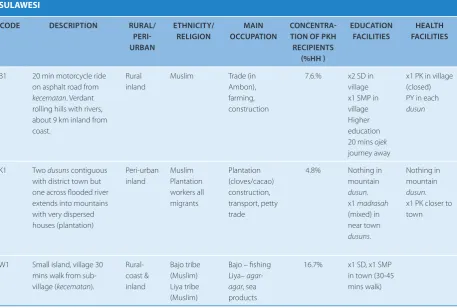
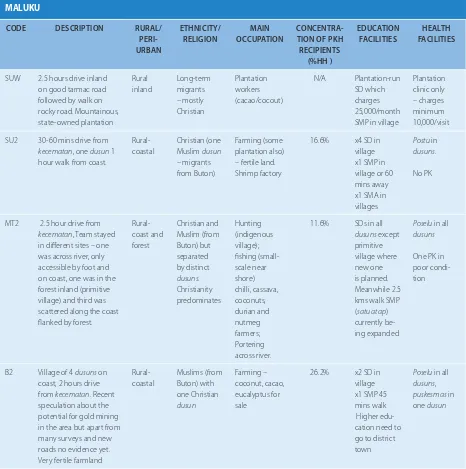
Table 1 lists the study locations with reference to these key determinants.
TABLE 1: STUDY LOCATIONS IN RELATION TO PURPOSIVE SELECTION CRITERIA
SULAWESI
B1 20 min motorcycle ride on asphalt road from kecematan. Verdant rolling hills with rivers, about 9 km inland from coast.
sub-Research Methodology
SUW 2.5 hours drive inland on good tarmac road
SU2 30-60 mins drive from kecematan, one dusun 1 in different sites – one was across river, only in the area but apart from many surveys and new
The villages are not named in this report in order to protect the identity, anonymity and confidentiality of participants for ethical reasons but also and especially as there is a possibility that the study may be extended over a longer period of time as a longitudinal study requiring visiting the families again.
Selection of households
Nineteen host households participated fully in the study (researchers stayed with them for four nights and four days) and a further three households, situated on a state-owned plantation, hosted our team members for just one night.
Understanding Poverty from the Perspectives of People Living in Poverty: Indonesia
10
All host households were identified by team members through discussions with villagers and the host households themselves. Only two household selections were referred through the relevant village chief (kepala desa) but in both cases researchers were able to maintain final jurisdiction over the selection to ensure that host families met the study criteria. In all other cases, no authorities were involved in household selection.4
Households were selected with a view to representing the kinds of households that the social assistance programmes are designed to target (see section 2). Care was taken to ensure that people understood the nature of the RCA and the importance of staying with ordinary families and not being afforded guest status. The researchers worked with villagers to choose host households that were comparatively poor (defined by local perceptions of poverty as discussed in section 5) and included children of school-going age.
Team members entered villages independently and on foot to keep the process “low key”. The households selected by different members of the same team were at least 10 minutes walk away from each other and where possible further away to ensure interaction with a different constellation of focal households.
In addition to intense interaction with the host households (talking to family members and accompanying them in their daily activities), each team member also had extensive conversations with neighbours. This was usually with at least four other households living in poverty (referred to as focal households). They also had opportunistic conversations with local service providers such as teachers, formal and informal health service providers, motorbike taxi (ojek) operators, small shopkeepers and teashop owners (see annex 5). In total, the research involved conversations with over 1,300 people and represents more than 1,200 hours of conversation.
Timing
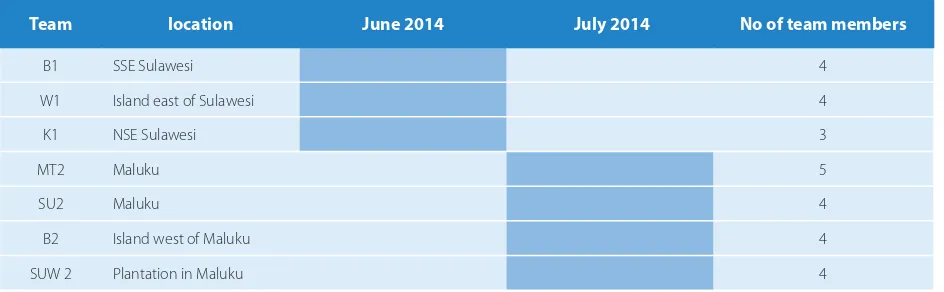
The RCA study was conducted with six teams of three to five members in six different sites during the months of June and July 2014, as described in table 2.
TABLE 2: TEAM COVERAGE OF LOCATIONS
Team location June 2014 July 2014 No of team members
B1 SSE Sulawesi 4
W1 Island east of Sulawesi 4
K1 NSE Sulawesi 3
MT2 Maluku 5
SU2 Maluku 4
B2 Island west of Maluku 4
SUW 2 Plantation in Maluku 4
Each team member stayed with their respective host households for four nights and four days. Average conversational interaction with host families, neighbours and frontline service providers per team member was at least 50 hours. The entire study therefore provided the equivalent of 1,200 hours of conversation (roughly equivalent to 250 focus group discussions) and had the advantage of being supplemented by high levels of immediate and extensive triangulation, largely because of the immersion element of the study.
Research Methodology
11
Reality Check Approach (RCA) methodological considerations: offsetting bias
Like all research methods, the Reality Check Approach takes note of and attempts to offset potential bias. The following is an analysis of the potential for bias and the way the researchers in this study and through the approach itself sought to minimise these biases.
Bias from being researched
The approach benefits from being low key and unobtrusive. It seeks to provide the best possible conditions to listen, experience and observe ordinary daily lives and deliberately seeks to reduce the biases created by an external research presence. The team members take time to get to know the families they stay with, work alongside them and adapt to their pace and way of life. Ideally they seek to listen to family conversations and interactions rather than engage in lengthy question and answer sessions. Considerable effort is made to ensure the host families feel comfortable and at ease so they tell their own stories and explain their realities in their terms and in their own way. This goes some way to ensuring that the families do not feel their answers should be filtered, measured or in any way influenced by the presence of the outsiders. The team members actively suspend judgment. Considerable effort is made in pre-field team training to make the researchers aware of their own attitudes and behaviour which may be conducive or obstructive to openness and trust among those they interact with.
Bias from location
At least three team members stayed in each village (desa), each living with a different poor family. All homes were at least 10 minutes walking distance from one another (and most were considerably more than this) so that each team member could maximise the number of unique interactions with people and service providers in the community and avoid duplication with other team members.
Researcher bias
A minimum of three researchers were allocated to each village but they worked independently of each other thus allowing for more confidence in corroborating data. Each village team underwent a day-long debriefing to review information and findings emerging from each location immediately after completing the immersion. This enabled a high level of interrogation of the observations, experiences and responses and reduced the possibility of individual researcher bias. Furthermore, following completion of the entire baseline study, a validation workshop was held with the entire research team to analyse and confirm the main findings and ensure that both specificity and diversity in the findings were captured, along with more generalisable findings.
Evaluation framework bias
Understanding Poverty from the Perspectives of People Living in Poverty: Indonesia
12
Triangulation
An integral part of the RCA methodology is the continuous triangulation that ensues. Conversations take place at different times of the day and night allowing unfinished conversations or ambiguous findings to be explored further. Conversations are held with different generations separately and together in order to gather a complete picture of an issue. Conversations are complemented by direct experience (for example, visits to health clinics, accompanying children to school, working with families on their farms) and observation (family interaction/dynamics). Cross checking for understanding is also carried out with neighbours, service providers (for example, traditional birth attendants, community health workers, school teachers and teashop owners) and power holders (informal and elected authorities). Conversations are at times complemented with visual material or illustrations, for example by jointly reviewing baby record books or school books as well as through various activities, such as drawing maps of the village, ranking household assets, scoring income and expenditure proportionally, and so on. In the course of four intensive days and nights of interaction on all these different levels, some measure of confidence can be afforded to the findings.
Confidentiality, anonymity and continuing non-bias in project activities
The study locations are referred to by code only and the team is at pains to ensure that neither the report nor other documentary evidence, such as photos, reveal the locations or details of the host households. Faces of householders and images that reveal the location are either not retained in the photo archive or identities are digitally removed. This is partly to respect good research practice with regard to confidentiality but also has the benefit of ensuring that no special measures or consideration are given to these locations or households in the course of the programme. All families are asked to give their consent for their stories and photos to be recorded and shared.
Study limitations
In addition to the determinants listed in table 1, practical considerations were also taken into account in choosing locations for the study. However, long road journeys of 12–14 hours were required for locations SU2 and K1. Other locations were reached by combinations of boat, road and foot (including wading through rivers for MT2 and K1) on journeys of 3–4 hours. The most remote location was reached via a local flight and then a walk (W1). Even though the journeys undertaken were not necessarily easy or quick, other possible locations were even less accessible and would have required journeys of several days so they had to be excluded from the study.
The June phase of the study partly coincided with the school holidays in some areas (different in different locations) which affected observations of school going and interaction with school children was affected (some children were way from home visiting relatives).
Research Methodology
13
Reality TV had filmed in Sulawesi and some parts of Maluku some years ago and there were expectations that the research team were also “secretly filming”. These expectations meant that constant reassurance was required that this was not the case.
Location Maluku B2 had had a series of researchers visiting recently, apparently associated with speculation regarding the extractives industries. A pyramid marketing scheme for pharmaceuticals had also been recently set up by outsiders. Both had raised expectations that had to be managed carefully by the team.
Chapter III
Understanding Poverty from the Perspectives of People Living in Poverty: Indonesia
16
This section looks at how poverty is experienced and perceived by people living in poverty themselves as well as how it is perceived by other members of the community in the different study locations. This inevitably takes a multidimensional view of poverty, exploring its changing dynamics as well as peoples’ aspirations for the future. It investigates the nexus between private and public poverty and how these factors interplay resulting in individual households’ particular experience of poverty and vulnerability.
Whilst the study concentrated on the 19 host households,5 researchers interacted with more than 80 additional
focal households and gathered information about the village as a whole through conversations with other people, including frontline service providers (teachers, health workers, local administrators) and through the researchers’ own observations. The triangulated findings are therefore somewhat representative of the locations rather than just the small number of host households.
Who is poor?
During the course of conversations, we asked our host and focal households and others who they considered to be the poor people in the community, sometimes obliquely using phrases like people “who live more simply” or “who are less fortunate” because of the sensitivities around this issue. People explained that it was easier to describe who was not poor rather than who was poor. Nevertheless, a number of recurrent themes permeated conversations in all locations. These are presented below in approximate order of frequency. The first descriptor refers to those who are struggling and need help and people felt this category was both easy to describe and uncontested. The second descriptor is “lack of cash” and came through strongly as something that distinguishes the very poor.
5 Plus a further three plantation-located host households where researchers stayed for one day and night. BOX 1: UNCONTESTED ‘FAMILIES IN NEED’
The following are a few examples of families that other poor people considered clearly in need of help:
My host household neighbours told me they wished my host family had been a bit more open about their situation to me. They said: “They have struggled so much, especially paying for the treatment of the mother. She coughs blood and the puskesmas here is hardly ever open so they have to take her to town. The health card does not help as it only partly pays for medicines for this. The family conserves water by sending the children to the river to bathe and they eat poorly. The mother no longer goes to the women’s savings group because she is embarrassed” (Field notes, Sulawesi, B1).
I was told a mother abandoned her three children in the village without saying a word. The father is currently still in the village but it seems he does not take care of the children. I saw one of the children sleep outside a neighbour’s’ house one night on a bamboo bed. People said she was fed by different people in the village (Field notes, island off Sulawesi, W1).
This twice divorced woman [in my host household], now in her 60s, has struggled most of her life as a single mother raising three children. She used to sell spices until an earthquake destroyed the plywood factory where most of her customers worked and the factory never reopened. Now she has been left two of her grandchildren to look after as her daughter and son-in-law cannot afford to look after them. She also feeds an orphaned boy who lives next door. She has moved to the island to be close to her brother but because she has no identity card she is not entitled to any official assistance here (Field notes, island off Sulawesi, W1).
People’s Perspectives on Poverty
17
• Those who need help
As the study purposively sought out poorer locations, the prevailing feeling among study participants was that “everyone is poor in our village”. However, further conversations and probing revealed more nuanced responses with people often volunteering the categorisation of “those needing help”. The particular families who fell into this category seemed to be universally clear and uncontested within the community. Box 1 describes some of the households that people put into this category. Those needing help, according to other poor people, include: families that have members with chronic medical conditions (recognising the actual costs and the opportunity costs of care); those caring for elderly people; elderly people living on their own with no support from relatives; widows living on their own or caring for children or the elderly; and abandoned women and children.
• Access to cash
Having or not having cash in the house (Maluku, SU2) is, according to people living in poverty, one of the most important determinants of poverty. People told us that it is not possible to exist without cash any more, as it used to be in the past. Former subsistence farmers explained that they have to find ways to earn cash to pay for food, electricity (or kerosene), water (sometimes), school costs, medicine, farm inputs, social obligations,6 new clothes,7 and so the list goes
on. The days of bartering are largely over and we only found the practice in one village.8 But it is cash flow
and the ability to meet day-to-day cash demands which people feel creates the biggest divide between
the poor and poorer. Simply put, those with a range of ways to raise “instant cash” are better off than those who have limited or few ways to do this. So, for example, the widow described in the third paragraph in Box 1 has no means of raising cash except through occasional kitchen garden surplus. However, a self-declared subsistence farmer host household in Sulawesi B1, despite facing huge demands for cash (with twelve children, ten of
6 Including donations to mosques or churches. In one Maluku location all families were expected to contribute IDR250,000 to facilitate a meeting of the local synod, something they felt they got no benefit from but had no way to avoid. Others are frequently required to contribute to building and renovation costs yet feel the church offers no services to the community except worship.
7 Especially at celebrations such as Lebaran or Christmas
8 In B2, Maluku, households processed cassava and exchanged this for fish.
Understanding Poverty from the Perspectives of People Living in Poverty: Indonesia
18
whom are in full-time education), has a range of options to raise instant cash. The family can do a number of things: collect rocks or dredge and sell sand for construction; clear other peoples fields; work as unskilled day labourers on construction sites; sell cassava cakes house to house; and cut and sell firewood. A household with a single livelihood or crop to sell is at a disadvantage compared to one with year-round alternatives. As a farmer in Maluku noted:
“I have my crops but can also sell banana and cassava leaves to passing traders and if necessary I can cut wood from the forest, which takes me a week, and sell it to traders in town. We sometimes catch and sell parrots. There is always a way to earn some cash somehow” (host household, Maluku, SU2).
His youngest son currently makes regular trips to the forest to earn money to pay for his tuition fees. Box 2 gives an example of cash-earning possibilities available to those living near an urban centre but we also found multiple options if there was some indication of local economy in rural areas. On the island off Sulawesi, fishing and agar agar cultivation are the main livelihoods and depend solely on middlemen from outside who have a monopoly on pricing. There is little local economic activity (not much construction or disposable income) so no means of earning the small cash sums needed for day-to-day consumption. In one Maluku fishing village the poorest were those who had to raise cash through loans: “If you have to borrow money then you get into difficulty” (host household, Maluku MT2).9 By
contrast, the villages where there was a lot of hawker
activity indicated that households had disposable cash income. For example, in one of the coastal villages in Maluku vendors sold kecup (soy sauce), MSG and other seasonings daily from house to house.
9 Considered a “slippery slope”
BOX 2: MULTIPLE WAYS OF EARNING “INSTANT CASH” NEAR THE TOWN
My host household works on a share-cropped clove and cacao plantation but supplements this income with clearing land for others, making and selling alcohol from wild palm and selling leafy vegetables collected from the mountain. The mother of the family has bought a motorbike on credit and works as an ojek driver. The father picks up occasional work on construction sites in town (Field notes, host household 1, K1).
The host household cultivates cloves in a share-cropping arrangement with the landowner and can earn about IDR11 million per year but the income is seasonal and cash is needed throughout the year so they also cut wood, offer insect-spraying services, clear other people’s fields and buy and sell sugar house to house: “Life is better than before because there are many ways to earn cash” (the family migrated) (Field notes, host household 2, K1).
People’s Perspectives on Poverty
19
• What you do for work
In all locations, people stated that if you have a government salaried job then you are better off. People noted that a salaried job meant not only job security and “fixed money” but also that the incumbent would be considered credit-worthy and be able to purchase assets such as a motorbike, television and fridge or use loans for house construction and education, especially higher education. So strong is the association between having a fixed income and wealth, in some areas people suggested that this was the only livelihood to aspire to. One host said:
“The kepala dusun is rich but he is a failure because none of his children have tertiary education and all (eight) are just traders” (host household, B2 Maluku).
Many parents shared their hopes of their children getting government jobs, especially in health and education.10
Fishermen on the island off Sulawesi complained that even non-accredited teachers (guru honor) earn ”so much and only work half a day“.11
Traders and shopkeepers, followed by transport providers, skilled construction workers (including carpenters and electricians), factory workers12 and
mine workers (especially at gold mines) were usually mentioned as the next better off. Often these jobs involved migration, albeit temporarily. The idea of going away to make money was entrenched in most of
the study locations. For example, on the island off Sulawesi, only those who worked away picking cloves, selling spices or working in construction were regarded as less poor than those remaining. This tradition of working away from home has existed for several generations and is referred to as “bernakat”.13 The idealism expressed
in this term however belies the reality that fortunes are not made. A different view was expressed in Maluku MT2 where people implied that only poor people had to migrate as the fishing or farming village life was good enough. This was one of the three villages where people said that resources were sufficient and only lazy people were poor (see the last descriptor in this list).
The next categories of relative wealth become more indistinct. Fishermen, we were told, can be comparatively wealthy if they have larger ocean-going boats and outboard engines but if not, they can be among the poorest. Farmers can be comparatively wealthy if they have sufficient, good quality, irrigated land but if they are only subsistence farmers and have no supplementary income, they too can be among the poorest. However, people recognise that even landed farmers who used to be considered wealthier are facing increasing problems. Profitability is less secure with no direct connection to a value chain and with increased labour costs because young people are now in school rather than helping on the family farm. This is combined with less predictable
10 The military was mentioned as another option but the various payments required to secure places were generally considered too much of a burden for poor people. 11 Unaccredited teachers (guru honor) supported in part here were able to earn IDR3 million per month by working in three different schools, said to be more than fully qualified teachers earn.
12 Factory workers are a special case as sometimes the employment conditions (short-term contracts, daily wage basis) are considered risky and insecure and so they do not always fit in this category.
Understanding Poverty from the Perspectives of People Living in Poverty: Indonesia
20
seasons and cash wages required for labour. A farmer who has just started out is poor compared to others : “It takes 4–5 years for cacao and cloves to establish – this is a period of struggle ” (farmers in K1, peri-urban Sulawesi).
Unskilled labour (for example, portering at harbours or to cross rivers) and dependency on others for day-wage employment were seen as risky livelihoods without opportunities to move out of this unpredictable hand to mouth existence.
Conversations around livelihoods often resulted in discussion of the next most talked about element of poverty, the capacity to work and the number of household members who could work.
• Whether you can work
We heard in several different locations that older widows find working the land too hard, even when the land is theirs to cultivate. Getting help increasingly involves cash payment or reciprocity and the latter is usually in the form of labour but older women are not considered productive so reciprocal labour arrangements are limited or non-existent. Paying for labour is not possible so the land remains idle or minimally cultivated. We observed many fields that had been abandoned in this way. The family may have managed to work the land before the father died but cannot continue subsequently. People shared their observation that this is less often a problem for widowers as they may still be able to cultivate the land and engage in reciprocal labour arrangements but also because “they usually marry again and get help”.
Women of all ages who were on their own as a result of abandonment or divorce or because their husbands were away working told us that managing the farmland is hard. Physically managing tasks such as insecticide spraying and digging cassava is difficult and the cost of labour is prohibitive so, again, their land remains largely idle. In Sulawesi B1, several young mothers were struggling to provide for their children as their husbands had left to start trading in Ambon. The unpredictability of remittances or visits home and their inability to work because of child care duties left them vulnerable. One host household mother (Sulawesi, B1) confided, “children are a burden, to feed and care for and are preventing me from working” and added she had not been able to work for daily wages in people’s fields for nearly nine years.
People’s Perspectives on Poverty
21
• Whether you have things
Although often mentioned first by people as a possible indicator, having electricity (where it was available) on further discussion was not deemed a good indicator as poorer households often took connections from neighbours, usually at nominal monthly rentals.14 The widespread use of mobile phones has made having a
connection (to charge the phone) more important than before. Poorer households whose electricity connections came from others typically had a single light bulb and socket to charge the mobile phone. People said having electricity used to be a good way to determine poverty but now it only makes sense if you consider who has their own meter. The prohibitive costs of new connections,15 people told us, mean that households without their
own connections are unlikely to ever have them and are likely to be poor. Some communities, such as the sub-village situated across the river from town in Sulawesi, where predominantly short-term migrants work on small plantations, did not have electricity. This was partly because houses were located several kilometres away from each other but also because the migrants did not have identity cards.16
• Where you live: accommodation
The type of house people inhabit was not considered particularly informative; some people had more than one house and the “run-down one you see is not their main house” was a comment heard in several locations, especially in Sulawesi where people had abandoned houses to work in Ambon,17 for example. Traditional
wooden or bamboo houses can be linked to poverty in some areas, people explained, but with caution.18 On the
island off Sulawesi, for example, stone houses lined the main thoroughfare while those behind were bamboo and they were where poorer families lived. Better-off families here used concrete for the stilts for their houses while those less well-off used wood (which needs replacing every three years). How a house looks from the front and is described by the owner is also misleading. For example, in a fishing village in Maluku (MT2) the “houses looked like pretty concrete houses with tin roofs from the front but were very rough wood with pebble floors behind the façade” (researcher notes, Maluku, MT2). Government resettlement programmes (for example, those after the 1999-2002 conflict in Maluku)19 where concrete housing is often provided further blurs housing type as a
potential indicator.
Some families indicated that they had refused offers of government housing, preferring their traditional bamboo homes.20 Inhabitants of the “primitive dusun” in one of the Maluku study sites had largely abandoned
government-provided housing (with electricity) preferring to live in their traditional forest homes where they felt safer. In Maluku B2 people now living in government housing were “not interested in making it better – we had better houses before the conflict”.
14 IDR10–20,000 per month.
15 For example, the fee was IDR1.5 million in B1 (Sulawesi) ten years ago but people say it will be at least IDR3 million now. On the island to the east of Sulawesi, they said connection costs were IDR2 million about 10 years ago but would be IDR10 million today. New connections in Maluku where the infrastructure has recently been installed cost IDR1.5 million and there was little likelihood of new connections being made.
16 Which also prevented them accessing government-distributed solar panels 17 Sometimes using them only for family gatherings, for example at Lebaran
18 Photos of the study host households, which were considered poorer households, show they are all wood or bamboo.
19 The conflict involved inter-communal fighting between Christians and Muslims across the archipelago of Maluku and lasted about four years. 20 Considered by many in the study as “less pretty, less modern but cooler”
People told us the shabby house
might not be their main house or
in some cases the beautiful exterior
Understanding Poverty from the Perspectives of People Living in Poverty: Indonesia
22
People pointed to families who owned motorcycles, televisions , fridges and furniture21 as better off but
cautioned that these could be gifts, especially from relatives working abroad or they could have been purchased on credit, often by more credit-worthy relatives on their behalf. Although credit-worthiness was linked to permanent employment (teaching and other civil service jobs) or to businesses with regular incomes (for example, shops), credit was also readily available for poor families whose incomes were linked to seasonal sales (where the lenders risks are mitigated). In the peri-urban village in Sulawesi, pre-harvest loans and credit deals were assertively sold (based on harvest incomes due in July/August) leading to high levels of indebtedness. Households here had televisions, the latest phones, other electrical items and the latest fashions, for example, but nearly all bought on credit. People who owned the assets they needed for their livelihoods, such as boats for fishing, chainsaws for logging, motorcycles to provide motorbike taxi (ojek) services, were not necessarily better off than their neighbours. These means of production, too, were often bought on credit or rented.
While firewood is used mostly for cooking, people also use kerosene, for example, to fry things quickly. By the coast, people collect rubber sandals and other flotsam as cooking fuel. Collecting firewood is restricted in some areas and so people have to buy fuel. People said that the requirement to buy rather than collect the wood for free is an indicator of poverty.
Toilets are not a good indicator of poverty as people do not necessarily prioritise them. Where there is a beach that is constantly being washed by the sea or jungle which is not cultivated, investment in toilets is not given precedence. This is well illustrated by the map drawn by people in Maluku MT2 where a variety of other assets were highlighted as indicators of becoming better off but toilets were excluded.
21 Meaning sofa sets, cupboards, chairs and beds
Firewood is typically used for cooking but now increasingly people use mixed fuel sources.
This map shows household assets which people felt were important – everyone has mobile phones, two-thirds have televisions but less than half have toilets, giving this low priority
Washing in the river rather than
having your own water source can
People’s Perspectives on Poverty
23
• Where you live: position
In the Maluku study fishing villages, those who owned their own boats and outboard engines lived along the coastal road. These tuna fishermen indicated they could make as much as a million rupiah per day during the high season (March–December) but the poor relied on the small coconut groves, small-scale farming and fishing in small boats without engines for their own consumption. They lived away from the main road. Similarly, the better-off fishermen on the island off Sulawesi occupied stone houses along the main road. In other locations, the poor were described as living at the edge of the village or behind the village “in the jungle”. For example in B1 (Sulawesi) the hosts waved their hands towards the hill behind the village, saying: “That’s where you will find really poor people.” However, there was much
evidence that those who may formerly have lived away from the village had recently abandoned their old dwellings in order to access electricity and some concomitant government schemes that encouraged this move.
• Where you live: community
Another aspect of “where you live” refers to the kind of community you live in and its internal and external relations (what is referred to as social capital in development parlance). On the island off Sulawesi, people spoke of “open or broad mindedness” meaning a willingness to include everyone, support each other and work cooperatively, as an important dimension of feeling less poor than others who were “closed minded” and concerned about themselves. Closed people or communities, they explained, have a tendency to migrate out of the village and abandon others and there is less cooperative spirit. People from the marginalised Muslim sub-village in the largely Christian village in Maluku (SU2) also spoke of the importance of social cohesion and working together. The neighbouring Christian sub-village practised reciprocal help arrangements between families (see Box 3), a practice in decline in other study areas where earning cash is prioritised. Others in Maluku noted that social cohesion and mutual support had increased since the religious conflict of 1998 and this included supporting those less well off.
• Where you live: public amenities
Finally, where you live encompasses access to public facilities. Communities that are remote and lack health centres, schools, roads and markets (with high levels of public poverty) are difficult places to live. Costs are incurred in accessing facilities and the disconnectedness is also considered impoverishing.
“Those who live far away from the road
are the most poor”
host household Sulawesi
BOX 3: WORKING TOGETHER – SOCIAL COHESION MEANS WE ARE LESS POOR
Understanding Poverty from the Perspectives of People Living in Poverty: Indonesia
24
• What you eat
Missing meals or eating less food was regarded less an indicator of poverty these days than it was in the past. People explained that it can be a choice households make in order to service other needs, especially school and other consumer goods or services. In K1 (on the outskirts of town in Sulawesi) people explained that they consciously cut back on food in order to buy cosmetics, fashion items and the latest gadgets (see Box 4). In B2 (Maluku islands) the following quotes were typical: “If others are fashionable, how can I not be” and we want to be “more beautiful, like people in the
city”. Their lifestyle involved constant loud music and conspicuous alcohol consumption and we were also made aware of many extra-marital affairs. Families who received social assistance also spent IDR 600,000 on hair straightening. This was confirmed by spending time with the hairdresser who had a thriving business in this small Muslim coastal village.
There were a few cases of families feeding their neighbour’s or relatives’ children (sometimes considered a burden to those who are slightly better off – see later) because the family could not afford to do so.
What you eat is considered a better indicator of poverty than how many times you eat. However, in all cases this was found to be context-specific so no generalisations could be made. The inhabitants of the very poor village on an island east of Sulawesi ate fish and other seafood in abundance daily but rice was a rarity. Here people said things like: “the better-off can buy food” and rice was a major expense for all those with whom we jointly examined expenditures. In contrast, people in the village close to town in Sulawesi said they rarely ate fish because they could not afford it. They ate rice and vegetables or leaves gathered from the mountain. In Southeast Sulawesi, families often ate cassava, sago and maize instead of rice and had their own plentiful production, supplementing their diets with mostly homegrown vegetables and fish bought from peripatetic tradespeople. On one of the Maluku islands, eating rice was “what people in the city do – everyone there eats rice … for us it is just for special occasions“(host household, Maluku B2). The issue is what food the household feels it has to buy or pay for and how much of a burden this is to them.
However, many conversations suggested being able to buy what some regard as luxury items, such as sugar22
and snacks (including noodles), is something poor people should be able to do and inability to do this makes them feel poorer. However, in the village close to the main town in Sulawesi, the plantation workers are anxious to cut costs as the purpose of their migration is to make money to invest back home. Some families actively discourage their children from snacking and drinking sweet tea or coffee: ”We don’t want our children to be spoilt like rich children.“
22 When sugar was used in host households, it was consumed in large quantities, for example being added to fresh coconut water, comprising half of a cup or glass of coffee , sweetening cassava cakes, and so on
The hairdresser in the village does
good business going house to house
straightening and curling hair at a
cost of IDR600,000. Customers can
pay on credit. People reduce their
food intake to afford this
(Maluku)BOX 4: “OUR CHOICE TO MISS MEALS”
People’s Perspectives on Poverty
25
• Who you marry
Families comprising local women married to outsider men may be poorer as they have no land to cultivate. This was pointed out to us in several study locations and Box 5 gives two such examples.
• If you never travel
The idea expressed by some is that the poor are those who are not able to travel and learn through travel:
“Our kepala desa did not graduate from primary school but he has travelled, even to Singapore, so he knows things, is open to trying things” (host household, Sulawesi).
Such sentiments were shared elsewhere too. Education is one way to progress but exposure to other places and other ideas, people explained, is another way to “try things” and ”move ahead”.
Typically our study host households ate simple meals comprising a staple and, in this case, leaves collected from the forest – this is supplemented by fish when they can afford it.
When the family has cash, they buy fish. The fish costs about IDR10,000 (Sulawesi) and the women buying in Maluku spend about the same each day.
BOX 5: MARRYING AN OUTSIDER
My host household is considered poor by others in the community because the husband is not local. He met his wife when he was a road construction worker and later got work as a logger in the area. Because he is not from this village, he has no land inheritance. His wife has only a small piece of inherited land. As a daughter she was given land with no established coconut or cacao, so currently it is only suitable for subsistence vegetable production (Field notes, Maluku SU2).