Corresponding author: Jusniar Ariati
E-mail: [email protected]
The relationship of climate to dengue cases in Manado, North Sulawesi: 2001-2010
Jusniar Ariati, Anwar Musadad
The National Institute of Health Research and Development, Ministry of Health of Indonesia
Received: April 12, 2013; Revised: April 26, 2013; Accepted: May 8, 2013
Abstrak
Latar belakang: Kondisi iklim merupakan salah satu faktor yang berpengaruh terhadap Demam Berdarah Dengue (DBD). Penelitian ini mengeksplorasi faktor iklim yang dominan terhadap jumlah kasus DBD di Kota Manado.
Metode: Data on the number of dengue cases per month for 10 years (2001-2010) from the Health Department of the city of Manado, while the climate data (temperature, humidity, rainfall and rainy days) derived from the Meteorology, Climatology and Geophysics Agency (BMKG). To determine the dominant factors of the number of dengue cases used linear regression method.
Hasil: Pada musim hujan periode bulan Januari-Maret suhu merupakan faktor dominan berpengaruh terhadap jumlah kasus DBD, yaitu dengan meningkatnya suhu sebesar 10 C akan menurunkan jumlah kasus DBD sebanyak 18 kasus [koefi sien regresi (β) = -18,47; P = 0,133]. Pada musim kemarau bulan April-Juli kelembaban dan hari hujan merupakan faktor dominan yang berpengaruh terhadap jumlah kasus DBD. Meningkatnya 1 poin kelembaban akan meningkatkan sebanyak 2,4 kasus (β) = 2,44; P = 0,021). Sebaliknya dengan bertambahnya satu hari hujan akan menurunkan 2 kasus DBD (β = 2,05; P = 0,024). Pada musim hujan periode bulan Agustus-Desember yang menjadi faktor dominan adalah kelembaban dan hari hujan. Dengan meningkatnya 1 poin kelembaban akan meningkatkan 13,6 kasus (β = 13.65; P =0.100). Namun, dengan meningkatnya 1 point hari hujan akan menurunkan 7 kasus DBD (β = -7,69; P =0,035).
Kesimpulan: Pada setiap musim terdapat perbedaan faktor iklim yang berdeda terhadap DBD di kota Manado. (Health Science Indones 2013;1:22-6)
Kata kunci: demam berdarah dengue, iklim, suhu, kelembaban, hari hujan
Abstract
Background: Climatic condition is one of the factors that infl uence Dengue Hemorrhagic Fever (DHF). This study explores the correlation between climate and the number of dengue cases in the city of Manado. Methods: Data on the number of dengue cases per month for 10 years (2001-2010) in Manado was available from the Health Department of the city of Manado, while the climate data (temperature, humidity, rainfall and rainy days) was derived from the Meteorology, Climatology and Geophysics Agency (BMKG). Linear regression was used to determine the dominant climatic factors related to the number of dengue cases. Results:In the rainy season period from January to March temperature was the dominant factor affecting the number of dengue cases. An increase in temperature of 1o C would reduce the number of dengue cases by 18 [regression coeffi cient (β) = -18.47; P =0.133]. While in the dry season period from April to July humidity and rainy days were the dominant factors affecting the number of dengue cases. An increase of 1 point of moisture was found to increase the number of dengue cases by 2.4 (β = 2.44; P = 0.021). However, 1 day of rain decreased the number of dengue cases by as much as 2 (β = 2.05; P = 0.024). In the rainy season period from August to December, the dominant factors were humidity and rainy days. An increase of 1 point in the humidity was found to increase the number of cases by 13.6 (β = 13.65; P =0.100). However, an increase of 1-point in the rainy days was found to reduce the number of dengue cases by 7 (β = -7.69; P =0.035). Conclusion: In the city of Manado, the dominant climatic factors for DHF varied by season. (Health Science Indones 2013;1:22-6)
Dengue Hemorrhagic Fever (DHF) is a disease caused by the dengue virus and transmitted through the bite of the Ae. aegypti and Ae. albopictus mosquitoes. Transmission of dengue viruses is infl uenced by climate, among many other factors. Dengue transmission is largely confi ned to tropical and subtropical regions because freezing temperatures kill overwintering larvae and eggs of the Ae. aegypti mosquitoes. Temperature strongly affects pathogen replication, maturation, and period of infectivity.3 The climatic conditions will
also affect the lives of vectors and will thrive when the temperature and humidity are optimum for life.4
In addition to climatic factors, the rapid spread of this disease is affected by other environmental changes such as the rate of population growth, environmental sanitation, growing pockets of poverty and increasing inter-regional migration activities.5
This study aims to determine the dominant climatic factor on the number of dengue cases in the Manado.
METHODS
The study was conducted in the city of Manado, North Sulawesi. The population in 2010 was 451,172 people. Manado is located at the equator, with two seasons: the rainy season and the dry season, and has an equatorial rain type with peak rainfall in April and October.6
The data analyzed were the number of dengue cases per month for 10 years (2001-2010) and originated from the Manado city health offi ce. Climatic data (temperature, humidity, rainfall and rainy days) were obtained from the Meteorology, Climatology and Geophysics Agency (BMKG). To determine the dominant factors related to the number of dengue cases linear regression was used implemented by
incidence of dengue in the rain since 2001-2010 in the city of Manado. The number of rainy days in the city of Manado for 10 years has a minimum value of 3 days and a maximum of 30 days.
Figure 2 shows the distribution pattern of the incidence of dengue in temperatures since the year 2001 to 2010, incidence of dengue during the last 10 years tend to have increased, while the stable temperature per year with a minimum value of 250C and 280 C maximum.
Figure 3 shows the distribution pattern of the incidence of dengue in moisture since 2001-2010, with a minimum value of 61% and maximum 88%.
Results of data analysis showed that there were differences in the dominant climate factor in every season with different magnitudes.
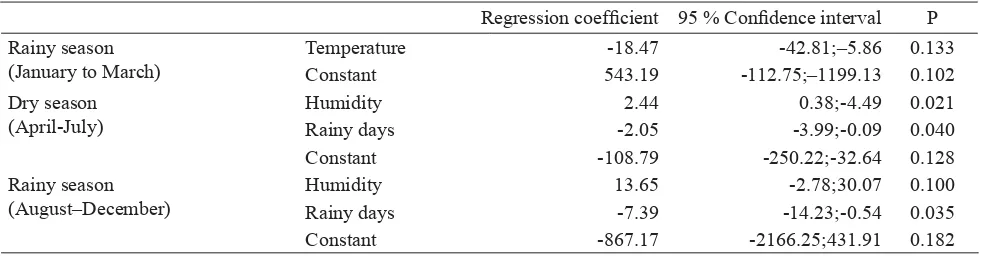
Table 1 show that during the rainy season months of January to March there was only one risk factor (temperature) that affects the number of cases of dengue. Increasing temperature of 10 C will decrease
the number of dengue cases as many as 18 cases.
In the dry season (April to July) humidity was the dominant risk for DHF. The number of dengue fever patients will increase with increasing humidity. With a 1 point increased in humidity will increase 2.4 cases. In contrast with the increase in number of rainy days will decrease 2 cases.
Figure 1. Distribution of DHF cases by rainy days per months/years in Manado city, 2001-2010
Figure 2. Distribution of DHF cases by temperature per months/years in Manado city, 2001-2010
DISCUSSION
Our fi ndings have several limitations. We understand that there are many other factors that affect the number of dengue cases in a region, including vector density, population density, climate and disease eradication programs. However, we did not have the complete data (2001-2010 period.
For this analysis the available climate data were temperature, humidity, and the number of rainy days in the city of Manado. The pattern of increase in all three parameters is in line with the assumption that there is climate change, that the earth is getting warmer and that it may increase temperature, humidity, and rainfall.7
In the city of Manado, the dominant climate parameters for increasing the number of DHF cases occurred during the dry season (April to July). During this period there was greater air humidity and more rainy days.
Our results noted that higher air humidity will increase the number of DHF cases. Our fi nding was consistent with a study in North Jakarta in 1999-2003 which found that there was a signifi cant positive relationship between humidity and the number of DHF dengue cases.8
Furthermore, the results of the Andriani study in Jakarta (2001) noted a signifi cant relationship between humidity and the incidence rate of dengue fever during 1997-2000.9 Humidity affected the
life of the mosquito Aedes aegypti is a vector-borne dengue fever. When the humidity is low, less than 60%, the life of the mosquito may be shortened.10, 11
Based on the pattern of rainfall, Manado City has the equatorial precipitation type. There are 2 peaks of rainfall a year, occurring in March and October. Our study shows that cases of dengue fever tend to
increase during this period. The rain precipitation index (ICH) does not directly affect the breeding of mosquitoes, but the rainfall may produce ideal conditions for mosquito breeding. In the rainy season period from January to March, the temperature affects the number of dengue cases in Manado. Our
fi nding noted that a 1o C increase can reduce the DHF
cases by 18. Our fi nding was similar with the study which concluded that there is a signifi cant correlation between climatic factors with dengue incidence rates during 1997-2000 in Jakarta, especially for the air temperature.9 Mosquitoes can survive at low
temperatures, but their metabolism is decreased or even stopped when the temperature drops to below the critical temperature. At temperatures higher than 350 C the mosquito experiences slower physiological
processes. The average optimum temperature for the growth of mosquitoes is 25°-27° C. The mosquito growth stops completely when the temperature is approximately 10° C more or over 40° C.12
Conclusion
In the city of Manado, the dominant climate factors for DHF varied by season. Increases in temperature and rainy days will decrease the number of DHF cases. On the other hand, increased humidity will increase the number of DHF cases.
REFERENCES
1. Window Epidemiology Bulletin [Internet]. 2010 Aug [cited 2013 April 17] ; vol 2. Avaiable from: http://www.depkes.go.id/downloads/publikasi/ buletin/buletindbd..pdf. Indonesian.
2. Manado City Health Offi ce. Annual report. Manado. The Offi ce. 2010. Indonesian.
models of global climate change environmental. Health Perspectives. 1998;106:147-53.
4. Sukowati S. Vector problems Dengue Hemorrhagic Fever (DHF) and its control in Indonesia. Window Epidemiology Bulletin [Internet]. 2010 Aug [cited 2013 April 17]; vol 2. Avaiable from: http://www.depkes.go.id/downloads/publikasi/ buletin/buletindbd.pdf. Indonesian.
5. Ministry of Health of Indonesia. Complete instructions for disease prevention and control of Dengue Fever and Dengue Hemorrhagic Fever. Jakarta. The Ministry. 2003. Indonesian.
6. Kadarsah. Three Indonesian rainfall patterns. Blog [Internet]. Kadarsah. 2007 June [cited 2013 April 12]. Available from: http//www.kadarsah. wordpress.com/2007/06/29/tiga-daerah-iklim-Indonesia/. Indonesian.
7. Patz JA. The potential health impacts of climate variability and change for the United States: executive summary of the report of the health sector of the U.S. National Assessment. Environ Health Perspectives. 2000;108:367–76.
8. Sungono V. Relationships between climate and Dengue Hemorrhagic Fever incidence in municipalities of North Jakarta Year 1999-2003 [thesis]. Depok. Universitas Indonesia 2004. Indonesian.
9. Andriani DK. Factors relations with the climate change density vector and dengue fever cases and dengue hemorrhagic fever incidence fi gures in Jakarta, 1997-2000 [thesis]. Depok. Universitas Indonesia. 2001. Indonesian.
10. Yanti. Climate factors relationships with dengue fever cases in East Jakarta municipality 2000-2004 [thesis]. Depok. Universitas Indonesia, 2004. Indonesian.
11. Silaban D. Climate with Dengue Incidence in Bogor Relations 2004-2005 [thesis]. Depok. Universitas Indonesia. 2005. Indonesian.