145
INTERNAL GOVERNANCE MONITORING AND
EARNINGS QUALITY
RUSMIN
Fakultas Bisnis dan Teknologi Informasi Universitas Teknologi Yogyakarta
Abstract: This study examines the earnings quality of the Indonesian manufacturing listed firms for years 2003 to 2009. Statistical analysis reveals that size of board and board commissioner independence help predict the quality of financial information. A large number of board commissioner members relates with higher earnings quality. Moreover, the presence of the independent board of commissioners associates with higher financial reporting quality. Interestingly, audit committee attributes especially percentage of independent members on the audit committee and number of audit committee member are not significant predictors. This has significant implications for Indonesian companies since globally companies are moving towards a more regimented corporate governance structure to enhance firm performance.
Keywords: Earnings quality, internal governance monitoring, Indonesia
INTRODUCTION
This paper focuses on internal governance monitoring mechanisms, especially the potential impact of board of commissioner1 and audit committee effective-ness on the quality of financial reporting. Earnings quality is an issue of growing international importance to investors, policy makers, market analysts
146
and the general public. For their part, policy makers have sought to introduce various corporate governance reforms designed to aid in the constraint of earnings manipulation. In addition, scholars have not been apathetic. Healy and Wahlen (1999), for example, in a review of the earnings quality literature, called for greater research of factors that limit earnings manipulation.
Some researchers (e.g., Morck, Shleifer, and Vishny 1988; Fan and Wong 2002; Wang 2006; Dechow, Sloan, and Sweeney 1996) suggest that the nature of a corporation's governance structure, specifically board of com-missioner and audit committee characteristics enable to provide an effective monitoring mechanism on management activities. Consequently, they are jointly able to oversee the company‘s financial reporting process. This study, in response to both the growing concern toward earnings quality and calls for more empirical research, investigates the relationship of internal governance monitoring mechanisms with the quality of financial information. Consistent with previous research (e.g., Francis, LaFond, Olsson, and Shipper 2004; Velury and Jenkins 2006; Ball and Shivakumar 2008; Tong and Miao 2011), this study uses earnings predictability and accrual quality to proxy quality of financial reporting while board of commissioner and audit committee characteristics as measures for internal monitoring mechanisms (e.g., Dechow et al. 1996; Beasley 1996; Bedard, Chtourou, and Courteau 2004).
This study differs from prior research on at least two main fronts. Firstly, it provides further evidence on the relation between internal monitoring mechanisms and the level of financial reporting quality using data from unique and different domestic settings, Indonesia. Secondly, I enrich the literature by analyzing the joint relationship between several monitoring mechanisms (number of board commissioner and audit committee members and independent board of commissioner and audit committee) attributes, and earnings quality. As Vafeas and Theodorou (1998) remark, the study of key related corporate governance characteristics in isolation may hide key inferences, leading to misleading findings.
147
LITERATURE REVIEW AND HYPOTHESES DEVELOPMENT
The majority of the literature seeking to explain the incentives to manage earnings draws on costly contracting theory. This study utilizes costly contracting theory which is characterized the corporation as a ‗legal nexus of contractual relationship‘ and assumes that corporate reporting enables principals (shareholders) to monitor agents (managers) compliance with contractual obligations (Godfrey, Hodgson, and Holmes 2003). Jensen & Meckling (1976) identify the existence of two agency relationships: (1) the manager-shareholders (e.g, bonus plans) which the manager acts as an agent for the shareholders who are considered to be the owners; (2) the shareholder-debtholder (e.g., debt contracts) where the manager is assumed to act on behalf of the shareholders, thus the manager is an agent whereas the debt-holder becomes the principal. Such situations impose agency costs, due to the existence of conflicts of interest between the agents and the principals. Bartov, Gul & Tsui (2001) note that agency costs include manager‘s incentive to manage earnings. Empirical evidence from agency theory also reports that management have a preference to manage earnings numbers in order to benefit from the contracting process (Holthausen, Larcker, and Sloan 1995).
Prior studies document that the higher transaction costs are translated from the greater information asymmetry among market participants. When the markets or investors have less information and cannot observe a company‘s performance and prospects, they then require higher rates of return and lower current company‘s stock prices (Bartov and Bodnar 1996). Several studies also document evidence that the existence of information asymmetry between managers and shareholders is a necessary condition for earnings manipulation (Dye 1988). This is because shareholders have less information, thus corporate management can use its insider position to manage reported earnings (Lobo and Zhou 2001). Earnings manipulation reduces the reliability of earnings because reported earnings is biased, and misrepresents the true reporting earnings figure. Arthur Levitts, Jr., (1998) the former chairman of SEC, states that practice of earnings manipulation has negative effects on reliability and credibility of financial reporting.
Governance Monitoring Mechanisms and Earnings Quality
manage-148
ment cases. Cadbury (1997) suggests that strong governance occurs if there is balancing between reporting firm performance with an appropriate level of monitoring. It is argued that corporate governance structures are likely to influence the level of earnings management (e.g., Jensen 1993; Firth, Fung, and Rui 2007; Dalton, Johnson, and Ellstrand 1999; Klein 2002; Xie, Davidson III, and DaDalt 2003).
Board ofcommissioner characteristics and earnings quality
The board of commissioners is intended to perform critical functions of monitoring and advising corporate management. It is perceived that the number of members on the board affects the board‘s ability to function effectively. Dalton, Daily, Johnson and Ellstrand (1998) argue that the larger the boards the better the performance because larger boards potentially bring more experience and knowledge as well as offer better advice. However, Huther (1997) suggests that, as any other decision making bodies, governing boards face coordination problems. These problems increase as the size of governing bodies increase. Consequently, Lipton and Lorch (1992) and Jensen (1993) suggest that larger boards are less likely to be effective than smaller boards because of coordination problems and director free-riding. They further argue that the size less than eight is optimal as a smaller board works better and could be less manipulated by the delegated director. Yermack (1996) and Eisenberg et al. (1998), additionally, support the notion that smaller boards are better boards. Especially, they document a negative association between board size and firm‘s performance, as measured by Tobin‘s Q.
Goodstein, Gautam and Boeker (2007) argue that different number of board members is needed in different functions. Goodstein et al. (2007) and Zahra and Pearce (2007) suggest that smaller boards, between four to six members, might be more effective in performing advising function, while larger boards is needed in monitoring management activities. Some studies (e.g., Xie et al. 2003; Gong, Firth, and Cullinane 2006) report that having a larger board is associated with higher earnings quality (lower abnormal accruals, proxy for earnings management). Thus, my first hypothesis is:
H1: There is a positive relationship between the number of members on
board of commissioners and the level of earnings quality.
149
independence if they do not have any relationship with the company beyond the role of director. Lipton and Lorsch (1992) define an independent director as a director who has no connection with the company, either as management, customer or supplier of goods or services. Thus, the independent board refers to a non-executive director who is not employed by the company and entirely independent from management. The non-executive directors are more likely to have incentives to guard shareholder interests well as they have invested their reputation in a firm (Vafeas and Theodorou 1998; Fama and Jensen 1983).
A number of previous studies report a positive association between board independence and actions that are in the best of interest of shareholders. For example, Beasley (1996) finds that the existence of independent directors associates with less financial statement fraud. Using a sample of U.S. and China firms, Klien (2002) and Firth et al. (2007) respectively reports a negative relation between board independence and the magnitude of earnings manage-ment (a proxy for earnings quality). Peasnell, Pope and Young (2000) show evidence supporting Klein‘s and Firth et al. findings in U.K. context. In addition, Dechow et al. (1996) reveal that the more proportion of independent directors the less likely the firm is subjected to Securities and Exchange Commission (SEC) enforcement actions because of violating U.S. GAAP. Consequently, the second hypothesis is:
H2: There is a positive relationship between the proportion of independent
board of commissioners and the level of earnings quality.
Audit committee characteristics and earnings quality
150
Empirical studies provide inconclusive evidence of the impact of audit com-mittee size on financial reporting quality. Abbott, Parker and Peters (2004) and Xie et al. (2003) find no significant association between the number of directors on the audit committee and earnings quality measures. Nonetheless, Yang and Krishnan (2005) reveal that earnings quality is negatively related to the size of the audit committee.
In addition, as suggested above that smaller boards may be more effective (e.g., Yermarck 1996; Eisenberg et al. 1998; Jensen 1993). This is because of larger boards are characterized by slower decision making (Goodstein, Gautam and Boeker 1994), or less cohesive (Lipton and Lorsch 1992), or are more easily manipulated by management (Alexander, Fennell and Halpern 1993). As a result, a smaller number of boards would be beneficial. This study‘s sample indicates that more than 74% of the firms have audit com-mittees of three or fewer members. Given that the mean of audit committee size in the sample is not so large (which is 2.70) and consistent with Lipton and Lorch (1992) and Jensen (1993) who argue that the maximum size of boards is eight, I expect a positive relationship between audit committee size and financial reporting quality. Thus, my third hypothesis is:
H3: There is a positive relationship between the number of members on
audit committee and the level of earnings quality.
Prior literature indicates that the effectiveness of an audit committee i s dependent on its objectivity or independence (Bedard et al. 2004; Davidson, Goodwin-Stewart, and Kent 2005). Lynn (1996) argues that it is impossible for the audit committee to function effectively if they are also members of executives of the firm. Thus, an audit committee should comprise entirely of non-executive or independent directors (Menon and Williams 1994; Lipton and Lorch 1992). This argument is supported by Jiambalvo (1996) who finds that audit committee independence is associated with a higher degree of active oversight and a lower incidence of financial statements fraud. This leads to my fourth hypothesis:
H4: There is a positive relationship between the proportion of independent
audit committee and the level of earnings quality.
RESEARCH APPROACH
Sample
151
are dominant in Asia and Indonesia. As Dhawan, Mangaleswaran, Padhi, Sankhe, Schwan and Paresh (2000, , p. 42) noted: ―Asia has become the work -shop of the world: more than half of all manufacturing on Earth is estimated to take place there.‖ Within the Indonesian context, Craig and Diga (Craig and Diga 1998, , p. 248) noted that ―Indonesia was represented strongly by manufacturing-type entities.‖
The sample examined in this study comprises all manufacturing companies listed on the Indonesia Stock Exchange (IDX) for the longitudinal period 2003 to 2009. There are a total of 166 manufacturing firms listed on the IDX. However, I am unable to collect sufficient information to construct a full set of proxy measures for 70 entities; therefore, it is left with a final usable sample of 96 firms or 672 firm-years.
Estimation of Variables
This study examines the earnings quality of manufacturing firms listed in IDX for the fiscal years 2003 to 2009 using the internal governance monitoring mechanisms as the prime predictors. Following previous studies (e.g., Schipper and Vincent 2003; Ball and Shivakumar 2008; Velury and Jenkins 2006; Francis et al. 2004; Tong and Miao 2011) earnings quality is measured using two separate proxies: earnings predictability and accrual quality.
Predictability captures the notion that earnings are of higher quality the more useful they are to predict future earnings. Predictability is viewed as a desirable attribute of earnings because it increases the precision of earnings forecasts. Based on Lipe (1990) earnings predictability is estimated by the
R2 of the error variance from a regression of current earnings on lagged earnings (NIBEi, t = + βNIBEi, t-1 + εi, t).
Where: NIBE is firm i’s net income before extraordinary items in year t
divided by total assets at the beginning of period t.
Large (small) values of predictability infer less (more) predictable earnings. The measure of accrual quality is based on Dechow and Dichev‘s (2002) model. It is defined as the standard deviation of the residuals of the following regression of total current accruals to lagged, current and future cash flows from operations:
TACi, t = + β1CFOi, t-1 + β2CFOi, t + β3CFOi, t+1 + εi, t
152
Large (small) value of accrual quality relates to poor (good) earnings quality.
This study employs four internal governance monitoring mechanisms (number of board of commissioner and audit committee members and the independent of the board of commissioner and audit committee) to predict the quality of financial reporting. The study measures board of commissioner or audit com-mittee size by the total number of members on the board or audit comcom-mittee. While, board of commissioner or audit committee independence are proxied as percentage of the board of commissioners (audit committee) that is in-dependent (Klein 1998, 2002; Han and Wang 1998; Bedard et al. 2004; Davidson et al. 2005).
153
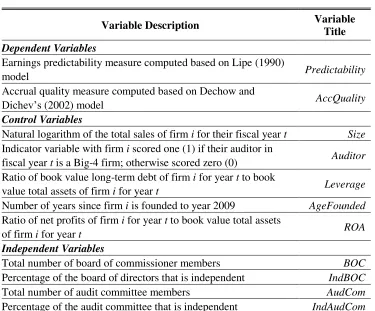
Table 1 Variable Definition and Description
Variable Description Variable Title Dependent Variables
Earnings predictability measure computed based on Lipe (1990)
model Predictability
Accrual quality measure computed based on Dechow and
Dichev‘s (2002) model AccQuality
Control Variables
Natural logarithm of the total sales of firm i for their fiscal year t Size
Indicator variable with firm i scored one (1) if their auditor in
fiscal year t is a Big-4 firm; otherwise scored zero (0) Auditor Ratio of book value long-term debt of firm i for year t to book
value total assets of firm i for year t Leverage
Number of years since firm i is founded to year 2009 AgeFounded
Ratio of net profits of firm i for year t to book value total assets
of firm i for year t ROA
Independent Variables
Total number of board of commissioner members BOC
Percentage of the board of directors that is independent IndBOC
Total number of audit committee members AudCom
Percentage of the audit committee that is independent IndAudCom
Empirical Model Equations
This study uses OLS multiple regression as the main statistical technique to test the hypotheses. The main regression model is defined in the following equation:
EarningsQualityi= + β1BOC + β2IndBOC + β3AudCom + β4IndAudCom +
β5Size + β6Big4 + β7ROA + β8Leverage + β9AgeFounded
+ εi
DESCRIPTIVE AND STATISTICAL ANALYSES
154
Sales (million IDR) 2,031,443 503.960 4,750,877 96 25,636,995
AgeFounded 36.17 32.67 22.08 7.76 108.97
Panel B – Dummy regression variables
Auditor Type Frequency Percentage
Non Big 4 41 42.71
Big 4 55 57.29
Legend: See Table 1 for full definitions and descriptions for the dependent, independent and control variables.
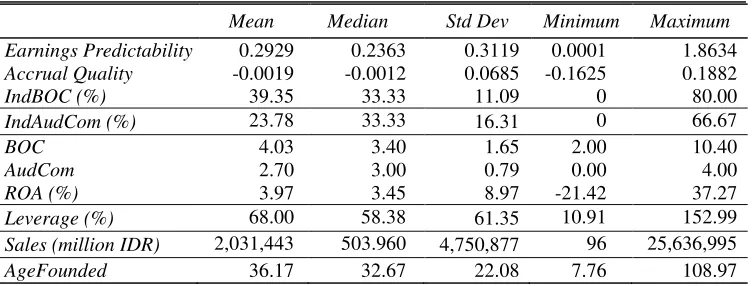
Table 1, Panel A indicates that average earnings predictability is 0.2929 (ranging from 0.0001 to 1.8634). Accrual quality measure has a mean (median) value of -0.0019 (-0.0012) and a standard deviation of 0.0685. In regard to independent variables, the percentage of independent commissioner has an average of 39.35% with a median of 33.33%. On average, only 23.78% of audit committee members are independence. This is consistent with many other developing countries that the percentage of independent commissioners and independent members of the audit committee are under 50%. In addition, the sample firms have, on average, 4 and 3 members sitting on the board of commissioners and audit committee respectively.
155
sample firms earn relatively lower profits during 2003 to 2009 financial years. As presented in Panel A, the sample firms‘ net profit to total assets, on average, is 3.97% ranging from losses 21.42% to profit 37.27%. Indonesian firms on average are 36 years old. Finally, the Big-4 accounting firms audit more than half the Indonesian manufacturing listed firms.
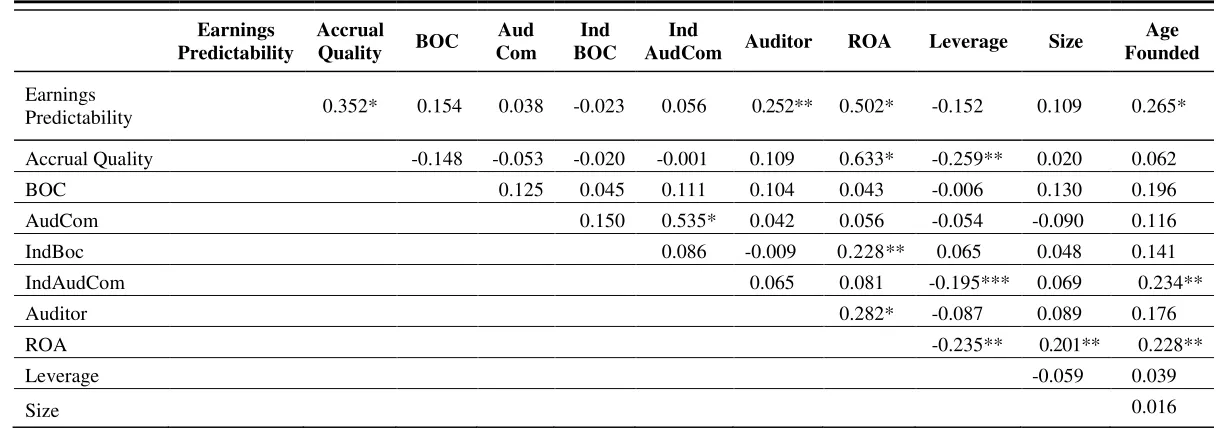
The correlations of the variables are presented in Table 3. The Pearson cor-relation coefficients provide some evidence of the direction of the results. All of the internal governance monitoring variables is negatively correlated with Accrual Quality. These negative coefficients imply that these board commissioners and audit committee characteristics are associated with higher earnings quality. Consistent with predictions, independent board of com-missioners (IndBOC) is negatively associated with Earnings Predictability, inferring that independent commissioner members act as an effective monitoring mechanism in overseeing the financial reporting process thus higher earnings quality. However, those relationships are statistically not significant.
In addition, there is a significant correlation between the two independent variables (AudCom and IndAudcom) with a coefficient of 0.535 (p<0.001), however this is below the critical limit of 0.80 (Hair, Anderson, Tatham, and Black 1995; Greene 1999; Cooper and Schindler 2003). In respect to cor-relations between independent and control variables, and amongst control variables themselves, the highest correlations are between Leverage and
156
Table 3 Pearson Correlation Matrix
Earnings Predictability
Accrual
Quality BOC
Aud Com
Ind BOC
Ind
AudCom Auditor ROA Leverage Size
Age Founded
Earnings
Predictability 0.352* 0.154 0.038 -0.023 0.056 0.252** 0.502* -0.152 0.109 0.265*
Accrual Quality -0.148 -0.053 -0.020 -0.001 0.109 0.633* -0.259** 0.020 0.062
BOC 0.125 0.045 0.111 0.104 0.043 -0.006 0.130 0.196
AudCom 0.150 0.535* 0.042 0.056 -0.054 -0.090 0.116
IndBoc 0.086 -0.009 0.228** 0.065 0.048 0.141
IndAudCom 0.065 0.081 -0.195*** 0.069 0.234**
Auditor 0.282* -0.087 0.089 0.176
ROA -0.235** 0.201** 0.228**
Leverage -0.059 0.039
Size 0.016
157
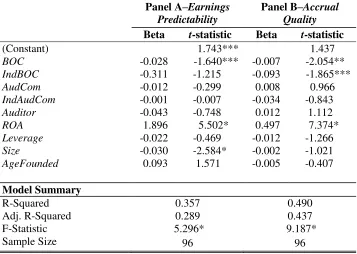
The main result for testing the impact of corporate governance monitoring mechanisms on earnings quality is reported in Table 4.
Table 4 Multiple Regression Results
Panel A–Earnings Predictability
Panel B–Accrual Quality Beta t-statistic Beta t-statistic
(Constant) 1.743*** 1.437
BOC -0.028 -1.640*** -0.007 -2.054**
IndBOC -0.311 -1.215 -0.093 -1.865***
AudCom -0.012 -0.299 0.008 0.966
IndAudCom -0.001 -0.007 -0.034 -0.843
Auditor -0.043 -0.748 0.012 1.112
ROA 1.896 5.502* 0.497 7.374*
Leverage -0.022 -0.469 -0.012 -1.266
Size -0.030 -2.584* -0.002 -1.021
AgeFounded 0.093 1.571 -0.005 -0.407
Model Summary
R-Squared 0.357 0.490
Adj. R-Squared 0.289 0.437
F-Statistic 5.296* 9.187*
Sample Size 96 96
Legend:
*, **, and *** indicate significance at p<0.01, p<0.05 and p<0.10, respectively (based on two-tailed tests). See Table 1 for full definitions and descriptions for the dependent, independent and control variables.
Panels A and B present the results of regression using earnings predictability and accrual quality respectively. Regression model estimates reported in Table 4, Panels A and B are all statistically significant (F-statistic p<0.001) with explanatory power of 29% (Panel A) and 44% (Panel B). The coefficients on BOC are negative and statistically significant in both earnings quality measurements (at p<0.10 and p<0.05 respectively). Thus, the evidence support the notion that larger number of board commissioner members associates with higher quality of financial information and therefore, H1 is
158
However, this finding is inconsistent with Lipton and Lorch (1992) and Jensen (1993) who suggest that larger boards are less likely to be effective than smaller boards because of coordination problems and director free-riding.
In regard to board of commissioners independence, as predicted, this study finds that the coefficients on IndBOC is negative and significant (at the bottom level of p<0.10) associated with Accrual Quality (but it is insignificant for
Earnings Predictability). Thus, H2 is partially accepted. This implies that
independent members of board commissioner do act in the best of interest of shareholders. They act as an effective monitoring mechanism to oversee the accounting and financial reporting processes of a company. Thus, this finding support previous studies (e.g., Klein 2002; Peasnell et al. 2000; Firth et al. 2007). Finally, this study fails to support the argument that audit committee provides shareholders with the greatest protection in maintaining the credibili-ty of a company‘s financial statements. The coefficients on AudCom and
IndAudCom are negative associated with, especially Earnings Predictability, but it is statistically insignificant. Therefore, both H3 and H4 are rejected.
IMPLICATIONS AND CONCLUSION
The results of this study partially support the empirical validity of the claims that the four internal governance monitoring mechanisms (board of commis-sioners and audit committee size, and board and audit committee independence) influence the quality of financial reporting. As expected, the findings show a negative association between the twomeasures for earnings quality (Earnings Predictability and Accrual Quality) and BOC. In line with Dalton et al. (1998), Xie et al. (2003) and Gong et al. (2006), this evidence suggests that larger member of boards of commissioners is associated with higher earnings quality. The results of this study, however, contradict to the conclusion reported by Yermack (1996) and Eisenberg et al. (1998).
This study also finds that board of commissioner independence is negatively and significantly associated with Accrual Quality. It infers that the presence of independent board of commissioners provides a greater incentive to monitor management activities reduces agency costs, thus, enhances earnings quality. In other words, companies with more independent board of commissioners have better performance than their counterpart.
159
fail to confirm Jiambalvo (1996), Yang and Krishnan (2005) and Mitra et al. (2007) who argument that more audit committee member and or greater use of audit committee independence can lead to more effective internal monitoring.
The findings of this study have implication, especially, to regulators and corporate governance reformists. Special attentions need to be given by Indonesian policy makers in strengthening corporate governance framework; primarily, in regard to: (1) the process for monitoring and selection of independent board of commissioners and audit committee, (2) enhance the skills and knowledge of the independent boards and audit committee members, and (3) separation of management from the owners and appointment of professional managers.
REFERENCES:
Ball, R., and L. Shivakumar. 2008. Earnings quality at initial public offerings. Journal of Accounting and Economics 45:324-349.
Bartov, E., and G. M. Bodnar. 1996. Alternative accounting methods, information asymmetry and liquidity: Theory and evidence. The Accounting Review 71 (3):397-418. Bartov, E., F. A. Gul, and J. S. L. Tsui. 2001. Discretionary-accruals models and audit
qualifications. Journal of Accounting and Economics 30 (3):421-452.
Beasley, M. S. 1996. An empirical analysis of the relation between the board of director composition and financial statement fraud. The Accounting Review 71 (4):443-465.
Becker, C. L., M. L. DeFond, J. Jiambalvo, and K. R. Subramanyam. 1998. The effect of audit quality on earnings management. Contemporary Accounting Research 15 (1):1-24.
Bedard, J., S. M. Chtourou, and L. Courteau. 2004. The Effect of audit committee expertise, independence, and activity on agressive earnings management. Auditing: A Journal of Practice & Theory 23 (2):13-35.
Bradbury, M. E. 1990. The incentives for voluntary audit committee formation. Journal of Accounting and Public Policy 9 (1):19-36.
Cadbury, A. 1997. Board focus: The governance debate: Egon Zehnder International. Claessens, S., S. Djankov, and L. H. P. Lang. 2000. The separation of ownership and control
in East Asian corporations. Journal of Financial Economics 58:81-112.
Collier, P. 1993. Factors affecting the formation of audit committees in major U.K. listed companies. Accounting and Business Research 23 (91):421-430.
Cooper, D. R., and P. S. Schindler. 2003. Business research methods. 8th ed. Boston, U.S.: McGraw-Hill, Irwin.
Craig, R., and J. G. Diga. 1998. Corporate accounting disclosure in ASEAN. Journal of International Financial Management and Accounting 9 (3):246-274.
160
Dalton, D. R., J. L. Johnson, and A. E. Ellstrand. 1999. Number of directors and financial performance: A meta analysis. Academy of Management Journal 42 (6):674-686. Davidson, R., J. Goodwin-Stewart, and P. Kent. 2005. Internal governance structures and
earnings management. Accounting and Finance 45 (2):241-267.
Dechow, P. M., and I. D. Dichev. 2002. The quality of accruals and earnings: The role of accrual estimation errors. The Accounting Review 77 (Supplement):35-39. Dechow, P. M., R. G. Sloan, and A. P. Sweeney. 1995. Detecting earnings management.
The Accounting Review 70 (2):193-225.
Dechow, P. M., R. G. Sloan, and A. P. Sweeney. 1996. Causes and consequences of earnings manipulation: An analysis of firms subject to enforcement actions by the SEC.
Contemporary Accounting Research 13 (1):1-36.
DeFond, M. L., and J. Jiambalvo. 1994. Debt covenant violation and manipulation of accruals.
Journal of Accounting and Economics 17 (1 & 2):145-176.
Dhawan, R. K., R. Mangaleswaran, A. Padhi, S. Sankhe, K. Schween, and V. Paresh. 2000. Asia revaluate. The McKensey Quarterly 4:38-47.
Dye, R. A. 1988. Earnings management in an overlapping generations model. Journal of Accounting Research 26 (2):195-235.
Eisenberg, T., S. Sundgren, and M. T. Wells. 1998. Larger board size and decreasing firm value in small firms. Journal of Finance Economics 48 (1):35-54.
Fama, E. F., and M. C. Jensen. 1983. Separation of ownership and control. Journal of Law and Economics 26 (2):301-325.
Fan, J. P. H., and T. J. Wong. 2002. Corporate ownership structure and the informativeness of accounting earnings in East Asia. Journal of Accounting and Economics
33:401-425.
Firth, M., P. M. Y. Fung, and O. M. Rui. 2007. Ownership, two-tier board structure, and the informativeness of earnings: Evidence from China. Journal of Accounting and Public Policy 26:463-496.
Francis, J., R. LaFond, P. M. Olsson, and K. Shipper. 2004. Costs of equity and earnings attributes. The Accounting Review 79 (4):967-1010.
Francis, J. R., K. Reichelt, and D. Wang. 2005. The pricing of national and city-specific reputations for industry expertise in the U.S. audit market. The Accounting Review 80 (1):113-136.
Frankel, R. M., M. F. Johnson, and M. W. Nelson. 2002. The relation between auditors' fees for non-audit services and earnings management. The Accounting Review 77 (Supplement):71-105.
Godfrey, J., A. Hodgson, and S. Holmes. 2003. Accounting theory. Fifth ed. Australia: John Wiley & Sons., Inc.
Gong, S. X. H., M. Firth, and K. Cullinane. 2006. The information content of earnings releases by global airlines. Journal of Air Transport Management 12:82-91. Greene, W. 1999. Econometric analysis. Fourth ed. New York, U.S.: Prentice-Hall, Inc. Gul, F. A., C. J. P. Chen, and J. S. L. Tsui. 2003. Discretionary accounting accruals,
managers' incentives, and audit fees. Contemporary Accounting Research 20 (3):441-464.
Hair, J. F., R. E. Anderson, R. L. Tatham, and W. C. Black. 1995. Multivariate data analysis. Fourth ed. Englewood Cliffs, U.S.: Prentice-Hall, Inc.
161 Healy, P. M., and K. G. Palepu. 1990. Effectiveness of accounting-based dividend covenants.
Journal of Accounting and Economics 12 (1-3):97-123.
Heninger, W. G. 2001. The association between auditor litigation and abnormal accruals.
The Accounting Review 76 (1):111-126.
Holthausen, R. W., D. F. Larcker, and R. G. Sloan. 1995. Annual bonus schemes and the manipulation of earnings. Journal of Accounting and Economics 19 (1):29-74. Huther, J. 1997. An empirical test of the effect of boardsize on firm efficiency. Economics
Letters 54:259-264.
Jaggi, B., and S. Leung. 2007. Impact of family dominance on monitoring of earnings management by audit committees: Evidence from Hong Kong. Journal of International Accounting, Auditing & Taxation 16:27-50.
Jensen, M. C. 1993. The modern industrial revolution, exit and the failure of internal control systems. Journal of Finance 48:831-880.
Jensen, M. C., and W. H. Meckling. 1976. Theory of the firm: Managerial behavior, agency costs and ownership structure. Journal of Financial Economics 3:305-360. Jiambalvo, J. 1996. Discussion of causes and consequences of earning manipulation: An
analysis of firms subject to enforcement by the SEC. Contemporary Accounting Research 13 (1):37-47.
Klein, A. 1998. Firm performance and board committee structure. Journal of Law and Economics 41 (1):275-303.
———. 2002. Audit committee, board of director characteristics, and earnings management.
Journal of Accounting and Economics 33 (3):375-400.
Kothari, S. P., A. J. Leone, and C. E. Wasley. 2002. Performance matched discretionary accrual measures. In Working Paper. MIT Sloan School of Management, Cambridge, U.S.
Krishnan, G. V. 2003. Does big 6 auditor industry expertise constrain earnings management?
Accounting horizons 17 (Supplement):1-16.
Levitt, A. 1998. The numbers game 1998 [cited 6 June 1998]. Available from http://www.sec.gov/news/speech/speecharchive/1998/spch220.txt.
Lipe, R. 1990. The relation between stock returns and accounting earnings given alternative information. The Accounting Review 65:49-71.
Lipton, M., and J. Lorch. 1992. A modest proposal for improved corporate governance. The Business Lawyer 48:59-77.
Lobo, G. J., and J. Zhou. 2001. Disclosure quality and earnings management. Asia-Pacific Journal of Accounting & Economics 8 (1):21-41.
Lynn, R. S. 1996. The role of auditor in corporate governance disclosure. Australian Accounting Review 6:16-18.
Lys, T., and R. L. Watts. 1994. Lawsuits against auditors. Journal of Accounting Research
32 (Supplement):65-93.
Mayhew, B. W., and M. S. Wilkins. 2003. Audit firm industry specialization as a differentiation strategy: Evidence from fees charged to firms going public.
Auditing: A Journal of Practice & Theory 22 (2):33-52.
McMullen, D. A., and K. Raghunandan. 1996. Enchancing audit committeeeffectiveness.
Journal of Accountancy 182 (2):79-81.
Menon, K., and J. D. Williams. 1994. The use of audit committee for monitoring. Journal of Accounting and Public Policy 13 (2):121-139.
Mitra, S., M. Hossain, and D. R. Deis. 2007. The empirical relationship between ownership characteristics and audit fees. Review of Quantitative Financial Accounting
162
Morck, R., A. Shleifer, and R. W. Vishny. 1988. Management ownership and marke t valuation: An empirical analysis. Journal of Financial Economics 20 (1):293-315. Peasnell, K. V., P. F. Pope, and S. Young. 2000. Accrual management to meet earnings targets: U.K. evidence pre-and post-Cadbury. British Accounting Review 32 (4):415-445.
Press, E. G., and J. B. Weintrop. 1990. Accounting-based constraints in public and private debt agreements. Journal of Accounting and Economics 12 (1-3):65-95.
Roberts, R. W. 1992. Determinants of corporate social responsibility disclosur e: An application of stakeholder theory. Accounting, Organizations and Society 17 (6):595-612.
Schipper, K., and L. Vincent. 2003. Earnings quality. Accounting horizons 17 (Supplement):97-110.
Statistics Indonesia. 2005. Statistics Indonesia 2005:
http://demografi.bps.go.id/versi2/index.php?option=com_tabel&task=show&Ite mid=165&lang=en.
Sweeney, A. P. 1994. Debt-covenant violations and managers' accounting responses. Journal of Accounting and Economics 17 (3):281-308.
Tong, Y. H., and B. Miao. 2011. Are dividends associated with the quality of earnings?
Accounting horizons 25 (1):183-205.
Tseng, L. J., and C. W. Lai. 2007. The relationship between income smoothing and company profitability: An empirical study. International Journal of Management 24 (4):727-733.
Vafeas, N., and E. Theodorou. 1998. The relationship between board structure and firm performance in the U.K. British Accounting Review 30 (4):383-407.
Velury, U., and D. Jenkins. 2006. Institutional ownership and the quality of earnings. Journal of Business Research 59:1043-1051.
Wang, D. 2006. Founding family ownership and earnings quality. Journal of Accounting Research 44 (3):619-656.
World Fact Book. 2004. World Fact Book. In http://www.mytravelguide.com/guides-and-advice/fact-book/cia/Australia.php (accessed on 19 September 2004).
Xie, B., W. N. Davidson III, and P. J. DaDalt. 2003. Earnings management and corporate governance: The role of the board and the audit committee. Journal of Corporate Finance 9 (3):295-316.
Yermack, D. 1996. Higher market valuation of companies with a small board of directors.