Media Peternakan, April 2013, pp. 26-31 ISSN 0126-0472 EISSN 2087-4634
Accredited by DGHE No: 66b/DIKTI/Kep/2011
Online version: http://medpet.journal.ipb.ac.id/ DOI: 10.5398/medpet.2013.36.1.26
*Corresponding author: E-mail: [email protected]
In Vitro Fertility of Post-thawed Epididymal Ram Spermatozoa after Storage
at 5 °C before Cryopreservation
N. W. K. Karjaa,*, M. Fahrudinb, & M. A. Setiadia
aDivision of Reproduction & Obstetric, Department of Clinic, Reproduction and Pathology,
Faculty of Veterinary Medicine, Bogor Agricultural University
bDivision of Anatomy, Department of Anatomy, Physiology, and Pharmacology, Faculty of Veterinary Medicine,
Bogor Agricultural University
Jln. Agatis, Kampus IPB Dramaga, Bogor 16680, Indonesia (Received 31-10-2012; Reviewed 08-03-2013; Accepted 05-04-2013)
ABSTRACT
This study addressed the effects of storage duration of epididymides at 5 °C before sperm collec -tion and their fertility after cryopreserva-tion in vitro. Spermatozoa from one of the testes pairs were immediately collected, evaluated and frozen (control group). The remaining epididymides were cooled to 5 °C and stored for 24, 48, 72, and 96 h (experimental groups), after which spermatozoa were col -lected and frozen as in the control group. Before and after thawing, sperm motility, sperm viability and plasma membrane integrity were assessed. The fertilizing ability of frozen-thawed spermatozoa of each group was evaluated by in vitro fertilization of matured sheep oocytes. Sperm quality (sperm
motility, viability, and plasma membrane integrity) at collection and after cryopreservation decreased as the duration of the epididymal storage interval increase (P<0.05). The motility decreased steadily along the studied time periods. Although, the fertilizing ability of post-thawed epididymal spermato-zoa gradually decreased as the storage period was prolonged, the spermatospermato-zoa collected from the cauda epididymides stored at 5 °C for up to 96 h were able to fertilize 16%-65% of oocytes in vitro. Results of the present study showed that ram epididymal spermatozoa survive in storage at 5 °C for up to 96 h. These spermatozoa maintain their fertilizing ability and may be suitable for use in IVF and other assisted reproductive procedures.
Key words: epididymis, sheep, spermatozoa, in vitro fertilization, cryopreservation
ABSTRAK
Penelitian ini bertujuan untu�� mengetahui daya fertilisasibertujuan untu�� mengetahui daya fertilisasi post-thawed spermatozoa yang di��ole��si dari epididymis setelah disimpan pada suhu 5 oC selama 96 jam post mortemsecara in vi-tro. Epididimis disimpan pada suhu 5 oC selama 0-96 jam sebelum dibekukan. Kualitas spermatozoa (motilitas, viabilitas, dan integritas membran plasma) dievaluasi sebelum dan setelah dibekukan dengan interval wa��tu 24 jam. Kemampuan spermatozoa setelah dibe��u��an untu�� memfertilisasi oosit secara in vitro dievaluasi dengan fertilisasi in vitro. Walaupun terjadi penurunan ��ualitas spermatozoaterjadi penurunan ��ualitas spermatozoa seiring dengan waktu penyimpanan epididymis (P<0,05) tetapi sperma yang hidup dan motil masih dapat di��ole��si setelah 96 jam post mortem. Berdasar��an pembentu��an pronu��leus setelah fertilisasi in vitro, 16%-65% oosit terfertilisasi secara16%-65% oosit terfertilisasi secara in vitro oleh post-thawed spermatozoa yang di��ole��si dari epididimis setelah disimpan 0-96 jam. Dapat disimpulkan bahwa walaupun kualitas spermatozoa yang dikoleksi dari epididimis pasca penyimpanan dan pembekuan menunjukkan penurunan tetapi sper -matozoa tersebut masih mempunyai kemampuan untuk membuahi oosit secara in vitro.
Kata kunci: epididymis, domba, spermatozoa, fertilisasi in vitro, kriopreservasi
INTRODUCTION
The recovery and cryopreservation of viable sperm from the epididymis of dead animals (post-mortem re
-covery) from genetically valuable animals or endangered species is an important technique for preserving male gametes and thus for maintaining germ-plasm banks. Sperm stored in the cauda epididymis have usually good quality and a high level of maturation, being able to fertilize oocytes (Matas et al., 2010; Pamungkas et al.,
-duce progeny of an animal after its death (Hishinuma et al., 2003). However, in order to get good quality samples, sperm collection and processing should be carried out immediately after the death of the animal since the con
-ditions (time and temperature) under which epididymis is handled could cause important changes in the viability of spermatozoa (Martinez-Pastora et al., 2005). Shakeri et al. (2008) reported that the better quality of ram sperma
-tozoa preserved at room temperature for 48 h was found when it was collected in the first 24 h after death. Garde et al. (2005) reported that viability and in vitro fertility of sperm decreased when the time between the animal’s death and the moment of semen collection increased (up to 40 h at ambient temperature). Thus, storing method is required for temporarily preserving spermatozoa vi
-ability when spermatozoa could not be collected and/or frozen immediately. If longer preservation of sperm was possible, it would provide greater flexibility and more options for producing embryos from the sperm of dead animals.
To date, many studies on influence of prolonged cold storage of epididymis of several species to the qual
-ity and fertil-ity of the spermatozoa with various results were reported. It is possible to obtained viable gamete and even fertile sperm from refrigerated epididymes for many hours or days such as in bovine (Martins et al.,
2009), equine (Vieira et al., 2012), domestic cat (Ganan et al., 2009; Thuwanut et al., 2010), dog (Suppawiwat et al., 2006), ram (Mir et al., 2012), wild ruminants
(Martinez-Pastora et al., 2005), camel (Waheed et al., 2012), buf
-falo (Barati et al., 2009), and red deer (Soler et al., 2003;
Malcotti et al., 2012). These works showed that sperm quality deteriorates depending on time postmortem and that storage of the epididymis at around 5 °C prolongs the survival of spermatozoa in the epididymides allows extra time for sperm recovery and processing. However there are dissimilarities between species, possibly due to differences on cold shock endurance of epididymal sperm (Martinez-Pastora et al., 2005). There are few re
-ports on effect of prolonged storage of epididymis prior freezing on the in vitro fertility of post-thawed epididy
-mal spermatozoa in ram. Therefore, the purpose of this study was to determine viability and in vitro fertilizing
ability of cryopreserved epididymal ram spermatozoa after storage of epididymis at 5 °C for up to 96 h prior cryopreservation. The fertility of post-thawed epididy
-mal ram spermatozoa was measured by their penetra
-tion ability to sheep matured oocytes in vitro.
MATERIALS AND METHODS
Ram Epididymides and Spermatozoa Collection and Spermatozoa CollectionSpermatozoa Collection Collection
Twelve pairs of testes with attached epididymides from adult rams were obtained at local slaughterhouse. They were transported to laboratory at room tempera
-ture. The testes were washed with isotonic saline supple
-mented with 100 IU/ml penicillin (Sigma, St. Louis, MO, USA) and 0.1 mg/ml streptomycin (Sigma, St. Louis, MO, USA). The epididymis from one testes of each pairs was dissected free and spermatozoa were recovered
from it in a culture dish containing 1 mL NSF-I extender to serve as a control group. Immediately after semen collection, the motility of sperm was measured. Only semen samples with an initial sperm motility > 65% to 70% were used for freezing. The remaining testes of the pair were put into plastic bags and stored in refrigerator of around 5 °C for 24 (24 h group), 48 (48 h group), 72 (72 h group), and 96 h (96 h group),and afterwards the spermatozoa were recovered, evaluated, and frozen.
Extenders for Ram Epididymal Sperm Freezing
Niwa and Sasaki freesing (NSF) extender was pre
-pared according to a method described by Pamungkas et al. (2012) as follow: Niwa and Sazaki Freezing (NSF)-I extender consisted of a mixture of 8.8% (wt/vol) lactose (Merck, Germany), 20% (v:v) egg yolk, and 100 µg/mL penicillin and streptomycin in distilled water. The NSF-II extender consisted of 92.5% (v/v) of NSF-I, 1.48% (v/v) of orvus ES paste (Miyazaki Kagaku, Tokyo, Japan) and 6% (v/v) glycerol (Merck, Germany).
Freezing of Ram Epididymal Sperm Freezing
Freezing of spermatozoa was performed according to the method described by Karja et al. (2010). After col
-lection, the spermatozoa (about 100 µL) was diluted with 400 µL of NSF-I extender and were equilibrated at 4 °C for 2 h. Thereafter 250 µL of NSF-II extender was added and then equilibrated at 5 °C for an additional 5 min. At the end of the equilibration period, the same volume (250 µL) of the NSF-II extender was added at 4 °C until a final volume of 1 mL was reached, resulting in a final concentration of 3% glycerol. The spermatozoa were then immediately loaded into a 0.25 mL French straw (I.V.M., France), which were placed in liquid nitrogen vapor for 20 min (4 cm above the surface of liquid nitro
-gen), and subsequently stored in liquid nitrogen.
Evaluation of Sperm Quality
Sperm samples of each group were evaluated for sperm motility, viability and membrane integrity before and after freezing. The percentage of motile was deter
-mined subjectively on a warmed glass-slide immediately
after collection and after freezing by a phase-contrast
microscope at magnification of x 400. Number of viable spermatozoa was assessed by aeosin-nigrosin staining. The functional integrity of the sperm plasma membrane was evaluated using the hypoosmotic swelling test (HOS test). HOS-test was assessed with fructose and sodium citrate. The results are expressed in percentage.
Penetration Assay by in Vitro Fertilization
Sheep ovaries were collected at local slaughter
-house. Each ovary was sliced repeatedly with a scalpel blade to release cumulus-oocyte complexes (COCs) in a 60 mm culture dish containing m-PBS (Gibco, Grand Island, NY, USA) at 37 °C. Only COCs exhibiting uni
Cumulus-oocyte complexes were cultured separately in a 100 µL drop of maturation medium under mineral oil (Sigma, St. Louis, MO, USA) for 28 h. The maturation medium consisted of tissue culture medium (TCM) 199 with Earle’s salts (Gibco, Grand Island, NY, USA), supple
-mented with 5% bovine serum albumin (BSA, Sigma), 0.1 IU/mL follicle stimulating hormone (Teikokuzoki, Tokyo, Japan), 10 IU/mL human chorionic gonadotropin (Chorulon, intervet international B.V. Boxmeer-Holland), and 50µg/mL gentamycin (Sigma, St. Louis, MO, USA). All cultures were performed in a 38.5 °C humidified incubator containing 5% CO2 in air.
Matured oocytes were then fertilized by frozen-thawed sperm of each group experiment. Briefly, after thawing at 37 °C, the spermatozoa were washed in fertil
-ization medium by centrifugation at 1800 rpm for 5 min. In vitro fertilization medium consisted of 90 mM NaCl, 12 mM KCl, 25 mM NaHCO3, 0.5 mM NaH2PO4, 0.5 mM MgSO4 7H20, 10 mM Sodium lactate, 10 mM hepes, 8
mM CaCl2 2H2O, 2 mM sodium pyruvate, 2 mM caffeine,
and 5 mg/ml BSA (Sigma, USA). The supernatant was removed and the sperm pellet was diluted in 500 µL of the IVF medium. The spermatozoa concentration was adjusted to 5×10⁶ spermatozoa/mL in the IVF medium. Matured oocytes were then fertilized separately into 100 µL of the sperm microdrops in concentration of 5×10⁶ spermatozoa/mL for 14 h. Thereafter, presump -tive zygotes were fixed and stained for the assessment of fertilization. Zygotes were fixed with acetic acid: ethanol (1:3 v:v) for 48 to 72 h. The fixed oocytes were stained with acetic-orcein (1% orcein in 45% acetic acid) and examined under a phase-contrast microscope with 200x of magnification. Oocytes containing both female and male pronuclei were considered to be fertilized and were categorized as normal or polyspermic, according to the number of pronuclei in the cytoplasm.
Statistical Analysis
The percentages of sperm motility, sperm mem
-brane integrity, and the oocytes fertilized were subjected to arc sin transformation before analysis. Transformed data were tested by ANOVA followed by a post hoc, Fisher’s protected least significant difference (PLSD) test using the Statview program (Abacus Concepts Inc., Berkeley, CA, USA). Differences P<0.05 were considered significant.
RESULTS AND DISCUSSION
This study addressed the effects of duration of stor
-age of epididymides at 5 °C before sperm collection and their fertility after cryopreservation. The motility de
-creased steadily along the studied time periods (Figure 1). After 24 h of storage (67%±2.0%) no change in motil
-ity was observed compared to control group (74%±1.0%), but the motility decreased significantly around 48 h of storage (P<0.05). The same pattern was observed for spermatozoa from epididymis after cryopreservation.
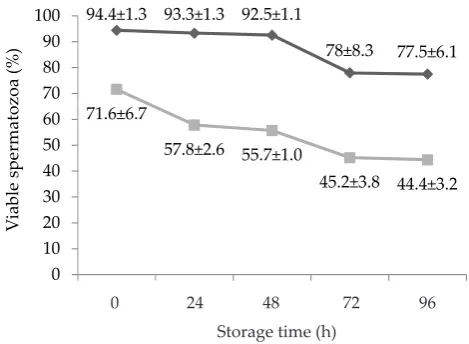
Figure 2 showed a significant decrease in viability of spermatozoa after 72 h of storage. Nevertheless, even at 96 h postmortem, 77.5%±6.1% of spermatozoa were
alive, as assessed by live-dead sperm staining. However,
after freezing, the decrease of viability has already
ob-served in spermatozoa retrieved from epididymis 24 h
after storage.
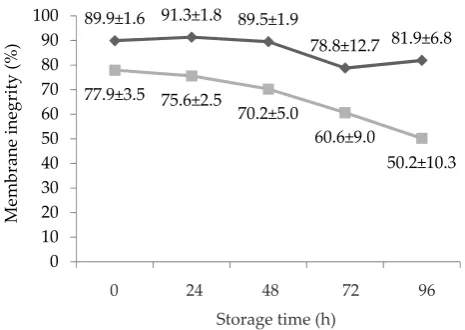
The plasma membrane is of crucial importance to the freeze-thaw survival of spermatozoa and is regarded as the primary site of freezing injury. In our study, the percentage of membrane integrity of spermatozoa in the epididymis for up to 96 h did not decrease signifi
-cantly (Figure 3). A slower decrease in sperm membrane integrities after cryopreservation was seen as storage time progressed. A significantly decrease (P<0.05) was
observed after 96 h of storage.
In general, the results in this study showed that sperm quality at collection decreased as the duration of the epididymal storage interval increase, this reduction was also seen after cryopreservation. The decrease of sperm quality along with post mortem due not only to sperm aging, but also to the processes inherent to tissue decomposition after death. Ram epididymal spermato
-Vol. 36 No. 1 IN VITRO FERTILITY OF POST-THAWED EPIDIDYMAL
Figure 1. Number of motile epididymal spermatozoa collected from ram epididymis stored at 4 °C for up to 96 at 5 °C
zoa in this study, and possibly the spermatozoa of all other mammalian species, begin to degenerate within the testis and male genital tract after death. Hishinuma et al. (2003) working with sika deer epididymis, described the degeneration of the epididymal tubules, showing that histological changes several days postmortem.
Nevertheless, results of our study suggested that cold storage of epididymed at 5 °C prevented a quick decrease in motility of epididymal spermatozoa, which coincides with other findings in many species (Kaabia et al., 2003; Soler et al., 2003; Wani, 2009). The beneficial effect of refrigeration on various parameters of sperm quality, especially motility, may be explained by the reduced metabolic rate of sperm cells when they are at 5 °C (Salomon & Maxwell, 2002). In this sense, Sankai et al. (2001) find that motility of mouse epididymal sper
-matozoa decreases when the storage temperature is in
-creased, suggesting that this effect is related to changes in spermatozoa metabolic activity. Whereas,
Reyes-Moreno et al. (2002) reported in bovine that the survival of sperm stored in epididymis related to the secretory epididymal proteins sustain sperm motility during stor -age in vitro. Bovine epididymal epithelium fluid from cauda epididymides was able to protect sperm against oxidative damage and to enhance frozen-thawed sperm motility and survival in vitro. Little is known about the epididymal secretions and the molecular mechanisms that allow sperm survival and preservation of sperm function during cauda epididymal storage. To date, the proposed mechanisms regulating sperm protection dur
-ing epididymal storage could implicate potent inhibitors of complement mediated cell lysis (Reyes-Moreno et al., 2002), the enzymes involved in glutathione conjugation and metabolism that provide protection against oxida
-tive damage (Agarwal et al., 2003; Zubkova & Robaire, 2004), and potential proteolysis activity regulators such as serine- and cysteine-protease inhibitors that may protect membrane-sperm from inappropriate proteo
-lytic degradation (Fouchecourt et al., 2000). Therefore
cauda epididymal fluid can be considered as a complex mixture of survival or sperm-maintaining factors that
can be retained in vitro. In addition, cryopreservation of
spermatozoa in this study caused a decreased in qual
-ity of sperm samples (considering progressive motil-ity, number of viable spermatozoa and plasma membrane integrity of spermatozoa), in which the 72 h and 96 h groups were affected to a greater extent with less post-thaw quality than other groups (P<0.05). It is well known during the freezing and thawing process, the sperma
-tozoa may be affected by several factors that can cause loss of plasma membrane integrity, acrosomal damage and mitochondrial dysfunctions, resulting in irreversible loss of motility and fertilizing capacity (Pukazhenthi et al., 2002).
The fertilizing ability of post-thawed epididymal spermatozoa gradually decreased (P<0.05) as the storage period was prolonged in this study, however, the sper
-matozoa collected from the cauda epididymides stored at 5°C for up to 96 h were able to fertilize 16%-65% of
oocytes in vitro (Table 1). This result coincides with other previous reports. Fertilizing ability of bull epididymal spermatozoa that were cryopreserved shortly after death of the animals was demonstrated by Martins et al. (2007). In cats, epididymal spermatozoa have similar fertiliza
-tion rates as fresh spermatozoa until 2 days of storage, but reduced by day 7 (Bogliolo et al., 2004). Similarly, fer
-tility rates of the mouse epididymal spermatozoa have been reported to decrease on storage for up to 5 d at 22 °C (Sato & Ishikawa, 2004). Kaabi et al. (2003) reported that spermatozoa collected from the cauda epididy
-midis of ram were able to fertilize oocytes in vitro and
similar cleavage rates for oocytes inseminated with ram sperm from epididymes stored at room temperature or refrigerated, both at 24 and 48 h postmortem. Moreover, even the samples have lost its motility because of a long storage, normal live fetuses were even obtained using immotile spermatozoa retrieved 20 d when the sperma
-tozoa were injected into oocytes (Kishikawa et al. 1999).
In the present study, it was observed that spermatozoa retained their motility and fertilizing ability for a greater duration within the epididymis.
CONCLUSION
Ram epididymal spermatozoa survive in storage at 5 °C for up to 96 h. These spermatozoa maintain their
Figure 3. Number of membrane integrity of spermatozoa col
-lected from ram epididymis stored at 4 °C for up to 96 at 5 °C before (-♦-) and after (-■-) freezing
KARJA ET AL. Media Peternakan
0 24 48 72 96
Oocyted fertilized (%) ± SD (n)
Total Normal Polyspermic Note: Means in the same column with different superscript differ sig
-nificantly (P<0.05).
fertilizing ability and may be suitable for use in IVF and other assisted reproductive procedures. These techniques are important tools for animal preservation when sperm cells could not be cryopreserved immediately after an animal’s death.
ACKNOWLEDGEMENT
This study was supported by Hibah Bersaing Institut Pertanian Bogor T.A. 2011 No. 15/13.24.4/SPP/T.A. 2011 No. 15/13.24.4/SPP/
PHB/2011. We thank Fitra Aji Pamungkas and Arie Febretrisiana, graduate students of Graduate School of Biology of Reproduction, Bogor Agricultural University,
for their help.
REFERENCES
Agarwal, A., R. A. Saleh, & M. A. Bedaiwy. 2003. Role of
reactive oxygen species in the pathophysiology of hu
-man reproduction. Fertil Steril. 79:829-43. http://dx.doi. org/10.1016/S0015-0282(02)04948-8
Barati, F., M. K. Mahabady, & Gh. Mohammadi. 2009.
Cryo-preservation of in situ cool stored buffalo (Bubalus bubalis)
epididymal sperm. Iranian J. Vet. Res. 10: 339-345
Bogliolo, L., P. Bonelli, L. Madau, M. T. Zedda, C. Santuc
-ciu, G. Leoni, S. Pau, & S. Ledda. 2004. Fertilizing
abil-ity ofepididymal cat spermatozoa after cryopreservation or storage at 4 °C. Reprod. Fertil. Dev. 16: 222 (Abstract). http://dx.doi.org/10.1071/RDv16n1Ab202
Fouchecourt, S., S. Metayer, A. Locatelli, F. Dacheux, & J. L. Dacheux. 2000. Stallion epididymal fluid proteome: quali
-tative and quanti-tative characterization; secretion and dynamic changes of major proteins. Biol.
Reprod.62:1790-1803. http://dx.doi.org/10.1095/biolreprod62.6.1790 Ganan, N., M. Gomendio, & E. R. S. Roldan. 2009. Effect of
storage of domestic cat (felis catus) epididymides at 5 8c on sperm quality and cryopreservation. Theriogenology
72:1268-1277. http://dx.doi.org/10.1016/j.theriogenology.2 009.07.023
Garde, J., N. Ortiz, A. Garcı´a, A. L. Gallego, C. T. Landete, & Lo´pez. 2005. Postmortem assessment of sperm charac-Postmortem assessment of sperm charac
-teristics of the red deer during the breeding season. Arch.
Androl. 41:195-202. http://dx.doi.org/10.3109/01485019808 994891
Hishinuma, M., K. Suzuki, & J. Sekine. 2003. Recovery and
cryopreservation of sika deer (Cervusnippon) spermatozoa from epididymides stored at 4 degrees C. Theriogenology
59:813-20. http://dx.doi.org/10.1016/S0093-691X(02)01154-8
Kaabia, M., P. Pazb, & M. Alvareza, E. Anela, J. C. Boixoa, H. Rouissic, P. Herraezb, & L. Anela. 2003. Effect of epididy
-mis handling conditions on the quality of ram spermato
-zoa recovered post-mortem. Theriogenology 60:1249-1259. http://dx.doi.org/10.1016/S0093-691X(03)00139-0
Karja, N. W. K., E. M. A. Respaty, L. Nuraini, S. A. Prihatno, &
S. Gustari. 2010. Characteristic of frozen-thawed epididy
-mal spermatozoa and refrigerated storage of ram sperma
-tozoa. J. Indonesian Trop. Anim. Agric. 35:63–67.
Kishikawa, H., H. Tateno, & R. Yanagimachi. 1999. Fertility of
mouse spermatozoa retrieved from cadavers and main -tained at 4 degrees C. J. Reprod. Fertil. 116:217-222. http://
dx.doi.org/10.1530/jrf.0.1160217
Matas, C., M. Sansegundo, S. Ruiz, F. A. García-vázquez, J. Gadea, R. Romar, & P. Coy. 2010. Sperm treatment affects capacitation parameters and penetration ability of ejacu
-lated and epididymal boar spermatozoa. Theriogenology
74:1327-1340. http://dx.doi.org/10.1016/j.theriogenology.2 010.06.002
Malcotti, V., V. Pelufo, N. Bergamo, & E. Aisen. 2012. Recovery
of epididymal spermatozoa from bull and red deer, stored at different times and temperatures before freezing–thaw
-ing. Anim. Prod. Sci. 52: 741-745. http://dx.doi.org/10.1071/
AN11366
Martins, C. F., K. Driessen, P. M. Costa, J. O. Carvalho-Neto, R. V. de Sousa, R. Rumpf, & M. N. Dode. 2009. Recovery, cryopreservation and fertilization potential of bovine
sper-matozoa obtained from epididymides stored at 5 degrees C by different periods of time. Anim. Reprod. Sci. 116:50-7. http://dx.doi.org/10.1016/j.anireprosci.2008.12.018
Martins, C. F., R. Rumpf, D. C. Pereira, & M. N. Dode. 2007.
Cryopreservation of epididymal bovine spermatozoa from dead animals and its uses in vitro embryo production. Anim. Reprod. Sci. 101:326-331. http://dx.doi.org/10.1016/ j.anireprosci.2007.01.018
Martinez-Pastora, F., C. Guerrab, M. Kaabib, A. R. Diaza, E. Anelb, P. Herraeza, P. de Paza, & L. Anelb. 2005. Decay
of sperm obtained from epididymes of wild ruminants depending on postmortem time. Theriogenology 63:24-40. http://dx.doi.org/10.1016/j.theriogenology.2004.03.003
Mir, S. S., F. A. Lone, M. Z. Khan, A. A. Mali��, R. Q. Islam, &
K. A. Sofi. 2012. Effect of cold storage period on the qual
-ity of ram cauda epididymal spermatozoa recovered post
-mortem. Turk. J. Vet. Anim. Sci. 36:683-687
Pamung��as, F. A., M. A. Setiadi, & N. W. K. Karja. 2012.
Characteristics and in vitro fertilization ability of ram spermatozoa: comparison of epididymal and ejaculated spermatozoa. Med. Pet. 35:38-44. http://dx.doi.org/10.5398/ medpet.2012.35.1.38
Pukazhenthi, B., R. Spindler, D. E. Wildt, L. M. Bush, & J. G. Howard. 2002. Osmotic properties of spermatozoa from felids producing different proportions of pleiomor
-phism: influence of adding and removing cryoprotectant.
Cryobiology 44:288-300.
http://dx.doi.org/10.1016/S0011-2240(02)00035-4
Reyes-Moreno, C., M. Boilard, R. Sullivan, & M. A. Sirard. 2002. Characterization and identification of epididymal factors that protect ejaculated bovine sperm during in vitro storage. Biol. Reprod.66:159–166. http://dx.doi.org/10.1095/
biolreprod66.1.159
Salamon, S., & M. W. Maxwell. 2000. Storage of ram semen. Anim. Reprod. Sci. 62:77-111. http://dx.doi.org/10.1016/ S0378-4320(00)00155-X
Sankai, T., H. Tsuchiya, & N. Ogonuki. 2001. Short-term non
-frozen storage of mouse epididymal spermatozoa. The
-riogenology55:1759–68. http://dx.doi.org/10.1016/S0093-691X(01)00518-0
Sato, M., & A. Ishi��awa. 2004. Room temperature storage of mouse epididymal spermatozoa: exploration of factors affecting sperm survival. Theriogenology 61:1455-1469. http://dx.doi.org/10.1016/j.theriogenology.2003.07.013 Shakeri, M., H. Roshanfekr, M. Mamoei, & Kh. Mirzadeh.
2008. Effect of epididymis handling condition on the qual
-ity of ram spermatozoa recovered post mortem. Asian J. Anim. Vet. Ad. 3:400-408. http://dx.doi.org/10.3923/aja -va.2008.400.408
Soler, A., M. Pe´rez-Guzma´n, & J. Garde. 2003. Storage of red
deer epididymides for four days at 5 8C: effects on sperm motility, viability, and morphological integrity. J. Exp.
Zool. 295A:188-99. http://dx.doi.org/10.1002/jez.a.10194
Suppawiwat, P., K. Chatdarong, S. Sirivaidyapong, & C.
Lo-hachit. 2006. Freezing of epididymal spermatozoa from
dogs after cool storage for 2 or 4 days. Theriogenology 66:1633-1636. http://dx.doi.org/10.1016/j.theriogenology.2 006.01.032
Thuwanut, P., K. Chatdarong, A. Johannisson, A. S. Bergqvist, L. So¨derquist, & E. Axne´r. 2010. Cryopreservation of
epididymal cat spermatozoa: effects of in vitro antioxi
dative enzymes supplementation and lipid peroxidation induction. Theriogenology 73:1076-1087. http://dx.doi. org/10.1016/j.theriogenology.2010.01.007
Vieira, L. A., J. Gadea, F. A. García-Vázquez, K. Avilés-López, & C. Matás. 2012. Equine spermatozoa stored in the epi
-didymis for up to 96h at 4°C can be successfully cryo
-preserved and maintain their fertilization capacity. Anim.
Reprod. Sci 136: 280-288. http://dx.doi.org/10.1016/j.anire -prosci.2012.10.027
Waheed, M. M., M. M. Al-E��naha, & S. M. El-Bahrb. 2011.
Some biochemical characteristics and preservation of epi
-didymal camel spermatozoa (Camelus dromedarius).
The-riogenology 76:1126-1133. http://dx.doi.org/10.1016/j.theri -ogenology.2011.05.021
Wani, N. A. 2009. In vitro embryo production in camel (
Cam-elusdromedarius) from in vitro matured oocytesfertilized
with epididymal spermatozoa stored at 4 °C. Anim.Re
-prod. Sci. 111: 69–79. http://dx.doi.org/10.1016/j.anirepros
ci.2008.02.005
Zub��ova, E. V. & B. Robaire. 2004. Effect of glutathione deple
-tion on antioxidant enzymes in the epididymis, seminal vesicles, and liver and on spermatozoa motility in the ag