Energy expenditure of the spotted snow skink,
Niveoscincus ocellatus
,
at two climatic extremes of its distribution range
Luh P.E.K. Yuni, Susan M. Jones, Erik Wapstra
nSchool of Biological Sciences, University of Tasmania, Private Bag 55, Hobart, Tasmania 7001, Australia
a r t i c l e
i n f o
Article history:
Received 29 November 2014 Received in revised form 11 June 2015
Accepted 9 July 2015 Available online 17 July 2015
Keywords: Energy expenditure Doubly labelled water Lizards
Activity time Metabolism
a b s t r a c t
The study of energy expenditure between populations of a wide ranging ectothermic species may pro-vide an insight into how organisms respond to variation in environmental conditions. In this study, the energy expenditure of male spotted snow skinks,Niveoscincus ocellatus,living at the two extremes of the species’distribution range (warm lowland versus cold alpine site) was measured using the doubly la-belled water method. Males at the cold alpine site expended more energy per gram per hour compared to their counterparts living at the warm lowland site. Lizards living at high altitude were active at lower temperatures compared with those at the low altitude site, which resulted in a longer activity time for the highland population. However, the differences in energy expenditure cannot be explained only by these differences in activity time. We further suggest that at the cold alpine site, lizards compensated for the low temperatures by elevating their metabolism which subsequently increased their energy ex-penditure. An elevated metabolic rate combined with modified thermoregulatory behaviour is likely an important mechanism allowingN. ocellatusto cope with the cold environments at high altitude sites.
&2015 Elsevier Ltd. All rights reserved.
1. Introduction
Studying energy expenditure and energy allocation by an ani-mal in nature helps us to understand how organisms have adapted to the environmental conditions. Such studies can also provide insights into how species respond to temperature differences be-tween different latitudes or altitudes (Porter, 1989; Angilletta,
2001a). This is especially important for ectotherms in which life
processes, including metabolism (DeVries et al., 2013), are strongly affected by the thermal environment (de Queiroz and Ashton,
2004;Fernandez et al., 2011).
An animal's metabolism, often measured as standard or resting (in ectotherms) or basal (in endotherms) metabolic rate, reflects the cost of maintenance of an animal’s energy expenditure (
Hul-bert and Else, 2000). Energy expenditure of an animal comprises
of several components including those associated with main-tenance, growth, activity, and reproduction (Nagy et al., 1984;
Pontzer et al., 2010). Among these, maintenance comprises the
largest proportion of an animal's energy expenditure (Angilletta,
2001b;Clarke, 2003). Accordingly, basal metabolic rate is generally
related to energy expenditure in endotherms (e.g.,Pontzer et al.,
2010;Dalton et al., 2014), and standard or resting metabolic rate in
ectotherms (e.g.,Beaupre and Duvall, 1998;Angilletta and Sears,
2000) because standard or resting metabolism relates to the en-ergy required for maintenance (Pörtner et al., 2000; Homyack
et al., 2010). Energy expenditure (and metabolic rate) of
ec-totherms is typically related to activity patterns (e.g.,Sears, 2005;
Smith et al., 2008). This is because higher level of activity is
ty-pically associated with higher body temperatures: thus, within species, energy expenditure varies with season or geographic variation in altitudes or latitudes (Karasov and Anderson, 1984;
Patterson and Davies, 1989; Grant and Dunham, 1990; Clarke,
1991, 2003; Hare et al., 2010; Powers and Anderson, 2010;
Schaefer and Walters, 2010). The relationship between energy
expenditure and activity patterns is likely to be especially pro-nounced in ectotherms compared to endotherms because of the stronger relationship between activity patterns and higher body temperatures in ectotherms. In general, ectotherms living in war-mer environments have higher resting metabolic rates because the speed of chemical reactions, including aerobic respiration, in-creases exponentially with temperature (Clarke and Fraser, 2004;
Martinez del Rio and Karasov, 2010). For example, eastern fence
lizards, Sceloporus undulatus, living in a warmer environment (lower latitude) had higher resting metabolic rates than those living in colder environment (higher latitude) (Angilletta, 2001b). Similarly, energy expenditure was higher in a population of the same species that experienced a longer activity time at their pre-ferred temperature than in a population with a shorter activity time (Angilletta, 2001a). In addition, the population with the higher energy expenditure also had a significantly higher Contents lists available atScienceDirect
journal homepage:www.elsevier.com/locate/jtherbio
Journal of Thermal Biology
http://dx.doi.org/10.1016/j.jtherbio.2015.07.003 0306-4565/&2015 Elsevier Ltd. All rights reserved.
n
Corresponding author.
metabolisable energy intake than those with the lower energy expenditure (Angilletta, 2001a).
However, it may not be as straightforward as previously thought. Ectotherms primarily respond to the the variation in their thermal environment by behaviourally regulating their body temperatures (Seebacher et al., 2004; Kearney et al., 2009;
Za-mora-Camacho et al., 2013;Sunday et al., 2014), although it may
be limited by several factors, e.g., thermal quality of the environ-ment (Scheers and Van Damme, 2002; Besson and Cree, 2010), predation risk (Gutierrez et al., 2010), and time allocation for ac-tivities other than thermoregulatory behaviour (Huey and Slatkin,
1976;Sinervo et al., 2010). When thermoregulatory opportunities
are limited due to a trade-off between multiple costs and benefits
(Huey and Stevenson, 1979; Seebacher, 2009), ectotherms may
shift their physiological and biochemical rates in order to allow an optimum physiological or physical performance (Seebacher, 2005;
Beldade et al., 2011). Individuals from cooler environments such as
high altitudes or latitudes may have adaptations that extend their daily activity (e.g.,Van Damme et al., 1989; Addo-Bediako et al.,
2000; McConnachie et al., 2009; Bonino et al., 2011), therefore
affecting energy expenditure. For example, to be active at low temperatures, ectotherms can shift the body temperatures downward to allow basic physiological processes, such as perfor-mance (e.g., sprint speed or endurance) are optimised at low body temperatures (Clarke, 1993;Angilletta, 2009;Lourdais et al., 2013). A downward shift in lower limit of performance curve and thermal optima in locomotor performance have been documented in many ectotherms species (reviewed inAngilletta (2009)). Basic physio-logical processes at low body temperatures can be achieved by elevating standard or resting metabolic rates at specific tempera-tures in populations living in cold environments compared to those from warm environments (e.g.,Hare et al., 2010;Schaefer
and Walters, 2010). This is known as metabolic cold adaptation or
MCA (Clarke, 1991,2003; Hare et al., 2010; White et al., 2012). Metabolic cold adaptation (MCA) reflects compensation to cold temperatures (Clarke, 1991). It has been demonstrated within populations of eurythermal species living in the cold environment especially where the environment is highly variable, but not in stenothermal species due to stable temperatures (Pörtner, 2006). MCA occurs via adjustments of mitochondrial density and capacity according to the environmental temperature regime (Pörtner et al., 2000,2008). For example, an elevation of mitochondrial density causes a rise in energy expenditure due to the cost of mitochon-drial maintenance (Pörtner et al., 2000;White et al., 2012). Ele-vated standard or resting metabolic rates have been associated with a downward shift of critical temperatures in cold adapted populations of a species (Sommer and Pörtner, 2002; Pörtner, 2006). Metabolic cold adaptation has been observed in many species, including in reptiles species. One example of evidence of MCA was found in ‘cold populations’ of several species ( Hoplo-dactylus maculatus,H. chrysosireticus, andH. stephensi)of noctur-nal geckos from New Zealand where they had a higher standard and resting metabolic rate than diurnal‘warm’populations (Hare
et al., 2010). Similarly, a northern (cold) population of
cotton-mouth snakes (Agkistrodon piscivorus leucostoma), had a higher standard metabolic rate at low temperatures than a southern (warm) population (Zaidan, 2003).
Niveoscincus ocellatusare small viviparous lizards (adult body mass 3–12 g) living over a wide geographic and climatic range in Tasmania with concomitant effects on life history traits (Wapstra
and Swain, 2001;Wapstra et al., 2001;Atkins et al., 2007;Cadby
et al., 2010,2014;Pen et al., 2010;Uller et al., 2011). Individuals are
considerably larger in body size at maturity (and larger overall) at the colder extremes (65 mm versus 55 mm) of the species’range
(Wapstra et al., 2001) where the active season is reduced to
ap-proximately October to April, compared to their counterparts that
are active approximately from September to May at the warmer extreme of the species’range (Wapstra et al., 1999). Individuals reach maturity at three years old at the warm lowland sites compared to four tofive years old at the cold alpine sites (Wapstra
et al., 2001; Pen et al., 2010). Key reproductive events such as
mating and parturition occur approximately one month later at cold highland sites compared with lowland warmer sites (Wapstra
et al., 1999;Pen et al., 2010;Uller et al., 2011). The effect of climate
on life history traits, especially on embryonic development and the associated effects on the offspring traits such as on offspring birth date, size and sex, has created divergent selection pressures on basking behaviour in this species (Wapstra et al., 1999,2004,2009,
2010;Pen et al., 2010;Cadby et al., 2014). Divergence in basking
behaviour has been demonstrated in a laboratory study where females from high altitude populations thermoregulated more actively (i.e. bask more) than low altitude lizards especially under reduced thermal opportunities (Uller et al., 2011; Cadby et al., 2014) presumably because of past selection to maximise the use of the limited opportunities that occur in the colder environments.N. ocellatus at the high altitude site are probably active at lower temperatures than those at the lower altitudes: at the high alti-tude site, opportunistic basking has been under selection in order to ensure the offspring’s optimal development and potentially offspringfitness (Atkins et al., 2007;Uller et al., 2011;Cadby et al., 2014). It is clear that the thermal environment can create selection on basking and presumably other thermoregulatory behaviour, such behaviour that can certainly translate to males if the trait is under selection in females only because it is also likely that her offspring inherit the traits (Cadby et al., 2014). AlthoughN. ocel-latushas been extensively studied, the physiologicalflexibility that underpins the observed geographic variation in life history traits has not yet been studied.
In this study, we investigated the energy expenditure of N. ocellatus,under natural living conditions at the two climatic ex-tremes of its distribution range: a warm lowland site versus a cold alpine site. Both cold alpine and warm lowland sites are located near the upper and lower limit of this species distribution ranges
(Jones et al., 1997; Cadby et al., 2010). Accordingly, this species
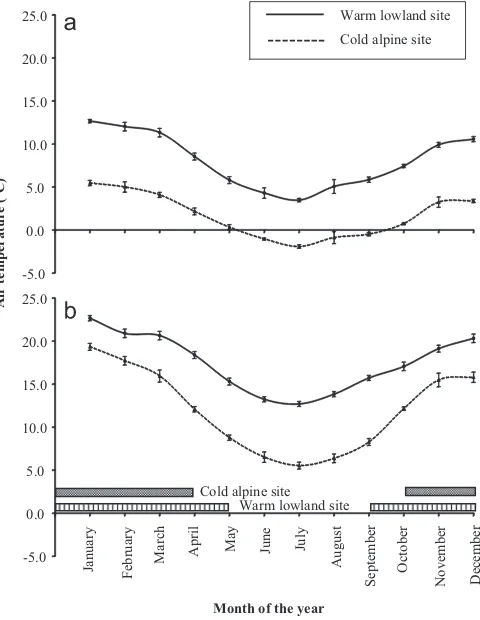
presents ideal opportunity to understand how a wide ranging ectothermic species has adapted to the environmental conditions they live in. The climate at the cold alpine site is colder than at the warm lowland site (Fig. 1; see Pen et al., 2010). N. ocellatusare typical temperate shuttling heliotherms that actively bask in the morning (when weather permits) and then use shade and sun intermittently to maintain temperatures at or near their optimum body temperature. During these periods of activityN. ocellatusis an active forager (Wapstra and Swain, 1996). On warmer days (especially in the warmer months), activity is distinctly bimodal with active basking only in the mornings and later afternoon. Typically, studies have found that ectotherms living in cold en-vironments, such as at high altitudes or latitudes, have more re-stricted activity times than those living at lower altitudes or lati-tudes, which is due to more limited thermal opportunity. How-ever, we suggested that it is not as straightforward as this because lizards at the cold alpine site might have physiological adaptations that allow them to cope with cold environments. This resulted in a higher energy expenditure in this population than that at the warm lowland site.
Energy expenditure was estimated using the doubly labelled water (DLW) method which allowed us to calculate the cost of living in the wild (Hulbert and Else, 2000). Only male lizards were used in this study because during the spring and summer months female snow skinks are at various stages of pregnancy (Jones et al.,
1997;Wapstra et al., 1999) which affects both basking behaviour
and energy expenditure in lizards (e.g.,Beuchat and Vleck, 1990;
Thompson, 2000;Schultz et al., 2008;Dupoue and Lourdais, 2014). To determine whether the energy expenditure was related to ac-tivity in this species, we estimated the potential available period of time that the lizards were capable of being active (actively basking or foraging) at each of the study sites.
2. Materials and methods
2.1. Study sites
The warm lowland site is located near Orford (147°44’E; 42°33’S; 50 m asl), and the cold alpine site is located at Miena on the Central Plateau (146°45’E; 41°55’S; 1050 m asl). Monthly mean minimum and maximum air temperature (2008–2012) at the nearest weather station to each study site were obtained from the Bureau of Meteorology Australia (Fig. 1). The cold alpine site has lower mean minimum (Fig. 1a) and maximum (Fig. 1b) air tem-peratures than the warm lowland site. The difference in thermal characteristics between sites has profound effects on daily activity patterns and the length of the activity season of lizards. At the warm lowland site, lizards are active from August to May, with occasional emergence during winter in warmer days. At the cold alpine site, however, their activity is restricted in early spring (September) and during autumn (April–May) (Wapstra and Swain, 1996). It is beyond the scope of this study to present morefi ne-scaled detail on annual activity patterns based on the data ob-tained in this study because there would be significant annual variation that would be hard to capture and present. Despite the difference in their thermal characteristics, the availability of sub-strate for basking sites is similar at both study sites.N. ocellatusis a
saxicolous (rock-dwelling) species in which their occurrence is typically associated with rocky outcrops which are used as basking sites (Melville and Swain, 2000).
2.2. Estimation of the length of active time
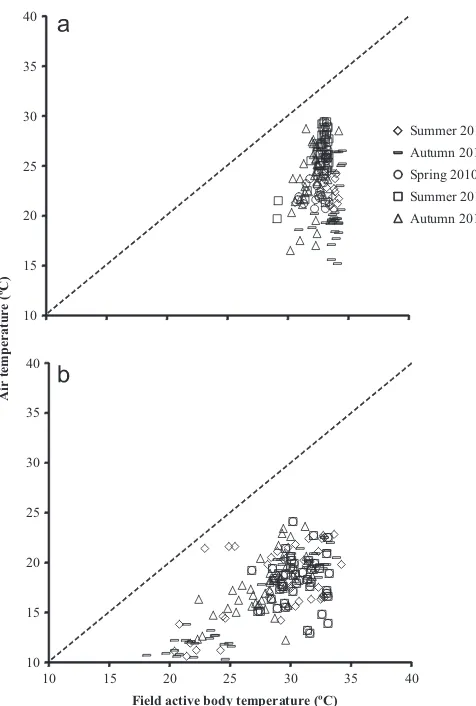
Prior to the doubly-labelled water experiment, the potential active time ofN. ocellatuswas determined by measuring thefield active body temperatures of captured maleN. ocellatus and the corresponding air temperatures at the time of capture over several seasons (Summer 2009/2010, Autumn 2010, Spring 2010, Summer 2010/2011, and Autumn 2011 at each study site; N¼164 and
N¼221 body temperature measurements for the warm lowland
and cold alpine site respectively). Body temperature was measured to70.1°C using a thermocouple probe (K-type, 0.5 mm diameter) connected to a digital micro-processor thermometer (HH 21, OMEGA Engineering, Stamford, CT, USA), which was inserted 5 mm into the lizard’s cloaca immediately after capture. The air temperature (in the micro-environment) was measured 1 m above the ground in the shade using an air thermometer (humidity/ temperature pen, ProSciTech E800012). After body temperature was taken, and prior to their release at their site of capture, each lizard was marked on its back with a non-toxic silver pen for a temporary identification as a precaution against repeated mea-surements on the same individual on several consecutive days.
We then estimated active time during the DLW study using these body and environmental (air) temperatures combined with weather characteristics obtained from the nearest Bureau of Me-teorology stations of the sites (rain occurrence, air temperature, time of sunrise and sunset) during the period of the DLW study at each study sites. The ibuttons were previously placed within the study sites to record the air temperature. However, the computer program malfunctioned so the air temperature data from the Bu-reau of Meteorology weather station were used. The data for the warm lowland site were obtained from Cambridge weather station (45 km from the study site), and the data for the cold alpine site were obtained from the Liawenee weather station (10 km from the study site). These weather stations were chosen because they both represent a close approximation of the weather at our specificfield sites and have been used before to model lizard activity and re-sponses to climate (Cadby et al., 2010). There is a Bureau of Me-teorology weather station within 7 km of the site at the warm lowland site but it is limited in the data available (maximum and minimum temperature, rain only) and does not have thefine-scale 30 min resolution. When these two east coast weather data were compared, they were closely matched. Both are on the lower east coast of Tasmania, at a similar altitude and experience the same weather patterns.
In order to estimate the length of potential active time available for each population, assumptions were set as follows:
a. The maximum length of active time estimated for each lizard was based on the time the DLW solution was injected into the lizard to the time when the second blood sampling was col-lected (see below).
b. The maximum period over which the lizards could be active during this time was calculated based on the time of sunrise and sunset during the DLW study. This species usually emerged about 2 h after sunrise and retreated about 2 h prior to sunset at both study sites (L. Yunipers.obs); therefore, the maximum active period was set between two hours after sunrise and two hours prior to sunset at both study sites. c. We also took into account the specific weather experienced
during the DLW study to refine our estimate of activity. The lizards were assumed to be active when there was no pre-cipitation during the active period and the air temperature -5.0
0.0 5.0 10.0 15.0 20.0 25.0
-5.0 0.0 5.0 10.0 15.0 20.0 25.0
Air temp
e
ratu
re
(
C)
Month of the year January February Mar
ch
Apr
il
May June July
August
September
Oc
tober
Nove
mber
Decemb
er
Warm lowland site Cold alpine site
Warm lowland site
Cold alpine site
was a minimum of 10.3°C for the cold alpine site and 15.2°C for the warm lowland site. These minimum air temperatures represent the lowest air temperatures at which lizards were captured from Summer 2009/2010 to Autumn 2011 at each of these sites (seeSection 3). A tolerance range of 0.5°C from the minimum air temperature recorded at each study site was added because lizards may have already been active below the minimum air temperature recorded before they were located and caught.
2.3. Measurement of energy expenditure using doubly labelled water
Energy expenditure was estimated using DLW for a period of 7 (72) days in Summer 2011/2012. The study was conducted at the warm lowland site from 20 to 29 December 2011, and at the cold alpine site from 14 to 22 January 2012. The approximately one month time difference between the studies took into account the documented differences in the timing of annual activity cycles and reproductive events at the cold alpine site compared with the warm lowland site (Wapstra et al., 1999;Cadby et al., 2010;Uller
et al., 2011). All key reproductive events occur approximately one
month later at the cold site including vitellogenesis and parturi-tion in females and spermatogenesis in males (seeWapstra et al.,
1999;Uller et al., 2011,Atkins et al., 2007;Cadby et al., 2010,2014).
In males, testes begin to increase in volume in December with a peak in testis size in January in the warm lowland population, with a corresponding increase in January with a peak in February in the cold alpine population (Wapstra et al., 1999). The DLW method involves injecting the animal with stable isotopes of hydrogen (2H) and oxygen (18O) and measuring the decline in activity of these isotopes in blood samples over time (Nagy, 1988;Southwood et al., 2006). Prior to thefield experiment, a solution of DLW was pre-pared in the laboratory, such that the lizards could be injected with a solution containing 0.15ml18O-water (97%18O) per g of li-zard body weight and 0.06ml D2O (99.9% deuterium) per g of lizard body weight (Metabolic Solutions protocol modified from
Speak-man (1997)). The dosage of the DLW solution was prepared to
allow a 7 (72) days recapture period in which to obtain the second blood sample: the second blood sample must be taken before the injected isotopes are washed out from the animal’s body. A 100ml sample of the DLW solution was placed into a 2 ml capped glass vial; this solution was kept separate from the bulk solution used for injection. It provided the baseline reading when the blood plasma containing the DLW solution was analysed by Isotope Ratio Mass Spectrometry (IRMS). The DLW solutions were stored at room temperature (20°C) away from direct sunlight until used in thefield.
For each population, maleN. ocellatus were collected in the field byfishing with a mealworm tied onto a piece of cotton. Forty-one and forty-six lizards were injected at the warm lowland site and at the cold alpine site respectively. Each lizard was toe-clip-ped, weighed to the nearest 0.1 g, and a round piece of cloth tesa-tapeswas stuck on its back to assist recognition from a distance. A piece of marking tape with the lizard’s number on it was stuck to the area of substrate closest to the site of capture to assist in the re-location of individuals at release and recapture. Each lizard was injected with 0.21ml (0.15ml18O-water and 0.06ml D2O) per gram of lizard body weight by intra-peritoneal injection using a pre-viously calibrated 10ml syringe (Hamilton). For example, a 5 g an-imal was injected with 1.05ml of DLW solution (Metabolic Solu-tions protocol modified fromSpeakman (1997)). The exact time of injection was recorded, and each animal was left for approxi-mately 2.5 h to allow the DLW solution to become equilibrated with their body water. During this period, they were kept in the shade (air temperature less than 20°C) in a large plastic container (804060 cm) layered with paper pellets and terracotta
saucers for cover. At the end of this period, 50–60ml of blood was collected from the lizard’s sub-orbital sinus using a 75ml heparin-coated capillary tube. The exact time of the blood collection was recorded, and each blood sample was placed into a heparin-coated eppendorf tube. These tubes were stored in a portable cooler at 4-8°C until they were returned to the laboratory. In addition, a sample of 50–60ml of blood was collected from three uninjected male lizards: these blood samples were required to provide the baseline reading of plasma without DLW solution in the mass spectrometry analysis. We collected the blood samples for baseline reading from three different uninjected males since we could not bled individual lizard three times because of their small sizes. After the blood sampling, all lizards were released at their point of capture. On returning to the laboratory, the blood was centrifuged for 5 min at 3000 rpm. The separated plasma was transferred into a labelled cryogenic storage tube and stored in a freezer.
The injected lizards were recaptured within 5–9 days after the day of injection; a sample of 50–60ml of blood was collected from the sub-orbital sinus using a 75ml heparin-coated capillary tube and processed as described above. Each lizard was re-weighed to the nearest 0.1 g prior to bleeding and the time of blood collection was recorded. All lizards were re-released at their point of capture. Twenty-three injected lizards were recaptured at warm lowland site, and twenty-five were recaptured at the cold alpine site. However, only those plasma samples with a volume more than 30ml could be used for analysis because this is the minimum vo-lume required for the IRMS analysis by Metabolic Solutions, Inc. (United States of America). Thus, for each site, 28 frozen plasma samples (14 individuals2 samples) were later transported on dry ice to Metabolic Solutions, Inc. (United States of America) for IRMS analysis.
The rate of CO2production was estimated using theLifson and
McClintock (1966)equationrCO2¼(N/2) (k18–k2) which assumes
that the total body water pool (N) is a homogeneous compartment that remains constant during observation. This equation is
rCo2= (N/2)
(
k18−k2)
whererCO2is the rate of CO2production (in ml g 1h 1),Nis the total body water pool,k18is the rate of elimination of18O and
k2is the rate of deuterium (D2O) elimination. The total body water was obtained by plotting a decay curve for each isotope, D2O and 18O. The decay data were linearised by taking the logarithm of the
18O and deuterium data. By the extrapolation to time zero, the
total body water was obtained. N. ocellatus is primarily in-sectivorous (Wapstra and Swain, 1996), so the rate of CO2 pro-duction was converted to energy expenditure based on a thermal equivalent of 25.7 J per ml CO2for a diet of insects (Nagy, 1983). Therefore, energy expenditure (in J g 1h 1)
¼(CO2in ml g 1h 1) (25.7 J).
Lizards have a very low metabolism when they are cold and inactive, which is only 11–17% of total daily energy expenditure
(Bennett and Nagy, 1977). Accordingly, the result obtained from
2.4. Statistical analysis
All statistical analyses were conducted in SAS 9.2. with sig-nificance
α
set at 0.05. Prior to the analysis, the data for the energy expenditure and length of active time were checked for normality using a normal quantile plot. Both data sets were normally dis-tributed, so transformation was not required. The energy ex-penditure ofN. ocellatus(J g 1h 1) and the active time (hours) were compared between sites using one-way ANOVA. Similarly, a one-way ANOVA was used to compare the water flux rate (ml g 1h 1) between sites. Thefield active body temperature and the air temperature data were descriptively analysed to determine the range (minimum and maximum) of temperature at which the lizards were active at each study site (see above). Field active body temperature data were compared between populations using two-way ANOVA to determine whether their body temperature varied with season across the two sites (Summer 2009/2010, Autumn 2010, Spring 2010, Summer 2010/2011, and Autumn 2011) at the climatic extremes of their distributional range. When the full models were significant, planned comparison tests were used to isolate significant interactions between sites and seasons as well as the main effect of site and seasons. A one-way repeated ANOVA was used to determine whether the body masses of lizards changed during the course of DLW study. A simple correlation data analysis was also conducted to determine the relationship be-tween energy expenditure and body size bebe-tween sites.
3. Results
A wider range offield active body temperature measurements from Summer 2009/2010 to Autumn 2011 were observed in the cold alpine population (18.1–34.2°C;N¼221) compared with the warm lowland population (29.1–34.5°C; N¼164) (Fig. 2). The body temperatures were collected when lizards were active at air temperatures between 10.3–26.6°C at the cold alpine site and 15.2–29.4°C at the warm lowland site. The field active body temperature ofN. ocellatusshowed significant interaction among sites and seasons (F4,384¼9.44, Po0.0001) with a strong site
(F1,384¼202.83,Po0.0001) and seasonal (F4,384¼6.60,Po0.0001)
main effect also. The mean active body temperature recorded was the lowest in autumn compared to in spring and summer at both sites (in Autumn 2011 at the warm lowland site and in Autumn 2010 at the cold alpine site). Thefield active body temperature of the high altitude population (33.487S.E. 0.26°C, 33.677S.E. 0.13°C, 32.77S.E. 0.12°C, 32.747S.E. 0.13°C, 31.927S.E. 0.14°C in Summer 2010, Autumn 2010, Spring 2010, Summer 2011 and Autumn 2011, respectively) was significantly lower than those at the low altitude (28.877S.E. 0.58°C, 27.277S.E. 0.74°C, 30.537S.E. 0.25°C, 30.47S.E. 0.29°C, and 28.0270.36°C in Summer 2010, Autumn 2010, Spring 2010, Summer 2011 and Au-tumn 2011, respectively) in all seasons observed (Summer 2010
F1,56¼34.22,Po0.0001; Autumn 2010F1,78¼126.79,Po0.0001;
Spring 2010F1,79¼14.67,P¼0.0002; Summer 2011F 1,87¼19.32,
Po0.0001; Autumn 2011F1,80¼49.01,Po0.0001).
The time from when the lizards were injected with the DLW solution to the time when the second blood samples were taken for the DLW study was similar in both populations (8–9 days or 151.7475.4 h and 7–8 days or 158.1373.7 h for the warm and cold site respectively;F1,26¼0.98,P¼0.3316). In total, we had 13 and 14 plasma samples for IRMS analysis from the warm lowland and the cold alpine sites, respectively. Energy expenditure was significantly higher at the cold alpine site than at the warm low-land site (8.967S.E. 0.29 J g 1h 1and 6.317S.E. 0.37 J g 1h 1 respectively; F1,26¼32.25, Po0.0001) (Fig. 3a). No significant
changes in the mean body mass of lizards occurred during the
DLW study (4.8070.24 g versus 4.6870.22 g (t value¼0.36,
P¼0.7238) and 5.3870.82 g versus 5.2970.93 g (t value¼0.27,
P¼0.7852)) at the warm and cold sites respectively. A significant (F1,12¼6.08,P¼0.03) but weak (r2¼0.36) relationship between the energy expenditure and body mass was found in the warm low-land population. However, no significant relationship was found in the cold alpine population (F1,13¼0.20,P¼0.67,r2¼0.02). In ad-dition, there was no significant difference in waterflux rate be-tween the warm lowland and cold alpine populations (F1,26¼2.49,
P¼0.1275). The mean water flux rate was 5.357S.E. 0.64 ml g 1h 1 at the warm lowland site while 4.337S.E. 0.19 ml g 1h 1at the cold alpine site.
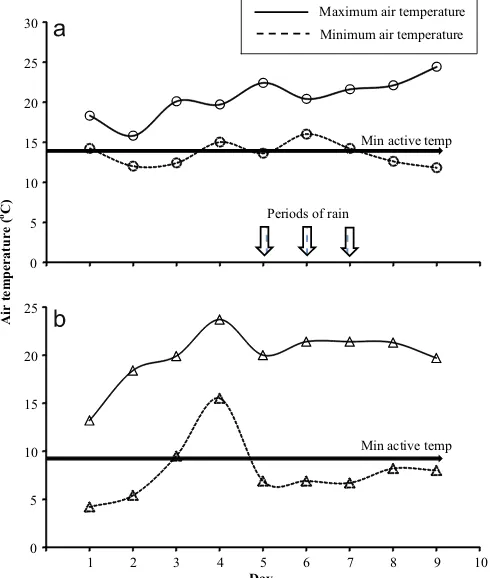
The estimated activity time during the DLW study was sig-nificantly longer in the cold site (71.797S.E. 1.3 h) than the warm site (62.517S.E. 2.2 h) (F1,26¼14.01, P¼0.001). In part this was because during the DLW study there were three rain periods re-stricting lizard activity at the warm lowland (day 5 (120 min), day 6 (120 min), day 7 (30 min)) whereas there was no rain restricting activity at the cold site. The temperature profile (minimum and maximum air temperature) and the rain periods are presented in
Fig. 4. When the rate of energy expenditure took into account the
activity time of each lizard, the rate of energy expenditure re-mained higher in cold alpine population (19.707S.E. 0.6 J g 1h 1) than in warm lowland population (15.3370.9 J g 1h 1) (F
1,26¼15.80,P¼0.0005; (Fig. 3b). 10
15 20 25 30 35 40
Summer 2010
Autumn 2010
Spring 2010
Summer 2011
Autumn 2011
10 15 20 25 30 35 40
10 15 20 25 30 35 40
Air temp
e
ratu
re
(ºC)
Field active body temperature (ºC)
4. Discussion
We measured the energy expenditure in two populations of a widespread lizard, the spotted snow skink,N. ocellatus,using the DLW method. We also estimated the potential activity time of the lizards at both study sites based on an analysis of their activity patterns in relation to air temperatures. MaleN. ocellatus at the cold alpine site expended a higher rate of energy per gram per hour than at the warm lowland site. Previous studies in a range of endotherms (e.g.,Pontzer et al., 2010;Zelova et al., 2011) and ec-totherms (e.g., Angilletta, 2001a; Naya et al., 2008; Smith et al., 2008) found that energy expenditure is primarily associated with activity period, although other factors, such as reproductive stage
(Bennett and Nagy, 1977; Schultz et al., 2008), oxygen levels
(Frappell et al., 1992), predation levels (Congdon, 1989), or prey
densities (Brown et al., 1992;Christian et al., 2007) could also play a role in differences in energy expenditure across populations. In endotherms, higher energy expenditure results from increased energy use during periods of activity (e.g., Pontzer et al., 2010;
Zelova et al., 2011). In ectotherms, in addition to the energy used
during periods of activity (e.g., Angilletta, 2001a; Smith et al.,
2008;Powers and Anderson, 2010), a higher energy expenditure
also reflects a higher cost of maintenance because cost of main-tenance comprises the largest component of energy expenditure (e.g.,Angilletta, 2001b;Pörtner et al., 2008).
There are potentially two explanations for the differences in energy expenditure between the two populations ofN. ocellatus. Thefirst explanation is the difference in activity times of lizards between sites during the DLW study. Individuals from the cold alpine site had a longer active time than those from the warm lowland site. Thisfinding is in agreement with other energy ex-penditure studies conducted in many species: individuals with a longer activity time have a higher energy expenditure than their counterparts with a shorter activity time, either within population e.g., variation between seasons (Christian et al., 2003;Smith et al., 2008) or between populations (Powers and Anderson, 2010). Ty-pically, ectotherms living in cold environments, such as at high altitudes or latitudes, have more restricted active times than those living at lower altitudes or latitudes due to more limited thermal opportunity (e.g.,Gutierrez et al., 2010;Ibarguengoytia et al., 2010;
Valdecantos et al., 2013). However, we found the opposite: over
the period when the DLW study was conducted,N. ocellatusat the cold alpine site had a longer activity period than those at the warm lowland site. Some of this variation was because there were short periods of rain which restricted the lizards’activities at the warm site – while we attempted to ensure the weather was as com-parable as possible (by offsetting our experiments at the two sites by1 month), some geographic variation in weather patterns are inevitable in the temperate climate of Tasmania. However, the largest contributor to the longer active time at the cold alpine site was that the lizards were able to be active at lower minimum air temperatures (10°C) than those at the warm lowland site (15°C). The cold alpine lizards were also active at a lower, and a greater range, of body temperatures (18.1–34.5°C) than the warm lowland lizards (29.1–34.5°C). The range of body temperatures at which the lizards were active at the cold alpine site was 14°C higher than their Critical Thermal Minimum (Caldwell et al., 2015). In addition, thermal preference of the cold alpine lizards were 27.3–28.4°C which indicated that they were able to be active at 10°C below their thermal preference (Uller et al., 2011,Cadby
et al., 2014). No geographic variation, however, was observed in
thermal preference in this species (L. Yuni, unpublished). The ability to be active at lower air and body temperatures suggests a potential adaptation toward lower temperatures in the cold alpine populations ofN. ocellatus which allows these lizards to extend their active time.
0.0 6.0 12.0 18.0 24.0
0.0 6.0 12.0 18.0 24.0
Warm lowland Cold alpine
Site
Energy expenditure (J
g
-hr
- )
Fig. 3.Box plot of the energy expenditure (J g 1
h 1
) of maleNiveoscincus ocellatus from the warm lowland site and the cold alpine site in Tasmania over (a) the whole period when the DLW study was conducted and (b) the potential activity time available for each population.
0 5 10 15 20 25 30
0 5 10 15 20 25
1 2 3 4 5 6 7 8 9 10
Min active temp
Min active temp Periods of rain
Air temperature (
oC)
Day
Maximum air temperature
Minimum air temperature
Fig. 4.Minimum and maximum temperature profile and rain occurrence at warm lowland site (a) and cold alpine site (b) during the doubly labelled water study.
Rain occurrence. Maximum air temperature;
In order to maintain a high and stable body temperature when thermal opportunities are restricted (e.g., cool seasons or at high altitudes), within species comparisons reveal that to maintain a high and stable body temperature when thermal opportunities are restricted (e.g., cool seasons or at high altitudes), lizards can in-crease their basking intensity by up 50% compared to those at lower altitudes (Huey and Slatkin, 1976;Vidal et al., 2010). This is in agreement with past work onN. ocellatuswhich suggests strong selection on basking in highland populations, i.e., they bask more than low altitude lizards when exposed to poor reduced thermal opportunities to maximise the use of limited thermal opportu-nities (Uller et al., 2011;Cadby et al., 2014). However, increased basking intensity is not without costs via an increase in the risk of predation, increased costs of metabolism and potentially de-creased time available for other activities such as foraging, espe-cially for actively foraging lizards (Huey and Slatkin, 1976;Wapstra
and O’Reilly, 2001; Sears, 2005; Angilletta, 2009;Isaksson et al.,
2011). To some extent these costs can be avoided by being active (i.e., foraging rather than basking) at lower and at a wider range of body temperatures as we found, i.e., they cease basking at a lower temperature than conspecifics from warmer areas.
While the higher energy expenditure at the cold subalpine site can be explained in part by their extended daily activity period, it does not fully explain the differences. When we took the differ-ences in activity time between sites into account, individuals from the cold site still had a higher mass specific energy expenditure. Some ectotherms elevate their standard or resting metabolic rate to facilitate physiological processes in order to compensate for the effects of the low temperatures in high altitudes or latitudes: this is known as metabolic cold adaptation (MCA) (Clarke, 1993;
Lourdais et al., 2013). Metabolic cold adaptation had been
ob-served in many species of ectotherms living in highly variable cold environments, and has been used to explain wide thermal toler-ances in these zones (e.g., reviewed byAddo-Bediako et al., 2002;
Cano and Nicieza, 2006;Pörtner, 2006;Lourdais et al., 2013), and
this could further explain our results in N. ocellatusat the high altitude. ForN. ocellatusfrom the cold alpine site,MCA may pro-vide a mechanism for this population to compensate for the effect of low and variable temperatures to maintain their physiological processes at an optimal rate. Previous studies have revealed that the elevated metabolic rate occurs via adjustments of mitochon-drial density and capacity that results in higher temperature-de-pendent maintenance costs, and subsequently in higher energy expenditure because cost of maintenance comprises the major portion of energy expenditure (Pörtner et al., 2000, 2008;
Ho-myack et al., 2010). A similar phenomenon had been observed in
the lizard Sceloporus undulatus (Angilletta, 2001b) in which a higher maintenance metabolism resulted in higher energy ex-penditure in a cold population compared to a warm population. Another example of MCA was also demonstrated in fish black-spotted topminnow (Fundulus olivaceus) in which the northern (cold) population had a higher mass specific metabolic rate com-pared to a southern (warm) population at set temperatures
(Schaefer and Walters, 2010). This explanation for N. ocellatus is
supported by their ability to be active at lower body temperatures and is further supported by population differences in temperature dependent performance. In the highland population, both sprint speed and endurance have a wider performance breadth and are maximised at a lower body temperature than in the warm lowland population (L. Yuni unpublished). It has been understood that elevated metabolic rates due to MCA have been associated with observations of a downward shift of critical temperatures in cold adapted populations of the Polychaete worm (Arenicola marinaL.)
(Sommer and Pörtner, 2002; reviewed in Pörtner (2006)). The
combination of elevated metabolic rate and modified thermo-regulatory behaviour is likely an important mechanism allowingN.
ocellatusto cope with the cold environments at high altitude sites. To support the higher energy expenditure at the cold alpine site than at the warm lowland site, a higher energy intake would be required by this population. We also calculated the waterflux rate of the lizards by usingNagy and Costa (1980)equation for a con-stant body water based on the elimination rate of Deuterium to determine the rate of energy intake in these populations and found there were no significant difference in their energy intake rate between sites during our study period. This does not preclude higher energy expenditure at other times of the year to support their higher energetic requirements. In a recent detailed labora-tory study examining the diet of this species in these two popu-lations using the geometric framework, we found little evidence for differences in diet preference but strong evidence for greater intake by cold site lizards (Yeoh et al., unpublished). The ability to be active at low temperatures at the cold alpine site provides a mechanism for this population to forage at a wider range of temperatures to fulfil their high energy expenditure. Resource availability is high at both cold alpine and warm lowland sites during the summer months indicated by large fat reserves in late summer/early autumn (Wapstra and Swain, 2001). N. ocellatus
exhibits an active foraging behaviour. They take a wide variety of terrestrial arthropods opportunistically, including cryptic and hidden prey in accordance with a wide ranging foraging strategy
(Wapstra and Swain, 1996).
To summarise, the variation in energy expenditure between populations measured in this study adds to the evidence of how a wide range of ectothermic species, exemplified by N. ocellatus, respond to variation in environmental conditions. Differences in the active time between the cold alpine and warm lowland po-pulations, potentially coupled with MCA, resulted in higher energy expenditure at the cold highland population than the warm low-land population. Strong evidence for population-level differences in temperature-dependent metabolism should next be addressed in the laboratory by examining metabolic rate under standard conditions in a range of populations along an altitudinal gradient at a range of different ambient temperature.
Acknowledgements
The authors thank Ken Nagy (University of California, Los An-geles) for advising the approach and methodology for the doubly labelled water study, and David Wagner (Metabolic Solutions Inc. USA) for carrying out the IRMS analyses and advising the calcu-lation of the results. The authors also thank Keisuke Itonaga for his assistance in administering the DLW protocol in the field. This study was funded by the Ministry of the National Education of the Republic of Indonesia, Udayana University, and the University of Tasmania, Australia. Erik Wapstra acknowledges the support of the Australian Research Council (Grant no. W0019483). This study was carried out under Animal Ethics Permit Number A0011593 from the University of Tasmania and a Scientific Permit (FA 11117) from the Department of Primary Industries, Parks, Water and Environ-ment in Tasmania.
References
Addo-Bediako, A., Chown, S.L., Gaston, K.J., 2000. Thermal tolerance, climatic variability and latitude. Proc. R. Soc. Lond. B 267, 739–745.http://dx.doi.org/ 10.1098/rspb.2000.1065.
Addo-Bediako, A., Chown, S.L., Gaston, K.J., 2002. Metabolic cold adaptation in in-sects: a large-scale perspective. Funct. Ecol. 16, 332–338.http://dx.doi.org/ 10.1046/j.1365-2435.2002.00634.x.
//dx.doi.org/10.1890/0012-9658(2001)082[3044:TAPCOE]2.0.CO;2.
Angilletta, M.J., 2001b. Variation in metabolic rate between populations of a geo-graphically widespread lizard. Physiol. Biochem. Zool. 74, 11–21.
Angilletta, M.J., 2009. Thermal Adaptation: A Theoretical and Empirical Synthesis. Oxford University Press, Oxford.
Angilletta, M.J., Sears, M.W., 2000. The metabolic cost of reproduction in an ovi-parous lizard. Funct. Ecol. 14, 39–45.http://dx.doi.org/10.1046/
j.1365-2435.2000.00387.x.
Atkins, N., Swain, R., Wapstra, E., Jones, S.M., 2007. Late stage deferral of parturition in the viviparous lizardNiveoscincus ocellatus(Gray 1845): implications for offspring quality and survival. Biol. J. Linn. Soc. 90, 735–746.http://dx.doi.org/ 10.1111/j.1095-8312.2007.00770.x.
Beaupre, S.J., Duvall, D., 1998. Variation in oxygen consumption of the western diamondback rattlesnake (Crotalus atrox): implications for sexual size di-morphism. J. Comp. Physiol. B 168, 497–506.http://dx.doi.org/10.1007/ s003600050170.
Beldade, P., Mateus, A.A., Keller, R.A., 2011. Evolution and molecular mechanisms of adaptive developmental plasticity. Mol. Ecol. 20, 1347–1363.http://dx.doi.org/ 10.1111/j.1365-294X.2011.05016.x.
Bennett, A.F., Nagy, K.A., 1977. Energy expenditure in free-ranging lizards. Ecology 58, 697–700.http://dx.doi.org/10.2307/1939022.
Besson, A.A., Cree, A., 2010. A cold-adapted reptile becomes a more effective thermoregulator in a thermally challenging environment. Oecologia 163, 571–581.http://dx.doi.org/10.1007/s00442-010-1571-y.
Beuchat, C.A., Vleck, D., 1990. Metabolic consequences of viviparity in a lizard,
Sceloporus jarrovi. Physiol. Zool. 63, 555–570.
Bonino, M.F., Azocar, D.L.M., Tulli, M.J., Abdala, C.S., Perotti, M.G., Cruz, F.B., 2011. Running in cold weather: morphology, thermal biology, and performance in the southernmost lizard clade in the world (Liolaemus lineomaculatussection: Liolaemini: Iguina). J. Exp. Zool. 315, 495–503.http://dx.doi.org/10.1002/ jez.697.
Brown, R.P., Perez-Mellado, V., Diego-Rasilla, J., Garcia, J.A., Naranjo, A., Speakman, J. R., 1992. Individual and population energetics of a lizard on a Mediterranean islet. Oecologia 91, 500–504.
Cadby, C.D., Jones, S.M., Wapstra, E., 2014. Geographical differences in maternal basking behaviour and offspring growth rate in a climatically widespread vi-viparous reptile. J. Exp. Biol. 217, 1–5.http://dx.doi.org/10.1242/jeb.089953. Cadby, C.D., While, G.M., Hobday, A.J., Uller, T., Wapstra, E., 2010. Multi-scale
ap-proach to understanding climate effects on offspring size at birth and date of birth in a reptile. Integr. Zool. 5, 164–175.http://dx.doi.org/10.1111/ j.1749-4877.2010.00201.x.
Caldwell, A.J., While, G.M., Beeton, N.J., Wapstra, E., 2015. Potential for thermal tolerance to mediate climate change effects on three members of a cool tem-perate lizard genusNiveoscincus. J. Therm. Biol. 52, 14–23.http://dx.doi.org/ 10.1016/j.jtherbio.2015.05.002.
Cano, J.M., Nicieza, A.G., 2006. Temperature, metabolic rate, and constraints on locomotor performance in ectotherm vertebrates. Funct. Ecol. 20, 464–470. http://dx.doi.org/10.1111/j.1365-2435.2006.01129.x.
Christian, K.A., Webb, J.K., Schultz, T.J., 2003. Energetics of bluetongue lizards ( Ti-liqua scincoides) in a seasonal tropical environment. Oecologia 136, 515–523. http://dx.doi.org/10.1007/s00442-003-1301-9.
Christian, K.A., Webb, J.K., Schultz, T.J., Green, B., 2007. Effects of seasonal variation in prey abundance onfield metabolism, waterflux, and activity of a tropical ambush foraging snake. Physiol. Biochem. Zool. 80, 522–533.http://dx.doi.org/ 10.1086/519959.
Clarke, A., 1991. What is cold adaptation and how should we measure it? Am. Zool. 31, 81–92.
Clarke, A., 1993. Seasonal acclimatization and latitudinal compensation in meta-bolism: do they exist? Funct. Ecol. 7, 139–149.http://dx.doi.org/10.2307/ 2389880.
Clarke, A., 2003. Costs and consequences of evolutionary temperature adaptation. Trends Ecol. Evol. 18, 573–581.http://dx.doi.org/10.1016/j.tree.2003.08.007. Clarke, A., Fraser, K.P.P., 2004. Why does metabolism scale with temperature?
Funct. Ecol. 18, 243–251.http://dx.doi.org/10.1111/j.0269-8463.2004.00841.x. Congdon, J.D., 1989. Proximate and evolutionary constraints on energy relations of
reptiles. Physiol. Zool. 62, 356–376, DOI: 0031-935X/89/6202-8831. Dalton, A.J.M., Rosen, D.A.S., Trites, A.W., 2014. Season and time of day affect the
ability of accelerometry and the doubly labelled water methods to measure energy expenditure in northern fur seals (Callorhinus ursinus). J. Exp. Mar. Biol. Ecol. 452, 125–136.
DeMarco, V., 1993. Metabolic rates of female viviparous lizards (Sceloporus jarrovi) throughout the reproductive cycle: do pregnant lizards adhere to standard allometry? Physiol. Zool. 66, 166–180.
de Queiroz, A., Ashton, K.G., 2004. The phylogeny of a species-level tendency: species heritability and possible deep origins of Bergmann’s rule in tetrapods. Evolution 58, 1674–1684.http://dx.doi.org/10.1554/03-596.
DeVries, Z.C., Kells, S.A., Appell, A.G., 2013. Standard metabolic rate of bed bug, Cimex lectularius: effects of temperature, mass, and life stage. J. Insect Physiol. 59, 1133–1139.http://dx.doi.org/10.1016/j.jinsphys.2013.08.012.
Dupoue, A., Lourdais, O., 2014. Relative reproductive effort drives metabolic chan-ges and maternal emaciation during pregnancy in a viviparous snake. J. Zool. 293, 49–56.http://dx.doi.org/10.1111/jzo.12116.
Fernandez, J.B., Smith Jr., J., Scolaro, A., Ibarguengoytia, N.R., 2011. Performance and thermal sensitivity of the southernmost lizards in the world,Liolaemus sar-mientoiandLiolaemus magellanicus. J. Therm. Biol. 36, 15–22.http://dx.doi.org/ 10.1016/j.jtherbio.2010.09.006.
Frappell, P., Lanthier, C., Budinette, R.V., Mortola, J.P., 1992. Metabolism and venti-lation in acute hypoxia: a comparative analysis in small mammalian species. Am. J. Physiol. 262, R1040–R1046, Regul. Integr. Comp. Physiol. 31. Grant, B.W., Dunham, A.E., 1990. Elevational covariation in environmental
con-straints and life histories of the desert lizardSceloporus merriami. Ecology 71, 1765–1776.http://dx.doi.org/10.2307/1937584.
Gutierrez, J.A., Krenz, J.D., Ibarguengoytia, N.R., 2010. Effect of altitude on thermal responses ofLiolaemus pictus argentinusin Argentina. J. Therm. Biol. 35, 332–337.http://dx.doi.org/10.1016/j.jtherbio.2010.07.001.
Hare, K.M., Pledger, S., Thompson, M.B., Miller, J.H., Daugherty, C.H., 2010. Noc-turnal lizards from a cool-temperate environment have high metabolic rates at low temperatures. J. Comp. Physiol. B 180, 1173–1181.http://dx.doi.org/10.1007/ s00360-010-0489-3.
Homyack, J.A., Haas, C.A., Hopkins, W.A., 2010. Influence of temperature and body mass on standard metabolic rate of eastern red-backed salamanders (Plethodon cinereus). J. Therm. Biol. 35, 143–146.http://dx.doi.org/10.1016/j.
jtherbio.2010.01.006.
Huey, R.B., Slatkin, M., M., 1976. Cost and benefits of lizards thermoregulation. Q. Rev. Biol. 51, 363–384.http://dx.doi.org/10.1086/409470.
Huey, R.B., Stevenson, R.D., 1979. Integrating physiology and ecology of ectotherms: a discussion of approaches. Am. Zool. 19, 357–366.http://dx.doi.org/10.1093/ icb/19.1.357.
Hulbert, A.J., Else, P.L., 2000. Mechanisms underlying the cost of living in animals. Annu. Rev. Physiol. 62, 207–235.http://dx.doi.org/10.1146/annurev.
physiol.62.1.207.
Ibarguengoytia, N.R., Medina, S.M., Fernandez, J.B., Gutierrez, J.A., Tappari, F., Sco-laro, A., 2010. Thermal biology of the southernmost lizards in the world: Lio-laemus sarmientoiandLiolaemus magellanicusfrom Patagonia, Argentina. J. Therm. Biol. 35, 21–27.http://dx.doi.org/10.1016/j.jtherbio.2009.10.003. Isaksson, C., While, G.M., Olsson, M., Komdeur, J., Wapstra, E., 2011. Oxidative stress
physiology in relation to life history traits of a free-living vertebrate: the spotted snow skink,Niveoscincus ocellatus. Integr. Zool. 6, 140–149.http://dx. doi.org/10.1111/j.1749-4877.2011.00237.x.
Jones, S.M., Wapstra, E., Swain, R., 1997. Asynchronous male and female gonadal cycles and plasma steroid concentrations in a viviparous lizard,Niveoscincus ocellatus(Scincidae), from Tasmania. Gen. Comp. Endocrinol. 108, 271–281. http://dx.doi.org/10.1006/gcen.1997.6971.
Karasov, W.H., Anderson, R.A., 1984. Interhabitat differences in energy acquisition and expenditure in a lizard. Ecology 65, 235–247.http://dx.doi.org/10.2307/ 1939476.
Kearney, M., Shine, R., Porter, W.P., 2009. The potential for behavioral thermo-regulation to buffer“cold-blooded”animal against climate warming. Proc. Natl. Acad. Sci. 10, 3835–3840.http://dx.doi.org/10.1073/pnas.0808913106. Lifson, N., McClintock, B., 1966. Theory of the use of the turnover rate of body water
for measuring energy and material balance. J. Theor. Biol. 12, 46–74.http://dx. doi.org/10.1016/0022-5193(66)90185-8.
Lourdais, O., Guillon, M., DeNardo, D., Blouin-Demers, G., 2013. Cold climate spe-cialization: adaptive covariation between metabolic rate and thermoregulation in pregnant vipers. Physiol. Behav. 119, 149–155.http://dx.doi.org/10.1016/j. physbeh.2013.05.041.
Martinez del Rio, C., Karasov, W.A., 2010. Body size and temperature: why they matter. Nat. Educ. Knowl. 3, 10.
Melville, J., Swain, R., 2000. Evolutionary relationships between morphology, per-formance and habitat openness in the lizard genus Niveoscincus (Scincidae: Lygosominae). Biol. J. Linn. Soc. 70, 667–683.http://dx.doi.org/10.1006/ bijl.1999.0422.
McConnachie, S., Alexander, G.J., Whiting, M.J., 2009. Selected body temperature and thermoregulatory behavior in the sit-and-wait foraging lizard Pseudo-cordylus melanotus melanotus. Herpetol. Monogr. 23, 108–122.
Nagy, K.A., 1983. Ecological energetics. In: Huey, R.B., Pianka, E.R., Schoener, T.W. (Eds.), Lizard Ecology: Studies of a Model Organism. Harvard University Press, Cambridge, Massasuchetts, pp. 24–54.
Nagy, K.A., 1988. Doubly-labeled water studies of vertebrate physiological ecology. In: Rundel, P.W., Ehleringer, J.R., Nagy., K.A. (Eds.), Stable Isotopes in Ecological Research. Springer-Verlag, New York.
Nagy, K.A., Costa, D.P., 1980. Waterflux in animals: analysis of potential errors in the tritiated wather method. Am. J. Physiol.: Regul. Integr. Comp. Physiol. 238, R454–R465.
Nagy, K.A., Huey., R.B., Bennett, A.F., 1984. Field energetics and foraging mode of Kalahari Lacertid lizard. Ecology 65, 588–596.
Naya, D.E., Veloso, C., Bozinovic, F., 2008. Physiologicalflexibility in the Andean lizardLiolaemus bellii: seasonal changes in energy acquisition, storage and ex-penditure. J. Comp. Physiol. B 178, 1007–1015.http://dx.doi.org/10.1007/ s00360-008-0292-6.
Patterson, J.W., Davies, P.C.M., 1989. A possible effect of climate on resting meta-bolic rate in lizards. Copeia 3, 719–723.
Pen, I., Uller, T., Feldmeyer, B., Anna, H., While, G.M., Wapstra, E., 2010. Climate-driven population in sex-determining systems. Nature 468, 436–439.http://dx. doi.org/10.1038/nature09512.
Pörtner, H.O., 2006. Climate-dependent evolution of Antartic ectotherms: an in-tegrative analysis. Deep-Sea Res. II 53, n1071–n1104.
Pörtner, H.O., Bock, C., Knust, R., Lannig, G., Lucassen, M., Mark, F.C., Sartoris, F.J., 2008. Cod and climate in a latitudinal cline: physiological analyses of climate effects in marinefishes. Clim. Res. 37, 253–270.http://dx.doi.org/10.3354/ cr00766.
adaptation: trade-offs in eurythermal and stenothermal ectotherms, Antarctic Ecosystems: Models for Wider Ecological Understanding. Caxton Press, Christchurch, New Zealand.
Pontzer, H., Raichlen, D.A., Shumaker, R.W., Ocobock, C., Wich, S.A., 2010. Metabolic adaptation for low energy throughput in orangutans. Proc. Natl. Acad. Sci. USA 107, 14048–14052.http://dx.doi.org/10.1073/pnas.1001031107.
Porter, W.P., 1989. New animal models and experiments for calculating growth potential at different elevations. Physiol. Zool. 62, 286–313.
Powers, S.D., R.A. Anderson, 2010. How does spatial variation in climate cause spatiotemporal patterns in lizard energetics? SICB 2010, Annual Meeting Ab-stracts, Seattle, WA, January 3–7.
Robert, K.A., Thompson, M.B., 2000. Energy consumption by embryos of a vivi-parous lizard, Eulamprus tympanum, during development. Comp. Biochem. Physiol. A 127, 481–486.http://dx.doi.org/10.1016/S1095-6433(00)00278-6. Schaefer, J., Walters, A., 2010. Metabolic cold adaptation and developmental
plas-ticity in metabolic rates among species in theFundulus notatusspecies com-plex. Funct. Ecol. 24, 1087–1094.http://dx.doi.org/10.1111/
j.1365-2435.2010.01726.x.
Scheers, H., Van Damme, R., 2002. Micro-scale differences in thermal quality and a possible case of evolutionaryflexibility in the thermal physiology of lacertid lizards. Oecologia 132, 323–331.http://dx.doi.org/10.1007/s00442-002-0970-0. Schultz, T.J., Webb, J.K., Christian, K.A., 2008. The physiological cost of pregnancy in
a tropical viviparous snake. Copeia 3, 637–642.http://dx.doi.org/10.1643/ CP-06-182.
Schwarzkopf, L., Shine, R., 1991. Thermal biology of reproduction in viviparous skinks,Eulamprus tympanum: why do gravid females bask more? Oecologia 88, 562–569.
Sears, M.W., 2005. Resting metabolic expenditure as a potential source of variation in growth rates of the sagebrush lizard. Comp. Biochem. Physiol. A 140, 171–177.http://dx.doi.org/10.1016/j.cbpb.2004.12.003.
Seebacher, F., 2005. A review of thermoregulation and physiological performance in reptiles: what is the role of phenotypicflexibility? J. Comp. Physiol. B 175, 453–461.http://dx.doi.org/10.1007/s00360-005-0010-6.
Seebacher, F., 2009. Responses to temperature variation: integration of thermo-regulation and metabolism in vertebrates. J. Exp. Biol. 212, 2885–2891.http: //dx.doi.org/10.1242/jeb.024430.
Seebacher, F., Sparrow, J., Thompson, M.B., 2004. Turtles (Chelodina longicollis) regulate muscle metabolic enzyme activity in response to seasonal variation in body temperature. J. Comp. Physiol. B 174, 205–210.http://dx.doi.org/10.1007/ s00360-003-0331-2.
Sinervo, B., Mendez-de-la-cruz, F., Miles, D.B., Heulin, B., Bastiaans, E., Villagran-Santa Cruz, M., Lara-Resendiz, R., Martinez-Mendez, N., Calderon-Espinosa, M. L., Meza-Lazaro, R.N., Gadsden, H., Avila, L.J., Morando, M., De la Riva, I.J., Se-pulveda, P.V., Rocha, C.F.D., Ibarguengoytia, N., Puntriano, C.A., Massot, M., Le-petz, V., Oksanen, T.A., Chapple, D.G., Bauer, A.M., Branch, W.R., Clobert, J., Sites Jr., J.W., 2010. Erosion of lizard diversity by climate change and altered thermal niches. Science 328, 894–899.http://dx.doi.org/10.1126/science.1184695. Smith, J.G., Christian, K., Green, B., 2008. Physiological ecology of the
mangrove-dwelling Varanid Varanus indicus. Physiol. Biochem. Zool. 81, 561–569.http: //dx.doi.org/10.1086/590372.
Sommer, A.M., Pörtner, H.O., 2002. Metabolic cold adaptation in the lugworm
Arenicola marina: comparison of a North Sea and a White Sea population. Mar. Ecol. Prog. Ser. 240, 171–182.
Southwood, A.L., Reina, R.D., Jones, V.S., Speakman, J.R., Jones, D.R., 2006. Seasonal metabolism of juvenile green turtles (Chelonia mydas) at Heron Island, Aus-tralia. Can. J. Zool. 84, 125–135.http://dx.doi.org/10.1139/Z05-185.
Speakman, J.R., 1997. Doubly Labelled Water: Theory and Practice. Chapman & Hall,
London.
Sunday, J.M., Bates, A.E., Kearney, M.R., Colwell, R.K., Dulvy, N.K., Longino, J.T., Huey, R.N., 2014. Thermal-safety margins and necessity of thermoregulatory beha-viour across latitude and elevation. Proc. Natl. Acad. Sci. 111, 5610–5615.http: //dx.doi.org/10.1073/pnas.1316145111.
Uller, T., While, G.M., Cadby, C.D., Harts, A., O’Connor, K., Pen, I., Wapstra, E., 2011. Altitudinal divergence in maternal thermoregulatory behaviour may be driven by differences in selection on offspring survival in a viviparous lizard. Evolution 65, 2313–2324.http://dx.doi.org/10.1111/j.1558-5646.2011.01303.x.
Valdecantos, S., Martinez, V., Lobo, F., Cruz, F.B., 2013. Thermal biology of Liolaemus lizards from the high Andes: being efficient despite adversity. J. Therm. Biol. 38, 126–134.http://dx.doi.org/10.1016/j.jtherbio.2012.12.002.
Van Damme, R., Bauwens, D., Castilla, A.M., Verheyen, R.F., 1989. Altitudinal var-iation of the thermal biology and running performance in the lizardPodarcis tiliguerta. Oecologia 80, 516–524.
Vidal, M.A., Habit, A., Victoriano, P., Gonzalez-Gajardo, A., Ortiz, J.C., 2010. Ther-moregulation and activity pattern of the high-mountain lizardPhymaturus palluma(Tropiduridae) in Chile. Zoologia 27, 13–18.http://dx.doi.org/10.1590/ S1984-46702010000100003.
Wapstra, E., Swain, R., Jones, S.M., O’Reilly, J., 1999. Geographic and annual variation in reproductive cycles in the Tasmanian spotted snow skink,Niveoscincus ocellatus(Squamata: Scincidae). Aust. J. Zool. 47, 539–550.http://dx.doi.org/ 10.1071/ZO99038.
Wapstra, E., Swain, R., 1996. Feeding ecology of the Tasmanian spotted skink, Ni-veoscincus ocellatus(Squamata: Scincidae). Aust. J. Zool. 44, 205–213.http://dx. doi.org/10.1071/ZO9960205.
Wapstra, E., Swain, R., 2001. Reproductive correlates of abdominal fat body mass in Niveoscincus ocellatus, a skink with asynchronous reproductive cycle. J. Her-petol. 35, 403–409.http://dx.doi.org/10.2307/1565958.
Wapstra, E., Olsson, M., Shine, R., Edwards, A., Swain, R., Joss, J.M.P., 2004. Maternal basking behaviour determines offspring sex in viviparous reptile. Proc. R. Soc. B 271, S230–S2332.http://dx.doi.org/10.1098/rsbl.2003.0152.
Wapstra, E., Swain, R., O’Reilly, J., 2001. Geographic variation in age and size at maturity in a small Australian viviparous skink. Copeia 2001, 646–655. Wapstra, E., Uller, T., Sinn, D.L., Olsson, M., Mazurek, K., Joss, J., Shine, R., 2009.
Climate effects on offspring sex ratio in a viviparous lizard. J. Anim. Ecol. 78, 84–90.http://dx.doi.org/10.1111/j.1365-2656.2008.01470.x.
Wapstra, E., Uller, T., While, G.M., Olsson, M., Shine, R., 2010. Giving offspring a head start in life:field and experimental evidence for selection on maternal basking behaviour in lizards. J. Evol. Biol. 23, 651–657.http://dx.doi.org/10.1111/ j.1420-9101.2009.01924.x.
Wapstra, E., O’Reilly, J.M., 2001. Potential‘cost of reproduction’in a skink: inter-and intrapopulational variation. Aust. Ecol. 26, 179–186.http://dx.doi.org/ 10.1046/j.1442-9993.2001.01104.x.
White, C.R., Alton, L.A., P.B. Frappell, P.B., 2012. Metabolic cold adaptation infishes occurs at the level of whole animal, mitochondria and enzyme. Proc. R. Soc. B 279, 1740–1747.http://dx.doi.org/10.1098/rspb.2011.2060.
Zaidan III, F., 2003. Variation in cottonmouth (Agkistrodon piscivorus leucostoma) resting metabolic rates. Comp. Biochem. Physiol. A 134, 511–523.http://dx.doi. org/10.1016/S1095-6433(02)00344-6.
Zamora-Camacho, F.J., Reguera, S., Moreno-Rueda, G., Pleguezuelos, J.M., 2013. Patterns of seasonal activity in a Mediterranean lizard along a 2200 m altitu-dinal gradient. J. Therm. Biol. 38, 64–69 10.1016/j.jtherbio.2012.11.002. Zelova, J., Sumbera, R., Okrouhlik, J., Skliba, J., Lovy, M., Burda, H., 2011. A seasonal