Antagonism of Bacterial Isolates from Local Microorganisms against Rhizoctonia solani and Their Effect on the Growth of Rice Seedlings
Hersanti : [email protected] Luciana Djaya : [email protected]
Jurusan Hama dan Penyakit Tumbuhan, Fakultas Pertanian Universitas Padjadjaran
Abstract
Local Microorganisms (MOL) are obtained from the liquid as a result of the fermentation of some organic material mixed in rice washing water or coconut water. Rice farmers usually use MOL in the cultivation of padi SRI (System of Rice
Intensification).
The research was objected to obtain bacterial isolates from 6 different MOLs [the material in the mixture were daun cebreng (leaf of Gliricidia sepium), pucuk waluh (young leaves of Sechium edule), buah maja (fruit of Aegle marmelos), rebung (young bamboo shoots), bonggol pisang (banana hump), pisang (banana)], which are antagonistic to Rhizoctonia solani in vitro, and able to stimulate the growth of rice seedlings. The antagonism was tested by dual culture method on PDA. The experiment was arranged in the completely randomized design with 19 treatments (19 bacterial isolates) and a control. The experiment to study the stimulation effect of the isolates on the rice
seedlings was carried out in the glasshouse. The isolates were applied by soaking the rice seeds in the bacterial suspensions for 24 hours.
From the 19 bacterial isolates obtained from the 6 MOLs, there were 6 isolates antagonistic to Rhizoctonia solani; 1 from maja, 1 from bonggol pisang, 3 from daun cebreng, and 1 from pucuk waluh. The isolates: MR1, MM4, MPW1, MM1, and MM3 were able to increase the number of germinated seeds which were 81%, 81%, 78%, 85%, and 98% respectedly, compared to control which was only 70%, and increase the growth of the seedlings.
Key words : Local Microorganisms, Rhizoctonia solani, antagonistic bacteria, PGPR
INTRODUCTION
Rice is a staple food crop for Indonesian. The government has attempted to increase the production of rice and managed to overcome some constraints such as the decrease of soil fertility, pests and diseases, excessive use of chemical fertilizers and pesticides, the in-optimal use of natural resources.
manures. Organic liquid fertilizers are also used. The liquid fertilizers are obtained from the fermentation of various organic materials available in the field and around the house of farmers such as kitchen waste. The organic materials are fermented in coconut water for 14-21 days. The result of the fermentation is called MOL (local microorganisms).
MOLs act as decomposer, fertilizer, and biological control agent, because of the bacteria which grow in the basic material. Kishore et al. (2005) reported that some bacteria obtained from the phylloplane and used in seed treatment, are able to induce the growth of peanut and increase the resistance to pathogen.
Leaf blight caused by Rhizoctonia solani is a major rice disease. The disease intensity on conventional rice is higher than the intensity on SRI organic rice farming (Hersanti et al., 2007). It was assumed that this was caused by the MOLs used in the SRI farming. The objective of this study was to isolate the bacteria from the MOLs which are able to control the pathogen and promote the growth of rice (act as Plant Growth
Promoting Rhizobacteria).
METHODS
Inoculum of Rhizoctonia solani
The inoculum of Rhizoctonia solani was obtained from Balai Besar Penelitian Tanaman Padi, Sukamandi. It was cultured on potato dextrose agar.
Isolation and morphological characterization of MOL bacteria
Six MOLs were obtained from Yayasan Aliksa, Nagrak, Sukabumi; they were: daun cebreng (leaf of Gliricidia sepium), pucuk waluh (young leaves of Sechium edule), buah maja (fruit of Aegle marmelos), rebung (young bamboo shoots), bonggol pisang (banana hump), and pisang (banana).
The bacteria were isolated on nutrient agar by dilution method. The morphology of the colonies was characterized.
Antagonism test
The in vitro antagonism between MOL isolates and Rhizoctonia solani was tested by dual culture method on potato dextrose agar (PDA).
Agar disk of Rhizoctonia solani (0.7 cm) was placed on PDA in Petri dish 1.5 cm from the side; the bacterial suspension was streak 3 cm from the disk. The activity of the MOL bacteria is shown by the inhibition zone around the colony of Rhizoctonia solani.
The experiment was arranged in the completely randomized design, with 19 treatment of MOL bacterial isolates and 3 replications. The parameter observed was the percentage of the inhibition.
PGPR test
RESULTS AND DISCUSSION
Bacterial isolation
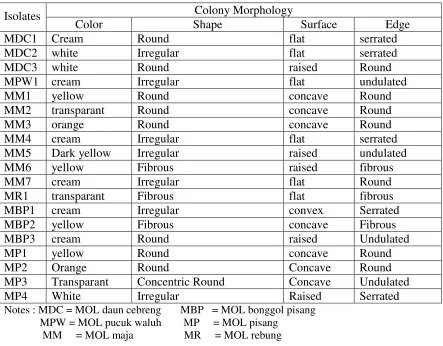
Nineteen isolates of bacteria were obtained from the six MOLs, i.e. 3 isolates from MOL daun cebreng, 1 from MOL pucuk waluh, 7 from MOL maja, 1 from MOL rebung, 3 from MOL bonggol pisang, and 4 from MOL pisang. The morphology of their colonies on nutrient agar were summarized in Table 1.
Table 1. Colony Morphology of MOL Isolates
Colony Morphology Isolates
Color Shape Surface Edge
MDC1 Cream Round flat serrated
MDC2 white Irregular flat serrated
MDC3 white Round raised Round
MPW1 cream Irregular flat undulated
MM1 yellow Round concave Round
MM2 transparant Round concave Round
MM3 orange Round concave Round
MM4 cream Irregular flat serrated
MM5 Dark yellow Irregular raised undulated
MM6 yellow Fibrous raised fibrous
MM7 cream Irregular flat Round
MR1 transparant Fibrous flat fibrous
MBP1 cream Irregular convex Serrated
MBP2 yellow Fibrous concave Fibrous
MBP3 cream Round raised Undulated
MP1 yellow Round concave Round
MP2 Orange Round Concave Round
MP3 Transparant Concentric Round Concave Undulated
MP4 White Irregular Raised Serrated
Notes : MDC = MOL daun cebreng MBP = MOL bonggol pisang MPW = MOL pucuk waluh MP = MOL pisang
MM = MOL maja MR = MOL rebung
Antagonism test
Table 2. Inhibition of MOL isolates to Rhizoctonia solani
No. Treatment Inhibition (%)
1. MOL Maja 1 25,17 d
2. MOL Maja 2 19,83 c
3. MOL Maja 3 8,33 b
4. MOL Maja 4 8,89 b
5. MOL Maja 5 9,00 b
6. MOL Maja 6 8,78 b
7. MOL Maja 7 52,11 gh
8. MOL bonggol pisang1 48,89 b 9. MOL bonggol pisang 2 8,33 b 10. MOL bonggol pisang 3 8,28 b 11. MOL daun Cebreng 1 67,83 i 12. MOL daun Cebreng 2 50,72 gh 13. MOL daun Cebreng 3 44,78 e
14. MOL pisang 1 9,78 b
15. MOL pisang 2 9,56 b
16. MOL pisang 3 7,56 b
17. MOL pisang 4 5,94 b
18. MOL pucuk waluh 54,44 h
19. MOL rebung 8,94 b
20. Kontrol 0 a
Some of the bacterial isolates were able to inhibit the growth of Rhizoctonia solani on PDA. Isolates from MOL daun cebreng caused the highest inhibition. It was assumed that the endophytic bacteria in the leaves of cebreng acted as the antagonistic bacteria.
Results of some laboratory tests showed that many strains of bacteria were able to protect rice from blas, sheath blight, sheath rot, and stem rot (IRRI, 2003). Pseudomonas fluorescens was reported as the biocontrol agent of rice blas (Vasudevan et al., 2002 in IRRI, 2003). The microorganisms which cause in vitro inhibition of the pathogen growth will also cause in vivo inhibition in a glass house trial (Broadbent et al., 1971 in
Hasanuddin, 2003).The antagonistic bacteria produce antibiotics and siderofor, and also act as the competitors.
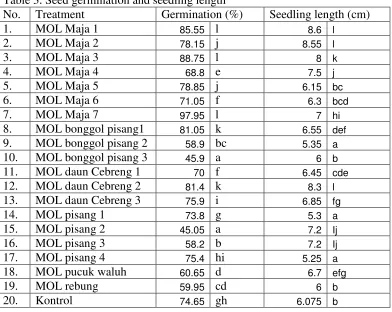
The percentages of the germinating seeds were higher in those treated with the antagonistic isolates compare to control. MBP3, MM6, MM5, MP1, MP3, MP4, MDC3 and MM7 caused lower percentage of germinating seeds. Those isolates were probably pathogenic to rice.
Kishore et al. (2005) reported that some bacteria isolated from phylloplane and applied as seed treatment were able to promote the growth of peanut and induce the resistance to pathogens. It was also reported that the phylloplane bacteria had higher ability than the rhizoplane bacteria.
Table 3. Seed germination and seedling length
SUMMARY
From the experiment it was obtained 2 bacterial isolates from MOL daun cebreng which were antagonistic to R. solani and able to promote the seed germination and the growth of seedlings (PGPR); and 3 bacterial isolates from MOL maja which were able to promote the growth of rice seedlings (PGPR).
REFERENCES
Dwidjoseputro, D. 1982. Dasar-dasar Mikrobiologi. Djambatan. Jakarta. 188 hlm.
Hasanuddin. 2003. Peningkatan Peranan Mikroorganisme dalam Sistem Pengendalian Penyakit Tumbuhan Secara Terpadu. Jurusan Hama dan Penyakit Tumbuhan No. Treatment Germination (%) Seedling length (cm)
1. MOL Maja 1 85.55 l 8.6 l
2. MOL Maja 2 78.15 j 8.55 l
3. MOL Maja 3 88.75 l 8 k
4. MOL Maja 4 68.8 e 7.5 j
5. MOL Maja 5 78.85 j 6.15 bc
6. MOL Maja 6 71.05 f 6.3 bcd
7. MOL Maja 7 97.95 l 7 hi
8. MOL bonggol pisang1 81.05 k 6.55 def
9. MOL bonggol pisang 2 58.9 bc 5.35 a
10. MOL bonggol pisang 3 45.9 a 6 b
11. MOL daun Cebreng 1 70 f 6.45 cde
12. MOL daun Cebreng 2 81.4 k 8.3 l
13. MOL daun Cebreng 3 75.9 i 6.85 fg
14. MOL pisang 1 73.8 g 5.3 a
15. MOL pisang 2 45.05 a 7.2 Ij
16. MOL pisang 3 58.2 b 7.2 Ij
17. MOL pisang 4 75.4 hi 5.25 a
18. MOL pucuk waluh 60.65 d 6.7 efg
19. MOL rebung 59.95 cd 6 b
Hersanti, E. Santosa dan SK. Triny. 2007. Keragaman Penyakit, Sebaran Hama dan Musuh Alaminya pada Pertanaman Padi Organik “System of Rice Intensification” (SRI) di Jawa Barat. Laporan akhir Penelitian Fundamental. DIKTI.
International Rice Research Institute (IRRI). 2003. Biological Control Agents for Rice Pathogens. http://www.pustaka-deptan.go.id. Diakses tanggal 10 Oktober 2008.
Istikorini, Y. 2002. Pengendalian Penyakit Tumbuhan Secara Hayati yang Ekologis dan Berkelanjutan. Makalah Falsafah Sains (PPs 702), Institut Pertanian Bogor. hlm. 2.