ABSTRACT
Kurniawan, Erda. 2015. The Analysis of Taboo Words and Swear Words in George Carlin’s Monologue Seven Words You Can’t Say on Television Yogyakarta: English Language Education Study Program, Department of Language and Arts Education, Faculty of Teachers and Training and Education, Sanata Dharma University.
This thesis discusses the emergence of taboo words and swear words in George Carlin’s monologue entitled Seven Words You Can’t Say on Television. This occurrence is considered problematic by the Federal Communication Commission (FCC). The Supreme Court then upheld the right of FCC to define indecent material using some those taboo words and swear words for the consideration.
This study aims at observing how problematic the occurrence taboo of words and swear word in the monologue is. Hence, the problems are formulated as follows: 1.What are the references or senses of taboo words and swear words uttered in George Carlin’s monologue? 2. How are the taboo words and swear words used in George Carlin’s monologue?
This study uses content analysis method. The research subjects of this research are the recorded version of the monologue Seven Words You Can’t Say on Television and the transcription of the monologue. Several relevant books related to some theories such as semantics, pragmatics, sociolinguistics, psychology, and history are used as the references to address the problem formulation.
Based on the analysis, this study found that the reference or sense of the taboo words and swear words in this monologue are included in six themes such as profanity, sexual activity, bodily effluvia, intimated part of the body, ancestral allusion, and name of animal. Then, Carlin utters the taboo words and swear words in five ways: descriptively, idiomatically, abusively, emphatically, and cathartically.
ABSTRAK
Kurniawan, Erda. 2015. The Analysis of Taboo Words and Swear Words in George Carlin’s Monologue Seven Words You Can’t Say on Television
Yogyakarta: Program Studi Pendidikan Bahasa Inggris, Jurusan Pendidikan Bahasa dan Seni, Fakultas Keguruan dan Ilmu Pendidikan, Universitas Sanata Dharma.
Skripsi ini membahas kata tabu dan kata makian yang ada dalam monolog George Carlin yang berjudul Seven Words You Can’t Say on Television. Kemunculan kata tabu dan kata makian tersebut dianggap bermasalah oleh Federal Communication Commission (FCC). Mahkamah Konstitusi Amerika kemudian memberikan hak kepada FCC untuk merumuskan materi yang dianggap tidak layak dengan menggunakan kata tabu dan kata makian yang ada dalam monolog George Carlin tersebut sebagai rujukan.
Penelitian ini bertujuan untuk mengamati seberapa bermasalah kata tabu dan kata makian yang ada dalam monolog tersebut. Oleh karena itu, masalah dirumuskan sebagai berikut: 1. Apa referensi dan pengertian dari kata tabu dan kata makian yang diucapkan dalam monolog George Carlin tersebut? 2. Bagaimana kata tabu dan kata makian tersebut digunakan dalam monolog ini?
Penelitian ini menerapkan metode analisis isi. Subjek dari penelitian ini adalah rekaman dari monolog George Carlin yang berjudul Seven Words You Can’t Say on Television dan transkrip dari rekaman tersebut. Buku-buku yang relevan terkait beberapa teori seperti semantik, pragmatik, sosiolinguistik, psikologi, dan sejarah juga digunakan sebagai rujukan untuk menjawab rumusan masalah.
Berdasarkan hasil analisis, penelitian ini menemukan bahwa referensi dan pengertian dari kata tabu dan kata makian dalam monolog tersebut mencakup enam tema, yaitu kiasan terhadap istilah religius, aktivitas seksual, hasil keluaran tubuh, bagian intim tubuh, kiasan terhadap garis keturunan, dan nama binatang. Kemudian, Carlin mengungkapkan kata tabu dan kata makian tersebut dengan lima cara, yaitu secara deskriptif, idiomatik, abusif, empatik, dan katartik.
THE ANALYSIS OF TABOO WORDS AND SWEAR WORDS
IN GEORGE CARLIN’S MONOLOGUE
SEVEN WORDS
YOU CAN’T SAY ON TELEVISION
A SARJANA PENDIDIKAN THESIS
Presented as Partial Fulfillment of the Requirements
to Obtain the Sarjana Pendidikan Degree
in English Language Education
By
Kristoforus Erda Kurniawan
Student Number: 091214052
ENGLISH LANGUAGE EDUCATION STUDY PROGRAM
DEPARTMENT OF LANGUAGE AND ART EDUCATION
FACULTY OF TEACHERS TRAINING AND EDUCATION
SANATA DHARMA UNIVERSITY
YOGYAKARTA
i
THE ANALYSIS OF TABOO WORDS AND SWEAR WORDS
IN GEORGE CARLIN’S MONOLOGUE
SEVEN WORDS
YOU CAN’T SAY ON TELEVISION
A SARJANA PENDIDIKAN THESIS
Presented as Partial Fulfillment of the Requirements
to Obtain the Sarjana Pendidikan Degree
in English Language Education
By
Kristoforus Erda Kurniawan
Student Number: 091214052
ENGLISH LANGUAGE EDUCATION STUDY PROGRAM
DEPARTMENT OF LANGUAGE AND ART EDUCATION
FACULTY OF TEACHERS TRAINING AND EDUCATION
SANATA DHARMA UNIVERSITY
YOGYAKARTA
A
@crn
Pewdidikan Thesis onI
THE ANALYSIS OF TABOO WORDS AND SWEAR WORDS
\
IN GEORGE
CARLIN'S
MONOLOGUE
SEWN
WOftITS Y.Oq CAN'TSAY ON
TELEWSION
Apprwed by
l1
THE ANALYSIS OF TABOO WORDS Ah[D SWEAR WORDS
IN GEORGE
CARLIN'S
MONOLOGUE
SEWN
WORDS YOUCAN'T
SAY ON
TELEWSION
By
Kristoforus Erda Kurniawan
Student Number: 091214052
' .i
Deferded b9{o1e the Board of Examiners
rr
:
on February 5h,2a15and Declared dcceptable
Board ofExaminers
Chairperson : P. Kuswandono, Ph.D.
a
Secretary
: Drs. Ba,rii Bram,:MF.d,, Ph,D,Member
: Drs. Barli Bram,'M,Ed., Ph.D,Member
: Drs. Y.B. Gunawan, M.A.Member
: P. Kuswandono, Ph.D.Yogyakart4 February 5'h:, 2Ol 5
Faculty of Teachers Training and Educatidn
Sanata Dharma University Dean
Rohandi, Ph.D.
iv
DEDICATION PAGE
It's a great word,
fuck,
nice word, easy word,
cute word, kind of easy
word to say…
.
STATEMENT OFWORK'SORIGINALITY
{
I h*estly declare that ttris thesiq which I have written, does not contain the work or parts of the work of other people, except those cited in the quotations and the
references, as a sciertific paper should.
Yogyakart4 Febnrary Ss, zOtS
The Writer
09rzt4052
LEMB^A.R PERI\IYATAAN PERSETUJUAN PUBLIKASI KARYA
ILMIAII
T'NTUK KEPENTINGAI\ AXAONVTTSYang bertanda tangan di bawah ini, saya mahasiswa Universitas Sanata Dharma:
Nama
: Kristoforus Erda KumiawanNomorMahasiswa
:091214052Demi pengembangan ilmu pengetahuan, saya mernberikan kepada Perpustakaan
Universitas Sanata Dharma karyailmiah saya yang berjudul:
THE ANALYSIS OF TABOO WORDS
AI\D SWEAR WORDS
IN GEORGE
CARLIN'S MONOLOGUE
SEVEN
WORDS YOUCAN'T
SAY ON
TELEVISION
Beserta perangkat yang diperlukan (bila ada). Dengan demikian saya memberikan kepada Perpustakaan Universitas Sanata Dharma
hak untuk
menyimpan,mengalihkan dalam bentuk media lain, mengelolanya dalam bentuk pangkalan data, mendistribusikan secara terbatas, dan mempublikasikannya di internet atau media
lain
untuk kepantingan akademis tanpa perlu memintaijin
dari
saya maupun mernberikan royalti kepada saya selama tetap mencantumkan nama saya sebagai penulis.Demikian pernyataan ini yang saya buat dengan sebenarnya.
Dibuat di Yogyakarta
Pada tangg al 23 J anuai 201 5
Yang menyatakan
vl
vii
ABSTRACT
Kurniawan, Erda. 2015. The Analysis of Taboo Words and Swear Words in George Carlin’s Monologue Seven Words You Can’t Say on Television Yogyakarta: English Language Education Study Program, Department of Language and Arts Education, Faculty of Teachers and Training and Education, Sanata Dharma University.
This thesis discusses the emergence of taboo words and swear words in George Carlin’s monologue entitled Seven Words You Can’t Say on Television. This occurrence is considered problematic by the Federal Communication Commission (FCC). The Supreme Court then upheld the right of FCC to define indecent material using some those taboo words and swear words for the consideration.
This study aims at observing how problematic the occurrence taboo of words and swear word in the monologue is. Hence, the problems are formulated as follows: 1.What are the references or senses of taboo words and swear words uttered in George Carlin’s monologue? 2. How are the taboo words and swear words used in George Carlin’s monologue?
This study uses content analysis method. The research subjects of this research are the recorded version of the monologue Seven Words You Can’t Say on Television and the transcription of the monologue. Several relevant books related to some theories such as semantics, pragmatics, sociolinguistics, psychology, and history are used as the references to address the problem formulation.
Based on the analysis, this study found that the reference or sense of the taboo words and swear words in this monologue are included in six themes such as profanity, sexual activity, bodily effluvia, intimated part of the body, ancestral allusion, and name of animal. Then, Carlin utters the taboo words and swear words in five ways: descriptively, idiomatically, abusively, emphatically, and cathartically.
viii
ABSTRAK
Kurniawan, Erda. 2015. The Analysis of Taboo Words and Swear Words in George Carlin’s Monologue Seven Words You Can’t Say on Television Yogyakarta: Program Studi Pendidikan Bahasa Inggris, Jurusan Pendidikan Bahasa dan Seni, Fakultas Keguruan dan Ilmu Pendidikan, Universitas Sanata Dharma.
Skripsi ini membahas kata tabu dan kata makian yang ada dalam monolog George Carlin yang berjudul Seven Words You Can’t Say on Television. Kemunculan kata tabu dan kata makian tersebut dianggap bermasalah oleh Federal Communication Commission (FCC). Mahkamah Konstitusi Amerika kemudian memberikan hak kepada FCC untuk merumuskan materi yang dianggap tidak layak dengan menggunakan kata tabu dan kata makian yang ada dalam monolog George Carlin tersebut sebagai rujukan.
Penelitian ini bertujuan untuk mengamati seberapa bermasalah kata tabu dan kata makian yang ada dalam monolog tersebut. Oleh karena itu, masalah dirumuskan sebagai berikut: 1. Apa referensi dan pengertian dari kata tabu dan kata makian yang diucapkan dalam monolog George Carlin tersebut? 2. Bagaimana kata tabu dan kata makian tersebut digunakan dalam monolog ini?
Penelitian ini menerapkan metode analisis isi. Subjek dari penelitian ini adalah rekaman dari monolog George Carlin yang berjudul Seven Words You
Can’t Say on Television dan transkrip dari rekaman tersebut. Buku-buku yang relevan terkait beberapa teori seperti semantik, pragmatik, sosiolinguistik, psikologi, dan sejarah juga digunakan sebagai rujukan untuk menjawab rumusan masalah.
Berdasarkan hasil analisis, penelitian ini menemukan bahwa referensi dan pengertian dari kata tabu dan kata makian dalam monolog tersebut mencakup enam tema, yaitu kiasan terhadap istilah religius, aktivitas seksual, hasil keluaran tubuh, bagian intim tubuh, kiasan terhadap garis keturunan, dan nama binatang. Kemudian, Carlin mengungkapkan kata tabu dan kata makian tersebut dengan lima cara, yaitu secara deskriptif, idiomatik, abusif, empatik, dan katartik.
ix
ACKNOWLEDGEMENTS
First, I would like to express my deepest gratitude to The Creator for
giving me life. Every challenge given to me makes me stronger in accomplishing
each phase of life.
I respectfully express my gratitude to my advisor, Drs. Barli Bram, M.Ed.,
Ph.D., for sharing his idea and knowledge. I appreciate his support, trust, and
patience in guiding me to write this undergraduate thesis. My gratitude also goes
to all of the lecturers and staff of the English Education Study Programme for all
their help and guidance during my study at this university.
I would like to express my sincere gratitude to my beloved parents,
Norbertus Darmadiyono and Yosephin Erika Lestari, for giving me a chance to
attend this university. Their affection and sacrifice for me are irreplaceable. The
support and prayer from them are the eternal fuel for the journey of my life. I also
thank my only sister, Kristofora Erma Kurniawati, for giving me countless
inspirations.
I really thank all of my comrades in UKPM Natas who play an important
role in introducing some perspectives of knowing the world. I would also thank all
my fellows in English Language Education Study Programme for their care and
cooperation in accomplishing the study at ELESP of Sanata Dharma University.
At the end, I would like also express my dearest gratitude to Teresia Dian
x
the strongest psychological support and instills a positive anxiety in me so that I
can finally complete this thesis.
xi
TABLE OF CONTENTS
Page
TITLE PAGE ... i
APPROVAL PAGES ... ii
DEDICATION PAGE ... iv
STATEMENT OF WORK’S ORIGINALITY ... v
PERNYATAAN PERSETUJUAN PUBLIKASI ... vi
ABSTRACT ... vii
ABSTRAK ... viii
ACKNOWLEDGEMENTS ... ix
TABLE OF CONTENTS ... xi
LIST OF APPENDICES ... xiv
CHAPTER I INTRODUCTION ... 1
1.1. Research Background ... 1
1.2. Research Problem ... 6
1.3. Problem Limitation ... 7
1.4. Research Objectives ... 7
1.5. Research Benefits ... 8
1.6. Definition of Terms ... 9
CHAPTER II REVIEW OF RELETED LITERATURE ... 12
2.1. Theoretical Description ... 12
2.1.1 The Concept of Taboo ... 12
2.1.2. Major Topics of Taboo Words ... 19
2.1.3. Taboo Words and Swear Words ... 23
xii
CHAPTER III METHODOLOGY ... 35
3.1. Research Method ... 35
3.2. Research Setting ... 36
3.3. Research Subject ... 36
3.4. Instruments and Data Gathering technique ... 36
3.5. Data Analysis Technique ... 37
3.6. Research Procedure ... 38
CHAPTER IV RESEACH FINDINGS AND DISCUSSION ... 41
4.1. The References and Senses of the Taboo Words and Swear Words ... 41
4.1.1. Profanity ... 42
4.1.2. Sexual Activity ... 42
4.1.3. Bodily Effluvia ... 43
4.1.4. Intimated Part of the Body ... 44
4.1.5. Ancestral Allusion ... 44
4.1.6. Name of Animal ... 45
4.2. How the Taboo Words and Swear Words Are Used ... 45
4.2.1. Taboo Words or Swear Words Uttered Descriptively ... 46
4.2.2. Taboo Words or Swear Words Uttered Idiomatically ... 63
4.2.3. Taboo Words or Swear Words Uttered Abusively... 80
xiii
4.2.5. Taboo Words or Swear Words Uttered Cathartically ... 86
CHAPTER V CONCLUSIONS AND RECOMMENDATIONS ... 89
5.1. Conclusions ... 89
5.2. Recommendations ... 91
REFERENCES ... 93
xiv
LIST OF APPENDICES
Page
Appendix A The transcript of Seven Words You Can’t Say on Television ... 98
Appendix B The Table of Reference and Sense ... 104
1
CHAPTER I
INTRODUCTION
This chapter discusses six major sections: the research background, research problem, problem limitation, research objectives, research benefits, and definition of
terms.
1.1. Research Background
Since Ramadan Month of 2012 Komisi Penyiaran Indonesia (Indonesian
Broadcasting Commision), or KPI in short, had a lot of task keeping an eye on some Ramadan-themed television programs. Recently KPI had found several programs which were considered problematic by several cases, one of which was conclusively about the use of some indecent words by the hosts or people involved in the programs
toward others (as can be seen at http://www.kpi.go.id/index.php/siaran-pers-1/30755-pelanggaran-serupa-dan-berulang-di-acara-komedi-ramadhan). The official site of KPI, www.kpi.go.id, noted that there were seven Ramadan-themed television programs which were accused to infringe the law of Indonesian broadcasting six of
which were comedy shows. KPI then has sent admonitory letters to the stations which
2
Almost the same but quite different cases also happened in the USA. Indecent
words case in American media frequently attracted the attention of the Federal Communication Commission (FCC) since 1937 (Levi, 2008). Yet, one of the influential cases is FCC v. Pacifica Foundation in which George Carlin was posed to be the defendant. In 1975, the FCC reprimanded Pacifica Foundation due to
broadcasting Carlin’s Filthy Words routine in its radio channel namely WBAI FM, New York. The case began when WBAI FM aired a recorded comedic monologue performed by Carlin entitled Seven Words You Can’t Say on Television in 1973. A father (John Douglas) who once was driving with his son heard the broadcast and sent
a complaint letter to FCC a few weeks later. Carlin’s monologue was considered to be full of obscene words which are not appropriate to be heard especially by kids.
FCC then claimed that Carlin’s monologue was “patently offensive” (Samaha, 2010). Later in 1978, the U.S. Supreme Court allowed FCC to regulate (prohibit)
“indecency” on broadcast radio or television during the hours when children were
likely to be listening (Pinker, 2008) using some (considered) indecent words appearing in Carlin’s monologue as the consideration (Levi, 2008). There are seven words which could not be said on broadcast, i.e. shit, piss, fuck, cunt, cocksucker, motherfucker, and tits. Here is the influential point of this case.
Since then, The Supreme Court upheld FCC’s right to define that to be obscene materials must meet three criteria (by means known as Miller Test): first, an
3
describe, in patently offensive way, sexual conduct specifically defined by applicable
law; third, the material, taken as a whole, must lack serious literacy, artistic, political or scientific value (Ljung, 2011, p. 10; Levi, 2008; Pinker, 2007).
However, some claimed that the definition was not determinative enough to convey the punishable act which was aired (Ljung, 2011, p.10). The “contemporary
community standards”, as the first point states, was claimed to be no more than ideas of morality possessed by the commissioners themselves (Levi, 2008). This condition made a slight fissure of debatable issue, especially for those who concerned about free speech. The most conflict was the clash between the regulation and the First
Amendment of the U.S. constitution which guaranteed that the government would not interfere with the publication of mass media as the symbol of democracy. However, The Supreme Court claimed that the case of obscenity was excluded from the
protection of the First Amendment (Cohen, 2002).
In response to this policy, Carlin himself insisted that his monologue had an origin in a love of words (Carlin, 1997). Steven Pinker (2008), a psychologist, wrote an article The Atlantic Magazine stating that Carlin said fuck not to describe sexual
activities nor to shock the audience, but to show how people use taboo words and the government should not regulate them. Pinker came to this statement with the notion
that the rules (which restricted Carlin’s speech) “mocks” the very rationale for free
speech. Adam M. Samaha (2010) in his Public Law and Legal Theory Working Paper
4
words from a long scroll” (Samaha, 2010). The strugglers of free speech, such as Mark Leigh and Mike Lepine (2005), Jonathan Hunt (2009), and some others delivered denial opinion about the policy separately.
In fact, it was not Carlin solely who had been charged by FCC due to indecent word case. Some exemplary series of similar cases were sanctioned as follows: first,
James Joyce’s book Ulysses was declared obscene and banned in the United States in 1921; second, Lady Chatterley’s Lover of D.H. Lawrence was banned in the United
States due the case of “obscene libel” and the use of taboo words in 1928; third, between 1961 and 1964 the comedian Lenny Bruce was frequently arrested for
obscenity and banned from performing in many cities. Bruce’s popular themes were satires about some issues like abortion, drugs, the Ku Klux Klan, and the Roman Catholic Church (Hughes, 2006, p 435). He then died in 1968 while appealing a
four-month sentence by a New York Court and was finally pardoned by the Governor thirty-seven years after his death (Pinker, 2007); fourth, the FCC fined Howard Stern for violation by shock jocks. He was fined $ 1.7 million which was the highest fine ever paid for the case of indecency (Levi, 2008; Pinker, 2007; Hughes, 2006).
The fear of the FCC and the U.S. Supreme Court is somewhat depicted schematically in Stanley Cohen’s Moral Panic theory. There are the “folk devil”
(scapegoat to be blamed for a state of affair) and the “moral entrepreneur” (the
interest group intending to eliminate the moral problem) who conflicted about values
5
the context in England at that time. Meanwhile, McEnery (2006) criticizes that the
debate about morality was very ambiguous with vague goal and (the case’s contextualization) was outdated. McEnery also claims that the state of problem was posed for the sake of those who took advantage from the absence (and the presence) of the taboo words in media. In the case of FCC v. Pacifica Foundation, similar
scheme is obvious considering the case that the FCC maintains the increasing amount of fine (forfeiture) which Levi (2008) claims “as minor costs of doing bussines”. Here Carlin (as well as WBAI FM) was accused to be the folk devil while the FCC and the Supreme Court played as the moral entrepreneur.
Are those words so bad that the FCC could be such reactive about the case? Meanwhile, Andersson and Trudgill (1990) say that no words are bad. Since then it is
important to convey the meaning beyond Carlin’s utterances of indecent words. Here semantic and pragmatic analysis of those words plays an important role. Yet, the discussion about indecent words is always covered by the moral and cultural boundaries (context). However, the value which the moral based on cannot as well be separated from the power dominating certain area, as it is schemed by McEnery. The
sure thing is that the indecent words have a strong relation with things which is claimed as taboo. This thesis will analyze further the taboo words and swear words uttered by Carlin in his monologue to provide semantic and pragmatic understanding about those words.
6
students do not shed their constitutional right to freedom of speech or expression at
the schoolhouse gate” (p. 61). However, taboo words and swear words are a phenomenon which is present in daily language across ages, gender, and social class (Howe, 2012). Jay (2000) claims that taboo topics are not regarded as a legitimate topic for scholarly examination due to the nature of the taboo itself, which
perpetuates and strengthens the taboo within the culture (p. 10). As the future teacher of English, the ELESP students should be able to teach their ESL students well about taboo, swear words, and their implementation in order to understand that phenomenon. Some universities, like University of Colorado Denver, have had a
curricular subject which discusses “taboo” in particular (the syllabus can be seen in appendix C). By adopting Carlin’s monologue as a model, this thesis tries to provide information and analysis about taboo words and swear words which might help make
the design. Being taught properly about taboo words and swear words, the ESL students are expected to be able to use taboo words and swear words appropriately and know the situation in which they have to use them or not.
1.2. Research Problems
This study addresses two research questions:
1. What are the references or senses of the taboo words and swear words uttered in Carlin’s monologue?
7
1.3. Problem Limitation
In this research, the writer focuses on analyzing words, phrases, or sentences which contain words with taboo as their origin (both taboo words and swear words).
In his monologue Carlin provides the contexts where the taboo words and swear word are uttered. The scope of this research is the semantic and pragmatic aspect which makes the taboo words and swear words. The other words, phrases, or sentences
which do not contain taboo words/ swear words or do not have a relation with those words are not going to be analyzed further.
Primarily the form of the data is recorded monologue, but for this research the writer used the verbatim transcription of Seven Words You Can’t Say on Television monologue in order to be easier for the writer to analyze and present the analysis. The writer uses only one of Carlin’s monologues due to its abundance of taboo words and swear words which is considered to be sufficient to be analyzed in this thesis.
1.4. Research Objectives
The purposes of this study are:
1. To figure out the taboo-themed words used in Carlin monologue Seven Words You Can’t Say on Television and their reference or sense. These various taboo
words and swear words will provide different cases in which those usually
8
of the swear words in this study. The writer will describe the historical contexts
from which the swear words originates if necessary. Obviously, the contexts are still related to the existence of taboo.
2. To find out the pragmatic aspect taboo words and swear words uttered. Despite the cultural contexts, there is also a certain way of using taboo words and swear
words in the speech. The writer will determine the pragmatic aspect of the taboo words or swear words by considering the contexts provided in the utterances in which those words take place.
1.5. Research Benefits
The benefits of this research are as follows:
1. For scholars: The background knowledge of taboo, taboo words and swear words will help the students understand the context in which taboo words and swear words are acceptable. The information in this research can improve the understanding about the concept of taboo and the words derived from it which is
9
2. For future researchers: As this research contains information about taboo, taboo
words, and swear words. The researchers who want to conduct similar research can use the information in this thesis as a reference.
3. For those who are interested in the discussion about taboo, taboo words, or swear words: This thesis is expected to be a source of information for those who need to
know about taboo, taboo words, and swear words. Taboo words and swear words might occur in daily conversation. Hopefully, the information within can help the reader understand the matters of taboo words and swear words.
1.6. Definition of Terms
There are several key words which are better to be understood to deal with the research of this thesis. Here is the definition of those considered important terms:
1. Taboo
Taboo is generally used to describe something which is “unmentionable” in the sense that it is ”ineffably sacred” or “unspeakably vile” (Hughes, 2006). In the context of this research taboo refers to anything or any activity which is considered not appropriate to reveal in front of public.
2. Taboo words
10
by the society (Hughes, 2006). Taboo words include oath, blasphemy or profanity
(hell, damn, bloody Mary), obscenity or vulgarity (fuck, shit, piss, pussy, cock), ethnic/ racial slurs (yankee, kaffir, gringo, nigger), and so on.
3. Swear words
Swear words are taboo words which are uttered by involving emotive function
and do not refer to its literal meaning (Ljung, 2011). The eleventh edition of Oxford English Dictionary mentions that the emotion carried on in swearing is
merely anger. Whereas, in the context of this research, swear words can also express any other emotions like happiness (Scherer & Sagarin, 2006).
4. Reference
Reference is the actual object or real world entity picked out by a linguistic expression (Frawley, 1992). Reference is also understood as a relation that holds
between speakers and what they are talking about in particular occasions (Lyons, 1995, p. 294).
5. Sense
Sense means the idea or other information derived from how the expression is
expressed as the product of logic (Lyons, 1995). Frawley (1992) also conceptualizes that sense is all the information which makes a sentence meaningful to someone who may or may not know the referential facts of a word.
From the definitions above it can be synthesized that this research analyzes
11
12
CHAPTER II
REVIEW OF RELATED LITERATURE
This chapter reviews some related studies which support the present
research. There are two major points that are discussed in this section. The first
point is the theoretical description which reviews some theories and also other
related studies relevant to the topic. The second point is the theoretical framework
which provides the synthesized major theories which help the researcher solve the
research questions.
2.1. Theoretical Description
Before going further to the analysis of taboo words in Carlin‟s monologue
it is important to convey the basic concept of taboo and some topics related to it.
2.1.1. The Concept of Taboo
Since the origin of taboo words and swear words is from a sort of things
considered taboo, it is important to dig out the concept of taboo itself for the
reason that it will be the notional basic of the whole discussion in this thesis.
Factually, there is no certain author capable of defining taboo precisely. Yet, some
in Melanesian) which etymologically means “sacred, set apart for God, kings,
priests, or chiefs, and therefore prohibited for general use (Hughes, 2006, p. 462).
. However, the concept of taboo grows in ages adapting the cultural
contexts which bound the culture and the society. The context also includes the
moral value which is accepted and embedded within a society. As a result, the
present understanding about taboo somehow differs from the context in which that
word was firstly accepted by the society.
Freud (2004) defines taboo in the context of ancient Aboriginal
Australian. He explains that Aboriginal Australian professes totemism as their
system of tribal life. Different symbols of totem are attached to the clans (clans
are the smaller division of the tribe). Totem itself could be animals or sometimes
plants and some natural phenomena (such as rain or water) which are believed to
be their “guardian spirit” protecting the clans from danger by its oracle (p.3).
Therefore, the members of a clan must not destroy, kill, eat its flesh, nor take
benefit from their totem to avoid the consecutive sanction. Thus, as Freud claims,
this relation between the totem and the tribe is called “sacred obligation”. Besides,
it is also noted that totemism has a strong bond with exogamy. The totem
symbolized by the clan functions as sign to prevent incest among the same totemic
clans. Thereby, marrying or having sexual intercourse with the same member of
the clan (with the same totem) is prohibited. Conclusively Freud notes that there
Freud emphasizes that since people do not have the exact concept of
taboo, it is hard to define precisely what taboo really is. Yet in an attempt to
define taboo, Freud highlights that the meaning of taboo diverges in two contrary
directions: „sacred‟ or „consecrated‟ and „uncanny‟, „dangerous‟, „forbidden‟, or „unclean‟ (p. 21). Above that all, Freud also underscores that taboo is then
manifested in „prohibition and restriction‟. It is obvious that Freud determines the
meaning of taboo based on his finding which is still related to Aboriginal
Australian context.
Coming out from the context of Aboriginal Australian, some authors also
offer some other definitions of taboo in more general sense. Hughes admits that
taboo in present context transforms into some prohibitions and restrictions varying
in all societies (2006, p. 462). It indicates that there are different taboos in
different regions of which cultures are also distinct. Hughes then tries to expand
the definition into some aspects in which taboo is manifested. The manifestation
could be in several relations of things, creatures, human experiences, condition,
deeds, and words. Yet, all of those manifestations still convey the sense of “ought to be avoided” and “strictly speaking”. Further Hughes extracts that prohibition is
fundamental and found in taboos in all societies, prohibition in doing either in saying. Here only left the notion of “prohibition” and the main reason why the
things are prohibited disappears by time and space.
Dwelling upon Jay‟s logic, this condition is then accommodated by an
institution to fill the vain in which the notion of taboo is absent. Jay (2009)
At the institutional level, there are some authorities which own a power to
regulate and define the taboo and have right to punish those who break the
prohibition (Allan & Burridge, 2006, p. 154).
An example of this case is described by Foucault (1978). Foucault
explains that sex is defined as taboo by Victorian regime. At the beginning of the
seventeenth century, the theme “sex” was more freely spoken, discussed, or even
performed. Actually, there had existed the codes which regulated sexual matters.
Yet, those codes were not too strict compared to those of the nineteenth century.
Foucault explains that condition as the period when bodies “made display of themselves” (p.3).
But then, after the Victorian bourgeoisie took place, the discussion about
sex was then put into silence and the pleasure about sex was strictly concealed.
Sex had to aim for procreative purpose under a penal law. Those who employed
sexual pleasure not for procreative purpose must be sanctioned. Since then sexual
intercourse should be done by married couple in a private room. Topic about sex
must only be discussed in confessional as Christianity also took role in that
censorship (p. 20). Even uttering a subject of sex (which had been claimed as
indecent) in public would cost death penalty. It was until 1617 people were
burned to death as the sanction for saying indecent words (Sulistya, 2012, p.246).
Then why must that prohibition be legalized in that certain period?
Population was considered as wealth and labor capacity, which became an
The government needed many labors to establish their industrial state. Thus, many
new human were needed every year to perpetuate the run of the industry. Here the
government acted as the “institution” itself. That archaic example conveyed that a
power might define taboo and propagate hegemony toward people.
Therefore, the two different examples presented by Freud and Foucault still contain the notion of “prohibition”. Yet, the two examples are somewhat
different in how the “prohibition” is made. People of Australian aborigine
considered their taboo as their “sacred obligation”, which means the prohibition is
conventionally received. Meanwhile, in Foucault (1978), the prohibition arises
from authority or power with a set of law. There is also an unrevealed interest of
the institution to establish the prohibition i.e. industrialization of the state.
The hegemony about taboo heralded by the institution supported by its
apparatus (law, media, etc.) makes the society sensitive to any notion of the
tabooed things (Crystal, 2007, p. 172). As a result, people then internalize this
concept of taboo in individual level. Therefore, Jay argues that no one is born with
the concept of taboo (2009, p. 153). He claims that people acquire the concept of
taboo when they become aware of institutional standards through the socialization
with others and the elements of institution which strengthen the existence of
taboo. Another more recent example is, of course, the case of Carlin versus the
FCC, as Fairman (2006) claims as a perfect example of institutional taboo (p. 33).
But the question is “why is a mere saying about taboo prohibited?”
people believe that certain creatures or forces cannot or must not be named e.g.
God, the Devil, death, damnation, diseases, varieties of copulation and sexual
reference and the predicates people tend to avoid such as being poor, being fired,
and so on (2006, p.463). Words are believed to have symbolic power and are
considered as magic. Besides, mere utterance of taboo words is believed to be
capable of evoking the uttered idea in mind, in this case the tabooed things
(Pinker, 2007). It can be a possible reason why even uttering tabooed things is
strictly forbidden.
But yet, it cannot be separated from the context of culture. Wajnryb
(2006) states that the cultural context influences the words‟ sense of danger. She
then explains that there is a “reflexive relationship” between the words and the
cultural context: “the view that the certain words have power invests these words
with power. This manifested power then reinforces the view that these words have power” (p. 32).
Some beliefs claim that mere uttering of the tabooed things, such as evil,
or misfortune, will wreak that force in front of the speaker (Ljung, 2011, p. 47).
The example can be in form of superstition as can be found in the beginning of
chapter two in Chinua Achebe‟s novel, Things Fall Apart, as described below:
“…Children were warned not to whistle at night for fear of evil spirits. Dangerous
In his novel, Chinua Achebe uses Igbo culture of African as the setting where the
whole story takes place. The description above is one of the ways how taboo is
understood. Something, in this case snake, which is believed to bring an evil
force, is not allowed to be mentioned. In addition to this, Allan and Burridge
(2006) explain that taboo arises out of social constraint on the individual‟s
behavior where it can cause harm, discomfort, or injury (p. 1).
The case of restriction by power is also reflected in Orthodox Judaism
culture. In that culture, people do not call the name of God (Yahweh, spelled
YHWH). It is only the high priest of an ancient temple who might utter such name.
In the daily conversation, people use the word hashem (“the name”) to refer to
God (Pinker, 2007; Ljung, 2011).
Beside word magic, some authors, like Pinker and Jay, underline the relation between the words uttered and the ability of human‟s mind to evoke the
idea of the words as a reason for restriction toward tabooed things. For instance,
the utterance about bodily effluvia might cause disgust toward the listener (Hunt,
2009). This is another reason why even uttering taboo word is problematic.
Hence, it can be concluded that there are various concepts on how taboo is
understood. Different contexts of place on time serve different manifestations of
taboo. That is why several authors claim that there is no absolute taboo. Yet, the notion of “prohibition” cannot be separated from the idea of taboo in all contexts
2.1.2 Major Topics of Taboo Words
The topic of taboo varies in different areas and context of time. Yet, the
dichotomy of religious and secular taboo is believed by some author to be the
major topic of taboo (Crystal, 2007; Ljung 2011). These two topics will be
discussed briefly in this part to give a frame in classifying the words containing
taboo. This part also tries to figure out the terminology used to label the taboo
word with its reference.
In short, religious taboo relies on profanity or blasphemy (goddamn, damn,
hell, bloody Mary). Therefore, secular taboo includes the theme of sexual
activities (fuck, cunt, blowjob, motherfucker, cocksucker), excretory product/
bodily effluvia (shit, crap, douche, piss), some animal names (bitch, pig, ass), and
intimated part of the body (tit, asshole, cock, prick, dick). Despite that dichotomy,
there are also several types of taboo from which taboo words and swear words are
derived e.g. ethnic-racial-gender slurs (nigger, fag, dago), perceived
psychological, physical, or social deviation (retard, wimp, lard ass), ancestral
allusions (son of bitch, bastard), substandard vulgar terms (fart face, on the rag),
and offensive slangs (cluster fuck, tit run) (Jay, 2009). Meanwhile Allan and Burridge (2006) added “food gathering, preparation, and consumption” in
categories of taboo in their book. Wardaugh (2006) adds that (discussion of)
politics might also be included in tabooed topic for some contexts. Thomas (2004) also puts the topic of “death” into taboo in several cultures. However, that
classification will be made more succinct to give ease in the further analysis in
The most common religious taboo is known as blasphemy or profanity. The word “blasphemy” is from Greek word “blasphemia” which means “profane
speech or evil slander” (Hughes, 2006, p.31). Even though the root of the words shares some concept about “evil”, Hughes (2006) notes the differences between
the two terms. The distinction is in the intention in which the words are spoken;
blasphemy is more intentional and profanity is more habitual. This premise is
strengthened by Wajnryb (2006) who states that blasphemy “deliberately vilifies
religion or anything associated with religious meaning” (p. 17). Wajnryb also adds
that profanity involves the use of religious terminologies in a more secular manner (e.g. “God!” or “Jesus!”) and added no more information about intention (p.21).
Crystal (1997) underscores that profanity had a wider range than blasphemy (p.
173). However, the source of the reference is still the same i.e. anything related to
religion which is considered sacred and not to be uttered without necessity
(sacrilege).
Hughes (2006) claims that profanity historically formed the first major
area of taboo (p. 127). Christian believes that this taboo is related to the third Commandments in one part of the Old Testament which ban people to “take the
Lord‟s name in vain” (Holy Bible, Exodus. 20.7). This quotation is claimed to be
the most firm basis of plenty executions for blasphemy and profanity (Ljung,
2011, pp. 48-49). In some regions dominated by Catholic culture, like England,
religious profanity is common considering its firm bond to its people. Then
blasphemous libels refer to crime committed if a person insults, offends, or vilifies
surely would bring the doers into punishment particularly in ancient times.
Hughes records that the punishment would be “burning at the stake” up to 1677
and death penalty prevailing in Scotland until 1825 (Hughes, 2006, p.32). No
wonder that the Church had authority to punish people in such regions since the
Church was considered as the part of the law itself (2006, p.31). Beside death
penalty, the other kinds of punishment for uttering taboo during the 25th century
are imprisonment and excising of the tongue (Pinker, 2007; Vingerhoets et al.,
2012)
Chronologically speaking taboo has moved from religious to sexual and
racial area in the last two centuries (Hughes, 2006, p.331). This secular taboo
began to be more popular than the religious one. According to Hughes this
changing inclination happened due to the overtaking of censorship on publications
by the ecclesiastical court which concerned more about sacrilegious matters (in
England). Pinker (2007) added that this extenuation of religious taboo is a
consequence of the secularization of Western culture (p. 213).
In scope of secular taboo the term like obscenity and vulgarity are the
common one. Those two terms include the theme of intimate parts of the body.
During the seventeenth century, the reference of those terms goes broader which
includes private (genital) part and sexual activities (Hughes, 2006, p. 332).
Hughes records some articles which are believed to be the proto definitions of
obscenity. One of them is the Obscene Publication Act which was held in 1857.
feelings of decency in any well-regulated mind” (p.333). Wajnryb also suggests
that there is an emotive function in the definition of obscenity with direct
reference to intimated part of the body as well as the body‟s function and product
(bodily effluvia) which includes the words shit and fuck (p. 21).
Another kind of secular taboo is vulgarity. It shares the same theme with
obscenity i.e. the intimated part of the body. However, it does not contain emotive
function like obscenity does. Vulgarity works like dysphemism (Wajnryb, 2006,
p.22). It means that in case of vulgarity, taboo words replace the position of the other word in a sentence e.g. “I have to finish this shit” in which the word shit
refers to “task”, for instance. It is also said that vulgarity is broader than obscenity
even though it is loosely used interchangeably with obscenity.
The next theme of taboo is ethnic/ racial slurs. Ethnic/ racial slurs include
the words which have derogatory meaning toward a certain ethnic, race,
community, or a particular group of people e.g. nigger, yankee, kaffir, gringo, and
so on. According to Hughes ethnic/ racial slurs are a linguistic manifestation of
xenophobia and prejudice against out-group (p. 146). Hughes also states that the
abusive point of ethnic/ racial slurs is not in the words themselves, but who uses
it, for instance, J.L Dillard pointed out, “even nigger was not offensive to Blacks until Whites used in derogatory way” (1997, in Hughes, 2006) as the effect of
colonialism. Beside colonialism, it is also explained that migration, war, religious
conflict, and expansion take a role in forming the perception of the ethnic/ racial
2.1.3. Taboo Words and Swear Words
There is a certain similarity which makes these two kinds of words share
a same definition. The similarity is the root of both kind of word which is
emanated from taboo. Nonetheless, there is a difference between both. Karjalainen
(2002) states that although all swear words are taboo, not all taboo words are
swear words. Cannibalism, for instance, is taboo in some cultures, yet the swear
words derived from that theme are absent (p.18) The using of the words here is
specifically how the users use the words and involve their emotion to their
utterance. However, Ljung (2011) thinks that taboo word and swear words are two different cases. The difference could be clearer by observing Ljung‟s criteria of
swear words:
1. Swearing (uttering swear words) is the use of utterances containing taboo
words.
2. The taboo words are used with non-literal meaning.
3. Many utterances that constitute swearing are subject to severe lexical,
phrasal, and syntactic constraints which suggest that most swearing qualifies
as formulaic language.
4. Swearing is emotive language: its main function is to reflect, or seem to reflect, the speakers‟ feeling or attitude.
(Ljung, 2011, p. 4)
The second point of Ljung‟s criteria underlines that the reference of taboo
words which has transformed into swear words might be used as metaphor to refer
word) refers to “feces”, but in utterance “put that shit in your bag!” the word shit t
might refer to “something which is considered unpleasant” (p. 17). The third point
of Ljung‟s criteria emphasizes on the fixed grammar (formulaicity) of swear
words of which meaning cannot be simply derived from the composing word. In the expression “what the fuck do you mean?” for instance, the sense is deduced
from the grammatical arrangement rather than from each composing word (p. 19).
In one of his approaches (Approach 1: Meaning and References), Frawley (1992)
splits up the referential meaning into two: reference and sense. Reference is the
actual object or real world entity packed out by linguistic expression (e.g. shit for
feces). Reference can also be understood as the relation which holds between
speakers and what they are talking about on particular occasions (Lyons, 1995, p.
294) e.g. the word “bat” in one context refers to “a nocturnal animal” and refers to “sport instrument” in another context (which is commonly called homonymy
(Aitchison, 2003)). Meanwhile, sense means the idea or other information of how
the expression is expressed, for example when someone shouts “Fuck! my toes!”
it can be derived that the person does something bad or terrible toward his/ her
toes. As the third point of Ljung‟s category suggests, swear word emphasizes on
the sense they make when they are uttered since it is not related their reference as
taboo word is.
At the fourth point, Ljung highlights that uttering swear words involves “direct expression of the speaker‟s attitude what he/ she is speaking about” (p.
21). The presence of emotive function might be identified by the emergence some
joy, fear, pain, or surprise), emphasizer (usually after interrogative WH-word such as “What the hell are you doing?”), and expletive slot-filler (such as in “I need the
bloody hammer.”).
However, the reference or sense of taboo words and swear words can only
be known considering the context and the way they are used. Pinker (2007)
presents five different ways in which people use taboo words or swear words: 1)
descriptively, 2) idiomatically, 3) abusively, 4) emphatically, and 5) cathartically
(Pinker, 2007, p. 219). Terminologically, that typology is called the typology of
swearing. Pinker‟s typology of swearing provides a concise tool to analyze what
people do when they use swear words.
Descriptive swearing includes the use of taboo words which refers directly
to their literal meaning. Literal meaning is defined as the meaning (of word or
sentence) which is computed from the lexical meaning automatically associated
any entries before any extra interferences based on contextual assumptions have
been derived (Giora, 1997, p. 185). (e.g. “let‟s fuck” with the word fuck refers to “have sex”). Mere utterances of taboo words with no context which might change
the references of those words also indicate that those taboo words are used with
their literal meaning.
The next is idiomatic swearing. As the name suggests, the use of taboo
words and swear words as idioms is included here. Idioms are the expressions
with fixed phrases, consisting of more than one word, with meaning which cannot
be inferred from the meanings of the individual words (Fromkin et al., 2000).
metaphorical expressions which established themselves in the language and
became frozen in their form of meaning (p. 181) e.g. “when the shit is going to hit the fan” means “when disastrous consequences of something become known”.
Idioms also involve collocation of a special kind (Palmer, 2001, p. 79.) e.g. “fucked up” for “destroyed”. Taboo words and swear words in a form of metaphor
also belong to this type. In the case of metaphor, the words are not used with their
literal meaning as their reference. Instead, the reference of the words swaps with
something else based on a certain context, as it is conceptualized by Lakoff and
Johnson (2003). Lazar (2003) defines that metaphor is a comparison which
identifies one thing with another in which some qualities of the second are
transferred to the first (p. 3). For example in the case of “job is unpleasant thing”,
the reference of the word shit in “I think I can‟t finish this shit” is possibly “task”.
The third type is abusive swearing in which people use taboo words to
abuse or offend someone. An utterance of taboo words or swear words might be
offensive since it serves the emotional needs of the speaker and affects the
listeners (addressees) emotionally as well (Jay, 2000). It strongly carries emotive
function like the example “fuck you, motherfucker!” As the example shows, swear
words which belong to this type are used as expletive interjections and the
utterance is directed to addressees (Ljung , 2011).
Emphatic swearing here is manifested in the use of taboo words as
expletive interjections or slot-filler like in “that painting is fuckin’ amazing!”
(Ljung, 2011). The taboo words here usually role as an adjective intensifier which
words as interjections might also belong to this type when it is followed by
utterances which contain a sense of amazement.
The last but not least is cathartic swearing. Here the taboo words are used
to spontaneously convey the emotional burst of the speaker in response to
something that happens to him/ her (Pinker, 2007). In this case of cathartic swear
word, Crystal (1986) also adds that uttering swearing words might ease the
emotionally psychological burden of the swearer, which he claims as an “excellent relief mechanism”. Cathartic swear words might occur when the swear
words or taboo words are used as expletive interjections to express anger,
surprise, pain, relief and other feelings and not addressed to anyone (Ljung, 2011),
which differentiate this type from abusive swearing, e.g. when someone hits his/ her own finger with hammer he/ she shouts “fuck!” or “damn!”.
Nevertheless, Ljung (2011) gives an overlook to Pinker‟s typology. He
states that the typology “spills over each other” (p. 26), which means an utterance
of taboo words could possibly belong to more than one type, for example the utterance “fuck you!” might belong to abusive swearing, idiomatic, or cathartic
swearing (p. 26). Therefore, a discursive review about the utterance becomes
necessary at this point. There can be one more than one type to be applied in
analysis by considering the context in the discourse.
Furthermore, according to Ljung, not all type of Pinker‟s typology deal
with the complexity of swear words (p. 27). In the other word, some of the
categories are out of the discussion about pragmatic use of taboo words and swear
said a swear word or a taboo word. Ljung puts emphasis on the second category of Pinker‟s typologyi.e. idiomatic swearing. According to him this category is “out
of the track” compared to the other four due to the lack of content about emotive
function as Ljung has at his fourth criterion of swear word. Yet, this second category of Pinker‟s typology is still capable of describing the way people use
taboo words.
The way people use swear words, however, affects the reference of the
words. The word fuck, for instance, does not always refer to “copulation” if it is
uttered in a certain way. It has been stated in the second point of Ljung‟s category
of swearing that when being used as swear word, taboo word will lose its literal
meaning. Considering Pinker‟s typology, taboo words only refer to their literal
meaning when they are used descriptively. Taboo words or swear words, as
metaphors, might also have different reference when it is used idiomatically. In the expression “take that shit out,” for instance, the word shit does not refer to
“feces”, instead it refers to anything (depends on the context) which has the sense
of unpleasant (Wajnryb, 2006; Sheidlower, 2009). Besides, there are also some expressions using taboo words or swear words which Pinker claims as “show no
discernible analogy (reference) to their subject matters” (p. 223) such as “He went
through a lot of shit”, “ Get your ass over here”, “Stop fuckin’around”,“Aw, fuck it”, etc. Pinker then concludes that those expressions incorporate taboo words or
swear words for their ability to grab the interest of the listener. The expression
might emerge when a speaker uses taboo words or swear words abusively or
emerge when those words are used as expletive like “fuckin’ amazing”. This
occurrence might take place when taboo words or swear words are used
emphatically (Pinker, 2007; Sheidlower, 2009).
2.2. Theoretical Framework
Having known the concept of taboo and the classification of taboo words
and swear words, it is now easier to convey the reference or sense of taboo words
and swear words.
In his monologue Carlin includes a lot of taboo words, but not all of those
are swear words. For example, the following sentence contains only taboo words
“The original seven words were, shit, piss, fuck, cunt, cocksucker, motherfucker,
and tits.”Meanwhile, there is a swear word in this sentence “Oh, the shit hurt the
broccoli!”
In the first sentence, each taboo word does not contain the emotive
function. The words are plainly uttered and they contain their literal meaning. The
second sentence is a different case. The word shit there has non-literal meaning
and by then it constructs the formulaic structure of swearing. It means that the
words bring out a patent meaning recalled at the time they are used rather than
being the subject to generation or analysis by the language grammar (Ljung,
2011).
It is important to distinguish whether the taboo word is purely taboo word
could be their literal meaning or not regarding the context in which the words are
uttered. To figure out the appropriate meaning of the taboo words or swear words
uttered, the writer uses sources composed by several authors which provide some
possible references for taboo words or swear words uttered in various contexts
such as Pinker (2007), Ljung (2011), Wajnryb (2006), Hughes (2006), Hunt
(2009), and Sheidlower (2009).
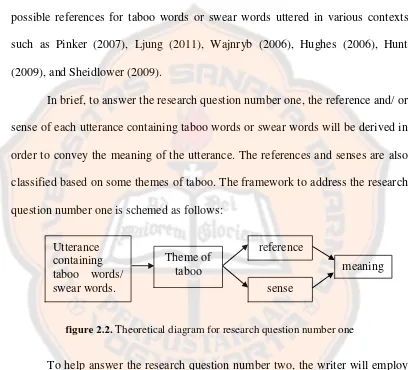
In brief, to answer the research question number one, the reference and/ or
sense of each utterance containing taboo words or swear words will be derived in
order to convey the meaning of the utterance. The references and senses are also
classified based on some themes of taboo. The framework to address the research
question number one is schemed as follows:
[image:47.595.102.512.187.557.2]war
figure 2.2. Theoretical diagram for research question number one
To help answer the research question number two, the writer will employ Austin‟s theoryto assert Pinker‟s typology. Austin (1955) states that one might do
something in and/ or by saying an utterance. Such utterance is called “performative”. Meanwhile, an utterance which does not bring any action (mere
saying) is called “constative” (p.54). To deal with the complexity of performative
utterance, speech act theory of Austin will come in handy. Austin draws three
distinction of speech acts i.e. locution, illocution, and perlocution. In brief Austin
explains that locution is an act of saying something, illocution is an act in saying Utterance
containing taboo words/ swear words.
reference
sense
meaning Theme of
something, and perlocution is the feeling, attitude, or act of the addressee as a
result of the utterance (p. 99). Austin emphasizes that the essential point of
performative utterance is on the illocution by which the locution is used to: asking
or answering a question, giving some information or an assurance or a warning,
announcing a verdict or an intention, pronouncing sentence, making an
appointment or an appeal or a criticism, making an identification or giving a
description, etc. Austin depicts the concrete of that context in three (famous)
examples: locution: He said to me „Shoot her!‟ meaning by „shoot‟ shoot and referring by „her‟ to her, illocution: He urged (or advised, ordered, etc.) me to
shoot her, perlocution: He persuaded me to shoot her (Austin, 1955, p. 101).
By the examples it is now clearer the difference between locution,
illocution, and perlocution. The focus of the three sentences is in the verb “shoot”. In locution the word „shoot‟ is merely uttered. In illocution the word „shoot‟ is
uttered to make the addressee do so which make it has illocutionary force. In perlocution the word „shoot‟ is uttered and then (whether intended or not) the
addressee determined to do so. Yet, as Saddock (2004) states, illocution is the central of Austin‟s innovation (p. 59) since by conveying the illocutionary force
within an utterance the act done by the utterance can be figured out. This is also
relevant to know whether each taboo word or swear word has illocutionary force
or not. Furthermore, by knowing the existence of the illocutionary force, it can
also be determined whether an utterance is performative or constative (Saddock,
In advance, to deal with the intention of an utterance, the illocution should
be made clearer to figure out what kind of act done in speaking. Searle (1976), as
an alternative taxonomy form Austin, proposes a theory which conveys the action
one commits with the utterances or is called the function of utterance. This
taxonomy is regarded as the basic of illocutionary act (p. 10). It is stated that there
are five basic kinds of action, namely representatives, directive, commissive,
expressive, and declarative. Representative act is the act of committing the
speaker to something which is being the case. Some examples of representative
act are stating, announcing, informing, suggesting, and so on. In the case of
directive act, the speaker gets the hearer (addressee) to do something. Directive
act involves commanding, requesting, asking, ordering, etc. Commissive act
means the act of committing the speaker to some future course of action such as
promising, offering, etc. Expressive act is the act of expressing the psychological
state of affairs specified in the propositional content. The examples are thanking,
apologizing, congratulating, welcoming, and so on. Meanwhile, declarative act,
linguistically speaking, is the act of bringing about the correspondence between
the propositional content and reality. The examples are declaring war, firing an
employee, baptizing, etc.
It is a little bit tricky to determine whether an utterance with taboo words
or swear words in it has an illocutionary force or not since Carlin often slips them
in sub-clauses some of which are merely examples of the possible utterances in
often utters illocution within a statement which is merely a locution. In solving
such case the felicity of the utterance should be checked by using Austin‟s criteria
of felicity. To be a felicitous an utterance must meet some rules i.e.:
(A.1) There must exist an accepted conventional procedure having a certain
conventional effect, that procedure to include the uttering of certain words
by certain persons in certain circumstances, and further,
(A.2) the particular persons and circumstances in a given case must be appropriate
for the invocation of the particular procedure invoked.
(B.1) The procedure must be executed by all participants both correctly and
(B.2.) completely.
(T.1.) Where, as often, the procedure is designed for use by persons having certain
thoughts of feelings. Or for the inauguration of certain consequential
conduct on the part of any participant, then a person participating in and so
invoking the procedure must in fact have those thoughts or feelings, and the
participants must intend so to conduct themselves, and further
(T.2) must actually so conduct themselves subsequently.
(Austin, 1955, pp.14-15)
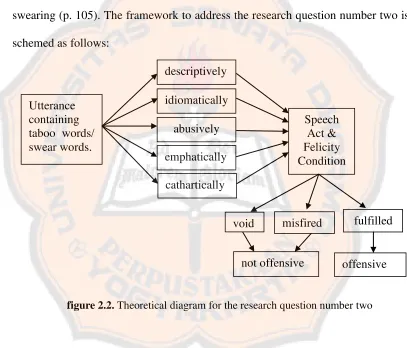
Rules A.1, A.2, B.1, and B.2 must be fulfilled in order to make the act
achieved. If one or more of the criteria is not fulfilled the sentence becomes
misfired (the act is not achieved). Then rules T.1 and T.2 determine whether the
utterance has effect or not. In the other word, the speaker must intend to do the
act. If the speaker does not really intend to do the act, the rules T.1 and T.2 are not
rules A.1 and A.2 are certain: Carlin is a comic who performs his monologue in a
comedy show (A.1) and the audiences are supposed to laugh as a response of Carlin‟s joke (A.2). One point worth noted in Austin‟s lecture about illocution is
that swearing (the act of evincing emotion) is claimed not to have an illocutionary
force. However what is meant by swearing here is peculiarly the cathartic
swearing (p. 105). The framework to address the research question number two is
schemed as follows:
[image:51.595.101.508.244.592.2]