Journal of Biological and Chemical Research
ISSN 0970-4973 (Print)
ISSN 2319-3077 (Online/Electronic)
(Published by Society for Advancement of Sciences®)
Volume 31 (2), July to December, 2014
List of Contents
Part C
S.No. 1. Tissue Specific Distribution of Esterases in Pomacealineata Order: Gastropoda. By P. Swapna, V. Vimala and T. Ravinder Reddy.
View|Download 998-1104
S.No. 2. Pesticide Residues in Vegetable and Fruit Samples from Andhra Pradesh, India. By A. Harinathareddy, N.B.L. Prasad and K. Lakshmi Devi.
View|Download 1005-1015
S.No. 3. Larval and Nectar Host Plants of Butterflies at Visakhapatnam, A.P., India. By D. SandhyaDeepika, J.B. Atluri and K. LaxmiSowmya.
View|Download 1016-1032
S.No. 4. Selection of Saccharomyces Spp Isolates (Isolation from Colon Beef of Bali Cattle) as Probiotics Agentand Colon Cancer Preventionandits Effect on Pollard Quality as Feed.
By I.G.N.G. Bidura, D.P.M.A. Candrawati and I.B.G. Partama. View|Download
1043-1047
S.No. 5. Pollard in Diet Supplemented with Yeast on Broiler Performance and Ammonia-N Concentration of Excreta.
By EnyPuspani, I. G. N. G. Bidura, D.P.M.A. Candrawati and I. G. A. IstriAryani. View|Download
1048-1055
S.No. 6. In Vitro Inhibitory Effect of the Hydro-Alcoholic Extract from the Avicennia marina (Hara) on Candida albicans.
By Mohamad Reza Havasian. View|Download
1056-1062
S.No. 7. Assessment of Lead Toxicity Awareness among Battery Charging Garage Workers of Jimma Town, Southwest, Ethiopia.
By GirmaSelaleGeleta and BekaAlemu. View|Download
S.No. 8. Impact of Salinity on Enzyme Activities in Calcareous Soils of Uzbekistan. By YulduzErgasheva and DilfuzaEgamberdieva.
View|Download 1072-1077
S.No. 9. Diversity and Relative Abundance of Freshwater Cladocera (Crustacea: Branchiopoda) in Manmade Ponds at Boye Wetland, Jimma Zone, Southwestern Ethiopia. By SeyoumKiros, K.K subash and EbaAlemayehu.
View|Download 1078-1092
S.No. 10. Effect of Different Weed Control Practices on Growth and Yield of Sesame in South-West Nigeria.
By Ajibola, A.T., Modupeola, T.O. and Adenuga, A.A.. View|Download
1093-1100
S.No. 11. Micropropagation of Dioscoreaalata L. (Yam) from Shoot-Tip and Nodal Explants.
By FikruMosisa and BalchaAbera. View|Download
1101-1116
S.No. 12. The Impact of Tillage and Crop Rotation on Yield and Soil Quality under Arid Soil Conditions.
By BotirKhaitov, KholikAllanov, BakhromIzbosarov, JonibekKhudaykulov, BakhromAzizov, TulkinNematov and OybekSattorov.
View|Download 1117-1126
S.No. 13. Detection of Heavy Metals Absorbed by Water Hyacinth Growing in Godavari River near Saikheda.
By ShilpaSangle and S.S. Ghumare. View|Download
1127-1129
S.No. 14. Isolation of Natural Acid Base Indicator from Bougainvillea spectabills [Wild] Flower Bracts.
By More Rekha and S.S. Ghumare. View|Download
1130-1134
S.No. 15. Monitoring of Resistance to Organophosphorus and Pyrethroides Insecticides against Pink Bollworm Pectinophoragossypiell (Saund.) During 2012 and 2013 Seasons. By M.K. El-Hadek.
S.No. 16. Potency Lignocellulose Degrading Bacteria Isolated from Bali Cattle Rumen Content Waste and Termites as Nonconventional Waste Degrader.
By Partama, I. B. G., I M. Mudita, N. W. Siti, I W. Suberata, and A.A.A. S. Trisnadewi.
View|Download 1143-1149
S.No. 17. Effects of Probiotics in Poultry Production: A Review of In Vitro Findings. By EstifanosHawaz.
View|Download 1150-1161
S.No. 18. Isolation and Characterization of Phosphate Solubilising and Growth Promoting Bacteria Isolated from Soil of Bihar.
By Amardip Singh, Poonam and A. K. Ghosh. View|Download
1162-1172
S.No. 19. Comparative Evaluation of Oxidative Stress Indices in Albino Rats Administered Aqueous, Ethanol and Methanol Extracts of Moringaoleifera leaves and Seeds Locally Grown in Abakaliki, Nigeria.
By P.M. Aja. View|Download 1173-1186
S.No. 20. A Long Term High Fat Diet/Low Dose Streptozotocin Develops a Type 2 Diabetic Rat Model Showing Clinical Presentation and Pathophysiology of Natural History of Diabetes.
By SohailShaukat and Rahman M. Hafizur. View|Download
1187-1204
S.No. 21. Air Pollution Tolerance Index of Some Seasonal Crops Growing in Different Industrial Areas of Dhar District (M.P.), India.
By Aarti Chauhan, Iqbal Sanjeeda and BafnaAngoorbala. View|Download
1205-1227
S.No. 22. Sources of Soil Enzymes. By Hamid Kheyrodin.
View|Download 1128-1235
S.No. 23. Study of Plant Tissue Culture Technology. By Hamid Kheyrodin and SadafKheyrodin. View|Download
1236-1244
Selection
of
SaccharomycesSpp
Isolates(Isolation
fromColon Beef of BaliCattle) as
ProbioticsAgentandColonCancerPreventionandIt
s Effect on Pollard Quality as Feed
By
I.G.N.G. Bidura, D.P.M.A. Candrawati and I.B.G. Partama
ISSN 0970-4973 (Print)
ISSN 2319-3077 (Online/Electronic)
Index Copernicus International Value
IC Value of Journal 4.21 (Poland, Europe) (2012) Global Impact factor of Journal: 0.587 (2012)
Scientific Journals Impact Factor: 2.597
J. Biol. Chem. Research
Volume 31 (2) 2014 Pages No.
Journal of
Biological and
Chemical Research
(An International Journal of Life Sciences and Chemistry)
Indexed, Abstracted and Cited: Index Copernicus International (Europe), Universal Impact Factor, Polish Ministry of Science and Higher Education (Poland, Europe) Research Bible (Japan), Scientific Journals Impact Factor Master List, Directory of Research Journals Indexing (DRJI),Indian Science. In, Database Electronic Journals Library (Germany), Open J-Gate, Google Scholar, CAS, J Gate e-Journal Portal, Info Base Index, International Impact Factor Services (IIFS) (Singapore), International Institute of Organized Research (I2OR) and Eye Source
Published by Society for Advancement of Sciences®
Selection
of
SaccharomycesSpp
Isolates(Isolation
fromColon Beef of BaliCattle) as
ProbioticsAgentandColonCancerPreventionandIt
s Effect on Pollard Quality as Feed
By
I.G.N.G. Bidura, D.P.M.A. Candrawati and I.B.G. Partama
ISSN 0970-4973 (Print)
ISSN 2319-3077 (Online/Electronic)
Index Copernicus International Value
IC Value of Journal 4.21 (Poland, Europe) (2012) Global Impact factor of Journal: 0.587 (2012)
Scientific Journals Impact Factor: 2.597
J. Biol. Chem. Research
Volume 31 (2) 2014 Pages No.
Journal of
Biological and
Chemical Research
(An International Journal of Life Sciences and Chemistry)
Indexed, Abstracted and Cited: Index Copernicus International (Europe), Universal Impact Factor, Polish Ministry of Science and Higher Education (Poland, Europe) Research Bible (Japan), Scientific Journals Impact Factor Master List, Directory of Research Journals Indexing (DRJI),Indian Science. In, Database Electronic Journals Library (Germany), Open J-Gate, Google Scholar, CAS, J Gate e-Journal Portal, Info Base Index, International Impact Factor Services (IIFS) (Singapore), International Institute of Organized Research (I2OR) and Eye Source
Published by Society for Advancement of Sciences®
Selection
of
SaccharomycesSpp
Isolates(Isolation
fromColon Beef of BaliCattle) as
ProbioticsAgentandColonCancerPreventionandIt
s Effect on Pollard Quality as Feed
By
I.G.N.G. Bidura, D.P.M.A. Candrawati and I.B.G. Partama
ISSN 0970-4973 (Print)
ISSN 2319-3077 (Online/Electronic)
Index Copernicus International Value
IC Value of Journal 4.21 (Poland, Europe) (2012) Global Impact factor of Journal: 0.587 (2012)
Scientific Journals Impact Factor: 2.597
J. Biol. Chem. Research
Volume 31 (2) 2014 Pages No.
Journal of
Biological and
Chemical Research
(An International Journal of Life Sciences and Chemistry)
Indexed, Abstracted and Cited: Index Copernicus International (Europe), Universal Impact Factor, Polish Ministry of Science and Higher Education (Poland, Europe) Research Bible (Japan), Scientific Journals Impact Factor Master List, Directory of Research Journals Indexing (DRJI),Indian Science. In, Database Electronic Journals Library (Germany), Open J-Gate, Google Scholar, CAS, J Gate e-Journal Portal, Info Base Index, International Impact Factor Services (IIFS) (Singapore), International Institute of Organized Research (I2OR) and Eye Source
J. Biol. Chem. Research. Vol. 31, No. 2: 2014
An International Journal of Life Sciences and Chemistry
Ms 31/2/28/2014, All rights reserved
ISSN 0970-4973 Print
ISSN 2319-3077 Online/Electronic
I.G.N.G. Bidura http://www.jbcr.in [email protected]
RESEARCH PAPER Received: 27/04/2014 Revised: //2014 Accepted: //2014
Selection of
Saccharomyces Spp
Isolates
(Isolation fromColon Beef of BaliCattle) as
Probiotics Agentand Colon Cancer
Preventionandits Effect on Pollard Quality as
Feed
I.G.N.G. Bidura, D.P.M.A. Candrawati and I.B.G. Partama
Faculty of Animal Science, Udayana University, Denpasar-Bali, Indonesia
ABSTRACT
This experiment was carried out to study probiotics properties and colon cancer prevention of Saccharomyces spp isolation from colon beef of Bali cattle samples can be used to alleviate the negative effect of pollard as feed. Three isolates of Saccharomyces spp (Sc.SB-3; SB-6; and SB-7) were isolated from colon beef of Bali cattle samples in the first experiment. The whole isolate of Saccharomuces spp showed resistant growth in different temperature (100-450C) andacid conditions (2.5-4.5).However, only two isolates (Sc.SB-6 and SB-7) had potential as probiotics sources (resistant on both acid and bile salt, and couldprevent colon cancer). The study showed that fermentation of pollard using of Saccharomyces spp.SB-6 and SB-7 culture could improve significant differences (P<0.05) on digestibility of its dry matter (DM), organic matter (OM), crude protein (CP), crude fibre (CF), and increased its metabolizable energy of pollard. Fermentation caused increase of crude protein (CP) and crude fibre (CF) of pollard.It was concluded that two isolates (Sc.SB-6 and SB-7) were isolated from colon beef of Bali cattle samples.They were potential as probiotics sources and colon cancer prevention.Their utilization in pollardfermentation could increase nutrient composition and digestibilities.
Key words: Saccharomyces spp., Colon Cancer, Probiotics, Digestibility and Pollard.
INTRODUCTION
Probiotics as single culture or mixed of live microbes that when consumed by human or animals will be maintaining balance of microflora, naturally present in the body of its host (Havenaar and Huis, 1992). Probiotics are often associated with gastrointestinal health, as it can help suppress the growth of harmful bacteria (Hegar, 2007).
Generally,probioticsis group of non pathogen microorganisms that have positive effect on physiology and health ofgastrointestinal tractofits hostif regularly consumed in sufficient quantities (Schrezenmeir and DeVrese, 2001). In the digestive tract, probiotic groups able to decipher toxic compounds derived from protein and fat metabolism. In that case, concentration of toxic compound scan be reducedor even eliminated (Alimyameen, 2011).
Tests conducted to assess potential microbial probiotics could be developed such as: resistance tolow pH, bileacids, anddigestivetractenzymes(Ahmad, 2005). Besides, abilityto transformcholicacid(CA) to deoxicholicacid(DCA) alsorequired to betested in vitroto know whether can didate probiotics could stimulate the occurrence of colon cancer or not (Ariwati, 2012).
Bacterial metabolismof bile acidshas an important roleincoloncancer risk. It is assumed that the secondary bile acids (produced by microbial metabolism) could be the promoter of colon cancerin formation process. The process of dehydrogenation of steroid nucleus in generating bonddelta 1 and delta 4 bind to 3-keto grouphasan important role related to colon cancer. Certain strains of Clostridia in vitro are known to form this reaction (Wahyudi and Hendraningsih, 2007).
Probiotic group showed functional effects, such as anti diarrheal effects, lowering blood cholesterol, improve bowel motility and detoxification, inducing immune system, resulting a wide variety ofmetabolites, such as:hydrogenperoxide, lacticacidandaceticacid. They were able to maintain a balance pH and microecology intestineand assist metabolize vitamins, minerals and hormones. In addition, probiotics also acts asan antitumoragentby preventing formationof carcinogenicnitrosamines(Tjay andKirana, 2007).
Pollard is a by-product of wheat milling industry which is abundantly available during harvesting. This by-product unfortunately contains toxic factors as of: trypsin inhibitor, lectin, phytic acid as phytate, and high content of crude fiber. These anti-nutritive factors reported by Kahlique et al. (2003) caused reduction of feed intake and depress performance of poultry. The potency of pollard as poultry energy source depends on its cell wall content, degree of microbial fermentation in poultry large intestine, absorption and production of the volatile fatty acids (Wanget al.,2003).
Hong et al. (2004) and Bidura et al. (2012) reported that fermentation of feed using khamir increased digestibility of its dry matter (DM), organic matter (OM), and crude fiber (CP). The inclusion of soluble dietary fiber (wheat bran) increased daily NSP excreted from feces (Wang et al., 2004; Jaelani et al., 2008; Suprapti et al., 2008). Chen et al. (2005) reported that addition of 0.20% complex probiotic (L. acidophilusandS. cerivisae) in basal diets increased digestiblity of DM and CP.Related studies clearly conveyed that supplemented probiotics to diets in NSP results in significant reduction in the intestinal viscosity, enhances energy, and protein utilization (Bidura et al., 2012; Bidura et al., 2009).
It is suggested to study on probiotics properties and colon cancer prevention of
Saccharomyces spp isolation from colon beef of Bali cattle samples in order to alleviate the negative effect of pollard as feed.
MATERIAL AND METHODS
Source ofisolates/Contentsof Colon
Source of isolatesin this studyis excreta colon beefof Bali cattle obtained from abattoir (slaughter house) in Denpasar, Bali.
Media PDA (potato-dextrose-agar)
Oneliterof PDAweighed 39.4ginstant, added1000 ml distilled water, homogenizedby heating andsterilizedat 1210Cautocalvefor 15minutes temperature., The mediawas poured into petridishes and storedat 4°C temperatures inan ice cupboard after expelled from auto calve.
Isolation ofSaccharomyces spp
Khamir probiotic candidates were isolated using method followed by dilution and growth on Potato Dextrose Agar medium (PDA). In this research, colon beef of Bali cattle excreta samples were purchased from RPH Denpasar. 10 g of colon excreta beef added to 90 ml of 1% peptone which previously sterilized to obtain the level of dilution of 10-1, shaked until homogeneous and taken as 1 ml for further diluted in 1% peptone solution seriesto obtain dilution rate of 10-2- 10-6. Moreover, 1 ml suspension of dilution 10-4,10-5, and 10
-6inserted into sterile petri dish, added 20 ml of PDA medium between 40 - 450C , set
andincubated in the incubator inverted position of 300C for 48 hours, and then observed growth of colony. Nikon (2004) and Ahmad (2005) reported that colonies which have khamir characteristics isolated within following the method: purified and cultured on PDA solid medium for further analysis; stored prior to characterization; testing its resistance to low pH, deoxicholic acid and cholic acid into transpormation deoksikolat acid (Hyronimus
et al., 2000; Prangdimurti, 2001).
Probiotics properties
The initial bacterial concentration was 106-8cfu/ml. Culture was incubated at 370C. After 0; 0.5; 1; 2; and 4 hours incubation, cell were serially diluted tenfold in 0.1 M sodium phosphate buffer (pH 7.2), and viable cells enumerated on MRSagarplate at 370C for 2 days.
Bile resistance: The resistance to bile was examined according to method of Hyronimus
et al. (2000). Each strain was inoculated in MRS broth with 0.5 or 1% (w/v) bile salt (Difco). Culture was incubated at 370C for 24 hours, and numbers of viable cell were determined and compared to a control (without bile salt) on MRSagarplates.
Termsof khamirtobe developedas probioticwereresistant tobilesalts. Firstly,
Kamirisolatesweregrownfromthe manufacturedivortexworkingculture.Secondly,put4
pieces oftubes containing 5m Lin each mediaof PDB.50mL of suspensionkamirwas added in each tube. Firsttubeas a controlwas notaddedwith sodiumDeoksikolat(NaDC). The second tube was addedwith 10mLof 100 mMNaDC(NaDC concentration of0.2mM). Third tube was added with 20mLof 100mMNaDC(NaDC concentration of0.4mM). Fourth tube was added with 30mLof 100mMNaDC(NaDC concentration of0.6mM).Then,the whole
tubes were incubatedat 37°C for 24hours.
Khamir isolates resilience against NaDC measured by turbidity(OD 660nm) using aspectrophotometer. In order to obtain representative data then 3 time sreplication was conducted(Hyronimusetal., 2000 andPrangdimurti, 2001).
Test of Cholic Acid Transformed into Dioxicholic Acid
This test was conducted to determine whether cholic acid transformed into deoxicholic acid by isolates obtained in this study. Pure cultures isolated khamir from colon beef of Bali cattle suspension derivedfrom glycerol stock by suspending 50 mL culture into 5 ml of PDB and incubated at 370C for 24 hours. Then, 50 mL of cultures grown in PDB suspended in 5 ml of GDP plus Ca and incubated at 370C for 24 hours. Subsequently, 1 ml of culture in Ca pipetted into Eppendorf centrifuged for 5 minutes at 5000 rpm.A total of 0.1 ml of the supernatant was then pipetted, added with 500 mL ethyl acetate and 20 mL HCL, centrifuged for 5 minutes at 5000 rpm, supernatant pipetted and evaporated, added with 500 mL ethyl acetate, centrifuged for 5 minutes at 5000 rpm, supernatant pipetted and evaporated for 48 hours in room temperature, add with15 mL methanol. 10 ml Cyclohexane, Ethyl Acetate 15 mL and 4 mL Acetic Acid mixed in the Chamber, and allowed to stand for 30 minutes prior to TLC on alluminium cilica gel. After 30 minutes, DCA, Ca, and each 1 mL isolatesplattered on aluminum silica gel, dried with hairdrayerplaced in the chamber containing eluent solution, allowed to stand until the silica absorbed solution, dried, sprayed with acid dyes Phosporic Molibddo and roasted until the spot of each isolate was visible on silica gel. If isolates transformed CA into DCA then isolated will be similar to spot with DCA spot, otherwise if DCA transformation isolated the spot will be similar to CA spot (Ariwati, 2012).
Fermentation of Pollard
The study was carried out at Bioscience Laboratory of Udayana University, Bali, Indonesia. Fermented commercial pollardwas prepared as follows:approximately 0.40% (2.56 x 10⁶ spores)Saccharomyces spp.SB-6 and SB-7 isolates culture, respectively added to 100 g of steamed pollard. Then, water added to bring the product to 50% content and leave out for three days fermentation. After that, fermented pollardwas dried at 450C for six hours was analyzed. Unfermented pollard was also also conducted for its chemical analysis.
Retention and Excretion of Nutrients
In order to determine nutrient digestibility and metabolizable energy (ME) value of the pollard, twenty weeks old male native chickens were used in this study. All birds were deprived of feed for 24 hours to ensure that their alimentary canals were empty from feed residues. Then, they were force-fed with specific amount of pollard (fermented and unfermented). Stainless steel funnel with 40 cm stem was used inforce feedingtechnique
(Mustafaet al., 2004). The amount of pollard used was 40 g based on preliminary assays. The birds were kept over excreta collection trays and their housing time was recorded. Excreta voided from 0 to 24 hours and 24 to 48 hours (which represent metabolic plus endogenus excretion) after housing were collected quantitatively. Water was availablead libitum during the experimental period. Excreta were collected for two hours. Other substances (such as feathers, scurf, etc.) in the collected excreta were removed before drying at 600C for 48 hours and subsequent grinding. Feed and feces were analyzed by AOAC (l994) procedures for proximate components. The retention of nutrients was calculated by dividing the amount of retained nutrient (ingested nutrient minus excreted nutrient) by the amount of ingested. Gross Energy (GE) was measured with an adiabatic oxygen bomb calorimeter (Parr, USA), Crude Fibre (CF) was analysed according to Van Soest (1991).
The total excreta were collected in plastic trays. The excreta samples were frozen, allowed to equilibrium with the atmospheric moisture, weighed, and ground through one mm sieve. Samples of excreta and pollard were subjected to appropriate analysis to determine DM, OM, CP, CF, and gross energy.
Measurements
Feed intake was determined by measuring feed residues on daily basis since the beginning of the experiment. Apparent metabolizable energy (AME) was calculated using the formula of Mustafaet al. (2004): AME = IE FE, where IE = ingested energy and FE = fecal energy of the fed birds;
Dataanalysis
Analysis ofthe dataforthe endurance testisolateskamirtolow pH and
thesodiumdeoxicholic(NaDC) andcholic acid transformationtest performed with
sourdeoxicholic descriptive method. In order todeterminewhetheraculturecan
RESULTS
Figure 5.1belowis themorphology oftwoisolates ofSaccharomycessppthat can be isolatedfromcolonof beef Bali cattle. Thesecond cellweremicroscopicisolatesare the same,butthe color ofthecolonytwodifferentstrains, i.e.isolates ofSaccharomycessppSB-6 translucent whitecolorandSaccharomycessppisolatesSB-7 color is clear, so it is consideredtwoyeaststrainsaredifferent.
Figure1. MorphologyofSaccharomyces sppisolate with a magnification of400x
ResilienceisolateSaccharomycesspp.thelow pHis one ofthe characteristics requiredmetby acandidateor aprobioticthatcould be developed intoa potentialprobiotic. Onthistest, the
mediumpHwas adjusted to1.5;3.0; 4.5; and 6.0by usingHCl(hydrochloric acid),
becauseHClhascharacteristics similar tostomach acid. Resistant to highly acidicnature needs to be ownedby thecandidateprobiotic, becausetheapplicationlater, this probiotic can did ate mus passveryacidicstomachconditions, beforereachingthe colon.
Observationsas presentedin Table 1. In this study,as many asthreeisolatesSaccharomyce sspp. isolated from colon of beef Bali cattle sampleswas testedresistance tovariouspH, at pH1.5,3.0, 4.5, and 6. Sixisolates wereunable to growat pH1.5, whichisolatesthe 1; SB-2; SB-4; SB-5; SB-8; and SB-9.Saccharomycesspp.1, 4; 5, and SB-8isolatesevensimply could notgrow atallpHtreatmentsgiven. Onlythreeisolateswereable togrow well, namelySaccharomycesspp.SB-3, SB-6, and SB-7 isolates. There is atendency ofthe higherpH, especiallyat pH6, most of theisolateshas decreasedthenumber ofcolonylife.
Table 1.The number of colony isolatesSaccharomyces spp(Log colony/g) at various pH.
Code Isolate pH
1.5 3.0 4.5 6.0
Saccharomyces spp.SB1 - - -
-Saccharomyces spp.SB2 - + + +
Saccharomyces spp.SB3 3.45 4.53 4.11 3.13
Saccharomyces spp.SB4 - - -
-Saccharomyces spp.SB5 - - -
-Saccharomyces spp.SB6 4.06 4.71 4.58 4.29
Saccharomyces spp.SB7 4.13 4.65 4.51 4.27
Saccharomyces spp.SB8 - - -
-Saccharomyces spp.SB9 - - + +
In the testof resistance tobilesaltsas showedin Table2shows, threeisolates wereable to
surviveandgrowon amedium containingbilesaltsboth atconcentrations
of0.2mMand0.4mM, whereasat a concentration of0.6mMnoisolatescansurvive.
Microbialisolatesresistancetobilesaltsis usedtoassess theability tosurvivedigestive tractisolatescontainedbilesaltsonthesurface of theintestine.
Table2. Ability ofyeastSaccharomycessppisolateswereresistantlivinginbilesalts.
Isolate Bilesaltconcentration(absorbance)
0.0 mM 0.2 mM 0.4 mM 0.6 mM
Saccharomyces spp.SB3 ++(0.698) +(0.317) +(0.245) +(0.217)
Saccharomyces spp.SB6 +++(1.661) +++ (1.629) +++ (1.140) +++(1.096)
Saccharomyces spp.SB7 +++(1.325) +++ (1.198) +++ (1.219) +++(1.296)
Description:
- : A<0.1 (not bear bilesalt) + : A0.1-0.5(abilesalt-resistant) ++ : A0.5-1.0(bile salt-resistant) +++ : A>1.0(highly resistantof bilesalts)
SB-3s/dSB-7is aSaccharomycessppisolateswereisolatedfromcolon of beef Bali cattle
Probioticswill bedealingwiththe environmentin thesmall intestine, in which there
werebileorbilesaltsareremovedby the liverthroughthe gall bladder,
aftersuccessfullypassingthe acidic conditionsinthe stomach. Therefore, in the process ofdevelopingnew probiotic, or anewprobioticcandidatemust beable to pass thetest ofresistance tobileorbilesaltswereperformed in vitro. Based on thenature of theresistanceshown bysomeisolates, strain SB-6 and SB-7 indicates thatthestrainhas the potentialtobe developed into apotentialprobiotics.
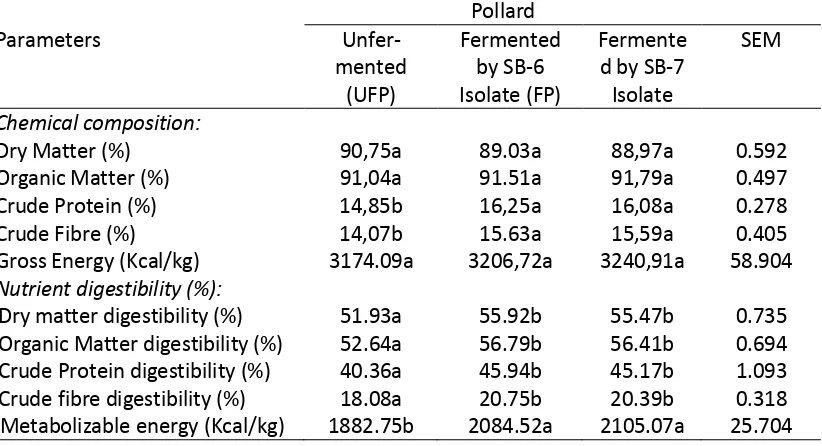
Chemical composition and nutrient digestibility of pollard (fermented compared to the unfermented) were shown in Table 3 as below
Table 3. Chemical composition and nutrient digestibility of unfermented and fermented pollardbySaccharomyces Spp.SB-6 and SB-7 isolates culture (in % Dry Matter).
Pollard Parameters Unfer-mented (UFP) Fermented by SB-6 Isolate (FP) Fermente d by SB-7 Isolate
SEM
Chemical composition:
Dry Matter (%) 90,75a 89.03a 88,97a 0.592
Organic Matter (%) 91,04a 91.51a 91,79a 0.497
Crude Protein (%) 14,85b 16,25a 16,08a 0.278
Crude Fibre (%) 14,07b 15.63a 15,59a 0.405
Gross Energy (Kcal/kg) 3174.09a 3206,72a 3240,91a 58.904
Nutrient digestibility (%):
Dry matter digestibility (%) 51.93a 55.92b 55.47b 0.735
Organic Matter digestibility (%) 52.64a 56.79b 56.41b 0.694
Crude Protein digestibility (%) 40.36a 45.94b 45.17b 1.093
Crude fibre digestibility (%) 18.08a 20.75b 20.39b 0.318
Note:
UFP = Unfermented pollard; FP = Fermented pollard by 0.20% yeast culture
SEM = standart error of the treatment means
The different superscript at the same row is significantly different (P<0.05)
Table 3 showed that nutrient in the content of crude protein, crude fibre (CF), and gross energy were slightly increased by fermentation. In contrast, fermentation caused decreasing dry matter (DM) and organic Matter (OM) of the pollard. The result indicated that all of nutrient digestibility of pollard fermented bySaccharomyces sppisolates culture were increased significantly (P<0,05) different rather than unfermented pollard.
Table 3 shows the nutrient digestibility and metabolizable energy of unfermented pollard (UFP) and fermented pollard (FP) ingredient. The digestibility of crude protein, organic matter, and crude fiber, were slightly increased significantly different (P<0.05) by the fermentation, both bySaccharomyces spp.SB-6 and SB-7, respectively. The metabolizable energy of FP was increased significantly different (P<005) than metabolizable energy of UFP. Fermented of feeding ingredient were caused increased of crude protein, organic matter, and crude fibre digestibilities, resvectively than UFP ingredients.
DISCUSSION
Actually, this probiotic yeast already present in the human digestive tract or other animals, such as beef Bali cattle colon to help suppress microbial populations gastrointestinal pathogens (Alimyameen 2011). Microbes can be developed into a candidate probiotic microbes if they meet the following requirements: (i) these microbes are pathogenic to animals and humans; (ii) is a microbial flora of the gastrointestinal tract and have the ability to colonize the intestinal wall; (iii) the microbes resistant to stomach acids, bile acids and salts, digestive enzymes, immune system, animal or human; and (iv) does not transform deoxy cholic acid into cholic acid, so that no potential to induce colon cancer (Fuller, 1989).
The degree ofacidity(pH) of the ventriculusand proventriculusranged from1-2, so theonlyacid-resistant microbesthatcanliveonlyinthispartofthe digestivetractof poultry. Microfloraandthe interactionbetweenthe types ofdifferent microorganismsinthe digestive tractof poultryis verycomplex(Sabinietal., 2000). The yeastSaccharomycessppSB-6 andSB-7 turned out to beresistant topHextrimsso thatpotential asprobioticagents.
Probioticswill be dealingwith theenvironmentof the small intestinein which there is bile or bilesaltsareremovedby the livervia thegall bladder, aftersuccessfullypassingthe acidic conditionsinthe stomach. Therefore, in the process o developing new probiotic, new probiotic can did ate must be able to pass thetest ofresistance tobilesalts. Inthistest, the
candidate probioticGYPincubatedin medium supplemented withNaDCat various
concentrations(0.2; 04, and 0.6mM). The concentrationin a rowisNaDCconcentrationin normal individuals, candidate scancer patients, andcancer patients, respectively (Dawson, 1998).
To three isolates showed resistance to acid and bile salts that is characteristic of probiotic bacteria.Saccharomycesis a unicellular microorganisms lacking chlorophyll, grew well at 30oC and pH 4.8. pH value in the gastrointestinal tract of poultry in each section, are: crop (4.5), proventriculus (4.4), gizzard (2.6), duodenum (5.7-6.0), jejunum (5.8), ileum (6.3), colon (6.3), and ceca (5.7) (Hidayat, 2010). According to Ahmad (2005), temperature optimum environment for yeast growth is 25-300C and a maximum temperature of 35-470C. Some advantagesSaccharomycesmicroorganisms in the fermentation process that is rapidly proliferating, resistant to high alcohol content, resistant to high temperatures, has held steady and rapid nature of the adaptation.
Cholesterol is a precursor of primary bile salt formed in the liver and stored in the form of conjugated bile salts in primary gallbladder henceforth gradually secreted into the digestive tract. In the digestive tract (especially in the small intestine), conjugated bile salts will be instrumental in helping the absorption of fat, kolesteol, hydrophobic vitamins, and other components that are soluble in fat. The conjugated bile salt are absorbed from the small intestine and is passed by circulation system (hepatic portal system) to the liver (the liver to be returned). Only a small fraction of bile salts (250-400 mg) that is not absorbed will be wasted in the feces in the form of free bile salts (Corzo and Gilliland, 1999). In the form of free bile salts, the products of the liver is less soluble in water and less able to be absorbed by the intestinal lumen (absorbality is lower than in conjugated form), so that bile acids can push conjugated decrease serum cholesterol by increasing the formation of new bile acids to replace lost during enterohepatic circulation or by decreasing cholesterol absorption in the intestinal lumen.
Figure2. Chromatogramtest resultsbiotransformationof cholicacidinto
aciddeoxicholicinSaccharomycessppisolates. SB-6 andSB-7 isolated fromcolonbeef of Bali cattle.
DCA
One important test that s hould beperformedbeforeaspecies ofmicrobes(bacteria orkhamir) canbe developed intoprobioticsis thebiotransformation ofcholic acidinto atestdeoxicholicacid. Candidateprobioticsshould not bedoingthe biotransformationof cholicacidintodeoxicholicacidsinthe digestive tractof its host, becausecholicacid derivativeissuspectedas one of the compounds that may stimulate the on set of colon cancer(Brady etal., 2000;Pato, 2003;Liong, 2008). Therefore, althoughaspecies of probiotics showo ther potential properties, this species will not be usedas aprobiotic can didateifthe speciesdobio transformation of cholicacidinto aciddeoksikolat.
In this study,two isolates ofSaccharomyces spp.probiotics that have passed the test(test temperature, pH, and bile salts) as well asisolatesthatshowedgrowthresponse(resistance) inenvironments containingNaDCtested for their abilitytotransformation cholicacid(CA) to Deoxicholicacid(DCA). The result of this test (chromatograms) is shown inFigure2. Chromatogramin figure2, indicating that thetwoisolatestesteddidbiotranspormationCA toDCA, whichis not indicatedby the formation of spots(black spots) on theretention time(Rt) isthe same as the standard deoxicholic(DCA).
Figure2, indicating that both isolates khamir(Saccharomyces spp. SB-6 andSB-7) were isolated from the colon of beef Bali cattle likely tobe developed intoprobiotics, because ofall there quirements that were testedin this study can be metbyall isolates tested.In the digestivetractof poultry, biotransformation ofcholicacidintodeoxicholicacidis generally carried outbythe groupand the Clostridiumbacterium.Clostridiumscindenshiranois(Wells
etal.,2003). The bacteriumhasa set of genes that produce enzymes capable7-alfa-dehydroxilase. This enzymeis thought to workto break the tieshydroxycompoundsof cholicacid(Sujayaetal., 2008).
Table 3 shows the nutrient the content of crude protein, crude fibre (CF), and gross energy were slightly increased by fermentation. On the other hand fermentation caused decreasing dry matter (DM) and organic Matter (OM) of the pollard. These results indicated that carbohydrate was used for microbial growth and the reduction of dry matter. The result indicated that all of nutrient digestibility of fermented rice bran by
Saccharomyces spp culture were increased significantly (P<0,05) different rather than unfermented rice bran.
Table 3 shows the chemical composition of unfermented pollard (UFP) and fermented pollard (FP) ingredient. Fermentation feed purpose is to improve the usability of feed and elimination of anti- nutritional substances, as well as utilize biomass formed. Pollard fermented with yeast will be able to increase the microbial biomass, so that the crude protein content of pollard increased (Utamaet al.,2006). Pollard nutrient content, such ascrude protein, organic matter, crude fibre, and metabolizable energy were slightly increased by Saccharomyces spp.SB-6 and SB-7 isolates fermentation, resvectively. The increase in ME content ofpalm kernel cake(palm kernelcake/meal) asa result offermentationby thefungusT.reeseiof1824.13kcal/kg to1930.44kcal/kgsuspected
because of the degradation of mannanpolysaccharidesexist in palm kernelby
fungusT.reeseiintosimpler forms(monosaccharides) that producesenough energy value better than in the form ofpolysaccharidesmannan (Jaelani et al., 2008). Fermentedpalm kernel cakecan markedly increasethe crude protein contentcompared topalm kernel cake with out fermentation.
Thefungus of T.reeseiis able tode grade a polysaccharidemannanmannotriosa,
longer the storage timeof feed ingredientswhenfermented byTrichodermaviride, the more theloss ofdry matterand organic matter material, insteadincreasingthe crude protein contentand materials decreased crude fiber content material. Also reported that the longer the fermentation processor material sstorage time, the increased dry matter digestibility and organic matter materials. Suparjo et al. (2003) reported that fermentation of rice bran with 0.20%Aspergillus nigercultured for 72 hours can markedly increase protein and phosphorus content of rice bran, on the contrary lower crude fiber content and acid phytat rice bran.
The digestibility of crude protein, crude fiber, and ME were slightly increased by the fermentation. These results indicated that carbohydrates other than fibres were used for microbial growth (Saccharomyces spp) and the reduction of nitrogen free extract resulted in increased concentration of the other components. Yi et al. (l996) reported that supplementation of microbial in diets improved Nitrogen retention in broiler chickens and
in vitrodigestibility of vegetable protein. Also, Chenet al.(2005) reported that addition of 0.20% complex probiotic (L.acidophilus and S.cerivisae) in basal diets were inceased digestiblities of dry matter.
Fermented of pollard by Saccharomuces spp.SB-6andSB-7isolates culture had better digestibility, because Saccharomuces spp culture in the gastro intestinal tract can to be part of probiotic sources. Supplementation of probiotic could improve protein and energy retention in the gastro intestinal tract of the birds (Piao et al.,l999). Chenet al.
(2005) reported that dietary supplementation of complex probiotic slightly improved digestibility of nutrients. Also, Piao et al. (l999), suggested that probiotics in the gastro intestinal tract can improve protein and energy retention on the body of birds. These fungal are effective in degrading of the complex compounds such as beta-glucans and arabinoxylans (Bedford and Classen, 1992). Cho et al. (2007) reported that supplementation of microbe in diet could improve the bioavailability of dietary.Theyeast
Saccharomyces spp is yeast capable of producing the enzymes amylase and selulolase (Utama, 2011), so as to increase the digestibility of protein and crude fiber such as cellulose and hemicellulose, as has been over hauledin the form ofa simple monosaccharide.Cellulolytic yeasts capable of producing the enzyme 1,4 beta-endo-glukonase, 1,4beta-exo beta-endo-glukonase, andbeta-glucosidase that can de grade components of crude fiber into soluble carbohydrates(Howardetal., 2003)
Wang et al. (2004) reported that the inclusion of fiber sources such as wheat bran or potato starch reduced the maintenance of energy requirement. These fungi are effective in degrading complex compounds such as beta-glucans and arabinoxylans (Dubey, 2006). The high level of non-starch polysaccharides (NSP) in pollard is limiting its unrestricted use in poultry feeding. The NSP is known increasing the gut viscosity, reduce nutrient absorption in the intestine and affect indirectly the growth and performance of bird (Rhameset al., 2006; Choet al., 2007).
fermentation in the large intestine improves the bioavailability of dietary. Chen et al.
(2005) reported that dietary supplementation of complex probiotic slightly improved digestibility of nutrients. Inconsistent reports about the effect of probiotics may be due to several aspects such as strains of bacteria, dose level, diet composition, feeding strategy, feed form, and interaction with other dietary feed additives (Chesson, 1994).
Supplementation of microbial in diets improved N retention in broiler chickens and in vitrodigestibility of vegetable protein. Besides, Chenet al.(2005) reported that addition of 0.20% complex probiotic (L. acidophilus and S. cerivisae) in basal diets increased digestiblity of DM and CP (Chenet al., 2005; Yiet al., 1996; and Honget al., 2004). The inclusion of soluble dietary fiber (wheat bran) increased daily NSP excreted from feces (Wang et al., 2004; Suprapti et al., 2008), increased in both metabolizable energy and crude protein contents of palm kornel meal (Jaelaniet al., 2008).
CONCLUSION
It was concluded that two isolates (Saccharomyces spp.SB-6 and SB-7) were isolated from colon of beef Bali cattle samples, both were the potensial as a probiotics sources and has prevention colon cancer activity and its utilization in the pollard fermentation could increase nutrient composition and digestibilities.
ACKNOWLEDGEMENTS
The authors would like to thank Putu Ariwati, MSi, staffs of Biosience Laboratory of Udayana University for their assistance in chemical analysis of the samples. We gratefully acknowledged the Rector of Udayana University, Denpasar Bali for funding this research. The present study was also financially supported by Director of Higher Education in Jakarta, Indonesia.
REFERENCES
Ahmad, R. Z. 2005. Used of KhamirSaccharomyces cerevisiae for feeding.Wartazoa Vol. 15 (1): 49-55
Alimyameen. 2011. Penggunaan Probiotik dan Prebiotik Pada Ternak. Available from: http://alimyameen. Blogspot. Com/2011/04/penggunaan-probiotik-danprebiotik-pada-13.html. cited: 25/02/2012
Ariwati, N. L.P. 2012. Isolasi dan Identifikasi Khamir Saccharomyces spp dari Ragi Tape sebagai Agensia Probiotik dan Pencegah Kanker Kolon. Thesis, Program Studi Peternakan, Program Pasca Sarjana, Universitas Udayana, Denpasar
Assocciation of Official Analytical Chemists. l994. Official Methods of Analysis. 15th Edition. Associoation of Analytical Chemists, Arlington, Virginia pp. 1230
Bedford, M.R. and H.L. Classen. 1992. Reduction intestinal viscosity through manipulation of dietary rye and pentosanase concentration is affected through changes in the carbohydrate composition of the intestinal equous phase and result in improved wheats and food conversion efficiency of broiler chicks.J. Nutr. 122:560-569 Bidura, I.G.N.G., D. A. Warmadewi, D.P.M.A. Candrawati, I. G. A. Istri Aryani, I. A. Putri
Utami, I.B. Gaga Partama, and D.A. Astuti. 2009. The Effect of Ragi tape fermentation products in diet on nutrients digestibility and growth performance of Bali drake. Proceeding. The 1st International Seminar on Animal Industry 2009. Sustainable Animal Production for Food Security and Safety. 23-24 November 2009. Faculty of Animal Science, Bogor Agricultural University.Pp:180-187
Bidura, I.G.N.G., I.G. Mahardika, I.P. Suyadnya, I.B.G. Partama, I.G.L. Oka, and I.A.S. Aryani. 2012. The implementation of Saccharomyces spp.n-2isolates culture (isolation from traditional yeast culture) for improving feed quality and performance of male Bali ducking. Agricultural Science Research Journal. ISSN-L: 2026-6073 September: Vol. 2 (9): 486-492
Brady, L.J., D.D. Gallaher., and F.F Busta. 2000. The Role of Probiotik Culture in the Prevention of Colon Cancer. Journal Nutr. 130: 410S 414S.
Chesson, A. 1994. Feed Enzymes. Anim. Feed Sci. Technol. 45: 65-79
Chen, Y. J., K. S. Son, B. J. Min, J. H. Cho, O. S. Kwon, and I. H. Kim. 2005. Effects of Dietary Probiotic on Growth Performance, Nutrients Digestibility, Blood Characteristics and Fecal Noxious Gas Content in Growing Pigs. Asian-Aust. J. Anim. Sci. Vol. 18 (10): 1464-1468
Cho, J. H., B. J. Min, Y. J. Chen, J. S. Yoo, Q. Wang, J. D. Kim, and I. H. Kim. 2007. Evaluation of FSP (fermented soy protein) to replace soybean meal in weaned pigs: Growth performance, blood urea nitrogen, and total protein concentrations in serum and nutrient digestibility.Asian-Aust. J. Anim. Sci. Vol. 20 (12):1874-187.
Choct, M. 2002. Non-Starch polysaccharides: effect on nutritive value. In: Poultry Feedstuffs: Supply, Composition and Nutritive Value, pp.221-236. (Ed. J.M. McNab and K.N. Boorman), CABI Publishing.
Corzo, G. and S. E. Gilliland. 1999. Bile salt hydrolase activity of there strain of
Lactobacillus acidhophilus.J. Dairy Sci. 82: 472-479.
Dawson, P.A. 1998. Bile Secretion and the Enterohepatic Circulation of Bile Acids.P.1052-1063.
Dubey R. C. 2006. A Textbook of Biotechnology. Foutrh Revised & Enlarged Edition. Ram Nagar, New Delhi: S. Chand & Company LTD.
Fuller, R. 1989 History and Development of Probiotics, in: Probiotics the Scientific Basis. Ed. Fuller, R. First Ed. Fuller, R. First Ed London: Chapman and Hall.
Havenaar, R. and J.H.J.Huis in,t Veld. 1992.Probiotics:A General View. In The Lactic Acid Bacteria in Health & Disease, Wood, B.J.B (ed). Blackie Academic & Professional. Hegar, B. 2007. Mikroflora Saluran Cerna pada Kesehatan Anak. Jurnal Kesehatan dan
Hidayat, M.N. 2010. http://lambungsatu.blogspot.com/2010/04/mikroba-dalam-saluran-pencernaan-ternak_22.html
Hong, K.J., C. H. Lee, and S. W.Kim. 2004. Aspergillus oryzae GB-107 fermentation improves nutritional quality of food soybeans and feed soybean meal. J. Med. Food. 7: 430
Howard, R. L., Abotsi, E. J. Rensburg and S. Howard. 2003.African Jurnal of Biotechnology
Vol. 2 (12): 602-610).
Hyronimus, B., C. Le Mareec, A.H. Sassi, and A. Deschamps 2000. Acid and Bile Tolerance of spore-forming Lactic Acid Bacteria. Journal Food Microbiology Volume 61: 193-197.
Jaelani, A., W. G. Piliang, Suryahadi, Dan I. Rahayu. 2008. Hydrolysis of palm Kernel Cake (Elaeis guineensis Jacq) by fungi Trichoderma reesei thatdegraded mannan polysaccharides.Animal ProductionVol.10 (1): 42-49
Kahlique, A., K. P. Lone, T. N. Pasha, and A. D. Khan. 2003. Chemical composition and nutritional evaluation of variously treated defatted rice polishing for broiler.
Asian-Aust. J. Anim. Sci.Vol 16 (6): 873-879
Liong, M.T. 2008. Roles of Probiotics and Prebiotics in Colon Cancer Prevention: Postulated Mechanisms and In-vivo Evidence. Journal Mol Sci. 9(5): 854-863. Mustafa, M. F., A. R. Alimon, M. W. Zahari, I. Idris, and M. H. Bejo. 2004. Nutrient
digestibility of Palm kernel Cake for Muscovy ducks.Asian-Aust. J. Anim. Sci. Vol17 (4): 514-517.
Pato, U. 2003. Potensi Bakteri Asam Laktat yan Diisolasi dari Dadih untuk Menurunkan Resiko Penyakit Kanker. Jurnal Natur Indonesia. 5(2): 162-166.
Piao, X. S., I. K. Han, J. H. Kim, W. T. Cho, Y. H. Kim, and C. Liang. 1999. Effects of Kemzyme, Phytase, and Yeast Supplementation on the Growth Performance and Pullution Reduction of Broiler Chicks.Asian-Aust. J.Anim.Sci.12 (1):36-41.
Prangdimurti. 2001. Probiotik dan Efek Perlindungan Terhadap Kanker Kolon (Cited 2010 Des, 17) Available from:http://www.rudyct.com.
Rhames, K. R., G. Devegowda, and H. khosravinia. 2006. Effects of enzyme addition to broiler diets containing varying levels of double zero repeseed meal.AJASVol. 19 (9): 1354-1360.
Sabini, E., K. S. Wilson, M. Siika-aho, C. Boisset and H. Chanzy. 2000. Digestion of single crystals of mannan I by an endo-mannanase from Trichoderma reesei. Europe Journal Biochemestry267: 2340-2344.
Schrezenmeir, J. And M. de Vrese, 2001. Probiotics, Prebiotics and Symbiotics-Approaching and Definition. American Journal of Clinical Nutrition 73: 361S 364S.
Sumarsih, S., C. I. Sutrisno, dan E. Pangestu. 2007. Kualitas nutrisi dan kecernaan daun eceng gondok amoniasi yang difermentasi dengan Trichoderma viride pada berbagai lama pemeraman secara in vitro.J. Indon. Trop. Anim. Agric.Vol 32 (4): 257-262.
Suprapti, S. W. H., J. Wahju, D. Sugandi, D. J. Samosir, N. R. Anwar, A. A. Mattjik, and B. Tangenjaya. 2008. Implementation of fermented rice bran by Aspergillus ficuum
and its effect on feed quality and laying hens performance. J. Indon. Trop. Anim. Agric. Vol 33 (4): 255-261
Suparjo, Yatno, dan H. Handoko. 2003. Peningkatan nilai nutrisi dedak padi melalui proses biokonversi menggunakan kapang Aspergillus niger. Jurnal Ilmiah ilmu-Ilmu peternakanVol. 6 (4): 211-217
Steel, R.G. D. and J. H. Torrie. l989. Principles and Procedures of Statistics. 2nd Ed. McGraw-Hill International Book Co., London.
Tjay, T.H. Dan Kirana R. 2007. Obat-Obat Penting. Jakarta: Elex Media Komputindo.
Utama, C. S. N. 2011. Potensi Probiotik Bekatul. Poultry Indonesia. Vol VI, September: 78-80
Utama, C.S., I. Estiningdriati, V. D. Yunianto, dan W. Murningsih. 2006. The influence of addition of mineral level at sorghum fermented with Tempe yeast on nutrient digestibility in layer chickens. Protein, Jurnal Ilmiah Ilmu-Ilmu Peternakan dan PerikananVol. 13 (2): 103-107.
Van Soest, P. J., J. B. Robertson and B. A. Lewis. 1991. Methods for dietary fibre, neutral detergent fibre and non-starch polysaccharides in relation to animal nutrition. J. Dairy Sci. 74:3583-3597
Wahyudi, A. dan L, Hendraningsih. 2007. Probiotik, Konsep, Penerapan, dan Harapan. Fakutas Peternakan Perikanan, Universitas Muhammadiyah Malang, Malang. Wang J. F., D. F. Li, B. B. Jensen, K. Jakobsen, J. J. Xing, L. M. Gong and Y.H. Zhu. 2003.
Effect of type and level of fiber on gastric microbial activity and short-chain fatty acid concentrations in gestating sows. Anim. Feed Sci. Technol 104: 95-110
Wang, J. F., Y. H. Zhu, D. F. Li, H. Jorgensen, and B. B. Jensen. 2004. The influence of different fiber and starch types on nutrient balance and energy metabolism in growing pigs. Asian-Aust. J. Anim. Sci. Vol. 17 (2): 263-270
Wells, J.E., K.B. Williams., T.R. Whitehead., D.M. Hermand., P.B. Hylemon. 2003. Deelopment and Application of Polymerase Chain Relation Assay for the Detection and Enumeration of Bile Acid 7 Dehydroxilating Bacteria in Human Feces. Clin Chin Acta 331: 127-134.
Yi, Z., E. T. Kornegay and D. M. Denbow. 1996. Effect of microbial phytase on nitrogen and amino acid digestibility and nitrogen retention of turkey poults fed corn-soybean meal diets.Poultry Sci. 75: 979-990.
Corresponding author: Dr. I.G.N.G. Bidura, Faculty of Animal Science, Udayana University, Denpasar-Bali, Indonesia.