Advanced Statistics Demystified Algebra Demystified
Anatomy Demystified Astronomy Demystified Biology Demystified
Business Statistics Demystified Calculus Demystified
Chemistry Demystified College Algebra Demystified Differential Equations Demystified Earth Science Demystified
Electronics Demystified Everyday Math Demystified Geometry Demystified
Math Word Problems Demystified Physics Demystified
Physiology Demystified Pre-Algebra Demystified Pre-Calculus Demystified
Project Management Demystified Robotics Demystified
DEMYSTIFIED
ALLAN G. BLUMAN
McGRAW-HILL
part of this publication may be reproduced or distributed in any form or by any means, or stored in a database or retrieval system, without the prior written permission of the publisher.
0-07-147115-4
The material in this eBook also appears in the print version of this title: 0-07-144316-9.
All trademarks are trademarks of their respective owners. Rather than put a trademark symbol after every occurrence of a trademarked name, we use names in an editorial fashion only, and to the benefit of the trademark owner, with no intention of infringement of the trademark. Where such designations appear in this book, they have been printed with initial caps. McGraw-Hill eBooks are available at special quantity discounts to use as premiums and sales promotions, or for use in corporate training programs. For more information, please contact George Hoare, Special Sales, at [email protected] or (212) 904-4069.
TERMS OF USE
This is a copyrighted work and The McGraw-Hill Companies, Inc. (“McGraw-Hill”) and its licensors reserve all rights in and to the work. Use of this work is subject to these terms. Except as permitted under the Copyright Act of 1976 and the right to store and retrieve one copy of the work, you may not decompile, disassemble, reverse engineer, reproduce, modify, create derivative works based upon, transmit, distribute, disseminate, sell, publish or sublicense the work or any part of it without McGraw-Hill’s prior consent. You may use the work for your own noncommercial and personal use; any other use of the work is strictly prohibited. Your right to use the work may be terminated if you fail to comply with these terms.
THE WORK IS PROVIDED “AS IS.” McGRAW-HILL AND ITS LICENSORS MAKE NO GUARANTEES OR WARRANTIES AS TO THE ACCURACY, ADEQUACY OR COMPLETENESS OF OR RESULTS TO BE OBTAINED FROM USING THE WORK, INCLUDING ANY INFORMATION THAT CAN BE ACCESSED THROUGH THE WORK VIA HYPERLINK OR OTHERWISE, AND EXPRESSLY DISCLAIM ANY WARRANTY, EXPRESS OR IMPLIED, INCLUDING BUT NOT LIMITED TO IMPLIED WARRANTIES OF MERCHANTABILITY OR FITNESS FOR A PARTICULAR PURPOSE. McGraw-Hill and its licensors do not warrant or guarantee that the functions contained in the work will meet your requirements or that its operation will be uninterrupted or error free. Neither McGraw-Hill nor its licensors shall be liable to you or anyone else for any inaccuracy, error or omission, regardless of cause, in the work or for any damages resulting there from. McGraw-Hill has no responsibility for the content of any information accessed through the work. Under no circumstances shall McGraw-Hill and/or its licensors be liable for any indirect, incidental, special, punitive, consequential or similar damages that result from the use of or inability to use the work, even if any of them has been advised of the possibility of such damages. This limitation of liability shall apply to any claim or cause whatsoever whether such claim or cause arises in contract, tort or otherwise.
������������
Want to learn more?
We hope you enjoy this
McGraw-Hill eBook! If
you’d like more information about this book,
its author, or related books and websites,
CONTENTS
Preface
ix
LESSON 1
Introduction to Solving Word Problems
1
LESSON 2
Solving Word Problems Using
Whole Numbers
6
REFRESHER I
Decimals
11
LESSON 3
Solving Word Problems Using Decimals
14
REFRESHER II
Fractions
18
LESSON 4
Solving Word Problems Using Fractions
27
Quiz 1
31
REFRESHER III
Percents
35
LESSON 5
Solving Word Problems Using Percents
43
LESSON 6
Solving Word Problems Using Proportions
51
LESSON 7
Solving Word Problems Using Formulas
60
Quiz 2
66
REFRESHER IV
Equations
69
LESSON 8
Algebraic Representation
82
LESSON 9
Solving Number Problems
88
LESSON 10
Solving Digit Problems
98
LESSON 11
Solving Coin Problems
108
Quiz 3
118
LESSON 12
Solving Age Problems
121
LESSON 13
Solving Distance Problems
131
LESSON 14
Solving Mixture Problems
147
LESSON 15
Solving Finance Problems
160
LESSON 16
Solving Lever Problems
172
LESSON 17
Solving Work Problems
181
Quiz 4
194
REFRESHER V
Systems of Equations
197
LESSON 18
Solving Word Problems Using
Two Equations
207
REFRESHER VI
Quadratic Equations
226
LESSON 19
Solving Word Problems Using Quadratic
Equations
232
LESSON 20
Solving Word Problems in Geometry
240
Quiz 5
252
LESSON 21
Solving Word Problems Using Other
Strategies
255
LESSON 22
Solving Word Problems in Probability
267
LESSON 23
Solving Word Problems in Statistics
276
Quiz 6
283
Final Exam
285
Answers to Quizzes and Final Exam
293
Supplement: Suggestions for
Success in Mathematics
295
What did one mathematics book say to another one? ‘‘Boy, do we have problems!’’
All mathematics books have problems, and most of them have word lems. Many students have difficulties when attempting to solve word prob-lems. One reason is that they do not have a specific plan of action. A mathematician, George Polya (1887–1985), wrote a book entitled How To Solve It, explaining a four-step process that can be used to solve word prob-lems. This process is explained in Lesson 1 of this book and is used through-out the book. This process provides a plan of action that can be used to solve word problems found in all mathematics courses.
This book is divided into several parts. Lessons 2 through 7 explain how to use the four-step process to solve word problems in arithmetic or prealgebra. Lessons 8 through 19 explain how to use the process to solve problems in algebra, and these lessons cover all of the basic types of problems (coin, mixture, finance, etc.) found in an algebra course. Lesson 20 explains how to use algebra when solving problems in geometry. Lesson 21 explains some other types of problem-solving strategies. These strategies can be used in lieu of equations and can help in checking problems when equations are not appropriate. Because of the increasing popularity of the topics of probability and statistics, Lessons 22 and 23 cover some of the basic types of problems found in these areas. This book also contains six ‘‘Refreshers.’’ These are intended to provide a review of topics needed to solve the words that follow them. They are not intended to teach the topics from scratch. You should refer to appropriate textbooks if you need additional help with the refresher topics.
ix
This book can be used either as a self-study book or as a supplement to your textbook. You can select the lessons that are appropriate for your needs.
Best wishes on your success.
Acknowledgments
LESSON
Introduction to
Solving Word
Problems
In every area of mathematics, you will encounter ‘‘word’’ problems. Some students are very good at solving word problems while others are not. When teaching word problems in prealgebra and algebra, I often hear ‘‘I don’t know where to begin,’’ or ‘‘I have never been able to solve word problems.’’ A great deal has been written about solving word problems. A Hungarian mathematician, George Polya, did much in the area of problem solving. His book, entitledHow To Solve It, has been translated into at least 17 lan-guages, and it explains the basic steps of problem solving. These steps are explained next.
Step 1. Understand the problem.First read the problem carefully several times. Underline or write down any information given in the
1
problem. Next, decide what you are being asked to find. This step is called thegoal.
Step 2. Select a strategy to solve the problem. There are many ways to solve word problems. You may be able to use one of the basic operations such as addition, subtraction, multiplication, or division. You may be able to use an equation or formula. You may even be able to solve a given problem by trial or error. This step will be called strategy.
Step 3. Carry out the strategy.Perform the operation, solve the equation, etc., and get the solution. If one strategy doesn’t work, try another one. This step will be calledimplementation.
Step 4. Evaluate the answer.This means to check your answer if possible. Another way to evaluate your answer is to see if it is reasonable. Finally, you can use estimationas a way to check your answer. This step will be calledevaluation.
When you think about the four steps, they apply to many situations that you may encounter in life. For example, suppose that you play basketball. Thegoalis to get the basketball into the hoop. Thestrategyis to select a way to make a basket. You can use any one of several methods, such as a jump shot, a layup, a one-handed push shot, or a slam-dunk. The strategy that you use will depend on the situation. After you decide on the type of shot to try, you implement the shot. Finally, youevaluate the action. Did you make the basket? Good for you! Did you miss it? What went wrong? Can you improve on the next shot?
Now let’s see how this procedure applies to a mathematical problem.
EXAMPLE:Find the next two numbers in the sequence
10 8 11 9 12 10 13 _____ _____
SOLUTION:
GOAL: You are asked to find the next two numbers in the sequence.
IMPLEMENTATION: Subtract 2 from 13 to get 11. Add 3 to 11 to get 14. Hence, the next two numbers should be 11 and 14.
EVALUATION: In order to check the answers, you need to see if the ‘‘subtract 2, add 3’’ solution works for all the numbers in the sequence, so start with 10.
102¼8
8þ3¼11
112¼9
9þ3¼12
122¼10
10þ3¼13
132¼11
11þ3¼14
Voila!You have found the solution! Now let’s try another one.
EXAMPLE:Find the next two numbers in the sequence
1 2 4 7 11 16 22 29 _____ _____
SOLUTION:
GOAL: You are asked to find the next two numbers in the sequence.
IMPLEMENTATION:
1þ1¼2
2þ2¼4
4þ3¼7
7þ4¼11
11þ5¼16
16þ6¼22
22þ7¼29
29þ8¼37
37þ9¼46
Hence, the next two numbers in the sequence are 37 and 46.
EVALUATION: Since the pattern works for the first eight numbers in the sequence, we can extend it to the next two numbers, which then makes the answers correct.
EXAMPLE:Find the next two letters in the sequence
Z B Y D X F W H _____ _____
SOLUTION:
GOAL: You are asked to find the next two letters in the sequence.
STRATEGY: Again, you can use the ‘‘find a pattern’’ strategy. Notice that the sequence starts with the last letter of the alphabet Z and then goes to the second letter B, then back to the next to the last letter Y, and so on. So it looks like there are two sequences.
EVALUATION: Putting the two sequences together, you get
Z B Y D X F W H V J.
Now, you can try a few to see if you understand the problem-solving procedure. Be sure to use all four steps.
Try These
Find the next two numbers or letters in each sequence.
1. 5 15 45 135 405 _____ _____
2. 3 6 7 14 15 30 31 _____ _____
3. 128 64 32 16 8 _____ _____
4. 4 9 7 12 10 15 13 _____ _____
5. 1 A 3 C 5 E 7 G _____ _____
SOLUTIONS:
1. 1215 and 3645. The next number is 3 times the previous number.
2. 62 and 63. Multiply by 2. Add 1. Repeat.
3. 4 and 2. Divide the preceding number by 2 to get the next number.
4. 18 and 16. Add 5. Subtract 2. Repeat.
5. 9 and I. Use the odd numbers 1, 3, 5, etc., and every other letter of the alphabet, A, C, E, G, etc.
LESSON
Solving Word
Problems Using
Whole Numbers
Most word problems in arithmetic and prealgebra can be solved by using one or more of the basic operations. The basic operations are addition, subtraction, multiplication, and division. Sometimes students have a problem deciding which operation to use. The correct operation can be determined by the words in the problem.
Useaddition when you are being asked to find
the total, the sum,
how many in all,
how many altogether, etc.,
and all the items in the problem are the same type.
6
EXAMPLE: In a conference center, the Mountain View Room can seat 78 people, the Lake View Room can seat 32 people, and the Trail View Room can seat 46 people. Find the total number of people that can be seated at any one time.
SOLUTION:
GOAL: You are being asked to find the total number of people that can be seated.
STRATEGY: Use addition since you need to find a total and all the items in the problem are the same (i.e., people).
IMPLEMENTATION: 78þ32þ46¼156.
EVALUATION: The conference center can seat 156 people. This can be checked by estimation. Round each value and then find the sum: 80þ30 þ 45¼155. Since the estimated sum is close to the actual sum, you can conclude that the answer is probably correct. (Note:When using estima-tion, you cannot be 100% sure your answer is correct since you have used rounded numbers.)
Usesubtraction when you are asked to find
how much more, how much less, how much larger, how much smaller, how many more, how many fewer, the difference, the balance, how much is left, how far above, how far below,
how much further, etc.,
and all the items in the problems are the same type.
SOLUTION:
GOAL: You are being asked to find how much longer Lake Erie is than Lake Huron.
STRATEGY: Since you are being asked ‘‘how much longer’’ and both items are the same (miles), you use subtraction.
IMPLEMENTATION: 241 miles206 miles¼35 miles. Hence, Lake Erie is 35 miles longer than Lake Huron.
EVALUATION: You can check the solution by adding: 206þ35¼241. Usemultiplication when you are being asked to find
the product, the total,
how many in all,
how many altogether, etc.,
and you have so many groups of individual items.
EXAMPLE:Find the total number of seats in an auditorium if there are 22 rows with 36 seats in a row.
SOLUTION:
GOAL: You are being asked to find the total number of seats in the auditorium.
STRATEGY: Use multiplication because you are asked to find a total and you have 22 rows (groups) of seats with 36 (individual items) in a row.
IMPLEMENTATION: 3622¼792 seats. Hence, the auditorium has 792 seats.
EVALUATION: You can check your answer by estimation: 4020¼800. Since 792 is close to 800, your answer is probably correct.
EXAMPLE: The shipping department of a business needs to ship 496 calculators. If they are packed 8 per box, how many boxes will be needed?
SOLUTION:
GOAL: You are being asked to find how many boxes are needed.
STRATEGY: Here you are given the totalnumber of calculators, 496, and need to pack 8 items in each box. You are asked to find how many boxes (groups) are needed. In this case, use division.
IMPLEMENTATION: 4968¼62 boxes. Hence, you will need 62 boxes.
EVALUATION: Check: 62 boxes8 calculators per box¼496 calculators. Now you can see how to decide what operation to use to solve arithmetic or preaglebra problems using whole numbers.
Try These
1. The Rolling Stones tour grossed $121,200,000 in l994 while Pink Floyd grossed $103,500,000 in 1994. How much more money did the Rolling Stones make than Pink Floyd in 1994?
2. In New Jersey, the federal government owns 129,791 acres of land. In Texas, the federal government owns 2,307,171 acres of land, and in Maryland, the federal government owns 166,213 acres of land. Find the total amount of land owned by the federal government in the three states.
3. If 5 DVD players cost $645, find the cost of one of them.
4. If you can burn 50 calories by swimming for 1 minute, how many calories can be burned when you swim for 15 minutes?
5. If a person traveled 3588 miles and used 156 gallons of gasoline, find the miles per gallon.
7. The length of Lake Ontario is 193 miles, the length of Lake Erie is 241 miles, and the length of Lake Huron is 206 miles. How far does a person travel if he navigates all three lakes?
8. If a person needs 2500 sheets of paper, how many 500-page reams does she have to buy?
9. If you borrow $1248 from your brother and pay it back in 8 equal monthly payments, how much would you pay each month? (Your brother isn’t charging you interest.)
10. If Keisha bought 9 picture frames at $19 each, find the total cost of the frames.
SOLUTIONS:
1. $121,200,000$103,500,000¼$17,700,000 2. 129,791þ2,307,171þ166,213¼2,603,175 acres 3. $6455¼$129
4. 1550¼750 calories
5. 3588156¼23 miles per gallon 6. 20,320345¼19,975 feet
REFRESHER
Decimals
To add or subtract decimals, place the numbers in a vertical column and line up the decimal points. Add or subtract as usual and place the decimal point in the answer directly below the decimal points in the problem.
EXAMPLE:Find the sum: 32.6 þ231.58þ6.324.
SOLUTION:
32.600 Zeros can be written 231.580 to keep the columns
þ6.324 in line 270.504
EXAMPLE:Subtract 15.8 5.326.
SOLUTION:
15.800
5.326 10.474
11
To multiply two decimals, multiply the numbers as is usually done. Count the number of digits to the right of the decimal points in the problem and then have the same number of digits to the right of the decimal point in the answer.
EXAMPLE:Multiply 28.62 3.7.
SOLUTION:
28.62 You need
3.7 3 decimal 20034 places in the 8586 answer 105.894
To divide two decimals when there is no decimal point in the divisor (the number outside the division box), place the decimal point in the answer directly above the decimal point in the dividend (the number under the division box). Divide as usual.
EXAMPLE:Divide 2305.1 37.
SOLUTION:
37Þ2305:1 62:3
222 85 74 111 111
To divide two decimals when there is a decimal point in the divisor, move the point to the end of the number in the divisor, and then move the point the same number of places in the dividend. Place the decimal point in the answer directly above the decimal point in the dividend. Divide as usual.
EXAMPLE:Divide 30.651 6.01.
SOLUTION:
6:01Þ30:651 601Þ3065:1 5:1
Move the points 3005 two places to the
Try These
1. Add 42.6 þ37.23þ 3.215. 2. Subtract 87.6 51.35. 3. Multiply 625.1 2.7. 4. Divide 276.345. 5. Divide 4.8643.2.
SOLUTIONS:
1. 42.600 37.230
þ 3.215 83.045
2. 87.60
51.35 36.25
3. 625.1
2.7 43757 12502 1687.77
4. 45Þ276:30 6:14
A zero was written to 270 complete the problem
63 45 180 180
5. 32Þ48:64 1:52
LESSON
Solving
Word Problems
Using Decimals
If you need to review decimals, complete Refresher I.
In order to solve word problems involving decimals, use the same strategies that you used in Lesson 2.
EXAMPLE:If a lawnmower uses 0.6 of a gallon of gasoline per hour, how many gallons of gasoline will be used if it takes 2.6 hours to cut a lawn?
SOLUTION:
GOAL: You are being asked to find the total number of gallons of gasoline used.
14
STRATEGY: Since you need to find a total and you are given two different items (gallons and hours), you multiply.
IMPLEMENTATION: 0.62.6¼1.56 gallons.
EVALUATION: You can check your answer using estimation. You use about one half of a gallon per hour. In two hours you would use about one gallon and another half of a gallon for the last half hour, so you would use approximately one and one half gallons. This is close to 1.56 gallons since one and one half is 1.5.
EXAMPLE:Before Harry left on a trip, his odometer read 46351.6. After the trip, the odometer reading was 47172.9. How long was the trip?
SOLUTION:
GOAL: You are being asked to find the distance the automobile traveled.
STRATEGY: In order to find the distance, you need to subtract the two odometer readings.
IMPLEMENTATION: 47,172.946,351.6¼821.3 miles.
EVALUATION: Estimate the answer by rounding 47,172.9 to 47,000 and 46,351.6 to 46,000; then subtract 47,00046,000¼1000 miles. Since 821.3 is close to 1000, the answer is probably correct.
Sometimes, a word problem requires two or more steps. In this situation, you still follow the suggestions given in Lesson 2 to determine the operations.
EXAMPLE: Find the total cost of 6 electric keyboards at $149.97 each and 3 digital drums at $69.97 each.
SOLUTION:
GOAL: You are being asked to find the total cost of 2 different items: 6 of one item and 3 of another item.
IMPLEMENTATION: The cost of the keyboards is 6$149.97¼$899.82. The cost of the digital drums is 3$69.97¼$209.91. Add the two answers: $899.82þ$209.91¼$1109.73. Hence, the total cost of 6 keyboards and 3 digital drums is $1109.73.
EVALUATION: Estimate the answer: Keyboards: 6$150¼$900, Digital drums: 3$70¼$210, Total cost: $900þ$210¼$1110. The estimated cost of $1110 is close to the computed actual cost of $1109.73; therefore, the answer is probably correct.
Try These
1. Find the cost of 6 wristwatches at $29.95 each.
2. Yesterday the high temperature was 73.5 degrees, and today the high temperature was 68.8 degrees. How much warmer was it yesterday?
3. If the total cost of four CDs is $59.80, find the cost of each one.
4. Kamel made six deliveries today. The distances he drove were 6.32 miles, 4.81 miles, 15.3 miles, 3.72 miles, 5.1 miles, and 9.63 miles. Find the total miles he drove.
5. A person mixed 26.3 ounces of water with 22.4 ounces of alcohol. Find the total number of ounces of solution.
6. Find the total cost of 6 pairs of boots at $49.95 each and 5 pairs of gloves at $14.98 each.
7. Beth bought 2 pairs of sunglasses at $19.95 each. If she paid for them with a $50.00 bill, how much change did she receive?
8. The weight of water is 62.5 pounds per cubic foot. Find the total weight of a container if it holds 6 cubic feet of water and the empty container weighs 30.6 pounds.
9. A taxi driver charges $10.00 plus $4.75 per mile. Find the total cost of a 7-mile trip.
SOLUTIONS:
1. 6$29.95¼$179.70. 2. 73.5868.88¼4.78. 3. $59.804¼$14.95.
4. 6.32þ4.81þ15.3þ3.72þ5.1þ9.63¼44.88 miles. 5. 26.3þ22.4¼48.7.
6. 6$49.95þ5$14.98¼$299.70þ$74.90¼$374.60. 7. 2$19.95¼$39.90; $50.00$39.90¼$10.10.
8. 662.5¼375; 375þ30.6¼405.6 pounds. 9. 7$4.75¼$33.25; $33.25þ$10.00¼$43.25.
REFRESHER
Fractions
In a fraction, the top number is called thenumeratorand the bottom number is called thedenominator.
To reduce a fraction to lowest terms, divide the numerator and denom-inator by the largest number that divides evenly into both.
EXAMPLE:Reduce 24 32.
SOLUTION:
24 32¼
248 328¼
3 4
To change a fraction to higher terms, divide the smaller denominator into the larger denominator, and then multiply the smaller numerator by that number.
EXAMPLE:Change5
6 to 24ths.
SOLUTION:
Divide 246 ¼4 and multiply 5 4¼20. Hence, 5 6¼
20 24.
18
This can be written as5 6¼
54 64¼
20 24.
Animproper fractionis a fraction whose numerator is greater than or equal to its denominator. For example,20
3, 65, and 33are improper fractions. Amixed numberis a whole number and a fraction; 813, 214, and 356are mixed numbers. To change an improper fraction to a mixed number, divide the numerator by the denominator and write the remainder as the numerator of a fraction whose denominator is the divisor. Reduce the fraction if possible.
EXAMPLE:Change216 to a mixed number.
SOLUTION:
6Þ21 3
18 3
21 6 ¼3
3 6¼3
1 2
To change a mixed number to an improper fraction, multiply the denominator of the fraction by the whole number and add the numerator. This will be the numerator of the improper fraction. Use the same number for the denominator of the improper fraction as the number in the denominator of the fraction in the mixed number.
EXAMPLE:Change 52
3to an improper fraction.
SOLUTION:
52 3¼
35þ2
3 ¼
17 3
To add or subtract fractions:
1. Find the LCD.
2. Change the fractions to higher terms.
3. Add or subtract the numerators. Use the LCD. 4. Reduce or simplify the answer if necessary.
EXAMPLE:Add 3 4þ 5 6þ 2 3: SOLUTION:
Use 12 as the LCD.
3 4¼ 9 12 5 6¼ 10 12
þ23¼128
27 12¼2
3 12¼2
1 4
EXAMPLE:Subtract 9 10
3 8:
SOLUTION:
Use 40 as the LCD.
9 10¼
36 40
38¼1540
21 40
To multiply two or more fractions, cancel if possible, multiply numerators, and then multiply denominators.
EXAMPLE:Multiply 3 8
SOLUTION: 3 8 4 9¼ 31 82 41 93¼
11 23¼
1 6
To divide two fractions, invert (turn upside down) the fraction after the sign and multiply.
EXAMPLE:Divide 9 10 3 5: SOLUTION: 9 10 3 5¼ 9 10 5 3¼ 93 102 51 31¼
31 21¼
3 2¼1
1 2
To add mixed numbers, add the fractions, add the whole numbers, and simplify the answer if necessary.
EXAMPLE:Add 15 6þ4
7 8:
SOLUTION:
15 6¼1
20 24
þ47 8¼4
21 24
541
24¼5þ1 17 24¼6
17 24
To subtract mixed numbers, borrow if necessary, subtract the fractions, and then subtract the whole numbers.
EXAMPLE:Subtract 6 9 102
SOLUTION:
6 9 10¼6
27 30
22 3¼2
20 30
4 7 30
No borrowing is necessary here.
When borrowing is necessary, take one away from the whole number and add it to the fraction. For example,
83 5¼8þ
3
5¼7þ1þ 3 5¼7þ
5 5þ
3 5¼7
8 5
Another example:
114
9¼11þ 4
9¼10þ1þ 4
9¼10þ 9 9þ
4 9¼10
13 9
EXAMPLE:Subtract 71 43
5 8:
SOLUTION:
71 4¼7
2 8¼6
10 8
35 8¼3
5 8¼3
5 8
35 8
To multiply or divide mixed numbers, change the mixed numbers to improper fractions, and then multiply or divide as shown before.
EXAMPLE:Multiply 33 82
SOLUTION:
33 82
2 3¼
279 81
81 31¼
9 1¼9
EXAMPLE:Divide 51 23
1 4
SOLUTION:
51 23
1 4¼ 11 2 13 4 ¼ 11 21 42 13¼ 22 13¼1
9 13
To change a fraction to a decimal, divide the numerator by the denominator.
EXAMPLE:Change58 to a decimal.
SOLUTION:
8Þ5:00
:625 5
8¼0:625 48
20 16 40 40
To change a decimal to a fraction, drop the decimal point and place the number over 10 if it has one decimal place, 100 if it has two decimal places, 1000 if it has three decimal places, etc. Reduce if possible.
EXAMPLE:Change 0.45 to a fraction.
SOLUTION:
0:45¼ 45 100¼
Try These
1. Reduce to lowest terms:12 30:
2. Add2 3þ
3 4þ
1 8:
3. Subtract11 12
5 9:
4. Multiply 5 6
3 10:
5. Divide8 9
2 3:
6. Add 11 2þ3
5 6:
7. Subtract 121 32
3 5:
8. Multiply 33 42
2 5:
9. Divide 41 21
1 2:
10. Change 5
16 to a decimal.
11. Change 0.64 to a fraction.
SOLUTIONS:
1: 12 30¼
126 306¼
2: 2 3¼ 16 24 3 4¼ 18 24
þ18¼243
37 24¼1
13 24 3: 11 12¼ 33 36
59¼2036
13 36 4: 5 6 3 10¼ 51 62 31
102¼ 11 22¼
1 4 5: 8 9 2 3¼ 84 93 31 21¼
4 3¼1
1 3
6: 1 1 2¼1
3 6
þ35 6¼3
5 6
48 6¼5
2 6¼5
1 3
7: 12 1 3¼12
5 15¼11
20 15
23 5¼ 2
9 15¼2
9 15
8: 3 3 42
2 5¼
153
41 123
51 ¼ 9 1¼9
9: 4 1 21
1 2¼
9 2
3 2¼
93 21
21 31¼
3 1¼3
10: 16Þ5:000
:3125 5
16¼3:125 48
20 16 40 32 80 80
11: 0:64¼ 64 100¼
LESSON
Solving
Word Problems
Using Fractions
If you need to review fractions, complete Refresher II.
In order to solve word problems involving fractions, use the same strategies that you used in Lesson 2.
EXAMPLE:Find the total thickness of three pieces of wood that are nailed together, if one is 11
4in. thick, one is 78in. thick, and one is 2163 in. thick.
SOLUTION:
GOAL: You are being asked to find the total thickness of three pieces of wood.
27
STRATEGY: Since you need to find a total and all items are in the same units (inches), use addition.
IMPLEMENTATION: 11 4þ
7 8þ2
3 16¼1
4 16þ
14 16þ2
3 16¼3
21 16¼4
5 16
EVALUATION: You can estimate the answer since 11
4in. is about 1 in.,78in.
is about 1 in., and 23
16in. is about 2 in. Hence, 1 in.þ1 in.þ 2 in.¼4 in.
Since 4 in. is close to 4165 in., your answer is probably correct.
EXAMPLE: How many pieces of ribbon 512 inches long can be cut from a piece of ribbon 381
2 inches in length?
SOLUTION:
GOAL: You are being asked to find the number of pieces of ribbon that can be cut from a piece 3812 inches long.
STRATEGY: Since you are given a total (3812in.) and need to find how many pieces (51
2 in.) are in the total, you can use division.
IMPLEMENTATION: 381 25
1 2¼ 77 2 11 2 ¼ 777 21 21
111¼7 Hence, you can cut 7 pieces.
EVALUATION: You can check by multiplying 7 512¼3812
EXAMPLE: A person has hiked 134 miles by noon. If his destination is 578 miles away from his starting point, how much further does he have to go?
SOLUTION:
GOAL: You are being asked to find how much further the person has to go.
STRATEGY: Since you need to find how much further, you use subtraction.
IMPLEMENTATION: 57 81
3 4¼5
7 81
6 8¼4
EVALUATION: You can check the solution by adding 134þ418¼168þ418¼578
Try These
1. How many pieces of pipe 35
8 inches long can be cut from a piece
29 inches long?
2. If the temperature is 62128 and drops 15348, what is the present temperature?
3. Find the total length of 5 pieces of wood if each piece is 21 4inches
long.
4. Find the total amount of wheat in 3 containers each holding 21 6
bushels, 13
8 bushels, and 4 1
3bushels of wheat respectively.
5. A recipe that serves 4 people calls for 312cups of flour. How much flour is needed if the chef wants to serve 12 people?
6. A candy store owner mixed 27
8pounds of caramels with 356pounds
of chocolate. How much candy did he have in all?
7. If you need to drive 823miles to pick up your friend and then drive 53
5miles to a mall, how far did you drive to and from your home?
8. Peter is 483
4inches tall. His sister is 5218inches tall. How much taller
is Peter’s sister than Peter?
9. A box of cookies weighs 1434 ounces. How much does a carton containing 12 boxes weigh?
10. How much wood would be needed to frame a 81
2 inch by 11 inch
SOLUTIONS:
1. 2935 8¼ 29 1 29 8 ¼ 291 1 8
291¼ 8 1¼8
2. 621 215
3 4¼62
2 415
3 4¼61
6 415
3 4¼46
38
4
3. 5 21 4¼ 5 1 9 4¼ 45 4 ¼11
1 4inches
4. 21 6þ1
3 8þ4
1 3¼2
4 24þ1
9 24þ4
8 24¼7
21 24 ¼7
7
8 bushels
5. 124¼3; 3 31 2 ¼ 3 1 7 2¼ 21 2 ¼10
1 2 cups
6. 27 8þ3
5 6¼2
21 24þ3
20 24¼5
41 24¼6
17
24 pounds
7. 82 3þ5
3 5¼8
10 15þ5
9 15¼13
19 15¼14
4 15; 14 4
152¼ 214
15
2 1¼
428 15 ¼28
8 15 miles
8. 521 848
3 4¼52
1 848
6 8¼51
9 848
6 8¼3
3 8 inches
9. 143
412¼ 59
41 123
1 ¼177 ounces
10. 81
2þ11þ8 1
Quiz 1
1. If a person earns $54,000 a year, what is the person’s monthly salary? (a) $4000
(b) $4200 (c) $4500 (d) $4800
2. The Arkansas River is 1459 miles long and the Delaware River is 390 miles long. How much longer is the Arkansas River than the Delaware River?
(a) 1849 miles (b) 1069 miles (c) 1129 miles (d) 1589 miles
3. Find the cost of 24 feet of chain if it sells for $1.29 per foot. (a) $32.25
(b) $31.20 (c) $32.40 (d) $30.96
31
4. Pennsylvania has 501 public school districts, Ohio has 661 school dis-tricts, and New York has 705 school districts. Find the total number of school districts in all three states.
(a) 1867 (b) 1206 (c) 1366 (d) 1162
5. A professor said 4
5 of his students passed his final examination. If 60
students took the exam, how many passed? (a) 42
(b) 56 (c) 48 (d) 75
6. A carpenter made 5 shelves that were 378feet long and 4 shelves that were 41
4feet long. How much lumber did he use?
(a) 363 8 inches
(b) 731 8inches
(c) 363 4 inches
(d) 7212inches
7. A person made the following purchases: $42.50, $39.98, $87.49, and $16.20. How much did this person spend in all?
(a) $184.27 (b) $188.77 (c) $186.17 (d) $192.37
8. A person purchased a refrigerator for $60 down and 8 monthly payments of $56.60. Find the total cost of the refrigerator.
9. How much ribbon is needed to make 23 Christmas tree ornaments if each ornament requires 456inches of ribbon?
(a) 1111 6 inches
(b) 42229inches
(c) 274 6inches
(d) 925 6inches
10. How many hours can a diesel engine run on a 600-gallon tank of fuel if it uses 7
8of a gallon per hour?
REFRESHER
Percents
Percentmeans hundredths or part of a hundred. For example, 37% means 0.37 or 37
100. You can think of 37% as a square being divided into 100 equal
parts and 37% is 37 equal parts out of 100 equal parts.
To change a percent to a decimal, drop the % sign and move the decimal point two places to the left. The decimal point in 37% is between the 7 and the % sign. It is not written.
EXAMPLE:Write each percent as a decimal:
(a) 54% (b) 6% (c) 235% (d) 42.8%
SOLUTION:
(a) 54% ¼0.54 (b) 6%¼0.06 (c) 235% ¼2.35 (d) 42.8%¼0.428
35
To change a decimal to a percent, move the decimal two places to the right and affix the percent sign.
EXAMPLE:Change each decimal to a percent:
(a) 0.83 (b) 0.05 (c) 4.32 (d) 0.137
SOLUTION:
(a) 0.83 ¼83% (b) 0.05 ¼5% (c) 4.32 ¼432% (d) 0.137 ¼13.7%
To change a percent to a fraction, drop the percent sign and place the number in the numerator of a fraction whose denominator is 100. Reduce or simplify if necessary.
EXAMPLE:Change each percent to a fraction:
(a) 40% (b) 66% (c) 125% (d) 8%
SOLUTION:
(a) 40%¼ 40
100¼ 2 5
(b) 66%¼ 66
100¼ 33 50
(c) 125%¼125
100¼ 5 4¼1
1 4
(d) 8%¼ 8
100¼ 2 25
EXAMPLE:Change each fraction or mixed number to a percent: (a) 3 5 (b) 9 10 (c) 5 8
(d) 11 4
SOLUTION:
ðaÞ 5Þ3:0
:6 3
5¼0:6¼60% 30
0
ðbÞ 10Þ9:0
:9 9
10¼0:9¼90% 90
0
ðcÞ 8Þ5:00
:625 5
8¼0:625¼62:5% 48 20 16 40 40 0
ðdÞ 11 4¼
5
4 4Þ5:00 1:25
11
4¼1:25¼125% 4
10 8 20 20
A percent word problem has three numbers: the whole, total, or base (B); the part (P); and the rate or percent (R). Suppose that in a class of 30 students, there are 6 absent. Now the whole or total is 30 and the part is 6. The rate or percent of students who were absent is 306 ¼15¼20%.
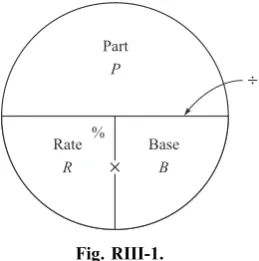
In the top portion of the circle, write the word part (P). In the lower left portion of the circle, write the word rate (R), and in the lower right portion, write the word base (B). Put a multiplication sign between the two lower portions and a division sign between the top and bottom portions.
If you are asked to find the part (P), place the rate (R) in the lower left portion of the circle and the base (B) in the lower right portion. The circle tells you to use the formulaP¼R Band multiply.
If you are asked to find the rate (R), place the part (P) in the top portion of the circle and the base (B) in the lower right portion. The circle tells you to use the formula R¼ PBand divide. The answer will be in decimal form and needs to be changed to a percent.
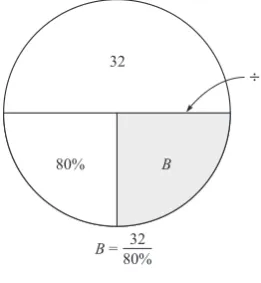
If you are asked to find the base (B), place the part (P) in the top portion and the rate (R) in the bottom left portion. The circle tells you to use the formula B¼ PR and divide. See Figure RIII-2. Be sure to change the percent to a decimal or fraction before multiplying or dividing.
Fig. RIII-1.
TYPE I: FINDING THE PART
EXAMPLE:Find 30% of 18.
SOLUTION:Since 30% is the rate, place it in the lower left portion of the circle, and since 18 is the base, place it in the lower right portion of the circle and then multiply. See Figure RIII-3.
P ¼RP
¼30%18
¼0:3018
¼5:4
Note: The number after the word ‘‘of ’’ is the base.
TYPE 2: FINDING THE RATE
EXAMPLE:12 is what percent of 20?
SOLUTION:Since 12 is the part, place it in the top portion of the circle, and since 20 is the base, place it in the lower right portion of the circle, and then divide. See Figure RIII-4.
R¼P B
¼1220
¼0:60¼60%
TYPE 3: FINDING THE BASE
EXAMPLE:32 is 80% of what number?
SOLUTION:Since 32 is the part, place it in the top portion of the circle, and since 80% is the rate, place it in the lower left portion of the circle and then divide. See Figure RIII-5.
B¼P R
¼8032%
¼032
:80
¼40
Fig. RIII-4.
Try These
1. Find 65% of 50.
2. What percent of 40 is 25?
3. 18 is 30% of what number?
4. What percent of 25 is 15?
5. 15 is 75% of what number?
6. Find 90% of 72.
7. 25 is what percent of 40?
8. What percent of 50 is 40?
9. Find 35% of 70.
10. 12 is what percent of 20?
SOLUTIONS:
1: P ¼RB
¼65%50
¼0:6550
¼32:5
2: R¼ P B
¼25
40
¼0:625¼62:5%
3: B¼ 18 30%
¼018
:30
4: R ¼ P R
¼15
25
¼0:6¼60%
5: B ¼ 15 75%
¼015
:75
¼20
6: P ¼RB
¼90%72
¼0:9072
¼64:8
7: R ¼ 25 40
¼0:625¼62:5%
8: R ¼ P B
¼4050
¼0:80¼80% 9: P ¼RB
¼35%70
¼0:3570
¼24:5
10: R ¼ P B
¼1220
LESSON
Solving Word
Problems Using
Percents
If you need to review percents, complete Refresher III.
A percent problem consists of three values. The base (B) is the whole or total, the rate (R) is a percent, and the part (P). One of these three will be unknown. For example, if a box contains 12 calculators, then the whole is 12. If three calculators are placed on a store’s shelf, then 3 is the part. Finally, the percent is 3
12¼14¼25%. That is, 25% of the calculators were placed on the
store’s shelf.
Percent problems can be solved using the circle method. Figure 5-1 shows how to use the circle method to solve percent problems.
43
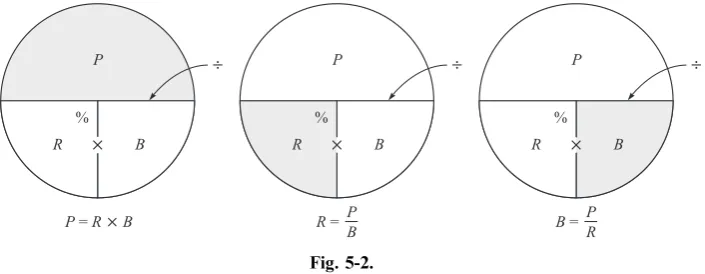
In the top of the circle, place the part (P). In the lower left portion of the circle, place the rate (%), and in the lower right portion, place the base (B). Now if you are given the bottom two numbers, multiply. That is,P¼RB. If you are given the top number (the part) and one of the bottom numbers, divide to find the other number. That is,R ¼P
Bor B¼PR. See Figure 5-2.
There are three types of percent problems. They are
Type 1: Finding the part. Type 2: Finding the rate. Type 3: Finding the base.
In order to solve percent problems, read the problem and identify the base, rate, and part. One of the three will be the unknown. Substitute the two known quantities in the circle and use the correct formula to find the unknown value. Be sure to change the percent to a decimal before multiplying or dividing.
Fig. 5-1.
TYPE 1: FINDING THE PART
In type 1 problems, you are given the base and rate and you are asked to find the part.
EXAMPLE:There are 30 students in a classroom. If 20% of them are absent today, how many students are absent?
SOLUTION:
GOAL: You are being asked to find the number of students who are absent.
STRATEGY: Draw the circle and place 20% in the lower left portion of the circle and 30 in the lower right portion of the circle since it is the total number of students in the class. To find the part, useP ¼RB. See Figure 5-3.
IMPLEMENTATION: Substitute in the formula and solve for P. P¼R B
P¼20% 30 P¼0.20 30 P¼6 students
Hence, 6 students are absent.
EVALUATION: Since 20%¼15 and 15of 30 ¼6, the answer is correct.
TYPE II: FINDING THE RATE (%)
In type II problems, you are given the part and the whole and are asked to find the rate as a percent. The answer obtained from the formula will be in decimal form. Make sure that you change it into a percent.
EXAMPLE:A person bought a DVD player for $78 and paid a sales tax of $4.68. Find the tax rate.
SOLUTION:
GOAL: You are being asked to find the rate (%).
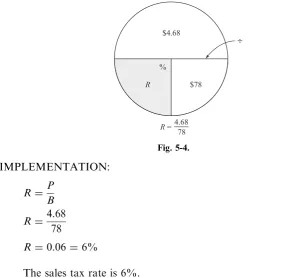
STRATEGY: In this case, the base (B) is the total cost, which is $78, and the sales tax, $4.68, is the part. Draw the circle and put $78 in the lower right portion and $4.68 in the top portion. To find the rate, use R ¼ PB. See Figure 5-4.
IMPLEMENTATION:
R¼P B R¼4:68
78
R¼0.06 ¼6%
The sales tax rate is 6%.
EVALUATION: To check the answer, find 6% of $78: 6% 78 ¼ 0.06 78 ¼ $4.68. The answer is correct.
TYPE III: FINDING THE BASE
In type III problems, you are given the part and rate and are asked to find the base or whole.
EXAMPLE: A salesperson earns a 15% commission on all sales. If the commission was $1125, find the amount of his sales.
SOLUTION:
GOAL: You are being asked to find the total amount of sales.
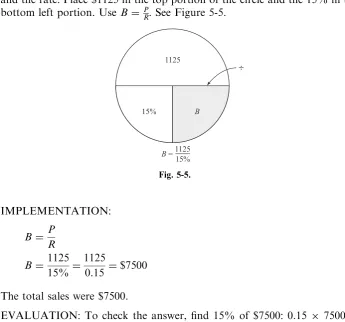
STRATEGY: In this type of problem, you are given the part (commission) and the rate. Place $1125 in the top portion of the circle and the 15% in the bottom left portion. UseB¼ P
R. See Figure 5-5.
IMPLEMENTATION:
B¼ P R B¼1125
15%¼
1125 0:15
¼$7500
The total sales were $7500.
EVALUATION: To check the answer, find 15% of $7500: 0.15 7500 ¼ $1125. Hence, the answer is correct.
Some percent problems involve finding a percent increase or decrease. Always remember that the original value is used as the base and the amount
of the increase or decrease is used as the part. For example, suppose a calculator sold for $40 last week and is on sale for $30 this week. The decrease is $40 $30¼$10. The percent of decrease is10
40¼0.25 or 25%. EXAMPLE: The price of a textbook increased from $60 to $75. Find the percent increase in the price.
SOLUTION:
GOAL: You are being asked to find the percent of the increase in price.
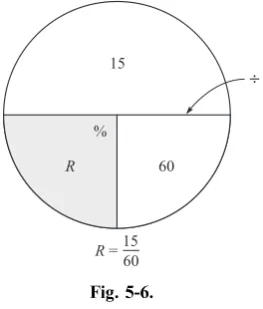
STRATEGY: Find the increase, and then place that number in the top portion of the circle. The base is the original cost. UseR¼PB. See Figure 5-6.
IMPLEMENTATION: The increase is $75 $60¼$15.
R¼P B R¼15
60¼ 15
60¼0:25¼25%
Hence, the rate of increase is 25%.
EVALUATION: Find 25% of 60: 0.25$60¼$15. The solution is correct.
Try These
1. In a local hospital, there are 80 nurses. If 15% of them are males, how many of the nurses are males?
2. Sean weighed 175 pounds before he lost 28 pounds. Find the percent of his weight loss.
3. The City Garage inspected 110 automobiles. If 90% of them passed, find the number of automobiles that passed.
4. A person paid a 6% sales tax of $29.70 on the purchase of an oven. Find the cost of the oven.
5. In a psychology class, 18% of the students are math majors. If there are 50 students in the class, how many of the students are non-math majors?
6. On an 80-point exam, a student had a score of 70%. How many questions did the student miss?
7. A person bought a classic automobile for $9600 and sold it later for $12,000. What was the percent profit?
8. A video game cost $32 and was discounted $4. What was the dis-count rate?
9. In a high school, there were 18 male instructors and 32 female instructors. What percent of the instructors are female?
10. An alcoholic beverage comes in 32 ounce bottles and is labeled 10.5% alcohol. How much of the drink is alcohol?
SOLUTIONS:
1. P¼R B
P¼ 15%80 ¼0.15 80 ¼12 2. R¼P
B R¼ 28
3. P¼R B
P ¼90%110¼ 0.90110¼ 99
4. B¼ P R B ¼$29:70
6% ¼ $29:70
0:06
¼$495
5. P¼R B
P ¼18%50 ¼0.18 50 ¼9; 509 ¼41 6. P¼R B
P ¼70%80 ¼0.70 80 ¼56; 80 56¼ 24 7. $12,000$9600 ¼$2400
R¼ P B R¼ $2400
$9600¼0:25¼25% 8. R¼P
B R¼ $4
$32 ¼0.125 ¼12.5% 9. 18 þ32 ¼50
R¼ P B R¼ 32
50¼ 0.64¼64%
10. P ¼RB
LESSON
Solving Word
Problems Using
Proportions
In order to solve word problems using proportions, it is necessary to understand the concept of a ratio. Aratiois a comparison of two numbers by using division. For example, the ratio of 4 to 10 is 4
10, which reduces to 25.
Ratios are used to make comparisons between quantities. If you drive 160 miles in 4 hours, then the ratio of miles to hours is 1604 or 401. In other words, you averaged 40 miles per hour.
It is important to understand that whatever number comes first in a ratio statement is placed in the numerator of the fraction and whatever number comes second in the ratio statement is placed in the denominator of the fraction. In general, the ratio of atob is written asa
b.
51
Aproportionis a statement of equality of two rations. For example,3 5¼
9 15
is a proportion. A proportion consists of four terms, and it is usually necessary to find one of the terms of the given proportion given the other three terms. This can be done by cross-multiplying and then dividing both sides of the equation by the numerical coefficient of the variable.
EXAMPLE:Find the value of x:5
6¼ x 42: SOLUTION: 5 6¼ x 42
6x¼542 Cross-multiply 6x¼210
61x 61 ¼
210
6 Divide by 6
x¼35
EXAMPLE:Find the value of x: 10 x ¼ 30 6 : SOLUTION: 10 x ¼ 30 6
30x¼106 Cross-multiply 30x¼60
301x 301 ¼
60
30 Divide by 30
x¼2
The strategy used to solve problems involving proportions is to identify and write the ratio statement and then write the proportion.
SOLUTION:
GOAL: You are being asked to determine how far the plane can travel in 5 hours.
STRATEGY: Write the ratio: The ratio statement is 360 miles to 3 hours or
360 miles 3 hours ¼
xmiles 5 hours
IMPLEMENTATION: Solve the proportion.
360 miles 3 hours ¼
xmiles 5 hours
3x¼3605 3x¼1800
31x 31 ¼
1800 3
x¼600 miles
The plane can fly 600 miles.
EVALUATION:
360 3 ¼
600
5 Substitute the value forx in the proportion 3600¼5360 and cross-multiply. If the cross products
1800¼1800 are equal, the answer is correct.
EXAMPLE:If a carpet sells for $15.50 per square yard, how much will it cost to cover a room that measures 20 square yards?
SOLUTION:
GOAL: You are being asked to find the cost of 20 square yards of carpet.
STRATEGY: Write the ratio. It is $15:50 1 sq:yd:
. The proportion is $15:50 1 sq:yd:¼
x
20 sq:yd: .
IMPLEMENTATION: 1 x¼$15.50 20;x¼$310. The cost of the carpet is $310.
EVALUATION:
$15:50
1 ¼
$310 20
1$310¼$15:5020
$310¼$310
EXAMPLE: If 4 gallons of paint can cover 1120 square feet, how many square feet will 7 gallons of paint cover?
SOLUTION:
GOAL: You are being asked to find how many square feet 7 gallons of paint will cover.
STRATEGY: Write the ratio. It is 1120 sq4 gallons :ft:
. The proportion is
4 gallons 1120 sq:ft:¼
7 gallons
IMPLEMENTATION: Solve the proportion.
4 gallons 1120 sq:ft:
¼7 gallons
xsq:ft: 11207¼4x
7840¼4x 7840
4 ¼
41x 41
1960 square feet ¼x
7 gallons will cover 1960 square feet.
EVALUATION:
4 1120¼
7 1960
11207¼41960 7840¼7840
EXAMPLE:If the scale on a map reads 2 inches¼50 miles, how many miles are there between two cities whose distance on a map is 7.5 inches?
SOLUTION:
GOAL: You are being asked to find the distance between two cities.
STRATEGY: The ratio statement is2 inches
50 miles. The proportion is 2 in : 50 miles¼ 7
:5 in:
IMPLEMENTATION:
2 50¼
7:5 x 507:5¼2x
375¼2x 375
2 ¼ 21x
21
187:5 miles ¼x
The cities are 187.5 miles apart.
EVALUATION:
2 50¼
7:5 x 7:550¼2187:5
375¼375
Try These
1. If a person can burn 120 calories in 15 minutes of cycling, how many calories can the person burn in 75 minutes?
2. If a pizza delivery person drives 276 miles in 3 days, how many miles will the person drive in 5 days?
3. If an author writes 3 chapters in 10 days, how long will it take the author to write a 15-chapter book?
4. If it takes 12 yards to make 3 costumes, how many yards of material will be needed to make 10 costumes?
6. If a person earns $3250 in 3 months, how much will the person earn in 12 months?
7. On a map, the scale is 3 inches¼240 miles. How far apart are two cities whose distance on a map is 8 inches?
8. If two gallons of paint will cover 420 square feet of surface, how many gallons of paint will be needed to cover 1050 square feet?
9. If a recipe calls for 3.5 cups of flour to serve 4 people, how many cups of flour will be needed to make the recipe serve 9 people?
10. If a merchant can order 5 pairs of the same kind of shoes for $89, how much will 12 pairs cost?
SOLUTIONS:
1:
120 calories 15 min ¼
xcalories 75 min
15x¼12075 15x¼9000 151x
151 ¼ 9000
15
x¼600 calories
2:
276 miles 3 days ¼
xmiles 5 days
3x¼2765 3x¼1380 31x
31 ¼
1380 3
3:
3 chapters 10 days ¼
15 chapters xdays 1015¼3x
150¼3x 150
3 ¼ 31x
3 1
50 days¼x
4:
12 yards 3 costumes¼
xyards 10 costumes
3x¼1210 3x¼120 31x
31 ¼ 120
3
x¼40 yards
5:
4 pounds 1250 sq:ft:
¼3000 sqxpounds
:ft: 1250x¼43000 1250x¼12;000 12501x
12501 ¼ 12;000
1250
x¼9:6 pounds
6:
$3250 3 months¼
x 12 months
3x¼325012 3x¼39;000 31x
31 ¼
39;000 3
7:
3 in: 240 miles¼
8 in: x 2408¼3x
1920¼3x 1920
3 ¼
31x 31
640 miles¼x
8:
2 gal: 420 sq:ft:
¼1050 sqx
:ft: 420x¼21050 420x¼2100 4201x
4201 ¼ 2100
420
x¼5 gallons 9:
3:5 cups 4 people¼
xcups 9 people
4x¼93:5 4x¼31:5 41x
41 ¼
31:5 4
x¼7:875 cups 10:
5 pairs
$89 ¼
12 pairs x 1289¼5x
1068¼5x 1068
5 ¼
51x 51
LESSON
Solving
Word Problems
Using Formulas
In mathematics and science, many problems can be solved by using a formula. Aformulais a mathematical statement of the relationship of two or more variables. For example, the distance (D) an automobile travels is related to the rate (R) of speed and the time (T) it travels. In symbols, D¼RT. In order to evaluate formulas, you use the order of operations.
Step 1: Perform all operations in parentheses. Step 2: Raise each number to its power.
Step 3: Perform multiplication and division from left to right. Step 4: Perform addition and subtraction from left to right.
60
EXAMPLE:Find the interest on a loan whose principal (P) is $4800 at a rate of 5% for 6 years. Use I¼PRT.
SOLUTION:
GOAL: You are being asked to find the interest.
STRATEGY: Use the formulaI¼PRT. IMPLEMENTATION:
I¼PRT
¼$48005%6
¼$4800 ð0:05Þ 6
¼$1440
EVALUATION: You can estimate the answer by rounding $4800 to $5000 and then finding 5% of $5000, which is 0.05$5000¼$250. The interest for one year is about $250. The interest for 6 years then is 6$250¼$1500. Since this is close to $1440, the answer is probably correct.
EXAMPLE: Find the Celsius temperature (C) when the Fahrenheit temperature (F) is 868. Use C¼5
9ðF32Þ. SOLUTION:
GOAL: You are being asked to find a Celsius temperature.
STRATEGY: Use the formula C¼5
9ðF32 Þ.
IMPLEMENTATION:
C¼5
9ðF32 Þ
:
C¼5
9ð8632Þ
¼59ð54Þ
EVALUATION: You can estimate the answer by subtracting 308 from the Fahrenheit temperature and dividing the answer by 2: 86 30¼56; 56 2¼288. Since 288 is close to 308, the answer is probably correct.
EXAMPLE:The distance (d) an object falls in feet is d¼32t2wheretis the time in seconds. Find the distance an object falls in 3 seconds.
SOLUTION:
GOAL: You are being asked to find the distance an object falls in 3 seconds.
STRATEGY: Use the formulad¼32t2. IMPLEMENTATION:
d¼32t2
¼32ð3Þ2
¼329
¼288 feet
EVALUATION: Estimate the answer by rounding 32 to 30 and then multiplying 309¼270. Since this estimate is close to 288, the answer is probably correct.
Try These
1. Find the amount of work (W) done by applying a force (F) of 60 pounds moving a distance (d) of 9 feet. UseW¼Fd.
2. Find the distance (D) an automobile travels at a rate (R) of 35 miles per hour in 2.5 hours (T). Use D¼RT.
3. Find the amount of interest (I) earned on a principal (P) of $6000 at a rate (R) of 7% for a time (T) of 8 years. Use I¼PRT.
5. Find the Celsius temperature (C) when the Fahrenheit temperature (F) is 508. Use C¼59(F 328).
6. Find the volume (V) of a cylinder in cubic feet when the height (h) is 19 feet and the radius (r) of the base is 3 feet. UseV¼3.14r2h. 7. Find the force (F) of the wind against a flat surface whose area (A)
is 20 square feet when the wind speed (s) is 35 miles per hour. Use F¼0.004As2.
8. Find the surface area (A) of a cube in square feet when each side (s) measures 12 inches. UseA¼6s2.
9. Find the current (I) in amperes when the electromotive force (E) is 18 volts and the resistance (R) is 6 ohms. UseI¼ER.
10. Find the Fahrenheit temperature (F) when the Celsius temperature (C) is 508. Use F¼9
5Cþ328.
SOLUTIONS:
1. W¼Fd
¼60 9
¼540 ft.-lb.
2. D¼RT
¼35 2.5
¼87.5 miles
3. I¼PRT
¼$6000 7% 8
¼$6000 (0.07) 8
4. P¼2lþ2w
¼220þ28
¼40þ16
¼56 in.
5. C¼5
9ðF32 Þ
¼59ð5032Þ
¼59 18
¼108
6. V¼3.14r2h
¼3.14 32 19
¼3.14 9 19
¼536.94 cubic feet
7. F¼0.004As2
¼0.004 20 352
¼0.004 20 1225
¼98 pounds
8. A¼6s2
¼6 122
¼6 144
9. I¼E R
¼ 18
6
¼ 3 amperes
10. F¼9
5Cþ32
¼ 9
5 50þ32
¼ 90þ32
Quiz 2
1. Find the sales tax on a book that costs $25 if the rate is 6%. (a) $15
(b) $0.15 (c) $150 (d) $1.50
2. If a person earned $32,000 a year and received an $800 raise, what was the percent increase in her salary?
(a) 25% (b) 2.5% (c) 0.25% (d) 250%
3. A sales person received a commission of $60 on a sale of an item. If the commission rate is 20%, find the amount of the sale.
(a) $300 (b) $12 (c) $120 (d) $30
66
4. If a DVD player originally sold for $80 and was reduced 30% for a sale, what was the reduced price?
(a) $24 (b) $240 (c) $56 (d) $5.60
5. If a family purchased a home for $120,000 and put 20% down, how much was left to finance?
(a) $24,000 (b) $42,000 (c) $69,000 (d) $96,000
6. If a person can type 10 pages of text in 4 minutes, how many pages can the person type in 25 minutes?
(a) 40 (b) 25 (c) 62.5 (d) 100
7. If three electrical switches cost $2.10, how much will 10 switches cost? (a) $7.00
(b) $21.00 (c) $10.00 (d) $6.30
8. If 2 ounces of a food contains 130 calories, how many calories would be contained in 7 ounces?
9. If a person travels a distance of 840 miles in 12 hours, find the rate. UseR ¼DT.
(a) 50 miles per hour (b) 40 miles per hour (c) 60 miles per hour (d) 70 miles per hour
10. How far (in feet) will an object fall in 5 seconds? Use d¼ 32t2. (a) 160 ft.
REFRESHER
Equations
An algebraic expression consists of variables (letters), numbers, operation signs (þ, , , ), and grouping symbols. Here are a few examples of algebraic expressions:
3x 5(x5) 8x2 9þ 2
Anequation is a statement of equality of two algebraic expressions. Here are some examples of equations:
5þ4 ¼9 3x 2 ¼13 x2 þ3x þ2 ¼0
An equation which contains a variable is called aconditionalequation. To
solve a conditional equation, it is necessary to find a number which, when substituted for the variable, makes a true equation. This number is called a
solutionto the equation. For example, 5 is a solution to the equationxþ3¼8, since when 5 is substituted forx it makes the equation true, i.e., 5þ3 ¼8. The process of finding a solution to an equation is calledsolvingthe equation. The same number (except zero) can be added to, subtracted from, multiplied by, or divided into both sides of the equation without changing the nature of the equation.
69
EXAMPLE:Solve for x: x 7 ¼9
SOLUTION:
x 7 ¼9
x7 þ7 ¼9 þ7 add 7 to both sides x ¼16
EXAMPLE:Solve for x: x þ8 ¼10
SOLUTION:
xþ8 ¼10
xþ8 8 ¼10 8 subtract 8 from both sides x ¼2
EXAMPLE:Solve: x 4¼5
SOLUTION:
x 4 ¼5 41
1 x
41¼45 multiply both sides by 4 x¼20
EXAMPLE:Solve: 6x¼42
SOLUTION:
6x¼42 61x
61 ¼ 42
Try These
Solve each equation for x: 1. xþ18 ¼40
2. x22 ¼10 3. 5x ¼45 4. xþ6 ¼16 5. x
3 ¼8
SOLUTIONS:
1: xþ18¼40 xþ1818¼4018
x¼22
2: x22¼10 x22þ22¼10þ22
x¼32
3: 5x¼45 51x
51 ¼ 45
5 x¼9
4: xþ6¼16 xþ66¼166
x¼10
5:
x 3 ¼8 31
1 x
More complex equations require several steps to solve them. The goal is to use addition and/or subtraction to get the variables on one side of the equation and the numbers on the other side of the equation. Then divide both sides by the number in front of the variables.
EXAMPLE:Solve for x: 4x þ10 ¼34
SOLUTION:
4xþ10¼34
4xþ1010¼3410 subtract 10 4x¼24
41x 41 ¼
24
4 divide by 4
x¼6
EXAMPLE:Solve for x: 5x 6 ¼3x þ14
SOLUTION:
5x6¼3xþ14
5x6þ6¼3xþ14þ6 add 6 5x¼3xþ20
5x3x¼3x3xþ20 subtract 3x 2x¼20
21x 21 ¼
20
2 divide by 2
x¼10
5x6¼3xþ14 5ð10Þ 6¼3ð10Þ þ14
50