• Tidak ada hasil yang ditemukan

Hospital-based Phase III Cardiac Rehabilitation Program Improves Low Density Lipoprotein, Triglyceride, and Fasting Blood Glucose Level in Coronary Artery Disease Patients : a 6-month Follow up | Dwiputra | Journal of the Medical Sciences (Berkala ilmu Ke

N/A
N/A
Protected

Academic year: 2017

Membagikan "Hospital-based Phase III Cardiac Rehabilitation Program Improves Low Density Lipoprotein, Triglyceride, and Fasting Blood Glucose Level in Coronary Artery Disease Patients : a 6-month Follow up | Dwiputra | Journal of the Medical Sciences (Berkala ilmu Ke"

Copied!
9
0
0

Teks penuh

(1)

Corresponding author: [email protected]

Hospital-based phase III cardiac rehabilitation

program improves low density lipoprotein,

triglyceride, and fasting blood glucose

levels in coronary artery disease patients

Dwiputra B1*, Panjaitan F2, Hindoro E3, Fathoni N2, Santoso A1

1Faculty of Medicine, University of Indonesia/National Cardiovascular Center Harapan Kita, Jakarta, 2Pupuk Kaltim Hospital, Bontang, East Kalimantan, 3Faculty of Medicine, University of Pelita Harapan, Tangerang, Indonesia

ABSTRACT

Cardiac rehabilitation (CR) is reported as effective program to improve coronary risk factors and increase exercise tolerance in patients with coronary artery disease (CAD) after cardiac events. Normally, the CR program is performed in 3 phases i.e. acute (phase I), subacute (phase II), and chronic (phase III). In Indonesia, the most CR programs were conducted using phase I and some phase II, whereas phase III CR program has not often been performed due to it is not covered by national health insurance. The aim of the study was to evaluate the effects of phase III comprehensive CR program on physical status and coronary risk factors among CAD patients. Seventy-four patients were stratiied as the intervention group (n=37) and the control group (n=37). In the intervention group, patients participated in an hospital-based phase III CR program for 6 months, whereas in the control group, patients received a standard care. The CR program consists of warm-up, aerobic exercise, cool-down stretching, and health education session three days a week. Blood glucose level and lipid proile examinations were performed before and sixth month after the program implemented to assess patient’s metabolic status. Among 74 patients involved in this study, most patients were male (85.1%) with mean age 54.7±3.4 years old. Fifty-seven patients had procedural history (77% post-PCI, 4% post-CABG), 8 patients (11%) were still active smokers, 31 patients (42%) had diabetes, and 60 patients (81%) had hypertension. Participation in the hospital-based phase III CR program was signiicantly correlated with lower low-density lipoprotein (LDL) level (p=0.003; r=0.41), triglyceride level (p=0.001; r=0.38), and fasting blood glucose level (p<0.001; r=0.46) during 6-month follow up. In conclusion, patients with CAD who undergo hospital-based phase III CR program have signiicantly better fasting glucose control, LDL, and triglyceride levels. These results may encourage other hospitals to perform the same program achieving better prognosis of CAD patients.

ABSTRAK

(2)

sedangkan program RJ fase III belum banyak dilakukan karena tidak dibiayai oleh Badan Penyelenggara Jaminan Sosial Kesehatan (BPJS Kesehatan). Tujuan penelitian ini adalah untuk mengevaluasi efek program RJ komprehensif fase III terhadap kondisi isik dan factor risiko coroner pasien penderita PJK. Limapuluh empat penderita PJK dibagi ke dalam kelompok intervensi (n=37) dan kelompok kontrol (n=37). Pada kelompok intervensi, pasien menjalani program RJ fase III di rumah sakit selama 6 bulan, sedangkan kelompok kontrol pasien menjalani perawatan standar. Program RJ meliputi senam jantung sehat, senam aerobik, pendinginan dengan peregangan dan penyuluhan kesehatan 3 hari per minggu. Pemeriksaan kadar gula darah dan proil lipid dilakukan sebelum dan 6 bulan sesudah pelaksanaan program untuk menilai status metabolism pasien. Diantara 74 pasien yang terlibat dalam penelitian, sebagian besar (85.1%) laki-laki dengan rerata umur 54,7 ± 3,4 tahun. Sebanyak 57 pasien memiliki riwayat pernah menjalani operasi jantung (post-PCI 77%; post-CABG 4%), 8 pasien (11%) masih aktif merokok, 31 pasien (42%) menderita diabetes dan 60 psien (81%) menderita hipertensi. Keikutsertaan dalam program RJ fase III di rumah sakit berhubungan nyata dengan kadar LDL (p=0,003; r=0,41), trigliserid (p=0,001; r=0,38) dan gula darah puasa (p<0,001; r=0,46) yang lebih rendah setelah 6 bulan mengikuti program. Dapat disimpulkan, pasien PJK yang menjalani program RJ fase III di rumah sakit mempunyai kadar gula darah puasa, LDL dan trigliserid yang lebih baik secara nyata. Hasil ini dapat mendorong rumah sakit untu melaksanakan program yang sama dalam rangka memperbaiki prognosis pasien PJK.

Keywords: cardiac rehabilitation - high density lipoprotein - low density lipoprotein – triglyceride - blood glucose

INTRODUCTION

Cardiovascular diseases (CVDs) are the leading cause of death globally. It is estimated 7.4 million deaths per year due to ischemic heart disease.1 Indonesian National Health Survey (RISKESDAS) in 2013 placed cardiac-cerebro-vascular disease as the top rank of cause of death in Indonesia.2 These catastrophic diseases are known as non-communicable and preventable diseases. Establishing a preventive strategy, numerous studies were conducted in multicenter

worldwide, in order to determine the eficacy

of physical activity in reducing cardiovascular (CV) mortality. Anderson et al.3 demonstrated the importance of cardiac rehabilitation (CR) in coronary arterydisease (CAD) patients after cardiac events. This study revealed

the signiicant beneits of CR to decrease

total mortality, myocardial infarction, and revascularization. Moreover, CR could improve coronary risk factors, provide

cost-effectiveness as secondary CVD prevention, and increase quality of life (QoL) and exercise tolerance.3-5

In general, CR programs are performed in three main stages: acute stage (phase I), sub-acute stage (phase II), and chronic stage (phase III).6-8 Phase I CR starts immediately from

the irst day of patient admission in hospital.

(3)

rehabilitation on metabolic status, particularly in local population.

This study aimed to assess the beneicial

effects of 6-month hospital-based phase III CR program on physical status and coronary risk factors among CAD patients.

MATERIALS AND METHODS

Subjects

During January-June 2016, we retro-spectively enrolled 74 consecutive patients in cardiology outpatient clinic who were more than 40 years old. The all patients had been referred at least 6 months after a major coronary event, such as acute myocardial infarction, coronary artery bypass grafting, or percutaneous coronary intervention (PCI). Thirty-seven patients who consistently (>90% attendance) attending in a phase III CR program at Pupuk Kaltim Hospital were categorized as intervention group. Thirty-seven other patients who did not join in phase III CR program were categorized as control group. Patients with on going congestive heart failure, liver dysfunction (aspartate amino

transferase ≥40 IU/L), renal dysfunction (creatinine ≥2.0 mg/dL), or systemic diseases

(malignancy and collagen disease) were excluded.

Protocols

Entire subjects were directed for blood sample work up in order to have base line of metabolic parameters, comprise of body mass index (BMI), blood pressure, lipid

proile (low-density lipoprotein/LDL, high-density lipoprotein/HDL, total cholesterol and triglycerides), blood glucose proile

(fasting and 2 hours post prandial blood glucose levels) in 0 and 6 months observation. These laboratory parameters were determined in Pupuk Kaltim Hospital laboratories using

direct measurement by homogenous assay of COBAS INTEGRA 400 plus analyzer.

In the intervention group, subjects participated in a hospital-based phase III CR program, while the control group received usual outpatient care, including monthly medical examination by the physician in charge. Phase III CR program consists of warm-up (senam jantung sehat) for 10 minutes, aerobic exercise for the next 40 minutes, cool-down stretching for last 10 minutes, and health education session three days a week. Blood pressure and heart rate were monitored during the program and in outpatient clinic. Laboratory measurements were performed at the beginning and sixth month to assess patient’s metabolic status.

Except for the rehabilitation protocol, standard medical care was provided for both groups. Lipid-lowering drugs (simvastatin or atorvastatin 20 mg) that may affect lipid levels were given at stable doses for at least 4 weeks before entry, and the doses of these medications were not altered during the study period). The Research Ethics Committee of Pupuk Kaltim Hospital approved the protocol. All subjects received full verbal and written explanations of the nature and purpose of the study, and each gave written informed consent.

Data analysis

(4)

RESULTS

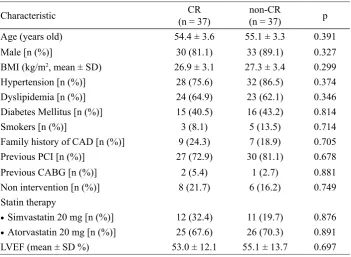
Among 74 patients involved in this study, most patients were over 50 years old and male dominant (81% in CR group and 89% in non-CR group, 85% of overall subjects). Mean

of BMI in CR group was 26.9 ± 3.1 kg/m2,

compared to 27.3 ± 3.4 kg/m2 in non-CR group. Non-CR group had slightly high percentage of hypertension, diabetes mellitus, smokers, and previous history of PCI compared to CR group (86.5 vs 75.6%; 43.2 vs 40.5%; 13.5 vs 8.1% and 81.1 vs 72.9%). In contrast, the

percentage of dyslipidemia, family history of CAD, previous coronary artery bypass graft (CABG) and non-intervention subjects in CR group were marginally greater than non-CR group (65 vs 62.1%; 24.3 vs 19%; 5.4 vs 2.7% and 21.7 vs 16.2%). There was no statistically difference between lipid drug consumed by the patients. Most patients received atorvastatin 20 mg once daily instead of simvastatin. Left ventricular ejection fraction (LVEF) by echocardiography examination showed grossly equivalent in both arms and within normal limit (TABLE 1).

TABLE 1. Baseline characteristic between groups

Characteristic CR

(n = 37)

non-CR

(n = 37) p Age (years old) 54.4 ± 3.6 55.1 ± 3.3 0.391

Male [n (%)] 30 (81.1) 33 (89.1) 0.327

BMI (kg/m2, mean ± SD) 26.9 ± 3.1 27.3 ± 3.4 0.299

Hypertension [n (%)] 28 (75.6) 32 (86.5) 0.374 Dyslipidemia [n (%)] 24 (64.9) 23 (62.1) 0.346 Diabetes Mellitus [n (%)] 15 (40.5) 16 (43.2) 0.814

Smokers [n (%)] 3 (8.1) 5 (13.5) 0.714

Family history of CAD [n (%)] 9 (24.3) 7 (18.9) 0.705 Previous PCI [n (%)] 27 (72.9) 30 (81.1) 0.678

Previous CABG [n (%)] 2 (5.4) 1 (2.7) 0.881 Non intervention [n (%)] 8 (21.7) 6 (16.2) 0.749 Statin therapy

• Simvastatin 20 mg [n (%)] 12 (32.4) 11 (19.7) 0.876 • Atorvastatin 20 mg [n (%)] 25 (67.6) 26 (70.3) 0.891

LVEF (mean ± SD %) 53.0 ± 12.1 55.1 ± 13.7 0.697

CR: cardiac rehabilitation (intervention group), non-CR:non-cardiac rehabilitation (control group), CAD: Coronary artery disease, PCI: percutaneous coronary intervention, CABG: coronary artery bypass graft, LVEF: left ventricle ejection fraction. The data were presented as a mean + SD values unless stated otherwise.

After 6 months observation in CR and non-CR group, several metabolic parameters via laboratory examination revealed some changes in terms of fasting blood levels, 2 hours post prandial blood glucose level and

lipid proile (LDL, HDL, total cholesterol and

(5)

TABLE 2. Blood glucose and lipid proile (mean ± SD mg/dL) pre- and post- CR program

Variable CR (n = 37) non-CR (n = 37)

0-month 6-month 0-month 6-month

Fasting blood glucose 106.2 ± 17.1 100.1 ± 15.8 117.0 ± 32.7 119.7 ± 44.2 2 hr PP blood glucose 154.1 ± 36.7 148.8 ± 31.3 156.4 ± 51.3 154.9 ± 58.4 Total cholesterol 175.3 ± 39.0 170.8 ± 44.8 175.2 ± 48.5 170.4 ± 39.9 LDL-cholesterol 113.8 ± 28.8 107.1 ± 29.2 121.8 ± 37.1 124.9 ± 27.6 HDL-cholesterol 45.1 ± 9.4 43.7 ± 10.5 42.9 ± 13.7 41.8 ± 12.8 Triglyceride 130.1 ± 48.4 119.6 ± 40.7 153.9 ± 63.6 163.8 ± 77.9

CR: cardiac rehabilitation (intervention group); non-CR:non-cardiac rehabilitation (control group); 2hrPP: 2-hour post prandial; LDL: low density lipoprotein; HDL: high density lipoprotein.

Subsequently, coronary risk assessment in CR group compare to non-CR group exhibited

statistically signiicant reduction in FBG level

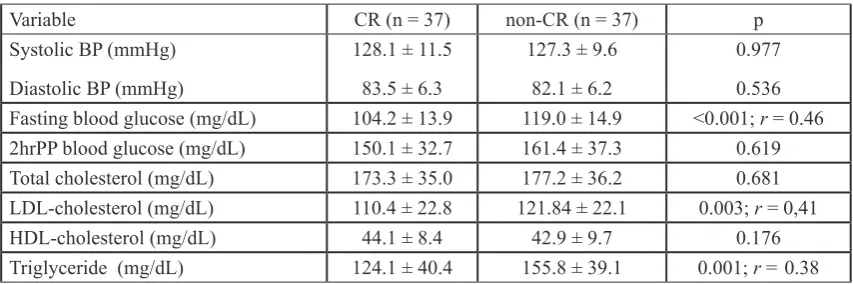
(p<0.001), LDL-C (p=0.003) and triglycerides (p=0.001). Pearson correlation test was done indicating a moderate correlation between phase III CR program and fasting blood glucose or LDL cholesterol level (r=0.46; 0.41). Moreover, weak positive correlation

between serum triglyceride and phase III CR program were observed (r =0.38) (TABLE 3). Multivariate analysis of variance showed that

there was still a signiicant difference between

CR and non CR group in terms of FBG, LDL, and triglyceride level when considering jointly over these 3 different variables (p<0.001; p=0.001; p=0.002).

TABLE 3. Blood pressure, blood glucose level, lipid proile (mean ± SD) during follow-up

Variable CR (n = 37) non-CR (n = 37) p

Systolic BP (mmHg) 128.1 ± 11.5 127.3 ± 9.6 0.977

Diastolic BP (mmHg) 83.5 ± 6.3 82.1 ± 6.2 0.536

Fasting blood glucose (mg/dL) 104.2 ± 13.9 119.0 ± 14.9 <0.001; r = 0.46

2hrPP blood glucose (mg/dL) 150.1 ± 32.7 161.4 ± 37.3 0.619

Total cholesterol (mg/dL) 173.3 ± 35.0 177.2 ± 36.2 0.681

LDL-cholesterol (mg/dL) 110.4 ± 22.8 121.84 ± 22.1 0.003; r = 0,41

HDL-cholesterol (mg/dL) 44.1 ± 8.4 42.9 ± 9.7 0.176

Triglyceride (mg/dL) 124.1 ± 40.4 155.8 ± 39.1 0.001; r = 0.38

(6)

DISCUSSION

This research population were observed as homogenous in intervention and non-intervention group. The results presented

statistically signiicant reduction of fasting

blood glucose (p<0.001), LDL cholesterol (p<0.003) and triglycerides (p=0.001) in phase III CR group than non-CR group. Since, one of the main pillars of CR is exercise training, mainly dynamic and aerobic exercise have been related with increased of

cardiorespiratory itness.10,11 Bauer et al.12 have demonstrated exercise training improves glucose metabolism, insulin signalling,

lipid proile, endothelial function, and blood

pressure as well as exercise tolerance, in both diabetic and non-diabetic patients. However, in diabetic patients these parameters were remarkably improved. Hindman et al.13 reported declining of FBG and blood lipid

proile in diabetic patients who participated

in a CR program after the onset of MI. Similarly, our study showed improved glucose metabolism and lipid metabolism, especially LDL-C and triglycerides with continued hospital-based phase III CR after cardiac events.

The basic mechanism of physical exercise in controlling blood glucose and lipid levels are consist of improvement of insulin sensitivity, by increases the activity of AMP-dependent protein kinase (AMPK), thereby stimulating the uptake and metabolism of glucose and lipids in skeletal muscles.14 These changes can be seen starting from acute phase of exercise (1-2 hours) to the chronic phase of exercise program. Abolishment of musclin expression

and increment in expression of GLUT4 were

also observed in physical activity to improve insulin resistance.15

Analysis of lipid proile in our study conirmed the previous investigations. A

signiicant decrease in total cholesterol and

triglycerides was also reported by other authors.5 It was found that low-intensity and moderate exercise induces an increase in HDL and decreases triglycerides in healthy subjects. However, reduction of total cholesterol is not always detectable.16 Similarly, we did not get

a signiicant reduction of total cholesterol. However, a signiicant decline of LDL-C

and triglyceride were observed. Other investigation was conducted, only triglyceride

were signiicantly decreased after 12 and 24

weeks of CR in CAD patients.17 J-CARP trial in Japan,18 irmly consistent with our study, it stated not only greater enhancement lipid prolife but decrement of BMI, fat mass and Apo-AI were perceived. Magkos et al.19 reported a prolonged moderate-intensity aerobic exercise augments the clearance rate of very low density lipoprotein-triglyceride (VLDL-TG) from plasma by enhancing the

eficiency of VLDL-TG removal from the

circulation, without affecting VLDL-TG secretion by the liver. This augmentation of clearance rate of VLDL-TG from plasma is the

main reason why triglycerides signiicantly

reduced in 6 months patients who undergoing phase III CR program.

Phase III CR program yielded LDL-C

levels enhancements with statically signiicant

and moderate positive correlation. Mean LDL-C reduction after 6 months CR program

is 6.7 mg/dL. The previous study revealed

a 1.7% reduction in major coronary events occurred with each 1% lowering of LDL-C in CAD patient subjects.20 Notwithstanding, based on ESC guideline of dyslipidemia21 risk

stratiication, our subjects are categorized as

very high risk patients. The target of LDL-C

in very high risk population is below 70 mg/

(7)

our population reached 5% of reduction. Thus, we realized that the phase III CR program is the key component toward LDL-C target despite of optimal lipid-lowering medications. Moreover, in this study, we observed that

there were no signiicant differences between

groups in terms of statin therapy prior to the intervention.

Stevens et al.23 established the effects of

itness were somewhat more consistent than

the effects of fatness. Hence, the best way to

reduce the risk of mortality, it persons need

to attain or maintain a normal body weight, and normal weight persons need to attain or

maintain at least a moderate level of itness. And, the inest approach to be it is having

moderate intensity aerobic exercise regularly,

150 minutes/weeks.24 Particularly in patients after cardiac event, continuing cardiac rehabilitation program in community levels is

the leading way to be it.

CONCLUSION

This study proves that patients with CAD who underwent hospital-based phase III

CR program has signiicantly better fasting

glucose control, LDL, and triglyceride level during 6-month follow up. Although this study

is the irst study that attempt to explore the role

of phase III CR program in post myocardial infarction patients in Indonesia, we still need a larger number of subjects that represent multi ethnicity of general population. Therefore, we strongly recommend further multicenter team works to carry out the importance of phase III CR program in metabolic improvement, so that phase III CR program can be delivered in many centers in Indonesia and covered by national insurance program. This will lead to better prognosis of future cardiac events and quality of life among CAD patients.

ACKNOWLEDGEMENTS

We thank our colleagues from National Cardiovascular Center Harapan Kita Jakarta and Pupuk Kaltim Hospital, Bontang, East

Kalimantan who provided insight, inancial

support, and expertise that greatly assisted the research.

REFERENCES

1. World Health Organization. WHO fact sheet: global status report on non communicable disease 2014. WHO. 2014. [cited 2016

October 14]; Available from: http://www. who.int/mediacentre/factsheets/fs317/en

2. Riset Kesehatan Dasar (RISKESDAS). Jakarta: Badan Penelitiandan Pengembangan Kesehatan, Departemen Kesehatan - Republik Indonesia, 2007.

3. Anderson L, Oldridge N, Thompson DR, Olddridge N, Zwisler AD, Rees K, et al. Exercise-based cardiac rehabilitation for coronary heart disease: Cochrane systematic review and meta-analysis. J Am Coll Cardiol 2016; 67(1):1-12.

https://doi.org/10.1016/j.jacc.2015.10.044

4. Lavie CJ, Arena R, Franklin BA.

Cardiac rehabilitation and healthy life-Style interventions: rectifying program

deiciencies to improve patient outcomes.

J Am Coll Cardiol 2016; 67(1):13-5.

https://doi.org/10.1016/j.jacc.2015.09.103

5. Taylor RS, Brown A, Ebrahim S, Jolliffe J, Noorni H, Rees K, et al. Exercise-based rehabilitation for patients with coronary heart disease: systematic review and meta-analysis of randomized controlled trials. Am J Med 2004; 116(10): 682–92.

h t t p s : / / d o i . o rg / 1 0 . 1 0 1 6 / j . a m j m e d .

2004.01.009

(8)

Monpère C, Hellemans I, McGee H, editors. Cardiovascular prevention and rehabilitation. London: Springer-Verlag, 2007: 30-3.

https://doi.org/10.1007/978-1-84628-502-8_5

7. Brown RA. Rehabilitation of patients with cardiovasculardisease: report of a WHO expert committee. WHO Tech Rep Ser 1964; 270:3-46.

8. Piotrowicz R, Wolszakiewicz J. Cardiac

rehabilitation following myocardial infarction. Cardiol J 2008; 15(5): 481-7.

9. Radi B. Cardiac rehabilitation in Indonesia. Global Heart 2009; 4(supp1):s49.

10. Stavropoulos-Kalinoglou A, Metsios GS, van Zanten JJV, Nightingale P, Kitas GD, Koutedakis Y. Individualised aerobic and resistance exercise training improves

cardio-respiratory itness and reduces cardiovascular

risk in patients with rheumatoid arthritis. Ann Rheum Dis 2013; 72:1819–25.

h t t p s : / / d o i . o r g / 1 0 . 1 1 3 6 /

annrheumdis-2012-202075

11. Dalager T, Justesen JB, Murray M, Boyle E, Sjøgaard G. Implementing intelligent physical exercise training at the workplace: health

effects among ofice workers-a randomized

controlled trial. Eur J Appl Physiol 2016; 116(7): 1433-42.

https://doi.org/10.1007/s00421-016-3397-8

12. Bauer TA, Reusch JE, Levi M, Regensteiner JG. Skeletal muscle deoxygenation after the onset of moderate exercise suggests slowed

microvascular blood low kinetics in type 2

diabetes. Diabetes Care 2007; 30(11): 2880-5.

https://doi.org/10.2337/dc07-0843

13. Hindman L, Falko JM, La Londe M, Snow R,

Caulin-Glaser T. Clinical proile and outcomes

of diabetic and nondiabetic patients in cardiac rehabilitation. Am Heart J 2005; 150(5): 1046-51.

https://doi.org/10.1016/j.ahj.2005.04.002

14. Musi N, Fujii N, Hirshman MF, Ekberg I, Fröberg S, Ljungqvist O, et al.

AMP-activated protein kinase (AMPK) is AMP-activated in muscle of subjects with type 2 diabetes during exercise. Diabetes 2001; 50(5): 921-7.

https://doi.org/10.2337/diabetes.50.5.921

15. Yu J, Zheng J, Liu XF, Feng ZL, Zhang XP, Cao LL, et al. Exercise improved lipid metabolism and insulin sensitivity in rats fed a high-fat diet by regulating glucose transporter

4 (GLUT4) and musclin expression. Braz J Med Biol Res 2016; 49(5):e5129. http:// dx.doi.org/10.1590/1414-431X20165129 https://doi.org/10.1590/1414-431X20165129

16. Durstine JL, Grandjean PW, Davis

PG, Ferguson MA, Alderson NL, Du Bose KD. Blood lipid and lipoprotein adaptations to exercise: aquantitative analysis. Sports Med 2001; 31:1033–62.

h t t p s : / / d o i . o rg / 1 0 . 2 1 6 5 / 0 0 0 0 7 2 5 6

-200131150-00002

17. Sandor B, Nagy A, Toth A, Rabai M, Mezey B, Csatho A, et al. Effects of moderate aerobic exercise training on hemorheological and laboratory parameters in ischemic heart disease patients. PLoS ONE 2014; 9:1-8.

https://doi.org/10.1371/journal.pone.0110751

18. Seki E, Watanabe Y, Shimada K, Sunayama S, Onishi T, Kawakami K, et al. Effects of a phase III cardiac rehabilitation program on

physical status and lipid proiles in elderly

patients with coronary artery disease: Juntendo Cardiac Rehabilitation Program (J-CARP). Circulation J 2008; 72:1230–34.

https://doi.org/10.1253/circj.72.1230

19. Magkos F, Wright DC, Patterson BW, Mohammed BS, Mittendorfer B. Lipid metabolism response to a single, prolonged bout of endurance exercise in healthy young men. Am J Physiol Endocrinol Metab 2006; 290:E355-E362.

https://doi.org/10.1152/ajpendo.00259.2005

(9)

non-HDL-C and apoB with risk reduction from statin therapy: a meta-analysis of randomized trials. J Am Heart Assoc 2014 Apr 14; 3(2): e000759.

https://doi.org/10.1161/JAHA.113.000759

21. Reiner Z, Catapano AL, De Backer G, Graham I, Taskinen MR, Wiklund O, et al. The task force for the management of dyslipidaemias of the European Society of Cardiology (ESC) and the European Atherosclerosis

Society (EAS). ESC/EAS Guidelines

for the management of dyslipidaemias. Eur Heart J 2011; 32:1769-818.

https://doi.org/10.1093/eurheartj/ehr158

22. National Cholesterol Education Program (NCEP) Expert Panel on Detection Evaluation and Treatment of High Blood Cholesterol in Adults (Adult Treatment Panel III). Third

Report of the National Cholesterol Education Program (NCEP) Expert Panel on Detection, Evaluation, and Treatment of High Blood Cholesterol in Adults (Adult Treatment Panel III): Final Report. Circulation 2002; 106(25): 3143-421.

23. Stevens J, Cai J, Evenson KR, Thomas R. Fitness and fatness as predictors of mortality from all causes and from cardiovascular disease in men and women in the lipid research clinics study. Am J Epidemiol 2002; 156(9):832-41.

https://doi.org/10.1093/aje/kwf114

24. Piepoli MF, Hoes AW, Agewall S,

Albus C, Brotons C, Catapano AL, et al. European Guidelines on cardiovascular disease prevention in clinical practice. Eur Heart J 2016; 37(29):2315–81.

Gambar

TABLE 1. Baseline characteristic between groups
TABLE 2. Blood glucose and lipid proile (mean ± SD mg/dL) pre- and post- CR program

Referensi

Dokumen terkait