Assessing Five Genre Writing Task-Based Practice On the Second-Year
Diploma 3 IT Students’ IELTS
Writing Test-like Essay
Rumondang Miranda Marsaulina
Institut Teknologi Del, Jl. Sisingamangaraja, Laguboti, Indonesia
Corresponding e-mail: [email protected]
Abstract: This paper assessed the results of five genre writing task-based practice in the second-year Diploma 3 IT students’ skills for writingan IELTS writing test-like essay. The problem of the study was to explore how the five genre writing practice impacted the students’ ability to discuss their opinion academically. The particular objective of this study was to inquire if the task-based learning enabled the students to ponder ideas and express opinions into well-defined, coherent and written explanations in compliance with good IELTS essay standard. The study was conducted in a quantitative method in which thestudents’ grades of a class test given after completing the tasks were analyzed based on the IELTS Task 2 Writing Band Descriptors and modified IELTS Reading Task Band Score Converter. The results showed the task-based learning method instructing the students to yield five basic essay genres from Narrative to Argumentative needed to be only focused on Argumentative genre writing task practice if the learning objective was to equip the students to produce an IELTS typical essay in good quality, for thestudents’essay writing grades revealed an unsatisfactory prediction band score, only 4.5 from a scale of 0 to 9. In particular, they should take more intensive drills in organizing unbiased but persuasive explanations, providing supporting examples for their personal views, picking proper transition markers for the text coherence and being aware of fragment and run-on sentences, Subject and Verb disagreement, Use of Tenses and Redundancy.
Keywords: Essay, genres, grades
1. INTRODUCTION
It is undeniable that all ESL/EFL learners need to devote time and energy to acquire writing skills so as to develop a writing habit. Harmer (2007) argues that a writing habit will contribute to their language acquisition. Similarly, Adyawati (2015:62) suggests that learning and practicing writing skills be important to help learners gain independence, comprehensibility, fluency and creativity while communicating their discoveries and thinking. In addition, learning writing skills is essential as the ESL/EFL students should meet one of the productive skill targets of learning English commonly set in ESL/EFL curricula, which require the learners to possess ability to communicate in writing.
The other reason why ESL/EFL students should drill writing skills is due to the complexity of writing activity itself. Raimes (1983) sees that in order to communicate in written forms, ESL/EFL learners should possess
skills in using words, sentences, grammar, text structures, transition markers or conjunctions properly to transfer and share their ideas, opinions and knowledge. This view is confirmed in Maarof and Eliwarti’s collaborative research (2014:113) stating the complexity of writing activity is because students should engage in various activities at the same time while writing, like brainstorming, expressing ideas, thinking about appropriate vocabulary, being aware of word spelling and mechanics, arranging the style and forming correct sentence structure for good English sentences. These complicated activities often result in students’ low writing performance, especially in academic texts. Such low writing ability will impact on thestudents’
yielding unsatisfactory writing products encouraged the author also an English lecturer at an IT college in a rural area to incorporate academic writing practice through genre approach into her mixed skill English syllabus for teaching all the second year diploma 3 IT students class of 2013.
Of the three well-known approaches to teaching writing consisting of Product-based approach, Process-based approach and Genre-based approach (Maarof and Eliwarti, 2014: 114), the lecturer decided to use the genre approach for drilling the second year Diploma 3 IT students to enhance their essay writing skills. As is said by Harmer (2007), the approach is the most suitable practice for various kinds of learners either English for Specific Purpose-oriented ESL/EFL students or those aiming at having skills and knowledge in General English like the IT students. Paltridge (2004) explains that the genre approach to teaching writing focuses on teaching particular genres, facilitating students to learn how to write many text models in academic settings. Though Hyland (2007) puts some criticism that the
practice of the approach reduces students’
creativity as it imposes text models to them, he also clarifies that it does not dictate that students write in a certain way nor determine what to write. Finally, Basturkmen (2008, p.3) suggested that using the genre-based practice for teaching writing improve the students’
proficiency.
Furthermore, the author also observed the IT college alumni were expected to get jobs in multinational companies in which their work environment used English for communication tool. Many of them also decided to continue to a
master’s degree at universities whose requirement was the prospective students’
internationally accepted intermediate-to-advanced level English proficiency test score, such as IELTS test score. Such background made the author, while teaching writing to the students, set extra target to enable them to write an IELTS task 2 essay type. Apart from that, according to IELTS Essentials official website, the IELTS Academic Writing Test Format version is suitable for anyone entering undergraduate or postgraduate studies or seeking professional registration. So, it is in line with the
author’s observation on why the IT students should be prepared with the skills getting them to be familiar with essays writing test.
The genres that the students had to learn and practice were as follows: Narrative through History, Descriptive, Procedural/Process,
Expository, and Argumentative subcategorized as Discussion, Opinion, and Solution. Actually, there are several other genres like Fiction-Narrative, Recount, Report, Explanatory, and News Item (Napitupulu, 2010:317-318). However, due to the limited number of class
meeting and the lecturer’s previous teaching
experience, only those five genres were exposed to the students to comprehend and practice. In order to make the students practice writing each genre, they were given numerous essay tasks. That was why the lecturer specified the genre writing approach she used as the five genre writing task-based practice.
In that relation, the author conducted a classroom action research to examine the results of practicing the five genre-based approach in
her students’ writing performance on IELTS writing task 2-like essay when they were situated to produce a text under equivalent length of time to that of a real IELTS test but with lower pressure. Due to the syllabus’
interest and time limitation, the burden of the final writing test was not equally high to that of the real IELTS because the test did not cover listening skills, reading comprehension and grammar knowledge problems as those in the IELTS. The students were not required to provide general writings and figure reports as those of IELTS writing task 1 either. They only had to focus on identifying how various genres were modeled and then demonstrate their writing skills through a type of essay usually done in a real IELTS test.
The questions that the author posed to study were as follows:
(1) How did the five genre writing task-based
practice impact the students’ producing
IELTS writing test-like essay if they should write it individually under the same length time as that required in the real IELTS test? (2) Which writing skill components should be suggested to the students to drill more intensively?
(3) What factors causing the results of the five genre writing task-based practice in the
students’ IELTS writing test-like essay performance?
2
. METHODOLOGY
2.1. ParticipantsThe subject of the research was all of the 86 second-year Diploma 3 IT students who already passed English 1, 2 and 3 drilling them in fundamental grammar knowledge, general writing, listening comprehension and extensive reading. Writing activity was familiar enough to the students because in the prior English courses, they were drilled to produce sentences in grammar practice, paraphrase, summarize and review in reading and developing some text genres including discussion essay despite no intensive writing classes by genre approach.
The author collected each Opinion essay test of the 86 participants and analyzed each result based on writing skill components in IELTS Writing for Task 2 Band Descriptor. 2.2 Time and Place
The genre writing class was held in 6 sessions for 6 week consecutively during the last
half of the students’ fourth semester at the IT university. Each brick-and-mortar session consisted of a 50 minute theory class and a 100 minute practical class. Aside from this, the students should allocate time to complete genre–
based essay assignments outside the classrooms weekly.
2.3. Procedure
2.3.1 Five Genre Writing-Based Practice Procedure
First, in the theory class the students were exposed to modeling of one genre text per week. In this stage, the lecturer developed the students’
understanding on the purpose of a genre, the specific target readers/the social functions for the genre, the generic structures of the genre and its language features/dominant grammatical aspects.
Then, in the practical session, the students were involved in developing the Introductory paragraph, structuring Supporting paragraphs and closing the text with Concluding paragraph by referring to the structure of a provided essay example. They practiced formulating thesis statements for Expository and Argumentative essays and choosing appropriate coordinating or subordinating conjunctions to create cohesive texts. Since the
practical session was also allocated for the students’
individual presentation on their assigned genre essay once it was finished and submitted to the lecturer, the students had to go through the writing activities outside classroom as their time to finish writing during the practical session had reduced.
Each week before the genre writing practical class began, the lecturer had submitted a topic related to the genre being learned on the internal academic
website. As the writing products should be in essay forms, in the practical session the students were also taught to quote references, mostly from Google documents to provide bases and examples supporting their topic elaboration.
In completing 5 genre essays outside classroom, the students were asked to write collaboratively. The theoretical perspective for assigning the students to write collaboratively was the genre-based approach has been a way of communicative writing as it explains how the writers share information, knowledge and their way of interaction in social context. (Callaghan, Knapp and Knobble, 1993:193). Also, as Storch (2005) found, collaborative writing contributes to a better quality of writing by immediate peer feedback assuring the quality improvement. Meanwhile, Swain & Lapkin (1998) states that collaborative writing increases students’
motivation. Thenthe students’ countless homework from their other courses and short deadline for their writing collection due to the limited class meetings also evoked the lecturer to assign her students to write genre-based essays collaboratively.
So, the students were divided into 4 or 5 member groups and given 3 days to jointly build their knowledge on the available topic through brainstorming and document research, plan and outline, construct the outline into essay form, share the first draft to the other members of the group to be reviewed, and type their revised draft based on the peer review in a special format told by the lecturer before at last submitted to her to be graded. In order to ensure that each member really engaged in the writing process and clarify or raise the students’
awareness of language and rhetoric, each member of the writing groups had to present some parts of their essay. Also, there was a short discussion between the lecturer and the writers on their essays.
2.3.2 Writing Test Procedure
The writing test was integrated into other tests
assessing the students’ knowledge on writing skills and components. Based on a topic given, individually the students had to develop a five paragraph Opinion essay, each comprising of 7 to 8 lines in 35 minutes.
The purpose was to assess each student’s individual
writing performance on an IELTS writing task 2 type-like essay within a length of time almost resemble that of IELTS.
The students were told to write an Opinion essay because it has been included as IELTS’ three
different essay types.
(IELTShttp://www.dcielts.com/ielts-essays/3-types-of-essay-question). As was initially determined by the lecturer, one target to deliver five genre writing task-based practice was to enable the students to develop IELTS typical essays.
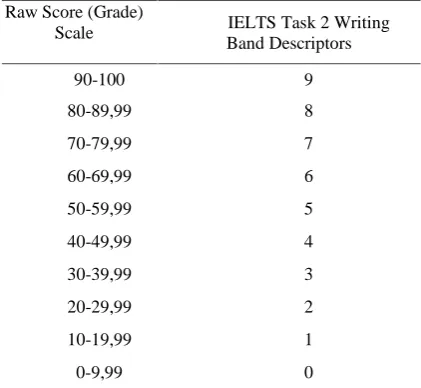
All of the five genres the students produced collaboratively and the Opinion essay they wrote individually during the final test were graded based on a modified IELTS Task 2 Writing Band Descriptors. The writing components graded taken from the rubric were as follows: task response, coherence and cohesion, lexical resource or vocabulary uses, and grammatical range and accuracy. However, as the IELTS Task 2 Writing Band Descriptors only provides exact point, from 0 to 9, a raw score/grade scale whose component descriptions were adjusted to those in the Band Descriptors was purposively designed as follows:
Table 1. Band Score Calculator For Students’
IELTS Task 2 Writing Band Score Prediction
Raw Score (Grade)
Scale IELTS Task 2 Writing
Band Descriptors
90-100 9
80-89,99 8
70-79,99 7
60-69,99 6
50-59,99 5
40-49,99 4
30-39,99 3
20-29,99 2
10-19,99 1
0-9,99 0
Each writing product had to be graded in raw scores instead of band scores to measure the
students’ English course final grades. Thus, the lecturer first marked each writing skill component of each essay and then set an equal percentage among the four writing components. Finally, the proportional component raw scores were summed to yield the final grade.
Of course, the lecturer based the raw score scaleon the IELTS’description on each level of the components. For example, the lecturer would mark a writing component with a score between 60 and 69.9 if it met the IELTS’
description of the component categorized as band score of 6.
2.5 Data ccollection and analysis
The data were quantitative collected from the
students’ Opinion essaywriting skill component grades.The students’raw score for each writing
component was tabulated and adjusted to IELTS Task 2 Writing Band Descriptors to get its IELTS band score prediction.
The quantitative data were described according to the writing skill component descriptions on the IELTS Task 2 Writing Band Descriptors. Based on the description, the grade equivalence of students’ each writing skill component to band score levels in IELTS Task 2 Writing Band Descriptors was predicted.
The author also used her weekly class observation to reveal the factors which might evoke the results of five genre writing approach
in the students’ IELTS Task 2 writing skills. However, the author remained to consider her study quantitative rather than mixed qualitative and quantitative as she did not disseminate a questionnaire nor conducted interviews to the students to confirm her field observation on the causes of five genre writing based practice results. She wanted to focus on assessing the
practice on the students’ IELTS Essay writing
performance.
3. FINDINGS AND DISCUSSION
3.1 How the Five Genre Writing Based Practice Impacts Students’ Writing Skills
Based on Table 2 displaying more distribution of students whose raw score or grade for task achievement component could be predicted to be equivalent with IELTS Writing Task 2 band score of 4 to 5, it was clear the students still had low writing skills to accomplish the IELTS typical essay task requirements despite their 6 times of five genre essay writing practice. Apart from it, they displayed weakness in choosing proper coordinating and subordinating conjunctions as cohesive devices to arrange the text coherently. What was good was part of them managed to demonstrate a fair ability in using range of grammar accurately. The students also succeeded to choose appropriate vocabulary in their essay as they were familiar with the topic given, resulting in good grades for the lexical resource component.
Table 2. The number of students with their writing component scores
Grade (Raw Score)
Scale
IELTS Writing
Task 2 Band Descriptor Prediction
TA C&C
LR G
R
-80-89.99 8 - - -
-70-79.99 7 - - 41
-60-69.99 6 3 - 34 41
50-59.99 5 58 43 7 23
40-49.99 4 18 39 4 22
30-39.99 3 7 4 -
-20-29.99 2 - - -
-10-19.99 1 - - -
-0-9.99 0 - - -
-Total
students 86 86 86 86
Note: TA = Task Achievement C&C = Coherence and Cohesion LR = Lexical Resource
GR = Grammatical Range and Accuracy
3.1.1 Low skill in task achievement
In detail,if the students’grades were adjusted to the IELTS Writing Band Descriptor for Task 2, no students managed to yield a grade predicted to be equivalent to band scores of 7 to 9, usually categorized as good-to-excellent. Only 3 students of 86 participants could be marked with grades predicted to be equivalent to band score of 6, a fair not yet satisfactory result. In task achievement component, of all students, 67.44% achieved grades predicted to be only equal to band score of 5, while 20.93% fell to band score of 4 prediction. Meanwhile, 8.15% got lower band score prediction of 3. As is put in the descriptor, band score of 4 to 5 generally indicates the writer at his/her best addresses the task only partially or respond to the task in a minimal way while band score of 3 refers to the
writer’s failure to address any requirements of the task sufficiently.
Based onthe author’sgeneral observation on the sub-components of Task Achievement the students should have accomplished, in this IELTS essay-like writing case, the students often ignored putting informational background at the beginning of the Introductory paragraph supposed to give a path for formulating the Thesis Statement to the given topic. Also, many students unconsciously negated their own Thesis Statement with irrelevant supporting paragraphs while explaining the Statement. The irrelevance seemed due to the students’ lack understanding of the role of Thesis Statement in an essay causing them to merely put it whereas their discussion and examples in supporting paragraphs failed to explain it.
Furthermore, they failed to use their genre writing practice experience to construct the background of the Introductory Paragraph and Supporting paragraphs correctly. Opinion essay as one of the Argumentative genre can be a mixed genre text. Sometimes, the writer of Argumentative text like Opinion essay should form the background of the Introductory Paragraph in a narrative way as it tells a history or descriptive for it depicts daily activities. Then, the writer may have to structure his/her supporting paragraphs in a procedural way. However, in the writing test the students did not follow the standard form and dominant language features of a genre whereas their elaboration tended to communicate the main idea usually delivered in the genre. They forgot about the genre-based text structures they had learnt and practiced.
3.1.2 Weakness in coherence and
cohesion
Eighty-two students or 95.34 % were weak in using correct and proper cohesive devices as transition markers to relate sentences and paragraphs coherent and cohesive. Most students only reached grades predicted to be equivalent to IELTS Writing Task 2 band score of 4 to 5. Their essays were found to contain misused conjunctions that presented incoherently arranged ideas and information.
3.1.3 Fair achievement in grammatical range and accuracy
On the contrary to the students’ low skills in the
task achievement and weakness in arranging coherent and cohesive sentences, about 41 students or 47.67% obtained grades predicted to be equivalent to band score of 6 in the IELTS writing task 2 rubric. The 41 students could use correct simple and complex sentences. However, they still failed to reduce their clauses if necessary making the sentences inefficient.
Other 45 students or 52.35% was predicted to only reach band score of 4 to 5 due to their limited range of sentence structures and repeated errors in fragment and run-on sentences, Subject and Verb disagreement, incorrect use of tense and redundancy. Despite the data, the rather balance number of students between predicted to get band score of 6 and band score of 4 to 5 suggested the five genre writing practicecontributed in the students’fair grammatical range and accuracy achievement upon writing IELTS writing task 2-like essay.
3.1.4 A hope for the use of lexical resource
About 41 students or 47.67% revealed good performance in vocabulary use marked with the grades predicted to be equivalent to band score of 7 in IELTS Writing 2 descriptor. Those students’
occasional errors in word choice, spelling and/or word formation.
Other 34 students or 39.5% was still at fair band score of 6 whereas 11 students or 12.79% showed low ability in word choice and use predicted to be equivalent to band score of 4 to 5.
So, overall most students were found to have a problem with text coherence and cohesion followed by task achievement and grammatical range and accuracy issues as was described in this table 3:
Table 3. Level of weakness of students’ writing
skills
Level of
weakness Writing Component
The number of
students with band
score prediction
of 4 to 5
1 Coherence and
Cohesion 82
2 Task Achievement 76
3 Grammatical Range
and Accuracy 45
4 Lexical Resources 11
Therefore, the students should engage in more intensive drilling or practice using coherence and cohesion, formulating the background for the Introductory Paragraph for correct Thesis Statement, collecting data and examples relevant to elaborate the Thesis Statement, arranging the suitable genre-based test structure and establishing the use of correct grammar.
3.2. Why the Five Genre Practice Failed on IT students’ performance on IELTS Writing Task-Like Essay
The results were quite unexpected as the students’ weekly assignment average grades demonstrated a series of fair-to-good enough writing skills as follows:
Table4. Students’weekly genre-based essay assignment average grades
Essay Genre Average grade
IELTS Writing Task 2 Band Score Pred.
Narrative 73.05 7
Descriptive 70.89 7
Procedural 65 6
Expository 67.26 6
Argumentative 66.96 6
Based on the lecturer’s weekly field notes to analyze the background, the factors causing significant result gap betweenthe students’five genre writing tasks and their IELTS writing-like essay test might be as follows:
1. Collaborative writing tasks demotivated the students to improve their writing skills independently. Though the collaborative approach pleased them as it saved their energy and time due to the chance for jointly doing each complex writing stage, in this case they became hesitant to self-practice building an individual writing habit, especially for writing complex texts like genre-based essays. For the reason, they became untrained to do complex writing activities independently from brainstorming to self-review under tight deadline. Based on the observation, the collaborative writing system might be replaced with independent writing approach to compel the students to self-focus, encouraging them to identify and fix their own weakness in writing skills.
2. Nevertheless, the IT students have hectic schedule and other course priority at the university as English is only supporting course, minimizing the possibility of practicing independent genre-based writing approach which will be time and energy consuming for both sides. Thus, it will be wiser if the collaborative approach is mixed with the independent approach but through other approach of teaching writing.
3. This raises a suggestion to also switch genre writing task-based practice to write for specific purpose teaching approach, which directs the learners to concentrate on studying and drilling only specific genre in line with what is expected from them to accomplish.
4
CONCLUSIONS
the students still performed low when they had to meet the sufficient IELTS typical essay task achievement and had problem with selecting correct cohesive devices for the coherence and cohesion of the essay texts. To be precise, they obtained a grade predicted to be only equivalent to IELTS band score scale of 4 to 5, described insufficient according to the IELTS Writing 2 Band Descriptor. So, the students should be given more intensive practice in modeling the essay especially in beginning the Introductory paragraph to formulate the Thesis Statement and constructing relevant explanations and examples to support the Thesis as well as choosing cohesive devices to arrange sentences and paragraphs coherently in proper text structure.
Also, so as to reduce the readers’ problem
with distracting essay due to many grammatical errors, the students should devote more time to practice grammar rules to build correct grammatical parts of speech despite their already fair achievement in the grammatical range and accuracy. They already have showed good vocabulary ability, yet it is recommended they remain to enrich the vocabulary by reading and practice using many more vocabulary in essay forms as the essay topic tested happened to be familiar with the students easing them to choose the appropriate vocabulary while discussing it.
All in all, it should be considered to change five genre writing task practice into a writing for IELTS purpose approach if the main objective of the writing class is to enable the students to already have had enough writing skills to pass IELTS Writing Test, especially IELTS Writing Task 2 band score categorized to reflect a good quality essay.
5
ACKNOWLEDGEMENTS
First, the author would like to thank her institution Del Institute of Technology which financially back up this study and presentation at this international seminar. Also, she thanked her students becoming the subject of this research who had worked hard in completing all essay writing tasks during the five genre writing practice classes and seriously performed as best as they could do in the IELTS writing test-like essay test. Finally, the author would like to express her gratitude for her colleagues in the Language Cluster who shared the information on this seminar and spared their busy time to review and give highly contributing feedback improving the quality of this research, and for her unconditional support from her family.
6 REFERENCES
Adyawati, E. N. (2015). A Study of the Teachers’ Beliefs in Using Communication Technology to Teach Writing. “Proceedings of the 9th International Conference, 61-71.
Basturkmen, H. (2008). Ideas and Options in English for Specific Purposes. New Jersey: Lawrence Erlbaum Associates, Inc..
Callaghan, Knapp, P., and Noble, G. (1993). ‘Genre in Practice.’ In B. Cope., and M. Kalantzis. (1993). (Eds). The powers of literacy. A genre approach to teaching writing. London: The Falmer Press. Jacobs, Holly L. Et.al. 1981. Testing ESL Composition: A Practical Approach. Newbury House Publishers, Inc. London.
Harmer J. (2007). “The Practice of English Language Teaching. 4th edition” Pearson, Longman
Hyland, K. (2007). Genre Pedagogy: Language, literacy and L2 writing instruction. “Journal of Second Language Writing”, 148-164.
IELTS Test Takers-My test score. Retrieved from
http://www.ielts.org/test_takers_information/getting_m y_results/my_test_score.aspx
Maarof, N. And Eliwarti. (2014). The Effects of Types of Writing Approaches On EFL Students’ Writing Performance, “Proceeding of SELT 2014’s Annual International Seminar on English Language and Teaching 2014,” 113-120
Napitupulu S (2010). Pemahaman Genre Dalam Ketrampilan Menulis Mahasiswa Bahasa Inggris FKIP Universitas HKBP Nommensen Medan. Jurnal Visi 18 no. 3, 314-328
Paltridge, B. (2004). Academic writing. Review Article Lang. Teach, 37, 87-105. DOI: 10.1017/S0261444804002216 Printed in the United Kingdom c_2004. Cambridge University Press. Raimes, A. (1983). Techniques in Teaching Writing. New
York: Oxford University Press.
Storch, N. (2005). Collaborative writing: Product, process, and students’ reflections. “Journal of Second Language Writing,”14, 153-173.
Doi:10.1016/j.jslw.2005.05.002
Swain, M., & Lapkin, S. (1998). Interaction and second language: Two adolescent French immersion students working together. The Modern Language Journal, 82, 320-337. Retrieved from