IMPACTS OF THE INDONESIAN GOVERNMENT POLICY
IN THE FIELD OF DEFENCE INDUSTRY ON THE OPERATIONS
AND SUPPLY CHAIN STRATEGIES OF PT PAL AND PT DAYA
RADAR UTAMA IN PRODUCING THE INDONESIAN NAVY’S
MAIN WEAPON SYSTEMS
DAMPAK DARI KEBIJAKAN PEMERINTAH INDONESIA
DI BIDANG INDUSTRI PERTAHANAN TERHADAP STRATEGI
OPERASI DAN RANTAI PASOK DARI PT PAL DAN PT DAYA RADAR
UTAMA DALAM MEMPRODUKSI ALAT UTAMA SISTEM SENJATA
TNI ANGKATAN LAUT
Syaiful Anwar
1Indonesia Defence University ([email protected])
Abstract – Two Indonesian companies, namely PT PAL and PT Daya Radar Utama (DRU), have been given the tasks by the Government of Indonesia to produce several warships for the Indonesian Navy. The Government has also issued a policy in the field of defence industry, which among others regulates matters related to the procurement of the TNI’s main weapon systems. This research is intended to examine the impacts of the policy on the operations and supply chain strategies of PT PAL and PT DRU in producing warships. By using descriptive qualitative analysis method, the Researcher analyzed empirical data obtained in the field research supported by several theories, namely theory of strategy, theory of operations and supply chain strategy, theory of public policy, and theory of self-sufficient. From the analysis, there are several findings. The policies have given a certain level of positive impacts on the industries, such as: the improvement of cooperations among them, the improvement of manufacturing process due to the product’s standardization, the improvement of self-reliance level of the industries, and the capability improvement of the companies due to cooperation with foreign parties. However, the policies still give negative impacts to the companies, such as: the low level application of the supply chain management, low level use of the domestic materials and ship’s components, and the low level of fair competition among domestic defence industries.
Keywords: operation strategy, supply chain, warship, PT PAL, PT DRU, Navy, Government of Indonesia, defence industry policy.
Abstrak – Dua perusahaan Indonesia, yaitu PT PAL dan PT Daya Radar Utama (DRU), telah diberi tugas oleh Pemerintah Indonesia untuk memproduksi beberapa kapal perang untuk Angkatan Laut Indonesia. Pemerintah juga telah mengeluarkan kebijakan di bidang industri pertahanan, yang antara lain mengatur hal-hal yang berkaitan dengan pengadaan sistem senjata utama TNI. Penelitian ini bertujuan untuk mengkaji dampak kebijakan strategi operasi dan rantai pasok dari PT PAL dan PT DRU dalam memproduksi kapal perang. Dengan menggunakan metode analisis deskriptif kualitatif, Penulis menganalisis data empiris yang diperoleh dalam penelitian lapangan yang didukung oleh beberapa teori, yaitu teori strategi, teori strategi operasi dan rantai pasokan, teori kebijakan publik,
Introduction 1
T
he Government of Indonesia (GoI) continually develops its capacity to defend the state. In the Law Number 3/2002 on the State Defence, it is mentioned that the State Defence is all efforts to defend the sovereignty of the state, the territorial integrity of the Unitary State of the Republic of Indonesia, and the safety of the nation from threats and disturbances.2In order to realize the development of its defence force, the GoI has determined the policy of building the strength of the main component of the State Defence Force, or TNI. The policy is named the Minimum Essential Force (MEF) of the Defence Main Component. This MEF is defined as a minimum standard of the TNI’s strength which is prepared as the main prerequisite and fundamental for the effective implementation of the TNI’s main tasks and functions in handling the actual threats.In line with the development of the TNI’s strength, the GoI also develops continuously the capability of the supporting component, particularly
1
2 Dephan RI, Buku Himpunan Perundang-undangan
yang Terkait dengan Penyelenggaraan dan Pengelolaan Pertahanan, (Jakarta: Biro Hukum Sekjen Dephan, 2007), p. 35.
the defence industry sector. The GoI has established several principles in the fulfillment of the TNI’s main weapon systems, which are mentioned in the Law No. 16/2012 on the Defence Industry, namely: (i) the users must use equipment which can be produced by the domestic industries; and (ii) the procurement of weapon systems from abroad can be carried out only if the domestic industries have not been able to produce them.3
Various efforts have been made by the GoI to meet the needs of the Indonesian Navy. Some of the fulfillment of weapon systems in the last period is conducted in various ways, namely: (i) purchasing products from abroad; (ii) jointly producing with foreign industries; (iii) producing based on technology transfer; and (iv)producing by several domestic shipping industries.4Although the procurement of the navy’s main weapon systems is from domestic sources, but various parties still observe various problems that arise. The main
3 Setneg RI, “Undang-Undang Republik
Indonesia Nomor 16 Tahun 2012 tentang Industri Pertahanan”, 2012. Downloaded from: http:// www.setneg.go.id, on 23 January 2018.
4 TNI AL, Alutsista Kebanggaan TNI Angkatan Laut
dari Masa ke Masa, Info Historia, Vol , No 3. 2014. Downloaded from http://www.tnial.mil.id/Portals, on 23 January 2017.
dan teori kemandirian. Dari hasil analisis, ada beberapa temuan. Kebijakan tersebut memberi dampak positif pada industri tersebut, seperti: peningkatan kerjasama di antara mereka, perbaikan proses manufaktur karena standarisasi produk, peningkatan tingkat kemandirian industri, dan peningkatan kemampuan dari perusahaan lokal karena kerja sama dengan pihak asing. Namun, kebijakan tersebut tetap memberikan dampak negatif kepada perusahaan, seperti: rendahnya penerapan manajemen rantai pasokan, rendahnya penggunaan bahan domestik dan komponen kapal, dan rendahnya persaingan usaha yang adil di kalangan industri pertahanan dalam negeri.
problems of the domestic defence industries are the low level of demand from users, the lack of demand-side sustainability, and the type diversity of main weapon systems ordered. This, in general, resulted in the low level of capacity of these companies in improving their ability, both in the development of human resources and in the conduct of research and development.
The operations and supply chain strategyof a company is a elaboration of the business strategy of the company concerned. The strategy is related to the preparation of broad policies and plans to use the resources of the company and must be integrated with corporate strategy.5 The strategy is an important element of the company in realizing the company’s policy of producing equipment ordered by the users or customers.
The policies that will be important variables in the analysis are the Law No. 16/2012 on Defence Industry and the Minimum Essential Force (MEF) of the Defence Main Component. The policies are government decisions that must be realized by all stakeholders. The policies will of course have profound effects on the business strategy of the companies involved, and will further affect the operations and the supply chain strategies of them. Some of the dimensions of the GoI policies to be implemented by the defence industry are:
5 F. R. Jacobs and Richard B. Chase, Manajemen
Operasi dan Rantai Pasokan, (Translated) 14th
Global Edition, (Jakarta: Salemba Empat, 2015), p. 33.
(i) cooperation between the integrators and the suppliers or vendors; (ii) the standard of production in accordance with the operational requirements of the users with the appropriate completion time on request; (iii) the use of domestic resources in the form of raw materials, materials, components, human resources, and research and development results; and (iv) cooperation with foreign parties in the manufacture of certain types of ship. These four dimensions are important factors which become the subject of deep discussion in this research and are made as the research problem. Because of the important of the problem, the Researcher focused on how and how far the impacts of the government policies on the operations and supply chain strategies of PT PAL and PT Daya Radar Utama (DRU).
From the explanation of the problems mentioned above, the Researcher decidesthat the research formula is: “What are the Impacts of Government of Indonesia’s Policies in the Field of Defence Industry on the Operations and Supply Chain Strategies of PT PAL and PT Daya Radar Utama (DRU) in Producing the Indonesian Navy’s Main Weapon Systems?”
formulation, the Researcher set four research questions as follows:
1. What are the impacts of GoI’s policiesfor internal cooperation on the companies’operations and supply chain strategies?
2. What are the impacts of GoI’s policiesfor the output standardization on the companies’operations and supply chain strategies?
3. What are the impacts of GoI’s policies for the use of domestic resources on the companies’operations and supply chain strategies?
4. What are the impacts of GoI’s policies for cooperation with foreign parties on the companies’operations and supply chain strategies?
Theoretical Framework Theory of Strategy
According to Clausewitz, strategy is the use of combat for the purpose of war. He further says that a strategist must set a goal for the overall operation of the war that would be in accordance with the aims of the war.6 While Antoine Henri Jomini conveys that strategy is the art of making war on the map, and further applying it to the whole battlefield.7 Basil H. Liddle Hart argues that strategy is the art of disseminating and applying military units in order to meet the targets of the policy. Goals should be balanced with the number
6 J. B. Bartholomees, “Theory of War and
Strategy”, Volume 1, US Army War College Guide
to National Security Issues. 13, 2012.
7 Ibid, p.14.
of means available, and the number of means used should be balanced with the values and purposes of the goals.8
US Army War College defines strategy as a relationship between the ends, ways, and means. It has also a definition that the art of strategy is the intelligence in formulating, coordinating, and applying the objective, the ways, and the means (supporting resources) to enhance and defend the national interests.9 Meanwhile Art Lykke states that strategy = ends + ways + means, which if unbalanced is assumed will pose a big risk.10
From some above opinions, it can be concluded that a strategy is a way used in order to achieve the goals that have been defined by utilizing all available resources. All three elements, i.e. goals, means, and resources, must be set in a balanced way to avoid the substantial risks posed by these imbalances.
Theory of Operations and Supply Chain Strategy
According to Jacobs and Chase11, an operations and supply chain strategy relates to the preparation of policies and broad plan to use the resources of a company and must be integrated with the company’s strategy. Meanwhile, according to Rusdiana, an operations strategy is a derivative of corporate strategy that detailing the overall
8 Ibid. 9 Ibid, p. 15. 10 Ibid, p. 48-50.
strategy of the vision and mission of the company.12 Sumayang argues that an operations strategy is a shadow or vision of the operation function, which is the driving force or determinant of direction for decision-making.13
From the above various opinions, we can see that the strategy they convey consists of several issues, namely: (i) a complete plan of operations and the supply chain; (ii) the plan is derived from the company’s strategy; (iii) the plan regarding matters relating to the use of company’s resources; and (iv) the objectives to be achieved by the effectiveness of operations and the supply chain.
The objectives in the operations and the supply chain strategy are intended as what is to be achieved related to the product to be produced. There are several options that can be taken by a company, namely (i) price leadership; (ii) produce different products in terms of quality; (iii) produce products in a faster time; and (iv) a mixture of the three previously described options (trade-offs).14
The second element of a strategy is the way to be selected to accomplish the defined mission or goal. Dilworth states that there are two choices of ways or manufacturing processes that can be selected by a company, namely: (i) job shop manufacturing; and (ii) repetitive
12 Rusdiana, Manajemen Operasi, (Bandung:
Pustaka Setia, 2014), p. 42.
13 L. Sumayang, Dasar-dasar Manajemen Produksi
dan Operasi, (Jakarta: Salemba Empat, 2003), p. 42.
14 F. R. Jacobs and Richard B. Chase, op.cit, p. 34-7.
manufacturing.15 Meanwhile Rusdiana states that a company can choose one of four production process designs, namely (i) focus on the process; (ii) repetitive process; (iii) continuing process; and (iv) mass customization.16
From the above explanations, it can be concluded that a company may choose one option from the following operations options: (i) Job-shop manufacturing; (ii) repetitive manufacturing; (iii) mass manufacturing; and (iv) continuous manufacturing.
The third element of the strategy that needs to be discussed is the resources or means to be used in the production process. Dilworth mentions that there are several resources to consider in developing strategies, namely: (i) the relationship between the company and its suppliers; (ii) production facilities; (iii) quality of human resources; (iv) technology and equipment; and (v) information systems.17 Meanwhile Kumar and Sureshmention that resources include: (i) men; (ii) materials; (iii) machines; (iv) information; and (v) capital.18
From these explanations, the resources or means used by a firm in the operations and supply chain strategy are as follows: (i) human resources; (ii) technology and machinery; (iii) production facilities; (iv) information systems; (v) production costs; and (vi) raw materials.
15 J. B. Dilworth, Operations Management. 2nd
Edition, (New York: McGraw-Hill, 1996), p. 52.
16 Rusdiana, op.cit, 74-8. 17 Dilworth, J. B, op.cit, p. 53.
18 S.A. Kumar and Suresh, Operations Management,
The fourth element of the strategy is the risk factor where it can generally occur due to a gap or a difference between the objective to be achieved and the way to accomplish the objective as well as the available resources. Jacobs and Chase argue that supply chain risk is the possibility of interference that will affect the ability of a company to continue supplying products or services.19 Burtonshaw-Gunnstates that the risks of the company can be: (i) technical risk; (ii) employment risk; (iii) political risks; (iv) social and geographical risks; (v) availability of resources, customs procedures, import duties, embargoes; and (vi) financial risk.20
From the above explanations, in the context of an operations and supply chain strategy, the risks involved are all possible unforeseeable barriers and disturbances that can stop or damage the production process. The risks may include: (i) technical risks; (ii) financial risk; (iii) risk of raw material availability; (iv) the risk of human resource availability; and (v) the risk of changing government policies.
Theory of Self-reliance
According to Johan Galtung, self-reliance is a principle applied by a country in the economy or in areas that are sub-systems of the economy. The basic rule of reliance is to produce what is
self-19 F. R. Jacobs and Richard B. Chase, op.cit, p. 40-1. 20 S. A. Burtonshaw-Gunn, Alat dan Teknik Analisis Manajemen, (Translated by Peni Rachmawati), (Jakarta: PT Indeks, 2011), p. 234.
need by using its own resources.21 Paul C. Godfrey defines self-reliance as the possession of a person toward a resource that goes beyond his or her needs, and a person’s ability to acquire and hold that resource. Ownership is the external output, something that depends on the person’s internal ability. Self-reliance contains two parts inherent in the ability, namely the ability to think, and the ability to act.22
From the above explanations, it can be summarized that self-reliance is ability of a country to produce its own needs, using its own human resources, its own economic resources, its own natural resources, in order to obtain maximum gain or benefits from the activities, and also to obtain maximum level of freedom to think and to act according to its own needs and capacity.
Theory of Public Policy
Harold Laswell and Abraham Kaplan provide the definition of public policy as a program projected with certain goals, certain values, and certain practices as well.23 Meanwhile Thomas R. Dyestates that public policy is everything the government does, why they do it, and
21 J. Galtung, “Towards A New Economics: On the
Theory and Practice of Self-Reliance”, in Paul Ekins (Ed), The Living Economy: A New Economics In The Making, (London: Routledge, 1986), p. 100-3.
22 P. C. Godfrey, More Than Money: Five Forms of
Capital to Create Wealth and Eliminate Poverty,
(Standford: Standford University Press 2014), p. 23-9.
23 H. Laswell, and Abraham Kaplan, Power and
the results that make a life together look different.24 Another expert, Riant Nugroho concludes that public policy is a decision made by the state as a strategy to realize the objectives of the country concerned.25
From the opinions we can see that
public policy contains several elements, namely:(i) public policy is a formal document or practice of the state; (ii) public policy is intended to respond the will of the public or the state; (iii) public policy is made or done in order to lead to better conditions of society or country; and (iv) public policy contains the rights and obligations of the parties stated in the policy.
The second issue of public policy is policy analysis. According to Dunn, policy analysis is an intellectual and practical activity aimed at creating, critically appraising, and communicating knowledge about the policy process. The procedures used in analyzing the policy are: (i) definition; (ii) prediction; (iii) prescriptions; (iv) description; and (v) Evaluation.26
If we look at the above explanations, the assessment of the consequences or effects of a policy on something falls within the scope of the policy analysis. The object of this research to be carried out by the Researcher is to examine the impacts of the Indonesian government policies on the defence industries and
24 T. R. Dye, Understanding Public Policy, (New
Jersey: Prentice Hall, 1995), p. 2.
25 R. Nugroho, Public Policy, (Jakarta: Elex Media
Komputindo, 2008), p. 55.
26 Ibid, p. 131-2.
the development of the main defence component’s strengths to the operations and supply chain strategies of the defence industries, in particular the companies involved in the manufacture of the navy’s main weapon systems (NMWSs).
The assessment of a policyimpact stated by Rossi and Freemanis intended to estimate whether the intervention produces the expected effect or not. Such estimates do not yield definite answers but only a few possible answers that make sense. The basic purpose of impact assessment is to estimate the “net effect” of an intervention.27
By examining from the micro aspect, in this case the operations and supply chain strategy aspect, the Researcher will obtain an answer or can conclude about the actual impacts of the policy. The findings in this micro scope will ultimately provide input to the macro aspect which is the government policy in building the capability of the defence industries. With reference to the above explanation, the efforts to be taken by the Researcher are to compare the dimensions of the components (strategy, objectives, types of operations, resources, risks, and cost) before and after the companies obtain jobs in manufacturing the NMWSs.
Defence Industry Models or Practices in Some Countries
Brazil develops its defence industry in order to relinquish its dependence
27 P.H. Rossi and H. Freeman, Evaluation: A
Systematic Approach, 2nd Edition, (California: Sage,
from foreign parties, as well as to gain foreign exchange through the export of its defence industry products. It choses to manufacture its marketable defence equipment at its regional level, namely: Super Tucano A-29 fighter, ASTROS II rocket launcher, EE-11 troop carrier, and light weapons. Its export products can thrive as there is effective support from its government.28
China develops its defence industry in order to meet its military needs, and at the same time maintains the status of its defence industry which has a certain degree of autonomy. It still maintains its independence in producing military equipment. However, it also develops cooperation with other countries, such as with Pakistan in designing and producing jet combat aircraft JF-17.29
India develops its defence industry in order to meet its military needs. It has succeeded in reducing dependence on overseas suppliers by designing, developing, installing and producing its own equipment. India cooperates with the United States in the missile programs, and ToT of F-16 as well as F/A-18 fighter aircraft. It also collaborates with Russiain producing BrahMos missile, the development of remote missiles, and the Glonas satellite navigation system. India also cooperates with Israelin the
28 P. Yusgiantoro, Ekonomi Pertahanan: Teori dan
Praktik, (Jakarta: Gramedia Pustaka Utama, 2014), p. 202-5.
29 J. D. K. Boutin, “Arms and Autonomy: The Limits of China’s Defence-Industrial Transformation”, in
Bitzinger, R. A. (Ed), The Modern Defence Industry,
(California: Praeger Security International, 2009),
p. 218-21.
PHALCON project, and several types of missile.30
The relations between the Govern-ment Policies on Defence Industries and the MEF with the Operations and Supply Chain Strategy
The GoI’s objectives in developing or building the defence industries are: (i) realizing a professional, effective, efficient, integrated, and innovative defence industries; (ii) realizing self-reliancein fulfilling the defence and security equipment; and (iii) improving the capability to producethe defence and security equipment. The defence industry is also an integral part of the state defence system that embraces the people’s defence system. Therefore in the law is re-emphasized the function of the defence industry, namely: (i) strengthening the defence industry; (ii) developing technology; (iii) promoting economic growth; (iv) establishing self-reliance of the state defence and security systems; and (v) building and improving human resources capability.
While the GoI’s policy on the MEF Main Component concerning the development of the sea power includes the provisions on the procurement of warships for the Navy. Prior to entering into a weapon system purchase contract, the organization specifies the standard, amount, and time of completion of each ship ordered. The number of ships
30 T. D. Hoyt, Military Industry and Regional Defence
ordered is aligned to the program plan and budget that has been made. While the delivery time of the ship is adjusted to the plan.
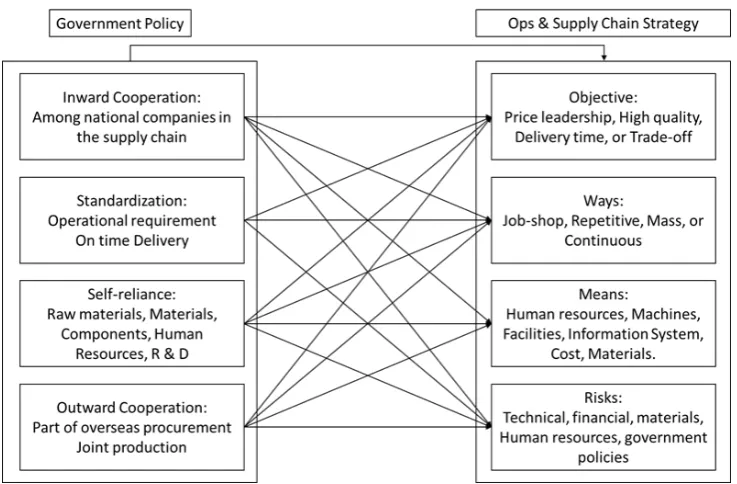
In this study, the main variable is the government policy, and the sub variables are the factors mentioned in the policy, namely: (i) inward cooperation; (ii) standardization;(iii) self-reliance; and (v) outward cooperation. While the second variable is the operations and supply chain strategy of the studied companies which contains four sub variables, namely: objective, way, resources, and risk.
Analysis of impact of a policy is conducted by comparing the variables and sub variables of the research object, with a focus on searching conditions before and after the implementation of policy. Thus, the analysis of this study will focus on the impact of policy variables in general on the operations and supply
chain strategy, and specifically on the impact of sub variables from the first variable to the sub variables of the second variable. The relationship of these factors is illustrated in Figure 1.
Previous Relevant Researches
compete intently because of limited resources, and still difficult to access the market due to limited human resource capabilities and supporting facilities. The second research is the study of Radhana Dwi Wibowo in 2016 with the title “The Problems in Realizing Defence Industry Self-Reliance.” This study analyzes three issues that arise in realizing the self-reliance of the defence industry, namely: the defence industry actors, the continuity of ordering equipment for defence and security equipment, and the ability of the defence industry to meet the specifications desired by the TNI. The third study is the research of Andyawan Martono Putra in 2014 with the title of “Civil Military Integration in the Field of Technology and Industry in Defence Industry of Indonesia.”This research analyzes the civilians and military integration ontechnology and industry sector in the Indonesian defenceindustry.
Framework
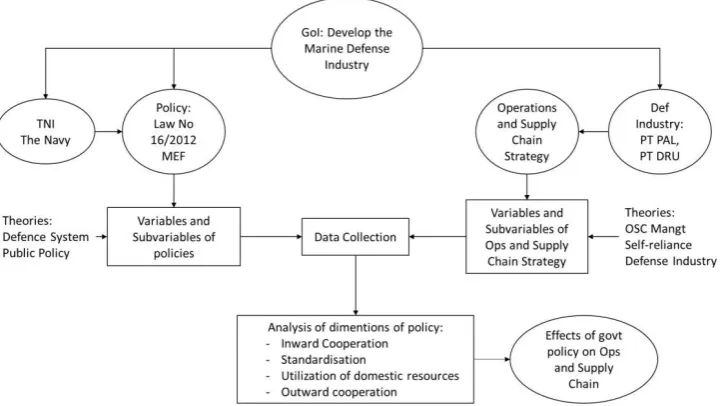
Framework of hypotheses of this research is illustrated in Figure 2, where the Researcher explaines the sequence of effort in addressing the research problem to the expected output of this study. In order to build a strong, resilient and high deterrence power, the GoI has made efforts to strengthen the state’s sea defence component, among others by increasing the capabilities and strengths of the navy, in particular the addition of the number of the navy’s warships. At the same time, the GoI also concerns to build the capability of the defence industry in order to have better capabilities, with increasing production capacity, as well as self-reliance and independence from foreign parties. To realize these two objectives, the GoI issued a policy in the form of Law No. 16/2012 on Defence Industry and the MEF Development Plan of the Defence Main Component.
In responding to these policies, the defence industry prepares a plan or business strategy that can accommodate what the government requests. There are several companies appointed by the GoI as the main integrator of the manufacture of the navy’s main weapon systems (NMWSs), two of them are PT PAL and PT DRU. Both companies are made by the Researcher as the research objects. Both companies in implementing the production process of the NMWSs have developed operations and supply chain strategies in accordance with the type of products made. Policy impact analysis is carried out on the variables of the operations and the supply chain strategy in general. However, in order to obtain a more detailed picture, then the strategy variables need to be spelled out into several sub variables.
Based on the determination of the relationsamong variables and among sub-variables, then the Researcher can determine the information and data needed for the analysis of this research. Based on the results of the collection of information and data, then the Researcher will conduct the analysis supported by several theories related to the policy’s impact and also the operations and supply chain strategy. The output of this analysis is the impact of GoI’s policies on the operations and supply chain strategies of PT PAL and PT DRU.
Research Method
Researcher uses qualitative research methodology with case study method. According to Robert K. Yin, case study is an empirical inquiry that investigates phenomena in the real-life context; when the boundaries between phenomena and context are not visibly apparent; and where multi-source evidence is utilized.31 The Researcher considers that the characteristics of this research are very suitable with the characteristics of the method of case studies stated by Robert K. Yin.Based on the explanation of the method used, the approach of this research will consist of several steps, namely: (i) conducting analysis to find and establish subvariabel of the government policy variable; (ii) analyzing the second variable of the operations and supply chainstrategy; (iii) illustrating the relations between the variables and between sub variables; (iv) collectingprimary and secondary data; (v) conducting a qualitative analysis using the case study analysis method; (vi) performing validity tests; and (vii) making a conclusion.
The primary data source in this study is the competent informants (subjects), who relate to the settings of the problems studied.32Therefore, the Researcher will collect data from statements and words from officials of PT PAL and PT DRU related to the production process of the NMWSs, the MoD officials and the Indonesian Navy 31 R. K. Yin, Studi Kasus: Desain dan Metode,
(Translated by M. Djauzi Mudzakir), (Jakarta: Raja
Grafindo Persada, 2009), p. 18.
32 Iskandar, Metodologi Penelitian Kualitatif,
officials.
The field studywas conducted by the Researcher by visiting PT PAL and PT DRU, the MoD, and the Navy Headquarters. This field study was conducted in order to carry out direct interviews with informants and observe the production process of the NMWSs being undertaken by both companies. The Researcher conducts structured interviews by applying the techniques defined by Moeleong, in which the Researcher will establish his own problems and questions to be asked, in order to find answers to the hypotheses that have been established.33The questions have been strictly conceived by making an interview protocol.
The qualitative data analysis according to Bogdan and Biklen is an effort done by working with data, organizing data, sorting it into manageable units, synthesizing it, searching and finding patterns, finding what is important and what is learned, and deciding what can be delivered to others.34 Data processing as described above, according to Prastowo is similar to Miles and Huberman’s model which divides the activities into three processes: (i) data reduction process (ii) data display process; and (iii) conclusion and verification process.35
The validation of data was conducted with the intention to test the
33 L. Moleong, Metode Penelitian Kualitatif. Revision
Edition, (Bandung: Remaja Rosdakarya, 2007), p. 138.
34 Ibid, p.248.
35 A. Prastowo, Metode Penelitian Kualitatif dalam
Perspektif Rancangan Penelitian, (Yogyakarta: Ar-Ruzz Media, 2012), p. 241-50.
validity of data, where in this study the Researcher used triangulation technique. According to Moleong, triangulation is a technique of checking the validity of data that utilizes something else outside the data for the purposes of checking or as a comparison of that data.36
The research was conducted in two companies, namely PT PAL and PT DRU located respectively in Surabaya and Jakarta, and the MoD and the Navy Headquarters both in Jakarta. In those places, interviews were conducted by the Researcher to the informants. While the survey that directly observes the production process of the NMWSs that being produced was done in locations where both companies have shipyards, namely in Jakarta, Surabaya, and Lampung. The time of the research and the writing of research report were conducted in the period of July until October 2017.
Research Result and Discussion Research Result
PT PAL is a State-Owned Enterprise (SOE), located in the northern area of Surabaya, East Java, Indonesia. The main business activities of this company include: (i) producing warships and commercial vessels; (ii) providing ship repair and maintenance services; and (iii) providing general engineering with certain specifications based on client needs. Currently the company is developing products that will be marketed domestically and abroad, especially
warships and state ships according to orders, among others from the MoD, the Indonesian Police, the Ministry of Ocean and Fishery, the Ministry of Energy and Mineral Resources, the Ministry of Finance, and overseas institutions. Products that have been mastered by this company include: 125 meter Landing Platform Dock (LPD), 60 meter Missile Fast Ship, 57 meter Fast Patrol Boat (FPB 57), 1200 GT Survey Ship, Fast Patrol Ship up to 38 meters, Tugboat and Anchor Handling Tug, Fishing Vessels up to 60 GRT, and Ferry and Passenger Ships up to 500 pax.
PT DRU is a private company established in 1972 at Tanjung Priok Port, Jakarta. The company started business as a general trading and services company, including shipbuilding business. Until now at the age of nearly 50 years, the company has completed the construction of hundreds of ships in various types and sizes such as Roll on Roll off (RORO) vessel type, cargo ship, tanker, navy’s patrol boat, fast patrol boat, tug boat, and speed boat.Landing Ship Tank (LST) is a product built in order to strengthen the strength of the fleet of the Navy. The company has accomplished one unit of this type of vessel by mid 2015, and is now producing several more for the same type subsequently ordered by the GoI.
PT PAL and PT DRU in producing warships orders, cooperate with the domestic defence industries. This cooperation is conducted for the fulfillment of the main components,
supporting component, and raw materials, as stated by the PT PAL’s Head of Procurement Division:
“Our strategy in procurement is that we have 3 philosophies, namely on quality, on budget and on schedule. First on quality, we fit the design and adjust the new specifications followed on budget and on schedule.”
In terms of the employment of human resources, PT PAL and PT DRU also cooperate with partners who are used to working with them. Some technical workers are taken from outside the companies, and also some works are carried out by the sub-contractors who are already partners of these companies.37The company’s strategy in dealing with the subvariabel of risk is conducted in its own way according to the type of risk faced by the companies. In relation to financial risk, PT PAL has a strategy of cooperating with third parties who can assist with funding.38 However, PT DRU in this context, does not cooperate with other parties, they manage the company’s cash flow as best as possible so that it can run the production smoothly.39Another risk that may be faced is the risk of availability of raw materials for production. PT PAL and PT DRU have cooperated with raw material suppliers. PT PAL uses long-term contracts in cooperation with the domestic industries, while PT DRU uses vendors’ database in an effort to address
37 Interview with PT PAL’s Head of Production
Division, 2017.
38 Interview with PT PAL’s Head of Finance Division,
2017.
39 Interview with DRU’s Head of Business
raw material risks.40
There are five procurement strategies of PT PAL, namely Priority, Frame Agreement, Contract Priority System, Stock Level, and the Ministry Project Standard.41Meanwhile, PT DRU overcomes the availability of raw materials by fostering good trade relations with its suppliers. This was conveyed by the DRU’s Head of Business Development that they maintain relationships with suppliers, who are members of the marine community, so they know the names of the vendors and the types of goods they have.
From the above description, it can be concluded that the operations and supply chain strategies of PT PAL and PT DRU toward subvariabel ‘inward cooperation’ have been implemented, seen from the sub-variable ‘objective’ that use ‘mix strategy’ or trade-offs; the sub-variable ‘way’ that use the Job-shop manufacturing strategy; the sub-variable of ‘resource’that use contract strategies for HR and raw materials; and use contract strategies to deal with sub-variable ‘risks’.
As a company that produces combat ships, PT PAL always prioritizes the fulfillment of operational requirements of the main weapon system. The company is committed to use raw materials in line with the standards of warship safety. It is also stated by the PT PAL’s Head of Procurement Division that in every procurement, it always adjusts the quality
40 Interview with PT PAL’s Head of Procurement
Division, 2017.
41 Interview with PT PAL’s Head of Procurement
Division, 2017.
and standard of material in accordance with the request of the users and the standardization of the MoD. PT DRU also undertakes shipbuilding in accordance with the requests from the ship users. For example, for the navy’s ships, because of the functions concerned, some parts of the ship’s body need to be thickened.42
For the production of combat ships, there is a constraint for PT PAL, which is caused by the ship production method itself. In the construction of LPD vessels in cooperation with Daewoo Company of South Korea, it used a block system where the ship construction was divided into small parts, therefore it took a longer time for the completion. In contrast to PT DRU, the navy’s ship building process is in accordance with the delivery time required by the Navy, therefore PT DRU obtains someother ship orders.
In their production activities, the defence industries shall prioritize the use of domestic raw materials, materials, and components, including human resources and the national R & D results. In this case PT PAL and PT DRU have used raw materials and components from inside the country. The steel for ship platform is supplied by PT Krakatau Steel. While other components, such as engines, and cranes, are supplied by PT Pindad, and casting is supplied by PT Barata Indonesia. Other supporting products such as doors, pipes, steel furniture, anti-fire curtains on boats are supplied by various domestic companies that have become partners of
42 Interview with PT DRU’s Head of Business
PT PAL.43
The DRU’s Head of Business Development also states the same matters that they have used several state-owned companies in terms of material compliance. PT DRU orders cranes and anchors to PT Pindad, and orders steel plates to PT Krakatau Steel. In PT DRU, all ship production processes are conducted in certain level of self-reliance using the Indonesian employees. However, for certain specialists, they use foreign workers with a short-term contract. The use of human resources from within the country is also required by the Indonesian Navy during the production of LSTs, where it is not allowed to use foreign employees.
In the context of foreign procurement, there will be cooperation between the domestic defence industries with foreign companies in the form of joint production. Opportunities for cooperation with foreign parties have been taken by PT PAL and PT DRU by purchasing certain components that can not be produced by domestic industries. PT PAL has cooperated several times with partners from abroad such as Damen, a company from Netherlands and Daewoo, a company from South Korea. This cooperation opportunity is utilized to improve the ability of PT PAL in producing warships.
The GoI’s policies, especially the Law No. 16/2012 on Defence Industry and the MEF Main Component are implemented
43 Interview with PT PAL’s Head of Procurement
Division, 2017.
with the supervision from the MoD as the regulator in procurement of TNI’s main weapon systems. The essence of the policy is that the fulfillment of main weapon systems can be carried out by implementing two strategies. For main weapon systems that can be manufactured in the country, it is mandatory for the Indonesian users to procure and purchase them, while foreign procurement through import can only be conducted if the domestic industries have not been able to produce such main weapon systems.
The Director of Domestic Industry Technology of MoD, First Marshal Gita Amperiawan conveyed that the supervision of the implementation of defence industry policy in general can be seen from how the progress of government priority programs.As long as the priority programs are well underway, it means that the defence industry is developed within the policy corridor. While the next supervision is how the implementation of off-set rule. In terms of supply chain and production management, the success of government policy implementation can be seen from how SOEs are able to act as lead integrators, and are capable to foster the second and third tiers of the defence industries.44
Other forms of oversight of the defence industry policy were stated by Major General (Ret) Jan Pieter Ate. For the military equipment procurement programs, the oversight is conducted by
44 Interview with First Marshal Gita Amperiawan,
the MoD’s Inspector General, the TNI’s Inspector General and the State Finance Oversight Agency. Meanwhile, the oversight for the implementation of the defence industry policies is conducted by the MoD. The supervision to PT PAL and PT DRU is carried out by the Directorate of Domestic Defence Industry of MoD, either directly or through a verification and monitoring program, or inviting the industries to attend various meetings conducted by the MoD.45
As the regulator, the GoI’s role is to encourage the defence industries to become lead integrators. The industries must be able to determine strategies to achieve profit for the companies. However, the government also supports fairly all industrial development works, where almost all their activities are paid by the government. Therefore with the man-hours are already paid the government, it is expected that SOEs can make profit.46
The advantage possessed by the domestic defence industries is that they are geographically close to the users. For example the Navy’s Eastern Fleet is close to PT PAL and the private shipyards in Lamongan, while the Navy Western Fleet is close to Tanjung Priok Port. This is an advantage over imported producers when there are technical problems, it will take a long time to bring in technicians to deal with disruptions. Regarding the product completion, stated by MG Ate that the weakness of domestic industries,
45 Interview with MG (Ret) Jan Pieter Ate, 2017. 46 Interview with First Marshal Gita Amperiawan,
2017.
especially SOEs, is delivery time. Another thing is after-sales service, which should be paid attention by the manufacturers. An example of delay in delivery experienced by the Navy is the production of LPDs that are two years behind schedule.47
Another issue that the Navy complains about is that the products of domestic industries are still in the development phase. It is mentioned by the Navy’s Head of Material Division that if the navy procure ships from the domestics industries, the status of the products is still in the engineering phase, which means they still need to be tested first in various operational fields. Another obstacle perceived by the Navy against the ability of the domestic defence industry is the lack of maintenance capability. Not all types of maintenance can be carried out domestically, for example for gas turbines. In addition, the combat vessels that are not in accordance with the technical specification of the Navy has also been experienced by the Navy, which is at the time of construction of KCR 40. The company could not install the Combat Management System (CMS) desired by the navy on the ship, because between them cannot be fittedtechnically. Furthermore, the ship did not meet the navy’s operational requirements, because there were stiil several weaknesses, such as: ship speed that still lower than expected, CMS that did not fit with the ship space, and spare space in the engine room that was not sufficient for the
operators movements.48
MG (Ret) Jan Pieter Ate also states that the reluctance of TNI in using domestic products causes the domestic defence industries to have difficulty in mastering technology, because their products are not used optimally by the TNI. Therefore, TNI is expected to be ready to use domestic products in order to build the Indonesia’s domestic defence industries. In the event of a war, all logistics and overseas procurement lines will be inhibited by the opposing party, while the domestic defence industry is not developing, so that Indonesia will find difficulties to survive.
Discussion
The Law Number 16/2012 on Defence Industry arranges several issues, one of them is regarding the actors of the production process of defence equipment. The policy regulates coverage of actors from the defence industries, including: (i) major equipment industries; (ii) main component and/or supporting industries; (iii) component and/or supporting industries (supplies); and (iv) the raw material industries. The policy mandates that the conduct of defence industry in producing defence and security equipment is implemented through inter-defence industry cooperation in the country. Generally, those who obtain a contract from the GoI in the procurement of the NMWSs are SOEs or domestic
48 Interview with Navy’s Head of Material Division,
2017.
private companies, which in this case implicitly put them as lead integrators.
The government’s policy mandates that both SOEs and private companies which awarded contracts or mandates as lead integrators are required to conduct supply chain management. The supply chain is defined as a group of mutually participating and interconnected companies seeking the added value of a modified input stream from their sources to become the finished product or services demanded by the end customers to which they are destined.49From the understanding of the supply chain, there are several companies involved as suppliers, suppliers of suppliers, OEMs (Original Equipment Manufacturer), distributors, and customers. Therefore, in the context of this research, PT. PAL and PT. DRU as OEMs or lead integrators, need to implement supply chain management. The practice and activities of supply chain management consist of three major parts, namely: (i) supply chain configuration; (ii) supply chain relationships; and (iii) supply chain coordination.50 Companies that act as lead integrators or OEMs can build relationships among companies engaged in the supply chain with the goal of achieving long-term stability, which is called stable network. They can also choose the way that the aim is to build dynamic networks. Most of them are short-term relationships with distributors and suppliers to achieve operational
49 D. Lu, Fundamentals of Supply Chain Management,
2011. Downloaded from bookboon.com, p. 9-10.
flexibility and strategic agility.51
Cooperation with various national companies in order to produce warships is realized by PT. DRU. However, the supply chains of such raw materials and components should be ensured not to affect their production strategies that prioritize the quality and delivery time appropriate to the contracts they receive. This is evidenced by the completion of the government order for the first LST, hereinafter named KRI Teluk Bintuni 520, which is now operationalized by the Navy.52
PT. PAL is also often trusted by the GoI to produce warships which will be used by the Navy. In carrying out the production
of various types of warship, such as FPB 57, LPD, KCR 60, PKR, the company acts
as lead integrator to assemble products made by various national companiesalso conducts a good supply chain with several national companies. This is applied so that the results obtained can satisfy various parties, from the producers, consumers, and the government as regulator. This is conducted in order to meet the government’s expectation of cooperation with various national companies in order to increase the local content of the warships produced, as well as to meet user expectations regarding product quality assurance and the products delivery time in accordance with the contracts.53
51 Ibid, p. 31.
52 Interview with PT DRU’s Head of Business
Development, 2017.
53 Interview with PT PAL’s Head of Production
Division, 2017.
From the above explanation, it can
be seen that the GoI’s policies regarding cooperation with the domestic industries have given positive impacts to the companies as the lead integrators. The cooperation among themhas produced
certain level of benefit to them in terms of finance, capacity building, and also
self-reliance. The domestic resources, human, material, and also expertise, are optimally utilised by the industries, in order to develop the national defence industries.
not ready to supply the needs with short time notices. Second, ordering items by searching catalogue of various suppliers and vendors will take time and for some circumstances is very uncertain about the availability of the items and also their technical specifications.Third, the law of supply and demand will apply in this method, therefore for some items the order costs and the items’s prices can be higher than market prices.
Another important issue that need to be discussed is the product’s standardization. The intention of this research is that the standardization of the military equipment produced by the producers shall be in accordance to the user’s master plan in the form of operational requirements of each equipment ordered. Operational requirements set by the users are based on thefunctionality of warship to be manufactured by the producers.After accomodating the requirements of the users, then the government will approve the requirements to become standard for design and production by the producers. With this standard, all stakeholders involved in the manufacturing process will have a defined document that can be used as guidance in involving themselves in the programs.
There are several functions of the product’s standard which have been decided by the government. First, it can be used for designing the products that to be manufactured by the producers.
According to Kotler, design is the totality
of features that affect the appearance
and function of certain products implied by the users.In the case of this design it is further said that in making the design, the factors that need to be considered are: style, durability, reliability, and reparability.54
Second, it can make the production process simpler and the product completion time is relatively shorter, because the product’s characteristics
have been defined properly, therefore
there is no need further negotiation
regarding the specifications of the
product. The product completion factor is very concerned with proper production planning and operation. The planning is an important key step in the overall management process. The main steps in making a plan are as follows: (i) determine the objectives to be achieved; (ii) determine the status of the company; (iii) determine the factors that support and which impede the achievement of the objective; and (iv) formulate activities to be carried out.55
The GoI’s policy regarding the ship standardization has given a certain positive impact to PT DRU. In the making of LST ordered by the government, PT
DRU has learned sufficiently from the making of first ship. Therefore, in the
making of the subsequent LSTs, the process is much easier. They do not have to do the design process from the scratch anymore, they do only some minor
54 Rusdiana, op.cit, 160-1.
changes for the subsequent ships’ design. In the production process, the company obtain advantages from the GoI’s policy, because the company conducts the same shop works, and install almost the same components or ship’s parts.
However, even the policy is already implemented appropriately, the company cannot apply the repetitive production strategy, which actually the best strategy in operations management. With this strategy, the company will get advantages, because human resources and equipment for the production process are special for the purpose of making warships. Therefore, by applying the repetitive operations strategy, the completion time of ships will be much shorter. In fact, the company still apply an operations strategy, which they call it ‘a multipurpose manufacturing system’, meaning a system that can be used either for producing warships or commercial vessels.This condition is caused by the
fluctuation of ship order by government,
for certain time the order is relatively high, but for certain time it is very low.
In general, this operation strategy can run appropriately, however for certain works, they subcontracts them to foreign contractors, and also they use foreign warship experts to installseveral ship’s components.56
PT. PAL, who often get the mandate from the government to produce warships, transport vessels and combat vessels, conveys that in terms of design, PT. PAL has a Ship Design Division, so
56 Interview in Jakarta, 11 December 2017.
this division learns from their partners in joint production. Actually, the design for the joint production has been decided as the standard for the ship. However, after
the cooperation is finished, the company
cannot use the initial design from the foreign partners. PT PAL, to meet the subsequent orders, has to do the process
from the beginning. For example, after
the cooperation with a German company
in producing FFB 57, for the subsequent
orders, the company has to make its own design, and the new type of ship called
KCR 60, which is actually based on the technology of FPB 57. Another example is
the making of SSV, which is designed by PT. PAL with reference of LPD, which is a joint production between PT. PAL and South
Korean Daewoo Company.From these
examples, it can be observed that the GoI’s policy regarding the standardization has not given a proper positive impact for the company, because it has to modify the initial ship design and also the manufacturing process when they start to produce ships by themselves. With this circumstance, the process of making a ship is relatively longer and more costly.57
In organizing the defence industry development, the GoI has issued a policy on the development of a strong and self-reliance defence industry. What is meantby self-reliance here is that the defence industries conduct the military equipment production process smoothly without any political and economic hurdles from other countries. Besides that our defence industry is built so
that if successful can provide economic
benefits for the nation. For that objective,
the government has issued a policy that the defence industry in its production activities must prioritize the use of domestic raw materials, materials, and components, including human resources and national R & D results.With the use of domestic resources, the national industries will emerge properly, and can
self-reliantly fulfill the governmentneeds.
The term self-reliance is a principle applied by a country in the economy or in areas that are sub-systems of the economy. The basic rule of self-reliance is to self-produce what is self-need by using its own resources. The principles in establishing self-reliance are: (i) some market mechanisms must be found to satisfy basic human needs; (ii) need to
figure out how we can produce what
we need; (iii) we must resist all forms of threat and violence, coming from outside; and (iv) establishing self-reliance should be at all levels: national, local, territory, and function.58
The GoI’s policy regarding self-reliance has given a certain positive impact to the defence industries. PT. DRU in executing the manufacture of LSTs, ordered by the Navy, refers to the policy of the GoI to maximize the use of domestic resources. About human resources, this company uses the workers from within the country, only for certain purposes they bring in experts from abroad. LST’s design is conducted by domestic experts. The company has maximized the use of
58 Galtung, op.cit, p. 100-3.
domestic raw materials, such as: steel plate, iron pipe, paint, and cable. While some components, such as cranes, doors, air conditioners, are supplied by domestic vendors.59
PT. PAL in producing KCR 60 and SSV
has also maximized domestic resources in order to build the self-reliant company.
The company has a sufficient piece of land
and facilities to produce various types of vessels. Human resources, working in the designs and manufacturing processes of these types of warships, are from within the country.The raw materials used, such as steel plates, pipes, paints, all come from within the country. While the necessary components, such as cranes, doors, casting, steel furniture, ceilings,
floors, bolts, nuts, are from within the
country, supplied by domestic suppliers. However, ship engines, and weapons, are still imported from abroad.60
The implementation of the GoI’s policy has not run as expected. Both companies still cannot fulfill their function as the lead integrators properly. Several materials and components can not be supplied yet by the domestic companies. Some of them do not produce such kind of components because their lack of knowledge and expertise regarding the materials and components. Some of them cannot meet the lead time of orders defined by the lead integrators, which are generally very short and very sudden. Some of them tend not to joint the programs, because based on
their considerations, the programs are economically not profitable for them. This condition has caused the self-sufficient policy achievement is still far from the expected. Some certain of the benefit cannot be enjoyed by the domestic companies, and also the Indonesia’s self-reliant state defence development program still contains a certain level of risks.
In the Law Number 16/2012 on Defence Industry, the GoI allows the domestic defence industries to cooperate
with foreign parties. Cooperation with
foreign parties is also often associated with the procurement programs required by the users but cannot be produced yet by the domestic industries.The procurement programs from overseas for the TNI’s main weapon systems can be conducted by the relevant government institutions with some of these conditions:
(i) the procurement must implemented in a government-to-government (G-to-G) basis; (ii) certain parts of the programs should contain joint productions between the equipment producers and the Indonesia’s domestic defence industries; (iii) the procurement programs should be accompanied by technology transfer; (iv) the procurement programs should be
also accompanied by an offset; (v) there
should be a guaranteed freedom of use in accordance with the interests of the buyers; and (vi) it should be guaranteed by the availability of the weapon’spare parts.61
61 P. Yusgiantoro, op.cit, p. 267-8.
The GoI’s policy regarding the joint cooperation has given a positive impact to PT PAL. As a SOE, the company is included in joint production with foreign parties
in PKR and submarines projects. Frigate
Sigma PKR 1 was delivered to the Navy in 2017. sNow PT PAL is building subsequent PKRs. The project of submarine
Changbogo Class DSME 209/1400
conducted by PT PAL by cooperating with South Korean company Daewoo.
Fulfilling the needs of the NMWSs with
joint production strategy is recognized by PT. PAL as a wise choice when it comes to weapon systems that have not been
mastered by them. Although profitability
is not as good as compared to self-reliance production strategy, this strategy
provides relatively large benefits for the
company: (i) the company workers will gain knowledge and skills in designing and manufacturing processes; (ii) the company has the opportunity to build production facilities for new types of warships; (iii) the company can obtain
improvements in various fields; (iv) the
reputation of the company will increase as it has been trusted as a partner of a world-class company; and (v) the company gets accurate information about the supply chain network.62
them to participate in joint programs between the company and foreign parties. They need also to extend their capacity and knowledge in designing and manufacturing naval combat ships, not only naval supporting ships, as they have done so far.
With the above explanations, it can be concluded that the GoI’s policy regarding the joint production with foreign parties has given positive impacts to the SOE, such as PT PAL, but not for the domestic private companies, such as PT DRU. The company considers that if domestic private companies are included in the government joint production programs, all the domestic industries, especially those already have the capability as lead integrators, will be given equal treatment by the government. Eventually, the policy will create a fair competition among the domestic defence industries and the government objective to develop a strong, self-reliant Indonesia’s defence industry will be properly realized.
Conclusion
The Indonesian Government Policies regarding the defence industry and the
MEF have given a certain level of impacts
on the domestics defence industries.
First, regarding cooperation with the
domestic industries, the policies have given positive impacts to both companies as the lead integrators, and also to the defence industries in general. They have cooperated with various domestic companies that provide materials
and components for the ship making.
However, the policies still give negative impacts to the companies, where they still cannot apply the proper supply chain management. Long-term relationship with vendors and suppliers is conducted by the companies with several domestic companies, meanwhile the rest of supply of materials and ship’s components are obtained from domestic and foreign suppliers with supply and demand basis during the ship’s production processes.
Second, The GoI’s policy regarding the ship standardization has given a certain positive impact to PT DRU. In the making of LST type ships ordered by the government, PT DRU has learned
sufficiently from the making of the first
ship. Therefore, in the making of the subsequent LSTs, from the design phase to production phase, the process is much easier. However, even the policy is already implemented appropriately, the company cannot apply the repetitive production strategy, which actually the best strategy in operations management. PT. PAL has a Ship Design Division that learns from several foreign companiesin the joint projects. Actually, the design for the joint production has been decided as the type standard for the ship. However, after
the cooperation is finished, the company
cannot use the initial design from the foreign partners.
of LSTs, refers to the GoI’s policy to maximize the use of domestic resources. LST’s design is conducted by experts from within the country. The company has maximized the use of domestic raw materials and components. PT. PAL, in producing various warships, has also maximized the domestic resources in order to build self-reliant company. They obtain various types of resources from the domestic suppliers. However, the implementation of the GoI’s policy has not run as expected. Both companies still
cannot fulfill their function as the lead
integrators properly. Several materials and components can not be supplied yet by the domestic companies.
Fourth, the GoI’s policy regarding the joint cooperation has given a positive impact to PT PAL. As a SOE, the company involves in joint production with foreign parties in PKR and submarines projects. Frigate Sigma PKR 1 was delivered to the Navy in 2017.Now PT PAL is building a second PKR and so on. However, PT DRU, as a private company, has not been included in any joint projects. The policy, until now, only includes SOEs, not private domestic companies. This circumstance makes the company considers that the policy should be modified in order to them included in joint programs between the company and foreign parties. With the joint projects, they can extend their capacity and knowledge in designing and manufacturing naval combat ships, not only naval supporting ships, as they have done so far.
Recommendation
PT. PAL and PT. DRU should keep improving their ability to meet the users’
needs, specifically in designing and the
manufacturing of warships, supported by a good supply chain strategy. To the Government of Indonesia, it is expected to continue increasing the opportunity for SOEs and private companies to improve their ability in designing and producing warships, by increasing the budget for the procurement of the navy’s main weapon systems. All domestic companies involved in the production process of warships, from upstream to downstream industries, need to be guided by the government, therefore, they can supply all raw materials, materials, and components.
References
Bartholomees, J. B. 2012. Theory of War and Strategy. Volume 1. US Army War College Guide to National Security Issues.
Boutin, J. D. K. “Arms and Autonomy: The Limits of China’s Defence-Industrial Transformation”, in Bitzinger, R. A. (Ed). 2009. The Modern Defence Industry. California: Praeger Security International.
Burtonshaw-Gunn, S. A. 2011. Alat dan Teknik Analisis Manajemen. Translator Peni Rachmawati. Jakarta: PT Indeks.
Dilworth, J. B. 1996. Operations Management. 2nd Edition. New York: McGraw-Hill.
Dye, T. R. 1995. Understanding Public Policy. New Jersey: Prentice Hall.
Galtung, J. 1986. “Towards A New Economics: On the Theory and Practice of Self-Reliance”. In Paul Ekins (Ed). The Living Economy: A New Economics In The Making. London: Routledge.
Gitosudarmo, I. 2014. Manajemen Operasi. Edisi 3. Yogyakarta: BPFE.
Godfrey, P. C. 2014. More Than Money: Five Forms of Capital to Create Wealth and Eliminate Poverty. Standford: Standford University Press.
Hoyt, T. D. 2007. Military Industry and Regional Defence Policy: India, Iraq, and Israel. Routledge. New York.
Iskandar. 2009. Metodologi Penelitian Kualitatif. Jakarta: Gaung Persada.
Jacobs, F. R. and Richard B. Chase. 2015. Manajemen Operasi dan Rantai Pasokan. 14th Global Edition. Jakarta: Salemba
Empat.
Kumar, S. A. and Suresh, N. 2009. Operations Management. New Delhi: New Age International.
Laswell, H. and Abraham Kaplan. 1970.
Power and Society. New Heaven: Yale University Press.
Lu, D. 2011. Fundamantals of Supply Chain
Management. Downloaded from
bookboon.com. on January 12, 2017.
MoD RI. 2007. Buku Himpunan Perundang-undangan yang Terkait dengan Penyelenggaraan dan Pengelolaan Pertahanan. Jakarta: Biro Hukum Sekjen Dephan.
Moleong, L. 2007. Metode Penelitian Kualitatif. Revision Edition.Bandung: Remaja Rosdakarya.
Nugroho, R. 2008. Public Policy. Jakarta: Elex Media Komputindo.
Prastowo, A. 2012. Metode Penelitian Kualitatif Dalam Perspektif Rancangan Penelitian. Yogyakarta: Ar-Ruzz Media.
Rossi, P.H. and H. Freeman. 1993. Evaluation: A Systematic Approach. 2nd Edition. California: Sage.
Rusdiana. 2014. Manajemen Operasi. Bandung: Pustaka Setia.
Sumayang, L. 2003. Dasar-dasar Manajemen Produksi dan Operasi. Jakarta: Salemba Empat.
Yin, R. K. 2009. Studi Kasus: Desain dan Metode. Translated by M. Djauzi Mudzakir. Jakarta: Raja Grafindo Persada.
Yusgiantoro, P. 2014. Ekonomi Pertahanan: Teori dan Praktik. Jakarta: Gramedia Pustaka Utama.
Website
Setneg RI. 2012. Undang-Undang Republik Indonesia Nomor 16 Tahun 2012 tentang Industri Pertahanan. Downloaded from: http://www.setneg.go.id, on 23 January 2018.