Neo-Liberal Ideology
Neo-Liberal Ideology
History, Concepts and Policies
Rachel S. Turner
© Rachel S. Turner, 2008
Edinburgh University Press Ltd 22 George Square, Edinburgh
Typeset in 11/13.5 pt Goudy by Servis Filmsetting Ltd, Manchester, and
printed and bound in Great Britain by Biddles Ltd, King’s Lynn, Norfolk
A CIP record for this book is available from the British Library
ISBN 978 0 7486 3268 8 (hardback)
Contents
Analytical Table of Contents iv
Acknowledgements vi
1 Introduction: Reinventing Liberal Ideology 1 Part I Ideas in Context
2 Liberal Traditions 21
3 The ‘Rebirth of Liberalism’ 47
4 Reinventing the Liberal Agenda 80
Part II Political Concepts
5 The Market: Against the State 115
6 Welfare: The Legitimacy of State Provision 140 7 The Constitution: Government and the Rule of Law 167
8 Property: Individualism and Ownership 192
9 Conclusion 216
Bibliography 227
Acknowledgements vi 1 Introduction: Reinventing Liberal Ideology 1
Objectives of the Book 2
The Contours of Neo-Liberalism 4
Neo-Liberalism and Ideology 9
The Use of Concepts in Political Argument 11
Outline of the Book 14
Part I Ideas in Context
2 Liberal Traditions 21
Introduction: History and Interpretation 21
Liberalism in National Contexts 22
The Challenge of Collectivism 35
Conclusion 43
3 The ‘Rebirth of Liberalism’ 47
Introduction: Liberal Revival 47
Revising History 48
The Mont Pelerin Society 69
Conclusion 74
4 Reinventing the Liberal Agenda 80
Introduction: Ideas and Action 80
Germany: The Social Market Economy 81
Britain: Retrieving Liberal Individualism 89 The United States: Conservative Capitalism 98
Part II Political Concepts
5 The Market: Against the State 115
Introduction: Market Values and Western Civilisation 115
Classical Liberal Political Economy 117
The Austrian Paradigm 121
Imperfections of the Market Order 126
National Market Capitalism 129
Markets and the Global Economy 132
Conclusion 136
6 Welfare: The Legitimacy of State Provision 140
Introduction: Welfare and Ideology 140
The Rise of the Modern Welfare State 141
‘The Fatal Conceit’: Mistaken Ideas About Welfare 148
Retrenching the Welfare State 155
Conclusion 162
7 The Constitution: Government and the Rule of Law 167 Introduction: Government, Liberty and Democracy 167
Constitutional Traditions 169
Law and Legislation 177
‘The Constitution of a Liberal State’ 182
Conclusion 188
8 Property: Individualism and Ownership 192
Introduction: Private Property and the Market Order 192
National Conceptions of Property 193
Private Property and Government 201
Property and the Modern Corporation 206
Conclusion 212
9 Conclusion 216
Varieties of Neo-Liberalism 219
Future Directions 223
Bibliography 227
Index 244
During the research for this book I have accumulated many debts from the following individuals and institutions I would like to record here. The Political Economy Research Centre at Sheffield proved to be a very sup-portive intellectual environment within which to carry out the original research for this book, from 2001 to 2004. I am particularly grateful to Sylvia McColm for providing such a friendly work environment. The Department of Politics was my second home during my time at Sheffield and I would like to thank all the staff there (especially Sarah Cooke) for creating such a warm and congenial atmosphere. I would also like to thank the Economic and Social Research Council for the financial support it pro-vided for my doctoral research.
I owe an enormous debt of gratitude to Prof. Andrew Gamble, who first interested me in neo-liberalism as a subject for research and provided invaluable support and advice during excellent supervision sessions. The most rewarding part of this research was the opportunity to work with him. I would like to thank him for his intellectual and emotional support. Special debts are also owed to Dr Duncan Kelly, Prof. Mike Kenny, Prof. James Meadowcroft and Prof. Raymond Plant. All have read drafts of the research on which this book is based and their insightful comments helped me to clarify my thinking. Similar thanks are due to Prof. Kenneth Minogue for giving me his time to discuss various aspects of neo-liberalism, and to Prof. John Henneberry for sharing with me his extensive knowledge of British property law. I have tried to do justice to the issues raised by all of the above. Any remaining errors, of course, are my own.
particular, I would like to thank my partner, Philip, who has been an unfailing source of encouragement, solace and support. I would also like to thank Grace and Martha for the many welcomed distractions they pro-vided from the pressures of academic research, and David, Gertie and Emma for their friendship and for making me feel a part of their family. Finally, I would like to express my deepest gratitude to my mother. She has helped me more than she will ever know. Without her unending love and encouragement, this book would not have been possible. It is to her that I dedicate it.
C h a p t e r 1
Introduction: Reinventing liberal ideology
In one of liberalism’s darkest hours in the immediate years after the Second World War, a new ideological movement met at Mont Pelerin in Switzerland to expose the dangers they felt were inherent in collectivism and to create an international forum for the rebirth of liberalism. Liberalism had since its conception regarded itself as the ideological force sustaining Western civilisation. However, in a vast programme of ideological readjust-ment stretching back as far as the late nineteenth century, liberalism in Western societies began to change its form, contours and emphasis. By the beginning of the twentieth century, the ideological dominance of classical liberal values – free trade and limited government – had given way to a pro-collectivist liberal creed embracing the principles of community, rational planning and institutional design.1 In a statement of its aims, the Mont
Pelerin Society (MPS) described its view of the prevailing crisis:
Over large stretches of the earth’s surface the essential conditions of human dignity and freedom have already disappeared. In others they are under constant menace from the development of current tendencies of policy. The position of the individ-ual and the voluntary groups are progressively undermined by the extension of arbi-trary power . . . The group believes that these developments have been fostered by the growth of a view of history which denies all absolute moral standards and by the growth of theories which question the desirability of the rule of law. It holds further that they have been fostered by the decline of belief in private property and the competitive market; for without the diffused power and initiative associated with these institutions it is difficult to imagine a society in which freedom may be effectively preserved.2
thinking; a task that would involve ‘purging traditional liberal theory of certain accretions which have become attached to it in the course of time’.3From its embryonic form in the MPS, this liberal movement has
created a huge intellectual network of foundations, institutes, research centres, ideologues and scholars who relentlessly publish and package new ideas that would restore the liberal faith and redirect the course of Western civilisation.
O b j e c t i v e s o f t h e b o o k
The purpose of the present book is to determine the contours of this liberal movement, which has popularly become known in academic and policy debates as neo-liberalism. Its principal objective is to uncover the distinct elements of neo-liberalism in the national contexts of Germany, Britain and the United States during the second half of the twentieth century through contextual and conceptual analysis. Neo-liberalism is a term that has come to be used with a lack of precision in contemporary political debates. What it stands for and what it explains is both confused and con-fusing. Although the ‘neo-liberal’ label may be ubiquitous in contempo-rary political discourse, its exact ideological form remains unclear. For example, some accounts of neo-liberalism such as those put forward by Susan Watkins and David Harvey present it as an all-encompassing hege-monic ideology, without actually defining what the term ‘neo-liberalism’ stands for. Such interpretations suggest that, since the 1970s, a ‘neo-liberal state’ has been emerging in a global marketplace where state sovereignty is surrendered and personal and individual freedom can be guaranteed. While the ‘neo-liberal turn’ may have originated in Britain and the United States under Thatcher and Reagan, Harvey contends that it has become, in various shapes and forms, the central guiding principle of economic thought and management across the world, from New Zealand and Sweden to post-apartheid South Africa and contemporary China.4Other
advocates of this view, most notably Alex Callinicos, maintain that neo-liberalism is synonymous with Anglo-American liberal capitalist values and with the Third Way, under which enterprise and justice can live in harmony.5 The principal problem with these interpretations is that they
isolate neo-liberalism at a governmental level and therefore fail to appre-ciate its ideological complexity.
dominant paradigm of the twenty-first century. Instead, the book high-lights the limited impact that neo-liberalism has had on government policy at the national level, and the contradictory obstacles that it faces to the realisation of its liberal programme at the global level. None of the accounts above attempts to trace the evolution of neo-liberalism and considers it in relation to other ideological trends, or unpacks the con-ceptual structure of neo-liberal thought. The central themes that this book addresses are how neo-liberalism has developed out of the tradi-tions of liberalism, what its core concepts are, how they have been inter-preted in different national contexts, and what makes neo-liberalism a distinctive ideology. The contention of the book is that understanding neo-liberalism as an ideology means deciphering the distinct elements typically combined in the term; indicating the variety of its uses in national contexts and the direction of the main path traced during the ideology’s rich history. Indeed, from a consideration of the possible range of meanings which the term ‘neo-liberal’ has carried in Western politi-cal thought, it is possible to survey neo-liberalism’s intellectual traditions and to isolate the distinct concepts which the ideology has come to con-flate. The central aim of the present book is to identify this distinctive-ness, to create a genealogy of neo-liberalism and a conceptual map of its core values. To achieve this, the book presents an inventory of the ide-ology’s internal structure, content and shape. While neo-liberalism may not be wholly logical and consistent in its application of ideas and values, the book claims that it is possible to identify those concepts that map its distinctive discursive space as an ideology and give it its inter-nal coherence.
The three countries that the book examines in depth are Germany, Britain and the United States. These countries have been selected because all three adopted, in some shape or form, key elements of the neo-liberal programme. At different stages during the second half of the twentieth century, all three were implacable opponents of state interventionism and supported many of the central tenets of neo-liberalism. The development of the different intellectual traditions in Germany, Britain and the United States has been assigned a prominent place within the body of the book in order to facilitate the reconstruction of the ways in which neo-liberalism drew on these traditions for inspiration and guidance and was in turn shaped by them. The book’s intention is to bring to the fore the complex and varied nature of neo-liberal ideology through a comparative exami-nation of these exami-national contexts.
Th e c o n t o u r s o f n e o - l i b e r a l i s m
The term ‘neo-liberalism’ was coined in the 1930s by the German econo-mist Alexander Rüstow, to indicate the distinction between the prevail-ing pro-collectivist liberal ethos and the principles of traditional liberalism. Neo-liberalism established itself as a variant of liberal ideology, driven by the constellation of threats it faced from rival political creeds to the realisation of its liberal project. In the post-war period many liberal thinkers supportive of ‘old’ liberal ideas began to push for a return to ‘true’ liberal values, which meant reconceptualising many of the principles lib-eralism stood for at the time. This required the recrudescence of an old intellectual tendency – classical liberalism – but with radically altered political dimensions, both to modernise liberalism as an ideology and to meet the economic and political demands of the era – hence the prefix ‘neo’. The neo-liberal project strove for a new understanding of the state, economy and society within an ideological framework of traditional liberal tenets. This entailed a major intellectual process of reinvention. Classical liberal tenets were stripped of accretions associated with the past and rein-terpreted on a new ideological terrain.6
In this book, neo-liberalism is defined by four generic principles or beliefs. In the first place, neo-liberalism places a stress on the importance of the market order as an indispensable mechanism for efficiently allo-cating resources and safeguarding individual freedom. Using the indi-vidualistic methodology of classical economics, neo-liberals maintain that unfettered markets produce a natural order in society from the vol-untary exchange of goods and services, promoting productive efficiency, social prosperity and freedom. This system coordinates the plans of decentralised agents more expeditiously than central government by accommodating uncertainty, continuous change and scattered knowl-edge. While the existence of market failure is acknowledged by liberals, the existence of government failure, they claim, is even more pronounced.7
The third principle of neo-liberalism is its advocacy of minimal state intervention. Neo-liberals advocate that the liberal state should be strong but minimal: it should embody political authority but at the same time be constitutionally limited. Its roles and responsibilities should be deter-mined by the public interest. Neo-liberalism has modified the principles of pure laissez-faireso as to afford the state the primary responsibilities of securing law and order, providing public goods and preserving the consti-tutional rules that safeguard the market order. What neo-liberals object to is an all-embracing corporate state of the kind found in Western societies in the post-war era. For instance, they do not deny the need for the exis-tence of some form of welfare system, but they insist that a distinction has to be made between an institutional welfare state and a residual system of provision.9
The final dominant principle of neo-liberalism is private property. A system of full private ownership forms an indispensable part of a neo-liberal social order, reinforcing the irreplaceable value of the individual against the collective. To neo-liberals, the institution of private property and its corollary, the free market, act as a vehicle for decentralising decision-making and for placing it at the level of the individual. The concept goes to the heart of the public–private divide and, consequently, of liberalism itself, by conceptually delineating a sphere of private ownership and auton-omy that no state institution may legitimately invade. As the Austrian economist Ludwig von Mises has commented: ‘The Programme of Liberalism, if condensed into a single word, would have to read: property, that is, private ownership of the means of production. All the other demands of liberalism result from this fundamental demand.’10
While neo-liberals differ among themselves on the many details of a liberal system, they all support these basic principles. This is not to suggest that there is one ‘pure’ form of neo-liberalism. Intellectual tensions exist between different neo-liberal ‘schools’ of thought in different national contexts, which started from different intellectual and historical tradi-tions.11Indeed, one of the central arguments of this book is that there are
many strands within neo-liberalism, which makes it a complex and varied ideology. The book points out that the complexity of neo-liberal ideology arises not only from the tensions that exists between various liberal schools in different national contexts, but also from their connections with other ideologies on the same end of the political spectrum; in partic-ular, with elements of New Right ideology in Anglo-America and of neo-conservatism and libertarianism in the United States. The overlaps that
neo-liberalism has with other right-wing ideologies is discussed at length in the individual chapters. One of the most fundamental problems in applying the label ‘neo-liberal’ to specific individuals and movements is that most neo-liberals reject the term, preferring the label ‘liberal’ instead, or, in the case of the United States, ‘neo-conservative’ or ‘libertarian’. Whilst not all conservatives and libertarians are necessarily neo-liberal, this book recognises that many of their core beliefs overlap with those of neo-liberalism.
The book claims that, despite the differences that exist between partic-ular strands of neo-liberal ideology, in many respects its various schools meet on common ground in terms of their aims, arguments and assump-tions, which makes them constitute a coherent and distinctive ideology. Indeed, the book points out the differences that exist in the nature of neo-liberalism in specific national contexts, but the ideas pursued are essentially part of the same political project. For example, the differences between the various forms of liberal constitutionalism that define the German
Rechtsstaat, the American Constitution and the British Constitution may be marked, yet all three constitutionalisms share the same reservations about unbridled state power and stress the need for its containment within a specified legal order. The book outlines the neo-liberal movement that arose in the post-war years, which generated political convergence around such core principles. The intellectual alliance of the MPS, the institution-alisation of its ideas in think-tanks and the accomplishments of political leaders and parties created an intellectual climate for transforming the nature of liberal ideology. The term ‘liberal’ subsequently shifted, from des-ignating ‘primarily a general attitude of mind’ to desdes-ignating the act of holding ‘specific views about the proper function of government’, defined within a definitive political programme.12
and the Centre for Policy Studies in Britain and the Heritage Foundation and Cato Institute in the United States became a rich source of neo-liberal ideas.13Hayek observed that shaping public opinion in favour of the ideals
held by the MPS would entail raising and training ‘an army of fighters for freedom’.14This amalgam of thinkers and ideologues served that function:
inside and outside of think-tanks, they both cultivated neo-liberal ideas and made them accessible to wider political audiences.
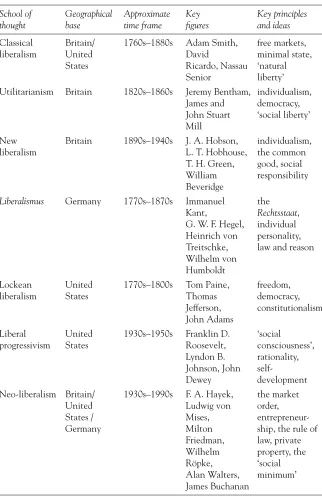
Throughout the book, various schools of liberal thought are discussed in depth in relation to neo-liberalism. Neo-liberals either have drawn some of their core principles from the ideas of these schools or have vehe-mently opposed and challenged their beliefs. The most prominent schools of thought discussed are classical liberalism, utilitarianism, the new liberalism, Liberalismus (German liberalism), Lockean liberalism, liberal progressivism and neo-liberalism. Table 1.1 distinguishes between these different variants of liberal ideology, outlined in the book. It is designed to make it easier for the reader to decipher the different stands of liberal thought under discussion.
An integral part of this book is the examination of the role that histor-ical and intellectual traditions have played in the formation of neo-liberal ideology. Yet, while there may be an historical emphasis to the book, the book itself is not a study of the history of political thought, but rather of ideology. It outlines the historical and intellectual traditions that liberals have drawn upon and examines how these traditions have been interpreted. The book is not concerned with presenting the ideas behind historical events like the American Revolution, or the ideas of political thinkers such as John Locke, Adam Smith and G. W. F. Hegel in their pure and unadulterated form, but rather in the neo-liberal reading or interpre-tation of these ideas. The book claims that neo-liberalism is an ideology of reinvention, which borrows ideas from the past and then reinterprets them on a new ideological terrain.
The present book does not present, therefore, a critique of neo-liberal ideas, but rather an analysis of the structure of neo-liberal ideology. Indeed, the term ‘neo-liberalism’ is not used in a pejorative sense, but to denote a tendency within liberal ideology. The book sees the events leading up to the rise of collectivist ideologies in the early twentieth century as liberals perceived them. Thus it uses the term ‘liberal’ as a neo-liberal expression, although it recognises that the same term was also used by new liberals such as John Hobson, John Hobhouse and J. M. Keynes and by liberal progressives such as John Dewey, whose ideas neo-liberals
n e o - l i b e r a l i d e o l o g y
Table 1.1 Variants of Liberalism
School of Geographical Approximate Key Key principles thought base time frame figures and ideas
Classical Britain/ 1760s–1880s Adam Smith, free markets,
liberalism United David minimal state,
States Ricardo, Nassau ‘natural
Senior liberty’
Utilitarianism Britain 1820s–1860s Jeremy Bentham, individualism,
James and democracy,
John Stuart ‘social liberty’ Mill
New Britain 1890s–1940s J. A. Hobson, individualism,
liberalism L. T. Hobhouse, the common
T. H. Green, good, social
William responsibility
Beveridge
Liberalismus Germany 1770s–1870s Immanuel the
Kant, Rechtsstaat,
G. W. F. Hegel, individual Heinrich von personality,
Treitschke, law and reason
Wilhelm von Humboldt
Lockean United 1770s–1800s Tom Paine, freedom,
liberalism States Thomas democracy,
Jefferson, constitutionalism
John Adams
Liberal United 1930s–1950s Franklin D. ‘social
progressivism States Roosevelt, consciousness’,
Lyndon B. rationality,
Johnson, John
self-Dewey development
Neo-liberalism Britain/ 1930s–1990s F. A. Hayek, the market
United Ludwig von order,
States / Mises,
entrepreneur-Germany Milton ship, the rule of
Friedman, law, private
Wilhelm property, the
Röpke, ‘social
Alan Walters, minimum’
vehemently opposed. It is, therefore, necessary to engage with the term ‘liberal’ in a contemporary analytical sense in order to discern the neo-lib-erals’ opposition to its usage within this context. Expressions such as ‘the rebirth of liberalism’, ‘reinventing the liberal agenda’ and ‘restoring the liberal faith’ are, however, presented as explicitly neo-liberal ones, where the term ‘liberal’ refers to the classical liberal ideal of free markets and limited interventionism. The historical analysis presented in this book is explicitly made from a neo-liberal perspective. For example, the interpre-tation of Hegel presented in the following chapters is not an impartial aca-demic one, designed to stand up to that type of scrutiny, but rather one that conforms to a neo-liberal interpretation of his ideas.
The remaining part of this chapter outlines the particular approach to ideology that the book adopts in relation to neoliberalism. The theoret -ical apparatus of the book is outlined in a discussion of the relations between ideologies and political concepts. Finally, a synopsis of the struc-ture of the work is given.
N e o - l i b e r a l i s m a n d i d e o l o g y
This book adopts an approach to neo-liberalism which transcends Marxist theories of ideology by placing less emphasis on issues of truth and distor-tion; instead, it takes the ubiquity of political ideologies as the starting point of analysis. Drawing on Michael Freeden’s approach, this book sug-gests that a contemporary evaluation of neo-liberalism as an ideology entails a threefold analysis: an analysis of the ideology’s internal structure; a contextual analysis of the ideology’s historical contingency; and an analysis of the ideology’s core concepts.15
The first point is that the internal structure of an ideology should not be perceived as a static construction. Ideologies are evolving systems of ideas which interact on a number of ideatic dimensions. As W. H. Greenleaf observes, studies of ideology ‘must reckon on and accept multiformity, overlap, divergence, inconsistency, obliquity and change as features intrin-sic to their subject matter’.16Thus ideologies should be identified not just
with similarities, but also with processes of change and adjustment. Freeden, however, makes it explicit that ideologies cannot develop in ways that transform their core concepts. The core is the unchanging part of an ideol-ogy, essential to its survival.17Seen from this perspective, it may be possible
to map the conceptual boundaries of neo-liberalism. The general parame-ters of the ideology, however, remain fragile and elusive. As an ideology,
neo-liberalism may not always be wholly logical or consistent in its position. As Stuart Hall observes, ‘there are always loose ends, breaks in the logic, gaps between theory and practice, and internal contradictions in any current of thought’.18Therefore recombinations within an ideology – even
within a variant of an ideology such as neo-liberalism – are normal and fre-quent. Boundaries may be traversed – either consciously or unconsciously – to broaden an ideology’s appeal and to take account of what were peripheral issues and concerns. On this reading, neo-liberalism may be open to any number of possible future formulations. Attempting a grand narrative of neo-liberalism is therefore a futile endeavour. Ideological identity rests on its distinct and recurring ideological premises, which are fixed at its core.
If ideologies are changing entities, they are also historically contingent entities. Internally, ideologies may change their contours and emphasis, but these changes are contingent on beliefs and practices inherited from traditions of the past which may be modified to meet new political ends.19
Indeed, for contemporary theorists such as Greenleaf, the study of politi-cal ideology is strictly an historipoliti-cal endeavour and must be understood in terms of categories of the past. Breaking down the dichotomy between events and ideas, Greenleaf claims that ideologies are best understood as traditions confined to certain periods of history. For example, he exhorts us to understand British political thought in the twentieth century in terms of the two opposing currents of libertarianism and collectivism. The value of Greenleaf’s traditions is that they provide a tentative framework for organising a mass of material in a historically credible and coherent form.20
An historical approach to ideology, this book suggests, should identify neo-liberalism against the background of the thinkers and organisations that inherited ideas and practices from the past and modified them in line with new political practice. It should employ, for example, Michel Foucault’s concept of genealogy as a method for investigating historical processes. For Foucault, genealogy is concerned with the exploration of what may not be evident, on the surface, in how social thought is pro-duced. It is an analysis of descent ‘situated within the articulation of history’.21It isolates the central components of political mechanisms and
society. The historical development of neo-liberalism, from this perspec-tive, can therefore be seen as a vast fabric of relations, meanings and values that represent the many confluences of past lines of descent. Its genealogy, this book suggests, exposes the motives, institutional pressures and anxi-eties which coalesced to make these lines of descent appear rational and necessary.
Structure, history and genealogy suggest that ideologies may be neither ‘pure’ in their boundaries nor linear in their descent. Internal consistency is maintained through the key propositions or core concepts that bind an ideology together and form a chain of interpretation and meaning. Together, these core concepts, to borrow Foucault’s metaphor, constitute an ideology’s ‘regime of truth’. Working together, they ‘form a distinct dis-cursive space of meanings, and sustain a particular logic of thought’.22
Th e u s e o f c o n c e p t s i n p o l i t i c a l a r g u m e n t
Mapping out and understanding the genealogy of ideas, however, is only half of the process of making sense of an ideology or system of thought. The context of political ideas must be accompanied by an understanding of the internal meaning of those central ideas or beliefs and of their role in creating a single ideological entity. The second half of the book, there-fore, goes on to identify and examine the conceptual framework of neo-liberal thought – those core concepts that underpin neo-neo-liberalism and give it identity as an ideology. Using Michael Freeden’s morphological approach to the study of political ideologies, the book seeks to identify those core and accompanying adjacent and peripheral concepts that can be said to form a constituent part of neo-liberalism’s ‘idea environment’ – the space which holds together a complex combination of political con-cepts in a sustainable pattern.23At the heart of Freeden’s approach is his
theory of ‘decontestation’. Ideologies, he argues, decontest concepts by limiting the essential contestability and indeterminacy of political terms, by ‘prioritising among options, accepting or ruling out paradigms that interpret political reality and competing over the legitimate meaning assigned to political language’.24
Freeden contends that the influence of these decontested concepts is affected by the specific morphological arrangements that place them in relation to each other. Structurally, ideologies consist of core, adjacent and peripheral concepts that exist in complex, dynamic internal relations with each other. Core concepts represent the unchanging part of an ideology.
They form a matrix of ideatic components that maintain the identity of an ideology. A number of important concepts exist adjacently to the core and are essential for the formation of an ideology.25Peripheral concepts
are also an important part of the core of an ideology, but they are not essen-tial to its survival. They attach meaning and relevance to the core and are responsible for updating and linking it to issues of contemporary concern. The peripheral concepts that exist within an ideology’s perimeter relate to the ideology’s cultural, historical and geographical setting; they ‘straddle an interface between time and space’. These may be not fully-fledged con-cepts, but loose ideas or policy statements.26
It is clear from Freeden’s complex morphological model that concepts within political ideologies can be distinguished by their core, adjacent and peripheral positions. Political concepts, however, do not exist in isolation from one another, but form the part of a larger whole. As Hall comments: ‘They hang together. They mutually define and modify one another; they entail each other – they are interdependent.’27 Indeed, at the heart of
Freeden’s approach is the idea of ideologies as ‘multi-conceptual con-structs’ or ‘conceptual configurations’. Freeden contends that it is from the ordering of core, adjacent and peripheral concepts in these configurations that ideological identity is ascertained. Ideologies, Freeden states, may develop and change over time; but, following Wittgenstein, Freeden states that they remain recognisable as ideologies from the ‘family resemblances’ they share with earlier variants.28
This book also adopts the conceptual–historical approach to liberalism advocated by Terence Ball. Like Freeden, Ball sees political con-cepts as an integral part of the vocabulary of politics. However, whilst Freeden focuses on the configuration of political concepts, Ball’s concern is not so much conceptual analysis as ‘conceptual history’ – ‘that is, a concern with conceptual change and the construction of conceptual his-tories’.29Histories of political concepts, he contends, are histories of
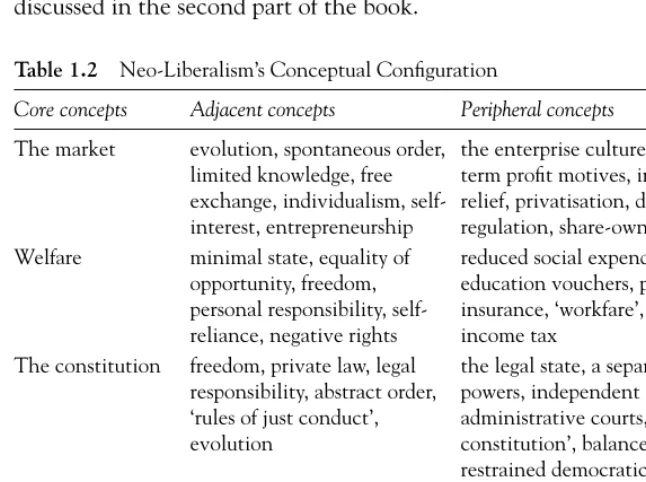
Utilising the conceptual tools of Freeden and Ball, this book attempts to formulate a set of common denominators for neo-liberals. This is done at a contextual level by taking a conceptual–historical approach to the construction of neo-liberal discourse and by examining the ways in which liberal political concepts have been reconstructed by neo-liberals on a new political terrain. The purpose of this conceptual history is to put the neo-liberal interpretation of specific concepts into the context in which they were conceived. The book examines how neo-liberals have drawn on, or rejected, various interpretations of specific liberal concepts in order to find their own distinctive interpretation. Neo-liberalism, in this book, is also analysed at a high level of abstraction, using core neo-liberal concepts and a range of adjacent and peripheral concepts that sustain, interpret and operationalise the core. Indeed, this book sees neo-liberalism as a concep-tual movement within liberalism that is made up of concepts such as ‘the market’ and ‘the constitution’ – which were previously adjacent or periph-eral within libperiph-eral ideology but, with the rise of neo-libperiph-eralism, have moved to the core. The following table sets out the core, adjacent and peripheral concepts in neo-liberalism’s conceptual configuration that are discussed in the second part of the book.
i n t r o d u c t i o n
Table 1.2 Neo-Liberalism’s Conceptual Configuration
Core concepts Adjacent concepts Peripheral concepts
The market evolution, spontaneous order, the enterprise culture, short-limited knowledge, free term profit motives, income-tax exchange, individualism, self- relief, privatisation,
de-interest, entrepreneurship regulation, share-ownership Welfare minimal state, equality of reduced social expenditure, opportunity, freedom, education vouchers, private personal responsibility, self- insurance, ‘workfare’, negative reliance, negative rights income tax
The constitution freedom, private law, legal the legal state, a separation of responsibility, abstract order, powers, independent
‘rules of just conduct’, administrative courts, a ‘fiscal evolution constitution’, balanced budgets,
restrained democratic rule Property ownership, possessive capital accumulation, voluntary
individualism, legal privilege, savings, private inheritance, individual initiative, maximised shareholder profits negative justice, private
This book does not suggest that there can ever be an a priori definition of neo-liberalism, but claims that its conceptual arrangements can be iden-tified from textual material and the perspectives of individual thinkers, which can be compared for overlaps and deviations. From this analysis, a clear profile of neo-liberal ideas and concepts can be created. These con-cepts may not be unique to neo-liberalism alone; what is unique is the way they are configured.
O u t l i n e o f t h e b o o k
From the above discussion it is apparent that neo-liberalism constitutes a complex set of thought-practices. These thought-practices can be analysed in three interconnected ways. First, they can be analysed through processes of conceptual change and adjustment within the internal struc-ture of neo-liberalism. Secondly, they can be analysed through the histor-ical context that shapes and sustains meaningful ideologhistor-ical expressions. Thirdly, they can be analysed through the ideational boundaries of neo-liberalism’s core concepts.
The structure of the book reflects this theoretical approach. The first part adopts Foucault’s genealogical approach and is devoted to the context of the historical ascendancy of neo-liberalism; it outlines and explains the fate of traditional liberal values in twentieth-century political thought. The second chapter explores liberal traditions in Germany, Britain and the United States. The chapter details unifying themes and varieties of thought in the history of German, British and American liberalism and notes the decline in traditional understandings of liberalism in the early part of the twentieth century. The purpose of the chapter is to outline, his-torically, the liberal traditions which neo-liberalism has both drawn upon and reacted against.
The fourth chapter deals with the impact of neo-liberal ideas on national policy agendas in Germany, Britain and the United States in the second half of the twentieth century. The chapter looks at the attempts made by think-tanks and politicians to overcome interventionism and to place liberal ideology at the heart of new policy proposals. In Germany, it details the nature of ordo-liberalism and the rise of the Social Market Economy in the 1950s; in Britain, it explores the grassroots opposition within the Conservative Party in the 1960s and 1970s and origins of the New Right; and, in the United States, it examines the impact of conservatism on economic policy measures. The chapter’s main con-tention is that neo-liberalism in the post-war years did not represent one single strand of thought, but rather a heterogeneous movement of ideas. Yet, whilst there are many strands of neo-liberalism, all exhibit similari-ties and represent a variation on a common doctrine, namely a distrust of the state.
The second part of the book concentrates on the ideas and assump-tions explicit and implicit in neo-liberalism’s core concepts. The four remaining chapters closely scrutinise four fundamental neo-liberal con-cepts: the market, the constitution, welfare and property. From a discus-sion of these concepts, the chapters examine comparatively the internal structuring of neo-liberal systems of thought in Germany, Britain and the United States.
The fifth chapter examines the concept of the market in relation to neo-liberalism. It allocates the market a core position in neo-liberalism’s ideological configuration. It discusses the role of the market in classical liberal political economy, in neo-classical political economy and in the philosophy of the Austrian School of Economics. It goes on to detail some of the imperfections of the market, such as monopoly, bureaucracy, and regulation and state intervention, and it examines how neo-liberals over-come these obstacles. Finally, the chapter explores the role of markets in the global economy, outlining the neo-liberal vision of a globalised market order. The chapter contends that markets, for neo-liberals, are sacrosanct to the functioning of the economy; they are part of the natural spon taneous order of civilised values and mutual cooperation that sus-tains capitalism.
The sixth chapter focuses on the concept of welfare in neo-liberal ide-ology. The chapter outlines the differences and similarities between the welfare measures pursued in Germany, Britain and the United States in the post-war years. It then looks in depth at neo-liberalism’s reaction to these
forms of welfarism, and relates this reaction back to neo-liberalism’s under-standing of other liberal concepts such as freedom, individual rights and justice. The chapter then examines neo-liberal policy regimes in relation to welfare in Germany, Britain and the United States. The main point of the chapter is that neo-liberalism holds distinct conceptions of welfare – de-politicised conceptions – which form an integral part of its collectivist value system.
The seventh chapter looks at the constitution and the rule of law. It sees the constitution as a fundamental concept for neo-liberalism, one through which the powers of government may be curtailed. The chapter explores national forms of constitutionalism, and identifies the different models of constitutional government that neo-liberalism draws upon to create its own ideal constitution. It sets out the neo-liberal ideal of a
Rechtsstaatand the fundamental distinction between law and legislation. The chapter argues that the emphasis which neo-liberalism places on the constitution demonstrates that, far from being anti-political, liberalism is rather an ideology with a serious doctrine about politics and government at its heart.
The eighth and final concept chapter is on property. The chapter focuses on the concept of private property in Germany, Britain and the United States, and on how different national strands of neo-liberalism draw on different intellectual traditions for their inspiration. The empha-sis is placed on the concepts of liberty, individualism, law and justice in relation to the neo-liberal conception of private property. The chapter examines in detail neo-liberalism’s interpretation of different forms of property ownership, in particular in relation to the modern corporation. The chapter claims that the concept of property is fundamental for neo-liberals as property forms the foundations of Western civilisation, acts as a basis for negative liberty by restraining the powers of government and encourages the individual initiative that leads to free market competition and economic efficiency.
N o t e s
1. In some accounts, this strand of twentieth-century liberalism is referred to as social-ism. However, to a large extent, policies that have been described as ‘socialist’ have often been left-wing liberal. Indeed, the differences between egalitarian liberalism and some theories of social justice are often difficult to discern.
2. The Mont Pelerin Society’s statement of aims, republished in Max Hartwell, A History of the Mont Pelerin Society(Indianapolis: Liberty Fund Inc., 1995), pp. 7–11. 3. The opening address of the Mont Pelerin Society, republished in F. A. Hayek, Studies
in Philosophy, Politics and Economics(London: Routledge, 1967) p. 149.
4. See Susan Watkins, ‘New Labour: A weightless hegemony’, New Left Review, 27 May/June 2004, pp. 1–28, and David Harvey, A Brief History of Neo-Liberalism
(Oxford: Oxford University Press, 2005).
5. Alex Callinicos, The New Mandarins of American Power(Cambridge: Polity, 2003). See also his Against the Third Way: An Anti-Capitalist Critique(Cambridge: Polity, 2001).
6. The synthesis between old and new in so-called ‘new’ ideologies is explored by Andrew Vincent in his ‘New ideologies for old?’, The Political Quarterly, 69: 1 (1998), pp. 48–58.
7. The locus classicusof this argument is the work of the Austrian economist Ludwig von Mises. See his ‘Economic calculation in the socialist commonwealth’, in A. Nove and D. M. Nutti (eds), Socialist Economics: Selected Readings(Harmondsworth: Penguin, 1972).
8. F. A. Hayek endorses the Rechtsstaatstate in his discussion of the legal and constitu-tional arrangements of a liberal society in his three-volume Law, Legislation and Liberty
(London: Routledge, 1973, 1976, 1979).
9. The conception of a minimal state has historically been a central part of the liberal tradition and has been adopted, in different manifestations, by all neo-liberal thinkers. Yet conflicts exist over the exact grounds for state interference. Hayek, for instance, defines the public interest not in terms of some form of common good, but rather as those interests which are kept separate form individual private interests. See his The Constitution of Liberty(London: Routledge, 1960), pp. 204–6. The Virginia School, however, explicitly rejects the Hayekian notion of a ‘public interest’ separate from private interests. There is only self-interested behaviour, which, in the case of gov-ernment actors – politicians and bureaucrats – must be constrained by precise consti-tutional specification. See James Buchanan, The Limits of Liberty: Between Anarchy and Leviathan(Chicago: University of Chicago Press, 1979).
10. Ludwig von Mises, Liberalism: In the Classical Tradition(New York: Foundation for Economic Education, 1985), p. 21.
11. For a discussion of these tensions, see Nigel Ashford’s work, Consensus and Conflict Within Neo-Liberalism(Strathclyde Papers on Government and Politics, 1984). 12. F. A. Hayek, ‘Liberalism’, in his New Studies in Philosophy, Politics, Economics and the
History of Ideas(London: Routledge and Kegan Paul, 1978), p. 147.
13. For a comprehensive discussion of British free-market think-tanks, see Richard Cockett, Thinking the Unthinkable: Think-Tanks and the Economic Counter Revolution, 1931–1983(London: HarperCollins, 1994). For the American context, see D. M. Ricci, The Transformation of American Politics: The New Washington and the Rise of Think-Tanks(New Haven: Yale University Press, 1993).
14. F. A. Hayek’s paper on the ‘The prospect of freedom’, Mont Pelerin Society Archive, quoted in Cockett, p. 104.
15. See Michael Freeden, Ideologies and Political Theory(Oxford: Oxford University Press, 1996).
16. W. H. Greenleaf, The British Political Tradition: The Ideological Heritage, Vol. II
(London: Methuen, 1983), p. 13.
17. Freeden, Ideologies and Political Theory, pp. 37–8.
18. Stuart Hall, ‘Variants of liberalism’, in James Donald and Stuart Hall (eds), Politics and Ideology(Milton Keynes: Open University Press, 1986), p. 36.
19. This approach follows Wittgenstein’s model of rule-following, which suggests that no set of concepts contained within an ideology can fix or limit the ways they might be modified. See L. Wittgenstein, Philosophical Investigations(Oxford: Blackwell, 1972). 20. Greenleaf, The Ideological Heritage, pp. 17–18.
21. Michel Foucault, ‘Nietzsche, genealogy and history’, in Paul Rainbow (ed.), The Foucault Reader: An Introduction to Foucault’s Thought(London: Penguin, 1991) p. 80. 22. Hall, ‘Variants of liberalism’, p. 38.
23. See Michael Freeden, ‘Political concepts and ideological morphology’, The Journal of Political Philosophy, 2: 2 (1994), pp. 145–61, and Freeden, Ideologies and Political Theory. 24. Freeden, Ideologies and Political Theory, p. 551.
25. Ibid., pp. 82–5. 25. Ibid., pp. 78–81.
27. Hall, ‘Variants of liberalism’, p. 39.
28. Freeden, Ideologies and Political Theory, pp. 90–1.
29. Terence Ball, ‘Political theory and conceptual change’, in Andrew Vincent (ed.),
Political Theory: Tradition and Diversity (Cambridge: Cambridge University Press, 1997), p. 36.
C h a p t e r 2
Liberal traditions
I n t r o d u c t i o n : H i s t o r y a n d i n t e r p r e t at i o n
Liberalism as an intellectual movement of ideas has been a pre-eminent force in the history of political thought, establishing itself since its con-ception in the early nineteenth century as ‘the outstanding doctrine of Western civilization’.1Liberalism, though, should not be identified with a
single tradition; it does not constitute a clear-cut body of either doctrine or practice but comprises a number of conflicting historical forms. Ideologies, as Clifford Geertz has written, are cognitive maps ‘of problem-atic social reality’.2This cartographical metaphor seems especially
appro-priate for describing the different and sometimes contradictory variants of liberal ideology. These variants, like maps, represent the historical land-scape in their own ways, and for different purposes. Their representations can be accurate, but, like maps, are always incomplete, emphasising some features and neglecting others. Changes in the core features of these vari-ants of liberalism are inevitable, as the varivari-ants themselves are constantly subjected to the forces of historical transformation.
associated practices that people inherit. These traditions are viewed as his-torically contingent; they are evolving and can be identified by tracing their historical connections back through time.3
Liberalism as a complex and pluralistic political ideology therefore has to be unpacked and clarified from within; it has to be understood as a number of internal variants in the form of traditions or phases. These tra-ditions are composed of competing beliefs and practices, which form a part of the larger narrative that is history. These varied beliefs, languages and customs, which may be contradictory and often permeate into rival ide-ologies, stay within the boundaries of liberalism through the ‘family resem-blances’ they share with those core concepts, expressions and values that can be labeled as fundamentally ‘liberal’.4
It is only by outlining these family resemblances that neo-liberalism’s place within the liberal creed can be identified. This chapter, therefore, traces the main strands of liberal traditions in Britain, Germany and United States which are relevant to neo-liberalism; it identifies unifying themes and conflicting tendencies. It examines the divergent nature of liberal thought-processes in the history of these three countries, revealing the historically contingent nature of liberalism’s key concepts and propo-sitions. Rather than presenting a straightforward history of liberal ideas, the intention of this chapter is to provide a historical narrative for assess-ing the impact of ‘old’ and ‘new’ liberal ideas on the neo-liberal ascen-dancy. Its concern is not to recount or analyse in any great detail a particular liberal perspective, but to provide a preliminary excavation of liberal thought; to reconstruct the intellectual path by which liberalism, by the 1970s, came to prominence as a distinctive ideology. National varieties of liberal ideology and the substance of their claims, the chapter argues, are of considerable significance in understanding and interpreting the general contours of neo-liberal thought, examined in the subsequent chapters.
L i b e r a l i s m i n n at i o n a l c o n t e x t s
Britain
modern period, disseminated by the classical economists Adam Smith, Thomas Malthus and David Ricardo. Classical liberalism’s advocacy of government constraint and its ideas on property were particularly suited to the development of a laissez-faireeconomy. Smith, in particular, is iden-tified by contemporary neo-liberals as one of the true founders of modern liberalism.5Smith’s free-market economy, first described in his Wealth of
Nations, was later adopted by F. A. Hayek and the Austrian School and became an important founding principle of neo-liberal ideology. Smith’s classical liberal position, encapsulated in his famous vision of the ‘invisi-ble hand’, proclaimed that social well-being would unintentionally but efficiently be served by countless self-interested decisions in the daily activities of the free market. These individual interests, Smith asserted, are naturally harmonious; under a system of free competition, the operation of the market continually tends to produce prices as low as is consistent with supplying the product, whilst yielding a fair return on the effort expended in its production. This freedom of exchange would produce as much economic advantage for individuals as the circumstances permit, thus maximising both individual and social benefits. Smith never referred to this economic order as capitalism or as free enterprise, but rather as the ‘natural system of perfect liberty and justice’.6
Smith stated that under this natural system of liberty government inter-vention should be severely curtailed. He argued that any attempt by central government to direct the ‘industry of private people’ would be quite superfluous, and, because it would require a degree of wisdom and knowledge which no government could possess, would in practice be dam-aging to the wealth of a nation. He proclaimed that government should restrict its activities in the economic sphere to enlarging the area of free trade and removing obstacles and disincentives to private enterprise.7 It
would be misleading, however, to describe Smith, without qualification, as a doctrinaire advocate of laissez-faire. His categories for intervention allow for a wider scope of state activity than the nineteenth century laissez-faire
image suggests.8In the political sphere, Smith ascribed to government the
right and duty of ‘erecting and maintaining certain public works and certain public institutions, which it can never be in the interest of any individual or small number of individuals to erect and maintain’.9While
Smith granted government an extensive range of roles in the provision of such public goods, he maintained that equality, liberty and justice are best achieved where politics is reduced to a minimum. In the political arena, however, a distorted conception of Smith’s ‘public goods’, coupled with
the growth in utilitarian philosophy, opened the way for much more extensive and fully considered acts of liberal interventionism after 1832 in policy areas that transcended the ‘general good’ – poor law, factories, ship-ping, banking, and company finance.10
To a large extent, utilitarianism overlapped with classical liberalism. Richard Leach points out that the utilitarians stemmed from a similar intellectual environment – the eighteenth-century Enlightenment – as the classical economists, and shared their strong belief in the individual-ist assumptions underpinning British liberalism.11 In the same way the
classical economists attacked monopoly, and especially the protection given to large landowners, the utilitarians attacked aristocratic govern-ment and renounced the concept of privilege. Jeremy Bentham and James and John Stuart Mill developed the utilitarian understanding of Smith’s market society. Like Smith, they never advocated a harsh laissez-faire, but extended the principle of laissez-faire to rationalise or modernise liberal perceptions grounded in traditions of the past. Utilitarians held that the moral criterion for measuring the social good lies in the rationalistic cal-culation of what provides the ‘greatest happiness of the greatest number’ of individuals. Stuart Hall, for instance, states:
Though Bentham believed that as much as possible the state’s functions should be ‘privatised’ and was firmly committed to the principle of laissez-faire, he also believed in the active intervention of legislation to clear away the old encum-brances to liberty and the need for efficient administration to instil by intervention from above, if necessary, the conditions of free and unrestrained action.12
John Stuart Mill developed the Benthamite basis of utilitarianism fur -ther. Like Bentham, Mill opposed, in a liberal manner, all forms of gov-ernment interference, yet his belief in representative govgov-ernment and his desire to see an educated democracy pushed him irrevocably towards a form of liberal interventionism. Mill’s concept of ‘social liberty’ repre-sented a compromise between a system of pure laissez-faireand unregulated state action; it involved a continuation of the strict tenets of individual-ism and an extension of individualindividual-ism into taking account of the ‘general welfare of the community’.13While the state, according to Mill, had no
For modern neo-liberals, however, the utility principle of the ‘greatest happiness of the greatest number’ involved a breach with laissez-faire prin-ciples and distorted true liberal faith by encouraging ‘constructivist ration-alism’ and interventionism. Neo-liberals point out a fundamental distinction that exists in the liberal tradition between a distorted utilitar-ianism conception of British liberalism and the true values of classical lib-eralism.15Theoretically, however, this tension between utilitarianism and
classical liberalism is somewhat overstated. It was the moral rationale for liberalism that had changed; the underlying premises of liberalism remained the same. Although there was an inveterate distrust of state power in both the utilitarian and the classical liberal schools, George Watson comments that ‘liberals always accepted a role for government. They debated not whether it should exist, but what it should be’.16
Intellectually, the British liberal tradition was a product of both classi-cal liberalism and utilitarianism, and it is these movements that set the ideological foundations of the Victorian period. Richard Bellamy places the growth of liberalism in the context of the historical development of British capitalism and of the moral order that it fostered. British industrial predominance, he writes, was attributed to a strong and coherent liberal tradition, endorsed by the middle and industrious classes. Although the principal originators of British liberalism – Adam Smith, John Stuart Mill and Herbert Spencer – held conflicting views over the exact interpreta-tion of liberty, all tended to emphasise the self-creating power of the indi-vidual. Central to British liberal philosophy at the time was the idea of an economic and moral revolution that would free the individual from the constraints of the aristocratic order.17Liberalism became more
ideologi-cally demanding as it took on new ideas and represented different inter-ests, in particular those of the middle class.
The most effective political expression of middle-class liberalism before the formation of the Liberal Party in the second half of the nineteenth century was the Anti-Corn Law League and its campaign for free trade. The intellectual basis of the mercantilist system had already been thrown into doubt by the publication of Smith’s Wealth of Nations. The leaders of the league, Richard Cobden and John Bright, repelled by the landed aris-tocracy’s monopoly over consumer markets, adopted Smith’s ideas in a simple form and turned free trade into a popular moral crusade. Intellectually, they drew on the liberal principles held by the Manchester School, and were influenced by the French economist Frederic Bastiat’s arguments on behalf of free trade. Free trade, Cobden and Bright claimed,
would not only lead to peaceful political association, in contrast to the Machiavellian power politics associated with the old aristocratic order, but also bolster British economic power within the world system. It was hoped that the extension of free trade would encourage mutual commercial dependence and eliminate war between nations. This metaphysical idea, of a harmonious order of market transactions, was invariably based, in some form or another, on an almost religious belief. Indeed, E. Halevy has christened Manchester liberalism by the name ‘non-conformist liberal-ism’, indicating its commitment to free markets and non-intervention.18
The liberal ideal of a self-regulating market society also had a strong moral dimension. The Manchester liberal position of Cobden and Bright was built around the concept of the individual and the philosophy of inde-pendence and self-help. Supporters of the Manchester School saw indus-trial growth as a product of individual effort. The individual, freed from the constraints of the agrarian and hierarchical order of the old society, was encouraged to create a new way of life. The so-called ‘age of
laissez-faire’ was defended by Herbert Spencer as a route to individual develop-ment and self-improvedevelop-ment. Spencer’s greatest exposition of the liberal creed, Man Versus the State, defended the freedom of the individual and warned against the threat which an encroaching state power posed to indi-vidual liberty. Samuel Smiles echoed Spencer’s concerns. His works, Self-Help and Character, captured the moral temper of the age, calling for individual self-discipline and initiative. Rejecting the social basis of Owenite socialism, Smiles claimed that attempts to shape and improve individual character through state action were futile: ‘character is formed by the individual, not for him’.19
It is this current of thought that led A. V. Dicey famously to characterise the middle fifty years of nineteenth-century Britain as an ‘age of individ-ualism’. Despite the dramatic increase in the amount of state intervention during this period, the fundamental principles behind the intervention were not yet collectivist but were as, Dicey rightly claimed, impeccably individualist.20For many contemporary neo-liberals, therefore, this
mid-Victorian era represented the high tide of British liberalism, with Cobden and Bright portrayed as the revered saviours of the liberal tradition.
and formed part of a larger liberal movement devoted to the cause of self-help versus self-help from the state. However, by the end of the nineteenth century, the British liberal tradition was irrevocably moving in another direction. The recognition of poverty and unemployment implied that individual self-development could not be automatically guaranteed through participation in the economic system. From the 1880s onwards, liberalism steadily transformed itself into a social philosophy committed to welfare reform, eroding the minimal state on which Victorian liberal-ism had based its identity.21
Germany
In Germany, the rich and vigorous intellectual and social developments of the Reformation consolidated a particular German tradition of liberty from its medieval roots, granting the individual ‘the right to private judge-ment’.22 The focal point of early German liberalism was religion as a
symbol of individual experience, reason and conscience. Historically, however, Germany was much slower than Britain to develop the political dimension of its liberal tradition. The type of aristocratic liberalism that played so important a part in Britain, with the Whigs, was almost entirely absent from German politics. Nor did Germany possess a reform ideology like that of the Manchester School, which drove the liberal market model in Britain. German liberalism developed its own, distinct, if somewhat restricted path to political realisation.23
The general weakness of the liberal tradition in Germany is reflected in the nature of its Weltanschauung. Ideologically, German liberalism devel-oped within the cultural and political context of the state. German liber-alism was state liberliber-alism: it ‘regarded the state as the essential instrument to realise its liberal programme’.24The German liberal movement held a
particular conception of the state that was far removed from the abso-lutism associated with the German principalities. The German liberal state was a legal and constitutional state. A Rechtsstaat(a constitutional state bound by the rule of law) was established in Germany as the embod-iment of a constitutional dualism between the governors and the gov-erned. The Rechtsstaat represents, as de Ruggerio observes, ‘the legal tradition of the whole people; it is a ‘civil juridical association’.25 This
liberal state is conceived so as to be limited by laws and by fundamental principles of legality, rather than as being a purely political organisation that can dispense law in the interests of polity. Indeed, it is paramount to
the freedom of the individual that the state’s functions are limited to the sphere of a legality compatible with the rule of law. It is this curtailment of state power through law and constitutional order which makes the
Rechtsstaat the ideal state form for many neo-liberals. As discussed in Chapter 4, it was to form the constitutional basis of Germany’s Social Market Economy in the post-war years, and has been widely endorsed by Austrian theorists such as F. A. Hayek, who have expressed support for the
Rechtsstaat’sseparation of legislative and executive functions.
A Kantian conception of liberty, law and reason provided the philosoph-ical background for the Rechtsstaat. Kant’s system of thought was connected with Prussian-German reform liberalism. Kant was concerned with trans-forming the monarchic state into a constitutional state. He based his theory of the constitutional state on the fundamental distinction between moral-ity and legalmoral-ity. In the sphere of moralmoral-ity, Kant held that individuals possess their own autonomous ground, with no limitations except those posed by individual conscience. The sphere of legality, in contrast, is controlled by the state. The state represents a legal order based on a coalition of the wills of private individuals – a public will – which provide the moral basis for rightful legislation. Adopting in substance, though with some modification, Rousseau’s concept of the general will, Kant argued that law does not rest on individual consent, but on what would be chosen by free and rational individuals acting together. Jeremy Waldron states that, for Kant, ‘[t]he test of a just society is not whether the individuals who live in it have agreed to its terms, but whether its terms can be represented as the object of an agree-ment between them’.26It is these constitutional arrangements, Kant argued,
that safeguard individual freedom. Freedom is not infringed by membership of that state, but is actually made possible by living under the state.
The Kantian conception of the state developed within the German ide-alist tradition and was carried further by Hegel. Hegel, drawing on Kant, developed a conception of the state as an abstract institution. In his
the state is not an external despotic force in society, which is elevated to a status above its individual subjects, but a constitutional order that exists in the interests of society, as an institution of representation.27
Heinrich von Treitschke’s political philosophy pushed the Hegelian tra-dition of state liberalism further. Following Aristotle, Treitschke consid-ered the state as a natural institution. The state, for Treitschke, is a representation of power.28It is at the same time, however, a representation
of freedom: the power of the state and the freedom of individuals are insep-arably connected. Indeed, Treitschke is careful to point out that the state must secure personal liberty to its citizens and introduce order and justice in society. This fusion between the ‘freedom of the people’ and ‘state power’ was embodied in Treitschke’s personal loyalty to the monarchical state of Prussia. As Krieger observes, ‘[t]he union in Prussia of the princely liberty of the past with the individual liberty of the future made it for Treitschke the German state, a rational reality upon which both kinds of freedom depended for their existence’.29
Treitschke’s preoccupation with the power aspect of the state, however, invoked criticism from other liberal theorists of the time, and later from neo-liberals. While Hegel and Treitschke believed in freedom through the state, the German philosopher Wilhelm von Humboldt demanded freedom from the state. Humboldt pushed the neo-liberal ideal of a
Rechtsstaatto its extreme form, limiting state activity to what is absolutely necessary – maintaining mutual security and removing obstacles that may impede citizens in the free exercise of their rights – without restricting the free actions of individuals. Hallowell points out that Humboldt is one of the few liberal theorists in German literature whose ideas can be closely identified with the classical liberalism of nineteenth-century Britain, and in particular with the anti-state ideas of Herbert Spencer.30 Humboldt’s
Essay on the Limits of State Action,written in 1792 and published in 1851, warned against regulation by the state which overrides the natural order of individual association. His support for Bildung’s beliefs – of the aesthetic development of individual initiative and ability – led him to attack state interventions designed to regulate the private lives of individuals. However, in the long-term, in a political atmosphere of state worship, Humboldt’s liberal views proved to be fundamentally unproductive. Later German liberals realised that Humboldt’s standpoint was untenable and abandoned such complete and uncompromising individualism.
A complementary concept to that of the state in German liberalism was the notion of the nation. In traditional German liberalism, the power of
the state and the freedom of the individual were merged with the idea of nationhood. As the nineteenth century advanced, more liberals came to desire a state based on both law (Rechtsstaat) and nation (Nationalstaat). The fate of liberal values thus became intimately connected with the cre-ation of a ncre-ational state. De Ruggerio places these ncre-ational sentiments within the historical formation of the German nation. In his history of European liberalism, he writes, the revolution in France ‘aroused a power-ful national consciousness in Germany. The idea of the Fatherland of the German nation was the new bond which replaced the broken fetters of the Empire.’31 By the mid-nineteenth century, liberalism and nationalism
were valid concepts for most of those who sought political change. The greatest campaign for national unification was fought during the 1848–9 Revolution.
The following decades were deeply coloured by the upsurge of German national feeling. While the revolution did little to alter the old power structures, it raised political awareness in middle-class circles of constitu-tional issues and the problem of naconstitu-tional unification. The notion of an emancipated Volk, encapsulated within a strong German state, invoked a conception of common citizenship. German liberals conceived of the nation as a ‘living and growing personality’.32Liberal theorists spoke to,
and for, a universal entity. They gave the Volka political function: within the context of their ideology, the Volkbecame the focus of their efforts and the source of their claim to set the course for the German future. Political unification, they believed, would be a culmination of German social, economic and cultural progress. This national dimension to German lib -eralism partly arose out of the industrial and commercial expansion of Germany in the mid-nineteenth century. William Carr comments that ‘businessmen and professional people, increasingly irritated by restrictions on economic activity and convinced of the benefits . . . which would flow from unification, set out to create a groundswell of opinion favourable to the creation of a strong Reich’.33However, as Hans Vorländer observes,
such a pro-national stance reflected the general weakness of liberal ideas both in German political discourse and in the political system in general. Liberalism became internally divided and eventually emptied of all sub-stantive meaning through its associations with the state, nation and economy.34
than in countries like Britain. Late industrialisation meant that the German economy took on a pronounced corporate and statist form from an early stage.35For some liberals like Max Weber, the nature of
capital-ism was irrevocably moving Germany towards a bürokratische Anstaltsstaat
(bureaucratic, rational and machine-like state). State paternalism, monopolistic practices and corporate power, Weber argued, were under-mining the traditional philosophical and social bases of liberalism. Weber’s analysis was not, however, intended to apply to Germany alone. His thought transcends its immediate national context, to address the fate of liberalism in a world characterised by competition between capitalist states.36
In Germany, the individual initiative and competitive spirit associated with the Protestant ethics and early entrepreneurial capitalism had been driven out by bureaucratic large-scale organisations. Weber did not deny the positive value of bureaucracy within the limits of its technical and administrative functions, but strongly opposed its extension to political life. The controlling pow