BANK DECISION FACTORS ANALYSIS IN GIVING
CREDIT SMALL MEDIUM ENTERPRISES (SMEs)
(Case Study at PT. Bank Rakyat Indonesia (Persero) Tbk)
Amanda Dhani Previa Yuda Suhadak
R. Rustam Hidayat
Faculty Of Administrative Science Brawijaya University Malang
ABSTRACT
The result is gathered from PT. Bank BRI Unit Office Klojen Malang’s decision in giving out
the credit for Small Medium Enterprises (SMEs). In cases where that factor is a variable of credit collateral value amounts 0,000 < Alpha score (0,05) which can not refuse Ho, that there is a significant influence between credit collateral value toward the decision of giving the credit for Small Medium Enterprises (SMEs). The variable types of business amounts 0,004 < Alpha score (0,05), then can refuse Ho, that there is a significant influence between the variable types of business toward the decision of giving the credit for Small Medium Enterprises (SMEs). Firm age variable itself amounts 0,005 < Alpha score (0,05), then can refuse Ho, that there is a significant influence between firm age variable toward the decision of giving the credit for Small Medium Enterprises (SMEs). Sales revenue variable amounts 0,007 < Alpha score (0,05), which can refuse Ho, that there is a significant influence between sales revenue variable toward the decision of giving the credit for Small Medium Enterprises (SMEs). Net income variable amounts 0,004 < Alpha score (0,05), which can refuse Ho, that there is a significant influence between net income variable toward the decision of giving the credit for Small Medium Enterprises (SMEs).
Keywords: 5 variables, bank’s decision in giving the credit, logistic regression
1. PENDAHULUAN
The national development is a continuously development efforts in order to realize a fair society and a prosperous Indonesia based on Pancasila and the Constitution of the Republic of Indonesia Year 1945. In connection with the implementation of the national development in the provisions of Article 4 No. 10 of 1998 dealing with the bank, determined that: "Bank Indonesia aims at supporting the implementation of national development in order to improve equity, economic growth and stability in improving the welfare of the people."
From this provision, it is clear that banking institutions have an important and strategic role which is not only move the national economy, but also directed to be able to support the implementation of
national development. This means that the development of national and international economy which moves continuously quickly also accompanied by an increasingly broad challenges and severe, need a quick response that should always be followed by the national banks which carrying out the functions and responsibilities. Thus, the national banks should be allowed to extend the range of services in all parts of the country, both as a general banking services that reach all levels of society and people's credit banks whose services are intended for economy class or small businesses (SMEs).
highly absorption’s labor rate which followed by small capital investment. This makes the Small Medium Enterprises (SMEs) are not susceptible to various external changes until the development sector of Small Medium Enterprises (SMEs) is able to support economic diversification and acceleration of structural change that became a requirement for long-term stable and sustainable economic development.
Society should make an effort to fulfill their life needed in order to enhance their welfare. In reality, not all people, especially people in middle class have enough financial capital to open or expand a business and productivity. So, in this case the middle class needs help in the form of loans or credits that they can easily find. One of them is in banking institutions. For small and medium businesses, credit is considered to be a quite important thing to keep the stability
of company’s progress even increasing
their accumulate finance working.
The credit is needed by society both individually and corporately. Bank as the financial institutions have a strategic role for the economic life of society. It can be seen from its main function as an institution that raise and channel funds from the public. From those main functions of the bank, it can be regarded as intermediary institution which becomes a link between people who have money and people who need money.
In developing countries like
Indonesia, especially in bank’s activities of
giving loan, becomes one of the most important and main activities. So that the income from credit like interest, is the biggest component of revenue compared with Basic Income. The credit has a strategic position as a source of money needed to fund operations that can be emphasized as one of the key to life for every human being. A credit facility granted by the bank is a great asset for the bank.
On the banking system, currently has many financial institutions banks started expanding market segment of small and medium enterprises. The government also now emphasizes the lending fund to Small Medium Enterprises (SMEs). This is because Small Medium Enterprises (SMEs) are the most business activities cultivated by the people. One of bank that began expanding small and medium market segments, namely bank BRI. Bank BRI is one of the guarantors of credit / financing to Small Medium Enterprises (SMEs) listed in the MoU on October 9, 2007, in accordance with this, the bank in the form of BRI implement awareness programs on empowering Small Medium Enterprises (SMEs). The purpose of this program is to increase the income of the people engaged in the activities Small Medium Enterprises (SMEs). This program will facilitate capacity building and micro businesses as well as business management skills as well as encourage the certainty, protection and development effort.
Banks BRI have factors into consideration as well as the most significant indicator in any factor that into the decision of banks in providing credit to Small Medium Enterprises (SMEs). The Bank classifies based on the fundamentals / principles of lending them to 6C there are Character, Capital, Cash, Collateral, Capacity, and Condition (Rose and Hudgins,2008).
The value of the collateral is an important instrument for credit transactions, payment of collateral/ guarantee debt function ensures customers if credit received cannot be paid under the contract. So as to reduce the risk of loss creditors, then held an assurance payable by the parties to submit the property of the debtor to the creditor. Therefore, the bank should do everything possible to find out the actual economic value of each object can be accounted for loan guarantees proposed by the prospective customer.
There are many types of business entities defined in the legal systems of various countries. Type of business consists of two kinds, namely, the business of selling goods/products and services. Different types of businesses, the risk of each is different. According to Firdaus and Ariyanti (2009: 35) states that the general type of business that the profit level high, the risks too high, while the types of businesses that profit level is low, then the risk was low.
Firm age in this case is the length of a Small Medium Enterprises (SMEs) conducted or the age of the business since the business is standing up at this time. Assuming that the business is running the longer it will lead to the development of a significant effort towards positive or negative. Development of the business depends on the climate and trade competition happening in the world of business or market. And usually a longer standing businesses tend to be more developed because it already has a lot of experience in running the business. And also businesses that have a lifespan that could arguably be able to compete with well-established businesses / other SMEs.
Sales revenue is the amount of money received by the company from product sales activity and / or services to customers. Sales revenue shows how much prospects of the business carried on customers. The greater the sales revenue obtained showed that the business carried on by the customer has a good prospect.
Net income is calculated by starting with a company's total revenue. From this, the cost of sales, along with any other expenses that the company incurred during the period, is removed to reach earnings before tax. The goals believe in the ability of borrowers to provide their own funds to meet its obligations towards the bank both principal and interest in a timely manner in accordance with the agreed. Great income will encourage industrialists to invest in the company to expand its business and is also key to progress and success of the company to continue and expand its business.
Objectives to be achieved in this research are: To know the credit collateral value, type of business, firm age, sales revenue and net income can affect the
bank’s decision in giving credit Small Medium Enterprises (SMEs)
2. LITERATURE REVIEW 2.1 Bank
A bank is a financial institution and a financial intermediary that accepts deposits and channels those deposits into lending activities, either directly by loaning or indirectly through capital markets. A bank is the connection between customers that have capital deficits and customers with capital surpluses.
Due to their influence within a financial system and an economy, banks are generally highly regulated in most countries. Most banks operate under a system known as fractional reserve banking where they hold only a small reserve of the funds deposited and lend out the rest for profit. They are generally subject to minimum capital requirements which are based on an international set of capital standards, known as the Basel Accords. (http://en.wikipedia.org)
deficit units. According to Indonesian banking law, Indonesian banking institutions are typically classified into commercial and rural banks. Commercial banks differ with rural banks in the sense that the latter do not involve directly in payment system and have restricted operational area. In term of operational definition, bank in Indonesia are classified into non-syariah and syariah-based principles commercial banks. (http://www.bi.go.id)
2.2 Credit
Credit is defined as confidence in a borrower's ability and intention to repay. People use the credit they have with financial institutions, businesses, and individuals to obtain loans. And they use the loans to buy goods and services. The credit a person has typically determines how much they will be permitted to borrow, for what purpose, for how long, and at what interest rates.
The level of "confidence" lenders have in potential borrowers depends on many factors. A person's income is an indicator of a person's ability to repay, particularly when compared to the amount of debt they already have. The amount of borrowing a person has already done and how well they handled repayment is an indicator of their intention and ability to repay. Some definitions of credit are as follows:
1) Credit is the provision of money or bills that can be equated with it. Based on an agreement only between bank borrowing with another party that requires the borrower to repay the debt in return for a certain period or for the results (Veithzal, 2005: ).
2) In Law 10 of 1998 (article 21 paragraph 11), the credit is the provision of money or bills that can be equated with that based on an agreement between the bank lending to other parties requires the borrower to pay off the debt at a certain period of time by giving interest.
Loans disbursed by the bank is the biggest part of the assets owned by the bank in question, so that the income derived from the proceeds of mortgage interest is also the largest source of income for banks. Under normal conditions, total bank loans to reach 90% of the bank's assets. This impact will certainly encourage economic growth and income (Firdaus and Ariyanti, 2009)
2.3 Small Medium Enterprise (SMEs) Small Medium Enterprises (SMEs) are an important part of the national economy in a country and plays an important role in social and economic life (Hua, 2009). Small Medium Enterprises (SMEs) according to the law No. 20 in 2008, SMEs are enterprises owned productive individuals and/or entities who meet the requirements of individual business enterprises as provided for in the legislation.
In Law No. 20 of 2008 on Micro, Small and Medium Enterprises there are several criteria used to define the definition and criteria of Small and Medium Enterprises. SME definitions are: 1) Small Business: Productive economic
stand-alone, carried by an individual or business entity that is not a subsidiary or branch company is not owned, controlled, or a part, either directly or indirectly from medium or large businesses that have a net Rp. 50 million till Rp. 500 million. Excluding land and buildings or annual sales of Rp. 300 million till Rp. 2.5 billion. 2) Medium Business: Productive
Information:
: Influence : Analysis tools 2.4 Research Framework
2.5 Hypothesis
Based on the literature and previous similar studies that have been presented previously, the hypothesis proposed in this study is thought to credit collateral value, types of business, firm age, sales revenue and net income have an influence on the bank's decision to give credit for Small and Medium Enterprise (SMEs).
3. METHOD
This is a quantitative descriptive research, which aims to describe and reveal a problem, situation, event facts as they are revealed in greater depth about the
factors that influence the bank’s decision
in giving credit Small Medium Enterprises (SMEs).
3.1 Techniques Data Analysis 1) Logistic Regression
In this study, the method used by the author is the logistic regression analysis. Logistic regression is a statistical analysis tool models that describe the response of affairs between the variables that have two or more categories with one or more explanatory variables or interval scale category (Hosmer and Lameshow, 2004).
Used logistic regression models to explain the relationship between X and
π(χ) which is not linear, abnormal
distribution of Y, diversity is not constant and cannot be explained by ordinary linear regression model. Data observations has p
independent variables χ1, χ2, …, χp with the response variable Y which has two possible values of 0 to indicate that the response does not have criteria and a value of 1 to indicate that the response has criteria. (Kuncoro, 2004):
1) Do not have the normality assumption on the independent variables used in the model.
2) Dependent variable consists of continuous variables, discrete, and dichotomous.
3) Distribution of expected response variable nonlinear.
Kinds of logistics are divided into binary logistic regression and multinomial logistic regression. In this study, the response is a binary variable that is an acceptable credit decisions or decisions of credit denied, then the incident at the time of granting credit decisions by potential Small Medium Enterprises (SMEs) borrowers recommended or accepted by the influence of a particular variable. The model used in the logistic regression Lending Decisions
Characteristics of Analysis
Micro banking scoring System
Credit Collateral Value
Type of Business
Firm Age
Sales Revenue
Net Income
Logistic Regression
analysis is logit (pi) = β0 + β1 * X with logit (pi) is the value of the logit transformation to a successful event
opportunities, β0 is the regression intercept, β1 is the slope of the regression
line models, and X is the explanatory variables (Nachrowi, 2002: 307):
Thus, the estimation model used in this study is:
[ ]
Descriptions:
[ ] : Credit accepted / rejected : Credit Collateral Value : Type of Business : Firm Age
: Sales Revenue : Net Income
2) Significance Testing Model and Parameters
a. Significance Test Model (Mc Fadden R-square (R2))
Significance test of the model done by considering the value of chi-square distribution of the Pearson method, Deviance, and Hosmer and Lemeshow. Mc Fadden R-square value can be interpreted as the value of R square in regression. Hypothesis:
H0 = No significant difference between the value of observations with model predictions
H1 = There is a significant difference between the value of observations with model predictions
If the p-value of the statistic is greater
than the real level (α = 5%), the decision is
to accept H0, which means the model is enough to be used in the prediction.
b. Eligibility Test Model (Likehood Ratio Test)
To test the suitability of the model together or simultaneously from all the parameters, use likehood ratio test (LRT). LRT method closely related to MLE method (Casella and Berger, 2002). H0= β1= β2= ….. = βp
H1 = there is at least one βj = 0 Statistical test used:
( )
Model B: The model consists only of constants only
Model A: The model consists of all variables
If H0 is rejected, meaning that the model A was significant at significance
level of α.
c. Significance Testing In Individuals predictor variables (Wald test)
Tests on the significance of each predictor variable individually performed with Wald test (Wj), with the formula:
Description:
β : β estimators
SE : standard error estimator of β
βk : predictor variables the coefficient k
Hypothesis : H0= β1 = β2 = ….. = βk = 0 H1= βk ≠ 0, k = 1,2,…,k Wj statistics follow a normal distribution (Z), if the value of Wj> Zα / 2 two-tailed p-value of the statistic Wj
smaller than the real level (α = 0.1) then
the decision is to reject H0 means the k predictor variables affects real or significant impact on the response variable.
d. Interpretation (Odds Ratio)
Interpretation of logistic regression models done by looking at the value odds ratio (hazard ratio) or the adjusted probability (probability) value of the odds ratio is used to describe the relationship between the response variable with the
predictor variables. Value odds ratio (θ) is
negative with an indication of the further value of 1 indicates the stronger the degree
of relationship. Meanwhile, if (θ) = 1
Ψ = exp(βi) = [g(1)-g(0)]
Odds ratio is to free variable x nominal scale that has a tendency y = 1 at
x = 1 for Ψ times compared to x = 0. Logit model coefficients βi reflects the change in value logit function g (x) for a unit change in independent variables x (Hosmer and Lemeshow, 2004;50). If the independent variable is continuous scale, so if not less than one, the greater the x, the greater the tendency for y = 1 (Hosmer and Lemeshow, 2004: 51).
4. RESULT AND DISCUSSION
Based on data analysis and has been applied to the logistic regression model, Table 7 shows that the number of borrowers who were sampled in this model are 93 respondents. From these samples, all variables used in the analysis as a whole which is indicated by the 100% figure in Table 1.
Table 1: Case Precessing Summary Case Processing Summary
Unweighted Casesa N Percent
Selected Cases Included in Analysis 93 100.0
Missing Cases 0 .0
Total 93 100.0
Unselected Cases 0 .0
Total 93 100.0
Source: Data Processed 2013
Then, described in Table 8 that the variable bound by the categories received a value of 1, and for the rejected category is 0.
Tabel 2: Dependent Variable Encoding Dependent Variable Encoding
Original Value Internal Value
Credit Rejected 0
Credit Accepted 1
Source: Data Processed 2013
4.1 Assessing Overall Model Fit
The initial step used in this analysis to assess the overall fit statistic data models that are used in the likelihood function (-2log Likehood). The hypothesis used in this model are:
H0: the hypothesized model fits the data H1: the hypothesized model does not fit the data
From the results of logistic regression
with 90% confidence level (α = 0.1) gives
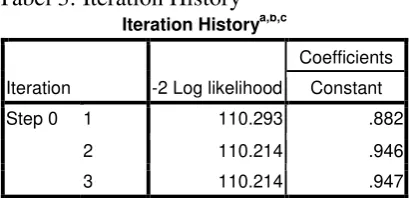
two values -2log Likehood, first for models that only include constants, while the second contains the constants and variables in the model as a whole. For the analysis of the first -2log Likehood values obtained 110.293 are shown in Table 3. Tabel 3: Iteration Historya,b,c
Iteration Historya,b,c
Iteration -2 Log likelihood
Coefficients
Constant
Step 0 1 110.293 .882
2 110.214 .946
3 110.214 .947
Source: Data Processed 2013
Then for the result-2log Likehood latter obtained a value of 71.598 as shown in Table 10 with value-2log Likehood large enough it can be concluded that all the variables in this study can be incorporated into the model.
Tabel 4: Model Summary Model Summary
Step
-2 Log likelihood
Cox & Snell R Square
Nagelkerke R Square
1 71.598a .340 .489
Source: Data Processed 2013.
4.2 Eligibility Testing Regression Models
Next is testing the eligibility of the logistic regression model used in this study. This test uses Hosmer and Lameshow's Goodness of Fit Test. Hypothetical criteria used are:
H0 is rejected if the value is < 0.1 H0 is accepted if the value is > 0.1 Table 5: Hosmer and Lameshow Test Hosmer and Lemeshow Test
Step Chi-square df Sig.
1 9.169 8 .328
Source: Data Processed 2013
On testing Hosmer and Lameshow in Table 5 shows the value of 9.169 counts with a significance value of 0.328 and the value obtained for comparison Chi square table with 8 degrees of freedom at 15.507. Because value of Chi square count smaller than value of Chi square table (9.169 < 15.507) and value significance greater than alpha 5% (0.328 > 0,050), then it can be concluded that the model of who used has a probability predictions the same with a probability which observed so that can is said that the this model feasible used. 4.3 Hypothesis Testing
Testing this hypothesis serves to see whether the independent variables consist of the credit collateral value, type of business, firm age, sales revenue and net income have an influence on the analysis of SME lending decisions. Tests conducted using the Wald test to test each of the independent variables with the following hypothesis:
H0 : βj = 0 for, J = 0,1, … ,p H0 : βj = ≠ 0
H0 rejected if Wj statistics follow a normal distribution (Z), if the value of
Wj> Zα / 2 two-tailed p-value of the
statistic Wj smaller than the real level (α =
0.1) then the decision is to reject H0 means the k predictor variables affects real or significant impact on the response variable.
Tabel: 6 Variables in the Equation
Variables in the Equation
B S.E. Wald df Sig. Exp(B)
Step 1a
X1 -1.862 .502 13.738 1 .000 .155
X2(1) -2.769 .957 8.372 1 .004 .063
X3 2.633 .932 7.980 1 .005 13.909
X4 1.144 .422 7.354 1 .007 3.138
X5 1.040 .363 8.214 1 .004 2.828
Constant -1.867 4.922 .144 1 .704 .155
Source: Data Processed 2013
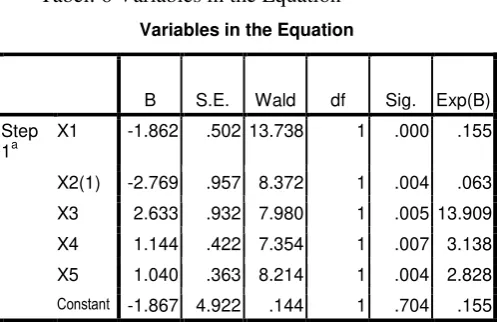
Processing the data in Table 6 show that the Wald test results for each variable are as follows:
1) Variable Value Credit Guarantee (X1) Of the Wald test is done the figure Sig. of 0.000 which is smaller than 0,050. So, variable X1 is significant.
2) Variable Type of Business (X2)
Of the Wald test is done the figure Sig. of 0.004 which is smaller than 0,050. So, variable X2 is significant.
3) Variable of Firm Age (X3)
Of the Wald test is done the figure Sig. of 0.005 which is smaller than 0,050. So, variable X3 is significant.
4) Variable Sales Revenue (X4)
Of the Wald test is done the figure Sig. of 0.007 which is smaller than 0,050. So, variable X4 is significant.
5) Variable Net Income (X5)
Of the Wald test is done the figure Sig. of 0.004 which is smaller than 0,050. So, variable X5 is significant.
Results of the test can be concluded that all variables be included in this study is a significant result. Based on the results of logistic regression coefficients in Table 6, it can be established a logistic regression equation is as follows:
analysis using SPSS (Statistical Product Service Solution) release 17.00 it can be seen the probability of respondents overall. Has a significance value of 0.704 and more than 5% alpha (0.704 <0.050) the respondent is included in the distribution of the respondents who received the Small Medium Enterprise (SME).
If the probability is > 0,050 respondents were then grouped the respondents were dismissed on the distribution of Small Medium Enterprise (SMEs), as well as when it is done until the last respondent. The results of the probability of each respondent and the distribution of opportunities to show the trend of the acceptance and rejection of small medium enterprise (SME). Test results of respondents' overall level of prediction can be presented in Table 7. Table 7: Classification Table the 93 respondents, the respondents filed a small and medium enterprise (SME) showed that the rejection of credit small and medium enterprises (SMEs) are as much as 26 observations, and the predicted results stated that there are 14 observations that express disapproval crediting small and medium enterprises (SMEs) and 12 observations indicating approval credit small and medium enterprises (SMEs). So there are 14 correct predictions of 26 observations or 82.8% correct prediction results.
4.4 Research Discussion
From the analysis of the data above shows that the independent variables in the model have a significant effect on the probability of the decision to giving credit SMEs consisting of the credit collateral value, type of business, firm age, sales revenue and net income. Discussion of research on the probability of acceptable in giving credit SMEs and the variables which have a dominant influence in giving credit SMEs. variables influence the research consists of the credit collateral value, type of business, firm age, sales revenue and net income on the probability of acceptable in giving credit Small Medium Enterprises (SMEs).
b. The Influence of Credit Collateral Value in Giving Credit Small Medium Enterprises (SMEs)
Variable X1 (Credit Collateral Value) has a significance value of 0.000 and less than 5% alpha (0.000 < 0.050), it can be concluded that the variables X1 (Credit Collateral Value) gives a noticeable effect on the response variable (bank loan) with a limit an error rate of 5%. Coefficient value of -1.862 is negative and stated that the influence of the variable X1 (Credit Collateral Value) of the response variable (bank) is negative or in other words that banks will tend to give credit if X1 value is higher than the value of the proposed loan. So the higher the value of collateral than the amount of the proposed loan, then the bank will consider it to be accepted.
is not merely to be the cause of the debtor will not be can meet its obligations, but when its revenue decline, of course this will burden the debtor in paying the loan installments. According to Fransiscus Haloho (Suyatna, 2007) stated credit collateral is a guarantee that affect the smooth lines of credit because of the greater value of the guarantees given the debtor at the time of acceptance of the credit, the credit will be seriousness in restoring order to guarantee the higher the return.
Existence the value of credit guarantees as a measure of credit guarantees to secure the repayment of the credit if the debtor cannot fulfill the agreement that has been agreed upon. Object disbursement of loan collateral proceeds expected to be used to pay off debts debtor to the bank. Creditors just assess the security object to determine the value (price). Based on some of the economic aspects related to object credit guarantees, as mentioned above it can be concluded about the feasibility of economically object credit guarantees. In connection with that the banks should do everything possible to find out the actual economic value that can be accounted for on every object credit guarantees proposed by the prospective customer.
In establishing the value of credit assurances, the bank should not be overly guided by the price (value) mentioned (applied) by the loan applicant. This is to prevent the occurrence of price bubbles is then problematic for banks and bank officers because they had hurt the bank. Prospective borrowers always tries to inflate the price (value) object filing credit guarantees to banks and therefore, banks are required to vote fairly in accordance with the bank's internal regulations. Bank is also one of the implementation of the principle of prudence in giving credit. c. The Influence of Type of Business in
Giving Credit Small Medium Enterprises (SMEs)
X2 (Types of Business) has a significance value of 0.004 and less than 5% alpha (0.004 < 0.050), it can be concluded that the variable X2 (Types of Business) provides a marked influence on the response variable (bank) to limit error rate by 5%. Coefficient value of -2.769 and a negative sign states that the effect of the variable X2 (Types of Business) of the response variable (bank) is negative or in other words the higher value of X2 can affect lending decisions. Highest value of X2 is 1 which is the type of business trade. Type of business in the field of trade is prioritized because it is considered to have better future prospects than the type of business in non-trade areas, in addition to the type of business in the field of trade has less risk than other types of businesses in non-trade areas.
d. The Influence of Firm Age in Giving Credit Small Medium Enterprises (SMEs)
X3 (Firm Age) has a significance value of 0.005 and less than 5% alpha (0.005 < 0.050), it can be concluded that the variable X3 (Firm Age) providing any real effect on the response variable (the bank) to limit error rate of 5%. Coefficient value of 2.633 is positive and stated that the influence of the variable X3 (Firm Age) to the response variable (bank) is positive or in other words that the bank would likely issue a decision to provide the loan along with the value of X3 (Firm Age) which is increasingly high. Firm age have a positive impact on the continuity of the work done. One's ability to generate revenue depends on a long business sector (Reed & Gill, 2005:186). It can be concluded that the longer the run the debtor's business, then the bank can give the decision to giving credit.
e. The Influence of Sales Revenue in Giving Credit Small Medium Enterprises (SMEs)
5% alpha (0.007<0.050), it can be concluded that the variable X4 (Sales Revenue) gives a noticeable effect on the response variable (bank loan) with a limit of error rate by 5%. Coefficient value of 1.144 is positive and stated that the effect of variable X4 (Sales Revenue) on the response variable (bank) is positive or in other words that the bank would likely issue a decision to provide loans in line with the value of X4 (Sales Revenue) is the higher.
The existence of significant influence can be said that the sales revenue can be measured by business conditions, income of the business which can reflect the level of liquidity and probability of business. Customer who has high revenue from selling, showed that the demand of product or services is high and have good prospect. The high revenue from selling product and services means that the business has grown well.
f. The Influence of Net Income in Giving Credit Small Medium Enterprises (SMEs)
Variable X5 (Net Income) has a significance value of 0.004 and less than 5% alpha (0.004 <0.050), it can be concluded that the variables X5 (Net Income) providing any real effect on the response variable (bank loan) with a limit of error rate by 5%. Coefficient value of 1.040 and is positive states that the effect of the variable X5 (Net Income) of the response variable (bank lending) is positive or in other words that the bank would likely issue a decision to provide loans in line with the value of X5 (Net Income) which higher. The existence of significant influence can be said that the net income directly support the financial ability possessed prospective customers, which directly affects the ability to process credit returns.
According to Francis Haloho (Suyatna, 2007) states that the expected sales of the positive effect of the credit for the smooth return of the higher net income
will be higher chance to repay the loan in accordance with a predetermined schedule bank at the time the credit agreement. It also states that in relation to ability and the ability of borrowers to repay the principal along with interest and other terms of the credit agreement.
5. CONCLUSION AND SUGGESTION 5.1 Conclusion
Variable credit collateral value it can be said that the influence of variable collateral against the credit decision SME and shows the size of the guarantees given to the prospective customer into consideration the bank to extend credit. With a coefficient of -1.862 makes the variable credit collateral value to be a variable that has a significant influence in making decision to giving credit Small Medium Enterprises (SMEs). With coefficient value is negative, in other words that banks will tend to give credit if X1 value is higher than the value of the proposed loan. So the higher the value of collateral than the amount of the proposed loan, then the bank will consider it to be accepted.
Variable firm age can be said to have a significant impact on lending decisions Small and Medium Enterprises (SMEs), where it is a barometer of how the ability of borrowers to manage their business, because the longer their business, the experience and the ability to manage their business will increase, in addition to the old business bias is also a picture of the endurance competition in the world. So that when business borrowers are progressing then this will greatly affect his credit. With a coefficient value of 2.633 makes variable firm age to be a variable that has a significant influence in making decision to giving credit Small Medium Enterprises (SMEs).
Variable sales revenue can be said to affect sales revenue between variable lending decision to small and medium enterprises (SMEs) which are directly measured by business conditions, income of the business which can reflect the level of liquidity and probability of business. Customer who has high revenue from selling, showed that the demand of product or services is high and have good prospect. With a coefficient of 1.144 make variable sales revenue to be a variable that has a significant influence in making decision to giving credit Small Medium Enterprises (SMEs).
Variable net income can be said to affect net income between variable lending decisions to small and medium enterprises (SMEs) which are directly owned by financially supporting the ability of borrowers, and this will greatly affect the ability of the credit repayment process. With a coefficient value of 1.040 makes variable net income to be a variable that has a significant influence in making decision to giving credit Small Medium Enterprises (SMEs).
5.2 Suggestion 1) For Customers
a. In an effort to provide assurance that the proposed credit is accepted by the bank the requirements
associated with any form of credit application procedures must be met. b. Customers are expected to always
provide data in accordance with the identity-owned banks that process can be carried out in accordance with the expectations of the customer and the bank.
2) For Others
For academics who are interested in continuing this research is expected to enhance by using other variables that affect the decision of the bank in lending Small and Medium Enterprises (SMEs) in the hope of this study to further develop and expand their horizons. Expected for the next researcher to analyze the micro or macro so that the process can be run in accordance with banking regulations expected.
REFERENCES
Bank Indonesia. 2011. “Banking
Institutions In Indonesia”, ccessed on January 8, 2013 from http://www.bi.go.id/web/en/Perbank
an /
Ikhtisar+Perbankan/Lembaga+Perba nkan/
Darmawi, Herman. 2011. Manajemen Perbankan. Jakarta: Bumi Aksara. Firdaus, H. R. & Ariyanti, M. 2009.
Manajemen Perkreditan Bank Umum. Bandung: Alfabeta.
Hosmer, David & Lameshow, Stanley. 2004. Applied Logistic 2nd Edition. Canada: John Wiley & Sons, Inc. Kasmir. 2009. Bank dan Lembaga
Keuangan Lainnya. Jakarta: PT. Raja Grafindo Persada.
Nachrowi, Djalal & Usman, Hardius. 2002. Penggunaan Teknik Ekonometrika, Pendekatan Populer & Praktis, Dilengkapi Teknik Analisis & Pengolahan Data Dengan Menggunakan Paket Program SPSS. Jakarta: PT. RajaGrafindo Persada.
Rose, Peter S & Hudgins Sylvia C. 2008. Bank Management & Financial Services 7th Edition. Singapore: McGraw Hill International Edition. Veithzal Rivai, & Andria Permata
Veithzal. 2005. Credit Management Handbook. Jakarta: PT. RajaGrafindo Persada.
Wikipedia. 2013. “Bank”, accessed on
January 8, 2013 from