NARCISSISM IN LOCAL BUDGETING:
THE MIRROR AND MASK EFFECTSOF PUBLIC ASPIRATION FUND
Oktavian Pasoloran1), EkoGanis Sukoharsono2) Darwis Said3), Yohanis Rura3)
Abstract
This study aims to interpret public aspiration fundin local budgeting in narcissism perspective. Discourse about "public aspiration fund”is a reality in budgeting leading to a contradiction, so the question is whether" public aspiration fund" that shows the reality in which the amount of funds used for realizing programs or activities in local government expressespublic needs and aspiration or contains another meaning related to personal interest and certain group interest.
The research results provide an understanding that local budgets have potential to accentuate the "hall of mirrors". Public aspiration funds were created bybudgeting actors to express their identity as "the representatives" and to entrust the management to bureaucrats to "serve" public interests. However, in reality, the public aspiration funds have been part of an effort to serve their interests. The public aspiration fundhas become a simulacrumthat produces allthe fake deviated from the reference and create a mark as a mask, camouflage, or a mirage.
Keywords: narcissism, budgeting, public aspiration funds, mirrors, masks
Prologue: Narcissism, "I Love Me"
‘narcissistic’ describes a person who is too self-esteem, over-confident. Narcissistic was very egocentric and attention seeker.
1) Participant of Doctoral Program in Economics, HasanuddinUniversity, Makassar 2) Professor of Accounting, Faculty of Economics and Business, University of Brawijaya
3) Doctor of Accounting, Faculty of Economics and Business, University of Hasanuddin Makassar
At the social level, a narcissistic person is a skillful manipulator to trigger and utilize narcissistic impulse to the people around them. Narcissism is the attitude of individual in maintaining and improving the high valuation on him. (Campbell et al., 2004). Narcissists tend to be cruel, lack of empathy and persuasive rationalization for belief system (Lutus, 2007). Chatterjee and Hambrick (2006)conclude that narcissism is a matter that leads a person to assume positions, power, and influence (Kernberg, 1975). Moreover, narcissism is closely related to self-esteem, helping people in their professional progress (Raskin et al., 1991). Narcissistic culprit tends to perform high self-appraisal, good intelligence, creativity, competence, and ability to lead (John and Robins, 1994). Therefore, narcissism makes people try to create a positive image which can give rise to optimism and strong belief on the results they will obtain.
Christopher Lasch in ‘the culture of narcissism’saw that the existence of this narcissism is very dangerous(Lasch, 1979). Narcissism celebrates the surface culture of narcissism rather than thesubstance of culture. They used face rationality, artificial popularity, and so forth. Narcissism Deniesthe substance of culture. Perceptions about the "I" experience such hyperbole and grind to exhausted the perception of "you" that is not "me". Thus, the perception of "us" became critical and problematic, not to say it becomesnil (Rachman, 2009).
elusive in grammar, are found along the road. The theme always relates to"the favor of people". However, those are only mantraps to be elected, because after that they were all busy with the political deal while making bigger political plans
Tracing the Public Aspirations Fund
Aspiration fund is the popular name for a budget policy that once championed by Golkar Party for the reason of acceleratingthe development in electoral districts of the members of House of Representatives (DPR) with the fund proposed reachedRp15 billionfor each electoral district or Rp 8.4 trillion per year. Of course, this raises the "furor" because of the polemic caused. At a meeting ofbargeting council of DPR in discussing about the framework of the preliminary drafting of State Budget (RAPBN) in 2011, Jakarta,the proposal was set to be officially proposed, but some factions in the House of Representatives (DPR) rejected the proposal. However, later the name becomes the program of acceleration and equalization of regional development through the regional development policy of constituentcy base. The funds are included in Working Committee report notes of the policy of Central Government Expenditure Budget Agency (Kompas, 06/04/2010).
The proposal of aspiration funds was rejected because the fund aspiration referred to as "pork barrel" that is prone to corruption or simply meet politicians’ piggy bank. The term ‘pork barrel’refers to spending managed by politicians or parliamentarian to their constituents in exchange for political support, either in the form of a campaign or vote in elections. The goal is that they can be re-elected in the next election. This political practice is constantly criticized because it tends to favor private interests rather than public interests as well as prone to fraud and misdirected. On one occasion the dialogue which was broadcastedon live
on SUN TV dated June 16, 2010, 20:00 pm
(www.benhan8.wordpress.com), Benny Handoko argues:
kickback from the contractor that ultimately declinesthe quality of projects and the people are disadvantaged.
According to Noda (2011), pork barrel is one of primitive forms emerged in Philippines in 1922 when the Public Works Act was approved. Since 1950, Congress was allowed to determine which projects will be funded under the Act, and from 1955 legislative projects were sponsored and separated from all the other items with the name "community projects". Finally, the project was further subdivided into "nationwide selected projects" set by Congress, and determined by Senator. Along the Marcos regime, the main arena for the funding of pork barrel was allocation of funds for multi-years infrastructure projects on public works projects under the Act set aside from the rest of national budget.To organize the fund, the Congress has the complete freedom to change the proposal of President or even impose a new, larger allocation. Due to the allocation of public works are multi-years, and because not all parts of the allocation that comes out of Congress were supported by the available funds, then conducted accumulation of projects which were implemented from three years earlier. After democratization in 1986, pork barrel was eventually incorporated into the general budget. This can increase the transparency of budget system. Although pork barrel did not longer exist, they use various forms of expenditure in general budget and thus become more visible.
In Indonesia, The practice of pork barrel in Indonesia is more or less the same as the pork barrel in the Philippines, where the aspiration funds or social aids for people are allocated to a particular project or program. Pork barrel is basically a series of budget politicization chain by legislature. This practice has a correlation in the election cycle and fiscal policy. Macro-economic assumptions such as; fuel prices, inflation, and economic growth is always used to make pork barrel program be realistic. Politicians want to create a good impression to the voters that the pork barrel is issued to support the economy stability. Pork barrel is considered as an act of generosity from governments (Farhan, 2013).
information has made a paradoxical effect where politicians get the political support about the pork barrel.Meanwhile this practice has harmful effects on the budget allocation for political interest.
Aspiration fund is the popular name for a budget policy that once championed by Golkar Party for the reason of accelerating the development in electoral districts of the members of House of Representatives (DPR) with the fund proposed reached Rp 15 billion for each electoral district or Rp 8.4 trillion per year. Of course, this raises the "furor" because of the polemic caused. At a meeting of bargeting council of DPR in discussing about the framework of the preliminary drafting of State Budget (RAPBN) in 2011, Jakarta, the proposal was set to be officially proposed, but some factions in the House of Representatives (DPR) rejected the proposal. However, later the name becomes the program of acceleration and equalization of regional development through the regional development policy of constituentcy base. The funds are included in Working Committee report notes of the policy of Central Government Expenditure Budget Agency (Kompas, 06/04/2010).
Although the aspiration fund that has been altered by nomenclature of acceleration and equalization program of regional development through regional development policy of constituentcy basehas been officially proposed by members of Parliament, but it seems precisely the "spirit" of this aspiration fund is still alive and maintained in the local budgeting process. The research resultsprovided an understanding that the mechanism of "public aspiration fund" is used as one of the mechanisms of budget allocation by local governments. In this case the allocation is an integral part of regional budget which is then implemented in the program and budgeting of the Local Government Unit.
Some facts indicate that the funds on behalf of public needsand social interests became a ‘plowing’ sources of budgeting actors, such as the alleged misuse of funds aspirations in Jeneponto reached Rp55 billion in 2012 (Tribunnews.Com). Cases of alleged deviation of social aid funds of the government in South Sulawesi Province in 2008.The total expenditures of the social aid funds amounting Rp151,5 billion, of which approximately Rp149.9 billion social aids for social organization and regional secretary of South Sulawesi Province (CPC 2009). Based on data from the Ministry of Home Affairs in the last ten years (from 2004 to 2014) there were 3,169 members of parliament (DPR), 325 regents were allegedly involved in corruption cases. In addition there were 1,221
civil servants who were also involved in corruption
executive in interaction can only make budget policy in maintaining a positive sense of self, maintaininf their ego, and preserving self-esteem.
Theatrical exploration in interaction of the local budgets actors in this research is to gain a unique perspective onlocal budgeting dynamics. Through an understanding of narcissism, this study explores the involvement of local budget actors in "identity game", how the public aspiration funds show a reality on public welfare policy partiality as the "holy" goal of local budgeting.
Public Aspiration Funds and Regional Budgeting Politic
Posner and Park (2007) stated that legislative authority on public funds has become the basis for budgeting and public accountability in the budget development proposed by executive. The basic power of legislative appropriation shows formative influence in allocating funds in various priority levels. Legislative influence over the executive was strengthened by implementation of supervision over the budget implementation and management. The role played by the legislature actually very spacious, among others are political forces, law and institutions as well as internal legislative structures and processes changeable by the legislative itself.
Over the last two decades The role of legislative in public policy making and budgeting is getting increased (Schick, 2001). Using case studies on four agencies, Johnson (1994) found that bureaucracy responded to the pressure exerted by the legislature in the process of budget and policy making. Hyde &Shafritz (1978) in Abdullah and Asmara (2006) stated that budgeting is a legislative process. Whatever the executive made in the budgeting process would ultimately depend on the legislature because the legislature has the power to ratify or reject proposed budgets of executive.
(1) The legislature cannot increase spending or the deficit, but can decrease spending or raise revenue; (2) the legislature requires Presidential approval before final passage to increase spending; (3) the legislature cannot increase the deficit, but can increase spending if increases revenue; and (4) the legislature can increase or decrease spending or revenue without restriction.
Division of constitutional responsibilities between executive and legislature has a great impact on the legislative-executive role in budgeting. Budget structure has effect on the role played by the legislature in budget process. With regard to the scope of legislative authority, according to Wehner (2004) one category of legislative influence on budgeting is that legislature has capacity to amend or reject the proposed budget of executive and replace them as proposed.
The management of programs and activities using public aspiration funds shows how the dominance of the board members may have an impact on accountability, including the impact and quality of these activities. According to Posner and Park (2007) the commission structure is the heart of legislative influence. Given the complexity and technical details in modern budget, the legislature realized the importance of task-sharing to review the commission budget. The relationship between budget committee and commission is important in determining the budget by legislature (Schick, 2002). The level of budget changes is one way to assess the influence of legislature on the budget.
Legislative officials often have informal influence toward executive budget before approval. The executive officers have incentive to anticipate and take into account the potential for legislative review on the accounts and their reactions when developing their proposals, either through informal negotiations or anticipatory behavior. Indeed, the absence of changes that may reflect bargaining and negotiations between the executive and the legislature during the formulation process, if there is an effective informal consultation (Posner and Park, 2007). Legislative intend to affect the public budget with not only maintain the program and priorities for funding, but also how it be "entrusted" through an executive agency.
with the norms and values of professional. Greater legislative involvement in budgeting presents important institutional challenges. Legislature Is a collegial board and representative institutions of policy making. As a political institution, their capacity for collective action is often hindered by different parties, either ideology or constituents. The legislature will be very responsive toconstituencies and constantly challenged to produce a response at high level constituents and take responsible action on behalf of the entire society (Meyers, 1999). Legislature and rules can assist the deliberation structure and voting to balance the frequently competing incentives, but politically can reverse when the political change (Shepsle, 1986).
The strong role of legislative in budgeting raises questions about how the role be expanded will influence and in contrary to the objectives and budgetary criteria such as: fiscal discipline (Joyce, 2005; Wehner, 2001), budget allocation, administrative efficiency, and accountability. The trade-off occurs between competing objectives. A budget process with the closer legislative control will increase the democratic accountability but with the potential risk erode the government's efficiency or fiscal discipline. Legislative control will depend on factors such as the nature of party system, the potential for collaboration and cooperation of all governments, the quality and capacity of legislators and their staff, and their incentive structures in balancing the potential for tension between the response of constituents and effective policy-making.
Schick (2002) shows how the role of legislature in budgeting gives strong consequences on executive power. Budgeting is potentially to restrict the action of legislature. Meanwhile, advance the interests of legislature as a priority does not mean that the reformation is a zero sum game, where the benefit legislative is the loss of executive.
memorandum and draft of local regulation (Raperda) toward regional budget including establishment of the allocation of "public aspiration fund" of each member of the board. More technical mechanisms and informal is the Commission Meeting together with partners from each Local Government Unit (SKPD).
At the commission meeting with the partners from each SKPD conducted "negotiations" about the programs to give fund by the aspiration to be "entrusted" on the budget of each SKPD partners.It is the point the "conspiracy" about the public aspiration fundsbe conducted. According to Davis (1994) the links, connections, partnerships, and alliances can serve to provide benefits or greater control. Coalitions are often represented as an informal power. In negotiations, it is likely to encourage others to make concessions (Cialdini, 1993). Unfortunately, the exchange of pleasure, compromise or arrangement of "under-table" may be unethical and illegal, or at least may not be the best interests of organization.
Public Aspiration Fund in Reality and Symbol Relationship
According Piliang (2010), reality is like a dynamic geographical map emerging in contour richness, surface, terrain, cracks or chips; whose elements are always changing, moving, or transforming. So he said that reality always revealed his form in a different way. Sometimes itappears as alleged, but often alsoin unforeseen circumstances; it does not sometimes appears as imagined, but sometimes also appear not as imagined. Sometimes it appears in regularities, but often also appears in irregular shape. Sometimes it is a reflection of a rational thing, but often it becomes a reflection of irrational thing. An object can represent reality through the materialdesignation (Piliang, 2012). In this case, the reality itself is a reference of sign. However, an object can be a copy, replica, mock, or duplication of the reference itself. It becomes an icon of reality, simulation. In this case, the difference between the sign and the reference is very thin, so it may be said that the sign itself is a reference. It may also happen that a sign is not at all referring to a reference or a certain reality.Therefore itis itself a fantasy, an illusion, or hallucination that changed its form as if it were reality-it is a pseudo-reality, hyper-reality. Public aspiration fund is a duplicated reality and then reproduced into a model created in the local budgeting policy. Public aspiration fund as a social reality at the level of social objectivity is the objectivity based on the agreement made by the actors of local budgets.
"created" by actors of local budgets and had become part of the "game" in the political cycle of local budgets. Giddens action theory states that individual actor as a member of a culture is skillful and knowledgeable of the culture. They "know how to play the game" (Boland, 1985). This means that they do not only capable to talk about things to be done and how things are performed in society, but they also have skills to act, monitor, and change their actions in certain circumstances which are known only by themselves "they know more than they can say."
Legislative understandsthe public aspiration as (1) a form of responsibilityof the council members as a representative of society, (2) allneeds of community development that is nominally represented in the local budget (APBD), and (3) one of forms of the political interests that aim for the need of equity based on constituency (electoral district) council members. The study provides an understanding of how the reading of public aspiration funds beinterpreted by the informant as: 1. Funds of "pork barrel". Particular Pork barrel do not often touch the
root of the problem existing society, because only segmented to specific recipients who may be considered a loyal voters. Pork barrel was then inherited in political practice as something that "must" be done. The local budget actors who take "part" of the public aspiration funds will at the end only bring benefits to themselves and their political careers, and not because they believe that the project for which they fought really worth it for the benefit of society.
2. Imaginary political fund. The practice of public aspiration fund has been developed into a political image in which the local budgeting actors are understood as a savior of society. Political budget cycle is shown in the budget posture, increasing spending, and unusual transfers. This budget distortion may occur because the politician wants to show himself as a good politician who always work hard for the benefit of society.
3. Entrusted fund, "locker". Public aspiration program is proposed by council members to be part of local budgets. The funds used in the fund aspirations program is considered as "entrusting" owned and controlled by the "entruster". Work program and budget on SKPD is defined as "locker" or the place where the aspiration fund is placed. 4. Funds of conspiracy. Conspiracy in the management of public
5. Inspiration and aspiration funds of local budgets actor. The program of public aspirations has become the inspiration for the local budget actors to aspire a number of public funds to finance the programs or activities aimed at public interests, but it was eventually be used as part of political incentives and private interests.
6. Unimpacted funds. Public aspirations fund does not only give effect of "shaving mustache". The problem is as if finished after "being shaved" but after that it will appear again. Public aspirations fund has not been comprehensively felt and not touched the public fundamental interests and is considered be only enjoyed by a certain group of people or by the budget actors themselves.
Thus, at the level of discourse, public aspiration fund is used as a
‘rational’ argument to realize the parliament action to "answer" people's
desire and fulfillment of "political promises" when campaigning and recess activities in electoral districts. At the practical level, public aspiration fund "provided by" local budgets as "legitimacy" that public aspirationshas been "implemented" through programs or activities in each work unit area. Authorization upon the symbol is described as the power to createa reality that as if legitimate in nature. The symbolic power occurs through the introduction made possible by habitus of work as a scheme of perception and appreciation of reality.
Public Aspiration Fund: The Mirror and Mask of Local Budget Actors
Amernic and Craig (2010) said that unethical behavior is suspected to arise because the organization is very narcissistic (and possibly the organization members) through obsession, self-aggrandizement, denial, and rationalization to justify what they are doing (Duchon and Drake, 2009). Research of Anderson and Tirrell (2004) showed that narcissists of CEO made the choice of accounting policies and management decisions and that the existence of extreme narcissism may help to explain the company’s decay (Schwartz, 1991). Budget accounting has a unique and distinctive feature to encourage the ego and improve the behavior of certain budget actors by using the budget language and steps as an important instrument in their discourse of accountability to the public. It is important for all other stakeholders to monitor the language of the budgets actors for signs of narcissists including signs provided by the language and budgeting action.
"... a solid dose of narcissism is a prerequisite for anyone who hopes to rise to the top of an organization". Competition in regent and legislators electionis an intense fighting and "allow individuals of strong narcissistic personality to prepare more in doing the difficult process for reaching positions of power" (Kets de Vries and Miller, 1985). This view is supported Pech and Slade (2007) who stated that narcissists "want a higher position" and they can satisfy their desire to gain power through legitimacy and adapt to demands of routines and rituals of organization.
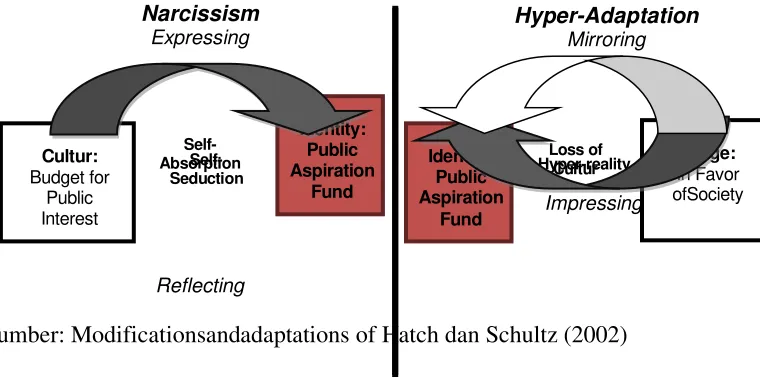
The policy of public aspiration funds in local budgeting has shown how legislature creates a symbol that indicates their responsibilities as the representativesto fight for public aspirations. However, in reality, the public aspiration funds have led to contradictions in an effort to serve their interests. Lancan in Piliang (2012) referred to it as a structured unconscious just like language structure. Lancan saw that as a language phenomenon, unconscious human journey is divided into two general phases, namelyimaginary phase and symbolic phase. Imaginary is associated with the identification experience of intuitive, affective and emotional; a variety of stimuli, as well as conceptual thoughts flowing without limit and with overlapping conditions, fluctuating, and criss-crossed, before moored permanently on the symbolic order. The symbolic order is alienation phase or subject splitting, namely the phase of losing part of his reality by identifying himself in symbolic order, in the form of a convention or code. Among the phases of this imaginary are the phase of mirror image and narcissistic identification phase (primary identification), in which the subject lives in ambiguous nature. At this narcissistic phase, the subject is seeing himself in the mirror with feelings of love due to its beauty, although what is seen (signifier) is not the truth (signified)of him. The public aspirations fund is one of the mirror and masks effects in budgeting context.
ofthemselves. This is consistent with many behavioral traits of extreme narcissism: grandiosity, vanity, fantasies of power and brilliance, search of admiration and arrogance and tends to have characteristics of destructive narcissism. Destructive narcissism is prone to paranoia and tend to maintain "some sort of stability". A leader who has the characteristics of a destructive narcissism can split himself as a "good representative", engaged in combat with "representatives of evil" (Glad, 2002).
Basically the local budget is designed as one of the implementations of the government's duty to serve and improve the public welfare. Therefore, the real budget is dedicated to the public interest. The public aspiration fund isone of the "absorptions" of action of local budgets actors to express their careness to the public. However, according to Edelman (1967) bureaucratic culture has been encouraging to see people as objects of administration, as a so many collection of "problems" to be solved, controlled, and improved or remade as a target for "social engineering", and generally designed and stored in the planned form with violence. The focus is attention to the dramatic political developments, but had no effect on welfare. The political discourse is usually bringing persons involved in tragic event.
In the model of organizational identity dynamics, Hatch and Schultz (2002) claimed that organization membersconcluded their identity based on how they express themselves to others and imaging who is in the shadow of self-expressions. Brown (1997) diagnosesthe conditions that unwilling or unable to respond to external impression as organizational narcissism. Based on the concept of Freud, Brown stated that narcissism is a psychological response to the needsof managing themselves, while narcissism in organization as a complex psychology which consists of denial, rationalization, self-aggrandizement, selfishness attribution and anxiety. Narcissism becomes dysfunctional when it existsin extreme conditions.
Hyper-Adaptation point of reference with their organizational culture in evolution stageof the image as described by Baudrillard (1994), in his book Simulacra and Simulation. In the first stage, the image represents the reality in line with the depth of the meaning of image (or sign). In the second stage, the image acts as a ‘mask’ to covers the reality hidden beneath the surface. In
the third stage, the image appears as a ‘mask’ butdoes not exist in reality.
Finally, in the fourth stage, the image has nothing to do with reality. An object can represent reality through the signifier which contains a specific meaning or signified. In this case, the reality is a reference from the signifier. However, it can also happen that an object does not refer to a specific reference or reality, because itis a fantasy or
hallucination to realize, Baudrillardcalled it as ‘hyper-reality’ (Piliang,
duplication of thenostalgia world and fantasy or becomes reality to substitute reality, fetish tomissing objects is no longer the object of representation, but the ecstasy of denial and annihilation of the ritual itself.
The hyper-reality world is a world loaded by alternation of the reproduction of simulacrum objects, objects of purely "sightings", deprived from the social reality of his past, or indeed possesses no social reality as a reference. In such a world,the subject as consumer is herded into "space experience" of hyper-reality experience to alternation of "sightings" in the room, mingling and melting of reality with fantasy, fiction, hallucinations and nostalgia, so the difference between each other is hard to find.In this case, hyper-reality toBaudrillard (1994)emphasizes both nostalgia and science fiction. People who are in this era are stuck in a state of schizophrenia, to remember them do not need to reflect the sign, message, meaning or norms. The populace is treated the reproduction of sighting values but not the reproduction of mythological or ideological values. The populace is the consumer who absorbsthe material values, the values of imaginary or sightings. Local budgeting has emerged mirror and mask effects for the involved budget actors. The problematic of symbols created by the local budgeting actors through discourse of public aspiration fund has opened space to expose the true reality behind the symbol.
Discourse and Potential of Local Budget Narcisism
When local budgeting can not show how the management of resources for public welfare, politicians, bureaucrats and legislators will seek to influence public perception by shaping the image as if they carry out the mandate entrusted by vouters (public). Thus, local budget has the potential to accentuate the "hall of mirrors".
Local budgets can claim rhetorical potency. When exploited by the actors of narcissistic budget, this rhetorical potential has power. Local budget facilitate the actors of narcissistic budget as part of a social expression. Glad (2002) analyzed the narcissist malignancy (political tyrants)leading to characteristic of destructive narcissism as a vicious circle that makes the "tyrant becomes increasingly isolated from the people under leading (Glad, 2002). Budget languagehas strong potential to be involved in the cycle by contributing to the isolation of budget actors from society. Thus, the abstraction of local budgets provides accounting (as a story) to another abstraction that is (metaphoric) of local government.
Public aspiration fund in this study is used as a theme of narcissism. According to Kets de Vries (2004) a dose of extreme narcissism is a prerequisite for anyone who hopes to rise to the top of the organization. In high competition, strong narcissistic personality is more preparableto carry out the difficult process to reach powerful position.Pech and Slade (2007) argued that narcissists "want a higher managerial position" for the satisfaction of gaining power through legitimate in corresponding to the demands of ritual organization. Narcissism is often referred to as onedimension of personality "Machiavellianism triad" (Paulhus and Williams, 2002) with a tendency of manipulation, a liar, opportunistic, but be able to attract attention, charismatic and pretend to emotion. Political narcissism according to Piliang (2009) is the tendency to exaggerated "self workship" of political elites, which builds image even though it is not the actual self-reality: "close to the farmer", "underprivileged defender", "familiar with the merchants in the market", "cautious leader","guard of nation unity","eradication of corruption", or"defenders of nation conscience". Political narcissism is the mirror of "political artificialism", through as good, smart, intelligent, perfect, and ideal as possible of self-image construction, regardless of general view of actual self-reality.
person comes into government with ideas about role and limitations, and then creates a program and budget based on personal narcissism in opposite to public sentiment. However, such mistaken is considered natural, because the public will usually forget it in a short time. The failure of social narcissism is demonstrated by inability of government policy to fight against the public instincts. However, the success of social narcissism is that government comes at the greatest power when the public confesses and reinforces the uncivilized desireof individual. The Government is successful to attract public collective narcissism while personally they only act for concern (Lutus, 2007).
Local budgeting as a discourse can be observed through language use and social relations that exist behind the budgeting process, in which the budget actor is speaking, writing and acting in local budgeting. This is in line with the notion of discourse by Piliang (2012) that the discourse is related to the use of language in certain time and place. The discourse is also directly related to social practices and daily life. In language area, discourse is defined as "... a certain way of speaking, writing, and thinking". Discourse can also be defined as a particular way in drafting and acting against social objects, which creates the implication on the subject. Itis manifested in social practices and physical composition (or structure)as well as in oral and written form. Therefore, discourse formes the object and object at the same(Piliang, 2012).
body and pleasure, there is a form of powerthat operates and determines the existence and the shape.
Conclusions, Implications, and Research Limitations Conclusion
Narcissism in local budgeting can be observed through a search on "public aspiration funds" created by the actor of local budgeting and as a form of local budgeting dynamics to shape identities attached to legislators as elected representatives or bureaucrats to serve the peoples. Public aspiration funds become "exspression" of local budgeting culture as a "physical" form of the service interests and public welfare.
The study also gains an understanding that when the identity becomes a "motive" to obtain the benefit of "private" or "certain groups" on behalf of the public, the aspiration funds have then been used as a means of "impression" that they are "as if" concerned with the public. Thus the public aspiration fund isnotlongerthe reality but it has become narcissism of political budgeting as a "mirror" that Piliang (2009) called it as "politics of seduction’. Aspiration funds have "disconnected" from their cultural roots (loss of culture).
Implication
At the practical level the mechanism of aspiration fund that was previously intended as fund allocation for legislative members in accordance with constituency has indeed become a local budgeting culture that tend to be manipulative.
As policy implications, the aspiration fund is a part of totalityby design of entire budgeting process. The practice so far shows that the level of accountability and transparency of public aspiration fund managementis very low, because the amount of aspiration fund allocation is unknown and only a part of "negotiation" between the local government and local Parliament (DPRD) through each device and their fittings.
The theoretical implication of this study indicates that local budgeting is not only observed in behavioral context, but can be developed in a broader perspective to observe the psychological, social, and politics impacts.
Limitations and Research Agenda for Future
Refference
Abdullah, Syukriyand JhonAndra Asmara. 2006.
PerilakuOportunistikLegislatifDalamPenganggaran Daerah;
BuktiEmpirisatasAplikasiAgency Theory di
SektorPublik.SimposiumNasionalAkuntansi 9 Padang, Padang, August, 23-26 2006.
Amernic, J.H. and Craig, R.J. 2010.Accounting as a Facilitator of Extreme Narcissism.Journal of Business Ethics, 96:79-93.
Anderson, R. E. and M. E. Tirrell: 2004, Too Good to be True. CEOs and Financial Reporting Fraud, Consulting Psychology Journal 56, 35-43.
Baudrillard, J. 1994. Simulacra and Simulation (trans. S.F. Glaser). Ann Arbor: University of Michigan Press.
Boland, R. J., andPondy, L. R. (1983). Accounting in organizations: toward a union of rational and natural perspectives. Accounting, Organizations and Society, 8 (2/3), 223–234.
Boland, R.J.Jr. 1985. Accounting and the Reproduction of Culture: Budgets and the Process of Structuration. College of Commerce and Business Administration Bureau of Economic and Business Research University of Illinois, Urbana-Champaign
Brown, A.D. 1997. Narcissism, identity, and legitimacy.Academy of Management Review, 22, 643-86.
Campbell, W.K., Keith Goodie S. Adam, and Foster D. Joshua.2004 Narcissism, Confidence, and Risk Attitude.Journal of Behavioral Decision Making, 17: 297–311.
Castellano, J. F. and S. S. Lightle.2005. Using Cultural Audits to Assess
Tone at the Top’, CPA Journal 75(2), 6-11.
Chatterjee, A. andHambrick, D.C. 2006. It's All About Me: Narcissistic Chief Executive officers and Their Effects on Company Strategy and Performance, Administrative Science Quarterly 52, 351-386. Christensen, L.T. and Cheney, G. 2000. Self-absorption and
self-seduction in the corporate identity game. In M. Schultz, M.J. Hatch and M.H. Larsen (Eds), The expressive organization: Linking identity, reputation, and the corporate brand. Oxford. Oxford University Press.
Dobell, Peter & Martin Ulrich. 2002. Parliament’s performance in the budget process: A case study. Policy Matters 3(2): 1-24. http://www.irpp.org.
Duchon, D. and B. Drake. 2009. Organizational Narcissism and Virtuous Behavior, Journal of Business Ethics 85, 301-308.
Edelman, M. 1967. The Symbolic Uses of Politics, Urbana, Univ. of Illinois Press (paperback).
Farhan, Yuna. 2013.
MenelusuriPolitisasiAnggaranpadaTahunPemilu.JurnalPemiludan Demokrasi29(2): 29-49.
Glad, B. 2002. Why Tyrants Go Too Far: Malignant Narcissism and Absolute Power. Political Psychology 23, 1-37.
Hatch, M. J. and Schultz, M. 2002.Organizational Identity Dynamics.Human Relations, 55, 989-1018.
Havens, Harry S. 1996. Budgeting and policy-making by the legislature in the United States.Budgeting and Policy Making SIGMA Papers No. 8, Organisation for Economic Co-operation and Development. Hyde, Albert C. and Jay M. Shafritz.(Eds.) 1978.Government Budgeting:
Theory, Process, and Politics. Oak Park, Illinois: Moore Publishing Company, Inc
John, O.P. and Robins, R. W. 1994. Accuracy and Bias in Self-Perception: Individual Differences in Self-Enhancement and The Role of Narcissism. Journal of Personality and Social Psychology, 66, 206-219.
Johnson, Cathy Marie. 1994. The Dynamics of Conflict between Bureaucrats and Legislators. Armonk, New York: M.E. Sharpe. Joyce, Philip. 2005. Linking Performance and Budgeting under the
Separation of Powers: The Three Greatest Obstacles Created by
Independent Legislatures”, paper presented at the International
Monetary Fund Seminar on Performance Budgeting, December, Washington DC.
Kernberg, O. 1975.Borderline Conditions and Pathological Narcissism.New York: Jason Aronson.
Kets de Vries, M.F.R. 2004.Organizations on the Couch: A Clinical Perspective on Organizational Dynamics. European Management Journal Vol. 22, No. 2, pp. 183–200.
Kets de Vries, M.F.R. and Miller, D. 1985. Narcissism and Leadership - an Object Relations Perspective.Human Relations 38 (6):583-601. King, R.F. 2000.Budgeting Entitlements: The politics of food
Koven, S.G. 1999. Public budgeting in the United States: The Cultural and Ideological Settings. Georgetown University Press,
Washington DC.
Lasch, C. 1977. The Narcissistic Personality of Our Time.Partisan Review, 44(1), 9-19.
Lutus, Paul, 2007. Social Narcissism, The Variety and Persistence of Human Self-Deceptionhttp://www.arachnoid.com/opi
Meyers, Roy T. 1999. Legislatures and Budgeting, in Roy T. Meyers (ed.), Handbook of Government Budgeting, Jossey-Bass, San Francisco, California, United States
Noda, Kohei. 2011. Politicization of Philippine Budget System: Institutional and Economic Analysis on “Pork-Barrel”. Policy Research Institute. Tokyo.
Pech, R.J. and Slade, B.W. 2007.Organisational Sociopaths: Rarely Challenged, Often Promoted. Why?.Society and Business Review 2(3), 254–269.
Paulhus, D.L. and Williams, K.M. 2002. The Dark Triad of Personality: Narcissism, Machiavellianism, and Psychopathy. Journal of Research in Personality, 36, 556–563.
Piliang, Y.A. 1998. SebuahDunia Yang dilipat, Bandung: Mizan Piliang, Y. A. 2009. Simulakra Politik (online),
http://taitaiberacun.wordpress.com/2009/06/05/narsisme-politik/ Piliang, Y.A. 2012.SemiotikadanHipersemiotika: Kode, Gaya
danMatinyaMakna. Edisi 4.PenerbitMatahari, Bandung.
Posner, Paul andChung-Keun Park. 2007. Role of the Legislature in the Budget Process: Recent Trends and Innovations. OECD Journal on Budgeting Volume 7 – No. 3
Rachman, A. 2009.Demokrasi,
NarsismedanKeaksaraanBudaya.MakalahpadaWorkshop
PenguatanKapasitasGerakanAntariman,conducted in Manado, North Sulawesi, June, 22-27 2009.
Raskin, R., Novacek, J. and Hogan, R. 1991. Narcissism, Self-Esteem, and Defensive Selfenhancement.Journal of Personality, 59, 20-38. Rogoff, K. 1990. Equilibrium Political Budget Cycles.American
Economic Review 80, 21-36.
Schick, Allen. 2002. Can National Legislatures Regain an Effective Voice in Budget Policy?.OECD Journal on Budgeting, 1:3, pp. 15-42.
Schwartz, H. S. 1991. Narcissism Project and Corporate Decay: The Case of General Motors, Business Ethics Quarterly 1, 249-268. Shepsle, Kenneth A. 1986). Institutional Equilibrium and Equilibrium
Institutions, in H. Weisberg (ed.), Political Science: the Science of Politics, Agathon, New York, United States.
Shi, M. andSvensson, J. 2002.Conditional Political Budget Cycles.CEPR Discussion Paper No. 3352.
Syarifuddin, 2009.KonstruksiKebijakanAnggaran: Aksentuasi Drama PolitikdanKekuasaan (StudiKasusKabupatenJembrana Bali). JurnalEkuitas, 307-331
Wehner, Joachim. 2004. Back from the Sidelines? Redefining the Contribution of Legislatures to the Budget Cycle.World Bank Institute, Washington DC.
Wildavsky, Aaron. 1988. The New Politics of the Budgetary Process. Glenview, IL: Scott, Foresman.
Other Source of References
Debat Dana Aspirasi, http://benhan8.wordpress.com/tag/dana-aspirasi-dpr/.16/06/2010,Benny Handoko (benhan) and Indra J Piliang (IJP), Golkaspolitician.