Dentofasial, Vol.13, No.2, Juni 2014:74-79 74
A.actinomycetemcomitans
adhesi protein increasing IL-8 titre in heart of wistar
rat with aggressive periodontitis
(Protein adhesin dari A.actinomycetemcomitans
meningkatkan titer IL
-8 di dalam jantung tikus wistar dengan periodontitis agresif)
Rini Devijanti Ridwan, Retno Indrawati Department of Oral Biology
Faculty of Dentistry Airlangga University Surabaya, Indonesia.
ABSTRAK
Penyakit kardiovaskular dan periodontal adalah kondisi keradangan yang umum dalam populasi manusia. Limfosit T berpartisipasi dalam patogenesis dan inflamasi pada aterosklerosis. Sel-sel kekebalan ini memasuki dinding arteri sehingga terjadi keradangan dan bergabung dengan makrofag melalui sejumlah interferon-c-inducible kemokin. Faktor kemokin (IL-8), sitokin, dan pertumbuhan juga berpartisipasi dalam proses ini. Interaksi antara IL-8 dan reseptornya, CXCR2, juga dapat berkontribusi untuk pembentukan lesi pada tikus. Penyebab utama periodontitis agresif adalah Actinobacillus actinomycetemcomitans. Pada penelitian sebelumnya, terungkap bahwa protein adhesin dengan berat molekul 24 kDa dari A.actinomycetemcomitans adalah adhesin spesifik, yang berperan dalam proses adesi pada host. Adesi protein adhesin ini dalam perlekatan pada sel epitel menyebabkan kolonisasi dan invasi A.actinomycetemcomitans yang merangsang respons kekebalan tubuh host. Penelitian ini dimaksudkan untuk menganalisis pengaruh induksi protein adhesin A.actinomycetemcomitans dengan berat molekul 24 kDa terhadap kadar IL-8 dalam jantung tikus Wistar dengan periodontitis agresif menggunakan metoda Elisa untuk mengukur dan menganalisis kadar IL-8. Setelah dianalisis dengan analysis of variance, menunjukkan perbedaan yang signifikan kadar IL-8 pada kelompok kontrol dan kelompok induksi A.actinomycetemcomitans, A.actinomycetemcomitans+protein adhesin A.actinomycetemcomitans 24 kDa dan hanya dengan protein adhesin A.actinomycetemcomitans 24 kDa saja. Disimpulkan bahwa protein adhesin A.actinomycetemcomitans dengan berat molekul 24 kDa memiliki peran dalam peningkatan kadar IL-8 dalam jantung tikus Wistar dengan periodontitis agresif.
Kata kunci: A.actinomycetemcomitans, protein adhesin , kadar IL-8, jantung, periodontitis agresif
ABSTRACT
Cardiovascular and periodontal diseases are common inflammatory conditions in the human population. T-lymphocytes participate in the pathogenesis and inflammatory events of atherosclerosis. These immune cells enter the inflamed artery wall and join macrophages via a number of interferon-c-inducible chemokines. Chemokines (IL-8), cytokines, and growth factors also participate in this process. The interaction between interleukin- 8 and its receptor, CXCR2, can also contribute to lesion formation in mice. The main causes of aggressive periodontitis is Actinobacillus actinomycetemcomitans. Previous studies have proven that adhesin protein with 24 kDa molecular weight from A.actinomycetemcomitansis a specific adhesin, this adhesin proteins play a role in the adhesion process on host. this kind adhesion in the epithelial attachment would lead to colonization and invasion of A.actinomycetemcomitansthat will stimulate the host immune response. This study aimed to analyze the influence of induction 24 kDa A.actinomycetemcomitansadhesin protein to the titre of IL-8 in heart of Wistar rat with aggressive periodontitis using Elisa method to measure and analyze the titre of IL-8. After analyzed with analysis of variance, showed significant differences of IL-8 titre in the control group and the group with the induction by A.actinomycetemcomitans, A.actinomycetemcomitans plus 24 kDa A.actinomycetemcomitans adhesin protein, and only with 24 kDa A.actinomycetemcomitansadhesin protein. It can be concluded that A.actinomycetemcomitansadhesin protein with 24 kDa molecular weight has a role in increasing of IL-8 titre in heart wistar rat with aggressive periodontitis.
Keywords: Actinobacillus actinomycetemcomitans, adhesin proteins, IL-8 titre, heart, aggressive periodontitis
Correspondence:Rini Devijanti Ridwan, c/o: Department of Oral Biology, Faculty of Dentistry Airlangga University,
Jl. Mayjen Prof. Dr. Moestopo 47 Surabaya 60132, Indonesia. E-mail: [email protected]
INTRODUCTION
Periodontal disease is by far the most common oral infection, and is the subject of most studies concerning therelationship betweensystemic disease and oral health. Periodontal disease caused by bacteria that found in dental plaque, that causes inflammation in the tissues of the gums and mouth. This inflammation can cause destruction of the
cells and. This spending will stimulate MMP-8 by neutrophils. The periodontal bacteria can enter the bloodstream and travel to major organs and begin new infections. Evidence suggests that this process may contribute to the development of heart disease, increase the risk of stroke, increase a woman’s risk of delivering a preterm low-birth-weight baby, and pose a serious threat to people whose health is compromised bydiabetesmellitus,respiratorydisease or osteoporosis.2Chemokines and their receptors are considered promising targets for the regulation of leukocyte infiltration in inflammatory and immune diseases, and many pharmaceutical companies are currentlyconducting clinical development programs targeting the chemokine system.Acute inflammation such asthat iscausedby bacterial infection, ischemia-reperfusion injury and acute glomerulonephritis, predominantly neutrophils infiltrate into the tissue. The critical role of CXCL8, related molecules, and their receptors CXCR1/2 has been established in various disease models. The contribution of each ligandandtheroleofthe receptors in different tissues and circumstances varies. Thus, the dual specific antagonists for CXCR1/2 would be an ideal way to block neutrophil infiltration. If acute inflammation is unable to be resolved by neutrophils, the inflammation perpetuates and develops in chronic inflammation inwhich macrophagesand lymphocytes predominate are the infiltrating cells.3
Based on Pussinen et al’s study on 2005, an infection by A.actinomycetemcomitans may be associated with the incidence of coronary heart diseases (CHD). Consistent with their findings, high serum levels of Immunoglobulin A (IgA) antibodies to A.actinomycetemcomitans have been found to predispose to cerebrovascular stroke in subjects free from CHD at baseline.Their study suggests that high IgA antibodies levels to both P.gingivalis and A. actinomycetemcomitans are associated with CHD. These results also indicate that serum antibodies to periodontal pathogens might be worth screeningwhen mapping individual risk factors for CVD.4Research using animals model in 1985 managed to find any biochemistry substrate that depresses the function of heart in a state of sepsis such as IL-1, IL-8, and C3a. Endotoxins derived from gram-negative bacteria lipopolysaccharide form will initiate the onset of TNF-αthat will interact with toll-like receptors–4 and cause interference with cell function cardiac muscle. The production of nitric oxide produced by induce nitric oxidesynthetase(iNOS) in the state sepsis also brings adverse effectsto thefunctionheartthrough the onsetofsubstance-thesubstanceis a strong oxidant.5.6
The data indicated that 70% of endocarditis cases
causedbyA.actinomycetemcomitanshave underlying heart diseases, such as valvopathy and prosthetic valves.Thecompromisedconditionofthehostcardiac valves, together with a transient bacteremia induced through daily activities, allows this endogenous oral bacterium to colonize, invade, and replicate at the extraoral sites.
Coincidental with advancesinthe understanding of inflammation mechanisms, including in part the discovery of the cell adhesion molecules described above, studies of atherosclerosis progressed beyond light microscopy, histopathology and into molecular biology. It is in this realm that the inflammatory hypothesis has garnered significant support. Another candidatetrigger of both autoimmune responses and inflammatory that leads to the initiation and or accelerationofatherosclerosis areinfection.Evidence
in humans suggest that infection predisposes to atherosclerosis is derived from studies demonstrating that the infectious agents reside in the wall of atherosclerotic vessels, and the seroepidemiological studies demonstrate an association between the pathogen-specific IgG antibodies andatherosclerosis.
Recently,it hasbeenproposed that multiple infectious agents contribute to atherosclerosis,and that the risk of cerebrovascular disease (CVD)posedby infection is related to the number of pathogens to which an individual has been exposed.7 There is an evidence to supporttherelationshipbetweenhumanperiodontal disease and an increased risk for acute myocardial infarction.8.9Periodontal disease is characterized by generalized alveolar bone resorption and, in severe cases, early loss of dentition.10 Despite rigorous clinical intervention strategies,recent reports suggest that up to 30% of adults in the USA over the age of 40 have measurable periodontal bone loss.11 Case control studies have demonstrated a significant correlation between CVD and periodontal disease after adjusting to cholesterol,smoking,hypertension,
social class, and body mass index.8,12 Following binding and invasion by the pathogenic microbes, endothelial cells respond by producing cell adhesion molecules (CAM) such as E-selectin, ICAM-1 and VCAM-1,aswellasa vast arrayofcytokines including
Dentofasial, Vol.13, No.2, Juni 2014:74-79 76
mediators, including IL-8, MCP-1, and IL-6, which collectively support atherogenesis.4 Adhesins are important in the initial recognition of receptors distributed on the surface of the host tissue. Both fimbrialand nonfimbrialadhesins havebeen identified on the surface of A. actinomycetemcomitans.13
The aim of this study was to analyze the influence of induction 24 kDa adhesin protein of A.actinomycetemcomitans to the titre of IL-8 in heart of wistar rat with aggressive periodontitis because of the role of A.actinomycetemcomitas adhesion protein in the pathogenesis of aggressive periodontitis, specially the influence of this adhesin protein on heart was not yet known.
MATERIALS AND METHOD
Culture and isolation of A.actinomycetemcomitans clinical isolate
The sample was A.actinomycetemcomitans clinical isolate that is isolated from patients with aggressive periodontitis in PeriodonsiaClinicFaculty ofDentistryAirlangga University Surabaya. Bacteria were grown in A.actinomycetemcomitans growth medium (AAGM) or in Luria Berthani (LB) medium and incubated at 37ºC anaerobically for 24 hours. Identification ofA.actinomycetemcomitanson AAGM platesbased on gross morphology such as adherence to the medium surface, a starlike inner structure and positive catalase. The identification of bacteria A.actinomycetemcomitans confirmed the use of Microbact system and PCR.
Isolation of adhesin protein of Actinobacillus
actinomycetemcomitansclinical isolate
A.actinomycetemcomitanswas cultured in 250 ml AAGM or LB medium, added with 10 ml of 3% tricholoro acetic acid (TCA), and allowed to stand for 30-60 minutes. After that they were centrifuged at 6.000 rpm at 4ºC for 15 minutes. Supernatant was discarded and the sediment suspended in 50 ml PBS on pH7.4 thenfimbriaewascut usingOmnimixer as a cutting tool and then centrifuged at 12.000 rpm for 15 minutes and the supernatant (fimbriae pieces) were stored.
Sodium dodecyl sulphate poliacrylamide gel electrophoresis (SDS-PAGE)
Molecular weight monitoring was doneby means ofSDS-PAGE followingLaemmli method.14Protein sample was heated 100ºC for 5 minutes in a buffer solutioncontaining5 mM Tris HCl pH6.8,2-mercapto
ethanol 5%, w/v sodium dodecyl sulfate 2.5%, v/v glyserol 10%,with bromophenol blue ascolor tracker.
The gel was 12.5% mini slab gels (4% gel tracking);
using 120 mV voltage.Coomassie brilliant blue was used for staining and pre stained, protein ladder was used as the protein marker.
Protein purification of A.actinomycetemcomitans adhesin protein hemaglutinin
Theprotein profile from the adhesin collections was performed by SDS-PAGE. The gels were cut straight at the desired molecular weight, collected, and put into a dialysis membrane tube containing electrophoresisrunningbuffer liquid.Electrophoresis used an electrophoresisapparatus horizontal (voltage of 125 mV for 25 minutes). Then the result of electrophoresis was dialysized. In the first 24 hours the dialisis used dH2O and continued with PBS pH 7.4 for the next 2x24 hours. Dialysate fluid of the SDS-PAGE protein band was precipitated using cold absolute ethanol. The precipitate was assessed using hemagglutination test.
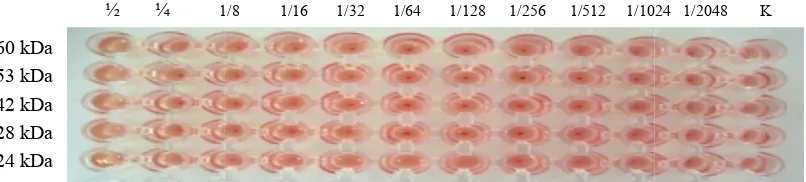
Hemagglutination assay
The hemagglutination test was done following Hanne andFinkelstein.15The sample was diluted into
concentration of ½ in the microplate wells for each 50μl volume.Each well was added with suspension of red blood cell of mice at concentration of 0.5%, and then shaken in rotator plate for one minute and resided at roomtemperature for an hour.Thetiterwas determined bythepresenceof red blood agglutination on the lowest dilution. The samples were whole-cell A.actinomycetemcomitans lysat, which were intact bacterial cells, and adhesin protein was already prepared.The type of red blood cells was taken from healthy mice.
Elisa method
Indirect Elisa was used to count the IL-8 titre in wistar rat heart, ELISA Kit, BG-RAT11336 (Novateinbio). First, heart tissue from wistar rat was prepared,add heart tissue with PBST (5X Volume)+ PMSF 4mM, crushed in mortal cold,then performed sonication about 10 minutes and centrifugation in 6000 rpm during 15 minutes in room temperature. Supernatant was added with cold absolute ethanol, centrifuge in 1000 rpm. In the next 10 minutes add pellets with Buffer Tris-Cl 20 mM.
sample+40 µL sample solvent). In the solvent blank added 50 µL of conjugateeach well except the blank shaker was uses to homogenize thi incubate it for 60 minutes at 37ºC solution as much as possible,remov as possible the contents well with was Homogenization was performed wi minute, remove the washing solution liquidwith filter paper.Repeat this p for a total 5 times washing. Add sub each 50 µL in each well and make then incubated for 15 min at 37ºC solution to stop the reaction mark change from blue to yellow. Mea density at a wavelength of 450 nm Create a standard curve with optic Y-axis and concentration on the X
thelinear regression equation.Thus of the sample can be determined.
Statistical analysis.
One-way Anova and Tukey's detect differences between the titre on the control group and the one on adhesin,adhesin plusA.actinomyce only A actinomycetemcomitansind
RESULTS
Adhesin protein was isolated fro actinomycetemcomitans by using NOG separation.Marker proteins used wa ladder (Sigma). Protein molecular w unit of kDa. There were five major proteins with their molecular mas kDa and 42 kDa, 28 kDa and 24 kDa
Table 1The mean and standart Group
In well standar add µL of HRP-antibody blank well. Then slow e this solution and C. Then discard the removingfluid as much l with washing solution.
with a shaker for 1 solution and the excess this procedure 4 times Add substrates A and B, make it homogenized
C. Add 50 µL stop n marked by the color . Measure the optical 450 nm for 15 minutes. th optical density as the the X-axis andcalculate
Thus,the concentration
Tukey's test was used to the titre of IL-8 in heart olecular weight was in the
major proteins of the ar mass of 60 kDa, 53 a and 24 kDa. Furthermore,
each of the collection protein agglutinations test (fig.1) after purification by using ele of the fifth adhesin protein highest titer (protein dilution other collections.The five colle of adhesin protein would be subsequent study.
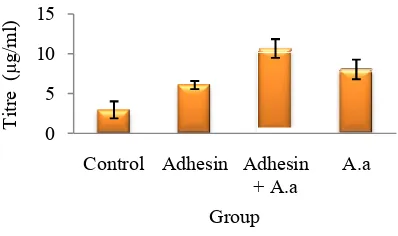
One-way Anova test res of the IL-8 in titre in the group with adhesin, adhesio actinomycetemcomitans, an actinomycetemcomitansinduct different (table 1), p=0.00 analyzed by the LSD test difference from the IL-8 titr and the group treated with indu plus Actinobacillus actino A.actinomycetemcomitansan groups. The highest IL-8 titre in in group with adhesin actinomycetemcomitans,then with A. actinomycetemcomit with adhesin protein induction titre was in control group. in fig.2.
DISCUSSION
This study found the hig rat heartwas in group with adhes actinomycetemcomitans, th induction with A.actinomyce by group with adhesin protei lowest was in control group. have found an increasing IL-8 in gingival wistarratafter
profile of five major adhesin proteins of A.actinomycetemcomi d 24 kDa)
1/8 1/16 1/32 1/64 1/128 1/256 1/512 1/1024
tandart deviation number of IL-8 titre in wistar rat heart
X SD Min
2.93a 1.07 2.16 6.06b 0.51 5.69
comitans 10.66d 1.18 9.82
8.02c 1.23 7.14
perscripts indicate that there are significantly differences between
protein passed through hem-ig.1) using mice erythrocytes using electroelution. Aglutinat protein collection was at the in dilution 1/128) compared with collection proteins 24 kDa uld be used as a sample for
test results showed the value in the control group and the adhesion plus Actinobacillus and the Actinobacillus induction were significantly
and between the treatment 8 titre in wistar rat heart was adhesin plus Actinobacillus then in group only induction comitans, after that in group in induction, and the lowest IL-8 This condition is shown expression and levels of afterinduction with adhesin
comitans (60 kDa, 53
78
protein of A.actinomycetemcomita showed that the A.actinomycetemcom protein influence theIL-8 expression IL-8 is an inflammatory chemokine mainlyasa neutrophil chemoattractan factor. IL-8 is found at higher lev crevicularfluidprior toclinical signs As periodontal disease seems to be progression of the inflammatory periodontal tissue,chemokinesfound tissueandcrevicular fluid may play an on its pathogenesis. In this regard history of periodontitis have high lev in gingival tissue andcrevicular fluid correlated with disease severity. Ch family of potent chemotatic cytokine thetraffickingandrecruitmentof leu sitesofinflammation.Thefine tuning of the chemokine system is essent homeostasis and defense,and itsabn is often associated with pathologica first cytokine identified to have chem was IL-8,which is proventobe a sele chemoattractant. Chemokines are fou tissue and crevicular fluid and are number of cell types in the period fibroblasts,polymorphonuclear leuk cells, endothelial cells, osteoclasts, monocytes, lymphocytes, and mast their effectslocally in paracrine or au Some chemokines have important effects andarerelatedto periodontal that involves the stimulation of bone induction of tissue damage. Chem affect the recruitment, differentiatio precursor cells to form osteoclas osteoclast survival. They could als periodontal disease by recruiting neutrophils, which protect host ag invasion.17
IL-1,IL-6,IL-8,andTNF-αC3a
factors that arise in response to sy
Figure 2IL-8 titre ini wistar rat heart 0 process to deeper foundin both gingival y play animportantrole regard, subjects with a e high levels of CXCL8 fluid;theselevels are erity. Chemokines are a be a selective neutrophil ines are found in gingival and are produced by a periodontium, such as leukocytes,epithelial eoclasts, macrophages, and mast cells and exert ine or autocrine fashion. portant proinflammatory dontal tissuedestruction n of bone resorption and e. Chemokines can also rentiation, or fusion of osteoclasts or enhance could also interfere with ruiting cells, such as host against bacterial
C3a are inflammatory se to systemic infection
in the state of sepsis. TNF-response to onset of endoto activated macrophages and can induce septic shock and instrumental in the early stag functionheart through the ind nitric oxide. The exact mech TNF-α resulted in impaired heart not yet clear. There is a hypoth disruption of calcium balance essential to cardiac muscle of and increased cellular produ produced by iNOS pathway in
Although mostof thebac it has long been recognized that stream may cause distant studies have demonstrated the bacteria in atherosclerotic pla aortal aneurysms, in particula the pathogenesis of periodon prospective studies have also evidencethat infections caused pathogens like P.gingivalis actinomycetemcomitans are stroke, increased risk of my acute coronary syndrome (AC not only colonize distant site also elicit a host-tissue response by a dense infiltrate of neutrop differentlymphoid cells.Thes adjacent host-tissue cells will subs immune–inflammatory respon differentcytokines andprostano IL-8, TNF-a, prostaglandin E2, metaloproteinases, which pl connective tissue and bone des the periodontal lesion. Thes metabolites beyond this poten may disseminate systemically or indirectly the atheroma pa
Afterstimulationbybacte (LPS, and peptidoglycans), produces inflammatory cytok peptidoglycans are recogniz systemandspecific receptors re
Vol.13, No.2, Juni 2014:74-79
-α is an early mediator in endotoxins that produced by es and cardiac muscle cells. It ck and in a state of advanced rly stages of a decline in pump inductionof prostanoid and mechanism underlying the
α resulted in impaired heart function until is a hypothesis that explains the balance which plays a role uscle contraction at the level lar production of peroxy nitrite athway in sepsis state.5,18
bacteraemias are transient, nized that bacteria in the blood distant site infections. Several
the presenceof certain oral erotic plaques and abdominal articular species implicated in periodontitis. Recently, many have also provided serological ns caused by major periodontal givalis and Aggregatibacter are associated with future of myocardial infarction, and (ACS).These bacteria may nt sites;their components will responsecharacterized locally neutrophils,macrophages,and These cellstogether with the ue cells will subsequently elicit an ry response with the release of prostanoids,suchas IL-1,IL-6,
landin E2, and different matrix ich play a pivotal role in the ue and bone destruction occurring in . These bacteria and released potential local pathogenicity mically and influence directly roma pathophysiology.19
bacteria andtheircomponents cans), the periodontal tissue cytokines(IL-1ߚ,TNF-ߙ,IL-6,
chemokines (MCP-5, IL-8,
LPS,peptidoglycans are not so strong stimulators of immune reaction. The presence of circulating oral bacteria orbacterial components may stimulate blood cells to produce cytokines. IL-6 levels significantly increased eight hours after scaling, while the IL-8 decreased.The cases of infectious endocarditiscaused by bacteria of dental plaque. The following bacteria were proven as etiological factors: Aggregatibacter actinomycetemcomitans,Capnocytophaga,Eikenella corrodens, Streptococcus species, Neisseria, and Lactobacillus. Bacteria of dental plaque and their components in the periodontal tissues may penetrate intothecirculationand exhibit pathogenic potential.20
From the discussion,it can be concludedthat A. actinomycetemcomitansadhesin protein with 24 kDa
molecular weight has arole in increasing of IL-8 titre in heart Wistar rat with aggressive periodontitis. Currently,adhesinprotein-basedvaccine development to control infectious diseases thrive. Barriers to the first stage of infection, namely bacterial attachment to host cell receptors and colonization can prevent infection.Vaccinebasedon adhesionmaterial is very interesting because this vaccine will provide two advantages,besides theformation of antibodies to the adhesin, which causes adhesion barrier in the entry of bacteria, as well as the antibodies produced will improve the process of elimination of bacteria by the immune system. Adhesin protein is a one of the material that can be used as a vaccine candidate to manage aggressive periodontitis.
REFERENCES
1. American Dental Association. Oral health topics a-z: oral systemic health (your health and your overall health). http://www.ada.org/public/topics/oralsystemic.asp. Accessed January 16, 2008
2. American Academy of Periodontology. Oral health information for the public: mouth body connection. www.perio. org/consumer/mbc.top2.htm. Accessed January 16, 2008
3. Matsushima K, Terashima Y, Toda E, Shand F, Ueha S. Chemokines in inflammatory and immune diseases: inflammation and regeneration 2011; 31 (1): 11-22
4. Pussinen PJ, Nyysso¨nen K, Alfthan G, Salonen R, Laukkanen JA, Salonen JT. Serum antibody levels to Actinobacillus actinomycetemcomitans predict the risk for coronary heart disease. Arterioscler Thromb Vasc Biol 2005; 25: 833-8
5. Sharma AC. Sepsis – induced myocardial dysfunction. Shock 2007; 28: 265-9
6. Kumar V, Abbas AK, Robbins FN, Cotran. Pathologic basis of disease. 7thEd. Elsevier Inc; 2005
7. Loscalzo J. Molecular mechanisms of atherosclerosis. Taylor & Francis, An imprint of the Taylor & Francis Group; 2005. p. 61-81,334-66
8. Scannapieco FA, Genco RJ. Association of periodontal infections with atherosclerotic and pulmonary diseases. J Periodont Res 1999; 34: 340–5
9. Haraszthy VI, Zambon JJ, Trevisan M. Identification of periodontal pathogens in atheromatous plaques. J Periodontol 2000; 71:1554–1560
10. Armitage GC. Development of a classification system for periodontal diseases and conditions. Northwest Dent 2000; 79:31–5
11. Oliver RC, Brown LJ, Loe H. Periodontal diseases in the United States population. J Periodontol 1998; 69: 269–78 12. Wu T, Trevisan M, Genco RJ. Periodontal disease and risk of cerebrovascular disease: the first national health and
nutrition examination survey and-its follow-up study. Arch Intern Med 2000; 160:2749–55
13. Tang G, Kitten T, Munro CL, Wellman GC, Mintz KP. A potential virulence determinant of Aggregatibacter actinomycetemcomitansin infective endocarditis. Infect Immun 2008; 76 (6): 2316–24
14. Laemli UK. Cleavage of structural protein during the assembly of the head of bacteriophage T4.Nature1970: 680-6 15. Hanne LF, Findkelstein RA. Characterization and distribution of the hemagglutinins produced by Vibrio cholerae.
Infect Immun1982; 36: 209-14
16. Devijanti R. Identification and the role ofActinobacillus actinomycetemcomitansadhesin protein in IL-8, osteocalcin expression and MMP-8 in aggressive periodontitis pathogenesis. [dissertation].Surabaya:Airlangga University;2012 17. Garlet GP, Aranha AMF, Silveira EM, Vieira AE, Queiroz-Junior CM, Madeira MFM, et al. The role of chemokines
and cytokines in the pathogenesis of periodontal and periapical lesions: current concepts. inflammation, chronic diseases and cancer - cell and molecular biology. Immunology and Clinical Bases; 2012. p. 220-64
18. Silbernagl S. Heart and circulation. In: Silbernagl S, Lang F, editor. Color atlas of pathophysiology. Thieme; 2000. p.230-4
19. Sanz M, D’Aiuto F, Deanfield J, Fernandez-Avile´s F. European workshop in periodontal health and cardiovascular disease-scientific evidence on the association between periodontal and cardiovascular diseases: a review of the literature. Eur Heart J 2010; 12 (Suppl B): B3–B12