United Nations
Economic and Social Commission for Asia and the Pacific
P r o -p o o r W a t e r a n d W a s t e w a t e r
M a n a g e m e n t i n S m a l l T o w n s
Water Supply Management in Cokrodiningratan Community
Note: The views expressed in this paper are those of the authors and do not necessarily reflect the views of the United Nations Secretariat. Mention of firm names and commercial products does not imply the endorsement of the United Nations. This publication has been issued without formal editing.
CONTENTS
SECTION 1: BACKGROUND ... 3
SECTION 2: PRACTICE DEVELOPMENT AND OPERATIONS... 9
SECTION 3: OUTCOMES ... 20
SECTION 4: SUSTAINABILITY ... 25
SECTION 5: POLICY IMPLICATIONS ... 28
SECTION 6: INFORMATION SOURCES AND VERIFICATION ... 30
SECTION 1: BACKGROUND
1.1. Name of the practice
Small Community Water Supply Management, Yogyakarta, Indonesia.
1.2. Location
RW07, Kampung Jetisharjo, Cokrodiningratan Village, Jetis Sub-district, Yogyakarta, Special Region of Yogyakarta Province, Indonesia.1
1.3. Focus
;Water distribution
; Water treatment
Water conservation
Drainage
Wastewater collection
Wastewater treatment
Others (specify)
Is this practice:
;Policy / legislative / planning-related
; Process / methodology / approach-related
Technology-related
Other (specify)
1.4 Scale of the practice
The practice was initially intended to fit within RW07, particularly regarding the operations of Usaha Air Bersih (UAB, or Clean Water Organization) Tirta Kencana.2 The number of connections before implementation was 65. The project added 50 connections that serve 53 households. The service area also includes part of RW06, a nearby neighbourhood. The capacity of a groundwater reservoir was expanded to 54 cubic metres (m3) and the upper-water reservoir was expanded to hold 4.2m3. On-site construction over 16 months cost US$14,207, from a project total cost of US$17,769. After completion, the project serves 115 connections in the area.
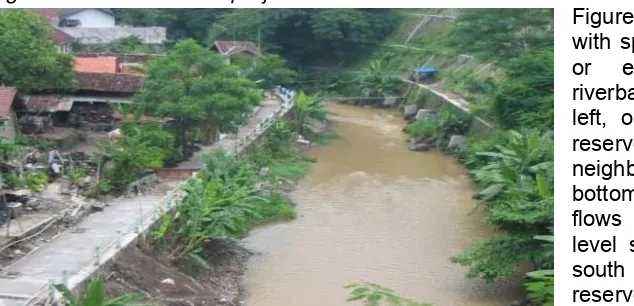
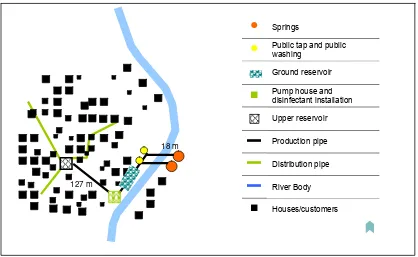
Figure 1: Location of the project
Figure 1 shows the location, with springs on the river’s right, or east side, above the riverbank. A settlement is on the left, or west side. The ground reservoir is built under the neighbourhood pathway, at the bottom left of the picture. Water flows naturally from the higher-level springs to the west, then south toward the ground reservoir.
Source: Henrika, May 2005.
1 RW (
rukun warga) means neighbourhood within a village. 2
1.5 Duration of the practice
Ms. Henrika Retno Tyas Arum, an alumnus of the Asian Institute of Technology (AIT), was awarded funding in 2005 through the Southeast Asia Urban Environmental Management Applications (SEA-UEMA) Project for a proposal to develop clean water supply management and treatment in RW07. The proposal was developed with the local community.
The project began in January 2005 and construction was completed in March 2006. It has been fully operated since January 2006, with new management and more infrastructures built since then. The existing water supply remained in operation while the project was developed. The scheme was planned to last for 20 years. However, as the project evolved, it was realized that several elements such as pipes and a water pump would be likely to last just 10 years. Continuity depends greatly on the availability and sustainability of water from local springs.
1.6 Socio-economic environment
The project was implemented in Jetis sub-district in the Special Region of Yogyakarta. Yogyakarta comprises one municipality (the city of Yogyakarta) and four districts. Due to urbanization and economic development, the city and part of Sleman and Bantul districts form an urban agglomeration. Administratively, the city has 14 sub-districts. Unlike other sub-districts, most of the Jetis area is by the Code River. The area is commonly categorized as a low-income settlement.
More than 1 million people live in the wider urban area, where all local economic activities are concentrated. Basic urban infrastructure services (transportation, a clean water supply, drainage and waste management) exist but are not distributed evenly, especially in the low-income settlement by the river. People living by the river rely on three methods for obtaining clean water: (i) A local government enterprise, Perusahaan Air Minum Daerah (PDAM), (ii) local community initiatives, which is where the project intervenes, and (iii) shallow wells and riverbank springs. Most residents who get their water from PDAM work in the formal economy while people who use the springs work mostly in the informal economy (for example, as scavengers or petty traders).
The RW07 community has occupied an area of 21,000 square metres (m²) for more than 70 years. There are 265 households with a total population of 1,250 people. Of these, only 103 households have land-ownership certificates in their name. In 2006, 41 households were registered as renting land. The settlement is dense not only in terms of building density but also in terms of the number of people living in the area, where two or three families commonly occupy one house.
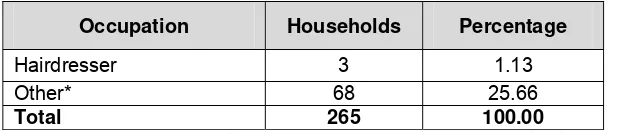
Table 1: RW07 households by occupation
Occupation Households Percentage
Civil servant, military or
police 36 13.58
Lecturer or teacher 2 0.75
Private employee 85 32.08
Self-employed 19 7.17
Petty trader 13 4.91
Carpenter 6 2.26
Construction worker 13 4.91
Becak’s driver 15 5.66
Occupation Households Percentage
Hairdresser 3 1.13
Other* 68 25.66
Total 265 100.00
* Men and women who have temporary work, such as helping construction workers.
Source: RW07 Board, September 2005.
Several government programs have been implemented in the area as part of the national development program. Completed programs include (i) a Code clean river program,3 (ii)
basic infrastructure development in 1996 for pathways, sanitation, drainage and clean water, (iii) riverbank development, (iv) development of a social safety net,4 and (v) program
evaluation in redevelopment and rehabilitation of slum areas in 2001-2003.
In line with these programs, the RW07 community initiated UAB Tirta Kencana in 1991, with local government support. UAB Tirta Kencana’s historical development is as follows.
(i) The initiative began in 1991 when the RW07 community decided to utilize nearby springs to deliver water to six houses using a hydraulic manual pump.
(ii) In 1999, the Kimpraswil Agency of sub-dinas Cipta Karya, under the Ministry of Public Works, provided a water pump and production and distribution pipes. The project delivered services to 17 more houses, bringing to 23 the number served by the community initiative.
(iii) In 2001, the Program for Evaluation in Redevelopment and Rehabilitation of Slum Areas by the same sub-dinas and agency almost doubled the number of water supply connections to 55. The program marked the official founding of UAB Tirta Kencana.
(iv) UAB Tirta Kencana added another 10 connections, to total 65 connections.
1.7 Access to water and sanitation services
Water problems in the area arise from lack of access to formal services provided by the local government as well as the community’s economic status. PDAM does not cover all riverbank residences, reaching only households on the upper bank. Most people living on the riverbank work in the informal economy or have low-wage jobs in the formal economy (see Table 1). Although households may have adequate funds to pay for the services, PDAM may deem an area as economically unsuitable for installation of new connections because of the physical environment. Local people are therefore reluctant to try to access PDAM services and instead use water supplied through other methods such as public taps, public washing areas, directly from the springs, sharing with neighbours and individual shallow wells.
As of November 2004, before the project began, 265 households in RW07 did not have proper connections to water supply services provided by PDAM or UAB Tirta Kencana. Of 65 connections in the project area and nearby area (59 in RW07 and six in RW06), 44 houses were connected to both UAB Tirta Kencana and PDAM. Another 21 were served by UAB Tirta Kencana. The rest of the community obtained water from other sources.
Public bathrooms and toilets in the area are designated for individuals and households that do not have private bathrooms, although they may be connected to the existing water supply network. The public facilities cost IDR2,000 (US$0.20)5 per family a month. The fee covers
3
Prokasih in 1991-1992. 4 PDM-DKE and P2KP in 2001. 5
maintenance and cleaning. Similarly, public washing areas where women do laundry cost IDR2,000 (US$0.20) per family a month. Collection of fees for both services is the responsibility of the head of the rukun tetangga (an RW sub-neighbourhood).
Traditionally, men are responsible for public activities while women are responsible for domestic activities. This situation brings disadvantages, mainly to women because their domestic activities tend to require consuming a lot of water, which is not easily available, for washing kitchen utensils, clothes, children and themselves (at public bathrooms and washing areas). Women have to spend much of their time obtaining water outside the home.
There is little information on waste-water management, but field observations found two communal government-built septic tanks near public bathrooms. One served 15 households and the other 60 households.
1.8 Institutional structure
Basic needs, especially water supplies, are a primary concern of the local government. In Yogyakarta, various agencies provide basic urban infrastructure services. All are wholly or partially controlled by the local government. Technical units are responsible to set up infrastructure networks and facilities while local enterprises are responsible to provide daily services and maintenance and expansion of the network and coverage area. At least three local government agencies are involved in the water sector: PDAM, the Cipta Karya unit of the Regional Settlement and Infrastructure Agency, and the Health Agency.
PDAM provides clean water commercially. Its name indicates the institution is responsible to provide drinking water, but it only provides clean water. PDAM’s main tasks are to provide clean water to customers on a commercial basis and to regulate the regional municipal policy on water use and consumption. There is some ambiguity as PDAM is expected to produce a profit while also carrying out a social mission in regulating the use and consumption of water.6
The Cipta Karya unit is responsible to supervise technical aspects of drinking water provision (planning activities) by (i) supervising the development master plan and formulating standards, requirements, guidance and a manual on drinking water provision; (ii) identifying drinking water provisions within the Special Region of Yogyakarta Province with the aim of achieving targets under the Millennium Development Goals; (iii) facilitating cooperation among municipal and district governments in common raw water provision; (iv) helping to seek financial resources from the government, private sector and foreign sources to fund development infrastructure; (v) supporting the central government’s PDAM recovery program; (vi) supporting rapid drinking water service coverage and drinking water provision in dry and water-vulnerable areas; and (vii) providing and maintaining raw water sources.7
The local Health Agency is responsible to ensure that the use and consumption of water complies with standards set by the national Ministry of Health (biological, physical and chemical aspects).
Water-related regulations include the following.
(i) Law No. 11/1974 on Irrigation.
(ii) Law No. 5/1960 on Basic Regulation of Agriculture.
(iii) Law No.5/1990 on Conservation for Natural Biodiversity and the Ecosystem.
6 Digital library online, http://digilib.ampl.or.id/data/airminum-issue.php, last accessed March 23, 2007 7
(iv) Law No. 24/1992 on Spatial Planning.
(v) Law No. 23/1997 on Environmental Management.
(vi) Law No.22/1999 on Local Government.
(vii) Law No. 41/1999 on Forestry.
(viii) Law No. 7/2004 on Water Resources.
1.9 Key partners
The project’s planning process involved three institutions: The Southeast Asia Urban Environmental Management Applications (SEA-UEMA) Project, the Graduate Program in Urban and Regional Planning of Gadjah Mada University (MPKD-UGM) and UAB Tirta Kencana. More partners joined as the project got under way. The partners’ roles and responsibilities are as follows.
The SEA-UEMA Project is a partnership between the Canadian International Development Agency (CIDA) and the Asian Institute of Technology (AIT), based at the AIT in Bangkok, Thailand. The aim is to promote best practices and applications of urban environmental management in cities throughout Southeast Asia. The project’s Alumni Demonstration Projects (ADP) component provides funding and implementation support to SEA-UEMA alumni to execute projects dealing with solid waste, water and sanitation, and air pollution management.
ADP funding was awarded for the project in 2005 after an application by Ms Henrika Retno Tyas Arum, an alumnus of SEA-UEM, who worked with the RW07 community and UAB Tirta Kencana to develop a proposal for clean water supply management and treatment as an expansion of the existing service. Ms Arum acts as a coordinator and team leader in developing the service as well as liaising among the local community, UAB Tirta Kencana, MPKD-UGM and SEA-UEMA.
MPKD-UGM facilitated submission of the proposal to SEA-UEMA. A team from the school assists UAB Tirta Kencana in directing the practice and it manages communication between the community and SEA-UEMA. The team members are also on a committee formed as part of the project’s planning and implementation process. In addition, MPKD-UGM helps the community promote its work.
UAB Tirta Kencana is a community-initiated and owned water provider that independently distributes clean water in the area, seeking to fill the gap in PDAM’s service. It is the recipient of the SEA-UEMA funds. A UAB Tirta Kencana board comprising several community members is elected to deal with operation and maintenance activities, including identification of infrastructure needs. As an independent provider, UAB Tirta Kencana sets tariffs based on local community agreement. Its tariffs are lower than those charged by PDAM.
The RW07 board and local community, as owner of UAB Tirta Kencana, actively took part in the project. RW07’s leader and former leader were part of a committee in charge of planning and implementation, as were sub-neighbourhood leaders and women’s group representatives. All initiatives proposed through committee meetings were initiated by community leaders, who had a strong voice during planning and practice implementation. The community members agreed to implement their leaders’ decisions.
community to maintain the facilities and ensure a balance between economic and social accountability.
Sub-dinas Cipta Karya, as initiator of the development of clean water provision in the practice area (from which UAB Tirta Kencana developed), has provided support and advice to the project from its inception, including through attendance at a meeting involving the community and MPKD-UGM.
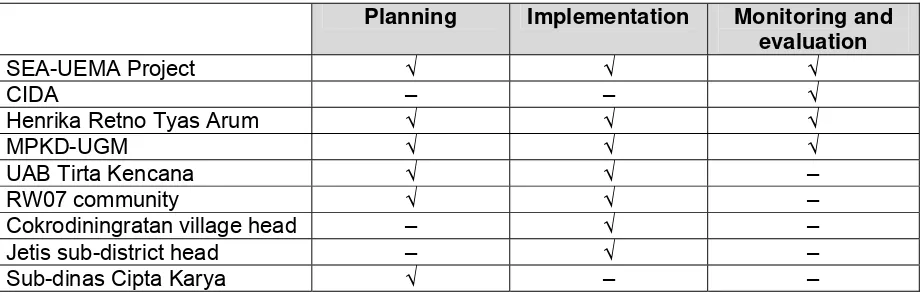
Table 2: Individuals and institutions involved
Planning Implementation Monitoring and
evaluation
SEA-UEMA Project √ √ √
CIDA – – √
Henrika Retno Tyas Arum √ √ √
MPKD-UGM √ √ √
UAB Tirta Kencana √ √ –
RW07 community √ √ –
Cokrodiningratan village head – √ –
Jetis sub-district head – √ –
Sub-dinas Cipta Karya √ – –
1.10 Needs addressed
The project aimed to (i) expand services to more beneficiaries in order to lessen the burden of accessing clean water, especially for households without water service connections, (ii) ensure continuity of quality water supplies, and (iii) encourage community participation in planning and implementation.
With just 59 connections among the 265 households in RW07, the community suggested 100 more connections could be made. However, a rapid appraisal by the MPKD-UGM team recommended 46 new connections on the basis of the perceived willingness of prospective customers to pay expected connection and monthly fees of IDR600,000 (about US$65.57).
The assessment found that most households that did not access to clean water from PDAM and UAB Tirta Kencana obtained water from the river and public taps. Other households with access to PDAM services asked about access to UAB Tirta Kencana services because the PDAM supplies were insufficient, especially in the dry season. The assessment found a need for (i) an additional network of connections to prospective buyers, (ii) a strengthened water-capturing structure to ensure quality and quantity of water supplies, (iii) expanded capacity in the ground reservoir and upper reservoir so as to provide expanded distribution, and (iv) improved institutional capacity for the operation and management of activities and services.
SECTION 2: PRACTICE DEVELOPMENT AND OPERATIONS
2.1 Initiation, planning and design
Demand for a clean water supply has increased in the area as the population has grown. However, UAB Tirta Kencana was unable to meet demand because of limited infrastructure capacity. UAB Tirta Kencana aims to deliver a social-based service, but it has had difficulty attracting private sector investment. Nevertheless, its service is regarded as successful from an academic and community development perspective. Research in 2005 concluded the service was one of the best practices in the Yogyakarta municipality and could be scaled up with sufficient funding and detailed planning.8
Responding to SEA-UEMA’s call for proposals, Henrika Retno Tyas Arum and an MPKD-UGM team discussed the issue with the RW07 community. As a mediator between SEA-UEMA and the RW07 community, the MPKD-UGM team offered to discuss possible funding options for clean water supply. The community welcomed the opportunity and provided information to develop the proposal, which was then submitted to SEA-UEMA. As a result, SEA-UEMA provided funds but also required the community to make an in-kind contribution during implementation, which was expected to take 12 months.
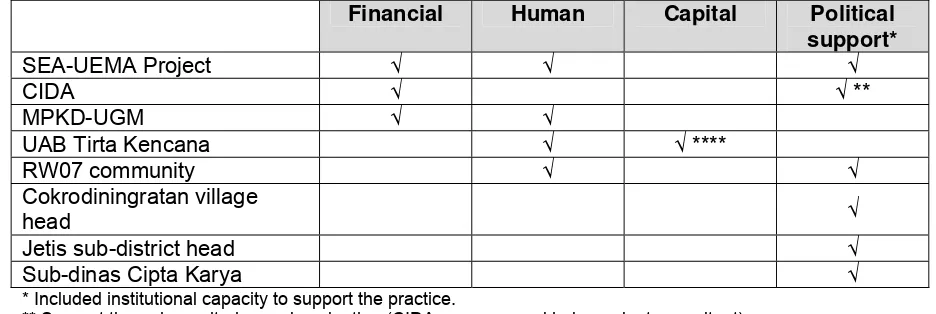
The practice was planned in detail after discussion with the community and a rapid appraisal. The appraisal looked at specific needs and the potential market in the practice area, as well as what components ought to be included in the scheme. A committee was formed to identify tasks and responsibilities, determine criteria for each position and assign the work. A key task was to deal with day-to-day activities during implementation. Estimates were made of the resources needed to put the practice into service, as outlined in Table 3. Suitable people were then sought to fill each position and, if they agreed to accept the appointment, their name was listed on a chart.
Table 3: Resources
Financial Human Capital Political
support*
SEA-UEMA Project √ √ √
CIDA √ √ **
MPKD-UGM √ √
UAB Tirta Kencana √ √ ****
RW07 community √ √
Cokrodiningratan village
head √
Jetis sub-district head √
Sub-dinas Cipta Karya √
* Included institutional capacity to support the practice.
** Support through monitoring and evaluation (CIDA assessor and independent consultant). *** Local agency directly responsible.
The committee drafted a technical proposal with the support of the MPKD-UGM team, which submitted the proposal to SEA-UEMA for approval. On approval, funding was made available in three instalments to MPKD-UGM, which distributed funds to the committee to be used according to the approved activities. As required for good governance practice, all activities in the field were reported in a logbook as part of the reporting and financial document for SEA-UEMA. During implementation, all aspects related to financial
8 Tri Rahayu.
administration were discussed by the committee and MPKD-UGM, with the results sent to SEA-UEMA for comment and approval if any changes to the initial plan were made.
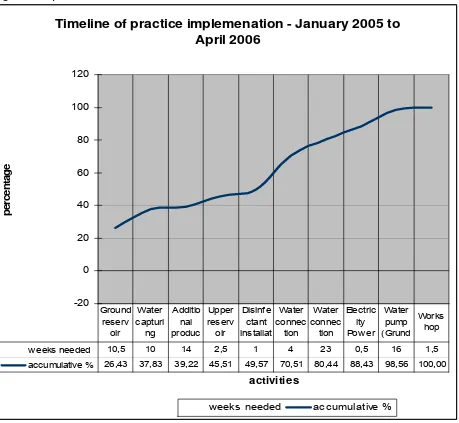
The practice was scheduled to begin operation after 12 months of planning and construction. In reality it took 16 months to complete. Figure 2 depicts a timeline showing the key stages and milestones in the project's development. During implementation, work other than that done by regular workers was done through communal work, or gotong royong, whereby a community traditionally works together on common activities. The community provided volunteers to build the infrastructure, usually doing the work on Sundays.
The project was expected to provide the community with a continuous quality water supply and to expand existing service coverage areas and beneficiaries. It was to involve the community and the board of water supply management.
Figure 2: Implementation timeline
Timeline of practice implemenation - January 2005 to
April 2006
accumulative % 26,43 37,83 39,22 45,51 49,57 70,51 80,44 88,43 98,56 100,00
Ground
The water is tapped from two springs and stored in the ground reservoir, providing continuous service. Water-capturing financed through the project was installed to protect the springs from debris and dirt and to ensure a clean water supply. The ground reservoir indirectly benefits other users in the area, including women who run home laundry businesses and people who use public washing areas and bathrooms, because UAB Tirta Kencana provided water-capturing pipelines feeding untreated water from the ground reservoir into public washing areas and bathrooms.
Treatment to meet health standards takes place after the water is pumped from the ground reservoir to the upper reservoir. Disinfectant is applied at the pump-house. Distribution of the water exploits gravity to send a flow of clean water downhill to customers.
Figure 3: Distribution system after intervention
Source: Field survey, February 2006.
●
Springs●
Public tap and public washingGround reservoir
■
Pump house anddisinfectant installation
Upper reservoir
▬
Production pipe▬
Distribution pipe▬
River Body■
Houses/customers18 m
127 m
Table 4 outlines activities to develop infrastructure and facilities during implementation in 2005-2006.
Table 4: Infrastructure and facilities, 2005-2006
Activities Before Intervention In-kind
community contribution
Purpose or reason for development
Ground reservoir
12m3 54m3 Labour, land,
skills,
refreshments
The ground reservoir was designed to contain water from the springs before it is pumped to the upper reservoir. It previously did not have the capacity to conserve water at night, when most people do not use water, and much water was lost through overflow. The
Activities Before Intervention In-kind Purpose or reason for
Water capturing was built to protect the source from dirt and pollutants. The previous construction was not well-built. However, the new construction was damaged in a landslide in February 2005.
Reconstruction was done, including rebuilding a retaining wall, with local government assistance.
The pipes are built to take water from the springs to public taps and the ground reservoir. The pipes run above the river, by its edge, and are attached to the pathway. Another section, under the
pathway, takes water from the ground reservoir to the upper reservoir.
Water pump and
accessories
One unit Three units Labour, skills, refreshments
The pump transfers water stored in the ground reservoir to the upper reservoir. The water then flows through pipes, by gravity, to households. More water pumps were bought to support service expansion.
The upper reservoir was initially built to store water before distribution to households. A water tank was added to increase capacity to serve more users. expand water delivery to more households in a wider area. connections in response to demand for it to expand its service.
Disinfectant applied
None One unit Labour, skills, refreshments
This activity was a
significant improvement to make the water safe to consume.
Electrical load capacity expanded
3500 VA N/A Skills More electrical power was
Activities Before Intervention In-kind Purpose or reason for
community development
contribution
for long-term and environmental
maintenance reasons. Workshop and
field study
N/A One session Skills To equip the community and UAB Tirta Kencana’s management with knowledge of operation and maintenance issues and to share experiences in managing community water supply services in different areas.
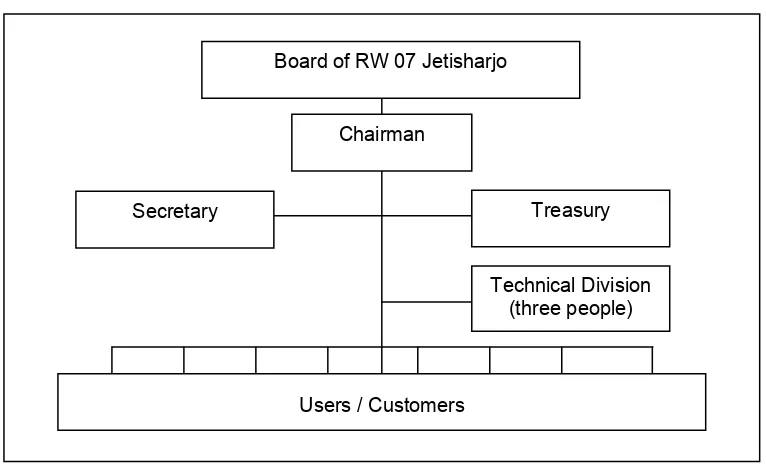
To run the operation from day to day, UAB Tirta Kencana appointed a chairman, a secretary, a treasurer and technicians to work under the supervision of RW07’s board. The chairman supervises daily operations and is responsible for administrative and financial issues. The secretary assists the chairman in administrative work. The treasurer deals with financial issues such as billing and financial reports, and works closely with the technical division (a technician calculates water consumption at each household). Technicians handle operation and maintenance, repairing the infrastructure if they are able to do so .If necessary, another party is invited to carry out maintenance tasks that are beyond the capabilities of the technicians. A meeting of the RW07 board, the heads of rukun tetanggas, the UAB Tirta Kencana board and a users’ representative selected people for these positions.
The treasurer prepares monthly bills that are sent to customers. Customers may pay the bill between certain dates each month. The treasurer also provides financial reports that are signed by the chairman before being sent to the heads of rukun tetanggas. The report details monthly revenues and expenditures and notes late payments. The report may be made public by the rukun tetanggas to remind people to pay their fees. If payment is not made within three months of a bill being delivered, the customer is sent a reminder letter. So far, no customers in RW07 have paid their bills late.
Figure 4: Organizational structure of UAB Tirta Kencana
Chairman
Secretary Treasury
Users / Customers
Technical Division (three people) Board of RW 07 Jetisharjo
UAB Tirta Kencana sets the payment for water consumption using progressive tariff rates. The rate increases as consumption increases and exceeds a set consumption benchmark. The aim is to control consumption and educate the community about using water efficiently.
Since project completion, UAB Tirta Kencana has managed the service with informal supervision by RW07 representatives. A total of 115 households are served. Average daily consumption is 60m3, including water accessed at public washing areas and taps. Of this, about 54m3 is treated before delivery.
2.3 Challenges and responses
Several organizational and natural challenges arose during implementation. Organizational obstacles emerged in seeking to ensure community members were equal partners and not just executors of a project designed by the local government or the private sector. Previously, community involvement in planning had been minimal, with people merely asked about their needs. In this case, the development was government-led until completion.
The project sought to encourage the community to play a bigger role in the development process in order (i) to encourage and stimulate active community participation from planning through to implementation, and (ii) to equip community members with basic management skills to oversee daily operation of the scheme. However, there were obstacles to achieving this during implementation because the community would usually take a subordinate role to local government representatives.
Data collection, especially to identify prospective customers and their willingness to pay, proved difficult. A dispute arose over the criteria for potential customers and the amount they would be willing to pay. It was intended that a cross-subsidy model would be developed after determining the number of households willing to pay for the service. However, over time the number of potential customers and their names changed, creating difficulties for the committee in deciding what kind of cross-subsidy scheme and progressive tariff might be applied. This also affected the planning process when the committee was assessing the proposed pipe network’s coverage area.
Natural hazards also affected the construction process, with a landslide damaging the ground reservoir and water-capturing pipes and preventing project activities for almost a month. Additional costs accrued and more time was spent on construction, although the anticipated outcome was not affected. After the landslide, a retaining wall was built near the water-capturing pipes and the ground reservoir was repaired and the broken pipes were replaced. Activities were back on schedule by mid-April 2005, after a setback of almost two months.
On the management side, reporting and accounting were a minor problem due to a lack of skills and therefore took more time (a few months) to complete than expected. This slowed implementation because SEA-UEMA required financial reports be verified before a new instalment was paid to the committee. Appointed managers also lacked the technical skills to assess existing and future needs of the service.
personal views. Despite these difficulties, most problems were resolved in a way that brought benefits to the community and, more specifically, to UAB Tirta Kencana’s board.
2.4 Focus on the poor
To balance the project’s social and economic objectives, the committee and the MPKD-UGM team discussed ways of implementing a cross-subsidy scheme to cover installation fees. The proposal was that individuals or households who fitted low-income criteria would be charged half the planned installation fee (IDR300,000 compared with IDR600,000). The committee also considered waiving the installation fee for an individual who provided land for the upper reservoir expansion and a waste collector (although in the end he was willing to pay the fee), as well as public facilities including a mosque and a public elementary school.
After a formal meeting with the MPKD-UGM team, community members and the committee met and decided that the installation fee would be differentiated on the basis of administrative area rather than socio-economic status. This meant that customers in RW07 would pay IDR300,000 instead of IDR600,000 for installation, regardless of their economic status, while people outside RW07 (such as those in RW06) would pay IDR600,000. The rationale was that UAB Tirta Kencana was founded by the RW07 community, and so it was reasonable to provide a discounted installation fee for households in RW07. The installation fee is set at three to four times the actual cost (for all prospective customers), an arrangement that helps to cover service provision for low-income households although monthly bills do not differentiate on the basis of economic status. Any tariff adjustment must be proposed by the RW07 board and followed by a neighbourhood meeting to decide on the proposal. The UAB Tirta Kencana board is required to implement the decision.
The community, of whom most members could be classified as low-income, has experienced considerable benefits as a result of the project. People need less time to obtain clean water for their daily use, and the quantity and quality of clean water to households and public taps have improved. Four families may share one tap, divide the monthly bill accordingly, and appoint someone to collect the fee and then pay it. Public toilets and bathrooms are available for households without such facilities, which is common because there is not enough space in some houses for individual bathrooms and toilets.
A socio-economic benefit was the generation of temporary employment for young people and unemployed people. The committee decided to provide temporary work to unemployed young people living in the project area. They worked seven hours a day and were paid daily wages for the duration of the project.
2.5 Finance
Table 5: UAB Tirta Kencana tariff system
Based on the tariff system utilized by UAB Tirta Kencana, a rough sketch of revenue and expenditure can be produced. The following table depicts average monthly revenue and expenditure after the project’s completion, based on the 2006 financial report.
Table 6: UAB Tirta Kencana revenue and expenditure
IDR USD
Revenue 1,622,733 176
Expenditure 1,410,550 153
Electricity 789,683 86
Honorarium for 3 people 200,000 22 Material for disinfectant 117,125 13 Maintenance, administration 303,742 33
Savings 212,183 23
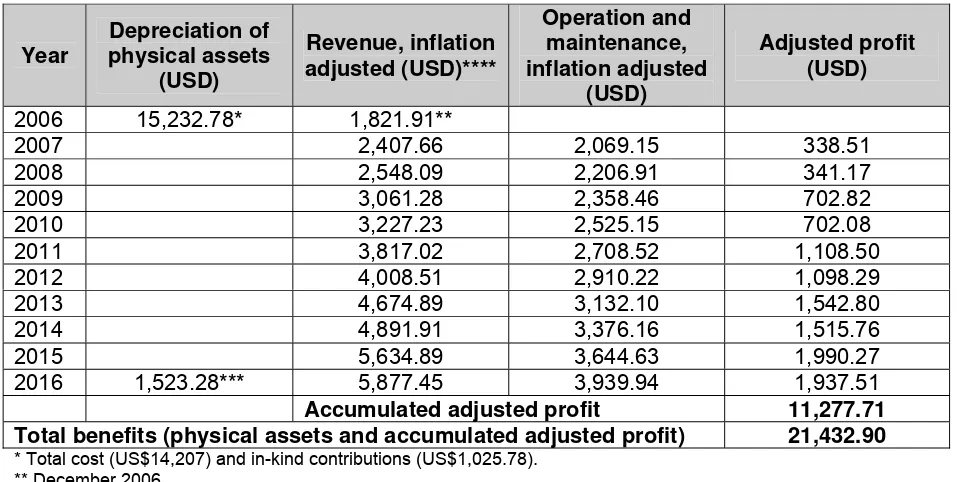
The practice generated IDR16.35 million (US$1,668.37) from 50 new units installed, to be collected after completion of all installations. The funds go to UAB Tirta Kencana’s savings account and any profit remains with UAB Tirta Kencana. Operation and maintenance costs in 2006 were used to estimate cash flow, hypothetical charges and profits over 10 years, as outlined in Table 7.
Table 7: Estimated economies of scale over 10 years
Year
2006 15,232.78* 1,821.91**
2007 2,407.66 2,069.15 338.51
2016 1,523.28*** 5,877.45 3,939.94 1,937.51
Accumulated adjusted profit 11,277.71
Total benefits (physical assets and accumulated adjusted profit) 21,432.90
* Total cost (US$14,207) and in-kind contributions (US$1,025.78). ** December 2006.
*** Adjusted depreciation cost of physical assets using straight line depreciation method (cost/life).
2.6 Legal structure
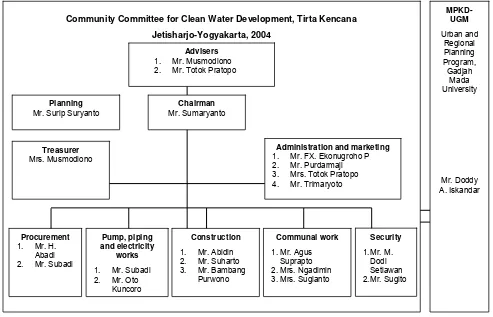
UAB Tirta Kencana was founded by the RW07 community and is supervised by the RW07 board. The board organized the community through the heads of rukun tetanggas and a women’s organization (PKK) and set up a committee to implement the project.
Figure 5: Organizational structure of clean water committee
Planning
Community Committee for Clean Water Development, Tirta Kencana
Jetisharjo-Yogyakarta, 2004
Committee structure for the Project
Source: Committee Meeting, October 2004
The RW07 board’s members (the former and current heads as well as informal community leaders) act as advisers, with the UAB Tirta Kencana chairman heading the water supply committee. The UAB Tirta Kencana board includes several positions that report to the chairman, who in turn reports activities to the RW07 board. A representative of MPKD-UGM has an equal position with the committee. To strengthen the committee, women, young people and other community members were invited to join. However, women remain under-represented, with only four women on the committee (the treasurer, an administrator and two positions coordinating women for communal work). The role of women in the project centres on traditional activities such as providing food for workers during communal work and the construction period.
The committee’s agenda is to (i) execute the project smoothly by involving all components of the local community and (ii) raise awareness about gender issues at the local level.
evaluate the practice on a day-to-day basis. In addition, CIDA appointed individual consultants to conduct monitoring and evaluation during implementation.
2.7 Stakeholder accountability
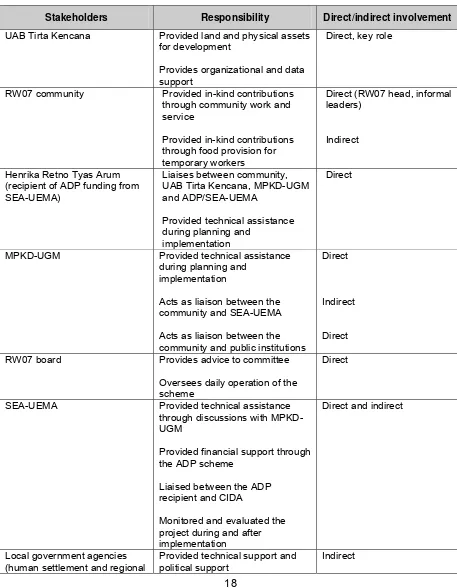
The responsibilities of directly involved individuals or entities were monitored through regular committee meetings, where disputes or problems and solutions were discussed. Those indirectly involved in the project provided suggestions and comments about various issues for consideration by the committee. Table 8 depicts the responsibilities of stakeholders in implementing the project.
Table 8: Stakeholders’ responsibilities and involvement
Stakeholders Responsibility Direct/indirect involvement
UAB Tirta Kencana Provided land and physical assets for development
Provides organizational and data support
Direct, key role
RW07 community Provided in-kind contributions through community work and service
Provided in-kind contributions through food provision for temporary workers
Direct (RW07 head, informal leaders)
Indirect
Henrika Retno Tyas Arum (recipient of ADP funding from SEA-UEMA)
Liaises between community, UAB Tirta Kencana, MPKD-UGM and ADP/SEA-UEMA
Provided technical assistance during planning and
implementation
Direct
MPKD-UGM Provided technical assistance
during planning and implementation
Acts as liaison between the community and SEA-UEMA
Acts as liaison between the community and public institutions
Direct
Indirect
Direct
RW07 board Provides advice to committee
Oversees daily operation of the scheme
Direct
SEA-UEMA Provided technical assistance
through discussions with MPKD-UGM
Provided financial support through the ADP scheme
Liaised between the ADP recipient and CIDA
Monitored and evaluated the project during and after implementation
Direct and indirect
Local government agencies (human settlement and regional
Provided technical support and political support
infrastructure) Local neighborhood
administration (Jetis)
Provided political support and mediated between municipal government and community
Direct and indirect
Existing customers Provided inputs during the planning process (noting
obstacles and expectations based on previous services)
Provided guidance on the quality and quantity of the water supply and overall quality of the UAB Tirta Kencana service
Indirect
Prospective customers Provided inputs during implementation and offered suggestions on the installation fee
Provided guidance on the quality and quantity of the water supply and service
Indirect
2.8 Community involvement
A rapid assessment was conducted before the project was implemented to investigate the needs and expectations of local people. Informal inquiries were also made among existing and prospective customers of the water service. Customers’ representatives were invited to a committee meeting to address their specific needs.
The equal participation of women and men was encouraged, with MPKD-UGM and CIDA representatives stressing the importance of gender equality in the practice. However, the committee adopted a traditional approach whereby women were involved in planning and implementation but their involvement on the committee was limited.
Overall community support for the project was evident in people’s participation during the construction stage, through voluntary work and provision of refreshments to workers.
Table 9: Impacts and participation during implementation
Individuals/community Impact Participation
RW07 community Easier access to clean water (time and distance)
Passive, consulted at general meetings
RW06 community Easier access to clean water (time and distance)
Passive, consulted at general meetings
Women with laundry businesses
Easier access to clean water (quantity and quality)
Passive, consulted at informal meetings and during rapid assessment
RW07 head Political considerations because the area is better able to attract capital investment through donor aid
Active, consulted at informal and general meetings and during rapid assessment Informal community
leaders
Political considerations because the area is better able to attract capital investment through donor aid
Active, consulted at informal and general meetings and during rapid assessment UAB Tirta Kencana board Fresh support in terms of technical
assistance and funding to extend service coverage
Semi-active, consulted at informal and general meetings and during rapid assessment Young people Provision of temporary jobs and
potential employment opportunities in the future
SECTION 3: OUTCOMES
3.1 Effectiveness
The project achieved its objectives in completing the proposed water supply development, as outlined in Table 10.
Table 10: Achievements and resulting changes
Activities Before Intervention After In kind
Ground reservoir two springs improved
Leaks, simple springs to public taps and ground reservoir
pump house to upper reservoir installed Connections to homes 65 units 50 units 115 units Labour, skills,
refreshments Disinfectant applied none 1 unit 1 unit Labour, skills,
refreshments
Table 11: Achievements and effectiveness
Achievement Assessment indicator Effectiveness
Ground reservoir capacity improved
Implementation of basic sustainable development through conservation of natural resources,
reduced time needed to access water by households and individuals
High: Spill-over from the springs at night, when consumption is low, is better conserved, which indirectly and positively affects access time
South and north water-capturing facilities at two springs improved
Implementation of basic sustainable development through conservation of natural resources
High: Quality of clean water from the springs can be ensured to meet health standards
Less time needed to access water by households and individuals allows time for other activities
Moderate:Some groups of users are assured of a continuous flow of clean water at public taps near their homes
Water pump and accessories
Less time needed to access water by households and individuals
Moderate: Other users do not have to go to public taps to get clean water Upper reservoir
capacity improved
Less time needed to access water by households and individuals
Less time needed to access water by households and individuals allows time for other activities
High
Disinfectant applied
Implementation of basic sustainable development through conservation of natural resources
High:Quality of clean water can be ensured to meet health standards
Additional electrical load capacity
Less time needed to access water by households and individuals
Moderate
Workshop and field study
Increased institutional capacity of UAB Tirta Kencana to deal with planning and daily operation and maintenance
Moderate: The community can learn about similar practices and how to respond to rising demand
With regard to gender issues, women’s participation increased gradually during implementation. Although the number of women involved is not high, a significant change is apparent in comparison with the traditional approach of men making all decisions. The community is also starting to encourage active participation by other people. Formal and informal leaders do not dominate decision-making to the same extent as previously.
Changes in people’s quality of life cannot be seen instantly. However, the creation of jobs has increased the confidence of unemployed people, especially the young, to contribute to the development process locally.
The poor also benefited from the cross-subsidy system.
3.2 Efficiency
The project added 50 new connections to the water supply syetm, for a total of 114 connections. The new connections provided UAB Tirta Kencana with IDR30 million (US$3,191.49) from payments for instalments. The average monthly bill of each of the 114 customers is IDR12.519 (US$1.331), providing UAB Tirta Kencana with expected revenue of IDR17,125,992 a year (US$1,821.91). Average operation and maintenance costs are expected to be IDR27,138,964.86 (US$2,887.12), leaving an average annual profit of IDR10,601,038 (US$1,127.77).
An initial investment of US$15,232.78 for physical assets development (wages and other expenditures included) could be expected to generate a total of US$21,432.90 at the end of 10 years. (See Table 7, Section 2.5, for details of estimated economies of scale over 10 years.) Thus, the total benefits accrued (in terms of physical assets and accumulated adjusted profit) are expected to exceed the initial investment. This estimate is based only on funds generated by UAB Tirta Kencana and the valuation of physical assets financed through the practice scheme, and excludes infrastructure existing before implementation. Wages account for 25 percent of funding and could be expected to stimulate local economic development through temporary jobs. Other benefits over 10 years include further capacity building through workshops and field visits to other projects, the encouragement of community participation (from planning and implementation to monitoring and evaluation) and improved gender equality.
3.3 Innovation
The project was not especially innovative, but it successfully encouraged community participation through in-kind contributions and partnerships among SEA-UEMA, the RW07 community and UAB Tirta Kencana, and MPKD-UGM. Obstacles encountered during implementation were resolved through regular committee meetings.
The project promoted social objectives ahead of economic ones. Cross-subsidies were encouraged at the planning level in the aim of reducing installation costs for low-income households. This was a way to balance social objectives with the economic mission. MPKD-UGM stressed to the RW07 committee that such a scheme also had political advantages by adding value to the water supply service compared with similar activities in nearby areas. Even with cross-subsidies, the scheme is expected to yield considerable profits over 10 years. (See Table 7, Section 2.5.)
The project encourages community participation and helped develop the community’s ability to identify problems and water needs. For example, before physical construction began, community members offered ideas and comments about the existing infrastructure, the expected impacts of improvements and potential interruptions during construction. The committee adjusted project activities accordingly.
An innovation in terms of local physical infrastructure development was the installation of measures to treat the water so that it meets health standards. It was not an easy task to convince the community to install the equipment because of concerns about the effect on taste (as occurs in the case of PDAM-supplied water). In this case, community leaders played a significant role in changing the community’s perceptions about the value of water treatment.
3.4 Unexpected outcomes
from UAB Tirta Kencana and public taps faced difficulties to access clean water. They had to collect water from the river or share water with households with a PDAM connection or shallow well. In view of the extensive damage and the community’s inability to repair the water system within the project framework, the government helped the community to rebuild the retaining wall. After a request from the community, water-capturing facilities were rebuilt simultaneously. Construction was completed in April 2005.
Other than seeking specifically to involve women, the project also targeted young community members who had left school early. The project provided temporary job opportunities for 10 to 40 people to carry materials from upper areas to riverbanks and also for construction workers. Local labour cost more than hiring workers from outside the area, but it helped young people to be actively involved in a positive way.9
3.5 Expansion of the practice
The project was designed to (i) extend UAB Tirta Kencana’s service and coverage, (ii) balance the social and economic mission of UAB Tirta Kencana, (iii) strengthen community participation in infrastructure development, and (iv) encourage partnerships for basic urban infrastructure provision (a clean water supply). By expanding the service and coverage area, UAB Tirta Kencana can achieve the other objectives. For example, improved infrastructure minimizes water use problems during peak times of consumption.
Buoyed by the project’s success, the community has taken the initiative to propose further expansion of the service, using a similar partnership model. Funding has been sought from the local government for another 100 connections in RW07 and nearby neighbourhoods. Informal discussions are under way between RW07 and other neighbourhoods regarding this matter.
In view of the expanded services, the RW07 community decided to change the organizational structure and orientation of UAB Tirta Kencana. Its board members are given a monthly salary instead of free consumption of clean water. Several tasks have been added to its main specific task, making UAB Tirta Kencana resemble a modern organization.
UAB Tirta Kencana’s board wants to expand the service’s coverage area and manage the springs directly. New water-capturing facilities were installed in July 2006 using savings accumulated from service provision. The board also plans to develop further by creating permanent jobs for management personnel and staff, to be paid minimum regional wages of about IDR500,000 (about US$51). Presently, however, it cannot afford to pay this rate.
Informal leaders have also proposed making use of water availability to promote the area’s appeal and to develop home-stays in the neighbourhood. The idea is still in development. Several study programs from public and private universities have contributed to the proposal development.10
3.6 Key operational lessons learned
It is common in Indonesia that community involvement in projects related to basic urban infrastructure, especially in low-income urban settlements, is relatively low. Any involvement in planning is commonly dominated by informal leaders, while community members merely add simple suggestions. A similar situation occurred during the RW07 project with regard to an informal meeting to prepare the initial proposal to SEA-UEMA. A lesson learned during
9 For example, moving sand to the site would cost IDR100,000-125,000 (US$10.20-12.76) using outside labour, compared with local labour costs of IDR175,000 (about US$17.86).
implementation was that the three-way partnership between SEA-UEMA, MPKD-UGM and the community appeared to assist in encouraging overall community participation.
Implementation went as planned, since the community has strong informal leaders with adequate links to various resources needed to conduct activities for providing basic services. These leaders tended to put forward their views forcefully during committee meetings, while other community members simply followed their “instructions”.
External inputs such as the financial and technical assistance from SEA-UEMA and MPKD-UGM were viewed by the community as gifts, without necessarily considering the proper management of this assistance. It was difficult to change this perception and encourage the community to view the assistance as a stimulant to provide better access to water that in turn would help people to develop their neighbourhood further.
SECTION 4: SUSTAINABILITY
4.1 Degree of sustainability
The scheme is expected to last for 20 years before upgrading and expansion, and is designed to be financially, economically, socially and environmentally sustainable.
From a financial perspective, the scheme can generate adjusted profits of US$11,277.71 after 10 years on the conservative estimate of 10 new customers a year.
Economically, the initial investment for physical infrastructure development of US$7,133.38 becomes US$884.26 after 10 years of operation. Assuming that renewal of the physical infrastructure would cost about the same, there is still room for considerable profit to be used for other purposes. An intangible benefit is the provision of a monthly salary for the manager and staff, a total of IDR200,000 a month (US$21.28) for three people, rather than free water. In addition, part of the investment goes toward the creation of temporary jobs for young people, who are paid weekly.
The project successfully balanced its economic and social objectives by providing cross-subsidies for installation and charging households for direct service while not charging for access to water at public taps and washing areas. Although UAB Tirta Kencana provides free services for people using public facilities, it still generates considerable profits. As well, the community has been encouraged to participate more actively in the planning process, and as a result it could be expected to play a greater role in wider neighbourhood planning. As women become gradually more involved in decision-making, it is expected that the number of women involved in daily operation and maintenance will increase significantly over 10 years. Finally, the scheme assists some young people by providing jobs that in turn help to increase their self-respect.
Community members using the UAB Tirta Kencana service have been taught to consume clean water efficiently. This is indirectly enforced through a progressive tariff scheme, where customers are charged more for greater consumption. The traditional view is to see water as abundant from time to time, without a need for its conservation until the dry season. Although seven springs are near the area, the RW07 committee decided to use only two springs in order to ensure efficient usage. Water loss through spill over was resolved by expanding the ground reservoir, which provides a lesson to the community about conservation.
4.2 Achieving greater sustainability
Figure 6: Possible institutional arrangement for greater sustainability
At the institutional level, the public sector and research institutions or universities could work together to provide a legal framework that stimulates the institutional capacity of UAB Tirta Kencana in terms of technical assistance (local, national and international training courses and workshops) and the potential for UAB Tirta Kencana to supply water on a larger scale so that it competes with other providers. UAB Tirta Kencana could be established as a tax-exempt non-profit organization.
At the macro level, the legal framework could be directed toward optimizing land use so that land conversion along the riverbank is prohibited and a high proportion of greenery and open space is encouraged through a higher floor area ratio and low building coverage ratio. This would help the community to learn more about conserving natural resources through various means, including a legal framework.
4.3 Challenges ahead
UAB Tirta Kencana relies heavily on two riverbank springs to tap water into the reservoir before distribution. Aside from technical issues, disappearance of the springs would be a loss for the community and jeopardize the existence of UAB Tirta Kencana. Thus, it is important that the community conserve the springs (seven in total). Although the scheme is not organized to tackle this problem directly, there are continuing discussions about the need to encourage and formalize basic principles of conservation and preservation (for example, through efficient land use and conservation of open space).
Another challenge that may emerge in the near future is a lack of capable people to take on managerial responsibilities and daily operation of UAB Tirta Kencana. People who have the necessary skills are employed elsewhere. People available for such positions lack the skills and capacities to carry out tasks properly. The scheme provides an opportunity for
UAB Tirta
SECTION 5: POLICY IMPLICATIONS
5.1 Potential for replication
The project was designed to fit with the geographical setting and the social and economic conditions of the community. It was intended to encourage stakeholders’ active participation through a tripartite partnership between SEA-UEMA, MPKD-UGM and the RW07 community. As the project’s focus was toward balancing access to basic urban infrastructure for low-income households, it is likely that it could be replicated elsewhere.
A similar project was conducted in Sleman district, using a model that encouraged community participation in clean water provision. A difference is that the Sleman project was in a rural area, where people are mostly farmers and the area is farmland. The project was financed through an international NGO, SATUNAMA, with funding from Australia. The partnership included the local community of Minggir and SATUNAMA, with the NGO conducting monitoring and evaluation.
5.2 Expansion
With the contribution of various actors as stated in Sections 4.1 and 4.2, the scheme can be expanded, not only in the low-income settlement along the Code River but also in nearby neighbourhoods. However, Since UAB Tirta Kencana relies heavily on the presence of springs; any expanded service would not be great in area, in comparison with PDAM, which covers all of Yogyakarta.
Service provision developed from the practice can be used as a model for basic urban infrastructure provision in other low-income settlements, due to the practicality and degree of involvement of various stakeholders (research institutions or universities, NGOs, the public and private sectors, and the community). However, several basic prerequisites should be fulfilled, such as ensuring the presence of strong leaders with clear vision, an equal position among partners and active community participation.
5.3 Necessary changes in policies and institutions
Any expansion of the scheme to reach the economies of scale that might be required by a financial institution would likely see a shift in focus and the mission of UAB Tirta Kencana, which currently is to empower the community, especially low-income households. As the scale of the operation increased, there would be additional demand for profit-making, which would lead to changes in captive-market orientation and type of service delivery. If the coverage area is expanded, additional investment would be needed (financial and human resources). This would affect water prices and possibly have a negative impact on low-income households if they were not able to afford the price.
A bigger operation would also mean a need for more professionals, leading to the likelihood of people outside the community replacing local people as managers and general staff. As such, a policy is needed to protect the rights of local people to work in UAB Tirta Kencana management positions. The policy could be drafted locally, or at the municipal level. Any such policy should be flexible in protecting local people in terms of employment while also allowing for other people to work as managers and staff at UAB Tirta Kencana if necessary.
coupled with assistance from research institutions, universities and NGOs, while technical assistance could be provided by NGOs, research institutions and the public sector.
Future discussion of ownership of the scheme needs to consider maintenance costs for the physical infrastructure, especially pipe networks and machinery. Although the service can finance operation and maintenance, partnerships for financial support may need to be considered if the service is to expand further. Future development should be directed toward partnerships regarding physical infrastructure, cost-sharing for operation and maintenance, and expansion of the service network. Financial responsibilities of each party should be elaborated in a legal framework.
Figure 7: Relationships among parties after replication and expansion
Local agencies
(sectoral) –at municipal
level responsible for basic urban infrastructure
UAB Tirta Kencana –
supervised by RW07 board, community and
customers
To achieve positive social and economic impacts on a larger scale, the CBO should be encouraged to take an active role in the provision of basic infrastructure, especially for water and sanitation. This means that local government should encourage community participation in the decision-making process, in turn stimulating community members to become informal leaders able to generate initiatives and activities directed to resolving community needs. Several local regulations should be drafted to enforce stakeholder participation in planning, implementation and monitoring and evaluation. In addition, research institutions, universities and NGOs should be encouraged to help empower local communities.
Physical infrastructure (pipeline network and
water pump)
1. Provide capital investment for initial development of infrastructure
2. Technical assistance for operation and maintenance
1. Maintain and operate the existing infrastructure 2. Finance minor upgrading
and repairs for infrastructure using profits
Private sector
(bank)/donor aid –
National and international level related to basic
urban infrastructure provision
1. Finance expanded infrastructure network as approved by local public agencies/planning institution responsible for such service 2. Monitor and evaluate the
implemented practice within the economic perspective
Note
SECTION 6: INFORMATION SOURCES AND VERIFICATION
6.1 Contacts
1. Dr. Ranjith Perera
Director, SEA-UEMA Project
UEM-SERD, Asian Institute of Technology
P.O. Box 4 , Klong Luang, Pathumthani, 12120, Thailand Phone: +66-2-5245777, Fax: +66-2-5162126, +66-2-5248338 E-mail: [email protected]
2. Ms. Henrika Retno Tyas Arum Team leader, MPKD-UGM Jl. Grafika No. 2 Sekip Yogyakarta 55281 Indonesia
Phone: +62-274-580095, Fax: +62-274-580852 Email: [email protected], [email protected]
3. Mr. Sumaryanto, former chairman, UAB Tirta Kencana
4. Mr. Totok Pratopo, former leader, RW07, and chair, FMCU
5. Mr. Musmodiyono, leader, RW07
6.2 Sources of information
All materials presented in this document were taken mainly from the final report of the Small Community Water Supply Management of Yogyakarta, Indonesia, which was submitted to SEA-UEMA’s ADP component. Supporting information was based mainly on the following.
• Tri Rahayu. Program Penataan Dan Rehabilitasi Permukiman Kumuh Studi Kasus Kawasan Bantaran Sungai Code Bagian Utara Yogyakarta. Unpublished research for graduate thesis on urban and regional planning. Gadjah Mada University.
• M. Natsir Basuki. Peran dan Tugas Dinas Permukiman dan Prasarana Wilayah, Propinsi Daerah Istimewa Yogyakarta dalam Pembinaan Teknis Penyediaan Air Minum. Paper.
6.3 Additional information likely to become available
Documentation of the legal structure
Documentation of financial arrangements
Budget information
; Documentary evidence of success in achieving the practice’s objectives
; Documentary evidence of impacts on or benefits to the poor
Other
6.4 Gaps in available information and documentation
6.5 Verification
All materials presented in this document were taken mainly from the final report of the Small Community Water Supply Management of Yogyakarta, Indonesia, which was submitted to SEA-UEMA’s ADP component. (See Section 6.2)
6.6 Independent evaluation
SECTION 7: CERTIFICATION
7.1 Starting and completion dates
January 2005 until April 2006.
7.2 Principal authors and contact details
1. Ms. Henrika Retno Tyas Arum Team leader, MPKD-UGM Jl. Grafika No. 2 Sekip Yogyakarta 55281 Indonesia
Phone: +62-274-580095, Fax: +62-274-580852 Email: [email protected], [email protected]
2. Dr. Sudaryono Sastrosasmita MPKD-UGM
Jl. Grafika No. 2 Sekip Yogyakarta 55281 Indonesia
Phone: +62-274-580095, Fax: +62-274-580852 Email: [email protected]
3. Mr. Doddy Aditya Iskandar MPKD-UGM
Jl. Grafika No. 2 Sekip Yogyakarta 55281 Indonesia
Phone: +62-274-580095, Fax: +62-274-580852
Email: [email protected], [email protected]
7.3 Relationship of authors with the practice
The authors are associated with the Graduate Program in Urban and Regional Planning of Gadjah Mada University (MPKD-UGM).
7.4 Certification of documentation
I/we certify that to the best of my/our knowledge this documentation provides an accurate account of the practice named in Section 1.
Henrika Retno Tyas Arum
Name Signature Date
Dr. Sudaryono Sastrosasmita
Name Signature Date
Doddy Aditya Iskandar