OPERATIONAL RISK ON MANUFACTURING AND SERVICE PROVIDER IN TELLECOMUNICATION INDUSTRY
(Case Study: PT Hariff Daya Tunggal Engineering)
FINAL PROJECT
By
Ary Wibowo Dirgantara 19004050
Undergraduate Program
School of Business and Management
Institut Teknologi Bandung
VALIDATION PAGE
OPERATIONAL RISK ON MANUFACTURING AND SERVICE PROVIDER IN TELLECOMUNICATION INDUSTRY
By:
Ary Wibowo Dirgantara
19004050
Undergraduate Program
School of Business and Management
Institut Teknologi Bandung
Validated By
RISIKO OPERASIONAL PADA MANUFAKTUR DAN PENYEDIA JASA DI INDUSTRI TELEKOMUNIKASI
(Studi Kasus: PT Hariff Daya Tunggal Engineering)
Ary Wibowo Dirgantara 19004050
Tanggal Ujian akhir: 7 Agustus 2007 Tanggal Wisuda: 27 Oktober 2007
Program Sarjana, Institut Teknologi Bandung, 2007 Pembimbing: Dr. Ir. Sudarso Kaderi Wiryono
ABSTRAK
Bisnis manufaktur dan penyedia jasa pendukung dalam industri telekomunikasi terekspose oleh berbagai risiko yang berasal dari dalam perusahaan yang dikenal dengan risiko internal atau berasal dari luar perusahaan yang dikenal dengan risiko eksternal.
Kajian yang dilakukan dibatasi hanya pada risiko yang berasal dari dalam dan lebih spesifik lagi terbatas pada risiko operasional. Dalam menjalani proses bisnis dan interaksi perusahaan perusahaan harus menghadapi berbagai risiko. Adanya risiko harus terlebih dahulu teridentifikasi dengan baik. Identifikasi risiko dilakukan dengan cara reaktif agar risiko tersebut dapat diukur dengan lebih tangible berdasarkan kejadian-kejadian yang menimpa perusahaan di masa lalu.
Hasil identifikasi, risiko-risiko yang mengekspose proses bisnis manufaktur dan penyedia jasa di industri telekomunikasi antara lain: Strategi pengembangan produk yang tidak efektif sehingga tidak dapat memenuhi kebutuhan konsumen, Kurang optimalnya pendukung produk yang diluncurkan, Produk cacat, Kegagalan sistem, Kurangnya koordinasi perusahaan dengan customer, kapasitas dalam pemenuhan order customer, dll.
Risiko-risiko yang teridentifikasi lalu diukur kemungkinan (probability) kejadiannya, serta dampak (severity) yang ditimbulkan oleh risiko tersebut terhadap perusahaan. Pengukuran risiko-risiko tersebut dilakukan dengan dua metode, yaitu dengan metode kuantitatif dan metode kualitatif. Seluruh risiko tersebut kemudian dikelola dengan melakukan berbagai tindakan manajemen risiko. Pengelolaan risiko bertujuan untuk meminimalisasi risiko yang dapat terjadi yang berdampak pada pengurangan kemungkinan terjadinya kerugian sehingga stabilitas profit perusahaan dapat terjaga. Ketika stabilitas profit perusahaan ini terjaga maka diharapkan akan meningkatkan nilai pemegang saham (stakeholder’s value).
Kata kunci: risiko internal, risiko eksternal, risiko operasional, kemungkinan, dampak, metode kuantitatif, metode kualitatif
OPERATIONAL RISK ON MANUFACTURING AND SERVICE PROVIDER IN TELLECOMUNICATION INDUSTRY
(Case Study: PT Hariff Daya Tunggal Engineering)
Ary Wibowo Dirgantara 19004050
Final Test Date: 7th August 2007 Graduation Date: 27th October 2007
Undergraduate Program, Institut Teknologi Bandung, 2007 Counselor: Dr. Ir. Sudarso Kaderi Wiryono
ABSTRACT
Business of manufacture and service provider supporter in telecommunication industry exposed by numerous risks that come from internal factor which known as internal risk or from external company which known as external risk. Research limited for internal risk and more specific limited into operational risk. In doing business process and interaction there are risk exposed to the company. The risks should be well identified. Risk identification done by reactive method in order to make sure that risk could be measure more tangible based on past events that company have passed.
Identification result, risks that expose business process of manufacture and telecommunication support service provider are: Product development strategy which not effective so can not fulfill customer’s order, Launch of supporting product that not optimal, Defect product, System failure, Lack of coordination between company and customer, Frontier capacity in fulfilling customer order, etc
Risks identified then being measure events probability and severity using two methods that are quantitative method and by qualitative method. All risks being managed by do risk management treatment. risk management treatments has objective to minimize potential risk that has impact on reduce probability and its severity so company profit stability could be maintain. When it maintained and company could reduce uncertainties then it looks forward to increasing stakeholder’s value.
Key words: internal risk, external risk, operational risk, probability, severity, quantitative method, qualitative method.
FOREWORD
Alhamdulillah writer send up praise and be grateful to presence Allah SWT, so writer could finish this final project with well expedite.
Writer realize that there are many parties who directly or not already help this research writing from precede idea stage until writer write this foreword.
Writer would like to say thank to:
1. Counselor Dr. Ir. Sudarso Kaderi Wiryono, counselor’s assistant Mrs. Yuenita, Mr. Erman Sumirat as Business Risk & Venture Capital lecturer.
2. PT Hariff Daya Tunggal Engineering Staff especially Mr. Budhy Erlangga for chance to doing research at Hariff. Thank to Mr. Ponda for guidance in doing research at Hariff, Mr. Tommy, Mr. Edhy , Mr. Dipa, Mr. Warman, Mr. Dhanny, Mr. Nurdin, Mr. Ridwan, Miss Wulan, Mr. Adwan, Mr. Gatot, and Mr. Yadi. 3. PT Hariff Daya Tunggal Engineering employees who couldn’t
mention one by one.
4. SBM-ITB Lecturer who have transfer knowledge and sharing their experience.
5. SBM-ITB Dean
6. Mr Suharto Kurniawan MBA, for your tremendous thesis about operational risk research. Your paper gives writer knowledge about what are company loss event and company activity that conclude operational risk.
7. Colleagues especially SBM-ITB 2007 that always be writer friends to strive.
8. Parents that writer always love Gatot Subroto (father) and Iis Tasiana (mother) for their support especially writer’s mother who always critical to the research.
9. Anggun Raras Gitasmitha for her inspiration, patient, and all support that cannot be said by word.
10. Family that always support Bambang Mekayana, Putry Ariana Agustina, Bimo Dharmawan Dzikrullah
11. All parties who couldn’t be mention one by one.
There is no perfect things in the world, writer realize that this research is far from perfect. Writer hopes this research bring benefits for all parties who used this research, company party, and writer itself.
Bandung 31 July 2007
LIST OF CONTENTS
ABSTRAK ...………...………...i
ABSTRACT ………..…ii
FOREWORD………..…………..………... iii
LIST OF CONTENTS ………..………... v
LIST OF FIGURE & TABLE………...…………... vii
CHAPTER I INTRODUCTION….………...………... 1
1.1 Background ………..……..………….. 1
1.2 Problem Identification………...………… 2
1.3 The Important of Problem Solving………..……….. 2
1.4 Scope of Research and Assumption ………... 3
CHAPTER II THEORITICAL FOUNDATION……..……… 5
2.1 Risk Concept ………...………. 5
2.1.1 Risk Definition ………..………... 5
2.2 Operational Risk ………...……….... 7
2.3 Risk Management ………...………. 8
2.4 Risk Management Process ………..……… 9
2.4.1 Risk Identification ……….………….. 9
2.5 Risk Measurement ………...……... 10
2.5.1 Measure Risk Probability ………..……… 11
2.5.2 Measure Risk Severity ………..……… 11
2.5.3 Risk Mapping/Plotting and Risk Level …….…..…….. 11
2.6 Manage the Risk ………...……. 12
CHAPTER III METHODOLOGY ………. 15
3.1 Research Methodology Definition ………….……….…... 16
3.2 Problem Identification and Formulating ……….... 16
3.3 Research Objective ………. 16
3.4 Literature Study ………...…... 16
3.5 Data Gathering ………..…. 16
3.6 Data Processing ………... 17
3.6.1 Risk Identification ………...………..…. 17
3.6.2 Evaluation and Risk Measurement ……...………...18 v
3.6.3 Risk Plotting/Risk Matrix ... 22 3.7 Data Processing Result Analysis ………...………. 22 3.8 Conclusion ……….………. 22
CHAPTER IV DATA COLLECTION & ANALYSIS ………...…….. 23 4.1 Data Collection ………...…… 23
4.1.1 PT Hariff Daya Tunggal Engineering Company Profile……….…..23 4.1.2 Organization Structure ………..………. 26 4.1.3 Company’s Sales and Profit Growth ……...………….. 27 4.2 Data Analysis ………..……... 27 4.2.1 Risk Identification ………..…… 27 4.2.2 Risk Measurement ………...…... 29 4.2.3 Risk Mapping/Risk Plotting and Risk Level ……...….. 43 4.2.4 Risk Management Recommendation …….………..….. 47
CHAPTER V CONCLUSION ……….………..… 57 5.1 Conclusion……….. 57 5.2 Suggestion……….…..……… 58 5.2.1 Suggestion for PT Hariff Daya Tunggal Engineering…. 58 5.2.2 Suggestion for next research development………...…... 59
REFERENCES ………...… 61
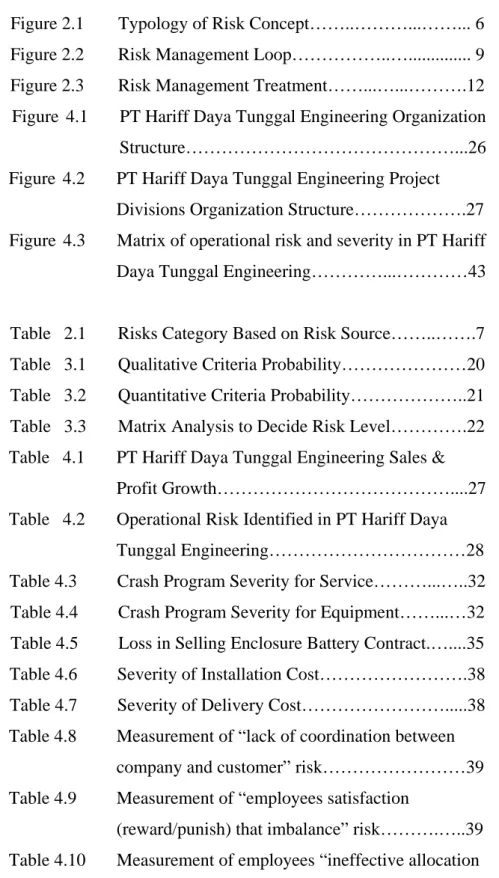
LIST OF FIGURE & TABLE
Figure 2.1 Typology of Risk Concept……..………...……... 6 Figure 2.2 Risk Management Loop………..…... 9 Figure 2.3 Risk Management Treatment……...…...……….12 Figure 4.1 PT Hariff Daya Tunggal Engineering Organization Structure………...26 Figure 4.2 PT Hariff Daya Tunggal Engineering Project
Divisions Organization Structure……….27 Figure 4.3 Matrix of operational risk and severity in PT Hariff Daya Tunggal Engineering…………...…………43
Table 2.1 Risks Category Based on Risk Source……..…….7 Table 3.1 Qualitative Criteria Probability………20 Table 3.2 Quantitative Criteria Probability………..21 Table 3.3 Matrix Analysis to Decide Risk Level………….22 Table 4.1 PT Hariff Daya Tunggal Engineering Sales &
Profit Growth………....27 Table 4.2 Operational Risk Identified in PT Hariff Daya
Tunggal Engineering………28 Table 4.3 Crash Program Severity for Service………...…..32 Table 4.4 Crash Program Severity for Equipment……...…32 Table 4.5 Loss in Selling Enclosure Battery Contract.…....35 Table 4.6 Severity of Installation Cost……….38 Table 4.7 Severity of Delivery Cost………...38 Table 4.8 Measurement of “lack of coordination between
company and customer” risk………39 Table 4.9 Measurement of “employees satisfaction
(reward/punish) that imbalance” risk……….…..39 Table 4.10 Measurement of employees “ineffective allocation
of employee” risk………...……..40
Table 4.11 Measurement of employees “technology dependencies of supplier”
risk………..……..40
Table 4.12 Measurement of employees “disobey duty/task and responsibility”
risk………..………..41 Table 4.13 Measurement of employees “fraud in transaction”
risk ………..……….41 Table 4.14 Measurement of employees “stealing or corruption of money/company’s asset” risk……..…………41 Table 4.15 Measurement of “changing in government
regulation” risk……….…………42 Table 4.16 Measurement of “frontier capacity in fulfilling
customer order” risk……….42 Table 4.17 Recapitulation of Hariff operational risk
measurement……….42 Table 4.18 Probability Scoring Criteria…………...………..44 Table 4.19 Probability Scoring of Hariff Operational
Risk………..44 Table 4.20 Severity Scoring Criteria………..………44 Table 4.21 Severity Scoring of Hariff Operational Risk…....45 Table 4.22 Recapitulation of Hariff operational risk scoring
result & risk level……….………46 Table 4.23 Risk management treatment………...……..47 Table 5.1 Hariff Operational Risk Identified, Risk Level, and Risk Management Treatment………...57