Mar. Drugs 2005, 3, 78-83
Marine Drugs
ISSN 1660-3397 www.mdpi.net/marinedrugs/Polycitorols A and B, New Tricyclic Alkaloids from an Ascidian
Hamad H. Issa,a,b Junichi Tanaka,*a Rachmaniar Rachmat,c Andi Setiawan,d Agus Trianto,e and Tatsuo Higa a
a
Department of Chemistry, Biology, and Marine Science, University of the Ryukyus, Nishihara, Okinawa 903-0213, Japan
b
Department of Sciences, School of Education, Arts and Sciences, The State University of Zanzibar, P.O.Box 146, Zanzibar, Tanzania
c
Research and Development Centre for Oceanology LIPI, Jl. Pasir Putih 1, Ancor Timur, Jakarta 11048, Indonesia
d
Department of Chemistry, Lampung University, Bandar Lampung 35145, Indonesia
e
Department of Marine Science, Diponegoro University, Semarang, Central Java 50234, Indonesia
*
Corresponding author. Tel/Fax: 81-98-895-8560; e-mail: [email protected]
Received: 24 January 2005 / Accepted: 13 June 2005 / Published: 23 September 2005
Abstract: Two new tricyclic alkaloids, polycitorols A (1) and B (2) have been isolated along with the known lepadiformine (3) from a marine ascidian of the family Polycitoridae. The structures of the new compounds were elucidated by analysis of NMR data and comparison with those of 3 and other related compounds [1-5]. Compounds 1 and 2 are closely related to cylindricines A and B, lacking C-4 oxygenation found in cylindricines and having a butyl instead of a hexyl appendage. NOE experiments on compounds 1 and 2 suggested the A/B ring fusion to be cis.
Keywords: polycitorols, Polycitoridae, tricyclic alkaloids, ascidian, polycyclic alkaloids.
Introduction
the first members of the family based on the perhydropyrrolo[2,1-j]quinoline and the perhydropyrido[2,1-j]quinoline ring systems, respectively. The structures and relative stereochemistries were unambiguously established by X-ray crystallography of their corresponding picrates. Moreover, these two compounds were reported to interconvert through aziridinium intermediate forming 3:2 equilibrium mixture upon standing in a solution. These compounds were reported toxic to brine shrimps [1]. Initially reported [2] structure for lepadiformine was revised to 3 [4], and its absolute configuration was recently determined [5]. Compound 3 exhibited cytotoxicity against several tumor cell lines[2] and in vivo and in vitro cardiovascular activity [6]. More recently, fasicularin, isolated from Nephteis fasicularis, was reported as a cytotoxin to Vero cells and was found to act as a DNA-damaging agent in the assay using a DNA repair-deficient yeast strain [3].
As a part of collaborative investigation of biologically active compounds from Indonesian marine organisms [7], we herein report the isolation and structures of two new tricyclic alkaloids polycitorols A (1) and B (2) together with known lepadiformine (3) from a marine ascidian.
3
Specimens (65.0 g, wet) of the ascidian of the family Polycitoridae were collected by SCUBA (-25 m) off Flores, Indonesia in August 2001 and were stored in ethanol after its collection. The sample was exhaustively extracted with MeOH and the resulting extract was chromatographed on a silica gel column followed by reversed-phase HPLC to give polycitorol A (1), B (2), and lepadiformine (3).
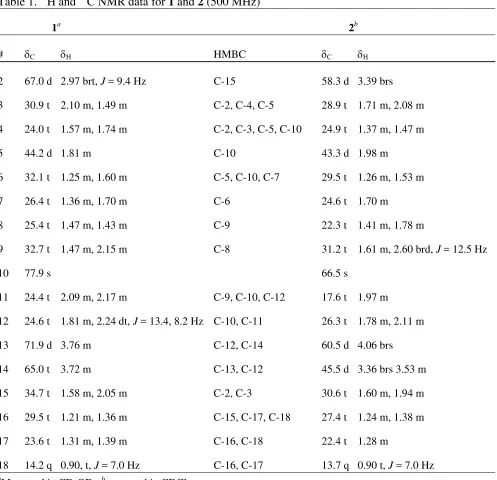
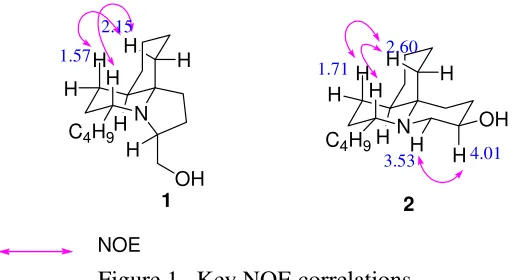
Enhancement of H-2 at δ 2.97 and H-4ax at δ 1.57 upon irradiation of H-9ax at δ 2.15 suggested a cis -fusion between rings A and B. The alkyl side chain at C-2 occupied β equatorial position on the basis of mutual NOE enhancements between H-2 and H-5. NOE between one of H-12 protons and H-13 may indicate the primary hydroxyl group as shown. Thus, the structure of compound 1 was elucidated.
Table 1. 1H and 13C NMR data for 1 and 2 (500 MHz)
1a 2b
# δC δH HMBC δC δH
2 67.0 d 2.97 brt, J = 9.4 Hz C-15 58.3 d 3.39 brs
3 30.9 t 2.10 m, 1.49 m C-2, C-4, C-5 28.9 t 1.71 m, 2.08 m
4 24.0 t 1.57 m, 1.74 m C-2, C-3, C-5, C-10 24.9 t 1.37 m, 1.47 m
5 44.2 d 1.81 m C-10 43.3 d 1.98 m
6 32.1 t 1.25 m, 1.60 m C-5, C-10, C-7 29.5 t 1.26 m, 1.53 m
7 26.4 t 1.36 m, 1.70 m C-6 24.6 t 1.70 m
8 25.4 t 1.47 m, 1.43 m C-9 22.3 t 1.41 m, 1.78 m
9 32.7 t 1.47 m, 2.15 m C-8 31.2 t 1.61 m, 2.60 brd, J = 12.5 Hz
10 77.9 s 66.5 s
11 24.4 t 2.09 m, 2.17 m C-9, C-10, C-12 17.6 t 1.97 m
12 24.6 t 1.81 m, 2.24 dt, J = 13.4, 8.2 Hz C-10, C-11 26.3 t 1.78 m, 2.11 m
13 71.9 d 3.76 m C-12, C-14 60.5 d 4.06 brs
14 65.0 t 3.72 m C-13, C-12 45.5 d 3.36 brs 3.53 m
15 34.7 t 1.58 m, 2.05 m C-2, C-3 30.6 t 1.60 m, 1.94 m
16 29.5 t 1.21 m, 1.36 m C-15, C-17, C-18 27.4 t 1.24 m, 1.38 m
17 23.6 t 1.31 m, 1.39 m C-16, C-18 22.4 t 1.28 m
18 14.2 q 0.90, t, J = 7.0 Hz C-16, C-17 13.7 q 0.90 t, J = 7.0 Hz
a
HN
Figure 1. Key NOE correlations
Polycitorol B (2), [α]D25 –10.3o (c 0.6, CHCl3), was isolated as a colorless oil. The molecular formula C17H31NO was determined by HREIMS, indicating that it was isomeric to 1. The IR spectrum of 2 was similar to that of 1. Comparison of NMR data of 1 and 2 revealed that considerable higher field shifts were observed for a methine at δ 58.3 and a quaternary carbon at δ 66.5 in the 13
C spectrum of 2. Furthermore, additional methine signal at δ 4.06 (δC 60.5) suggested that 2 had a secondary rather than a primary alcohol. The COSY spectrum indicated that this proton coupled to two nitrogen-attached methylene protons (δ 3.53, 3.36) and two other protons (δ 1.78, 2.11). Thus, the aforementioned data indicated that the pyrrolidine ring was rearranged to a piperidine ring. The relative stereochemistry of A/B rings was shown to be identical to that in 1 with a C-2α butyl side chain based on similar NOE data, particularly a set of mutual NOE enhancements between H-2, H-4ax and H-9ax. A trans fusion between rings A and C was suggested by NOE between 13/2, H-14ax/H-2 and H-5/H-2. Thus, rings A and C of 2 adopted a much more rigid trans 1-azadecalin system and the C-13 hydroxyl group occupied β equatorial position.
Conclusion
Two new tricyclic alkaloids, polycitorols A (1) and B (2), have been isolated along with the known lepadiformine (3) from a marine ascidian. The new compounds contain a butyl side chain instead of a hexyl group observed more commonly in known related compounds.
Experimental
General
The optical rotations were recorded with a Jasco DIP-1000 Digital polarimeter. IR spectra were measured on a Jasco FT IR-300 spectrometer. NMR spectra were taken on a Jeol α 500 FT NMR spectrometer and referenced to CHCl3 solvent signal at δ 7.26 for 1H NMR and δ 77.0 for 13C NMR spectra in CDCl3 as a solvent and also referenced to TMS signal at δ 0.00 for 1H NMR and δ 49.0 for 13
experiments. EIMS mass spectra were measured on a Hitachi M-2500 instrument. HPLC separations were carried out on a Hitachi L-6000 or Shimadzu LC 9A pumps equipped with Waters 486 or Hitachi L-4000 UV detector and Waters R401 Differential Refractometer. Columns used for HPLC were reverse phase Nacalai 5C18-AR II (10 × 250 mm). Kieselgel 60 (230-400 mesh) Si gel was used for column chromatography. TLC was carried out on precoated silica 60F254 plates and visualized with vanillin-EtOH-1% H2SO4.
Biological material
The specimens (65.0 g, wet wt.) of the ascidian (family Polycitoridae) were collected by hand using SCUBA (-25 m) at Misa Is., Labuhanbajo, Flores, Indonesia in August 2001 and were stored in ethanol after its collection. The ascidian was tentatively identified by Dr. Adrian Gittenberger, National Museum of Natural History Naturalis, Leiden, The Netherlands. A voucher specimen (0117J78) is deposited at Department of Chemistry, Biology, and Marine Science, University of the Ryukyus. A photo of the specimen can be viewed at
http://www.ascidians.com/families/polycitoridae/polycitoridae_blue/polycitoridaeblue.htm
Extraction and Isolation
A sample of tunicate (65.0 g wet weight) was cut into small pieces and soaked in acetone (300 mL) for 7 hr. After decantation, fresh solvent was added, and the procedure was repeated three times. The combined extracts were concentrated and partitioned between EtOAc and H2O. The organic layer was concentrated to give an oil (0.39 g). The oil was chromatographed on silica gel by eluting with step gradient of hexane/CH2Cl2/EtOAc/MeOH. Seven fractions were obtained. Fraction V was selected for further purification using HPLC (RP-18, MeOH/H2O/TFA) to afford compounds 1, 2 and 3.
Polycitorol A (1): Colorless oil; [α]D25 +15.3o (c 0.2, CHCl3); IR (film) 3384, 2937, 2867, 1671, 1455, 1201, 1132 cm-1; 1H and 13C NMR see Table 1; EIMS m/z 265 (25, M+), 234 (100), 222 (97), 208 (45), 194 (5), 178 (5); HREIMS found m/z 265.2410 (calcd for C17H31NO, 265.2406).
Polycitorol B (2): Colorless oil; [α]D25 –10.3o (c 0.6, CHCl3); IR (film) 3384, 2937, 2869, 1670, 1457, 1201, 1132 cm-1; 1H and 13C NMR see Table 1; EIMS m/z 265 (6, M+), 222 (29), 208 (100), 193 (7), 150 (5); HREIMS found m/z 265.2406 (calcd for C17H31NO, 265.2406).
Acknowledgments
This work was supported in part by grant-in-aid from the Ministry of Education, Culture, Sports, Science, and Technology (No. 11691208).
References and Notes
C.; Blackman, A. J. Cyclindricines C-G, perhydropyrrolo[2,1-j]quinolin-7-one alkaloids from the ascidian Clavelina cylindrica. Aust. J. Chem. 1994, 47, 1355-1361. (c) Li, C.; Blackman, A. Cyclindricines H-K, novel alkaloids from the ascidian Clavelina cylindrica. Aust. J. Chem. 1995, 48, 955-965.
2. Biard, J. F.; Guyot, S.; Roussakis, C.; Verbist, J. F.; Vercauteren, J.; Weber, J. F.; Boukef, K. Lepadiformine, a new marine cytotoxic alkaloid from Clavelina lepadiformis. Tetrahedron Lett. 1994, 35, 2691-2694.
3. Patil, A. D.; Freyer, A. J.; Reichwein, R.; Carte, B.; Killmer, L. B.; Faucette, L.; Johnson, R. K. Fascicularin, a novel tricyclic alkaloid from the ascidian Neptheis fascicularis. Tetrahedron Lett. 1997, 38, 363-364.
4. Abe, H.; Aoyagi, S.; Kibayashi, C. First total synthesis of the marine alkaloid (±)-fascicularin and (±)-lepadiformine based on stereocontrolled intramolecular Acylnitroso-Diels-Alder-Reaction. J. Am. Chem. Soc. 2000, 122, 4583-4592.
5. Sun, P.; Sun, C.; Weinreb, S. M. Stereoselective total syntheses of racemic form and the natural enantiomer of the marine alkaloid lepadiformine via a novel N-acyliminium ion/allylsilane spirocyclization strategy. J. Org. Chem. 2002, 67, 4337-4345.
6. Juge, M.; Grimaud, N.; Biard, J. F.; Sauviat, M. P.; Nabil, M.; Verbist, J. F.; Petit, J. Y. Cardiovascular effects of lepadiformine, an alkaloid isolated from the ascidians Clavelina lepadiformis (Muller) and C. moluccensis (Sluiter). Toxicon 2001, 39, 1231-1237.
7. Issa, H. H.; Tanaka, J.; Rachmat, R.; Higa, T. Floresolides, new metacyclophane hydroquinone lactones from an ascidian, Aplidium sp. Tetrahedron Lett. 2003, 44, 1243-1245.
Sample availability:
The authentic sample of both polycitorol A and B are deposited at Department of Chemistry, Biology, and Marine Science, University of the Ryukyus.