The Use of Local Knowledge
–
Application to the
Management of the Catfish Fishery in the Gambia
Gambia-Senegal Sustainable Fisheries Project (USAID/BaNafaa)
7ハヒユ#メラトホヒナテヨヒムミ#ヒユ#テリテヒホテトホヌ#ヌホヌナヨヤムミヒナテホホロ#ムミ#ヨハヌ#&ムテユヨテホ#5ヌユムラヤナヌユ#&ヌミヨヌヤ’ユ#ルヌトユヒヨヌ#テヨ# http://www.crc.uri.edu. For more information contact: Coastal Resources Center, University of Rhode Island, Narragansett Bay Campus, South Ferry Road, Narragansett, Rhode Island 02882, USA. Tel: 401) 874-6224; Fax: 401) 789-4670; Email: [email protected]
The USAID/BaNafaa project is implemented by the Coastal Resources Center of the University of Rhode Island and the World Wide Fund for Nature-West Africa Marine Ecoregion (WWF-WAMER) in partnership with the Department of Fisheries and the Ministry of Fisheries and Water Resources.
Citation Gibril, G., Drammeh, O. and L. Kelpsaite. 2012 . The Use of Local Knowledge –# Application to the Management of the Catfish Fishery in the Gambia
Disclaimer: This report was made possible by the generous support of the American people through the United States Agency for International Development (USAID). The contents are the responsibility of the authors and do not necessarily reflect the views of USAID or the United States Government. Cooperative Agreement # 624-A-00-09- 00033-00.
Cover Photo: USAID/BaNafaa project/World Wide Fund for Nature-West Africa Marine Ecoregion (WWF-WAMER)
Acknowledgements
There is little doubt that involving stakeholder communities in gathering local knowledge of a given fishery and linking that knowledge to scientific knowledge will provide a better understanding of the fishery and a strong foundation on which to develop a sustainable co-management plan for that particular fishery.. The local communities play very important roles in the planning and implementation of co-management plans, and in the important area of data collection and generating local information useful for fishery management purposes. We wish to thank the fisher folk communities of Kartong, Gunjur, Sanyang, Tanji, Brufut, Batokunku/Tujereng, Bakau, Old Jeshwang, Banjul, Barra, Albreida, Mbankam, Jinak Nigee, Jinak Kajata, Bintang and Tendaba communities for their participation in providing local ecological knowledge on the catfish: the different species, biology, life cycle,
reproduction, geographical distribution, population dynamics and migration, and the different types of harvesting methods and practices. This information dramatically
Table of Contents
Introduction ... 5
Methods and Materials... 6
Results... 7
Identified Catfish Species and Descriptions... 7
Migration Patterns... 12
Catfish Spawning... 14
Fishing Methods/Gears ... 16
Scientific Knowledge ... 19
Conclusion... 20
References ... 22
Introduction
The Catfish fishery in Gambian waters is of high importance for the local and regional food supply chain. However, not much is known about the species and the stocks. Artisanal fishermen target both saltwater and brackish/fresh water catfish species in The Gambia waters. Caught fish is landed at coastal and in-land landing sites and is consumed fresh or smoked at these landing sites. Processed saltwater catfish is transported and marketed up-country and some are exported to USA and Europe for the African populations, in these countries, whereas brackish/freshwater catfish is exported to West African region, mainly to Mali and mostly in dried form.
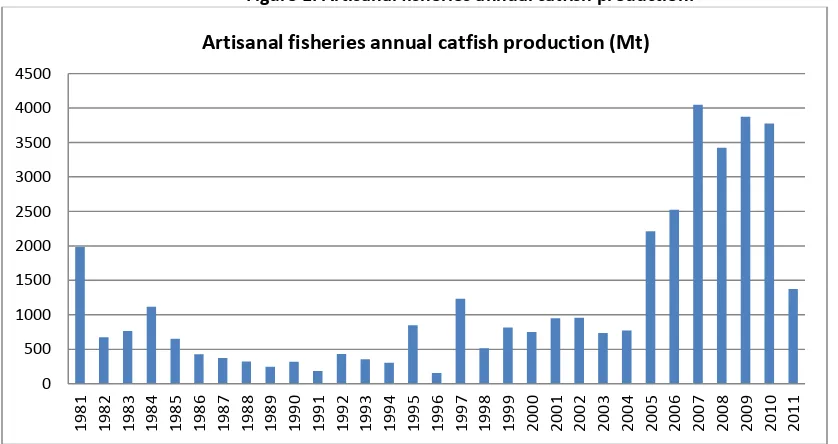
However, concerns have been raised over fishing practices and the high level of fishing effort and the sustainability of the marine stocks. The marine catfish is extensively targeted during spawning time, just before the rainy season, near the coast and within the estuary of the River Gambia. Data collected by the Department of Fisheries field staff show significant increase in catfish landing and production in last seven years, except 2011 (Figure 1). Catch landings data for 2012 is not yet available but fishermen have observed a decrease in the availability of catfish along the coast and in deeper waters.
Figure 1. Artisanal fisheries annual catfish production.
Artisanal fisheries annual catfish production (Mt) 4500
As part of catfish species study under the USAID/BaNafaa Project, Local Ecological Knowledge (LEK) collection on catfish species in the Gambia was done. LEK refers to a body of knowledge held by a specific group of people about their local ecosystems and is proving to be a valuable tool for resource management. Gathered Local Ecological
the catfish fishery management plan that will be a part of the multispecies fisheries co-management plan in The Gambia.
This report summarized collected LEK on catfish species, spawning behavior, fishing methods and practices and other useful information that will help have a better understanding of the catfish fishery.
Methods and Materials
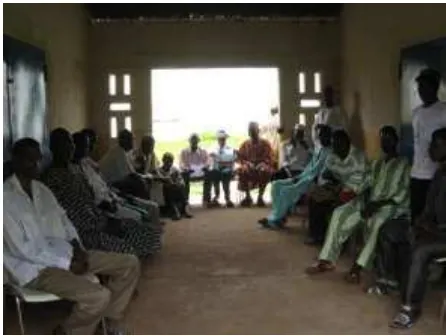
At each landing site that is known for catching and landing the catfish species, the local fishermen were invited for the meeting. The attendance varied from site to site - from ten to more than twenty men. USAID/BaNafaa project staff and NASCOM representatives led the meetings.
The questions from questionnaire (Annex I), that were prepared ahead of time, were presented to the men and the answers recorded. The meetings were held in local languages, Wolof and Mandinka.
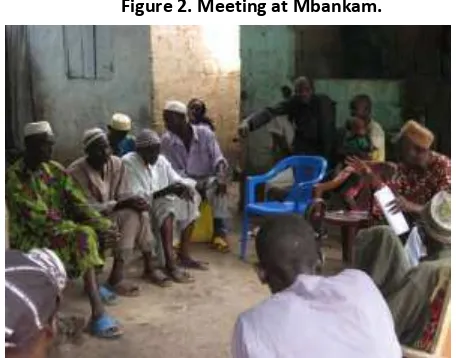
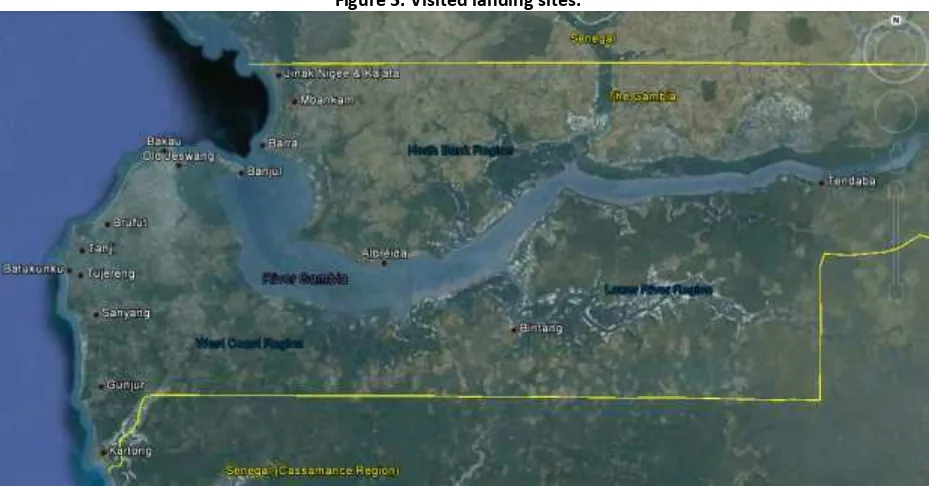
A total of 15 landing site communities within three regions of the country (Figure 2 and 3) were visited:
ク West Coast Region (WCR): Kartong, Gunjur, Sanyang,
Batokunku/Tujereng, Tanji, Brufut, Bakau, Old Jeswang, Banjul
ク North Bank Region (NBR): Barra, Albreida, Mbankam, Jinak Nigee & Kajata, ク Lower River Region (LRR): Bintang and Tendaba
The meetings were held during the months of July and August, 2012.
Figure 3. Visited landing sites.
The results from the local knowledge surveys were presented in the Annual NASCOM meeting on October 10, 2012 and fishermen and processers were asked to validate the information as part of their small group discussions.
Results
Identified Catfish Species and Descriptions
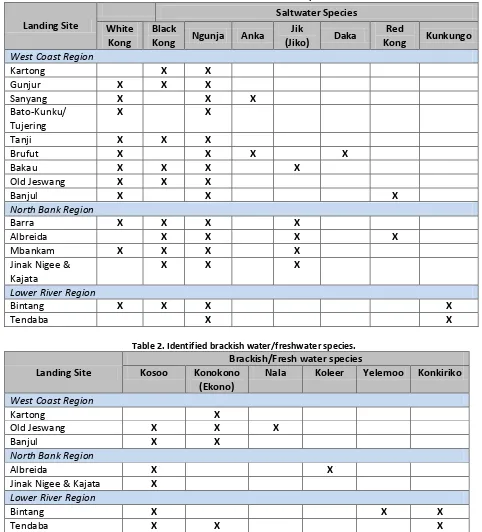
Different species of catfish were identified by the fishermen. Most of them were aware of the existence of three species namely: White Kong, Black Kong and Ngunja. The summary of the information/local knowledge gathered from the different fish landings sites is shown in Table 1 and Table 2. The Tables below show that there are eight saltwater catfish species and six brackish and freshwater species. Interesting information was that fishermen in the coastal fishing sites of Kartong, Banjul and Old Jeshwang identified the
Table 1. Identified Saltwater Catfish Species
Table 2. Identified brackish water/freshwater species.
Landing Site
Brackish/Fresh water species
Kosoo Konokono
(Ekono)
Nala Koleer Yelemoo Konkiriko
West Coast Region
Saltwater Catfish (Arius latiscutatus):
Black Kong: The species color is black as reported by fishermen at most of the landing sites. It is flatter, wider and found in rocky areas (Kartong). Fish head is short with a big mouth and it lives in rocky areas with Ngunja (Tanji). The fish has wide and short head (Barra) which is bigger and not flat (Gunjur). It has short mouth (Mbankam, Bakau) and ハヌテニ#テミニ#ヒユ#ホムミノヌヤ#ヨハテミ#ヨハヌ#ルハヒヨヌ#ムミヌ’ユ# 0トテミヘテマ .#The species is second biggest after Ngunja and its mouth is similar to Ngunja but smaller (Old Jeswang). Smaller/younger ones are lighter (Albreda). The species has a strong spine and not large head (Bintang).
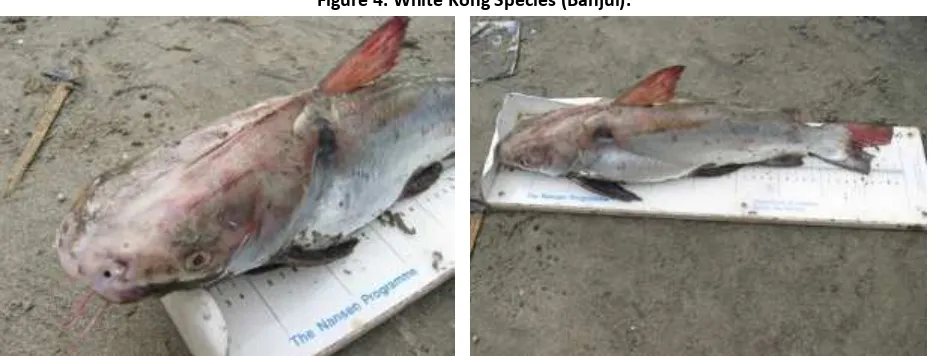
Figure 4. White Kong Species (Banjul).
White Kong (Dakart) (Figure 4): The different colors were reported for the species: fair (Sanyang), ash (Bato-Kunku/Tujering, Bintang, Banjul), grayish (Bintang), and white (Gunjur, Tanji, Brufut). Its stomach is white (Bakau, Banjul), slippery (Barra) and back is ash color (Banjul). The head is small (Bintang), narrow (Barra, Gunjur), with big eyes (Bato-Kunku/Tujering), wide (Banjul) and long (Bakau), narrow mouth (Barra, Mbankam). The Old Jeswang fishermen thought that the fish is much smaller with a mouth smaller than other species. At Tanji one man thought there is no difference between Black and White Kong.
It lives in the Pass (shallow, sandy area)(Tanji). Banjul fishermen indicated that White Kong grows bigger and then becomes Jik; the fish travel from saltwater to estuary.
Daka: The species bears characteristics of all other three catfish species, large/swollen stomach, bigger head and mustaches. It is not around here, only in Cassamance (Brufut).
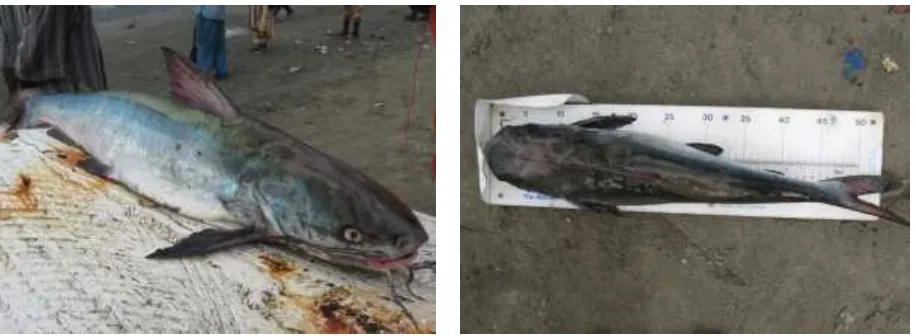
species have tail fin of the constant height (Albreda). The body of the fish is big and long (Bintang). It is bigger and longer than other species (Old Jeshwang, Barra). The back/top spine is strong (Sanyang). The fish is wide (Bato-Kunku/Tujering) and flat (Gunjur, Banjul). The head is big, flat (Bakau) and wide (Old jeshwang). Others reported that the head is small (Bintang), slim (Tanji), narrow and long (Barra). It has mustaches (Sanyang), small eyes (Bato-Kunku/Tujering), small mouth (Bakau, Old Jeshwang, Tanji, Banjul). The species has a special smell as per Tanji fishermen and smoother (Banjul).
Figure 5. Ngunja species (Banjul).
It is found in deep waters (Kartong).
Anka: The fish has fair/ash color (Sanyang, Brufut).
Jik (Jiko, Bata Wuloo): The fishermen at different landing sites agreed that Jik is the biggest and longest fish. Barra fishermen indicated that it is bigger than Ngunja. It has a black and big head (Bakau). Three fish colors were reported: ash/grey color (Barra), black (Mbankam), and red (Jinak Nigee & Kajata). Not many are found anymore (Mbankam).
Brackish/Freshwater Catfish:
Koleer: The species color is ash black and its body is slippery (Albreda).
Konkriko: Fish is black (Tendaba) and smaller than Kosoo (Bintang). It has strong and sharp spine (%ヒミヨテミノ ,#ヒヨユ#ハヌテニ#ホムムヘユ#ホヒヘヌ#ヤテヨ’ユ#head (Tendaba).
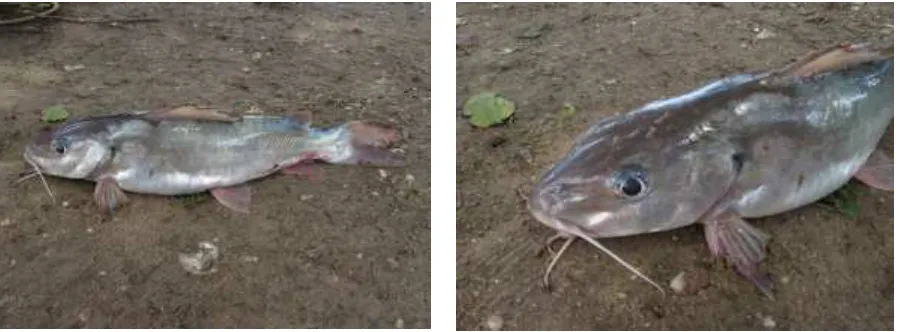
Kosoo: The catfish is light, ash color (Banjul), but its meat is yellowish (Old Jeshwang) (Figure 6). Tendaba fishermen reported that its color is white and in Albreda - reddish with white stomach. Its body is slippery and shiny (Bintang). The head is not big (Bintang,
Tendaba), slim (Banjul) with small mouth (Tendaba) and mustaches (Old Jeshwang). The bones are stronger than those of the other species (Banjul, Albreda). It has 3 spines (Old Jeshwang) which are more dangerous and stronger (Albreda).
Figure 6. Kosoo species (Tendaba).
Jinak Nigee & Kajata fishermen catch Kosoo species only by accident.
Kunkungo: These fish are large (fat) with large head but not long (Bintang, Tendaba).
Nala: This catfish species is black and resembles Kosoo, but its meat looks different (Old Jeshwang).
Old Jeshwang fishermen related that the body of all Kosoo, Konokono and Nala, fresh water catfish, is more slippery than the one of a seawater catfish.
Red Kong (Palm Oil Catfish, Bu-Hong Ha): The color of the species is light brown and stomach is white. Its skin and meat are soft. It has smaller mouth with red lips and more mustaches. The bones are not as strong as the ones of other species (Banjul). Albreia fishermen reported that the fish color is red.
Yelemoo: The fish is short and strong. It has a small head (Bintang).
Fishermen also described the differences between the male and female fish:
ク Male: male fish has smaller fins at the bottom of his stomach (Brufut), it has small stomach (most fishermen), bigger head than female (Barra), it is long, slim, and its fins are closer to the stomach (Banjul).
Old Jeshwang and Mbankam fishermen could not distinguish female catfish from male catfish.
Migration Patterns
The fishermen observed that the catfish migrate from the North, Saloum area of Senegal. According to Gunjur fishermen and some fishermen in Banjul, the catfish sometimes travels from North and sometimes –#from South. They also stated that the migration depends on the changes in environmental conditions. Tanji and Brufut fishermen indicated that the fish migrate from the south, Cassamance, like most other fish. The catfish migrates from
Northwest, deep waters, to the Gambia River through the river mouth according to the fishermen in Barra. The fish migrates to the river in January and returns to the ocean when the rains start (Bintang).
Various catfish species. Fishermen in all of the landing sites claimed that the catfish species can be caught all year round. Tanji fishermen agreed with the same statement but said that the catch peaks during the rainy season. Fishermen in Albreda claimed that during July-August very few fish are caught.
Fishermen of Tendaba catch the salt water catfish during the months February through August. Brackish/fresh water species, Konokono, Kosoo, Konkiriko, travel during the months of February –#August, and come back during months of August-October.
Jik. Fishermen at Barra landing site indicated that Jik is not a cluster fish and is not caught frequently. It can be found in deep waters. Jinak Nigee and Kajata fishermen expressed the concern that there are not many Jik catfish.
Ngunja. Kartong fishermen catch Ngunja all year round. This species follow cold water, therefore in cold months there is more fish available. For the following fishermen the peak season for Ngunja, when it is being caught closer to the shore, is:
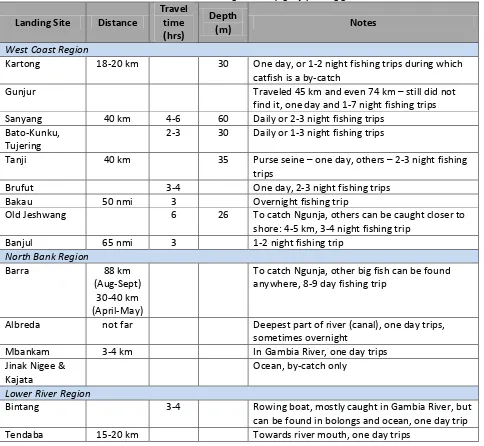
During other months the fishermen have to travel far to the ocean to catch Ngunja (Table 3). Sanyang fishermen find this to be the case as well. Barra fishermen reasoned Ngunja return to the deep waters as them being afraid of thunderstorms. Bintang fishermen said that Ngunja goes to deep waters when the rains come.
Mbangam fishermen expressed concern that they have not seen Ngunja for the last 5 years. They can only catch it further south - around Banjul, Bakau, Tanji, Kartong. Mbankam, Jinak Nigee & Kajata and Bintang fishermen also confirmed that there is not many Ngunja
compared to before.
Table 3. Fishermen travel to large catfish (Ngunja) fishing grounds.
Landing Site Distance
Travel
Kartong 18-20 km 30 One day, or 1-2 night fishing trips during which catfish is a by-catch
Gunjur Traveled 45 km and even 74 km –still did not
find it, one day and 1-7 night fishing trips Sanyang 40 km 4-6 60 Daily or 2-3 night fishing trips
Brufut 3-4 One day, 2-3 night fishing trips
Bakau 50 nmi 3 Overnight fishing trip
Old Jeshwang 6 26 To catch Ngunja, others can be caught closer to shore: 4-5 km, 3-4 night fishing trip
Banjul 65 nmi 3 1-2 night fishing trip
To catch Ngunja, other big fish can be found anywhere, 8-9 day fishing trip
Albreda not far Deepest part of river (canal), one day trips, sometimes overnight
Catfish Spawning
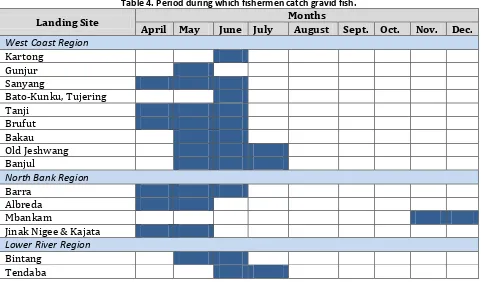
The catfish migrates to the waters closer to the shore to reproduce. The fishermen were asked to report their observations when they catch gravid fish. Most of them, except Mbankam, indicated the period between April and July (Table 4).
Table 4. Period during which fishermen catch gravid fish.
Landing Site Months
April May June July August Sept. Oct. Nov. Dec.
Jinak Nigee & Kajata Lower River Region Bintang
Tendaba
Then the catfish spawns during the months of May to September as observed by the majority of the fishermen (Table 5). Kartong fishermen find juvenile catfish in July, but according to Gunjur fishermen the eggs start to hatch in July. In Brufut fishermen disagreed whether catfish spawn once or twice during the three month period (April –#June). Jinak Nigee & Kajata fishermen claimed that spawning happens before the rains start (June-July).
Table 5. Catfish spawning time.
Landing Site Months
Landing Site Months
Jinak Nigee & Kajata Lower River Region Bintang
Tendaba
The catfish spawns:
ク Close to the shore: Kartong, Sanyang, Bato-Kunku/Tujering, Tanji, Bakau, Old Jeshwang, Banjul, Barra, Jinak Nigee & Kajata
ク In-land at mouth of Gambia River: Bato-Kunku/Tujering, Albreda
ク Upstream of Gambia River: Albreda
ク In bolongs: Bato-Kunku/Tujering, Jinak Nigee & Kajata, Bintang, Tendaba
ク In mangroves, shallow areas: Mbankam, Tendaba
Gunjur fisherman could not tell: whether the fish lives, that is where they spawn, but if one catches a fish at shore with eggs, that means that they are coming in to spawn.
Tanji fishermen also indicated that the catfish can also spawn in deep sea. However, Brufut fishermen explained that catfish come closer to shore to spawn, because if they spawn in deep sea, the big fish will eat the eggs.
Most of the juveniles are found in the same areas where the fish spawns as reported by the fishermen, which is close to coast, shallow areas (Kartong, Sanyang,
Bato-Kunku/Tujering, Tanji, Brufut, Bakau, Old Jeshwang, Banjul, Barra, Jinak Nigee & Kajata, Mbankam). Some of them find juvenile fish in deep waters (Gunjur). Young fish is also spotted near mangroves (Tendaba), in shallow areas and creeks (Albreda, Mbankam, Bintang, Tendaba), and in estuaries (Brufut).
Juvenile fish, stay in the bolongs until they grow up (about 1 month) before migrating to the Gambia River to avoid being eaten by the bigger fish; then after about 2-3 months the fish migrate to the ocean (Tendaba, Bintang). The juveniles return to the deep waters after 3 months (Sanyang, Tanji, Brufut, Bakau, Banjul, Barra). Many young fish get captured before they go out to deep waters (Tanji).
Albreda fishermen (Figure 7) observed that during the rainy season the saltwater travels upstream of Gambia River up to Tendaba. At the end of rainy season the salt water is being pushed back to the ocean and the juveniles migrate to the ocean together with the
returning water. During the months of August-October there is upwelling happening at the mouth of Gambia River that forces the juveniles to go to the ocean (O. Bojang, NASCOM). Bato-Kunku/Tujering fishermen reported that the juvenile fish return to the sea only after one year, Old Jeshwang fishermen - juvenile fish return to the deep waters after about 3 weeks and according to Mbankam fishermen –#after 1.5 months. Jinak Nigee & Kajata fishermen did not know.
During the validation workshop, fishermen supported the belief that catfish migrate to The Gambia to spawn from the Casamance area in the south except for one group that felt they migrated from the north to the west.
Fishing Methods/Gears
The fishermen use different types of gears for catfish fishing: hook and line, long line, surround nets, purse seine, different types of monofilament and multifilament nets. Some of the fisherman reported that they use different nets without specifying the actual types. Fishermen in Mbankam and Jinak Nigee & Kajata do not target catfish species –#it is only by-catch. The summary of gathered knowledge is shown in Table 6 and Figure 8.
Table 6. Fishing gear used for catfish.
Landing Site
Bato-Kunku, Tujering Bottom
gillnet
Landing Site
Old Jeshwang Bottom
gillnet
*catfish is by-catch only
Figure 8. Number of landing sites using different gear to catch catfish.
Number of landing sites using different gear to catch Catfish
16
Hook and Line Long Line Multifilament Monofilament Purse seine Surround nets Different (not specified)
Most effective gear to catch catfish is:
ク Net is effective (Banjul) because it catches more fish. Fishermen use different types of nets especially if they locate a school of fish (Old Jeshwang). Tendaba fishermen effectively use monofilament nets (chaso) of sizes 40 and 45.
Many different species are caught as a by-catch when fishermen are targeting the catfish, especially using a long line. Most common species, mentioned by the fishermen, are: Sompat Grunt (Sompat), Ladyfish (Tonone), African Sicklefish (Tapandarr), Law Croaker (Nguka), Cownose Ray (Tumbulan), Milk Shark (Gainde Gauge), Bobo Croaker (Jotor), Giant African Threadfin (Kujali), Tilapia (Furo), Cassava Croaker (Fotta), Great Barakuda (Sedda), Round Stingray (Raiyentan), Fresh water catfish (Kosoo), Sole fish, and Tiger Shrimp (Sipah). Some fishermen even catch Shad (bonga), but not Round Sardinella (Spanish sardine).
Mbankam and Jinak Nigee & Kajata do not target catfish, which is only a by-catch.
The Gambian Department of Fisheries maintains catch records per gear type for rough head sea catfish (A. latiscutatus) and smooth mouth catfish (A. heudelot) (in kg and percent of total catch). (2009-2012 data not yet available) (Tables 7 a and b).
Table 7a. Rough Head Sea Catfish
2006 2007 2008 2009 2010 2011 2012
total 2,525,603 2,563,160 3,388,087
Table 7 b. Smooth Mouth Sea Catfish.
gillnet
From this database, there has been a noticeable shift from gillnets to hook and line and longlines as the primary gear for the rough head sea catfish between the period from 2006-2008. The local knowledge survey conducted in 2012 verified that this trend has continued.
Scientific Knowledge
There is no data on growth of these species in the Gambia but it is reported in the same species from Guinea (Table 8). Growth is believed to be seasonal with one annulus formed per year (using dorsal spine). No differences were noticed between males and females. The growth function parameters for Guinean catfish are listed in Table 9. In Guinea, there are fish in the landings greater than 80 cm which are assumed to be between 20-30 years old. Their natural mortality is believed to be low. Their morphology with the hard skull and strong protective spines probably protects them from strong predation pressure.
Table 8. Von Bertalanffy growth parameters for Guinean catfish (from Conand et al 1995).
Species /∞#
Table 9. Age-length relationships calculated from growth. Lengths given are fork lengths.
The L50 for maturity is reported as between 27-28 cm for females (Age 3, Fishbase, 2012).
Fishermen have observed spawning from May (Kartong and Gunjur) through September (Banjul). They believe the fish spawn inshore near the mouth of the river and bolongs. They produce a small number of eggs (Figure 12) which the males incubate in their mouths for up to 2 months (Fishbase, 2012).
The MSC pre-assessment identified catfish species as high risk based on their
productivity/susceptibility attributes (Medley et al., 2008). The combination of slow growth, large investment in small number of young, and long life span makes these species very susceptible to overfishing and needs to be closely monitored. The fishermen in the validation workshop agreed that catfish appears to be overfished.
Conclusion
The fishermen at all 15 landing sites were eager to share their knowledge and
observations. Indicated in Tables 1 and 2 is the catfish identified at the landing sites and the names of different species varied. With these numerous species available, fishermen expressed deep concern about fish populations disappearing in the ocean and Gambia River. The knowledge found on Ngunja species catching grounds, summarized in Table 3, indicated that the fishermen have noticed a decline in populations and an increase in distance from the shore to find large fish. This could be related to increased number of fishermen and increase in catfish production in recent years as shown in Figure 1. Fishing close to the shore during spawning period (Table 4 and 5) and juvenile growth period, significantly increases the risk depleting the catfish populations.
The collected LEK is important in understanding fish behavior and the relationship of the fishermen and catfish populations. This basic knowledge of how the fish behave is inherent ヒミ#ヨハヌ#ネヒユハヌヤマヌミ’ユ#ルムヤヘ,#トラヨ#テ#ルヒニヌヤ#リヒヌル#ムネ#ハムル#ヨム#メヤムヨヌナヨ#ヨハヌヒヤ#ルムヤヘヒミノ#テヤヌテ#could benefit greatly. Recorded knowledge on fishing practices and gears used to catch catfish (Table 6 and Figure 8) provides a bigger picture on how fishermen behavior affects the catfish stocks. We now have a better idea of how the populations are managed and the effects of the gears on the populations. With further field studies, we will get quantitative data on the effects of the gear on the populations and determine the most efficient and safe fishing practices.
willing to assist during further studies and hot spot mapping. However, fishermen in Old Jeshwang expressed the desire to have allowances paid.
Based on collected information and knowledge the catfish fishery co-management plan will be developed. It will be used to protect and sustainably manage the fishery by closing near shore areas during spawning and juvenile growth periods, setting up catch limits and allowable gear requirements among others. The fishermen see the effects of declining fish populations and will directly benefit from the developed co-management plan.
Further studies and work in order to develop the co-management plan is needed in the areas of:
ク Identifying the catfish species
ク Measuring/Identifying existing stocks ク Tracking the catfish migration
ク Monitoring gear usage
References
Conand, F., Camara, S.B., and F. Domain. 1995. Age, growth of three species of Ariidae (Siluriformes) in coastal waters of Guinea. Bulletin of Marine Science 56(1): 58-67.
Department of Fisheries (DoFish), Artisanal Fisheries Annual Catfish Production, received September 12, 2012
ANNEX 1
Questionnaire
1. How many species of catfish there are? 2. How can you differentiate the species?
3. Are they caught seasonally or throughout the year?
4. If there are more than one species, are they seasonal or annual? 5. What time do they catch gravid catfish?
6. What time of year do they spawn? 7. Where do they spawn?
8. Do they enter from the North (Saloum) or South (Cassamance)? 9. In which areas are juveniles found?
10. When do juveniles return to the deep sea?
11. What type of fishing method do they use to catch catfish? 12. How far from the shore do they go to get BIG catfish (Ngunja)? 13. How long is the trip? How many days?
14. How to differentiate male fish from female? 15. What species are caught as the by-catch?
16. What gear is most effective for catching the catfish?