• Tidak ada hasil yang ditemukan

CCRGuide lowres.

N/A
N/A
Protected

Academic year: 2017

Membagikan "CCRGuide lowres."

Copied!
164
0
0

Teks penuh

(1)

How Resilient is YouR

Coastal CommunitY?

(2)

How Resilient is YouR Coastal CommunitY?

a Guide foR evaluatinG Coastal CommunitY ResilienCe

to tsunamis and otHeR HazaRds

U.S. Indian Ocean Tsunami Warning System Program

2007

Printed in Bangkok, Thailand

Citation:

U.S. Indian Ocean Tsunami Warning System Program. 2007. How Resilient is Your Coastal

Community? A Guide for Evaluating Coastal Community Resilience to Tsunamis and Other Coastal Hazards. U.S. Indian Ocean Tsunami Warning System Program supported by the United States Agency for International Development and partners, Bangkok, Thailand. 144 p.

The opinions expressed herein are those of the authors and do not necessarily reflect the views of USAID. This publication may be reproduced or quoted in other publications as long as proper reference is made to the source.

The U.S. Indian Ocean Tsunami Warning System (IOTWS) Program is part of the international effort to develop tsunami warning system capabilities in the Indian Ocean following the December 2004 tsunami disaster. The U.S. program adopted an “end-to-end” approach—addressing regional, national, and local aspects of a truly functional warning system—along with multiple other hazards that threaten communities in the region. In partnership with the international community, national governments, and other partners, the U.S. program offers technology transfer, training, and information resources to strengthen the tsunami warning and preparedness capabilities of national and local stakeholders in the region.

(3)

OctOber 2007

this publication was produced for review by the united states agency for

international development. it was prepared by the us indian ocean tsunami

warning system Program.

(4)
(5)

Acknowledgements

This guide was prepared as a collaborative effort between members of the US Indian

Ocean Tsunami Warning System (US IOTWS) Program including the National Oceanic and

Atmospheric Administration (NOAA), IRG-Tetra Tech, Asian Disaster Preparedness Center

(ADPC), the University of Rhode Island, Coastal Resources Center (CRC), and partner agencies

and organizations throughout the Indian Ocean region. Principal authors include Catherine

Courtney (IRG-Tetra Tech) Russell Jackson (NOAA), Adam Stein (NOAA), Alan White (The

Nature Conservancy), Ajurnaperrnal Subbiah (ADPC), Atiq Ahmed (ADPC), Pam Rubinoff

(CRC), Glen Ricci (CRC), and David McKinnie (NOAA).

We wish to thank the many agencies and organizations that have contributed to the

development of this Guide including:

India

State Relief Commission, Government of Tamil Nadu

UNDP - India Office, United Nations Development Program

Indonesia

Action Contre La Faim

BAKORNAS - National Disaster Management Coordinating Board of Indonesia

BAPPENAS - National Development Planning Agency

BMG - Agency for Meteorology and Geophysics

CARE International - Indonesia Office

COREMAP Project

detik.com

DKI - Ministry of Home Affairs

DKP - Ministry of Marine Affairs and Fisheries

DPR - The People’s Representative Assembly

Dream UPN

Dutch Red Cross

French Embassy

French Red Cross

GTZ - German Technical Cooperation

IDEP Foundation

IFRC - International Federation of Red Cross/Red Crescent Societies – Indonesia Office

IIDP - International Institute for Psychosocial Development

Islamic Relief

ITB - Center for Disaster Mitigation - West Java

Jakarta Post

Jaring Pela

KAPALA

KOGAMI - Tsunami Alert Community

Kompas

LIPI - Indonesian Institute of Sciences

Mercy Corps

Metro TV

(6)

Acknowledgements

Oxfam

Plan International

PMI - Indonesian Red Cross - West Sulawesi

PMI - Indonesian Red Cross - West Sumatra

PMI - Indonesian Red Cross – HQ

PMI - Indonesian Red Cross – Lampung

RISTEK - State Ministry of Research and Technology

Save the Children

SURFAID International

Tempo

UNDP - United Nations Development Program, Indonesia

UNESCO - United Nations Education, Scientific, and Cultural Organization

UNICEF - United Nations Children’s Fund

UNOCHA - United Nations Office for Coordination of Humanitarian Affairs

WHO - World Health Organization

Maldives

Regional Development Ministry of Planning and National Development

Malaysia

International Federation of Red Cross and Red Crescent Societies

National Security Division

WorldFish Center

Department of Meteorology

Ministry of Planning and National Development

National Disaster Management Center

Seychelles

Disaster Risk Management Agency

Sri Lanka

American Red Cross - Sri Lanka Office

Asia Foundation - Sri Lanka Office

CARE International - Sri Lanka Office

Central Environmental Authority

Coast Conservation Department

Coast Conservation Department - Maduganga Office

Coastal Resources Management Project

Coral Reef Research Unit

Department of Meteorology

Department of Wildlife Conservation

Disaster Management Centre - Batticaloa District Office

Disaster Management Centre - Galle District Office

Disaster Management Centre - Gampaha District Office

Disaster Management Centre - Hambantota District Office

Disaster Management Centre - HQ

Disaster Management Centre - Jaffna Office

(7)

Acknowledgements

Disaster Management Centre - Ratmalana District Office

Eastern University

FAO - Food and Agriculture Organization - Sri Lanka Office

Fisheries Harbour Corporation

Geological Survey and Mines Bureau

Goal Sri Lanka

Green Movement of Sri Lanka

IFAD - International Fund for Agricultural Development

IFRC - International Federation of Red Cross/Red Crescent Societies - Sri Lanka Office

IUCN - World Conservation Union - Sri Lanka Office

Land Use Policy Planning Division (LUPPD)

Ministry of Disaster Management and Human Rights

Ministry of Environment

Ministry of Land and Land Development

Munasinghe Institute for Development (MIND)

National Aquatic Resources and Development Agency (NARA)

National Building Research Organization (NBRO)

National Science Foundation

Sanasa Development Bank

Sarvodaya

Sewalanka Foundation

Sri Lanka Institute of Development Administration (SLIDA)

Sri Lanka Red Cross - Ampara Office

Sri Lanka Red Cross - Galle Office

Sri Lanka Red Cross - HQ

Sri Lanka Red Cross - Matara Office

Sri Lanka Tourist Board

Training and Public Awareness

UNDP - Sri Lanka Office, United Nations Development Program

University of Moratuwa

University of Peradeniya

SCOTIA Project

Practical Action

Thailand

ADPC - Asian Disaster Preparedness Center (ADPC)

AIT - Asian Institute of Technology

Department of Community Development

Department of Disaster Prevention and Mitigation (DDPM) - HQ

Department of Fisheries

Department of Local Administration

Department of Marine and Coastal Resources

Department of Provincial Administration - HQ

Disaster Prevention and Mitigation Academy

IUCN - World Conservation Union - Asia Regional Office

Ministry of Human Security and Social Development

Ministry of Public Health

(8)

Acknowledgements

Office of Mangrove Resources Conservation

Phuket Marine Biological Center

Rak Thai Foundation

Stockholm Environment Institute (SEI)

Thai Red Cross - HQ

UNDP - Regional Centre, United Nations Development Program

UNISDR - United Nations International Strategy for Disaster Reduction

WWF - World Wildlife Fund

Phuket Provincial Public Health Office

Phuket Social Development and Human Security Department

Nakorn Sri Thammarat Community Development Office

Thai Red Cross - Sirithorn RC Health Station

Thai Red Cross - Hua Hin Office

Save Andaman Network

International

Intergovernmental Oceanographic Commission (IOC)

Intergovernmental Coordination Group/Indian Ocean Tsunami Warning System (ICG/IOTWS)

Working Group 6

Wetlands International

Copy editing was accomplished by Kerry Brodersen, Tetra Tech EM Inc. Graphics, artwork,

and layout were accomplished by Regina Scheibner and Krista Carlson of the IRG-Tetra Tech,

US IOTWS Program.

(9)

Acknowledgements

Acronyms . . . vii

Chapter1

Introduction to the Coastal Community Resilience Guide . . . 1-1

What Is the Purpose of this Guide? . . . 1-1

How Was the Guide Developed? . . . 1-1

Who Is the Audience? . . . 1-2

How Is this Guide Intended to Be Used? . . . 1-3

What Is in this Guide? . . . 1-4

Chapter 2

Why Are Communities at Risk from Coastal Hazards? . . . 2-1

Risks from Coastal Hazards . . . 2-1

Community Vulnerability to Coastal Hazards . . . 2-7

Chapter 3

Why Is Resilience Critical to Coastal Communities? . . . 3-1

Characteristics of Resilient Coastal Communities . . . 3-1

Resilience Elements and Benchmarks . . . 3-3

Resilience at National and Local Levels . . . 3-6

Need for Conducting an Assessment of Coastal Community Resilience . . . 3-9

Chapter 4

What Are the Steps to Assess Coastal Community Resilience? . . . 4-1

Define the Purpose, Scope, and Participants of the Assessment . . . 4-2

Review CCR Benchmarks . . . 4-4

Prepare for the Assessment . . . 4-8

Collect Information and Data . . . 4-10

Conducting Interviews . . . 4-11

National and Subnational Level Interviews . . . 4-12

Community-Level Interviews . . . 4-12

Focus Group Discussions . . . 4-13

Participatory Mapping . . . 4-14

Compile and Analyze Data . . . 4-16

(10)

Contents

Chapter 5

How Can Resilience Initiatives Be Sustained Over the Long Term? . . . 5-1

Develop Action Plans to Enhance Resilience and Address Gaps. . . 5-1

Adapt Plans and Programs to Enhance Resilience . . . 5-2

Conduct Public Education Outreach to Improve Awareness . . . 5-3

Document, Evaluate, and Share Resilience Good Practices . . . 5-3

Chapter 6

Reference Guide to Resilience Elements and Benchmarks . . . 6-1

Governance . . . 6-3

What Is Governance? . . . 6-3

Why Is Governance an Essential Element of CCR? . . . 6-3

How Does Governance Relate to the Other Elements of CCR? . . . 6-5

Benchmarks for Resilience in Governance . . . 6-6

Society and Economy . . . 6-10

What Is Society and Economy? . . . 6-10

Why Are Society and Economy an Essential Element to CCR? . . . 6-10

How Does Society and Economy Relate to the Other Elements of CCR? . . . 6-13

Benchmarks for Resilience in Society and Economy . . . 6-15

Coastal Resource Management . . . 6-19

What Is Coastal Resource Management? . . . 6-19

Why Is Coastal Resource Management an Essential Element of CCR? . . . 6-19

How Does CRM Relate to the Other Elements of CCR? . . . 6-22

Benchmarks for Resilience in Coastal Resource Management . . . 6-24

Land Use and Structural Design . . . 6-28

What Is Land Use and Structural Design? . . . 6-28

Why Is Land Use and Structural Design an Essential Element of CCR? . . . 6-28

What Are Examples of Good Land Use and Structural Design Practices? . . . 6-29

How Does Land Use and Structural Design Relate to the Other

Elements of CCR? . . . 6-31

Benchmarks for Resilience in Land Use and Structural Design . . . 6-33

Risk Knowledge . . . 6-37

What Is Risk Knowledge? . . . 6-37

Why Is Risk Knowledge an Essential Element of CCR? . . . 6-37

How Does Risk Knowledge Relate to the Other Elements of CCR?. . . 6-39

Benchmarks for Resilience in Risk Knowledge . . . 6-41

Warning and Evacuation . . . 6-45

(11)

Contents

How Does Warning and Evacuation Relate to the Other Elements of CCR? . . . 6-47

Benchmarks for Resilience in Warning and Evacuation . . . 6-49

Emergency Response . . . 6-53

What Is Emergency Response? . . . 6-53

Why Is Emergency Response an Essential Element of CCR? . . . 6-53

How Does Emergency Response Relate to Other Elements of CCR? . . . 6-55

Benchmarks for Resilience in Emergency Response . . . 6-56

Disaster Recovery . . . 6-60

What Is Disaster Recovery? . . . 6-60

Why Is Disaster Recovery an Essential Element of CCR?. . . 6-61

How Does Disaster Recovery Relate to Other Elements of CCR? . . . 6-62

Benchmarks for Resilience in Disaster Recovery. . . 6-63

Appendix A: CCR Assessment Worksheets . . . A-1

Appendix B: References and Resources . . . B-1

(12)

Contents

Figures

Figure 2-1.

Risks from Coastal Hazards as a Function of Hazard Frequency and Severity . . . 2-2

Figure 2-2.

Factors that Contribute to Vulnerability in Coastal Populations. . . 2-8

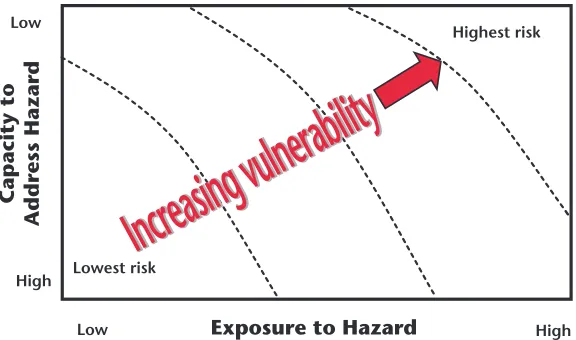
Figure 2-3.

Community Vulnerability as a Function of the Degree of Exposure and the

Capacity to Address Hazard Risks . . . 2-9

Figure 3-1.

Role of Resilience in Determining Community Response to a Hazard Event . . . 3-2

Figure 3-2.

Resilience as an Integrating Framework for Community Development, Coastal

Management, and Disaster Management Domains . . . 3-3

Figure 3-3.

Elements of Coastal Community Resilience. . . 3-3

Figure 3-4.

Coastal Resilience Cycle . . . 3-7

Figure 4-1.

Process to Adapt Resilience Benchmarks to Address Local Context . . . 4-5

Figure 4-2.

Rating as a Tool to Evaluate Assessment Results. . . 4-6

Figure 4-3.

Graphic Representation of Rating . . . 4-6

Tables

Table 3-1.

Benchmarks for Each Resilience Element by Core Capacities . . . 3-5

Table 3-1.

Benchmarks for Each Resilience Element by Core Capacities (continued) . . . 3-6

Table 3-2.

Enhancing Resilience in National Development Plans and Actions of Indian Ocean

Countries. . . 3-9

Table 4-1.

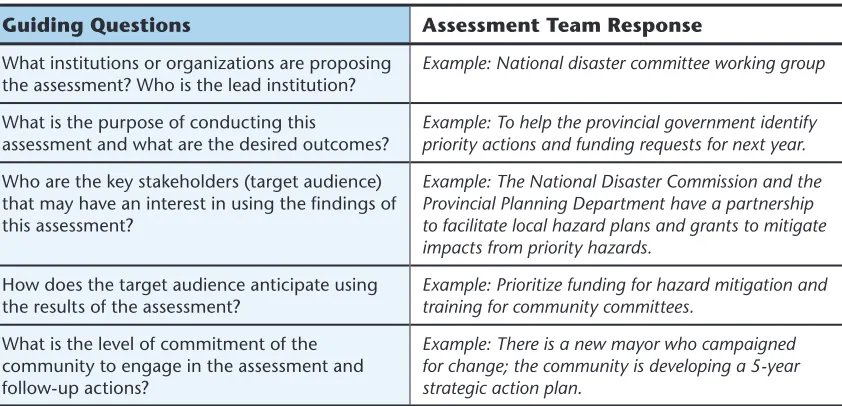
Deining the Purpose of the CCR Assessment . . . 4-2

Table 4-2.

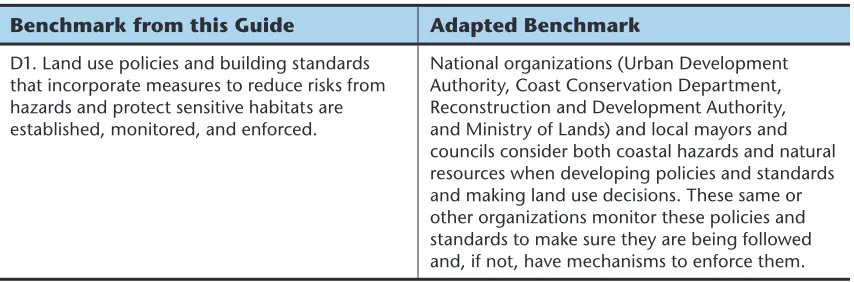
Example of a Benchmark Adapted to a Local Context . . . 4-4

Table 4-3.

Numerical Rating System for Each Benchmark. . . 4-7

Table 4-4.

Status and Trends Rating System for Each Benchmarkk . . . 4-7

Table 4-5.

Positive and Negative Features of Numerical Rating Systems . . . 4-8

Table 4-6.

Community Features to Consider for Mapping by Resilience Element . . . .4-14

Table 4-7.

Illustrative Assessment Findings and Analysis

(Using Worksheet 1 from Appendix A). . . .4-17

Table 4-8.

Analysis of CCR Assessment Results by Element and Benchmark Category. . . .4-18

Table 5-1.

Action Planning Steps . . . 5-2

Table 6-1.

Governance Benchmark on Policy and Planning Capacity . . . 6-6

Table 6-2.

Governance Benchmark on Physical and Natural Resource Capacity . . . 6-7

Table 6-3.

Governance Benchmark on Social and Cultural Capacity . . . 6-8

Table 6-4.

Governance Benchmark on Technical and Financial Capacity . . . 6-9

Table 6-5.

Society and Economy Benchmark on Policy and Planning Capacity . . . .6-15

Table 6-6

Society and Economy Benchmark on Physical and Natural Resource Capacity . . . .6-16

(13)

Contents

Table 6-8.

Society and Economy Benchmark on Technical and Financial Capacity . . . 6-18

Table 6-9.

Coastal Resource Management Benchmark on Policy and Planning Capacity . . . 6-24

Table 6-10.

Coastal Resource Management Benchmark on Physical and Natural

Resource Capacity . . . 6-25

Table 6-11.

Coastal Resource Management Benchmark on Social and Cultural Capacity . . . 6-26

Table 6-12.

Coastal Resource Management Benchmark on Technical and Financial Capacity . . . . 6-27

Table 6-13.

Land Use and Structural Design Benchmark on Policy and Planning Capacity . . . 6-33

Table 6-14.

Land Use and Structural Design Benchmark on Physical and Natural

Resource Capacity . . . 6-34

Table 6-15.

Land Use and Structural Design Benchmark on Social and Cultural Capacity. . . 6-35

Table 6-16.

Land Use and Structural Design Benchmark on Technical and Financial Capacity . . . 6-36

Table 6-17.

Risk Knowledge Benchmark on Policy and Planning Capacity . . . 6-41

Table 6-18.

Risk Knowledge Benchmark on Physical and Natural Resource Capacity . . . 6-42

Table 6-19.

Risk Knowledge Benchmark on Social and Cultural Capacity . . . 6-43

Table 6-20.

Risk Knowledge Benchmark on Technical and Financial Capacity. . . 6-44

Table 6-21.

Warning and Evacuation Benchmark on Policy and Planning Capacity . . . 6-49

Table 6-22.

Warning and Evacuation Benchmark on Physical and Natural Resource Capacity. . . . 6-50

Table 6-23.

Warning and Evacuation Benchmark on Social and Cultural Capacity . . . 6-51

Table 6-24.

Warning and Evacuation Benchmark on Technical and Financial Capacity . . . 6-52

Table 6-25.

Emergency Response Benchmark on Policy and Planning Capacity . . . 6-56

Table 6-26.

Emergency Response Benchmark on Physical and Natural Resource Capacity . . . 6-57

Table 6-27.

Emergency Response Benchmark Social and Cultural Capacity . . . 6-58

Table 6-28.

Emergency Response Benchmark on Technical and Financial Capacity . . . 6-59

Table 6-29.

Disaster Recovery Benchmark on Policy and Planning Capacity . . . 6-63

Table 6-30.

Disaster Recovery Benchmark on Physical and Natural Resource Capacity . . . 6-64

Table 6-31.

Disaster Recovery Benchmark on Social and Cultural Capacity. . . 6-65

(14)
(15)

Acronyms

ADB Asian Development Bank

ADPC Asian Disaster Preparedness Center

CBAT Community Based Action Team

CCR coastal community resilience

CERT Community Emergency Response Team

CRM coastal resource management

EAS Emergency Alert System

GIS geographic information system

GPS Global Positioning System

IBC International Building Code

ICS Incident Command System (ICS)

IOC Intergovernmental Oceanographic Commission

IOTWS Indian Ocean Tsunami Warning System

ISDR International Strategy for Disaster Reduction

km kilometer

m meter

MIND Munasinghe Institute for Development

MOU memorandum of understanding

MPA marine protected area

NDWC National Disaster Warning Center

NGO nongovernment organization

NOAA National Oceanic and Atmospheric Administration

PRiMO Pacific Risk Management ‘Ohana

PTWC Pacific Tsunami Warning Center

SEEDS Sustainable Environment and Ecological Development Society

TARNS Tsunami Alert Rapid Notification System

UBC Uniform Building Code

UN United Nations

UNDP United Nations Development Programme

USAID United States Agency for International Development

US IOTWS US Indian Ocean Tsunami Warning System Program

(16)
(17)

Chapter

1

Introduction to the Coastal Community

Resilience Guide

The Indian Ocean tsunami of December 2004, which exacted a devastating toll in

human suffering and destruction in affected coastal areas, was a painful reminder

that coastal communities are vulnerable to unforeseen events that can bring about

massive changes. Coastal communities today, around the world, are experiencing

an unprecedented rate of change due to population growth in coastal areas,

human-induced vulnerability, and global climate change. The effects of this change are

placing communities at increasing risk from coastal hazards such as tsunamis, severe

storms, and shoreline erosion.

It also has become evident that even without a major catastrophe such as a large

tsunami, most coastal communities are not resilient to normally recurring hazards.

This fact has raised the question of how to increase community resilience. The wide

range of hazards taking their toll on coastal communities requires that the response

to these various issues must be holistic, integrated, and long lasting.

What Is the Purpose of this Guide?

This Coastal Community Resilience (CCR) Guide was developed, building on lessons

learned and experience gained in the Indian Ocean region after the 2004 tsunami, to

address coastal hazards and reduce risk to vulnerable communities. The framework

described in this CCR guide was developed in partnership with institutions

throughout the Indian Ocean region, and is already beginning to guide development

along Asian coasts most in need of building resilience. This guide attempts to

broaden the perspective of sector plans so that a more holistic and robust planning

framework evolves to truly elevate the potential for community resilience. The results

of the CCR assessment process outlined in this guide can fit easily into and enhance

development plans for any given coastal area, and can thereby complement traditional

planning processes used by local and national governments.

How Was the Guide Developed?

(18)

Chapter 1: Introduction to the Coastal Community Resilience Guide

in a series of national and regional workshops to

determine what constitutes “coastal community

resilience” in each country. As a result of this

participation, the threats to coastal communities

in India, Indonesia, Maldives, Sri Lanka, and

Thailand in particular are represented and

addressed in the framework developed and

portrayed in this guide.

A key theme in the development of this guide

is that integration of efforts across sectors and

with various organizations is a prerequisite

to building community resilience. One of the

main lessons in the aftermath of the tsunami

of 2004—and seen in other coastal hazards

stemming from poorly planned development—is

that single-sector development planning cannot

solve the complexity of problems posed by

natural hazards nor build resilience to them.

Resilience requires the spreading of risk and the

development of integrated and holistic prevention

and management programs. In this manner,

unexpected changes can be absorbed more

easily, so that disaster scenarios can be avoided

whenever possible.

Single-sector development planning cannot solve the complexity of

problems posed by natural hazard, nor build resilience to them.

Who Is the Audience?

This CCR guide is intended for use by a broad cross section of government

agencies and nongovernmental organization practitioners involved in planning

and implementing community development, coastal management, and disaster

management programs. This varied audience and their roles in CCR assessment and

enhancement may include the following:

Practitioners working directly with coastal communities may incorporate elements

of resilience discussed in this guide into a wide range of activities, including

livelihood development, siting and construction of housing and settlements, health

and sanitation, and food security.

National and local government agencies may adopt the resilience framework

described in this guide to promote collaboration among different government

Events that Helped Shape the CCR

Guide

l The 1st Indian Ocean Regional CCR Workshop (May 2006) deined resilience concepts and identiied eight essential elements of CCR.

l National workshops on CCR in Sri Lanka (October 2006) and Indonesia (September 2006) provided insights on resilience based on country-speciic contexts and applications.

l A small grants activity of the U.S. IOTWS

Program provided opportunities for organizations throughout the region to work with communities to enhance CCR.

l National training courses on CCR in Sri Lanka (February 2007), Indonesia (April 2007), and Thailand (June 2007) developed skills for conducting CCR assessments.

l Trained organizations conducted CCR assessments in a range of communities, including rural, urban, and tourism areas of Sri Lanka, Thailand, Indonesia, India, and the Maldives.

(19)

Chapter 1: Introduction to the Coastal Community Resilience Guide

agencies and sectors, to develop plans and provide the enabling conditions for

communities to implement good practices for enhancing resilience.

International aid agencies, banks, and private donors may design and fund

programs to enhance CCR based on the assessment approach and elements of

resilience described in this guide to help sustain investments in these programs.

Collaboration and partnerships among these different stakeholder groups are

essential in sustaining long-term, consistent efforts to build CCR.

How Is this Guide Intended to Be Used?

The CCR guide is intended to serve as a framework to highlight strengths and identify

weaknesses and gaps in resilience that can be addressed by the community together

with government agencies, nongovernmental organizations (NGOs), private sector,

and other stakeholders. It focuses largely on how to assess CCR as a first step in

defining actions to reduce risk, accelerate recovery, and adapt to change. The guide

is intended to complement other planning tools and approaches. It is important that

local government planning processes are used and enhanced through community

participation and input, since often the only mechanism to build sustainability is

through the locally legitimate planning and implementation mechanisms.

The CCR assessment described in this guide is intended to serve as a rapid

assessment approach conducted as a collaborative and participatory undertaking

by coastal communities, national and local government agencies, NGOs, the

private sector, and other key stakeholders to identify strengths, weaknesses, and

opportunities to enhance resilience at local and national levels. It can be used in a

systematic manner to assess a CCR program in

a region or for a particular development

program.

The guide may also be used to

provide input to the design

of single-sector development

projects that must be integrated,

whenever possible, with other

ongoing development projects

in an area. It may also be

used to assist in coordination

among field programs that have

similar and possibly overlapping

objectives. Or it can simply be

used as a reference to enhance

other planning processes,

(20)

Chapter 1: Introduction to the Coastal Community Resilience Guide

of uses of this guide will be as varied as the number of potential users. Make the

most of this resilience guide for your needs—whatever they may be!

What Is in this Guide?

This guide is organized into six chapters, including

this introduction. A brief snapshot of each chapter is

provided below.

Chapter 1

describes the purpose, uses, and organization

of the guide and provides background on the

participatory process used to develop the guide. Over 25

agencies and organizations working in the Indian Ocean

region have contributed to the development of this guide.

Chapter 2

introduces the risks associated with coastal

hazards and the concepts and framework for CCR.

Chapter 3

introduces that CCR framework. The

framework for CCR is defined as the convergence of

community development, coastal management, and

disaster management. Eight essential elements of CCR emerged as a result of this

convergence and are introduced along with benchmarks that characterize the desired

conditions for each resilience element.

Value of the CCR Approach

Described in this Guide

l Provides a framework to integrate the goals of community development, coastal management, and disaster management

l Promotes a proactive approach to both chronic and episodic hazards rather than a reactive focus on response to disaster events

l Utilizes a broad assessment of community capacity and vulnerability to tsunami and other coastal hazards

l Merges goals of environmental

sustainability and humanitarian assistance

Uses of the CCR Assessment Tool Described in this Guide

Previous applications and potential uses of the CCR assessment tool include the following:

l Raise awareness of communities on the risks from coastal hazards and the need for community planning and preparedness

l Broadly assess community capacity and vulnerability to coastal hazards

l Help integrate and prioritize the contributions of different stakeholders in community development, coastal and environmental management, and disaster management

l Provide a guideline and checklist for community development for hazard mitigation

l Guide community and organizational capacity-building gap analysis

l Facilitate community issue identiication and proile development

l Evaluate projects to establish a resilience baseline and monitor change as a result of project implementation

(21)

Chapter 1: Introduction to the Coastal Community Resilience Guide

Chapter 4

describes the process and steps for conducting a CCR assessment. The

assessment process includes preparation, data and information collection, analysis,

and evaluation of the findings against the resilience benchmarks for each element.

This chapter also highlights the need to train the assessment team.

Chapter 5

provides detailed descriptions of the importance of and relationship of the

resilience elements. This chapter also serves as a reference to the benchmarks.

Chapter 6

provides an overview, benchmarks, and examples of resilience in action

for each of the eight essential elements of CCR. The benchmarks for each element

are described, and illustrative assessment questions are provided at the end of each

section. These sections serve as a reference for understanding each element and the

benchmarks used to conduct a CCR assessment.

(22)
(23)

Chapter

2

Why Are Communities at Risk from Coastal

Hazards?

The Indian Ocean Tsunami of December 2004 raised awareness worldwide of

the potentially devastating impacts of tsunamis. Coastal communities around the

world, big and small, are increasingly at risk from tsunamis and many other coastal

hazards including severe storms

, floods, and shoreline erosion. Risk is a function

of the hazard and vulnerability of a population to that hazard. Risks from coastal

hazards are defined by the type and severity of the hazard and its frequency of

occurrence. Vulnerability to coastal hazards is expressed as the degree of exposure

of the population and its capacity to prepare for and respond to the hazard (UN

International Strategy for Disaster Reduction [ISDR] 2004). An important outcome

of increasing the resilience of coastal communities is to reduce or avoid disasters

by reducing hazard risk and vulnerability. Understanding and assessing risk is

fundamental to enhancing the resilience of coastal communities.

Global climate change is predicted to cause an increase in sea level and the

frequency and power of storms and storm surge. This will cause increased shoreline

erosion; flood and storm damage; inundation of land; saltwater intrusion into the

freshwater lens aquifer; increased levels of land-based pollutants to coastal waters,

including sediments, nutrients, and contaminants; and more frequent, longer, and

more powerful El Niño and La Niña events. In addition, ocean acidification and

increased sea surface temperature resulting from global climate change are expected

to significantly alter the function and structure of marine ecosystems (Lewin and

Pershing 2006).

Risks from Coastal Hazards

Coastal communities are increasingly at risk from tsunamis and many other coastal

hazards. Coastal hazards are those natural and manmade hazards that occur at the

interface between the ocean and the shoreline. These chronic and episodic hazards

include human-caused actions and natural events that threaten the health and

stability of coastal ecosystems and communities.

Risk = Hazard

(frequency and severity)

x Vulnerability

(Exposure/Capacity)

(24)

Chapter 2: Why Are Communities at Risk from Coastal Hazards?

The risk from coastal hazards is characterized by the frequency of occurrence and

severity of the hazard (Figure 2-1). Tsunamis are typically infrequent events with

moderate to severe consequences. Mild

flooding may occur frequently, while severe

flooding may be an infrequent event. Coastal erosion may be a chronic event with

mild consequences or, coupled with other hazards, may result in severe impacts on

the shoreline. Infrequent events with limited predictability pose the greatest risk

of disaster and the longest time needed for disaster recovery. Frequent or ongoing

hazards such as resource or environmental degradation processes can be monitored

to reduce risk.

Figure 2-1.

Risks from Coastal Hazards as a Function of Hazard Frequency and Severity

Shoreline erosion can be caused by a combination of hazards including sea level rise, storm surge, coastal resource degradation, and coastal development

(25)

Chapter 2: Why Are Communities at Risk from Coastal Hazards?

Tsunamis.

A tsunami is a series of ocean waves typically generated by an

under-water earthquake. Landslides, volcanic activity, and meteor strikes may also generate

a tsunami. A tsunami wave may be very small in the deep ocean, but as it approaches

land can increase to more than 10 meters in height and reach shore as a fast-moving

wall of turbulent water. Tsunamis can inundate low-lying coastal areas with multiple

waves that can penetrate and cause destruction far inland. There are two types of

tsunamis: distant and local. A distant tsunami travels long distances from the event

that triggers it to impact the coast hours later. A local tsunami can impact the coast

within minutes after the triggering event, allowing little to no time for warning and

evacuation. The frequency of damaging tsunamis throughout the Indian Ocean

region has been low compared with other natural hazards such as tropical cyclones,

earthquakes, an

d floods.

Earthquakes. Earthquakes are geologic events that involve movement or shaking

of the earth’s crust. Earthquakes are usually caused by the release of stresses

accumulated as a result of the rupture of rocks along opposing fault planes in the

earth’s outer crust. Fault planes are typically found along borders of the earth’s ten

tectonic plates; these plate borders generally follow the outlines of the continents.

The areas of greatest tectonic instability occur at the perimeters of the slowly moving

plates, as these locations are subjected to the greatest strains from plates traveling

in opposite directions and at different speeds. Deformation along plate boundaries

causes strain in the rock and the consequent buildup of stored energy. When the

built-up stress exceeds the rocks’ strength, a rupture occurs. The rock on both sides

of the fracture is snapped, releasing

the stored energy and producing

seismic waves, thereby generating an

earthquake. Earthquakes can cause

significant damage due to intense ground

shaking and liquefaction. In addition, the

secondary impacts of earthquakes, such

as tsunamis and fires, can also cause

significant damage.

Storms. Numerous meteorological

events can impact the coast, including,

very commonly, storms. Various types

of storms impact coastal communities,

such as severe thunderstorms, tropical

cyclones, and extra tropical cyclones.

Storm Surge. Storm surge is simply

water that is pushed toward the shore by

the force of the winds swirling around

a storm. This advancing surge combines

with the normal tides to create the storm

Storm frequency and severity is increasing as result of global climate change

(26)

Chapter 2: Why Are Communities at Risk from Coastal Hazards?

tide. Tropical cyclone-induced storm tides can increase the mean water level 5 meters

or more. In addition, wind waves are superimposed on the storm tide. This rise in

water level can cause sever

e flooding in coastal areas, particularly when the storm

surge coincides with the normal high tides. The greatest potential for loss of life

related to a tropical cyclone is from the storm surge, which historically has claimed

nine out of ten victims of these events.

Flooding. Flooding is a localized hazard that is generally the result of excessive

precipitation. The primary types of flooding are riverine flooding, coastal flooding,

and urban flooding. Floods can be

generally classified as flash floods—the

product of heavy localized precipitation in

a short time period over a given location—

or general floods, caused by precipitation

over a longer time period and over a

given river basin. Historically, flooding is

the most common environmental hazard,

due to the widespread geographical

distribution of river valleys and coastal

areas and the attraction of human

settlements to these areas. The severity

of a flooding event is determined by a

number of local factors, including river

basin physiography, precipitation patterns,

and recent soil moisture conditions and

vegetative state. While flash floods occur

within hours of a rain event, general

flooding is a longer-term event, and may

last for several days.

Landslides. Landslides occur when masses of rock, earth, or debris move down a

slope. Landslides may be very small or very large, and can move at slow to very high

speeds. They are activated by storms and fires and by human modification of the land.

Landslides pose serious threats to highways and structures that support fisheries,

tourism, timber harvesting, mining, and energy production as well as general

transportation. Landslides are especially troubling because they often occur with

other natural hazards, such as earthquakes and floods. Landslides can also trigger

other hazards, such as tsunamis. Areas that are generally prone to landslide hazards

include existing old landslides; the bases of steep slopes; the bases of drainage

channels; and developed hillsides where leach-field septic systems are used. Areas that

are typically considered safe from landslides include areas that have not moved in the

past; relatively flat-lying areas away from sudden changes in slope; and areas at the

top or along ridges, set back from the tops of slopes.

Sea level rise causes chronic looding in coastal areas

(27)

Chapter 2: Why Are Communities at Risk from Coastal Hazards?

Spills and Chronic Pollution.

There are various ways in which pollution can

impact coastal areas. Spills can be in the form of oil spills from ships, toxic materials

released from storage tanks, petroleum releases from severed pipelines, etc. These

events can have devastating effects on coastal environments. In some cases these

episodic pollution events are caused by other coastal hazards such as tsunamis,

tropical cyclones, and storm surge.

Chronic pollution can be caused by numerous sources. Improper disposal of garbage

in coastal communities can be a cause of pollution. Improper treatment of human

waste prior to discharge in rivers and coastal waters can also be a cause of pollution.

Polluted surface water runoff from land-based sources can be a significant source

of pollution to coastal areas. Regardless of the source of pollution, the impacts on

coastal resources can be devastating. Many coastal communities rely on coastal

resources for their survival.

Shoreline Erosion.

Shoreline erosion is the

wearing away of the land surface by detachment

and movement of soil and rock fragments, during

a

flood or storm or over a period of years, through

the action of wind, water, or other geologic

processes. Wind, waves, and long shore currents

are the driving forces behind coastal erosion.

This removal and deposition of sand permanently

changes beach shape and structure. Additional

factors involved in coastal erosion include human

activity, sea-level rise, seasonal fluctuations, and

climate change. Shoreline erosion is typically a

chronic hazard, but severe shoreline erosion may

Oil spills are infrequent but often severe events

noaa libRaRY

Water quality degradation is a chronic hazard that affects ecosystem health and resilience

a. wHite

Shorelines and beaches are vulnerable to erosion as sea level rises and during storm events

(28)

Chapter 2: Why Are Communities at Risk from Coastal Hazards?

Sea Level Rise.

Sea level rise can be

defined as an increase in the mean sea

level. Throughout history, the earth has

gone through periods of sea level rise

and decline, which are directly tied to

climate change and global warming and

cooling trends over geologic and recent

time. Sea leve

l fluctuations are a part

of the natural processes on earth that

are determined by many factors, but

largely are influenced by climate and

global warming. In comparison to other

disasters that affect the coastal zone,

such as tropical cyclones, tsunamis,

floods, and earthquakes, sea level rise

is on a much more gradual time scale.

The impacts of a tsunami can be seen

immediately, whereas the effects of sea level rise take a longer period of time to

realize. A major potential impact of sea level rise on the natural environment in the

coastal zone is that of habitat loss due to wetland inundation, coastal erosion, salt

water intrusion, or shift in climate limits on vegetation.

Climate Variability and Change. Short- and long-term climate variability can

significantly impact coastal environments. Climate variability refers to temporal

variations of the atmosphere and ocean system around a mean state. Climate

variability can cause abrupt disruptions, such as floods, droughts, or tropical storms

(IRG 2007). Over the past decade, scientists have improved prediction capabilities

for some climate variability

events such as El Niño and La

Niña. Climate variability can

have huge impacts on coastal

environments by causing an

increase or decrease in storm

activity, which in turn could

lead to water supply issues,

drought, or increased flooding

and erosion.

Climate change resulting

from increased anthropogenic

inputs of greenhouse gases

is a key development issue

of our time (World Bank

2007). The direct impacts

of climate change, higher

Coral reef ecosystems are threatened by increasing sea surface

temperatures resulting from global climate change and other hazards

a.wHite

Island nations are at increasing risk from sea level rise and shoreline erosion

(29)

Chapter 2: Why Are Communities at Risk from Coastal Hazards?

a. wHite

temperatures, followed by changes in the patterns of precipitation, increased intensity

and frequency of extreme weather events, rising sea level, and ocean acidification are

expected to result in cascading environmental, economic, and social impacts.

Coastal Resource Degradation.

Many of the Earth’s most complex, diverse, and

productive ecological systems are located in coastal zones. Coastal resources are very

productive in both a biological and economic sense. Reefs, mangroves, wetlands, and

tidelands provide nursery and feeding areas for many marine species. In addition,

these coastal resources also provide important buffer areas for storm protection and

to control erosion. Frequently, human activities within coastal areas can contribute to

the degradation of these crucial resources.

Community Vulnerability to Coastal Hazards

The increased vulnerability of coastal communities to potential hazards is partly due

to the constantly increasing coastal population (Adger et al., 2005). Currently, an

estimated 23 percent of the world’s population (1.2 billion people) lives within 100

kilometers (km) of a shoreline and 100 meters (m) of sea level (Small and Nicholls

2003). By the year 2030, an estimated 50 percent of the world’s population will live in

the coastal zone.

Human activities are degrading the quality of the coastal environment and integrity

of coastal ecosystems on a daily basis, making coastal populations more vulnerable.

Coastal habitats such as reefs, mangroves, wetlands, and tidelands provide nursery

(30)

Chapter 2: Why Are Communities at Risk from Coastal Hazards?

protection and to control erosion. These coastal habitats are being destroyed by

a wide range of human uses, including shoreline development, land reclamation,

mining, and aquaculture. Runoff, wastewater discharges, and oil spills pollute

coastal waters and endanger marine life. Overfishing and the use of destructive

fishing practices are causing the decline of fishery resources and changes in marine

ecosystem structure and function. The degradation of the coastal environment from

chronic human-induced actions threatens food security, livelihoods, and the overall

economic development and well being of coastal communities.

Most of the coastal population lives in relatively densely populated rural areas

and small to medium cities, rather than in large cities. In these relatively rural

communities, basic services and disaster warning and response mechanisms are

limited (Figure 2-2). Limited capacity of a community to plan for and respond to

coastal hazards makes coastal populations increasingly vulnerable and increases

disaster risk.

Economic development pressures along the coast, population density and distribution,

and human-induced vulnerabilities, coupled with increasing frequency and duration

of storms, sea level rise, and other chronic coastal hazards, increase risk. These

conditions set the stage for more frequent and severe disasters and reduced time and

capacity to recover. The time period between disaster event and recovery is becoming

shorter, and some coastal communities find themselves in a state of perpetual

response to and recovery from one disaster event after another. The assessment of

risk is an important element of CCR. Communities must identify their exposure to

hazard impacts to proactively address emergency planning, response, and recovery

and implement hazard mitigation measures (Figures 2-2 and 2-3).

(31)

Chapter 2: Why Are Communities at Risk from Coastal Hazards?

Figure 2-3.

Community Vulnerability as a Function of the Degree of Exposure and the Capacity

to Address Hazard Risks

Coastal communities, dependent on the sea for food and livelihood, are at increasing risk from coastal hazards

a. stein

(32)
(33)

Chapter

3

Why Is Resilience Critical to Coastal

Communities?

Community resilience is the capacity of a community to adapt to and in

fluence the

course of environmental, social, and economic change. The resilience of

social-ecological systems is often described as a combination

of three characteristics: the magnitude of shock that

the system can absorb and remain within a given

state; the degree to which the system is capable of

self-organization; and the degree to which the system

can build capacity for learning and adaptation (Folke

et al. 2002). Common characteristics of resilient

systems include redundancy, diversity, efficiency,

autonomy, strength, interdependence, adaptability, and

collaboration (Godschalk 2003). Resilience provides

the capacity to absorb shocks while maintaining

function. When change occurs, resilience provides

the components for renewal and reorganization

(Gunderson and Holling 2002, Berkes and Folke

2002). Vulnerability is the flip side of resilience:

When a social or ecological system loses resilience, it

becomes vulnerable to change that previously could

be absorbed (Kasperson and Kasperson 2001). In a

resilient system, change has the potential to create

opportunity for development, novelty, and innovation.

In a vulnerable system, even small changes may be

devastating.

Characteristics of Resilient Coastal Communities

Resilient coastal communities take deliberate action to reduce risk from coastal

hazards with the goal of avoiding disaster and accelerating recovery in the event of

a disaster. They adapt to changes through experience and applying lessons learned

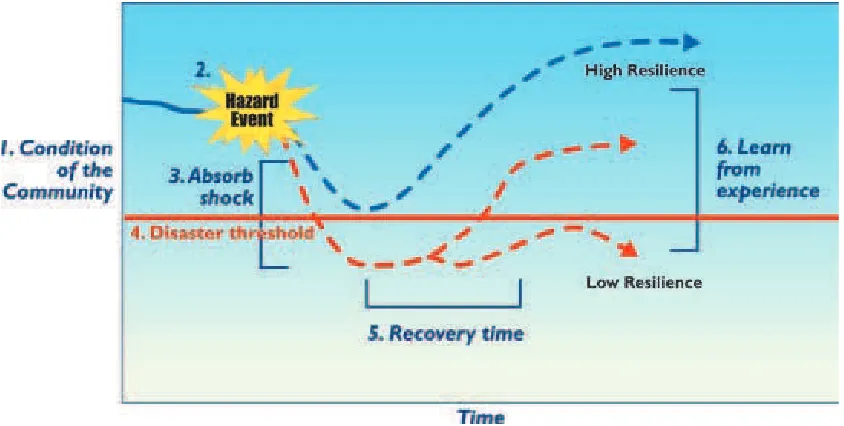
(Figure 3-1).

CCR serves as a unifying framework for community-based plans and programs.

Enhancing CCR requires integrating and maintaining an optimal balance of three

Some Definitions of Resilience

“Resilience determines the persistence of relationships within a system and is a measure of the ability of these systems to absorb change of state….and still persist.”

(Holling 1973)

“…Resilience for social-ecological systems is often referred to as related to three different characteristics: (a) the magnitude of shock that the system can absorb and remain within a given state; (b) the degree to which the system is capable of self-organization, and (c) the degree to which the system can build capacity for learning and adaptation.”

(Folke et al. 2002)

“The capacity of a system to absorb

(34)

Chapter 3: Why Is Resilience Critical to Coastal Communities?

community-based frameworks typically viewed as independent and separate domains:

community development, coastal management, and disaster management (Figure 3-2).

Community development provides the enabling governance, socioeconomic, and

cultural conditions for resilience (IMM; CED 2000). Coastal management provides

the framework for managing human uses of coastal resources and the coastal zone

in order to maintain environmental and ecosystem resilience (White et al., 2005;

Chua 1998; DENR 2001). Disaster management focuses on preparedness, response,

recovery and mitigation to reduce human and structural losses from disaster events

(ADPC 2005; 2004).

Figure 3-1.

Role of Resilience in Determining Community Response to a Hazard Event

Notes:

1. The y-axis represents the condition or state of the community’s economy, society, and environment.

2. Hazard events can be either episodic, such as cyclones and tsunamis, or more chronic, such as erosion or sea level rise.

3. Resilient coastal communities are able to absorb or avoid impacts of hazard events. Enhancing resilience decreases the magnitude of impacts of hazard events on the community.

4. A community crosses the threshold between a hazard event and a disaster when it cannot function without considerable outside assistance.

5. Resilient coastal communities are able to recover from hazard events quickly. Enhancing resilience accelerates recovery time.

(35)

Chapter 3: Why Is Resilience Critical to Coastal Communities?

Resilience Elements and Benchmarks

The CCR framework presented in this guide was developed through a series of

workshops and discussions with community development, coastal management, and

disaster management practitioners and specialists from government agencies and

nongovernmental organizations throughout the Indian Ocean region. Through this

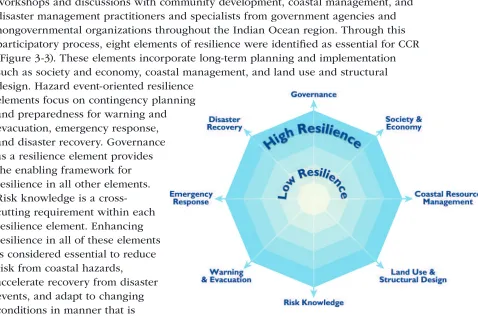
participatory process, eight elements of resilience were identified as essential for CCR

(Figure 3-3). These elements incorporate long-term planning and implementation

such as society and economy, coastal management, and land use and structural

design. Hazard event-oriented resilience

elements focus on contingency planning

and preparedness for warning and

evacuation, emergency response,

and disaster recovery. Governance

as a resilience element provides

the enabling framework for

resilience in all other elements.

Risk knowledge is a

cross-cutting requirement within each

resilience element. Enhancing

resilience in all of these elements

is considered essential to reduce

risk from coastal hazards,

accelerate recovery from disaster

events, and adapt to changing

conditions in manner that is

consistent with community goals.

Figure 3-2.

Resilience as an Integrating Framework for Community

Development, Coastal Management, and Disaster Management Domains

(36)

Chapter 3: Why Is Resilience Critical to Coastal Communities?

The desired outcome or overarching vision for each element of CCR can be described

as follows:

A.

Governance: Leadership, legal framework, and institutions provide enabling

conditions for resilience through community involvement with government.

B.

Society and Economy: Communities are engaged in diverse and environmentally

sustainable livelihoods resistant to hazards.

C.

Coastal Resource Management: Active management of coastal resources

sustains environmental services and livelihoods and reduces risks from coastal

hazards.

D.

Land Use and Structural Design: Effective land use and structural design that

complement environmental, economic, and community goals and reduce risks

from hazards.

E. Risk Knowledge: Leadership and community members are aware of hazards and

risk information is utilized when making decisions.

F. Warning and Evacuation: Community is capable of receiving notifications and

alerts of coastal hazards, warning at-risk populations, and individuals acting on

the alert.

G. Emergency Response: Mechanisms and networks are established and

maintained to respond quickly to coastal disasters and address emergency needs

at the community level.

H. Disaster Recovery: Plans are in place prior to hazard events that accelerate

disaster recovery, engage communities in the recovery process, and minimize

negative environmental, social, and economic impacts.

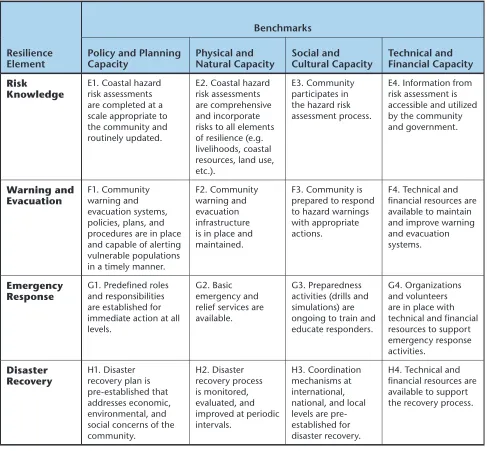
Benchmarks for each resilience element were identified to evaluate the resilience

condition or status of a community (Table 3-1). Each benchmark represents desired

conditions against which to evaluate the resilience status of a coastal community. The

benchmarks for each resilience element characterize desired conditions in four core

capacities: policy and planning, physical and natural resources, social and cultural,

and technical and financial. These core capacities were adapted from the TOSE

dimensions (technical, organizational, societal, and economic) outlined in Bruneau et

al. (2003) and the Sustainable Coastal Livelihood Framework assets (human, natural,

social, and financial) described by IMM.

(37)

Chapter 3: Why Is Resilience Critical to Coastal Communities?

Some benchmarks may need to be adapted to better re

flect the local context in

which they are used. Chapter 4 provides an approach for reviewing and adapting

the benchmarks, as needed, to reflect the local context. Chapter 6 provides detailed

descriptions of the elements and benchmarks of CCR.

Table 3-1.

Benchmarks for Each Resilience Element by Core Capacities

Resilience

used to manage for resilience. policies and plans build social capital and skills for economic diversity

(38)

Chapter 3: Why Is Resilience Critical to Coastal Communities?

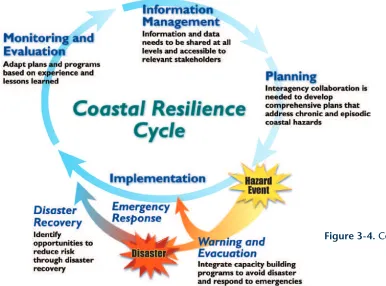
Resilience at National and Local Levels

Many opportunities exist to enhance resilience at national and local levels. The

generic planning and implementation cycle provides a framework for identifying

these opportunities (Figure 3-4).

Information and data sharing is fundamental to preparing national and local plans

that incorporate resilience. Information and data needed to address coastal hazards is

typically managed by multiple entities including government, nongovernmental, and

Table 3-1.

Benchmarks for Each Resilience Element by Core Capacities

(continued)

(39)

Chapter 3: Why Is Resilience Critical to Coastal Communities?

academic institutions. Data-sharing agreements and protocols need to be developed

to make information and data accessible for plan development

Multi-agency review of national disaster management and coastal management plans

and programs can provide valuable insights for enhancing resilience by ensuring

risk mitigation measures are comprehensive. Typically, different national and local

government agencies are responsible for addressing coastal hazards, managing

coastal resources, issuing hazard warnings and evacuation notices, and responding to

emergencies. Government agencies together with partner organizations need to meet

regularly and work together to develop long-term and contingency plans that address

all elements of resilience. Plans need to address both chronic hazards and potential

hazard events. Reducing risks from chronic coastal hazards, such as sea level rise

and shoreline erosion, should be integrated into medium- and long-term development

plans and programs.

National and local programs need to reinforce good practices and build capacity

to avoid disaster. Disasters, although marked by human suffering and loss, provide

special opportunities to enhance resilience, such as rebuilding to reduce exposure of

the population to hazard prone areas.

Monitoring and evaluation provides the insight and lessons learned to adapt plans

and programs for enhanced resilience. Monitoring and evaluation of plans and

programs provides information and data to measure progress and enhance resilience.

(40)

Chapter 3: Why Is Resilience Critical to Coastal Communities?

Linkages between community development, coastal management, and disaster

management processes and activities are needed to build CCR to both chronic

and episodic coastal hazards. These linkages need to be explicit and driven by

community members themselves, working in concert with national and local

government programs and NGOs. Community-based planning and assessment of

coastal hazards and risks is a fundamental first step in building CCR. Plans must

be regularly reviewed and updated based on new information and experiences and

lesson learned from implementation and monitoring. Some of the efforts undertaken

by governments in the Indian Ocean Region to incorporate elements of resilience into

their development are summarized in Table 3-2.

Pacific Risk Management ‘Ohana (PRiMO)—Working Together to Address

Natural Hazards

The U.S. Paciic Islands (Hawaii, American Samoa, Guam, and the Commonwealth of the Northern Mariana Islands) are susceptible to a wide variety of coastal hazards including tsunamis, typhoons, hurricanes, looding, coastal erosion, volcanic eruptions, earthquakes, and drought. Throughout history, the islands have been impacted by numerous events and, due to their isolation, have had to respond to and recover from these events with minimal outside assistance. The original inhabitants of the islands had developed traditional knowledge and practices to build resilience toward coastal hazards. In more recent times, many of these islands have experienced signiicant changes culturally and demographically that have resulted in a loss of some of the traditional knowledge and practices, and thus a reduction in resilience.

In 2002, the U.S. National Oceanic and Atmospheric Administration (NOAA), Paciic Services Center, initiated activities to help lessen the impacts of coastal disasters in the islands.

Recognizing the limitations of any one organization or institution to properly address the issue, the NOAA Paciic Services Center looked to build upon existing partnerships and establish new partnerships. From the outset, efforts focused on building a collaboration network across the three domains: community development planning, coastal resource management, and disaster management. Through these efforts, a new interagency working group, the Paciic Risk Management ‘Ohana (PRiMO), evolved to help enhance collaboration among numerous federal, state, county, private, academic, and NGO representatives and stakeholders that play a role in disaster risk management. The foundation of PRiMO is based on the Hawaiian word “`ohana,” or “family,” relecting the concept of working for the beneit of the collective and not the individual.

(41)

Chapter 3: Why Is Resilience Critical to Coastal Communities?

Table 3-2.

Enhancing Resilience in National Development Plans and Actions of Indian Ocean

Countries

Governance: In Sri Lanka and Thailand in 2005, new national disaster management organizations were formed and supported, and their efforts coordinated with those of existing government agencies. Other countries strengthened existing organizations to provide warnings, disaster management, and disaster recovery services to build resilience.

Society and Economy: Community development programs to develop alternative livelihoods, both post-tsunami and for long-term resilience, were initiated and are ongoing in Indonesia, Sri Lanka, and Thailand.

Coastal Resource Management: National coastal management agencies in Indonesia and Sri Lanka have actively incorporated resilience measures into their programs, including mapping of hazards, coastal setbacks, protection of vulnerable habitats, and other measures. India has revitalized its coastal management legislation to address coastal issues in relation to hazards and development.

Land Use and Structural Design: Thailand undertook an analysis of structural design and land use practices that would minimize tsunami impacts. Sri Lanka and India revised their national setback laws to be more sensitive to inundation along coasts.

Risk Knowledge: Maldives and most other Indian Ocean countries have undertaken major programs to enhance their collective national and local knowledge about risk from multiple hazards. Risk knowledge has increased across all countries in relation to primary hazards such as tsunamis, looding, and earthquakes as well as more chronic hazards.

Warning and Evacuation: National disaster and warning centers in Thailand, Sri Lanka, India, Indonesia, and Maldives have all been striving to make national warning systems functional from the national to the local level. In Thailand, a sophisticated warning and evacuation system has been tested several times with local participation.

Emergency Response: Incident command systems have been initiated in India, Sri Lanka, Indonesia, and Thailand in response to the need for effective response and coordination among national and local agencies.

Disaster Recovery: Thailand has strengthened its national disaster management organization to address recovery from any disaster.

Need for Conducting an Assessment of Coastal Community

Resilience

(42)

Chapter 3: Why Is Resilience Critical to Coastal Communities?

vulnerable, assessing the eight CCR elements will ensure that all the factors that can

minimize the impact of storm surge are brought into the planning discussion.

A CCR assessment provides an opportunity to initiate dialogue among key

stakeholders in the area. Dialogue is crucial to encourage the stakeholder community

to recognize the need for better resilience and to better understand what forces need

to be addressed to lessen the community’s vulnerability through planning. Such

dialogue is also an educational process, in which the various stakeholders can learn

together through a guided assessment of CCR.

Reasons to Conduct an Assessment of CCR

l Initiate a dialogue between the community, government and nongovernmental institutions, and other stakeholders on the goals and key elements of CCR

l Increase awareness and understanding of the risks associated with both episodic and chronic coastal hazards and the need to build resilience capacity at the community level

l Characterize the resilience status and trends at the community level

l Determine the capacity of an organization to provide assistance in each resilience element

l Provide input to local and national planning for community development, coastal management, and disaster management measures to enhance CCR

Gambar

Figure 2-1. Risks from Coastal Hazards as a Function of Hazard Frequency and Severity
Figure 2-2. Factors that Contribute to Vulnerability in Coastal Populations
Figure 2-3. Community Vulnerability as a Function of the Degree of Exposure and the Capacity to Address Hazard Risks
Figure 3-1. Role of Resilience in Determining Community Response to a Hazard Event
+7

Referensi

Garis besar

Dokumen terkait

Usually, building up those questions wil l take a very long time and effort because each of the questions that chosen must be filtered based on the students mentality level and

Building upon successful collaborations of the past 6 years in Mexico, the program has recently initiated the project Sustainable Development Practices in the Gulf of

Suggestions are as follows: a Government of India must take care about the facilities and problems of women and children working at construction sites; bThe Building and Other

The interview will take place on 6th floor, University Building No-2 on 25 August 2015.. All candidates must come in formal

Al- Ghazali 1989 argued that successful organizations must have ethical administrative and management practices based on four key aspects: planning al-Takhtit, organisation al-Tanzim,

Business ethics is an essential skill for today’s business professionals, who must understand the importance of ethical behavior in building trust with customers and avoiding legal

Components of Spiritual Competence: Awareness of Personal Beliefs: Recognizing and reflecting on your own spiritual beliefs, biases, and assumptions. Avoiding the imposition of personal beliefs on others. Knowledge: Understanding different spiritual traditions, practices, and worldviews. Recognizing the role spirituality plays in individuals' lives and its impact on health, relationships, and coping mechanisms. Skill Development: Building communication skills to explore spiritual issues with sensitivity. Creating safe spaces where individuals feel comfortable discussing their spirituality. Cultural Humility: Acknowledging and respecting the diversity of spiritual experiences without judgment. Being open to learning from the spiritual perspectives of others. Ethical Practice: Upholding professional boundaries while supporting spiritual needs. Ensuring that spiritual exploration is client-led and aligned with their values and preferences. Applications of Spiritual Competence: In Healthcare: Understanding how spirituality affects patients’ perspectives on illness, treatment, and recovery. In Counseling or Therapy: Integrating spiritual beliefs into therapeutic practices when relevant to clients' well-being. In Education: Respecting students' spiritual backgrounds to create inclusive learning environments. In Leadership: Supporting diverse teams by honoring spiritual diversity within organizational