THIS REPORT CONTAINS ASSESSMENTS OF COMMODITY AND TRADE ISSUES MADE BY
USDA STAFF AND NOT NECESSARILY STATEMENTS OF OFFICIAL U.S. GOVERNMENT
POLICY
-
Date:
GAIN Report Number:
Post:
Report Categories:
Approved By:
Prepared By:
Report Highlights:
Korean imports of seafood in 2016 totaled $4.5 billion, up 6.2 percent from 2015 due to rising prices. Imports of American seafood decreased by 2.6 percent from $233 million to $227 million making United States the fifth largest exporter with a market share of 5.1 percent. U.S. seafood is generally considered high quality and safe, but less price competitive when competing with other origins. By volume, frozen Alaska Pollack Surimi, Flatfish, Alaska Pollack Fish, Cod, Alaska Pollack roe, Monkfish, Hagfish, Ray, Atka Mackerel, and live Lobsters were the major seafood imported from the United States. By value, frozen Alaska Pollack Surimi, live Lobsters, Cod, Flatfish, Alaska Pollack Fish, Monkfish, live Hagfish, frozen Skate, Alaska Pollack roe, and frozen Hagfish were the top ten imported species.
Sun Young Yoo, Market Promotions Specialist
Lynne Larrabee, Director, ATO
Fishery Products
Seafood Market Brief Update 2017
Seoul ATO
Korea - Republic of
KS1726
9/22/2017
Public
General Information:
SECTION I: KOREAN SEAFOOD MARKET OVERVIEW
In 2016, Korea’s seafood imports from all origins amounted to $4.5 billion, up 6.2 percent from $4.24 billion in 2015. The United States was the fifth largest supplier of seafood products to Korea giving its fourth largest exporter rank to Norway. The largest seafood supplying country in 2016 was China at $1.2 billion, followed by Russia at $698 million, Vietnam at $615 million, Norway at $299 million, USA at $227 million, Thailand at $147 million, Japan at $142 million, Hong Kong at $100, Taiwan at $100 million and Peru at $89 million. These ten countries accounted for 80 percent of Korea’s total seafood imports in 2016. The most popular seafood imported in volume was Alaska Pollack Fish, followed by Alaska Pollack Surimi, Sand Lance, Squid, Mackerel, Saury, Poulp Squid, Baby Clam, Yellow Corbina, frozen Flatfish, Hair Tail, Monkfish, and Webfoot Octopus. By value, the most popular seafood was Shrimp & Prawn, followed by Alaska Pollack Fish, other fish Surimi, frozen/live Poulp Squid, Atlantic Salmon, live King Crab, frozen Hair Tail, frozen Yellow Corbina, frozen Webfoot Octopus, live Glass Eel for aquaculture, live Snow Crab, dried Alaska Pollack, frozen Squid, and live Lobsters.
Korea imported $227 million of U.S. seafood in 2016, down 2.1 percent from $233 million in 2015, but market share remained relatively steady at 5.1 percent. In Korea, U.S. seafood,
including aquaculture, is generally considered high quality, but higher in price compared to that of competing countries. Until 2011 the United States had been the fifth largest exporter of seafood to the Korean market following China, Russia, Vietnam and Japan, but in 2012 the United States became the fourth largest due to Korean consumers’ concern for Japanese seafood products after the nuclear power plant accident in Fukushima. However in 2016, Norway increased sales
performance of its seafood products drastically and is now the fourth.
The top ten seafood products that Korea imported in large quantities from the United States were frozen Alaska Pollack Surimi (20,243 MT), flatfish (11,307 MT), Alaska Pollack (10,748 MT), roes of Alaska Pollack and other fish (7,549 MT), cod (7,091 MT), monkfish (2,146 MT), hagfish (1,987 MT), ray (1,869 MT), Atka Mackerel (1,741 MT), and live lobster (1,527 MT).
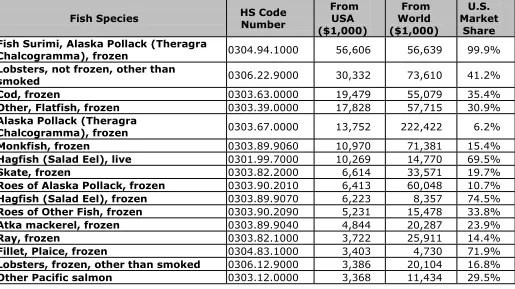
By value, Alaska Pollack Surimi ($56.6 million), live lobster ($30.3 million), cod ($19.5 million), flatfish ($17.8 million), Alaska Pollack ($13.8 million), monkfish ($11 million), live hagfish ($10.3 million), skate ($6.6 million), Alaska Pollack roe ($6.4 million), and frozen hagfish ($6.3 million) were the ten most leading seafood products exported from United States to Korea.
Table 12-1 of Section V below shows the major species exported to Korea from the United States and the world by value. Imports of 30 fish species accounted for 98 percent of the total imports of fishery products from the United States in 2016.
SECTION II: KORUS FTA AND CUSTOMS DUTY
KORUS FTA
With respect to the seafood sector, the KORUS FTA is expected to create more opportunities for U.S. seafood exporters. Customs duties for fishery products imported from the United States were cut to zero immediately, or phased out over the course of 3 to 10 years. For instance, the
customs duty for frozen Sockeye Salmon was cut to zero immediately, but duties for U.S. trout and sea bass were reduced to zero in 3 and 10 years, respectively. The customs duty elimination is prorated equally every year over the phase-out period.
There are three fish species which are subject to Tariff Rate Quotas (TRQ) under the FTA. For instance, customs duties are zero for imports of 2,248 metric tons of frozen flatfish and for 6,154 metric tons of frozen Alaskan Pollack in 2017. The quantities shall enter on a come, first-served basis. The duty-free quantities will increase each year as shown in the table below.
Table 1. Korea-United States FTA Seafood Tariff Rate Quotas (MT)
Year Flatfish/Frozen (HS 0303.39.0000)
Alaska Pollack/Frozen (HS 0303.79.1000)
Croaker/Frozen (HS 0303.79.9095)
1 (2012) 1,530 4,000 1,000
2 (2013) 1,652 4,360 1,050
3 (2014) 1,785 4,752 1,103
4 (2015) 1,927 5,180 1,158
5 (2016) 2,082 5,646 1,216
6 (2017) 2,248 6,154 1,276
7 (2018) 2,428 6,708 1,340
8 (2019) 2,642 7,312 1,407
9 (2020) 2,832 7,970 1,477
10 (2021) 3,058 8,688 1,551
11 (2022) 3,303 9,469 1,629
12 (2023) unlimited 10,322 unlimited
13 (2024)
11,251
14 (2025)
12,263
15 (2026)
unlimited
Industry forecasts that Korean consumers will take advantage of lower prices resulting from
elimination of import duties to demand more glass eel/live, Sockeye salmon/frozen, flatfish/frozen, salad eel/live, Alaska Pollack surimi/frozen, lobsters/live/frozen, Alaska Pollack/frozen,
monkfish/frozen, cod/frozen, Alaska Pollack roes/frozen, cod roes/frozen, fish fillet/frozen, fish surimi/frozen and skate/frozen.
For more detailed information about the results of the KORUS FTA including the tariff schedule for Korea, please visit: KORUS FTA Official Homepage in English and ATO Seoul Homepage FTA Section.
Table 2. Korean Tariff Schedule for Major U.S. Fishery Products Sold to Korea
Fish Surimi, Alaska Pollack, frozen 0304.94.1000
0304.99.1000 10% 0% 2014
Other, Flatfish, frozen 0303.39.0000 10%
0%
(TRQ 2,248
MT) 2023
10%
(Above TRQ)
Monkfish, frozen 0303.89.9060 10% 6.9% 2021
Roes of Alaska Pollack, frozen 0303.90.2010 10% 0% 2016
Skate, frozen* 0303.82.2000 10% 10% 2021
Hagfish (Salad Eel), live 0301.99.7000 10% 0% 2014
Cod, frozen 0303.63.0000 10% 0% 2016
Glass eel, live 0301.92.1000 0% 0% 2012
Alaska Pollack, frozen 0303.67.0000
0303.69.9000 10%
Hagfish (Salad Eel), frozen 0303.89.9070 10% 5% 2021
Roes of other fish, frozen 0303.90.2090 10% 0% 2016
Atka mackerel, frozen 0303.89.9040 10% 5% 2021
Fillet, Alaska Pollack, frozen 0304.75.0000 10% 6.9% 2021
Rock fish, frozen 0303.89.9050 10% 6.9% 2021
Ray, frozen 0303.82.1000 10% 6.9% 2021
Sockeye salmon, frozen 0303.11.0000 10% 0% 2012
Fillet, Plaice, frozen 0304.83.1000 10% 6.9% 2021
Sardines, frozen 0303.53.0000 10% 0% 2016
Sable fish, frozen 0303.89.1000 10% 0% 2016
Adductors of shell fish, frozen 0307.99.1100 20% 13.8% 2021
Lobsters, other than smoked 0306.12.9000
0306.22.9000 20% 0% 2016
Squid, frozen 0307.49.1020 10% 10% 2021
Anchovy, dried 0305.59.2000 20% 10% 2021
Fillet, Others, frozen 0304.89.9000 10% 0% 2014
Oyster, frozen 0307.19.1000 20% 0% 2012
Fish Surimi, the families Bregmacerotidae, Euclichthyidae, Gadidae, Macrouridae, other than Alaska Pollack, frozen
0304.95.1000 10% 0% 2016
Other Crabs, frozen, other than smoked
(Dungeness Crab) 0306.14.9090 14% 0% 2014
Other Crabs, frozen, other than smoked 14% 9.6% 2021
Plaice, frozen 0303.32.0000 10% 6.9% 2021
Other baby eels, live 0301.92.9010 10% 0% 2012
Source: Korea Customs and Trade Development Institute, Import/Export Customs Clearance General Guidebook of Korea, 2017
Negotiated customs duties on certain seafood products under the KORUS FTA are higher than the current Most Favored Nation (MFN) applied base rate, which Korea lowered after the trade
agreement was negotiated.
However, the MFN applied rate is used when it is lower than the KORUS duty. The KORUS duty takes effect when it is lower than the MFN rate. Table 3 below shows an example of how this works in practice; green highlights show applicable duties.
Table 3. KORUS FTA Tariff Schedule Applied to Frozen Skate Products
Product Base Rate 2012 2013 2014 2015 2016 2017 201 8 Fish, Frozen, of
the families
SECTION III: SUPPY, DEMAND AND MARKET OPPORTUNITIES
Supply
In 2016, Korean seafood production decreased slightly to 3.26 million metric tons, down 2.2 percent from 3.33 million metric tons in 2015. Production from adjacent waters was down 13.4 percent from 2015, and production from distant waters decreased by 21.3 percent. However, productions from shallow sea aquaculture (the largest production category) and inland waters (the smallest production category) were up 11.4 percent and 6 percent each, maintaining the status quo of overall seafood production.
The consecutive decreases in production from distant waters in 2015 and 2016 had been forecast by the industry well in advance because 2014 production had atypically increased due to an unusually high squid catch. It is expected that Korean domestic fish production volume will not increase significantly in the future due to reductions in fish resources in adjacent waters and the enforcement of Exclusive Economic Zones by Korea's neighboring countries. Constraints built into bilateral and multilateral fishing accords will further impact total harvest. The harvest from
adjacent waters consists primarily of squid, mackerel, corbina, hairtail and anchovy.
efforts to boost aquaculture production in shallow sea areas clearly indicate the importance of this sector as a future seafood resource.
Moreover, as seafood export opportunities with China, the EU and Japan grow, the Korean
government’s focus on shallow sea aquaculture is expected to continue in order to achieve plans to reach annual seafood exports of $10 billion by the year 2020.
To insulate select domestic seafood producers from imported products (mainly from China), the Korean government has set higher “adjustment tariffs” ranging from 22 to 50 percent for nine fish species which are not subject to tariff bindings under WTO agreements. Prior to implementation of the adjustment tariffs, imports of these nine species were subject to tariffs ranging from 10 to 20 percent. However, the Korea-China FTA implemented as of December 20, 2015, started to give rise to the surge of price-competitive and good quality Chinese seafood into the Korean market.
Table 4. Korean Seafood Production by Waters (1,000 MT)
Year Total Adjacent Waters Shallow Sea Aquaculture Distant Waters Inland Waters
2010 3,111 1,133 1,355 592 31
2011 3,256 1,235 1,478 511 32
2012 3,183 1,091 1,489 575 28
2013 3,135 1,045 1,515 550 25
2014 3,305 1,059 1,547 669 30
2015 3,330 1,058 1,662 577 33
2016 3,256 916 1,851 454 35
Source: Ministry of Oceans and Fisheries (MOF), Fishery Information Portal (www.fips.go.kr)
Table 5. Korean Seafood Production by Products (1,000 M/T)
Year Total Fishes Shell fish Crustacean Mollusks Other aquatic animals Seaweed
2010 3,111 1,331 440 147 256 22 915
2011 3,256 1,355 467 130 269 28 1,007
2012 3,183 1,267 433 135 293 23 1,032
2013 3,135 1,195 346 149 282 23 1,140
2014 3,305 1,245 419 160 357 27 1,097
2015 3,330 1,226 409 117 335 38 1,206
2016 3,256 1,140 423 116 170 46 1,361
Source: Ministry of Oceans and Fisheries (MOF), Fishery Information Portal (www.fips.go.kr)
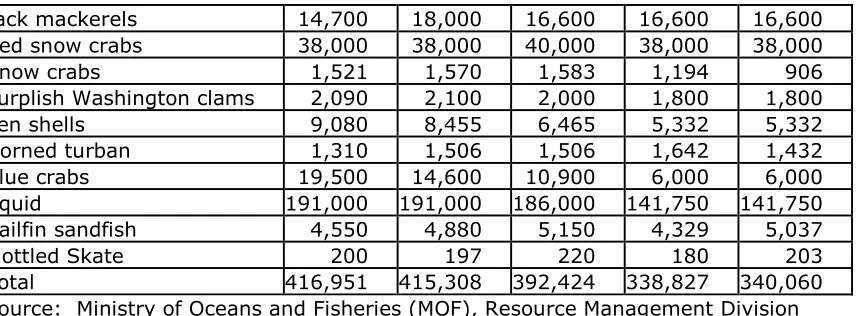
Korean Ministry of Oceans and Fisheries (MOF) established 340,060 metric tons as the Total Allowable Catch (TAC) for 2017 of eleven species as shown in Table 6 below. There are further restrictions such as limited catch seasons for some species as well as restrictions on the number of fishing boats and fishing methods.
Table 6. Korean Total Allowable Catch in 2017 (MT)
Species 2013 2014 2015 2016 2017
Jack mackerels 14,700 18,000 16,600 16,600 16,600
Red snow crabs 38,000 38,000 40,000 38,000 38,000
Snow crabs 1,521 1,570 1,583 1,194 906
Purplish Washington clams 2,090 2,100 2,000 1,800 1,800
Pen shells 9,080 8,455 6,465 5,332 5,332
Horned turban 1,310 1,506 1,506 1,642 1,432
Blue crabs 19,500 14,600 10,900 6,000 6,000
Squid 191,000 191,000 186,000 141,750 141,750
Sailfin sandfish 4,550 4,880 5,150 4,329 5,037
Mottled Skate 200 197 220 180 203
Total 416,951 415,308 392,424 338,827 340,060
Source: Ministry of Oceans and Fisheries (MOF), Resource Management Division
In 2015, Korean production of processed seafood was 1.83 million metric tons, down by 21.7 percent from 2.34 million metric tons in 2014 due to the reduced fish resource and
harvest. However, by value the decrease was only 5.7 percent which is attributed to increased prices of value-added seafood such as fish cake products, dried fish, and canned seafood.
Table 7. Korean Production of Processed Seafood
Year Production (MT) Value (Million K/Won)
2008 1,766,528 6,642,033
2009 1,898,135 6,046,188
2010 1,815,286 6,875,258
2011 1,865,546 6,540,369
2012 1,885,489 7,770,232
2013 1,819,693 7,422,605
2014 2,337,313 7,523,432
2015 1,829,141 7,097,394
Source: Korea Food Distribution Yearbook 2017
Demand
Korean consumers place high value on freshness, place of origin, taste, low cost, and food safety in the course of making seafood purchasing decisions. Overall performance of the Korean seafood market will depend greatly on production and consumption. Due to the shortage of ocean
resources, seafood production is not expected to increase in the near future. Despite this, consumption of seafood continues to grow as consumers view seafood as a healthy source of protein.
Price, quality and timeliness are the most important factors affecting U.S. trade. U.S. fish are generally considered to be high quality and, in turn, more expensive than other countries’
products. Therefore, the major species imported from the United States are species that Koreans enjoy and that other origins do not supply in large quantities.
shrimp, squid, tuna, Alaskan Pollack, yellow corbina, hair tail, flat fish, monk fish, eel, rock fish and cod. The success of the Korean industry efforts to change consumer perceptions of fish (as a healthy alternative to red meat), to diversify fish products, to improve quality, and to develop processing technology will be key in expanding domestic demand.
Due to increased incomes and improved standards of living, seafood family restaurants have grown in popularity in Korea and have been expanding over the years. Popular seafood family restaurants include Todai, Ocean Seafood, Bono-Bono, Marisco, Makinochaya, Fisher’s Market, Sea-n-More, Seafood Blue, El Mareta, Cfood Kitchen, D’ Maris, Muscus, Viking’s Wharf, and Soosa. These restaurants are using imported seafood as well as locally produced seafood.
Koreans eat fish in various states: fresh fish, chilled fish and lastly, frozen fish in the order of preference. Some fish are consumed raw (“Hoi”, or “Sashimi”), and commands a price premium. Korean consumers assume fresh fish tastes better than frozen fish after
cooking. Accordingly, fresh or chilled fish tend to be substantially more expensive than frozen fish.
As more and more women are working outside the home, the demand for convenience food has increased. Korean consumers are more attracted to precooked, prepared and preserved food available at supermarkets.
In 2013, CJ (Cheil Jedang) Corporation of Korea launched a new processed seafood brand called “Alaska Salmon”. The “Alaska Salmon” is a canned product made in Thailand (OEM) using natural salmon from Alaska, a region that is famous with its pristine waters. The price of a can is 3,600 Korean Won for 135 grams which can be converted to about $13.40 per pound. Even though the price was more than two times higher than those of regular canned tunas, this 100 percent natural salmon product hit the market making $8.2 million in sales in its first year with a market share of 86 percent. Stimulated by this successful launching of “Alaska Salmon” brand, competing
canneries such as “Dongwon” and “Sajo” also introduced their canned salmon products eroding CJ Corporation’s market share every year. CJ Corporation, still the leader with more than 60 percent market share in 2014 and 2015, diversified its canned salmon products by adding three new products in 2014, which contributed the record total market sales of $44.1 million in
2015. Currently five varieties of product (Original, Olive Oil, White Mayo, Brown Rice Oil, and Hot Pepper) are being sold in the market.
Hotels and department stores generally use high quality seafood for which they charge a higher price and some of the five-star hotels and leading department stores have already done special promotions featuring U.S. seafood products such as lobsters and scallops commemorating the 3rd and 4th anniversaries of the KORUS FTA implementation.
However, the institutional feeding and food service sector generally uses cheaper food ingredients to reduce cost as much as possible to remain competitive in the sector. The most popular fish products in this market include frozen flatfish (mostly yellowfin sole), skate, croaker (aka yellow corbina), Atka mackerel, Alaska Pollack roe and snow crab.
Total Demand Total Supply
Self-sufficiency rate Local
consumption
Exports Carry-over
Production Imports Inventory
2010 3,639 1,751 603 5,993 3,111 2,339 543 85.9%
2011 3,813 1,466 639 5,918 3,256 2,059 603 85.4%
2012 4,236 1,072 390 5,698 3,170 2,144 384 74.8%
2013 4,070 1,087 374 5,531 3,133 2,008 390 77.0%
2014 4,545 949 468 5,962 3,305 2,263 394 72.7%
Source: Korea Rural Economy Institute (KREI) 2015 Food Balance Sheet
Table 9. Korean Annual Per Capita Consumption of Seafood Products (Kg)
Product Category 2008 2009 2010 2011 2012 2013 2014 2015 (Preliminary) Fish and Shell fish 39.0 36.1 36.5 37.1 38.3 37.1 41.6 41.3
Seaweed 15.8 14.4 14.7 15.7 15.9 17.4 16.9 18.6
Total (kg/year) 54.8 50.5 51.2 52.8 54.2 54.5 58.5 59.9 Source: Korea Rural Economy Institute (KREI) 2015 Food Balance Sheet
Competitors
Seafood is imported into Korea from about 100 different countries. Major suppliers of fishery products to Korea include China, Russia, Vietnam, Norway, USA, Thailand, Chile, Japan, Peru and Taiwan. In 2016, the top ten supplying countries accounted for about 80 percent of total Korean seafood imports on a value basis. China continued to be the largest supplier, followed by Russia and Vietnam.
Several countries have recently entered into trade agreements with Korea that have also put many of their seafood products at zero or phased out duties, which has increased competition in the sector. For example, the KORUS FTA implemented in March 2012 has focused attention on U.S. lobster and a growing number of importers and retailers began to hold a series of large scale in-store promotions. In 2014, the tariff for live American lobsters dropped to 8% and total Korean imports of lobsters increased nearly 30% from 2013, nearly all of which was imported from the United States. However, the accelerated implementation of the Korea-Canada FTA in 2015 reversed the situation as tariffs dropped to zero for Canadian frozen lobsters in 2015. Over the past three years the total Korean market for lobsters has grown remarkably both by value and volume. Since 2013, total sales of American lobsters have increased over 50% and opportunities for American live lobster remains strong. However, competition will be fierce as the tariff for all Canadian lobsters dropped to zero in 2017.
Table 10. Tariff Phase-Out Schedule for Lobster Products under KORUS FTA
HSK 10 Description Country Base
Rate 2012 2013 2014 2015 2016 2017
2013 HSK 030622XXXX
Live, Fresh, Chilled Lobsters (Homarus
USA
20%
16% 12% 8% 4% 0% 0%
spp.)
HSK 10 Description Country Base
Rate 2012 2013 2014 2015 2016 2017
2013 HSK 030612XXXX
Frozen Lobsters (Homarus spp.)
USA
20%
16% 12% 8% 4% 0% 0%
Canada 20% 20% 20% 0% 0% 0%
Table 11. Korean Imports of Lobsters (Homarus Spp.): Live, Fresh, Chilled, Dried, Salted, In Brine, Including In Shell, Cooked by Steaming or by Boiling in Water, Frozen
Country 2013 2014 2015 2016
$1,000 MT $1,000 MT $1,000 MT $1,000 MT
World 57,469 2,939 74,069 3,766 82,000 3,840 93,715 4,500 Canada 36,194 1,805 32,973 1,634 44,242 2,073 59,658 2,869 United States 21,200 1,133 40,993 2,128 37,693 1,765 33,718 1,615
Others 75 1 103 4 65 2 339 16
Source: Korea Customs and Trade Development Institute, HS 030622, HS030612
A dozen supplying countries including China, Russia, Japan, Norway, Thailand, Chile, Canada, Indonesia, and others participate in the Busan International Seafood & Fisheries Expo
annually. These competitors exhibit a wide variety of seafood products targeting importers, wholesalers, distributors, retailers, hotels, restaurants and food processors. In 2016, competitors such as Norway, Canada and Japan have put considerable amount of strategic effort into
promoting their own country’s seafood exports to the Korean market through NSC (Norway), Trade Commissioner Service (Canada) and Ministry of Agriculture, Forestry & Fisheries (Japan) executing market research projects and market promotional events in Korea.
Marketing
Imports of seafood are relatively straight-forward compared to other food and agricultural products. Traders import fishery products, and generally sell to hotels and food service industry directly, and/or to distributors who sell to traditional markets and restaurants. When the volume is large, importers generally sell to retailers such as supermarkets, discount stores and
department stores directly. When the volume is small, importers sell to distributors who sell to retailers. Accordingly, U.S. suppliers should contact seafood importers to sell their fishery products to Korea.
Consumers like to purchase species that they are accustomed to, and importers tend to import the species consumers are demanding. As mentioned earlier, imports of only 30 species accounted for more than 98 percent of total seafood imports from the United States to Korea in 2016. This means that U.S. exporters should supply the species consumers prefer, and at the same time should also try to invest in building demand for other species with which consumers currently lack familiarity.
Possible sources of market information include Korean importers, U.S. state departments of
One way of finding potential importers while also assessing market potential is to participate in local food shows to showcase your products to a larger audience. Many Korean importers attending these shows are looking to establish reliable long-term trading relationships. Show participation enhances initial contacts with importers, agents, wholesalers, distributors, retailers and others in the food and beverage industry.
Seoul International Seafood Show (3S) 2017 was held in Seoul at COEX, May 10-12, 2017. Sponsored by the Ministry of Oceans and Fisheries (MOF) of Korea, this is the only show held in Seoul specializing in seafood, fishery, nursery, aquaculture, processing machinery and related equipment. This show will be held in May 9-11 again next year and targets seafood buyers, users, fishing businessmen and traders. Check the official website of the show (www.seoulseafood.com) for further details.
Busan International Seafood & Fisheries Expo (BIFSE) 2017 will be held in Busan at BEXCO convention center, November 8-10, 2017. It offers an excellent opportunity to explore possible market opportunities in Korea. This show has been held in November (or October) every year and targets importers, wholesalers, distributors, retailers, hotels, restaurants, food processors, and media. Currently, it is the only seafood show held in Korea supported by ATO Seoul. ATO Seoul has been participating in this show for 13 years, in cooperation with State Regional Trade Groups such as SUSTA and Food Export USA Northeast. Check BISFE’s official website (www.bisfe.com) for detailed information on the show. The registered trade show sales company in USA for this show is B-FOR the international exhibit people™, 520 William Street, Suite E, Fredericksburg, VA 22401-5775, USA (+1.540.373.9935 / [email protected] / www.b-for.com)
SECTION IV: FURTHER INFORMATION AND KEY CONTACTS
For further information on how you can enter the Korean market for imported food products:
ATO Seoul uses the USDA’s Global Agriculture Information Network (GAIN) system to provide stakeholders with market knowledge on Korean food trade. Exporters who want to find most recent copy of the annual Exporter Guide for the Korean market can access the GAIN and review the report at: 2016 Annual Exporter Guide Report by ATO Seoul
For any further information about Korean market, please contact:
U .S. Agricultural Trade Office (ATO)
Local address: Rm 303, Leema B/D, 42, Jongro 1-gil, Jongro-gu, Seoul, Korea 03152
U.S. mailing address: ATO, U.S. Embassy - Seoul, Unit 9600 Box 0050, DPO, AP 96209-0050 Phone: 82-2-6951-6848
Fax: 82-2-720-7921
SECTION V: TRADE STATISTICAL APPENDIX
Table 12. Korea’s Total Seafood Imports by Year ($million)
Year From World From USA U.S.
Market Share
2008 2,847 129 4.5%
2009 2,604 113 4.3%
2010 3,091 113 3.7%
2011 3,833 142 3.7%
2012 3,646 169 4.6%
2013 3,565 211 5.9%
2014 4,161 222 5.3%
2015 4,241 233 5.5%
2016 4,502 227 5.1%
Source: www.kita.net Korea’s Trade Statistics Database for 2016
Table 12-1. Korean Seafood Imports from Major Countries ($million)
Reporting Country: Korea, Republic of Top 15 Ranking
Import
Percent change (2015~2016) 2014 2015 2016
China 1,124 1,114 1,179 5.8%
Russia 672 705 698 -1.0%
Vietnam 627 574 615 7.1%
Norway 182 218 299 37.1%
United States 222 233 227 -2.5%
Thailand 165 168 147 -12.5%
Japan 97 116 142 22.4%
Hong Kong 73 34 100 194.1%
Taiwan 105 102 100 -2.0%
Peru 97 99 89 -10.1%
Chile 105 97 84 -13.4%
Canada 51 60 81 35.0%
Senegal 49 54 65 20.4%
Ecuador 44 50 52 4.0%
Indonesia 61 56 53 -5.4%
Other 487 561 572 2.0%
Total 4,161 4,241 4,502 6.2%
Source: www.kita.net Korea’s Trade Statistics Database for 2016
Table 13. Korea’s Total Seafood Exports by Year ($million)
Year To World To USA
2008 1,256 86
2009 1,326 101
2010 1,567 106
2012 1,973 129
2013 1,749 136
2014 1,642 133
2015 1,481 146
2016 1,637 157
Source: www.kita.net Korea’s Trade Statistics Database for 2016
Table 13-1. Korean Seafood Exports to Major Countries ($million)
Reporting Country: Korea, Republic of Top 10 Ranking
Export
2014 2015 2016
Japan 625 545 585
China 254 235 293
United States 133 146 157
Thailand 106 95 123
Vietnam 62 76 85
Hong Kong 27 42 50
France 26 42 44
Italy 20 24 38
Spain 38 16 29
Other 350 258 231
Total 1,642 1,481 1,637
Source: www.kita.net Korea’s Trade Statistics Database for 2016
Table 14-1. Top 30 Fish Imported to Korea from USA in 2016 (In Value, $1,000)
Fish Species HS Code
Number Fish Surimi, Alaska Pollack (Theragra
Chalcogramma), frozen 0304.94.1000 56,606 56,639 99.9%
Lobsters, not frozen, other than
smoked 0306.22.9000 30,332 73,610 41.2%
Cod, frozen 0303.63.0000 19,479 55,079 35.4%
Other, Flatfish, frozen 0303.39.0000 17,828 57,715 30.9%
Alaska Pollack (Theragra
Chalcogramma), frozen 0303.67.0000 13,752 222,422 6.2%
Monkfish, frozen 0303.89.9060 10,970 71,381 15.4%
Hagfish (Salad Eel), live 0301.99.7000 10,269 14,770 69.5%
Skate, frozen 0303.82.2000 6,614 33,571 19.7%
Roes of Alaska Pollack, frozen 0303.90.2010 6,413 60,048 10.7%
Hagfish (Salad Eel), frozen 0303.89.9070 6,223 8,357 74.5%
Roes of Other Fish, frozen 0303.90.2090 5,231 15,478 33.8%
Atka mackerel, frozen 0303.89.9040 4,844 20,287 23.9%
Ray, frozen 0303.82.1000 3,722 25,911 14.4%
Fillet, Plaice, frozen 0304.83.1000 3,403 4,730 71.9%
Lobsters, frozen, other than smoked 0306.12.9000 3,386 20,104 16.8%
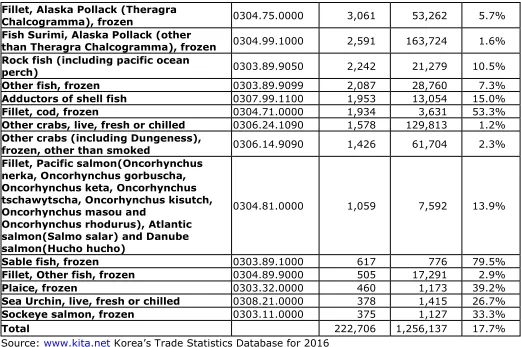
Fillet, Alaska Pollack (Theragra
Chalcogramma), frozen 0304.75.0000 3,061 53,262 5.7%
Fish Surimi, Alaska Pollack (other
than Theragra Chalcogramma), frozen 0304.99.1000 2,591 163,724 1.6% Rock fish (including pacific ocean
perch) 0303.89.9050 2,242 21,279 10.5%
Other fish, frozen 0303.89.9099 2,087 28,760 7.3%
Adductors of shell fish 0307.99.1100 1,953 13,054 15.0%
Fillet, cod, frozen 0304.71.0000 1,934 3,631 53.3%
Other crabs, live, fresh or chilled 0306.24.1090 1,578 129,813 1.2% Other crabs (including Dungeness),
frozen, other than smoked 0306.14.9090 1,426 61,704 2.3%
Fillet, Pacific salmon(Oncorhynchus nerka, Oncorhynchus gorbuscha, Oncorhynchus keta, Oncorhynchus tschawytscha, Oncorhynchus kisutch, Oncorhynchus masou and
Oncorhynchus rhodurus), Atlantic salmon(Salmo salar) and Danube salmon(Hucho hucho)
0304.81.0000 1,059 7,592 13.9%
Sable fish, frozen 0303.89.1000 617 776 79.5%
Fillet, Other fish, frozen 0304.89.9000 505 17,291 2.9%
Plaice, frozen 0303.32.0000 460 1,173 39.2%
Sea Urchin, live, fresh or chilled 0308.21.0000 378 1,415 26.7%
Sockeye salmon, frozen 0303.11.0000 375 1,127 33.3%
Total
222,706 1,256,137 17.7%
Source: www.kita.net Korea’s Trade Statistics Database for 2016
Table 14-2. Top 30 Fish Imported to Korea from USA in 2016 (In Quantity, MT)
Fish Species HS Code
Number
Fish Surimi, Alaska Pollack (Theragra
Chalcogramma), frozen 0304.94.1000 20,243 20,260 99.9%
Other, Flatfish, frozen 0303.39.0000 11,307 27,220 41.5%
Alaska Pollack (Theragra Chalcogramma),
frozen 0303.67.0000 10,748 204,249 5.3%
Cod, frozen 0303.63.0000 7,091 20,380 34.8%
Roes of Other Fish, frozen 0303.90.2090 2,641 6,731 39.2%
Other 0303.89.9099 2,574 20,955 12.3%
Roes of Alaska Pollack, frozen 0303.90.2010 2,334 14,657 15.9%
Monkfish, frozen 0303.89.9060 2,146 27,006 7.9%
Hagfish (Salad Eel), frozen 0303.89.9070 1,987 2,708 73.4%
Ray, frozen 0303.82.1000 1,869 9,734 19.2%
Atka mackerel, frozen 0303.89.9040 1,741 8,264 21.1%
Lobsters, not frozen, other than smoked 0306.22.9000 1,527 3,633 42.0%
Rock fish, frozen 0303.89.9050 1,188 11,212 10.6%
Fillet, Plaice, frozen 0304.83.1000 1,031 1,188 86.8% Fillet, Alaska Pollack (Theragra
Chalcogramma), frozen 0304.75.0000 998 19,887 5.0%
Skate, frozen 0303.82.2000 936 8,780 10.7%
Fish Surimi, Alaska Pollack (other than
Theragra Chalcogramma), frozen 0304.99.1000 917 102,775 0.9%
Other Pacific salmon(Oncorhynchus gorbuscha, Oncorhynchus keta, Oncorhynchus tschawytscha,
Oncorhynchus kisutch, Oncorhynchus masou and Oncorhynchus rhodurus)
0303.12.0000 917 2,246 40.8%
Fillet, Cod, frozen 0304.71.0000 324 680 47.6%
Plaice, frozen 0303.32.0000 198 581 34.1%
Dogfish and other sharks 0303.81.0000 133 2,880 4.6%
Fillet, Pacific salmon(Oncorhynchus nerka, Oncorhynchus gorbuscha, Oncorhynchus keta, Oncorhynchus tschawytscha,
Oncorhynchus kisutch, Oncorhynchus masou and Oncorhynchus rhodurus), Atlantic salmon(Salmo salar) and Danube salmon(Hucho hucho)
0304.81.0000 132 835 15.8%
Other crabs (including Dungeness),
frozen, other than smoked 0306.14.9090 118 9,668 1.2%
Fillet, Other fish, frozen 0304.89.9000 118 3,598 3.3%
Lobsters, frozen, other than smoked 0306.12.9000 88 867 10.2%
Adductors of shell fish (Scallops), frozen 0307.99.1100 80 1,040 7.7%
Sockeye salmon, frozen 0303.11.0000 75 213 35.2%
Other crabs, live, fresh or chilled 0306.24.1090 54 8,680 0.6%
Fish Surimi, Alaska Pollack (Theragra
Chalcogramma), frozen 0304.95.1000 47 47 100.0%
Total
74,721 542,644 13.8%
Source: www.kita.net Korea’s Trade Statistics Database for 2016
Table 15. Korean Imports of Fish Roes, Urchin Roes, Caviar and Livers by Country of Origin (MT)
2015 2016
USA 5,757 USA 4,982
Russia 16,175 Russia 14,932
Iceland 894 Iceland 1,307
New Zealand 795 New Zealand 952
Norway 547 Norway 797
Indonesia 300 Indonesia 239
Others 465 Others 504
Total 24,933 Total 23,713
Source: www.kita.net Korea’s Trade Statistics Database for 2016
Species 2013 H.S. Code 2015 2016
World USA World USA
Livers, frozen 0303.90.1000 218 5 58 2
Roes/AK Pollack, frozen 0303.90.2010 15,204 2,955 14,657 2,334 Other Roes, Frozen 0303.90.2090 7,466 2,792 6,731 2,641 Caviar and caviar substitutes 1604.31.0000
1604.32.0000 2,045 5 2,267 5
Total
24,933 5,757 23,713 4,982
Source: www.kita.net Korea’s Trade Statistics Database for 2016
Table 16. Korean Imports of Flatfish by Country of Origin (MT)
2015 2016
USA 14,781 USA 11,505
Russia 9,558 Russia 12,537 China 1,922 China 2,046 Guinea 1,124 Guinea 999 Senegal 1,050 Senegal 681
Spain 296 Spain 269
Others 584 Others 749
Total 29,315 Total 28,786
Source: www.kita.net Korea’s Trade Statistics Database for 2016
Table 16-1. Korean Imports of Flatfish by HS Code (MT)
Species H.S. Code 2015 2016
World U.S.A World U.S.A. Flat Fish, Live / Plaice,
Fresh 0301.99.8000 0302.22.0000 188 0 170 0
Halibut, Frozen 0303.31.0000 690 0 679 0
Plaice, Frozen 0303.32.0000 478 148 581 198
Sole, Frozen 0303.33.0000 78 0 136 0
Others, Frozen 0303.39.0000 27,881 14,633 27,220 11,307
Total
29,315 14,781 28,786 11,505
Source: www.kita.net Korea’s Trade Statistics Database for 2016
Table 17. Korean Imports of Ground Fish by Country of Origin (MT)
2015 2016
USA 11,307 USA 19,064 Russia 191,580 Russia 212,709 Portugal 3,404 Portugal 4,208 Japan 3,923 Japan 3,999 Others 6,300 Others 8,835
Source: www.kita.net Korea’s Trade Statistics Database for 2016
Table 17-1. Korean Import of Ground Fish by HS Code (MT)
Species H.S. Code 2015 2016
World USA World USA
Cod, Fresh 0302.51.0000 1,023 12 506 0
Alaska Pollack, Fresh 0302.55.0000 3,523 1 3,983 0
Cod, Frozen 0303.63.0000 15,724 3,981 20,380 7,091
Hake, Frozen 0303.66.0000 80 4 1,106 23
Alaska Pollack 0303.67.0000 180,771 5,885 204,249 10,748 Rockfish (ocean perch) 0303.89.9050 9,639 1,422 11,212 1,188 Alaska Pollack, Dried 0305.59.3000 5,754 2 7,379 14
Total
216,514 11,307 248,815 19,064
Source: www.kita.net Korea’s Trade Statistics Database for 2016
Table 18. Korean Imports of Fillet/Surimi by Country of Origin (MT)
2015 2016
USA 23,264 USA 23,810
Vietnam 57,928 Vietnam 54,751
China 31,246 China 34,793
Russia 17,119 Russia 19,156 Indonesia 6,391 Indonesia 6,428 Pakistan 4,985 Pakistan 4,514
India 4,234 India 3,520
Thailand 3,108 Thailand 2,849
Peru 2,463 Peru 2,665
Others 7,560 Others 8,562
Total 158,298 Total 161,048
Source: www.kita.net Korea’s Trade Statistics Database for 2016
Table 18-1. Korean Imports of Fillet/Surimi by HS Code (MT)
Species 2013 H.S. Code 2015 2016
World USA World USA Fillet of
0304.71.0000 425 114 680 324
Fillet of Plaice/fro zen
0304.83.1000 1,008 903 1,188 1,03
Fish/froze
0304.94.9000 58 0 8 0
Surimi of
0304.93.90000304.95.90000304.99.9000 2,006 25 3,288 0
Total
158,298 23,264 161,048 23,810
Source: www.kita.net Korea’s Trade Statistics Database for 2016
Table 19. Korean Imports of Crustaceans by Country of Origin (MT)
Source: www.kita.net Korea’s Trade Statistics Database for 2016
Table 19-1. Korean Imports of Crustaceans by HS Code (MT)
Species 2013 H.S.
Code
2015 2016
World USA World USA
Frozen peeled shrimps and prawns 0306.16.1090
0306.17.1090 20,840 0 22,819 0
Frozen other type of shrimps and prawns 0306.17.9010
0306.17.9090 20,560 19 21,921 0
Frozen crab meat 0306.14.1090 0 0 17 0
Frozen king crabs 0306.14.2090 360 1 46 0
Frozen blue crabs 0306.14.3090 22,491 0 20,846 0
Frozen other type of crabs 0306.14.9090 7,494 195 9,668 118
Not frozen lobsters (Homarus spp.) 0306.22.9000 3,277 1,645 3,633 1,527 Live, fresh or chilled shrimps and prawns 0306.26.1000 1 1 3 1
Salted or in brine shrimps and prawns 0306.26.3000 0 0 0 0
Live, fresh or chilled snow crab 0306.24.1020 5,501 1 5,040 2
Frozen rock lobster, other sea crawfish, dried shrimps, crabs, etc.
0306.11.9000 0306.26.2000 0306.27.2000 0306.24.2000 0306.29.2000
3,298 0 3,576 2
Total
84,385 1,982 88,436 1,738
Source: www.kita.net Korea’s Trade Statistics Database for 2016
Table 19-2. Korean Imports of Lobsters (Homarus Spp.): Live, Fresh, Chilled, Dried, Salted, In Brine, Not Frozen
Country 2013 2014 2015 2016
$1,000 MT $1,000 MT $1,000 MT $1,000 MT
World 47,247 2,556 67,992 3,518 66,837 3,277 73,610 3,633 Canada 31,311 1,606 29,963 1,493 33,687 1,630 43,243 2,106 United States 15,921 950 37,959 2,023 33,103 1,645 30,332 1,527
Others 15 0 70 2 47 2 35 0
Source: Korea Customs and Trade Development Institute, HS 030622
Table 19-3. Korean Imports of Lobsters (Homarus Spp.): Including In Shell, Cooked by Steaming or by Boiling in Water, Frozen
Country 2013 2014 2015 2016
$1,000 MT $1,000 MT $1,000 MT $1,000 MT
World 10,222 383 6,077 248 15,163 563 20,105 867
Canada 4,883 199 3,010 141 10,555 443 16,415 763
United States 5,279 183 3,034 105 4,590 120 3,386 88
Others 60 1 33 2 18 0 304 16
Source: Korea Customs and Trade Development Institute, HS 030612
Table 20. Korean Imports of Mollusks by Country of Origin (MT)
2015 2016
USA 218 USA 91
China 117,869 China 118,688
Chile 22,569 Chile 28,519
Peru 15,225 Peru 9,183
Thailand 9,490 Thailand 7,369
Japan 7,832 Japan 7,039
Argentina 4,533 Mauritania 3,148 Mauritania 4,384 Taiwan 3,025 Indonesia 2,719 Indonesia 1,751
Others 8,152 Others 7,083
Total 224,520 Total 215,988
Source: www.kita.net Korea’s Trade Statistics Database for 2016
Table 20-1. Korean Imports of Mollusks by HS Code (MT)
Species 2013 H.S.
Code
2015 2016
World USA World USA
Scallops 0307.2X.XXXX 9,977 1 8,349 2
Cuttlefish 0307.4X.XXXX 48,325 23 52,350 0
Octopus 0307.5X.XXXX 85,908 106 78,454 9
Hard clams, abalones, top shells, pearl oyster, ark shells, cockles, adductors of shell fish, sea urchins, sea cucumbers, hen clams, baby clams, jelly fish
0307.7X.XXXX 0307.8X.XXXX 0307.9X.XXXX
80,244 71 76,553 80
Oysters, mussels 0307.1X.XXXX
0307.3X.XXXX 66 17 282 0
Total
224,520 218 215,988 91
Source: www.kita.net Korea’s Trade Statistics Database for 2016
Table 21. Korean Tariff Schedule for Fishery Products
Live Fish, Ornamental, Other Live
0301.XX.XXXX except 0301.92.1000,
0301.92.2000 and 0301.99.4010 10%
Live Fish, Other, Eels, Glass Eels (not exceeding 0.3g per unit, for aquaculture) and Sea Bream Fry (for aquaculture)
0301.92.1000 and 0301.99.4010 0%
Live Fish, Other, Eels, Young Eels (exceeding 0.3g and not exceeding 50g per unit, for aquaculture)
0301.92.2000 5%
Fish, Fresh or Chilled 0302.XX.XXXX 20%
Fish, Frozen 0303.XX.XXXX 10%
Fish Fillets and Other Fish Meat - Fresh or Chilled Fillets of Tilapias, Catfish, Pacific Salmon, Trout, Flat Fish, Swordfish,
Toothfish, and Other Fish
Fish Fillets and Other Fish Meat - Frozen Fillets of Tilapias, Catfish, Cod, Haddock, Coalfish, Hake, Alaska Pollack, Pacific Salmon, Trout, Flat Fish, Swordfish, Toothfish, Herrings, Tunas and Other Fish
0304.6X.XXXX, 0304.7X.XXXX, 0304.8X.XXXX,
0304.9X.XXXX 10%
Fish, Dried, Salted or in Brine, Smoked Fish, whether or not cooked before or during the smoking process, Flours, Meals and Pellets of Fish, Fit for Human Consumption
0305.XX.XXXX 20%
Crustaceans, whether in shell or not, Live, Fresh, Chilled, Frozen, Dried, Salted or in Brine, Smoked Crustaceans, whether or not cooked before or during the smoking process, Crustaceans, in shell or not, Cooked by Steaming or by Boiling in Water, whether or not chilled, Frozen, Dried, Salted in Brine, Flours, Meals and Pellets of Crustaceans, Fit for Human Consumption
0306.XX.XXXX 10%
Mollusks, whether in shell or not, Live, Fresh, Chilled, Frozen, Dried, Salted or in Brine, Smoked Mollusks, whether in shell or not, whether or not cooked before or during the smoking process, Flours, Meals and Pellets of Mollusks, Fit for Human
Consumption – Oysters, Scallops, Mussels, Smoked Cuttle Fish and Squid, Octopus, Snails, Clams, Cockles, Ark Shells, Abalone, Top Shells and Adductors of Shell Fish
0307.1X.XXXX, 0307.2X.XXXX, 0307.3X.XXXX , 0307.4X.XXXX, 0307.5X.XXXX, 0307.6X.XXXX, 0307.7X.XXXX, 0307.8X.XXXX and 0307.9x.XXXX except
0307.11.1010, 0307.11.1090, 0307.41.XXXX, 0307.49.10XX,
0307.49.2000, 0307.49.3000, 0307.71.2010 and 0307.91.2010
20%
Mollusks, whether in shell or not, Live, Fresh, Chilled, Frozen, Dried, Salted or in Brine, Smoked Mollusks, whether in shell or not, whether or not cooked before or during the smoking process, Flours, Meals and Pellets of Mollusks, Fit for Human Consumption - Live, Fresh or Chilled Oyster Spat , Ark Shell and Pearl Oyster for Seed
0307.11.1010, 0307.71.2010, 0307.91.2010 0%
Mollusks, whether in shell or
Dried, Salted or in Brine, Smoked Mollusks, whether in shell or not, whether or not cooked before or during the smoking process, Flours, Meals and Pellets of Mollusks, Fit for Human Consumption - Live, Fresh or Chilled Oyster Spat Other Mollusks, whether in shell or not, Live, Fresh, Chilled, Frozen, Dried, Salted or in Brine, Smoked Mollusks, whether in shell or not, whether or not cooked before or during the smoking process, Flours, Meals and Pellets of Mollusks, Fit for Human
Consumption – Cuttle Fish, Squid
0307.41.XXXX, 0307.49.10XX, 0307.49.2000,
0307.49.3000 10%
Aquatic Invertebrates Other Than Crustaceans and
Mollusks, Live, Fresh, Chilled, Frozen, Dried, Salted or in Brine, Smoked Aquatic Invertebrates Other Than Crustaceans and Mollusks, whether or not cooked before or during the smoking process, Flours, Meals and Pellets of Aquatic Invertebrates Other Than Crustaceans and Mollusks, Fit for Human Consumption – Sea Cucumber, Sea Urchins, Jellyfish and Other
0308.XX.XXXX except 0308.90.1011 20%
Aquatic Invertebrates Other Than Crustaceans and
Mollusks, Live, Fresh, Chilled, Frozen, Dried, Salted or in Brine, Smoked Aquatic Invertebrates Other Than Crustaceans and Mollusks, whether or not cooked before or during the smoking process, Flours, Meals and Pellets of Aquatic Invertebrates Other Than Crustaceans and Mollusks, Fit for Human Consumption – Live, Fresh or Chilled Sea-Squirts for Seed
0308.90.1011 0%
Extracts and Juices of Fish or Crustaceans, Mollusks or Other Aquatic Invertebrates
1603.00.3000 and 1603.00.4000 30%
Prepared or Preserved Fish, Caviar and Substitutes Prepared from Fish Eggs – Salmon, Herrings, Sardines, Tunas,
Mackerel, Anchovies, Eels, Saury, Jerk Filefish, Fish Pastes, Fish Marinade, Fish Cake, Caviar and Caviar Substitutes
Crustaceans, Mollusks and Other Aquatic Invertebrates, Prepared or Preserved – Crab, Shrimps and Prawns, Lobster, Oysters, Scallops, Mussels, Cuttle Fish, Squid, Octopus, Clams, Abalone, Snails, Sea Cucumber, Sea Urchins, Jellyfish and Other Fish
1605.XX.XXXX 20%