Electronic copy available at: https://ssrn.com/abstract=2982376 Copyright 2017 GMP Press and Printing (http://buscompress.com/journal-home.html)
ISSN: 2304-1013 (Online); 2304-1269 (CDROM); 2414-6722 (Print)
CSR Practice on the Garments Sector: An Overall
Investigation to Work out an Effective Relationship
between CSR & Accounting to Develop the
Bangladeshi Garments Sector
Tapos Kumar
Shanto-Mariam University of Creative Technology, Bangladesh
ABSTRACT
The purpose of this study is to investigate the relationship between CSR & accounting by analyzing some factors that would include social accounting, human resource accounting, environment accounting, tax avoidance, balanced scored card and ethical standard. the study is on face-to-face interview with garments employee & employer. A closed-minded questionnaire was used for face-to-face interview to collect data from employees & employers of the garments factory. To analyze data, the study has used several statistical tools such as chi-square to test research hypothesis, Centroid method to analyze variables by developing a quantitative method. Findings show that CSR has a positive relation with accounting to enhance overall factory performance. Accounting describes every slogan of CSR by defining social accounting, environment accounting, human resource accounting, tax avoidance, balanced scorecards & accounting ethics. Moreover, this is the first depth research that investigates the relation between CSR & Accounting. Garments regulatory authorities in Bangladesh, accounting regulatory authorities in Bangladesh or other developing countries may find the findings of this paper useful.
Keywords: Accounting, Bangladesh, CSR, Factory performance
1. INTRODUCTION
Traditionally, a corporation's function on the market focused only on financial performance and profitability. As a result of rising globalization and pressing ecological issues, stakeholders– shareholders, suppliers, employees, the community, and government– have redefined corporations' role on the market and in society, attributing them a broader responsibility and evaluating their ethical and socially responsible performance. As a result of a shift in perception, the definition of corporate social responsibility has begun to meet strength on the international economic stage. Although there is no universally accepted definition of CSR, there is a consensus about what it represents: a method of business management, including ethics values, be able to produce an overall positive effect on the society and environment within which an organization operates.
Electronic copy available at: https://ssrn.com/abstract=2982376 Copyright 2017 GMP Press and Printing (http://buscompress.com/journal-home.html)
ISSN: 2304-1013 (Online); 2304-1269 (CDROM); 2414-6722 (Print)
business. Most of them derive from international workplace norms outlined in several International Labour Organization (ILO) conventions and the Universal Declaration of Human Rights. Probably the most globally recognized guidelines are the UN Global Compact (UNGC); Organization for Economic Cooperation and Development (OECD) Guidelines; ISO 26000; the ILO Tripartite Declaration of Principles on Multinational Enterprises and Social Policy; and the Global Reporting Initiative (GRI). Next, for them a few relevant CSR international initiatives specifically conceived for the garments sector: World Wide Responsible Apparel Production (WRAP), Fair Labour Association, Clean Clothes Campaign, Fair Wear Foundation, Workers Right Consortium, Control Union/Skal certificate and Oeko-Tex 100/1000 standard, are a number of them.
At the regional level, the European Union has implemented a unique initiative on the problem: the EU Eco Label standard. Established in 1992, it is just a certification scheme to simply help European consumers distinguish more green products and services. For garments, the Eco-label counts for the entire supply chain, from fiber to finished product. The scheme, in addition, has set environmental and performance criteria for judging products. Furthermore, the EU has a unique CSR policy and puts forward an agenda for action covering the time 2011-2014.
2. LITERATURE REVIEW
Different author & authorized body define CSR in different angle, they define it as;
"The policy and practice of a corporation's social involvement over and beyond its legal... (Enderle & Tavis (1998)
"[. . .] a concept whereby companies integrate social and environmental concerns in their business operations and in their interaction with their stakeholders on a voluntary basis." (In the green paper (2001) of the Commission of the European Communities)
"CSR relates to the fulfillment of a firm's responsibility towards the society while maintaining its profitability. Moreover, it entails treating the stakeholders, including the natural environment, in an ethical or responsible manner" (Hopkins, 2004).
"According to Mattern and Moon (2004), the concept of CSR overlaps with the concept of business ethics, corporate philanthropy, corporate citizenship, sustainability, and environmental responsibility."
"From a general perspective, Brown and Dacin (1997) defined CSR as a company's status and activities with respect to its perceived societal or at least to its stakeholder's obligations."
"Shareholders, it is argued, are merely one of the several claimants on the firm" (Heath and Norman 2004)
Burke and Logsdon (1996) define CSR as strategic "when it yields substantial business-related benefits to the firm."
Copyright 2017 GMP Press and Printing (http://buscompress.com/journal-home.html) ISSN: 2304-1013 (Online); 2304-1269 (CDROM); 2414-6722 (Print)
and Lee, 2005) to the initiative in which " social and business benefits are large and distinctive" (Porter and Kramer, 2006).
A study by Professor Stephen Erfle and Michel Frantantuono found that firms that were ranked highest in terms of their record on a variety of social issues had greater financial performance because such practices are capable of enhancing brand value of positive publicity. Zairi(2000) proposes that given the proven impact of social responsibility on business performance and corporate image, CSR should be included in business excellence models. By extrapolation, it can be argued that if CSR impacts on factors including company reputation and corporate image, that it shares characteristics with, and therefore can be regarded implicitly as, an integral component of at least some models of corporate identity.
The emphasis on 'green' issues has induced corporations to bring out their ecological contribution through environmental reporting (Subramaniam, 2010). Environmental reporting (ER or CER) relates to the collection, measurement, and publication of 'green' information to the community. Gray (1995) stated that the reporting of environmental information spread out mainly in an ad hoc manner and it was observed that it was known under different labels. It currently includes terms such as triple-bottom-line reporting1, corporate responsibility reporting, corporate social reporting, corporate environmental reporting, and sustainability reporting. These terms are often employed interchangeably when it comes to referring to environmental disclosures but it is important to stress that there are some differences between those terminologies. The triple bottom line stands for 'people, planet, and profit. Triple bottom line reporting takes into consideration the effects that business activities have in terms of social and environmental values along with financial benefits.
There is emerging evidence that effectively implemented; CSR can have a significant impact in motivating, developing and retaining staff. Novo Nordisk, a high-value CSR pharmaceutical company in Denmark, for example, after launching their Values in Action program, which aligns their business objectives with sustainable development principles, saw a 5% drop in staff turnover, while Sears found a 20% reduction in staff turnover since implementing their CSR program (Skinner, 2002, p.1). A landmark international CSR study of human resource practitioners conducted by the Society for Human Resource Management (SHRM) in 2006 reveals that CSR practices are seen as important to employee morale (50%), loyalty (41%), retention (29%), recruitment of top employees (25%) and productivity (12%)- (SHRM, 2007, p. 27).
Copyright 2017 GMP Press and Printing (http://buscompress.com/journal-home.html) ISSN: 2304-1013 (Online); 2304-1269 (CDROM); 2414-6722 (Print)
This view, however, is a "direct challenge to the authority of the state" (Sikka, 2010:156). The latter argues that firms have obligations to a range of stakeholders in the jurisdiction where profits are generated (Avi-Yonah, 2008; Sikka, 2010; 2013); paying taxes in accord with the spirit of the law is a "litmus test for corporate claims of social responsibility" (Sikka, 2010:154). Additionally, without tax revenue, governments cannot provide vital infrastructure and community services such as education and transportation provided to a firm's employees. Nor, can governments provide the services demanded by corporations including financial markets, legal systems, and oversight. Therefore firms have an obligation to pay the taxes as demanded (Avi-Yonah, 2008; Sikka, 2010). Having established this contradiction in Friedman's position, Avi-Yonah (2008) notes that regardless of the view of the firm, CSR is connected to tax payments and, therefore, firms have an obligation to avoid strategic actions designed only to minimize taxes.
According to, Porter and Kramer (2006) as leading proponents of the instrumental theory argue that "the essential test that should guide CSR is not whether a cause is worthy but whether it presents an opportunity to create shared value". Consequently, corporations should engage in "truly strategic CSR"; "it's about choosing a unique position – doing things differently from competitors…" (2006). In other words, CSR is no longer considered a social or even a moral obligation of a corporation to society at large, but a mere market opportunity to achieve competitive advantage. According to the article by the Harvard Law School on Financial Regulation and Corporate Governance, it was ascertained that activities, which were related, to Corporate Social Responsibility had a greater potential for the creation of various forms of value which were distinct to the customers. It was the perception of customers towards this value that can mediate the relationship between a company's CSR activities and its subsequent performance in finance. It is also through this article that it can be established that CSR increases a business firms' profitability due to increased loyalty of the clients, lower risks in reputation during crisis and willingness of paying the premium prices (Chandler, 2010, p.48-50).
Stakeholder Theory
This theory embodies the need to balance the claims of shareholders with these of other stakeholders (Ruf et al. 2001) and through this balancing act, the organization can attract and maintain the support of their stakeholders (Reynolds, Schultz, and Hekman 2006). The idea that organizations face a non-homogenous set of stakeholder views has recently been conceptualized by Rasche and Esser (2006) using Habermasian discourse ethics. These multiple views may be integrated and Neville and Menguc (2006) discuss how different stakeholders may even work together to achieve a common goal or indeed may be diametrically opposed to each other on an issue affecting the organization. In recent years, stakeholder attributes have received increasing attention (Frooman 1994) to aid managers in deciding how to allocate their limited time, energy and other scarce resources to different stakeholder groups (Vos 2003; Philips 2004). According to Cooper et al. (2001), when stakeholder theory is used as a managerial tool it is specifically concerned with identifying which stakeholders are more important, and so that should receive a greater proportion of management attention.
Copyright 2017 GMP Press and Printing (http://buscompress.com/journal-home.html) ISSN: 2304-1013 (Online); 2304-1269 (CDROM); 2414-6722 (Print)
Agle, and Wood (1997) identify urgency, legitimacy, and power as important stakeholder attributes, arguing that in their various combinations these attributes are indicators of the amount of management attention awarded to a given stakeholder. Power relates to the ability to bring about outcomes of desire or the ability of one actor within a social relationship to have another actor do something that they would not otherwise have done (Mitchell, Agle,1997). Legitimacy is the perception or belief that stakeholders' claims are proper, desirable or appropriate (Thorne, Ferrell, and Ferrell 2003). Urgency is based on two characteristics; time sensitivity and importance of the claim to the stakeholder (Thorne, Ferrell, and Ferrell 2003). In addition, Sachs et al. (2006) distinguish four categories of stakeholders as benefit providers/receivers or risk providers/ bearers. Stakeholders may be granted different levels of salience depending on the number of categories into which they fall. The main stakeholder groups include shareholders, employees, customers, the local community and the environment (Cooper et al. 2001; Wulfson 2001; Lepoutre, 2006). It also important to note that a single person may have different stakes in the organization, for example, they may be a customer, a prospective employee or an investor (Neville and Menguc 2006).
Frederick Classification
Frederick (1998) divided the first fifty or so years of CSR into four phases: CSR-1 (the 1960s – 1970s) as "doing the right things"; CSR –2 (the 1980s), according to Frederick, is marked by more responsive corporate behavior toward social responsibilities, that is, "corporate social responsiveness"; CSR -3 (1990s) is marked by compliance and Frederick imagines that CSR- 4 (Since then) will bring more on cosmological and spiritual aspects. It remains to be seen whether or not CSR will indeed become more holistic in nature. As it stands, it is a stretched out construct – maybe not a "tortured" one, but certainly hard to pinpoint. It took Archie Carroll (1999) e.g., almost thirty pages to revisit 50 years of CSR and provide an evolutionary perspective of a "definitional construct."So we can say that Archie Carroll is the person who presents most acceptable & modern theory about CSR.
3. EMPIRICAL STUDY
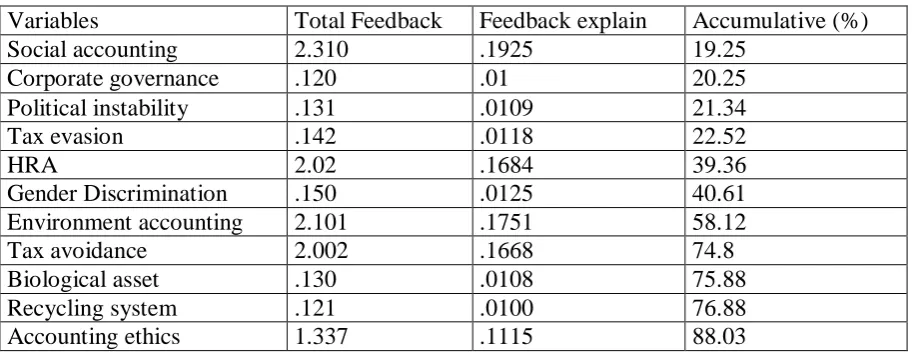
Table -1: Survey Feedback
Variables Total Feedback Feedback explain Accumulative (%)
Social accounting 2.310 .1925 19.25
Corporate governance .120 .01 20.25
Political instability .131 .0109 21.34
Tax evasion .142 .0118 22.52
HRA 2.02 .1684 39.36
Gender Discrimination .150 .0125 40.61
Environment accounting 2.101 .1751 58.12
Tax avoidance 2.002 .1668 74.8
Biological asset .130 .0108 75.88
Recycling system .121 .0100 76.88
Copyright 2017 GMP Press and Printing (http://buscompress.com/journal-home.html) ISSN: 2304-1013 (Online); 2304-1269 (CDROM); 2414-6722 (Print)
Balanced Scorecard 1.436 .1197 100
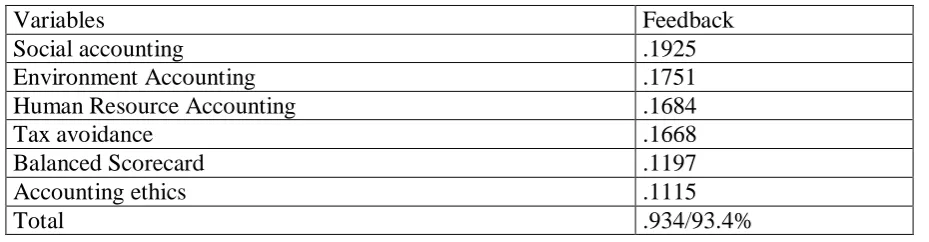
Table -1.2: Most emphasized feedback value based on variables
Variables Feedback
Social accounting .1925
Environment Accounting .1751
Human Resource Accounting .1684
Tax avoidance .1668
Balanced Scorecard .1197
Accounting ethics .1115
Total .934/93.4%
Table -1.3: CSR data on the basis of region & factory size
Corporate Social Responsibility Total (%)
City region Rural region
Run by big garments factory 39 22 61
Run by small garments factory 14.4 18 32.4
Total 53.4 40 93.4
4. RESEARCH METHODOLOGY & HYPOTHESIS TESTING
The study has adopted Bangladeshi garments factory with full-time employees exceeding 140 & annual sales turnover of exceeding $15 million which extend into cities & rural region of Bangladesh. The research population consists of two categories responder such as (a) employer & (b) employee of these garments factory which is numerically 93.4.Total sample numbers include 44 employees & 17 employers from big garments factory, 8.4 employees & 24 employers from small garments factory. This study has used Centroid method to analyze data. For hypothesis testing, a statistical model such as Chi-square & Yates' correction used to test research hypothesis. A questionnaire composed of two parts; demographic profile & factors that show relationships between Accounting & CSR. Demographic profile used to get information about respondent's background, gender, age, race, educational level and occupation. A set of the closed-minded questionnaire developed by CSR & Accounting related all information to focus factory performance. The questionnaire used 7 points summate scaling that starts from point 1 strongly disagree to point 7 strongly agree with point 4 reflecting neither agree nor disagree.
This study adopts the perspective that there is no difference so far as CSR run by big garments factory & small garments factory in cities & rural region. On the basis of this assumption, we can develop the following hypothesis
H1: Effective relationship between Corporate Social Responsibility & Accounting is equaled
Copyright 2017 GMP Press and Printing (http://buscompress.com/journal-home.html) ISSN: 2304-1013 (Online); 2304-1269 (CDROM); 2414-6722 (Print)
H2: There is no positional difference between CSR run by big garments & small garments in
cities & rural of Bangladesh.
With this hypothesis the expectation of CSR run by big garments factory in cities would be:
Expectation of (AB)=(A)×(B)
N
Where A= CSR run by big garments
B= CSR in cities
(A)=61; (B) =53.4 & N= 93.4
∴ Expectation of (AB)= 61 ×53.4
93.4 = 34.875803
Table -1.5: Expected frequencies
City region Rural region Total
Run by big garments factory 34.875803(AB) 26.124197 (Ab) 61 Run by small garments factory 18.524197 (aB) 13.875803 (ab) 32.4
Total 53.4 40 93.4
Table -1.6: Chi-square ( χ2)
Groups Observed frequency oij Expected frequency Eij (oij −Eij) �o
ij– Eij �2÷ Eij
(AB) 39 34.875803 4.124197 .488
(Ab) 22 26.124197 -4.124197 .651
(aB) 14.4 18.524197 -4.124197 .918
(ab) 18 13.875803 4.124197 1.226
χ2 =∑�oij– Eij � 2
Eij = 3.283
As one cell frequency is only 1.5625 in the given 2×2 table, so we can also compute χ2 value through Yates’ correction & this is as under:
χ2(Corrected)= [|39-34.875803|-0.5]2/34.875803+ [|22-26.124197|-0.5]2 /26.124197 +
[|14.4-18.524197|-0.5]2 /18.524197 + [|18-13.875803|-0.5]2/13.875803
=.376+.818+1.154+.946=3.294
∴ Degrees of freedom= (c-1) (r-1) = (2-1) (2-1) =1
Copyright 2017 GMP Press and Printing (http://buscompress.com/journal-home.html) ISSN: 2304-1013 (Online); 2304-1269 (CDROM); 2414-6722 (Print)
5. DATA ANALYSIS
First centroid variable A =.1796
.933,
Above information are presented under the following
Table -1.8: First centroid variable A
Variables variable loading concerning first centroid factor A
Social accounting .192
Environment Accounting .168 Human Resource Accounting .175
Tax avoidance .167
Balanced Scorecard .112
Accounting ethics .119
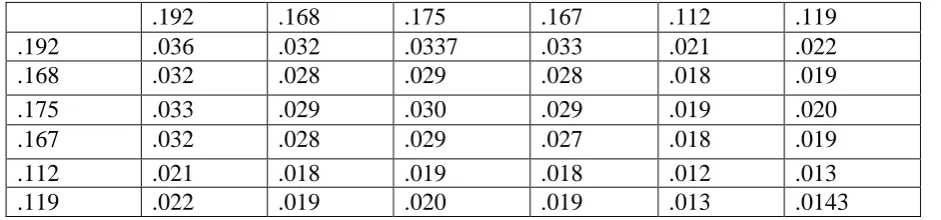
Now develop first matrix of variable cross product,Q1, to obtain the second centroid variable B
Table -1.8: Second centroid variable B
.192 .168 .175 .167 .112 .119
Calculate first matrix of residual coefficient (R1) by subtracting Q1
Table -1.9: First matrix of residual coefficient (R1)
.192 .168 .175 .167 .112 .119
.192 .0999 .0004 0 -.0009 .0004 .001
Copyright 2017 GMP Press and Printing (http://buscompress.com/journal-home.html) ISSN: 2304-1013 (Online); 2304-1269 (CDROM); 2414-6722 (Print)
.175 .0007 .0004 .0006 .0002 .0005 .0009
First Centroid variable B=.1025
.344,
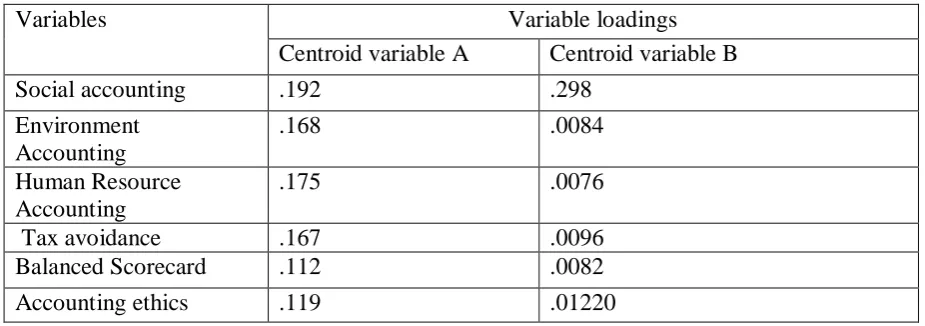
Table -2.1: Matrix of variable loading
Variables Variable loadings
Centroid variable A Centroid variable B
Social accounting .192 .298
Environment
Balanced Scorecard .112 .0082
Accounting ethics .119 .01220
Table -2.2: Communality & Eigen value
Variables Variable loadings Communality ( h2)
Copyright 2017 GMP Press and Printing (http://buscompress.com/journal-home.html) ISSN: 2304-1013 (Online); 2304-1269 (CDROM); 2414-6722 (Print)
Above variable analysis (table-2.2) indicates that variable A has loaded in excess of .025 on all variables, such a variable is usually called ‘' general variable'' & taken to represent whatever it is that all the variables have in common. Now we can consider selected six (6) variables to the product of some unobserved variable. The study chose variables name in such a way that it conveys what it is that all variables that correlate with it (load on it) have in common. Variable B has all loadings in excess of .025. The total variance (V) in variable analysis takes as equal to the number of variables involved on the basis of a presumption that variables standardized. So V= 4.0, the row labeled ‘'Eigenvalue'' or ‘'Common variance'' gives the numerical value of that part of the variance attributed to the variable in the concerning column above it. These are found by summing up the squared values of the corresponding variable loadings. Thus the total value, 4.0, is partitioned into .150 as Eigenvalue for variable A & .089 as Eigenvalue for variable B & the total .239 as the sum of Eigenvalues for these two variables. The corresponding proportion of the total variance, 4.0, show in the next; where we can see that 3.9% of the total variance related to these two variables, that is about 3.9% of the total variance is common variance whereas remaining 96.10 % of it made up of portions unique to each variable & the techniques used to measure them. The last row shows that of the common variance about 63% accounted for by variable A & the other 37% by variable B.
Thus, it concluded that the two variables together'' explain'' the common variance. So, we can classify above variables into following categories:
a. Perfectly explained variables b. High positive variables c. Multiple variables
Perfectly explained variables
Communality =Socialaccounting+HumanResourceAccounting
Copyright 2017 GMP Press and Printing (http://buscompress.com/journal-home.html) ISSN: 2304-1013 (Online); 2304-1269 (CDROM); 2414-6722 (Print)
Multiple variables
Communality =BalancedScorecard+Accounting2 ethics =(.013+2.014) =.0272 = .0135 (Mean value)
From the above communality analysis, it is found out that perfectly explained variables have higher Mean value (.078) than others. So, we can say that social accounting & Human resource accounting perfectly correlated with CSR to enhance factory performance. Then, high positive variables have higher Mean value (.028) than multiple variables that is positively correlated with perfectly explained variables to enhance factory performance. After that, multiple variables have least Mean value compare to others that are effectiveness of multiple variables depend on perfectly explained variables & high positive variables where CSR works as moderate variables.
6. RESULTS & DISCUSSION
The study has found highest feedback value (.1925) about social accounting which implies that most of the garments factories check cost & benefit to do socially responsible actions which consistent with the findings of Stephen Erfle and Michel Frantantuono. They emphasize that cost of operating a business is something more than what disclosed in public accounts, such as, pollution of environment (noise, water, air etc), spread of diseases, dislocation of inhabitants of a locality, local housing & transport problems, closure of cottage industry, social tensions & several other social evils.
These all elements they consider as the social liability. Then, they emphasize on providing roads, schools & colleges, dispensaries, railway lines, employment, etc. which considered the social asset. These all social issues enhance financial performance by creating corporate reputations. What social accounting does: social accounting is an approach to reporting a firm's activities which stress the need to show socially relevant behavior, determine those to whom the factory is accountable for its social performance and develop measures and reporting techniques. Therefore social accounting refers to CSR through social issues (social asset & social liability).
Concerning environment accounting, the study found relevant feedback (.1751) with earlier research work (Subramaniam, 2010 & Gray, 1995) which implies that most of the garments factory emphasis on 'green' issues. This green issue involves the environmental aspects of production. Activities directed towards alleviating or preventing environmental deterioration or pollution, such as air, water, noise pollution, and conservation of scarce resources & the disposal of solid waste included in environment accounting. Without proper economic environment or production climate, no garments factory can think about its expansion or revenue. What is your product quality, are you assure that factory going to produce a quality based product, are factory randomly through poisons into the river, are factory doing dangerous chemical testing on animals; these all slogans of CSR. So according to this point of view, we can say that CSR & Environment accounting intimately connected with each other.
Copyright 2017 GMP Press and Printing (http://buscompress.com/journal-home.html) ISSN: 2304-1013 (Online); 2304-1269 (CDROM); 2414-6722 (Print)
resources of a company that is the social performance of a business directed towards the well-being of employees. These are:
1. Organizational climate
1.2. Substantial commitment of time & effort to improve HRA
1.3. Direct recruitment vs. promotion
1.4. Impact of budgetary control on human relations & organizational behavior
1.5. A decision on relocating plants, closing down existing units, developing overseas subsidiaries.
1.6. Choosing the right method to valued HRA, that is Historical cost, Replacement cost, Opportunity cost.
1.7. Implicate capitalized human resources, once they recorded, that is how should the human resource be amortized? What are the tax implications of human resource amortization? What are the implications of human resource accounting on internal & external auditing?
1.8. HRA is emphasizing on internal & external auditing of each garments factory to give the true & fair view. It also emphasizes social auditing to recognize human resource. So, CSR & HRA has a relationship to improve garments sector.
Regarding tax avoidance, the findings of the study are consistent with the findings of earlier research works (Moser & Martin, 2012; Preuss, 2012) which imply that CSR linked with tax avoidance in two competing views of the firm—shareholder and stakeholder. Most of them argue (.1668) that tax avoidance is an issue between the firm and the government. Without tax revenue, governments cannot spend money on infrastructure and community neither services (education, transportation) for firm's employees nor, can give the services demanded by corporations including financial markets, legal systems, and oversight (Avi-Yonah, 2008; Sikka, 2010). So, CSR relates with tax avoidance to pay the fair tax and, set corporate principle to avoid unethical actions designed only to lower taxes.
This empirical study found relevant feedback (.1197) with earlier studies (Porter and Kramer 2006 & et al) which show that CSR has a positive relation with the balanced scorecard. They emphasize that balanced scorecard with CSR give a set of accounts with information which addresses both financial & non-financial performance. The balanced scorecard report factory performance from four separate perspectives:
Financial perspective- profits, capital employed earnings per share, etc.
Customer perspective- how well customer wants have satisfied, a number of complaints received per month, etc.
Internal perspective- internal efficiency of the factory, percentage of units requiring, reworking, etc
Copyright 2017 GMP Press and Printing (http://buscompress.com/journal-home.html) ISSN: 2304-1013 (Online); 2304-1269 (CDROM); 2414-6722 (Print)
In this systematic path overall factory performance measured by the benchmark. Benchmark show what they do & why they do it, provide an overall view of competitors, fully committed to achieving best practice which is indirectly related to CSR. In consequence, CSR introduces the value for money (VFM).
Value for money
Economy Efficiency Effectiveness
Money spent Inputs purchased Output produced
V V V
Inputs purchased outputs produced objectives achieved
“Fig”1 Value for money
If we see the above diagram, we will see that, ultimately, VFM relates money spent to factory objectives achieved. It also focuses financial performance (income statement) as well as non-financial performance, especial quality. So, CSR with balanced scorecard builds up a quality based product or quality based production, by monitoring factory performance.
Concerning accounting ethics, the findings (.1115) of the study are consistent with stakeholder theory (Vos 2003; Philips 2004, Neville and Menguc 2006; Sen, Bhattacharya & et al, 2006) which implies that factory should not give attention only to shareholders and neglect employers´ and customers´ interest. Not only profit maximizing, but also the concern for several stakeholders´ interests, not only investors, are important. The company must relate to several ethical factors as its activities influence several groups or organizations.
7. CONCLUSION
Copyright 2017 GMP Press and Printing (http://buscompress.com/journal-home.html) ISSN: 2304-1013 (Online); 2304-1269 (CDROM); 2414-6722 (Print)
complexity of global financial markets and sophistication of investor, as well as the increased importance of environment accounting and social accounting impacts, has changed the way successful corporation look at what positively impacts their bottom line. Therefore, garments factory that wants to meet long-term financial success must consider what is known as the Triple Bottom Line: Economic, Environmental and Social. This Triple Bottom Line is also known as the 3Ps: Profit, Planet, and People.
Regarding Human Resource Accounting, the findings of the study are consistent with earlier studies (Skinner, 2002, p.1, SHRM, 2007, p. 27) which suggest that effective HR policy with CSR practices are appreciably much-enhanced employee's morale, loyalty, retention, turnover, productivity & overall factory performance. The findings of the study confirmed with earlier research work (Moser & Martin, 2012; Preuss, 2012, Avi-Yonah, 2008; Sikka, 2010) which imply that CSR associated with tax avoidance by introducing two competing views—shareholder and stakeholder which is indirectly referred to firm & government. CSR monitor unethical factory behavior by paying the fair tax and, help government to development infrastructure, community service (education, transportation) & corporation's services (financial markets, legal systems, and oversight).Findings of balanced scorecard also consistent with earlier studies (Crespo, H, et al, 2005, p.1 Porter and Kramer 2006 & et al) which show that CSR with balanced scorecard checks financial & non-financial performance of garments factory.
Therefore it concluded that CSR doesn't only refer to philanthropic activity also advice factories ethical financial behavior, that is it's a direction to check & evaluate proper
corporate behavior as if they are not involved or running any unacceptable financial motive.
In light of these valuable findings, the study has some limitation to it. The study has considered only highest respondent's variable analysis that created a problem in selecting research variables & sample size. In some cases, some of the factories were not able to give concrete information. As a result, it was quite difficult to get all the necessary data that required completing the study. Therefore, it may interesting to have a sample of the lowest respondent's variables to investigate the relationship between CSR & Accounting which may consider as a research gap.
REFERENCES
[1] Avi-Yonah, R. S. (2008), "Corporate social responsibility and strategic tax behavior. In W. Schoen (Ed.) Tax and corporate governance: 183-198. Berlin: Springer-Verlag. [2] Bangladesh Garment Manufacturers and Exporters Associations(2013)", Trade
Information. Retrieved from
http://www.bgmea.com.bd/home/pages/TradeInformation#.UchZPjvOHME
[3] Brown, T.J., & Dacin, P.A. (1997) The company and the product: Corporate associations and consumer product responses. Journal of Marketing, 61(1), 68–84
[4] Carroll, A.B. (1999). Corporate social responsibility: Evolution of a definitional construct. Business and Society, 38, pp. 268–295
[5] Clean Clothes Campaign (2012). Hazardous Workplaces: Making the Bangladesh Garment industry safe. Retrieved from
Copyright 2017 GMP Press and Printing (http://buscompress.com/journal-home.html) ISSN: 2304-1013 (Online); 2304-1269 (CDROM); 2414-6722 (Print)
[6] Christensen, J., & Murphy, R. 2004. The social irresponsibility of corporate tax avoidance: Taking CSR to the bottom line. Development, 47(3): 37-44.
[7] Cooper, S., D. Crowther, M. Davies, and E. Davis. 2001. Shareholder or Stakeholder value: The development of indicators for the control and measurement of performance. London: The Chartered Institute of Management Accountants.
[8] Elkington, John, Cannibals with Forks: the Triple Bottom Line of 21st Century Business, 1998
[9] Enderle, G &Tavis, AL, 1998, "A Balanced Concept of the Firm and the Measurement of its long-term Planning and Performance", Journal of Business Ethics, Issue: 17 (11) [10] European Commission (2013). Countries and regions: Bangladesh. Retrieved from
http://ec.europa.eu/trade/policy/countries-and-regions/countries/bangladesh/
[11] El Economista (2012) Triple Bottom Line: Otra Forma de media el éxito Empresa rial. Retrieved from http://eleconomista.com.mx/finanzas-personales/2012/10/04/triple-bottom-line-otra-forma-medir-exito-empresarial
[12] European Commission (2001). ‘Promoting a European Framework for Corporate Social Responsibility,' green paper, EMCC, Dublin.Google Scholar
[13] Frooman, J. 1994. Stakeholder Influence Strategies. Academy of Management Review 24, no. 2: 191–206
[14] Fombrun, C.J., (1996), Reputation: Realizing Values from the Corporate Image, (Harvard Business school Press, Boston, MA)
[15] Friedman, M. 1970. The social responsibility of business is to increase its profits. NY Times, SM17.
[16] Gray, R., Kouhy, R., and Lavers, S. (1995) Corporate social and environmental reporting a review of the literature and a longitudinal study of UK disclosure. Accounting, Auditing & Accountability Journal, 8 (2), pp. 47-77
[17] Gray R. H., Kouhy R. & Lavers S. (1995), "Corporate social and environmental reporting: A review of the literature and a longitudinal study of UK disclosure", Accounting, Auditing, and Accountability Journal, 8 (2) 47-77.
[18] Hopkins, Michael. (2004), "Corporate social responsibility: an issues paper", Working Paper No. 27, International Labour Office.
[19] Heath, J. and Norman, W. (2004), "Stakeholder Theory, Corporate Governance and Public Management: What Can the History of State-Run Enterprises Teach us in the Post-Enron Era?", Journal of Business Ethics, 53, 247-265
[20] Harvard Law Review, 63, pp. 853–70.
[21] ILO (2013), ILO statement on reform of Bangladesh labor law. Retrieved from http://www.ilo.org/global/about-the-ilo/media-centre/statements-and
speeches/WCMS_218067/lang--en/index.htm
[22] ICF International (2012). Child Labor in the Informal Garment Production in Bangladesh. Retrieved from
http://www.dol.gov/ilab/programs/ocft/PDF/2013GarmentBangladesh.pdf
[23] Jackson, K. T., (2004), ‘Building Reputational Capital: Strategies for Integrity and Fair Play that Improve the Bottom Line', Oxford University Press, Oxford.
[24] Jenkins, R., & Newell, P. 2013. CSR, tax, and development. Third World Quarterly, 34(3): 378-396.
[25] Kotler, P. & N. Lee. (2005), "Corporate Social Responsibility." John Wiley & Sons, Hoboken.
Copyright 2017 GMP Press and Printing (http://buscompress.com/journal-home.html) ISSN: 2304-1013 (Online); 2304-1269 (CDROM); 2414-6722 (Print)
[27] Mitchell, R., B. Agle, and D. Wood. 1997. Toward a theory of stakeholder identification and salience: Defining the principle of who and what really counts. Academy of Management Review 22, no. 4: 853–96
[28] Matten, D., & Moon, J. (2004) Implicit and Explicit CSR: A conceptual framework for understanding CSR in Europe. ICCSR Research Paper Series (29-2004), University of Nottingham
[29] McIntyre, R. S., Gardner, M., & Phillips, R. 2014. The sorry state of corporate taxes: What Fortune 500 firms pay (or don't pay) in the USA and what they pay abroad – 2008-2012. http://www.ctj.org/corporatetaxdodgers/sorrystateofcorptaxes.pdf first accessed 20 December 2014.
[30] Moser, D., & Martin, P. (2012), "A broader perspective on corporate social
responsibility research in accounting", The Accounting Review, 87(3): pp 797-806. [31] Neville, B., and B. Menguc, (2006), "Stakeholder multiplicity: Toward an
understanding of the interactions between stakeholders", Journal of Business Ethics 66: pp377–91.
[32] Novo Nordisk (n.d.) Business Ethics and Vision and Strategy. Retrieved December 23, 2008, from http://www.novonordisk.com/sustainability/values in action/Business-ethics/business-ethics.asp
[33] Neville, B., and B. Menguc (2006), "Stakeholder multiplicity: Toward an understanding of the interactions between stakeholders", Journal of Business Ethics 66: pp 377–91. [34] Porter, M. E. and M. R. Kramer (2006), "Strategy & Society: The link between
competitive advantage and corporate social responsibility," Harvard Business Review, December, pp. 78 – 92
[35] Preuss, L. 2012. Responsibility in paradise? The adoption of CSR tools by companies domiciled in tax havens, Journal of Business Ethics, 110: pp1-14
[36] Philips, R. (2004), "Ethics and managers obligation under stakeholder theory", Ivey Business Journal March/April: 1–4.
[37] Ruf, B. K. et al., (2001), "An empirical investigation of the relationship between change in corporate social performance and financial performance: A stakeholder theory
perspective", Journal of Business Ethics 32: pp143–56.
[38] Reynolds, et al. (2006), "Stakeholder theory and managerial decision-making: Constraints and implications of balancing stakeholder interests", Journal of Business Ethics 64: pp 285–301.
[39] Rasche, A., and D. Esser (2006), "From stakeholder management to stakeholder accountability", Journal of Business Ethics 65: pp 251–67
[40] Skinner, C. (June 2002), "Links Between CSR and HR", Ethical Corporation Magazine.
[41] Society for Human Resource Management (SHRM) (2007), Corporate Social
Responsibility: United States, Australia, India, China, Canada, Mexico, and Brazil: A Pilot Study. Virginia, US: Author.
[42] Sikka, P. (2013), "Smoke and Mirrors: Corporate social responsibility and tax avoidance – a reply to Hasseldine and Morris", Accounting Forum, 37: pp15-28. [43] Timonen, P. (2008), "Corporate social responsibility and strategic tax behavior –
Comment on the paper by Reuven S. Avi-Yonah. In W. Schoen (ed.) Tax and corporate governance: 199 – 203). Berlin: Springer-Verlag.
Copyright 2017 GMP Press and Printing (http://buscompress.com/journal-home.html) ISSN: 2304-1013 (Online); 2304-1269 (CDROM); 2414-6722 (Print)
[45] Sen, S., C. Bhattacharya, and D. Korschun (2006), "The role of Corporate Social Responsibility in Strengthening Multiple Stakeholder Relationships: A Field Experiment" Journal of the Academy of Marketing Science 34, no. 2: pp 158–66. [46] Sachs, et al. (2006), "Corporate Social Responsibility for a ‘‘stakeholder view''
perspective: CSR implementation by a Swiss mobile telecommunication provider, Corporate Governance 6, no. 4: 506–15.
[47] Subramanian et al. (2010), "An approach to integrating environmental considerations within managerial decision-making", Journal of Industrial Ecology, 14 (3) (2010), pp. 378–398
[48] Thorne, et al.( 2003), "Business and Society: A strategic approach to corporate citizenship", Boston: Houghton Mifflin Company
[49] UN Global Compact (n.d.), "Occupational safety and health in the supply chain", Retrieved
fromhttp://www.unglobalcompact.org/docs/issues_doc/labour/tools_guidance_materials /Occupational_Safety_Health_in_the_Supply_Chain.pdf
[50] Vos, J. (2003), "Corporate Social Responsibility and the identification of stakeholders", Corporate Social Responsibility and Environmental Management 10, no. 3: pp141–52. [51] Wulfson, M. (2001), "The ethics of corporate responsibility and philanthropic
ventures", Journal of Business Ethics, 29: pp 135–45.