VOLUM E 26 No. 1 Febr uari 2014 Halam an 3-12
* Faculty of Da’wa and Communication Science, Syarif Hidayatullah State Islamic University, Jakarta
“SELLING” SELF-IM AGE IN THE ERA OF NEW M EDIA
Rulli Nasrullah*
ABSTRAK
Perkembangan media jurnalisme warga memberikan kesempatan bagi khalayak untuk memproduksi berita yang selama ini dikuasai oleh lembaga media massa. Dalam kasus ini, warga tidak hanya menjadi konsumen berita semata, tetapi juga bertindak sebagai produsen berita dan konsumen pada waktu yang sama (prosumer). Berdasarkan fenomena tersebut, penelitian ini mencoba untuk melihat bagaimana komodifikasi yang dilakukan oleh warga. Dengan menggunakan metode analisis komunikasi termediasi komputer dengan media Kompasiana sebagai instrumen penelitian, peneliti menemukan bahwa ruang jurnalisme warga telah digunakan sebagai media untuk komodifikasi diri sesuai target atau nilai yang ingin dicapai. Hasil penelitian ini juga menunjukkan bahwa warga jurnalisme menggunakan di Kompasiana untuk mencapai motif pribadi seperti untuk mendapatkan keuntungan materi atau untuk membangun citra diri atau wacana. Di tingkat media ruang, fasilitas Kompasiana seperti deskripsi profil dan kolom komentar merupakan fasilitas yang dapat digunakan sebagai aktivitas prosumer. Kegiatan dalam fasilitas ini adalah mungkin bagi khalayak untuk mempromosikan produk atau mempromosikan diri pengguna itu sendiri layaknya produk. Berdasarkan pertanyaan penelitian dan temuan di lapangan, peneliti membuat kesimpulan, pertama, kehadiran media jurnalisme warga adalah penonton positioning bukan sebagai entitas pasif lagi dan hanya mendapatkan efek informasi seperti yang diproduksi oleh industri media. Kedua, keterlibatan penonton sebagai subjek memberikan informasi dalam jurnalisme warga untuk kepentingan pribadi, misalnya untuk kegiatan ekonomi praktis.
Kata Kunci: internet, jurnalisme warga, khalayak, Kompasiana, media baru, prosumer
ABSTRACT
The rise of citizen journalism gives the public an opportunity for producing news which has been previously controlled by the mass media institutions. In this case, the citizen acts not only a news consumer, but also as a news producer and consumer at the same time (prosumer). Based on these phenomena, this research tries to see how citizens carry out commodification. Analyses of computer-mediated communication with the media of Kompasiana reveal that space for citizen journalism has become a medium for self commodification in accordance with their target or values they want to achieve. The results of this research also show that the citizens used the media in order to gain personal motives such as to get material benefits or to build a self-image. In the level of media space, the facilities provided by Kompasiana like a description of profile and comment column can be used for prosumer activity. It is possible for the audience to employ this facility to promote the products or the users themselves as products. Based on research questions and findings in the field, some conclusions can be drawn. First, the presence of media citizen journalism no longer positions the audience as a passive audience entity, affected only by information produced by the media industry. Second, the audience is involved as a subject who gives information in citizen journalism for private interest such as for practical economic activity.
INTRODUCTION
The rise of alternative media such as citizen journalism in distributing information (news) is a sign not only of how technology transforms the pattern of information consumption from traditional media to new media, but also of how the internet influences the mechanism of production, distribution, value exchange and information consumption, which are centered on traditional media for all this time (Gillmor, 2004). The characteristics of internet interaction allow not only one-way communication as in traditional media, but it also becomes more interactive by means of new media. Such communication does not use a pattern of one source spreading to many (broadcasted), centered, passive audience and recipients in an isolated position anymore (Levy, 2001:223; Kasiyan, 2012:292-302), but it is more dynamic, uncentered and involving audience (Holmes, 2005). For example, a phenomenon of users’ contents generated on the internet explains how audience produce, distribute and consume those media contents (Hesmondhalgh, 2010; Barlow, 2007). Such phenomenon is shown in citizen journalism.
Stuart Alan in Citizen Journalism, Global
Perspective (2009) states that there are various
terms of citizen journalism including grassroots
journalism, open source journalism, participatory journalism, hyperlocal journalism, distributed journalism and networked journalism. The use of these terms is basically based on the participation of the audience and the awareness of the rise of audience as citizens in producing information is basically the core of the term ‘citizen journalism’. Journalism academicians argue that when discussing citizen journalism, there are at least two categories of audience participation in which the audience cooperate with journalists or professional media institutions and the audience work individually and independently. The first category can be seen in the definition adopted by Marcel Danesi (2009:62), Ian Hargreaves
citizen journalism is an individual who contributes and integrates with professional journalists. Based on the definition above and the scope of the term ‘citizen journalism’, which citizen journalism is here defined as “a journalistic activity conducted by citizens, either amateur or professional, in publishing, distributing and developing more interactive information by means of traditional media or new media”. The words “developing” and “interactive” imply that the media of citizen journalism, especially portal or social networking sites on the internet enable interaction between citizens.
Meanwhile, the politics of self-representation is a process or effort carried out by the audience to create trust which influences the types of meaning. This definition is actually popularized by Arvidsonn (2005:236-7 in Sinclair, 2011:212), but the prevailing definition is the politics of representation of traditional market reality which involves management of the relation between product, price, place, packaging and promotion. According to this definition, the researcher considers how a space in media of citizen journalism is used by the audience to practice the politics of representation by producing contents centered to the audience and this image eventually can influence the audience as the consumer to consume the produced commodities. Therefore, the politics of representation establish fan audience which basically does not end with consuming commodities produced by the image maker (commodification of audience), but also play a role in distributing commodities (commodification of workers) by means of citizen journalism media (see Davis, 2003:41-49).
the audience plays a role in producing brand and inviting fan audience. The politics of representation or branding in the political economy perspective, according to Sinclair (2011:211), can be defined as “the process of transforming use values into
exchange values”. The meaning of politics of
representation, in Sinclair’s perspective, is not different from the meaning of the commodification term (Mosco, 1996/2009) that a product has value like using others commodities. An image is basically a different commodity and in reality when an individual wants to consume a commodity, he/she usually will look for a reference of the image in such commodity, or in this case, a brand. Furthermore, the politics of representation in citizen journalism media does not only explain how the content is consumed by the audience as consumer. All tools even self-identity of user in citizen journalism media can transform into a medium of image makers and change it into a commodity (see Bruns, 2010).
In order to answer the research questions about how the practices of functioning media citizen journalism by the audience (or the user of
Kompasiana as a new media of citizen journalism)
to “selling” their self-image, the researcher makes four levels of analysis by employing Computer-Mediated Communication Analysis, namely media space, media archive, media object and experiential stories. These levels of analysis are developed by the researcher by analyzing the relation in cyberspace which places the cyberspace (web sphere) as a unit of analysis as proposed by December (1996) and also an approach in perceiving the reality of internet functions based on the categories developed by Bell (2011). Media space, media archive and media object are the levels in which the research focus on virtual space or network, while media experiential story level is a multilevel analysis which views how a fact (offline) serves as the cause or the effect of the network realities (see Picture 1).
The level of media space can reveal how structure of new media is, for example how to create a procedure for publishing content of media display. The level of media archive is used to see how content—as a text and meaning contained therein—is published by means of new media. The next level is media object. In this level, the media object is a specific unit because the researcher can observe the activities and interaction between the users or inter-users. In the experiential story level, virtual world and real world are correlated in order to observe and reveal the underlying motives functioning and publishing the content in new media and also in order to see that what happens in the network (online) has a considerable influence in the real world (offline).
RESEARCH FINDINGS
At the level of media space, tools provided by
Kompasiana as citizen journalism media basically
are tools which can be used by the audience as a space of the politics of representation. Creating an account in Kompasiana is open; the user has the authority to build an avatar in the column of the user’s identity, to write his/her own profile in the identity column and to produce information and news. The functions and examples of the space in compassion as the politics of representation will be explained at the level of media archive.
In order to simplify the description of the research findings in the level of media archive, the
Media space
Media archive
Media object
Experiential stories Picture 1
researcher divides them into two categories, namely the user identity column and the content column. They are different because the identity column tends to be stable and is rarely updated, while the content column is a tool which is frequently updated with new information and news. In the identity column, Kompasiana gives space for users to do the politics of self-representation. In order to show how this image is displayed, two accounts, one owned by Hazmi Fitriyasa and the other by Etty Hadiwati Arief, are used as examples.
Hazmi Fitriyasa is the owner of Srondol account and also publishes a book entitled Srondol
Gayus ke Italy (Srondol Gayus to Italy), containing
a collection of contents in Kompasiana. Hamzi uses the name or identity Srondol or HamziSrondol as a nickname and identity of his account in
Kompasiana. The use of that name and
regularly-updated publication in the content column are used to make an impression that the account owner is a humor writer. Also, in the description part under the avatar display or self-profile photo, Hamzi writes a caption “Penebar virus Ceria Untuk Indonesia” or The Transmitter of the Virus of Cheerfulness for Indonesia (see Picture 2).
This fact is acknowledged by the account owner and he emphasizes that the use of the nickname and the picture attachment of book cover in the profile photo is an attempt on the politics of representation by means of Kompasiana. The use of the nickname or pseudonym is also an effort to make a “personal branding” or self-representation which is aimed at making it easy to remember by the audience or other users (Kompasianers).
Kalau pakai nama asli, selain kepanjangan, juga tidak menjual dan susah diingat, Mas… apalagi buat personal branding bagi kita yg serius di dunia menulis. hehehe… Srondol adalah nama yg cukup easy listening, easy reading dan berbau ‘humor’ untuk segment tulisan saya…. segment hiburan. Nama ’srondol’ yang aslinya adalah nama kampung di Semarang. Terinspirasi oleh musashi (samurai terkenal jepang) yang sebelum menjadi samurai bernama Takezo lalu saat terkenal memakai nama Miyamoto Musashi (Musashi dari Desa Miyamoto) (Hazmi,
interviewed on Desember 17, 2011)
Another example is Etty Hadiwati Arief, an author of fiction books, who uses a nickname “PipietSenja” in all works she has published, and also uses this pen name as the Kompasiana account as well as to present her self-image in the real world/offline.
Sudah terbiasa dengan nama pena, bukan hanya di Kompasiana, sejak menulis dan menjadi seorang penulisnya sudah memakai PipietSenja. Banyak penggemar lama seperti mereka yang sering baca karya saya di majalah Bobo, dia menemukan saya secara pribadi dan bisa komunikasi melalui Kompasiana. Ketika jumpa di darat, kopasaran; dia memelukku eraaaaat sekali, duuh, terharuuu!
Tetapi, ternyata banyak juga yang tak pernah mengenal saya, tak pernah baca karya saya, entah karena dia memang tak suka sastra atau buku populer. Pokoknya, dia tidak tahu; siapa
Picture 2
Srondol account in Kompasiana
Retrieved on 22nd Desember, 2011 from http://
itu PipietSenja. Lantas, dia komentar; weeeei, Piiiiet, Pieeet….Hehehehe. (PipietSenja, interviewed on December 16, 2011)
This choice is certainly a kind of strategy which brings the virtual world from the real world. Using pseudonym and photo display in the column of identity information in the Kompasiana account is basically to make other users easy to find the existence of the author in the virtual world. Furthermore, this step basically is an effort to sustain and establish communication with fans of the author (see Picture 3).
workers she met in foreign countries or based on BMI’s report.
Dalam 5 tahun terakhir, saya konsen bantu anak-anak BMI/TKW Hong Kong sebagai fasilitator, penyunting bagi karya-karya mereka. Kemudian, saya diundang oleh Dompet Dhuafa Hongkong dan ditugaskan untuk menjadi sahabat BMI Hongkong, konsultan dan guru menulis mereka.
Saya hanya berusaha ikut membantu menyuarakannya saja, via media-media online, bukan hanya Kompasiana melainkan jejaring social lainnya. (PipietSenja, on interviewed
December 16, 2011)
The aforementioned cases show that the users employ the identity column in Kompasiana to do such politics of representation. An image affirmation in that identity column is again emphasized by the contents in the Kompasiana content column because in this part the audience as users publish information or news related to the image they build.
The account PipietSenja shows that the user often writes her experience of interacting with migrant workers who work in foreign countries through http://www.kompasiana.com/www. pipitsenja.multiply.com (since 2012 this account user changes it into http://www.kompasiana.com/ pipietsenja). From the columns provided as the content categories in Kompasiana, there are 102 articles in the column on foreign issues (Rubrik
Luar Negeri) and it becomes the most frequent
column filled by the users. The researcher obtained these latest and newest data on August 2012.
Furthermore, based on the researcher’s observation from July to December 2012, posting or publication of information and news uploaded by the user contain many cases of migrant workers. From 56 articles published in the column on foreign issues, 50 or 89 percent of the total publication is about migrant workers, while only 6 articles or about 11 percent of the total publication does not contain migrant workers, but the user’s reports when visiting a country.
Picture 3
PipietSenja Account in Kompasiana
Retrieved on 16th Desember, 2011
http://www.kompasiana.com/www.pipitsenja. multiply.com
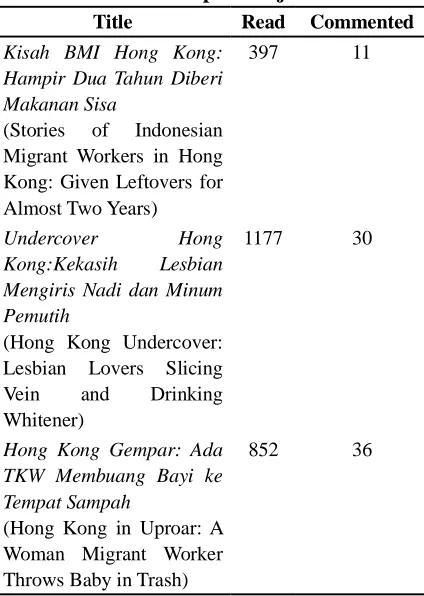
At the level of the media object, the politics of representation established by the user in Kompasiana space basically emerges as what’s in this research is called fan culture. Based on the total comments from users or how many times that page is seen, it shows that the contents published by Hamzi or PipietSenja have space for and are read by the audience (see Table 2).
In addition, PipietSenja also invites
Kompasiana users who are migrant workers to
write their stories and they will be published in a book. This book is finally published entitled
Surat Berdarah Untuk Presiden (Bloody Letters
for the President) (http://media.kompasiana.com/ buku/2011/07/15/ketika-bmi-menggugat-inilah-surat-berdarah-untuk-presiden/).
Karena ada banyak kisah nestapa, pilu dan sukses tentang BMI yang saya rekam sendiri dari mulut para pelakunya, dan melihat dengan mata kepala sendiri ke shelter-shelter di Hongkong, Macau dan China, maka saya pun tergerak untuk lebih menyuarakannya secara internasional.
Alasannya, sebagai sesama perempuan, sebagai anak bangsa merasa sangat prihatin dengan kondisi BMI di luar negeri. Ternyata bahkan di Hongkong yang konon hukum serta aturannya sudah bagus sekalipun tetap saja banyak terjadi kisah mengenaskan; diperkosa majikan, anak majikan, dianiaya sampai cacat bahkan mati secara mengenaskan, dibunuh oleh pasangan kumpul kebonya. Alamaaak!
(PipietSenja, interviewed on December 16, 2011)
The total read and commented contents show that the contents on migrant workers draw attention from other users. Certainly, it is not easy to draw a great deal of attention in Kompasiana which has a total number of more than one hundred thousand users and a total number of more than five hundred thousand articles uploaded in a day. Moreover, the researcher observed that the article entitled “Kisah
Nestapa TKW Hong Kong: Dua Bulan Diperkosa Berkali-kali” (A Sorrowful Story of Migrant
Workers in Hong Kong: Raped Many Times within Two Months) published on 30th September 2011
gets a total readership of 3915 (Picture 4). This is what is meant by that fan concept that fans will consume the things produced by the image maker, which in this case is PipietSenja.
Table 1
Topics about Migrant Workers in July-December in Pipiet Senja Account.
Topic Total
The result of individual observation in looking condition or situation of migrant workers in foreign countries
13
Rewritten Experiences of migrant workers in foreign countries
25
Interaction or cooperation with migrant workers
8
Republication of issues and comments on migrant workers
4
Table 2
The User Interaction in 20th-22nd November
2011 Period in Pipiet Senja Account
Title Read Commented
Kisah BMI Hong Kong: Hampir Dua Tahun Diberi Makanan Sisa
(Stories of Indonesian Migrant Workers in Hong
The result of the observation also reveals in the level of experiential stories that PipietSenja has been previously known as a writer since 1975 and there have been 105 books she produced until now. The effort of transformation of the image as “a writer” and image as “a friend for Indonesian Migrant Workers” is concluded by the researcher based on not only Kompasiana media (online), but also her interaction with the real world (offline) by inviting the migrant workers to write their experiences and publish books. One of the books is entitled Surat Berdarah Untuk Presiden (Bloody Letters to the President).
Surat Berdarah Untuk Presiden, bermula dari workshop selama sebulan saya berikan kepada Buruh Migran Indonesia (BMI) di Hongkong. Kemudian, saya lontarkan wacana untuk buat Lomba Menulis Surat Kepada Presiden. Direktur Dompet Dhuafa Hongkong, Abdul Ghofur sangat mendukung, bahkan menyediakan hadiah-hadiahnya yang menggiurkan berupa; laptop, Blackberry dan ratusan buku.
Ketika sudah terkumpul sebanyak 400-an, akhirnya terseleksilah 26 kisah inspirasi, kisah nyata dan 16 surat untuk Presiden. Buku ini
langsung merebut pangsa pasar, langsung laris manis! (PipietSenja, interviewed on
Desember16, 2011)
Based on the findings and the explanation above, the researcher concludes the commodification of the citizen as audience by
Kompasiana as shown in the following table:
Table 3
Function of Kompasiana as a Space for the Politics of Representation
Level Objectives
Media Space Functioning the user identity column as wanted by the image
Media Archive
Publishing information and news as expected by the image
Media Object Resulting in the politics of
representation in the form of fans who regularly interact, either in comment column or
offl ine.
Experiential Stories
Establishing more image
through offl ine activities, for
example by publishing a book.
Picture 4
PipietSenja’s site content in Kompasiana
Retrieved on 16th Desember, 2011 http://www.
kompasiana.com/www.pipitsenja.multiply.com
ANALYSIS OF RESEARCH FINDINGS
Basically, media industry uses the practice of politics of representation in order to make profit in the media of citizen journalism. Such practice is shown in the position of audience as a commodity to make a profit as in Kompasiana. The practice occurs by, firstly, using a number of audience as consumers who are sold to advertisers; secondly, the presence and claim of Kompasiana as media of citizen journalism basically emerge what is in the terminology of politics of representation called as fans. These fans are users (Kompasianer) who are, in fact, workers who supply contents of that media. Thirdly, the large numbers of audience
(Kompasianer) as registered the users becomes
writings through Kompas.com portal or freeze page in Kompas but also by using offline activities such as publishing a book with a label or logo of
Kompasiana on the book cover, holding events,
watching shows together, folding workshop for citizen how to use blogs in Kompasiana by cooperating with sponsors and so on.
What media industry does by means of media citizen journalism is a kind of functioning citizen by means of new media, internet. If during this time, traditional media such as newspaper, radio or television posits audiences as consumers— that number of consumers become a claim that the media or program produced is a strategic selling target for the advertisers and the media contents are entirely produced by professional workers or industry employees of that media. However, new media with the citizen journalism movement created by media industry currently also creates citizen as workers who produce commodities of media contents.
The facts the researcher finds in the fields that audience actually are not totally dominated and positioned as the exploited by media industry by means of citizen journalism. There is a resistance or functioning by audiences that they also do the politics of representation by means of media of citizen journalism Kompasiana. This happens because cyberspace, a term including media citizen journalism, basically provides what is called by Jones (1997:22) “new public space”. The characteristics of digital public space, or virtual space, can be defined as general or private, intercultural or cross-language, controlled or free public. It is like a town square where we can find many kinds of characteristics, including also demographic profile. Although everyone can be in the town square, it does not mean that we automatically become a part of that space. We can find an entity grouping in a corner of the town square and see how that group is different from other groups. It is a virtual space in which the politics of representation occur as conducted by an
media industry, in this context Kompasiana, when providing media for developing citizen journalism is basically tools which work with a network; the tool which is not closed (option in) can be accessed by everyone and media industry sometimes only provides a ready-to-use software. Although, the media industry uses audience as the users for the
intrinsically or extrinsically in the text or document published.
How this politics of representation happen in citizen journalism media? The researcher finds that the audience’s effort to do the politics of representation (branding) and create fans begins from easy for the audience to create content in citizen journalism media. The politics of representation are possible to do because the publication of content or news in citizen journalism media is related to everything, event or even thought, a feeling of the account owner including an effort to build a new image by means of citizen journalism media (for example Hamzi) and to build an image from offline to online (for example Pipiet).
REFERENCES
Allan, Stuart. (2008). News Culture. New York: Open University Press.
Allan, Stuart and Thorsen, Einar (Ed.). (2009).
Citizen Journalism, A Global Perspective. New
York: Peter Lang.
Barlow, Aaron. (2007). The Rise of the
Blogosphere. London: Praeger.
Bell, David. (2001). An Introduction to Cybercultures. London and New York:
Routledge.
Bruns, Axel. (2010). From Reader to Writer:
Citizen Journalism as News Produsage
Jeremy Hunsinger, Lisbeth Klastrup, and Matthew Allen. Internet Research Handbook. Dordrecht. NL: Springer. Pp. 19-134.
Castells, Manuel. (2001). The Internet Galaxy. Oxford: Oxford University Press.
Danesi, Marcel. (2009). Dictionary of Media and
Communications. New York: M.E. Sharpe,
Inc.
Davis, Joseph E. (2003). “The Commodification of Self” in The Hedgehog Review 5(2): 41-49.
December, John. (1996). “Units of Analysis for
Internet Communication”. In Journal of Communication46 (1) Winter. 0021-9916/96.
Retrieved on 4th Ausguts, 2012 from http://
jcmc.indiana.edu/vol1/ issue4/december. Friedland, Lewis and Kim, Nakho. (2009). Citizen
Journalis in Christopher H. Sterling (ed.). Encyclopedia of Journalism. California: Sage
Publications, Inc.
Gillmor, Dan. (2004). We The Media. California: O’Reilly Media, Inc.
Hargreaves, Ian. (2005). Journalism, A Very Short
Introduction. New York: Oxford University
Press, 2nd edition.
Hesmondhalgh, David. (2010). “User-generated
Content, Free Labour and the Cultural Industries”. Ephemera 10(3/4): 267-284.
Holmes, David. (2005). Communication Theory:
Media, Technology and Society. London,
Thousand Oaks, New Dehli: SAGE Publications.
Johnson, S. (1997). Interface Culture: How New
Technology Transform the Way We Create and Communicate. New York: Harper Collins.
Kasiyan. (2012). “Hegemoni Estetika Postcolonial dalam Representasi Iklan di Media Massa Cetak Indonesia Kontemporer” in Jurnal
Humaniora 24 (3): 292-302.
Levy, P. (2001). Cyberculture, Minnesota: University of Minnesota Press.
Meikle, Graham. (2002). Future Active: Media
Activism and the Internet. New York:
Routledge.
Mosco, Vincent. (1996/2009). The Political
Economy of Communication. London: Sage
Publication.
Porter, D. (Ed.). (1997). Internet Culture. London: Routledge.
and Realty of a Citizen-engaged Press. New
York: Routledge .
Sinclair, John. (2011). Branding and Culture. in Wasko, Janet, Murdock, Graham, and Sousa, Helena (ed.). The Handbook of Political
Economy of Communications. West Sussex:
Wiley-Blackwell. pp. 206-225.
Srondol, Hazmi. (2011). Srondol Gayus ke Italy. Jakarta: Mesem Media.