IN SERAYU RIVER
Windiarini Lestari1*, Yogi Putranto2, Nuning Setyaningrum1 and Sugiharto1
1Laboratory of Ecology, Faculty of Biology, University of Jenderal Soedirman, Purwokerto 2Dirjen Pengawasan dan Pengendalian Sumberdaya Kelautan dan Perikanan
*Penulis untuk korespondensi, E-mail: [email protected]
Abstract
The increasing demand for freshwater resources generated by human population growth, urbanization,
industrialization and irrigation have resulted in a decline or loss of freshwater ish such as Osteochilus
spp. The aims of research were to analysis the population of Osteochilus spp in terms of abundance,
longitudinal distribution and sex ratio and to determine environmental factors of river driven these populations. The research was carried out at upper part of Serayu River during wet season (January
– March) and dry season (June - August) 2007. Fishes were collected by using electro ishing and stratiied
random sampling was applied by dividing this river into ive strata based on altitude. The results showed
that the total abundances of Osteochilus spp. was 149 individuals and composed by O. hasselti (47)
with 8.30 – 24.35 cm and 11.20 – 198.70 g, O. microchephalus (101) with 11.35 – 25.21 cm and 17.9
– 206.5 g and O.kahajanensis (1)with 17.30 cm and 68.80 g. The size of population O. hasselti and O.
microchephalus gradually increased from 7 and 4 individuals in stratum A became 27 and 12 individuals
in stratum D, and then increased up to 43 and 17 individuals in stratum E. The sex ratio of O. hasselti was
10:16and O. microchephalus was 20:23. Both species were longitudinally distributed in Serayu River. It
seems that the population of O. hasellti and O. microchephalus were more inluenced by physical factors
such as depth and current rather than chemical factors i.e. DO and pH at Serayu River.
Key words: ishing, Osteochilus, population, serayu, sustainable
Introduction
There are 5,886 rivers in Indonesia (Directorate General of Water Resource Development, 1991), but less is known about the ecological factors important for determining the distribution and community
structure of freshwater ish. Even, there is no available
report illustrating the situation in Central Java, where most of the upper part of rivers are heavily shaded and surrounded by secondary forest. These parts are important ecosystems as biodiversity reservoir of aquatic organisms. The upper parts of stream are threatened by deforestation which increases the temperature and sediment load. The course of their flows are threatened by dam construction which
eradicates high gradient sector and alters the low
pattern down stream or canalization which reduces the heterogeneity of river bed and the number of available ecological niches (Kottelat & Whitten, 1996). Commonly, rivers receive organic matter from agricultural areas, housing and traditional food industries causing destruction of stream habitats, and degradation of water quality.
Fish is chosen as the focal or lagship group of species since they are species rich: out of 25,000 known ish
species over 40% or 10,000 are known exclusively from freshwaters (Kottelat & Whitten, 1996). The
total number of freshwater ish species in Java is 132
species with land area about 132,570 square km. About 9% or twelve species are endemic species, there are six species from the Cyprinid, one species from the Balitoridae, one species from the Cobitidae, one species from the Akysidae, one species from the Hemiramphidae and two species from the Gobiidae (Kottelat et al., 1993; Kottelat & Whitten, 1996). Family cyprinidae contributed up to 70% of all
freshwater ish in Banyumas Rivers and the most
common species was Osteochilus hasselti (Lestari,
2004). While in Indonesian freshwater, 24 species of Osteochilus are documented and one of them
Ostechilus kappeni is endemic species (Fishbase, 2007).
On the other hands, the knowledge of the Indonesian fish fauna is regarded as not well develop, it is demonstrated by the list of additions and new discoveries species. The present fish increase
about 18% in four years only (Kottelat et al., 1993).
is necessary to obtain basic data of ish in order to enable develop a strategies of sustainable ishing
(Raven & Wilson, 1992; Prins & Wind, 1993) and to
determine ish communities for management of river
habitat (Maitland & Morgan, 1997)
Materials and Methods
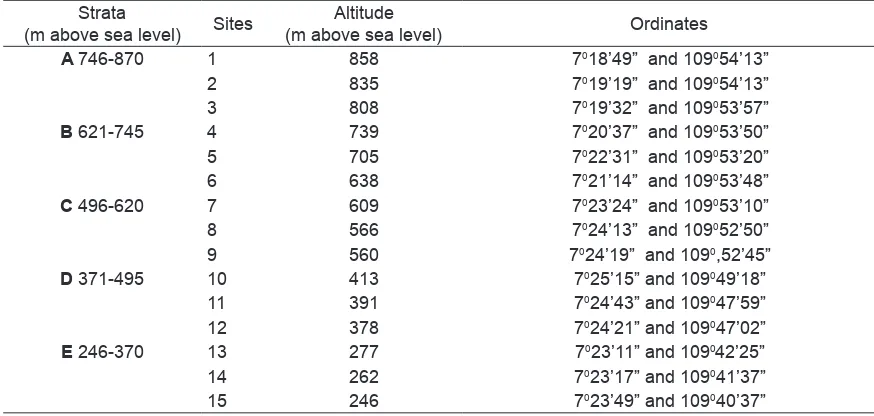
This study was conducted in the Serayu River from January to March and June to September 2007. Observations were started at the upper part and continued along the water body up to the Panglima Soedirman Reservoir. This river was divided into 5 strata based on the altitude and each stratum
consists of 3 sampling sites since of the micro habitat differences (Figure 1 and Table 1).
The ish sampling was performed during the day only (08.00 pm–18.00 am). Concerning that the eficiency of electric ishing is highest in such a condition as
follows depth < 1 meter with low current, solitary and
non migratory ishes with size > 30 cm (Casselman, et al. 1990 & Lestari (2006), meanwhile the conditions of the 15 sampling sites were varied, the combined
seine net and electric ishing was applied mostly in
this research it means that this combined method was the primary collection method (Gorman & Karr, 1978 and American Public Health Association, 1989).
Figure 1. Fiveteen sites for ish sampling along the Serayu River.
Table 1. Sampling sites of Serayu River.
Strata
(m above sea level) Sites
Altitude
(m above sea level) Ordinates
A 746-870 1 858 7018’49” and 109054’13”
2 835 7019’19” and 109054’13”
3 808 7019’32” and 109053’57”
B 621-745 4 739 7020’37” and 109053’50”
5 705 7022’31” and 109053’20”
6 638 7021’14” and 109053’48”
C 496-620 7 609 7023’24” and 109053’10”
8 566 7024’13” and 109052’50”
9 560 7024’19” and 1090,52’45”
D 371-495 10 413 7025’15” and 109049’18”
11 391 7024’43” and 109047’59”
12 378 7024’21” and 109047’02”
E 246-370 13 277 7023’11” and 109042’25”
14 262 7023’17” and 109041’37”
15 246 7023’49” and 109040’37”
Fish collection from each sampling site were coded,
recorded and counted. They were ixed in 10% formalin and preserved in 70% ethanol. Fish was identiied to
the species level according to the taxonomic keys of Saanin, 1986; Kottelat et al., 1993 and Fishbase, 2007. The population was analysed by counting the number of individuals (Krebs, 1972) per sampling site for 30 minutes effective time or about100 meter square.
In order to compare the river properties in the five strata, data of physical and chemical parameters and
population of Osteochilus spp were analyzed by ANOVA
(Zar, 1984). And then, interactions between
physic-chemical parameters and the population of Osteochilus
spp. were determined by calculating Pearson correlation (Zar, 1984) runs by program Statsoft (1989).
Data of Osteochilus spp were used as base in
determining the fish that could be caught. As well as, the information of river properties were applied in
determining the sites for ishing ground. Both aspects
are needed in development the sustainable programs.
Results and Discussion
Results
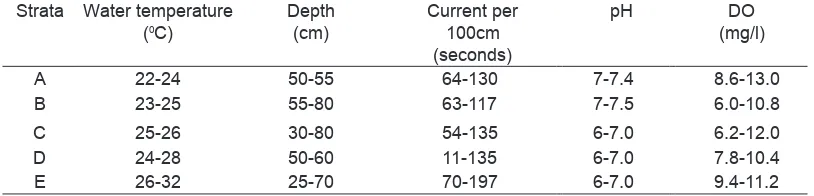
Like other tropical rivers, the complexity of micro habitat in Serayu River increased from upper to down stream part. Sampling sites in higher level of altitude possessed lower water temperature. For example, strata A with 220C, it was slightly increased to the down part, became 280C in strata D and 320C in strata E (Table 2).
Current was varied from site to other sites, but it
trends to be slower to the down part. It was relected
by increasing the duration for each 100 Cm, from 64
seconds in strata A became 197 seconds in strata E.
The longitudinal model plays in the Serayu River, particularly in the upper part. It is true in term of physical habitat characteristics such as depth, and, current. However, chemical and biological determinants were apparently not follow the longitudinal pattern of change. In general the physical and chemical parameters illustrated that Serayu River is remains in natural condition (Table 2).
The total number of Osteochilus spp.was 149
individuals composited by 47 of O. hasselti with
8.3–24.35 cm in lenght and 1.20–198.7 g in weght;
101 of O. microchephalus with11.35-25.21 cm and
17.9–206.5 g. One individual of O. kahajanensis with
17.30 cm and 68.80 g (Table 3). Most of ish captured
in down part was bigger that those captured in upper part. It could be related to the more natural food and space for moving.
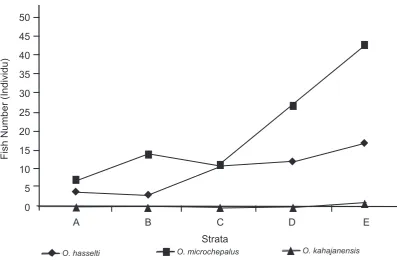
The populations of O. hasselti and O. microchepalus
gradually increased from stratum A to E. The population of O. hasselti increased from 4 individuals in stratum A became 17 individuals in stratum E. The same pattern was applied in population of
O.microchepalus. It increased from 7 individuals in stratum A and became 43 individuals in stratum E. (Figure 2).
Table 4 displays that sex ratio of O. hasselti
was 1:1.35, O. microchepalus was 1:1.40 and O.
kahajanensis with one female (Table 4.).Chi square results showed that the sex ratio of (x2 =0,551,
A 22-24 50-55 64-130 7-7.4 8.6-13.0
B 23-25 55-80 63-117 7-7.5 6.0-10.8
C 25-26 30-80 54-135 6-7.0 6.2-12.0
D 24-28 50-60 11-135 6-7.0 7.8-10.4
E 26-32 25-70 70-197 6-7.0 9.4-11.2
Table 3. Biological proiles of Osteochilus spp.
Species Length (cm) Weight (g) Total Number (individual) O. hasselti 8.30 – 24.35 11.20 – 198.70 47 O. microchephalus 11.35 – 25.21 17.9 – 206.5 101
Sampling sites in stratum A seem to be less complexity than others strata, this condition lead to
less population of ish. The sites in stratum A only
occupied by 17 individuals while sites in stratum E by 43 individuals. Complexity of micro habitat related to natural foods, nursuring and spawning grounds, especially increasing in depth will provide more place
for those activities (Vannote et al., 1980 and Payne,
1986).
Other reason for the increasing number of ish was
probably related to food available in down stream. Since down stream part of river was deposited part, naturally this part was rich part of detritus. This migration appeared to serve the function of placing eggs on suitable spawning substrate, usually gravels or submerged plants or stream feeding sites. Such as Cyprinus carpio used down stream part of the Mississippi River for spawning ground (Welcomme, 2001).
In term of sex ratio aspect, population of Osteochillus
spp. in Serayu River seems to able to sustain due to
more females than males. Like other ishes which
possesed number of females was more than males such as Rasbora tawarensis with 1: 4.72 (Brojo et
al., 2001), Puntius gonionotus with 1: 1.12, Puntius
bramoides with 1:1.07 (Kartamihardja, 1996) and
Labeo cylindricus with sex ratio 1:1.63 (Weyl and Booth, 1999). These sex ratios were more likely to adequate for supporting the population dynamics (Purwanto et al., 1986).
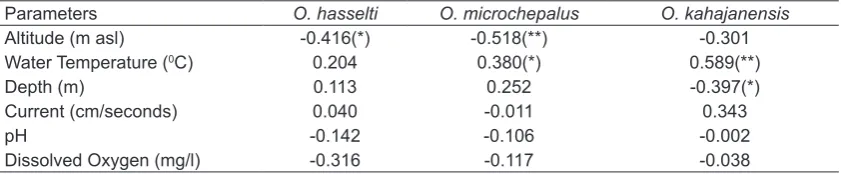
Populations of three species O. hasselti, O.
microchepalus and O. kahajanensis dynamically changed corresponded with the changes of physical parameters. Particularly, altitude drove the population of O. hasselti and O. microchepalus. These populations decreased by the increasing of altitude level.
Meanwhile, the changes of O. kahajanensis population
were drove more by water temperature (Table 5). This study demonstrated that the populations of
Osteochilus spp. have been driven by physical parameters. Naturally, the levels of altitude closed related to the changes of current, depth, and water
Figure 2. The populations of Osteochilus spp. in ive strata of Serayu River
Table 4. Chi square of sex ratio of Osteochilus spp.
Species Observed Expected x2
count x
2 0.05
male female male female
O. hasselti 20 27 17.54 29.46 0.551 3.84
O. microchepalus 42 59 37.69 63.32 0.809 3.84
O. kahajanensis 0 1 0.373 0.627 0.594 3.84
χ
O. hasselti O. microchepalus O. kahajanensis
temperature. From upper to down parts of rivers, the current will decrease, the depth and water temperature will increase (Payne, 1986 and Allan, 1995).
Moreover, Osteochilus species are widely distributed
throughout South East Asia (Fishbase, 2007); even this species might be an indicator for disturbance following logging. The physical effects of logging
that are presumed to be of important factors to ish
including the increasing of suspended sediment, temperature and amount of debris and the decreasing of dissolved oxygen. Greater of suspended sediment leads to lower production of micro algae may cause
the declining of species abundance of Osteocheilus
(Martin-Smith, 1998).
Species Osteochilus microchepalus was more available
than Osteochilus hasselti, even O. kahajanensis
occurred in very small population. Female occurred
more than male ish. Down part of Serayu River was
inhabited by more individuals therefore this part is
promoted as ishing ground.
Conclusion
Female Osteochilus microchepalus was recommended
as a legal ish to be caught rather than Osteochilus
hasselti and Osteochilus kahajanensifor sustainable
ishing and downstream part of Serayu was preferable sites for ishing ground.
Acknowledgement
This research was inancially supported by
DP2M-DIKTI with contract number: 033/SP2H/PP/DP2M/ III/2007. Our thanks are addressed to Y. Putranto for
ield work.
References
Allan, J.D. 1995. Stream Ecology: Structure and function of running water. Chapman and Hall, London.
American Public Health Associations. 1989. Standard
methods for examination of water and waste
water. American Public Health Associations, American Water Works Association, Water Public Control Federation, Washington D.C.
Brojo, M., S. Sukimin & I. Mutriasih. 2001. Reproduksi
Ikan Depik (Rasbora tawarensis) di perairan Danau
Laut Tawar. Jurnal Iktiologi Indonesia I(2).
Casselman, J.M., T. Penczak, L. Carl, R.H.K. Mann, J. Holcik & W.A. Woitowich. 1990. An evaluation of
ish sampling methodologies for large river systems.
Polskie Arch Hydrobiologii 7(4): 512-551.
Directorate General of Water Resource Development. 1991. Kapasitas sumber daya air menjelang tahun 2000. Seminar Kebijaksanaan dan strategi pengembangan sumber daya air jangka panjang di Indonesia. BAPPENAS, Jakarta.
Fishbase. 2007. Diversity of freshwater Fish in Indonesia. http://www.fishbase.org/summary/ speciesSummary.cfm?. Downloaded 30 March 2007.
Gorman, O.T & J.R. Karr. 1978. Habitat structure
and stream fish communities. Ecology 59(3):
507 - 515.
Kartamihardja, E.S. 1996. Structure of ish community
and reproductive biology of three species of Cyprinids in Kedungombo Reservoir. J. Indonesians Fisheries Research II (1).
Kottelat, M., A.J Whitten., S.N. Kartikasari & S. Wirjoatmodjo. 1993. Freshwater Fishes of Western Indonesia and Sulawesi. Periplus. Jakarta.
Kottelat, M. & T. Whitten. 1996. Freshwater biodiversity in Asia: with special reference to Fish. World Bank Technical Paper No: 343. Washington D.C.
Krebs, C.J. 1972. Ecology: The experimental analysis of distribution and abundance. Harper and Row. New York.
Parameters O. hasselti O. microchepalus O. kahajanensis
Altitude (m asl) -0.416(*) -0.518(**) -0.301
Water Temperature (0C) 0.204 0.380(*) 0.589(**)
Depth (m) 0.113 0.252 -0.397(*)
Current (cm/seconds) 0.040 -0.011 0.343
pH -0.142 -0.106 -0.002
Lestari, W. 2004. The ish community of a tropical
organically polluted rivers: A case study of the Logawa River, Central Java, Indonesia. Cuvilier Verlag, Gottingen, Germany.
Lestari, W. 2006. Detecting the efficiency of fish sampling technique on abundance and diversity
freshwater ish. J. Saintek Perikanan 1(2):
57-62
Maitland, P.S. & N.S. Morgan, 1997. Conservation and management of freshwater habitats. Chapman and Hall, London.
Martin-Smith, K.M. 1998 Effects of disturbance caused by selective timber extraction on fish communities in Sabah, Malaysia. Environ. Biol. of Fishes 53: 155-167.
Payne, A.I. 1986. The ecology of tropical lakes and rivers. John Wiley and Sons, Chichester.
Prins, H.H.T & J. Wind. 1993. Research for nature conservation in South-East Asia. Biological
Conservation63: 43 - 46.
Purwanto, G., W.M. Bob & S. Bustaman. 1986. Studi pendahuluan keadaan dan perbandingan kelamin
Ikan Cakalang (Katsuworus pelamis) di Perairan
sekitar Teluk Piru dan Elpa Putih Pulau Seram. J. Penelitian Perikanan Laut 34: 69-67.
Raven, P.H. & E.O. Wilson. 1992. Perspective: a ifty
year plan for biodiversity surveys. Science.258:
1099 - 1100.
Saanin. 1986. Taksonomi dan kunci determinasi ikan. Bina Cipta. Bogor.
Statsoft, Inc. 1995. Statistical for windows release 5.0. Tulsa Oklahoma USA.
Vannote, R.L., G.W. Minshall., K.W. Cummins, J.R. Sedell & C.E. Coshing. 1980. The river continuum concept. Canadian Journal Fish Aquatic Science 37: 130-137.
Welcomme, R.L. 2001. Inland fisheries: Ecology and management, Oxford, Fishing New Books. Blackwell Sciences.
Weyl, L.F. & A.J. Booth. 1999. On the life history of a
Cyprinid Fish, Labeo cylindricus. Environmental
Biology of Fishes Vol. 55(3): 29-41.