*Corresponding author: [email protected]
Research Article
Design and Evaluation of Gastro retentive Drug Delivery System of Anti
Ulcer Drug
J.S. Patil
1*, V.B.Biradar
2, P.R. Biradar, S.S
2. Shiralashetti
2, S.C. Marapur
2P.B.Gurav
11Department of Pharmaceutics, SVERI s College of Pharmacy, Gopalpur-Ranjani Road, Gopalpur, Pandharpur-413 304,
Maharashtra, India.
2 Department of Pharmaceutics, BLDEA s College of Pharmacy, BLDE University, Bijapur-413 304, Maharashtra, India.
ARTICLE INFO ABSTRACT
Received 10/06/2014 Received in revised form 08/08/2014
Accepted11/09/2014 Available online 01/10/2014
Floating matrix tablets of Lansoprezol were developed to prolong gastric residence time, leading to sustained action of the drug. Tablets were prepared by wet granulation technique, using hydroxypropylmethyl-cellulose as a polymer in two different grades, HPMC K4M and HPMC K15M. Tablets were evaluated for their physical characteristics, viz., hardness, thickness, friability, mass variation, drug content and floating properties. Further, tablets were studied for in vitro drug release characteristics for 24 hours. The tablets exhibited controlled and prolonged drug release profiles while floating over the dissolution medium. Non-Fickian diffusion was confirmed as the drug release mechanism from these tablets, indicating that water diffusion and polymer rearrangement played an essential role in drug release. The best formulation (F4) was selected based on in vitro characteristics and was used in vivo radiography studies by incorporating barium sulphate. These studies revealed that the tablets remained in the stomach for 12 hours in fasting rabbits and indicated that gastric retention time was increased by the floating principle, which was considered desirable for the absorption window drugs.
Keywords: Lansoprezol; floating tablets; gastric residence time; gastroretentive drug delivery system
1. Introduction
In recent years, oral dosage forms for gastric retention have drawn more and more attention for their theoretical advantage in permitting control over the time and site of drug release. This is particularly valuable for drugs that exhibit an absorption window in the upper part of the small intestine and dissolve better in the acidic environment of the stomach (Zhenping et al.,
2001). Oral delivery of drugs is, by far, the most preferable route of drug delivery due to the ease of administration, patient compliance, and flexibility in formulation. A controlled drug delivery system with prolonged residence time in the stomach is of particular interest for drugs that are locally active in the stomach,
preparations include micro-balloons, granules, powders, capsules, tablets, and laminated films (Sing and Kim, 2000). Based on the mechanism of buoyancy, two distinctly different technologies, i.e., non-effervescent and effervescent systems have been utilized in the development of floating systems. Non-effervescent systems commonly use gel-forming or highly swell-able cellulose type hydrocolloids, polysaccharides and matrix forming polymers such as polycarbonate, polyacrylate, polymethacrylate, and polystyrene. Effervescent systems utilize matrices prepared with swell-able polymers such as methocel or chitosan and effervescent compounds, such as sodium bicarbonate and citric or tartaric acid (Rubinstein and Friend, 1994). The various buoyant preparations include micro-balloons, granules, powders, capsules, tablets, and laminated films. Based on the mechanism of buoyancy, two distinctly different technologies, i.e., non-effervescent and effervescent systems have been utilized in the development of floating systems. Non-effervescent systems commonly use gel-forming or highly swellable cellulose type hydrocolloids, polysaccharides and matrix forming polymers such as polycarbonate, polyacrylate, polymethacrylate, and polystyrene. Effervescent systems utilize matrices prepared with swellable polymers such as methocel or chitosan and effervescent compounds, such as sodium bicarbonate and citric or tartaric acid, or matrices containing chambers of liquid that gasify at body temperature (Ritschel, 1991). Mahesh
et al. (2005) have developed the gastro-retentive drug delivery system (GRDDS) for ofloxacin with different polymers, such as psyllium husk, HPMC K100M, crosspovidone and their combinations in order to get the desired sustained release profile over a period of 24 h. Varshosaz et al. (2006) developed ciprofloxacin floating and bioadhesive extended release tablets to increase the duration of the drug presence in its absorption area.Intragastric floating (IGF) drug delivery systems can improve the controlled delivery of drugs that have an absorption window by continuously releasing the drug for a prolonged period of time before drug reaches its absorption site, thus ensuring the optimal bioavailability (Bansal, 2003). Lansoprazole is a gastric acid pump inhibitor belonging to the class of delayed release dosage forms known as proton pump
inhibitors PP)’s a dose regimen of PP)’s results in a
decrease in gastric acid secretion with a subsequent elevation in gastric pH. The objective of the present investigation is to prepare and to evaluate IGF tablets of lansoprazole, which will help to retain the dosage form in the stomach and to increase gastric residence time, resulting in prolonged drug delivery in stomach using
gel-forming polymers such as
hydroxypropylmethylcellulose (HPMC K4M, HPMC K15M). A formulation that shows both combined excellent buoyancy and sustained release characteristics was chosen for farther in vivo evaluation by X-ray study in rabbits for more than 10 h.
2. Materials and mehods 2.1 Materials
Lansoprezol (ZPR) was a generous gift sample obtained from Cipla pharmaceutical, Mumbai India. HPMC K4M and HPMC K15M was a generous gift sample received from Colorcon Asia Ltd, Goa India. Microcrystalline cellulose was a gift sample received from Ozone international, Mumbai India. All other chemicals and reagents were of analytical grade and purchased locally.
2.2 Methods of preparation of tablet:
The tablets were prepared according to the method followed by Gambier (2007) and Kuksal (2006). Lansoprazole, Polymer (HPMC K4M and HPMC K15M), Sodium bicarbonate were passed through sieve No.40 separately. The drug was mixed with the Polymers and other ingredients (table 1). Accurately weighed quantity of PVPK-30 was dissolved in isopropyl alcohol (IPA) to prepare a binder solution. The binder solution was added to the dry blend gradually with constant kneading to form a homogeneous mass. The dough mass was passed through a 2.0-mm sieve and the granular mass was allowed to dry at room temperature. The granules were passed through a 1.18-mm sieve. These granules were lubricated with magnesium stearate and talc and compressed into tablet using 10.0mm flat face tooling on a tablet compression machine (Remek mini press, India).
2.3 Evaluation of Tablet Characteristics:
2.3.1 Weight variation
Twenty tablets were selected random and weighed individually. The average weight was calculated. Individual weights of the tablets were compared with the average weight.
2.3.2 Hardness
Tablet hardness has been defined as the force required to breaking a tablet in a diametric compression. Hardness values of the prepared formulations were determined using Monsanto hardness tester (n=10). The tablet was placed between two anvils of hardness tester, force was applied to the anvils, and the crushing strength that causes the tablet to break was recorded.
2.3.3 Friability
Tablets require certain amount of strength or hardness and resistance to withstand mechanical shock of handling in manufacturing, packaging, and shipping.A pre-weighed sample (20 tablets) were placed in the friabilator, and operated for 100 revolutions. Thereafter, once again weight of the tablets is recorded. The percentage friability was calculatedbasedon theloss of weight of tablet after keeping in the friabilator.
2.3.4 Thickness
2.3.5 Drug content uniformity
Twenty tablets were powdered and powder equivalent to 30 mg of Lansoprazole was taken. The powder was transferred to 100ml volumetric flask. 50ml of 0.1 N HCl solutions was added, and stirred for 5 min. The volume was made up to 100ml with 0.1N HCl solution and filtered. The absorbance was measured at 276 nm, against blank prepared in similar manner. The experiments were conducted in triplicate. The drug content was estimated by an UV spectrophotometer at 276 nm.
2.4 In vitro buoyancy studies
The time taken for the tablet to emerge on to the the liquid and floating duration was recorded.
2.5 In vitro dissolution studies
In- vitro drug release study was carried out using USP XXIII, Paddle type dissolution apparatus in 900 ml of pH1.2 solution, as a dissolution medium. The paddles are rotated at 100 rpm. The Medium was set at 37 ± 0.5ºC. 1 ml of the sample was withdrawn at predetermined time intervals (30 min) for the period of 3 hrs and thereafter every hour for 24 hrs. The same volume of fresh medium was replaced. The withdrawn samples were diluted with 10 ml of same medium in volumetric flasks and analyzed by an UV spectrophotometer at 276 nm using 0.1 N HCl as a blank. The experiments were conducted in triplicate. The drug content and percent cumulative of drug release were calculated using the equation generated from standard calibration curve.
2.5 In vivo radiographic studies
The optimized formulation F4 was studied with regard to buoyancy using radiography. To make the tablet X-ray opaque, lansoprazole in formulation was replaced with 30 mg of barium sulphate (BaSo4) and the tablets were prepared as previously mentioned keeping all other ingredients constant. The protocol of in-vivo buoyancy studies on rabbits was carried out and monitored by a radiographic method. The animal experiment was approved by the Animal Ethical
Committee, BLDEA’s College of Pharmacy, Bijapur, )ndia
BLDEA’s COP/)AEC. Dated june 2009-Jan 2010). The tablet to each animal was administered through specially made oral gastric tube with 25 ml water in fasted state. The animals were not allowed to eat or drink throughout
the study. Before taking X-ray photographs, the animals were held in upright posture. The animals were exposed to X-ray photography in the abdominal region at different time intervals (0, 4, 8, and 12 hours) for 12 hours. The tablet that remained buoyant on the surface of the gastric content was observed visually from the X-ray photographs.
3. Results and discussion 3.1 Characterization of tablets
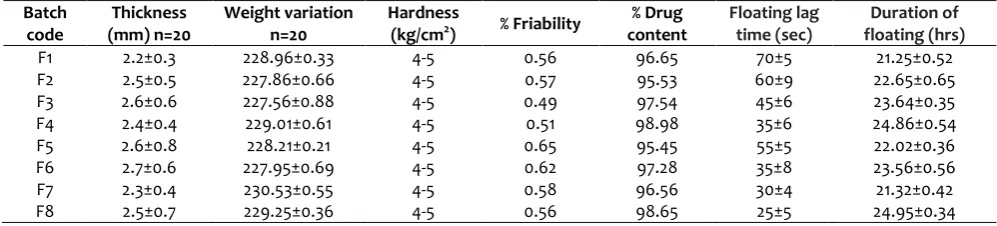
The hardness of batches F1-F8 was found to be between 4–5 kg cm2 indicating satisfactory mechanical strength. The thickness of prepared batches was between 2.2±0.3 and 2.7±0.6 mm. The friability was in the range of 0.49–0.65 % for all the formulations, which was an indication of good mechanical resistance of the tablet. The average drug content of tablets (n = 10) varied between 95.45 and 98.98%, indicating good drug content for the prepared formulations. All the batches exhibited uniformity of drug content and fulfilled the compendial specifications of the various quality control parameters.
Fig1. In-vitro floating lag time study of F8
3.2 In vitro buoyancy studies
Lansoprezole tablets were prepared using polymers such as HPMC K4M and HPMC K15M. Formulations F1-F4 was prepared with HPMC K4M, and F5-F8 was prepared with HPMC K15M. Tablets were evaluated for physical characteristics such as hardness, floating capacity and weight variation. The floating lag time was found between 25±5 and 70±5. The formulation F8 has shown very short floating lag time of 25±5 sec. (Fig 1). The sodium bicarbonate was used as a gas generating agent in order to float the tablet. The sodium bicarbonate induces CO2 generation in the presence of
time of 24.95±0.34 hrs (Fig 2) when compared to all other formulations followed by F4 which has shown 24.86±0.54 hrs. This indicated that the least amount of HPMC K15 M and maximum amount of gas generating agent used in F8 are responsible for good floating lag time and maximum duration of floating. The floating lag time and the duration of floating for the prepared tablets are given in Table 2. In general, all the prepared tablets floated between 21 to 24 hrs.
Fig 2. In-vitro floating duration profile of F8
Fig 3. In vitro dissolution profile of formulations F1- F4
Fig 4. In vitro dissolution profile of formulations F5- F8
3.3 In vitro dissolution studies
The release of lansoprezole was found to be a function of the polymer concentration. All formulations retarded the release of drug for 24 hrs (figure 3 and 4). The effect of HPMC K4M and HPMC K15M at different concentrations ranging from 100% to 160% and 80% to 120% respectively on the release of lansoprezole from tablet matrices was studied. Figure 2 and 3 shows the drug release profiles from HPMC K4M and HPMC K15M matrices, respectively. As the concentration of the polymer was increased in the different formulations, the rate of drug release was decreased. Finally, the retardant effect of the polymer on the drug release can be
indicated as: HPMC K15M>HPMC K4M. The release of the drug from the different formulations can be arranged as:
F1<F2<F3<F4<F5<F6<F7<F8. In vitro drug release studies revealed that the release of lansoprezole from different formulations varies with the characteristics and the composition of matrix forming polymers and the proportion of gas generating agents. The percent drug release was increased as the concentration of gas generating agents increased. A reverse trend was observed on increasing the polymer concentration.
3.4 In vivo radiographic studies
After ingesting of the final placebo formulations were developed by using barium sulphate in the released layer, the tablets were clearly seen in the GIT at different time points during the study and the duration of the tablet in the stomach and upper part of intestine was monitored by radiograph, it can be evidenced by Fig 5. It was found that the tablet stayed in the stomach for 12 hrs.
Fig5. Radiographic images showing the presence of a BaSO4-loaded floating tablet in the rabbit stomach at different time
periods (the tablet is indicated with a line drawn by pen).
4. Conclusions
studies are needed to assess the utility of this system for patients suffering from gastric ulcer.
5. References
Zhenping, W., Zhanfeng, Y., Dianzhou B. 2001. Design and evaluation of a two-layer floating tablet for gastric-retention using cisalpine as a model drug. Drug. Dev. Ind. Pharm. 27: 469–74.
Baumgartner, S., Kristal J., Vrecer F., Vodopivec, P., Zorko, B. 2000. Optimization of floating Matrix tablets and evaluation of their gastric residence time. Int. J. Pharm. 195: 125–35.
Sing, B. N., Kim, K. H. 2000. Floating drug delivery systems: an approach to oral controlled drug delivery via gastric retention, J Control Rel., 63: 235–59.
Rubinstein, A., Friend, D. R. 1994. Specific Delivery to the Gastrointestinal Tract, in Polymeric Site-Specific Pharmacotherapy. Ed AJ Domb Wiley Chichester. pp 283–85.
Ritschel, W. 1991. A Targeting in the gastrointestinal tract: new approaches. Exp Clin Pharmacol. 13: 313– 16.
Mahesh, C., Paras, J., Sachin, C., Rajesh, S., Pradeep, V. 2005. Development of sustained release gastroretentive drug delivery system for ofloxacin,
in vitro and in vivo evaluation. Int J Pharm. 304: 178–84.
Varshosaz, J., Tavakoli, N., Roozbahani F. 2006. Formulation and in vitro characterization of
ciprofloxacin floating and bioadhesive extended-release tablets. Drug Del. 13: 277–85.
Bansal, A, K. 2003. Gastric-retention: a means to address regional variability in intestinal drug ( drug delivery ) Absorption. Pharm Techno. 1–20.
Gambier, M, N. 2007. Development and in vitro evaluation of an oral Floating Matrix tablet Formulation of Diltizem Hydrochloride. AAPS Pharm Sci Tech. 8 Article 73.
Kuksal, A. 2006. Formulation and In Vitro, In Vivo Evaluation of Extended- release Matrix Tablet of Zidovudine. AAPS Pharm Sci Tech. 7: E1-E9.
Prabhu, P., Harish, N. M., Gulzar, A. M., Yadav, B. 2008. Formulation and In Vitro Evaluation of Gastric Oral Floating Tablets of Glipizide. Indian J Pharm Educ Res. 42: 174-83.
Aulton M E., Wells TI. 1988. Pharmaceutical preformulation. Pharmaceutics: The Science of Dosage Form Design. (Ed-III), Edinburgh London: Melbourne and New York. pp 224.
Feleke, F., Endale, A. 2007. Oral floating extended release stavudine hydrophilic matrix tablets; formulation design and in vitro investigations. Ethiop. Pharm. J. 25: 51-62.
Table 1: Composition of lansoprazole floating tablets (mg)
Formulation HPMC K4M HPMC K15M NaHCO3 DCP PVPK-30
All the tablets contain 30 mg lansoprazole, 5 mg magnesium stearate and 5 mg talc.
HPMC: hydroxypropyl methylcellulose, PVP: polyvinyl pyrrolidone, DCP: dicalcium phosphate, NaHCO3: Sodium bicarbonate
Table 2. Physicochemical properties and floating behavior of tablets
Baumgartner, S., Kristel, J., Vreer, F., Vodopivec, P., Zorko, B. 2000. Optimization of floating matrix tablets and evaluation of their gastric residence time. Int. J. Pharm. 195: 125–35.