DAFTAR SINGKATAN DAN DEFINISI TERMS OF REFERENCE
RINGKASAN EKSEKUTIF
1. PENDAHULUAN DAN LATAR BELAKANG 1.1 Pendahuluan
1.2 Latar Belakang
2. RUANG LINGKUP REKONSILIASI 2.1 Penerimaan Negara
2.2 Perusahaan yang Direkonsiliasi 3. METODOLOGI
3.1 Metologi Rekonsiliasi
3.2 Aktivitas dan Fokus dari Rekonsiliasi
viii 1 13 33 33 34 39 39 52 55 55 56
Daftar Isi
DAFTAR ISI DAFTAR TABEL DAFTAR GAMBAR i iii v3.3 Penyusunan Format Pelaporan 57
4.1 Perusahaan Migas Tahun 2014 4.2 Perusahaan Minerba Tahun 2014
5. PENERIMAAN NEGARA YANG TIDAK DI REKONSILIASI 5.1 Perusahaan Migas Tahun 2014
5.2 Perusahaan Minerba Tahun 2014
6. PENYALURAN DANA HASIL PENERIMAAN INDUSTRI EKSTRAKTIF 6.1 Alokasi Dana Bagi Hasil dari Pemerintah Pusat ke Pemerintah Daerah 6.2 Penetapan alokasi DBH SDA
7. PROSEDUR AUDIT
8. TEMUAN DAN REKOMENDASI
66 72 79 80 82 85 85 86 91 95 3.6 Proses Rekonsiliasi
3.7 Kendala dalam pengumpulan data 4. HASIL REKONSILIASI
63 64 65
8.1 Tindak lanjut rekomendasi pelaporan EITI tahun 2012 – 2013 8.2 Temuan dan rekomendasi pelaporan EITI tahun 2014
95 98
Tabel 2.4 Kilang LPG di Indonesia Tabel 2.5 Kilang LNG di Indonesia
Tabel 2.6 Tarif Royalti Perusahaan Mineral Tabel 2.7 Tarif Royalti Perusahaan Batubara
Tabel 2.8 Jasa transportasi (toll fee) minyak dan gas bumi
Tabel 2.9 Jasa Transportasi yang diterima PT Kereta Api Indonesia (Persero) Tabel 2.10 KKKS yang Direkonsiliasi Tahun 2014
Tabel 2.11 Daftar Penyebaran KKKS berdasarkan Wilayah Operasi Tahun 2014 Tabel 2.12 Perusahaan Minerba yang Direkonsiliasi Tahun 2014 berdasarkan
jenis izin usaha
43 44 47 47 49 50 53 53 53
Daftar Tabel
Tabel 2.1 Jenis Penerimaan dari Sektor Migas Tabel 2.2 Jenis Penerimaan dari Sektor Minerba Tabel 2.3 Kilang minyak di Indonesia
40 41 42 Tabel 0 Non-revenue information to be provided in the EITI Report
Tabel 1 Penerimaan Negara Tahun 2013 dan 2014 untuk Sektor Migas Tabel 2 Penerimaan Negara Tahun 2013 dan 2014 untuk Sektor Minerba
6 13 14 Tabel 3 Hasil Rekonsiliasi untuk Sektor Migas Tahun 2014
Tabel 4 Hasil Rekonsiliasi untuk Sektor MinerbaTahun 2014 Tabel 5 Jasa transportasi (toll fee) minyak dan gas bumi
23 25 27 Tabel 6 Jasa Transportasi yang diterima PT Kereta Api Indonesia 28
Tabel 4.4 Rekonsiliasi KKKS dengan Ditjen Anggaran Tahun 2014 (Valas) Tabel 4.5 Rekonsiliasi antara perusahaan dengan Ditjen Minerba
Tabel 4.6 Rekonsiliasi antara perusahaan minerba dengan Ditjen Pajak Tabel 4.7 Rekonsiliasi antara perusahaan minerba dengan Ditjen Anggaran Tabel 4.8 Rekonsiliasi antara PT Bukit Asam dengan PT Kereta Api Indonesia Tabel 5.1 Rekonsiliasi SKK Migas dengan Ditjen Anggaran Tahun 2014 (Valas) Tabel 5.2 Penjelasan Perbedaan Data Penerimaan Negara antara SKK Migas dan
Ditjen Anggaran
Tabel 5.3 Penerimaan negara yang tidak direkonsiliasi sektor migas Tabel 5.4 Data produksi migas
Tabel 5.5 Penerimaan negara yang tidak di rekonsiliasi sektor minerba Tabel 5.6 Data produksi dan penjualan minerba
Tabel 6.1 Penerimaan negara yang dapat dibagihasilkan
70 72 75 77 78 80 81 81 82 82 83 85 Tabel 4.1 Rekonsiliasi KKKS dengan SKK Migas Tahun 2014 (Valas)
Tabel 4.2 Rekonsiliasi KKKS dengan SKK Migas Tahun 2014 (Volume) Tabel 4.3 Rekonsiliasi KKKS dengan Ditjen Migas Tahun 2014
66 67 68
Tabel 6.2 Realisasi DBH Industri Ekstraktif 86
Tabel 3.2 Daftar perusahaan migas-partner yang tidak melapor Tabel 3.3 Daftar perusahaan minerba yang tidak melapor Tabel 3.4 Data kunjungan ke Entitas Pelapor
60 61 63
Gambar 4 Kontribusi Industri Ekstraktif pada PDB Nasional Gambar 5 Kontribusi Industri Ekstraktif pada Penerimaan Negara Gambar 6 Kontribusi Industri Ekstraktif pada Total Ekspor Nasional Gambar 7 Volume ekspor sektor pertambangan per komoditas utama Gambar 8 Kontribusi sektor pertambangan terhadap nilai ekspor Gambar 9 Ekspor minyak bumi tahun 2014
Gambar 10 Ekspor gas bumi tahun 2014
Gambar 11 Kontribusi industri ekstraktif pada lapangan kerja nasional Gambar 1.1 Standar Global EITI
Gambar 1.2 Tim multipihak (Multi-Stakeholder Group – MSG)
Gambar 2.2 Bagan Arus Kas atas Penerimaan Migas (dalam Rupiah)
16 17 18 18 19 19 20 20 34 35 46
Daftar Gambar
Gambar 1 Total Lifting Oil & Gas Tahun 2014 Gambar 2 Total Lifting Oil & Gas Tahun 2013
Gambar 3 Perusahaan Minerba Penyumbang Royalti terbesar Tahun 2013 dan 2014 14 15 15
Gambar 3.1 Kegiatan IA dilakukan dalam 5 tahap Gambar 3.2 Alur Penyusunan Laporan Rekonsiliasi
Gambar 6.1 Mekanisme penetapan perkiraan alokasi DBH SDA
56 56 86
dan Definisi
Acrual Basis Suatu basis pengakuan pendapatan dan/atau beban berdasarkan kepada kejadian yang sebenarnya, bukan pada saat diterima atau keluarnya kas dari perusahaan/entitas pelapor APBN Anggaran Pendapatan dan Belanja
Negara
AuP Agreed upon Procedures adalah prosedur yang disepakati Bagi Hasil Merupakan hasil produksi yang
tersedia untuk dibagi (Lifting) antara Pemerintah dan KKKS setelah dikurangi FTP (First Tranche
Petroleum), insentif investasi (jika ada) dan pengembalian biaya operasi Barel Satuan untuk minyak dan kondensat
ekuivalen 42 US galon atau 158,99 liter pada temperature 60⁰ F (enam puluh derajat Fahrenheit)
BOB Badan Operasi Bersama
BPHTB Bea Perolehan Hak atas Tanah dan Bangunan
BPK Badan Pemeriksa Keuangan BPKP Badan Pengawasan Keuangan dan
Pembangunan
BPMIGAS Badan Pelaksana Kegiatan Usaha Hulu Minyak dan Gas Bumi BUMN Badan Usaha Milik Negara
Cash Basis Suatu basis pengakuan pendapatan dan/atau beban berdasarkan pada saat diterimanya kas atau pada saat dikeluarkannya kas oleh
perusahaan/entitas pelapor Corporate &
Dividend Tax
Pajak Penghasilan dan Pajak Dividen yang terhutang oleh wajib pajak badan atau penghasilan kena pajak dalam suatu tahun pajak ditambah pajak dividen sesuai dengan peraturan ketentuan perpajakan yang berlaku
Cost RecoveryMerupakan pengambilan biaya operasi yang telah dikeluarkan oleh Kontraktor Kontrak Kerja Sama (KKKS) dari hasil produksi (dalam bentuk inkind) yang berasal dari wilayah kerja terkait, sesuai dengan ketentuan pada Kontrak Kerja Sama dan peraturan terkait CSR Corporate Social Responsibility
DAK Dana Alokasi Khusus
DAU Dana Alokasi Umum
DBH Dana Bagi Hasil
DBH SDA Dana Bagi Hasil Sumber Daya Alam Development
Bonus Merupakan bonus yang dibayarkanoleh KKKS kepada Pemerintah pada saat development of first commercial suatu wilayah kerja sesuai dengan KKS
DHPB Dana Hasil Penjualan Batubara, merupakan kewajiban yang harus dibayarkan oleh perusahaan pertambangan kepada Negara sebesar 13,5% dari nilai penjualan batubara tidak tergantung kepada tingkat kalori batubara
Dit. PNBP Direktorat Penerimaan Negara Bukan Pajak, Direktorat Jenderal Anggaran (DJA), Kementerian Keuangan Ditjen Migas Direktorat Jenderal Minyak dan Gas
Bumi, Kementerian Energi dan Sumber Daya Mineral (ESDM) Ditjen MinerbaDirektorat Jenderal Mineral dan
Pertambangan Batubara, Kementerian Energi dan Sumber Daya Mineral (ESDM)
Ditjen Pajak Direktorat Jenderal Pajak, Kementerian Keuangan
Dividen Pembagian keuntungan dari laba bersih yang dihasilkan perusahaan dalam periode tertentu kepada pemegang saham yang berhak berdasarkan persetujuan RUPS DJA Direktorat Jenderal Anggaran,
DJPb Direktorat Jenderal Perbendaharaan DJPK Direktorat Jenderal Perimbangan
Keuangan
DMO Domestic Market Obligation – adalah kewajiban penyerahan bagian KKKS/ perusahaan berupa minyak, gas bumi atau batubara untuk memenuhi kebutuhan dalam negeri DMO Fee Imbalan yang dibayarkan oleh
Pemerintah kepada KKKS atas
penyerahan minyak dan/atau gas bumi untuk memenuhi kebutuhan dalam negeri dengan menggunakan harga yang ditetapkan oleh Menteri yang bidang tugas dan tanggung jawabnya meliputi Kegiatan Usaha Minyak dan Gas Bumi
Dry Hole Pengeboran sumber eksplorasi dimana cadangan migas terbukti tidak ada
EITI Extractive Industries Transparency Initiative (Inisiatif Transparansi untuk Industri Ekstraktif)
Entitas Pelapor Dalam konteks Laporan ini, entitas pelapor adalah perusahaan/KKKS dan instansi Pemerintah
ESDM Energi Sumber Daya Mineral ETBS Equity To Be Split
FQR Financial Quarterly Report merupakan laporan yang harus disampaikan oleh KKKS kepada SKK Migas secara Kuartalan, yang menyajikan informasi kepada KKS yang meliputi:
1) Total Lifting Migas 2) First Tranche Petroleum 3) Investment Credit 4) Cost Recovery 5) DMO pada harga ICP 6) DMO Fees
7) Bagi hasil antara Pemerintah dan KKKS
8) Perhitungan Pajak Penghasilan atas Penghasilan dalam rangka KKS
FTP First Tranche Petroleum adalah sejumlah tertentu minyak mentah dan/atau gas bumi yang diproduksi dari suatu wilayah kerja dalam satu tahun kalender, yang dapat diambil dan diterima oleh Badan Pelaksana dan/atau KKKS dalam tiap tahun kelender, sebelum dikurangi pengembalian biaya operasi dan penanganan produksi (own use) Gas Bumi Hasil proses alami berupa hidro
karbon yang dalam kondisi tekanan dan temperatur atmosfir berupa fasa gas yang diperoleh dari hasil
penambangan minyak dan gas bumi. Gas bumi dapat diolah menjadi gas pipa, LNG dan LPG
IA Independent Administrator, yang ditunjuk untuk membuat Laporan EITI 2014
IAPI Institut Akuntan Publik Indonesia ICP Indonesia Crude Price – Harga Minyak
Mentah/Kondensat Indonesia yang ditetapkan oleh Pemerintah Indonesia dengan suatu formula dalam rangka pelaksanaan Kontrak Kerja Sama Minyak dan Gas Bumi serta penjualan Minyak Mentah/Kondensat bagian Negara yang berasal dari pelaksanaan Kontrak Kerja Sama Minyak dan Gas Bumi
IDR Rupiah (Rp), mata uang Republik Indonesia
IFRS International Financial Reporting Standard
INTOSAI International Organization of Supreme Audit Institutions
Investment
Credit Insentif investasi adalah tambahanpengembalian biaya modal dalam jumlah tertentu, yang berkaitan langsung dengan fasilitas produksi, yang diberikan sebagai insentif untuk pengembangan lapangan minyak dan/atau gas bumi tertentu
IPSAS International Public Sector Accounting Standards
ISSAI International Standards of Supreme Audit Institutions
IUP Izin Usaha Pertambangan, adalah izin untuk melaksanakan usaha
pertambangan
IUPK Izin Usaha Pertambangan Khusus, adalah izin untuk melaksanakan usaha pertambangan di wilayah izin usaha pertambangan khusus
Iuran Tetap (Land Rent) adalah iuran yang diterima Negara sebagai imbalan atas
kesempatan Penyelidikan Umum, Eksplorasi atau Eksploitasi pada suatu wilayah kerja
JOB Joint Operation Body
Joint Lifting Kerjaan lifting dilakukan secara bersama antara KKKS dan pemerintah dengan menggunakan kapal/pipa tujuan yang sama dimana hasilnya dibagi berdasarkan perkiraan hak sementara
JV Joint Venture
KAP Kantor Akuntan Publik
KESDM Kementerian Energi dan Sumber Daya Mineral (Ministry of Energy and Mineral Resource)
KK Kontrak Karya, adalah perjanjian antara pemerintah Republik Indonesia dengan perusahaan berbadan hukum Indonesia dalam rangka penanaman modal asing untuk melakukan usaha pertambangan mineral
KKKS Kontraktor Kontrak Kerja Sama yaitu Badan Usaha atau Bentuk Usaha Tetap, yang ditetapkan untuk
melakukan eksplorasi dan eksploitasi pada suatu wilayah kerja Migas berdasarkan Kontrak Kerja Sama dengan Badan Pelaksana
KKS Kontrak Kerja Sama adalah suatu bentuk Kerja Sama dalam Kegiatan Usaha Hulu Minyak dan Gas Bumi berdasarkan prinsip pembagian hasil produksi
Kondensat Minyak gas, nafta dan hidrokarbon relatif ringan lainnya (dengan beberapa gas hidrokarbon terlarut seperti butana dan propana) yang tetap cair pada suhu dan tekanan normal. Berasal terutama dari
reservoir gas, kondensat sangat mirip dengan minyak mentah ringan yang distabilisasi dan digunakan sebagai bahan baku untuk kilang minyak dan industri petrokimia lainnya
KP Kuasa Pertambangan, adalah wewenang yang diberikan kepada badan/perseorangan untuk
melaksanakan usaha pertambangan KPPN Kantor Pelayanan Perbendaharaan
Negara
LAKIP Laporan Akuntabilitas Kinerja Instansi Pemerintah
Lifting Sejumlah minyak mentah dan/atau gas bumi yang dijual atau dibagi di titik penyerahan (custody transfer point) LKPP Laporan Keuangan Pemerintah Pusat LNG Liquified Natural Gas adalah gas alam
yang dikonversi dalam bentuk cair yang memerlukan proses pendinginan untuk memudahkan transportasi LPG Liquified Petroleum Gas adalah gas
(umumnya butana dan propana) disimpan dan diangkut sebagai cairan di bawah tekanan. Tidak seperti LNG, LPG tidak memerlukan pendinginan untuk dicairkan
MSCF Ribuan standard cubic feet adalah sejumlah gas yang diperlukan untuk mengisi ruangan 1 (satu) kaki kubik, dengan tekanan sebesar 14,73 psi (empat belas dan tujuh tiga per sepuluh pound per square inch) atau 14,696 psi (empat belas dan enam sembilan enam per seratus pound per square inch) dan pada temperatur 60⁰ F (enam puluh derajat Fahrenheit) dalam kondisi kering
MSG Multi-Stakeholder Group – lihat Tim Pelaksana
Offshore Operasi minyak di lepas pantai Onshore Operasi minyak di daratan
Operator Kontraktor atau dalam hal Kontraktor terdiri dari beberapa pemegang participating interest, salah satu pemegang participating interest yang ditunjuk sebagai wakil oleh pemegang participating interest lainnya sesuai dengan kontrak kerja sama
Otsus Otonomi Khusus Over/(Under)
Lifting Over lifting adalah kelebihanpengambilan minyak dan gas bumi oleh salah satu pihak dibandingkan dengan haknya yang diatur dalam Kontrak Kerja Sama dalam periode tertentu. Under lifting adalah
kekurangan pengambilan minyak dan gas bumi oleh salah satu pihak dibandingkan dengan haknya yang diatur dalam Kontrak Kerja Sama dalam periode tertentu.
Pajak Penghasilan (PPh) Badan
Merupakan pajak penghasilan yang terutang oleh wajib pajak badan atas penghasilan kena pajak dalam suatu tahun pajak sesuai dengan peraturan ketentuan perpajakan yang berlaku Partner Pemegang participating interest dalam
KKS selain Operator KKS
PBB Pajak Bumi dan Bangunan adalah pajak yang dihitung berdasarkan luas tanah dan bangunan yang dibangun di atasnya. PBB dibayarkan oleh Wajib Pajak sesuai surat Pemberitahuan Pajak Terutang yang diterbitkan oleh Kantor Pelayanan Pajak
PDRD Pajak Daerah dan Retribusi Daerah Pemerintah Pemerintah Republik Indonesia PHT Penjualan Hasil Tambang, adalah
kewajiban pemegang izin PKP2B yang diatur dalam kontrak tersendiri. PHT merupakan selisih antara DHPB (13,5% dari nilai penjualan batubara) dikurangi royalti (3% s/d 7% dari nilai penjualan batubara tergantung dari kalori batubara)
PI Participating Interest
PKB Perjanjian Kerja Sama Batubara, adalah skema perjanjian yang
melibatkan suatu perusahaan di dalam area pertambangan batubara
PKP2B Perjanjian Kerjasama Pengusahaan Pertambangan Batubara, adalah perjanjian antara Pemerintah Republik Indonesia dengan perusahaan
berbadan hukum Indonesia dalam rangka penanaman modal asing atau penanaman modal dalam negeri untuk melakukan usaha pertambangan batubara
PNBP Penerimaan Negara Bukan Pajak PNBP
penggunaan kawasan hutan
PNBP yang berasal dari penggunaan kawasan hutan untuk kepentingan pembangunan di luar kegiatan kehutanan sebagai pengganti lahan kompensasi
PP Peraturan Pemerintah
PPN Pajak Pertambahan Nilai Production
Bonus Merupakan bonus yang dibayarkanoleh KKKS kepada Pemerintah setelah mencapai akumulasi dan/atau tingkat produksi tertentu sesuai dengan KKS PSC Production Sharing Contract atau
Kontrak Kerja Sama (KKS) Rekonsiliasi Proses membandingkan informasi
keuangan dan volume yang dilaporkan oleh KKKS dan instansi Pemerintahan yang terkait serta penjelasan atas perbedaan yang dapat diselesaikan dan identitikasi atas perbedaan yang tidak dapat diselesaikan
Royalti Iuran Eksplorasi dan Eksploitasi (royalty), adalah iuran produksi
pemegang kuasa usaha pertambangan atas hasil dari kesempatan
eksplorasi/ekploitasi
SAIPI Standar Audit Intern Pemerintah Indonesia
SAK Standar Akuntansi Keuangan
SAT Standar Atestasi
Scoping Study Penelitian ruang lingkup untuk pembuatan Laporan EITI 2014 yang dilakukan oleh Independent
Administrator dalam hal ini oleh kantor Ernst & Young (EY) - Indonesia
SDA Sumber Daya Alam
Sekretariat Sekretariat Tim Transparansi Industri Ekstraktif
Signature
Bonus Bonus yang dibayarkan kepadaPemerintah setelah penandatanganan KKS yang dibayarkan selambat-lambatnya 30 hari
SKK Migas Satuan Kerja Khusus Pelaksana Kegiatan Usaha Hulu Minyak dan Gas Bumi
SKPKB Surat Ketetapan Pajak Kurang Bayar, yaitu surat ketetapan pajak yang menentukan besarnya jumlah pokok pajak, kekurangan pembayaran pokok pajak, besarnya sanksi administrasi, dan jumlah pajak yang harus dibayar SKPKBT Surat Ketetapan Pajak Kurang Bayar
Tambahan, yaitu surat ketetapan pajak yang menentukan tambahan atas jumlah pajak yang telah ditetapkan
SPAP Standar Profesional Akuntan Publik SPKN Standar Pemeriksaan Keuangan
Negara
SSBP Surat Setoran Bukan Pajak
STP Surat Tagihan Pajak, yaitu surat untuk melakukan tagihan pajak dan/atau sanksi administrasi berupa bunga dan/atau denda
Tahun 2014 Dalam laporan ini, mengacu pada Tahun Kalender 2014
Tim Pelaksana Kelompok pemangku kepentingan Multi Stakeholder Group (MSG) yang menjadi pelaksana EITI, dimana keanggotaannya sesuai dengan Perpres No. 26 Tahun 2010 Pasal 10 Tim Teknis Tim Kecil yang ditunjuk mewakili Tim
Pelaksana USD atau Dolar
AS Dolar, mata uang Amerika Serikat WPOPDN Wajib Pajak Orang Pribadi Dalam
Terms of Reference
1. Background
The Extractive Industries Transparency Initiative (EITI) is a global standard for improving transparency and accountability in the oil, gas and mining sectors.
EITI implementation has two core components:
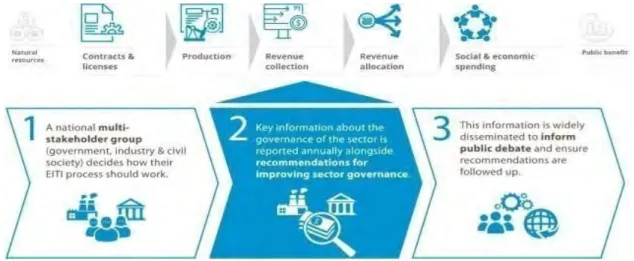
1. Transparency: oil, gas and mining companies disclose information about their operations, including payments to the government, and the government discloses its receipts and other relevant
information on the industry. The figures are reconciled by an Independent Administrator, and published annually alongside other information about the extractive industries in accordance with the EITI Standard.
2. Accountability: a multi-stakeholder group (MSG) with
representatives from government, companies and civil society is established to oversee the process and communicate the findings of the EITI reporting, and promote the integration of EITI into broader transparency efforts in that country. In Indonesia, and for the purposes of this TOR, “MSG” refers to the Transparency Implementation Team.
The EITI Standard encourages MSGs to explore innovative approaches to extending EITI implementation to increase the comprehensiveness of EITI reporting and public understanding of revenues and encourage high standards of transparency and accountability in public life, government operations and in business. The requirements for implementing countries are set out in the EITI Standard. Additional information is available via www.eiti.org. It is a requirement that the MSG approves the terms of reference for the Independent Administrator (EITI Standard 2016 requirement 4.9.iii), drawing on the objectives and agreed scope of the EITI as set out in the MSG’s workplan. The MSG’s deliberations on these matters should be in accordance with the MSG’s internal governance rules and procedures. The EITI requires an inclusive decision-making process throughout implementation, with each constituency being treated as a partner.
It is a requirement that the Independent Administrator be perceived by the MSG to be credible, trustworthy and technically competent
(Requirement 4.9.b.ii). The MSG and Independent Administrator should addresses any concerns regarding conflicts of interest. The EITI Report prepared by the Independent Administrator will be submitted to the MSG for approval and made publicly available in
On behalf of the government of Indonesia and the Transparency Implementation Team, the
Coordinating Ministry for Economic Affairs seeks a competent and credible firm, free from conflicts of interest, to provide Independent Administrator services in accordance with the EITI Standard. The objective of the assignment is to produce an EITI Report for 2014 in accordance with the 2016 EITI Standard and section 3, below.
EITI Implementation in Indonesia
Indonesia was accepted as an EITI Candidate in October 2010. Indonesia’s implementation of EITI entails large and medium-sized oil, gas and mining firms operating in Indonesia reporting the amount of tax and non-tax revenues they have conveyed to the government, and the government reporting what it receives from those companies. To date, EITI-Indonesia has produced three EITI Reports: the first report covering the calender year 2009; the second, 2010-2011; the third, 2012-2013, Indonesia was validated as an EITI-compliant country in 2014, and will undergo validation again in 2017, per the requirements/timelines set forth in the 2016 EITI Standard.The implementation of EITI-Indonesia is overseen by the Transparency Implementation Team (i.e. “MSG”), appointed by Presidential Regulation 26/2010 on Transparency of Local and National Extractive Industry Revenues. The Implementation Team membership represents all reporting
government entities, industry groups (oil/gas, mining, and coal), and three representatives from civil society groups.
Day-to-day implementation is managed by the National Secretariat, housed within the
Coordinating Ministry for Economic Affairs, These terms of reference include “agreed-upon procedures” for EITI reporting (see section 4) in accordance with EITI Requirement 4.9.b.iii. The international EITI Board has developed these procedures to promote greater consistency and reliability in EITI reporting. The EITI process should be used to complement, assess, and improve existing reporting and auditing systems. The Board recommends that the process rely as much as possible on existing procedures and institutions, so that the EITI process draws on, complements and critically evaluates existing data collection and auditing systems. In this way, the EITI process has the potential to generate important
recommendations to strengthen other oversight systems.
2. Objectives of the assignment
Funds for the Services will derive from the
Indonesia EITI Post-Compliance Project (Indonesia NR4D Grant No. TF0A2261), with an estimated cost for this activity of IDR 1.917.200.000.- .
3. Funding Resources
The Official in Charge of Making Commitments (Pejabat Pembuat Komitmen - PPK) or Project Officer for EITI Indonesia activities is Agus Budi Kuntjoro of the Deputy for Energy, Natural Resources and Environment Management in the Coordinating Ministry for Economic Affairs.
4. Name and organization of the
Official in Charge of Making
Commitments
The work of the Independent Administrator has five conceptual phases (see figure 1). These phases may overlap and there may also be some iteration between the phases. EITI reporting is generally preceded by scoping work which is sometimes undertaken by the Independent Administrator (phase 0 in the figure), and sometimes undertaken by the MSG or other consultants.
The Independent Administrator’s responsibilities in each phase are elaborated below.
5. Scope of services, tasks and
expected deliverables
and led by a National Coordinator (current the Assistant Deputy for Extractives).
More information can be found at http://eiti.ekon.go.id/
Objective: The purpose of the inception phase is to confirm that the scope of the EITI reporting process has been clearly defined, including the reporting templates, data collection procedures, and the schedule for publishing the EITI Report. In cases where the Independent Administrator is involved in scoping work, the inception phase will not be extensive. Where the Independent Administrator is not involved in scoping work, some work is required by the Independent Administrator to review prior scoping decisions and considerations taken by the MSG (1.1-1.2 below). The inception report thus ensures that there is a mutual understanding between the MSG and the Independent
Administrator of the scope of the EITI Report and the work to be carried out.
The MSG’s proposal for the scope of the EITI Report, to be revised and confirmed with the Independent Administrator during the inception period, is set out in TOR-Annex 1.
The Independent Administrator is expected to undertake the following tasks during the inception phase:
Phase 1 – Preliminary analysis and
inception report
1.1 Review the relevant background information, including the governance arrangements and tax policies in the extractive industries, the findings from any preliminary scoping work, and the conclusions and recommendations from previous EITI Reports and Validations. (A list of relevant documentation is provided TOR-Annex 2).
1.2 The Independent Administrator should review the scope proposed by the MSG in Annex 1 with a particular focus on the following:
1.2.1 Reviewing the
comprehensiveness of the payments and revenues to be covered in the EITI Report as proposed by the MSG in TOR-Annex 1 and in accordance with EITI Requirement 4 1.2.2 Reviewing the
comprehensiveness of the companies and government entities that are required to
report as defined by the MSG in TOT-Annex 1 and in accordance with EITI Requirement 4.1
1.2.3 Supporting the MSG with examining the audit and assurance procedures in companies and government entities participating in the EITI reporting process. This
includes examining the relevant laws and regulations, any reforms that are planned or underway, and whether these procedures are in line with international standards. It is recommended that the EITI Report includes a summary of the findings, otherwise the MSG should make the results of the review of audit and assurance practices publicly available elsewhere.
1.2.4 Providing advice to the MSG on the reporting templates based on the agreed benefit streams to be reported and the reporting entities (1.1.1– 1.1.2 above). Sample templates are available from the International Secretariat. It is recommended that the templates include a provision requiring companies to report “any other material payments to government entities” above an agreed threshold.
1.3 On the basis of 1.1 and 1.2 as applicable, produce an inception report that:
1.3.1 Includes a statement of materiality (TOR-annex 1) confirming the MSG’s decisions on the payments and revenues to be covered in the EITI Report, including:
• The definition of materiality
and thresholds, and the resulting revenue streams to be included in accordance with Requirement 4.1(b).
• The sale of the state’s share
of production or other
revenues collected in-kind in accordance with
Requirement 4.2.
• The coverage of
infrastructure provisions and barter arrangements in accordance with Requirement 4.3.
• The coverage of social
expenditure in accordance with Requirement 6.1. • The coverage of transportation revenues in accordance with Requirement 4.4.
• Disclosure and reconciliation
of payments to and from state owned enterprises in accordance with
Requirement 4.6.
• The materiality and inclusion
of direct sub-national payments in accordance with Requirement 4.5.
• The materiality and inclusion
of sub-national transfers in accordance with
Requirement 5.2.
• The level and type of
disaggregation of the EITI Report in accordance with Requirement 4.7.
• Any other aspects as agreed
by the MSG following the delivery of the Independent Administrator’s inception report.
1.3.2 Includes a statement of materiality (TOR-annex 1) confirming the MSG’s decisions on the companies and
government entities that are required to report, including:
• The companies, including
SOEs, that make material payments to the state and will be required to report in accordance with
Requirement 4.1(c).
• The government entities,
including any SOEs and sub-national government entities, that receive material payments and will be
required to report in accordance with
Requirement 4.1(c-d), 4.5 and 4.6.
• Any barriers to full
government disclosure of total revenues received from each of the benefit streams agreed in the scope of the EITI report, including revenues that fall below agreed materiality thresholds (Requirement 4.1(d)).
1.3.3 Based on the examination of the audit and assurance procedures in companies and government entities
participating in the EITI reporting process (1.2.3 above), confirms what information participating companies and government entities are required to provide to the Independent
Administrator in order to assure the credibility of the data in accordance with Requirement 4.9.
The Independent Administrator should exercise judgement and apply appropriate international professional standards in developing a procedure that provide a sufficient basis for a comprehensive and reliable EITI Report. The Independent Administrator should employ his /her professional judgemnt to determine the extent to which reliance can be placed on the existing controls and audit frameworks of the companies and governments. Where deemed necessary by the Independent Administrator and the multi-stakeholder group, assurances may include:
• Requesting sign-off from a
senior company or government official from each reporting entity
attesting that the completed reporting form is a complete and accurate record.
• Requesting a confirmation
letter from the companies’ external auditor that
confirms that the information they have submitted is comprehensive and
consistent with their audited financial statements. The MSG may decide to phase in any such procedure so that the confirmation letter may be integrated into the usual work programme of the company’s auditor. Where some companies are not required by law to have an external auditor and therefore cannot provide such assurance, this should
• Where relevant and
practicable, requesting that government reporting entities obtain a certification of the accuracy of the government’s disclosures from their external auditor or equivalent.
The inception report should document the options
considered and the rationale for the assurances to be provided.
1.3.4 Confirms the procedures for integrating and analysing non-revenue information in the EITI
Report. The inception report should incorporate Tabel 1 below, confirming the division of labour between the
Independent Administrator, the MSG or other actors in
compiling this data, and how the information should be sourced and attributed. 1.3.5 Confirms the reporting
templates, as well as any procedures or provisions relating to safeguarding confidential information.
Tabel 0 Non-revenue information to be provided in the EITI Report
Non-revenue information to be provided in
the EITI Report
Work to be undertaken by the
Independent Administrator
Legal framework and fiscal regime in accordance with EITI Requirement 2.1.
Update the material contained in the 2012-2013 EITI-Indonesia Report, and 2014 scoping decisions (TOR-Annex 1).
An overview of the extractive industries, including any significant exploration activities in accordance with EITI Requirement 3.1.
Update the material contained in the 2012-2013 EITI-Indonesia Report, and 2014 scoping decisions (TOR-Annex 1).
Information about the contribution of the extractive industries to the economy in accordance with EITI Requirement 6.3.
Update the material contained in the 2012-2013 EITI-Indonesia Report, and 2014 scoping decisions (TOR-Annex 1).
Production and export data in accordance with EITI Requirement 3.2 and 3.3
Update the material contained in the 2012-2013 EITI-Indonesia
Report, and 2014 scoping decisions (TOR-Annex 1).
Information regarding state participation in the extractive industries in accordance with EITI Requirement 2.6 and 6.2
Update the material contained in the 2012-2013 EITI-Indonesia Report, and 2014 scoping decisions (TOR-Annex 1).
Information about the distribution of revenues from the extractive industries in accordance with EITI Requirement 5.1.
Update the material contained in the 2012-2013 EITI-Indonesia Report, and 2014 scoping decisions (TOR-Annex 1).
Any further information further information requested by the MSG on revenue management and expenditures in accordance with EITI Requirement 5.3.
Update the material contained in the 2012-2013 EITI-Indonesia Report, and 2014 scoping decisions (TOR-Annex 1).
Information about license holders in accordance with EITI Requirement 2.3, and the allocation of licenses in accordance with EITI Requirement 2.2
Update the material contained in the 2012-2013 EITI-Indonesia Report, and 2014 scoping decisions (TOR-Annex 1).
3.3 The Independent Administrator should identify any discrepancies above the agreed margin of error established in agreement with the MSG (per TOR-Annex 1).
Objective: The purpose of the second phase of work is to collect the data for the EITI Report in accordance with the scope confirmed in the
Inception Report. The MSG and national secretariat will provide contact details for the reporting entities and assist the Independent Administrator in
ensuring that all reporting entities participate fully. The Independent Administrator is expected to undertake the following tasks during the data collection phase:
Phase 2 – Data collection
2.1 Distribute the reporting templates and collect the completed forms and associated supporting documentation directly from the participating reporting entities, as well as any contextual or other information that the MSG has tasked the Independent Administrator to collect in accordance with 1.3.4 above. 2.2 Contact the reporting entities directly to
clarify any information gaps or discrepancies.
Objective: The purpose of this phase is to complete an initial compilation and reconciliation of the contextual information and revenue data with a view to identify any gaps or discrepancies to be further investigated.
Phase 3 – initial reconciliation
3.1 The Independent Administrator should compile a database with the payment and revenue data provided by the reporting entities.
3.2 The Independent Administrator should comprehensively reconcile the
information disclosed by the reporting entities, identifying any discrepancies (including offsetting discrepancies) in accordance with the agreed scope and any other gaps in the information provided (e.g. assurances).
Objective: The purpose of this phase is to
investigate any discrepancies identified in the initial reconciliation, and to produce a draft EITI Report that compiles the contextual information, reconciles financial data and explains any discrepancies above the margin of error determined by the MSG, where applicable.
Phase 4 – investigation of
discrepancies and draft EITI Report
4.1 The Independent Administrator should contact the reporting entities to clarify the causes of any significant discrepancies or other gaps in the reported data, and to collect additional data from the reporting entities concerned.
4.2 The Independent Administrator should submit a draft EITI Report to the MSG for comment that comprehensively
reconciles the information disclosed by the reporting entities, identifying any discrepancies, and reports on contextual and other information requested by the MSG. The financial data should be disaggregated to the level of detail agreed by the MSG and in accordance with requirement 4.7. The draft EITI Report should:
a) describe the methodology adopted for the reconciliation of company payments and government revenues, and demonstrate the application of international professional standards. b) include a description of all revenue
streams, related materiality definitions and thresholds (Requirement 4.1).
c) include an assessment from the Independent Administrator on the comprehensiveness and reliability of the (financial) data presented, including an informative summary of the work performed by the
Independent Administrator and the limitations of the assessment provided.
d) indicate the coverage of the
reconciliation exercise, based on the government's disclosure of total revenues as per Requirement 4.1(d). e) include an assessment of whether all
companies and government entities within the agreed scope of the EITI reporting process provided the requested information. Any gaps or weaknesses in reporting to the Independent Administrator must be disclosed in the EITI Report, including naming any entities that failed to comply with the agreed procedures, and an assessment of whether this is likely to have had material impact on the
comprehensiveness of the report. f) document whether the participating
companies and government entities had their financial statements audited in the financial year(s) covered by the EITI Report. Any gaps or
weaknesses must be disclosed. Where audited financial statements are publicly available, it is
recommended that the EITI Report advises readers on how to access this information.
g) include non-revenue information as per Requirement 2,3,5 and 6 and other information requested by the MSG. The contextual information should be clearly sourced in accordance with the procedures agreed by the Independent Administrator and the MSG.
4.3 Where previous EITI Reports have recommended corrective actions and reforms, the Independent Administrator should comment on the progress in implementing those measures. The Independent Administrator should make recommendations for strengthening the reporting process in the future, including any recommendations regarding audit practices and reforms needed to bring them in line with international standards, and where appropriate,
recommendations for other extractive sector reforms
related to strengthening the impact of implementation of the EITI on natural resource governance. The Independent Administrator is encouraged to
collaborate with the MSG in formulating such recommendations.
4.4 The Independent Administrator is encouraged to make recommendations on strengthening the template Terms of Reference for Independent Administrator services in accordance with the EITI Standard for the attention of the EITI Board.
Objective: The purpose of this phase is to ensure that any comments by the MSG on the draft report have been considered and incorporated in the final EITI Report.
Phase 5 – Final EITI Report
5.1 The Independent Administrator will submit the EITI Report upon approval to the MSG. The MSG must endorse the report prior to its publication and will oversee its publication. Where
stakeholders other than the Independent Administrator decide to include additional comments in, or opinions on, the EITI Report, the authorship should be clearly indicated.
5.2 The final EITI Report must be produced in both Bahasa Indonesia and in English. 5.3 The Independent Administrator should
produce electronic data files12 to be published online with the final Report. 5.4 Following approval by the MSG, the
Independent Administrator is mandated to submit summary data from the EITI Report electronically to the International Secretariat according to the standardised reporting format available from the International Secretariat.
5.5 The Independent Administrator shall take appropriate measures to ensure that the report is comprehensible. This includes ensuring that the report has high levels of readability (in both Bahasa Indonesia and in English), legibility and usability. The report should be edited by a professional copy-editor and/or be designed by a professional graphical designer.
5.6 The Independent Administrator shall submit to the national secretariat all data gathered during reconciliation available, including the contact information of all institutions contacted during the reporting process.
The reconciliation of company payments and government revenues must be undertaken by an Independent Administrator applying international professional standards (requirement 4.9). It is a requirement that the Independent Administrator is perceived by the MSG to be credible, trustworthy and technically competent (ibid). Bidders must follow (and show how they will apply) the appropriate professional standards for the reconciliation / agreed-upon-procedures work in preparing their report.
6. Qualification requirements for
Independent Administrators
The Independent Administrator will need to demonstrate:
• Expertise and experience in the oil, gas and
mining sectors in Indonesia.
• Expertise in accounting, auditing and financial
analysis.
• A track record in similar work. Previous
experience in EITI reporting is not required, but would be advantageous. Previous experience in EITI reporting in other countries (not just
Indonesia) would be similarly advantageous.
• Broad knowledge of individual companies in the
extractive industries in Indonesia, as well as the flow of funds for state revenues from extractive industries, and government entities that collect and manage those revenues.
In order to ensure the quality and independence of the exercise, Independent Administrators are required, in their proposal, to disclose any actual or potential conflicts of interest, together with
commentary on how any such conflict can be avoided.
The Independent Administrator must provide a sufficient number of qualified experts and resources to deliver the services as defined in this TOR within the required timeframe.
Key Experts. Key experts’ CVs will be assessed to determine the acceptable qualification and
experience based on the requirements set out in the TOR. These experts should play a leading role in fulfilment of services under this Terms of
Reference.
The roles and estimated numbers of Key Experts are as follows:
1. One (1) Project Manager shall be responsible for assurance of fulfilment of services,
submission of work products/deliverables, and coordination of activities of all experts.
2. One (1) Extractives Sector Specialist shall be responsible for the development of all non-reconciliation data/analysis contained in the report (i.e. “contextual information”), and assistance in reviewing the reporting templates to adequately capture all relevant financial flows in accordance with the 2016 EITI Standard, and proposing recommendations on reporting process and potential sector reforms to improve overall governance of the extractive industries. 3. One (1) Financial Analysis Specialist shall be
responsible for reviewing the reporting template adopted by the Transparency Implementation Team, distributing and collecting completed templates from relevant government entities and companies, and performing financial reconciliation in line with the 2016 EITI Standard.
The above are estimate/indicative inputs, and the Independent Administrator may propose a team in composition, qualification and number as
appropriate to fulfill the assignment in the technical and financial proposals.
Qualifications of Key Experts are as follows:
• Project Manager, with a minimum of an
undergraduate education; at least 8 years’ experience working in accounting, auditing, and/or financial analysis related to extractives; and at least 5 years’ experience working on issues pertaining to the Indonesian oil, gas, and mining sector; and prior experience managing complex assignments.
The assignment is expected to commence on 5 December 2016, culminating in the finalisation of the EITI Report by 28 February 2017. The proposed schedule is set out below, subject to change as needed:
7. Reporting requirements and time
schedule for deliverables
• Extractives Sector Specialist(s) with
demonstrated expertise in the oil, gas and
mining sectors; and at least 10 years’ experience working in the sector.
• Financial Analysis Specialist(s) with a minimum
of an undergraduate education; and at least 7 years’ experience working in accounting, auditing, and/or financial analysis
Other Experts. The Independent Administrator may also include other qualified professionals as
appropriate (classified as non-key experts) in the technical and financial proposals to meet the requirements of the Terms of Reference. Support Staff. In addition, the Independent Administrator may employ supporting staff to provide the needed auxiliary services, such as the services for interpretation and translation, to ensure effective and efficient fulfilment of activities under this assignment.
Signing of contract 5 December 2016
Phase 1: Preliminary analysis
=> Inception report 23 December 2016
Phase 2: Data collection 10 13 December 2016 – 10 February 2017
Phase 3: Initial reconciliation 26 Desember 2016 – 2 February 2017
Phase 4: Investigation of discrepancies 10 – 16 December 2016
=> Draft EITI report 17 February 2017
The Independent Administrator shall also produce and deliver a 4-5 page summary report, highlighting the main findings of the 2014 EITI-Indonesia Report in a user-friendly format.
The schedule of payments shall be as follows:
• 10% following delivery of the inception report • 60% following delivery of the draft EITI report • 30% following Implementation Team approval
and publication of the EITI report The final EITI report should:
a) Include revisions of the draft as recommended by the Implementation Team;
b) Be approved by the Implementation Team; c) Include an executive summary that briefly
presents the contents of the report;
d) Be written in two languages, Indonesian and English. The authoritative version is the report in the Indonesian language;
e) Be in the form of electronic data files and 25 hard copies. The final report with executive summary will also be made in a form that is easy to read and reproduce, in multiple formats (pdf, word, and excel where relevant). All quantitative and reconciliation-related data files shall be presented in Excel (.xlsx) and/or CSV (.csv) format;
f) Include summary data to be sent electronically to the EITI International Secretariat according to the standardised reporting format available from the International Secretariat;
g) Contain colorized maps where relevant to facilitate readability;
h) All data collected for reconciliation should be formatted as specified by the EITI Indonesia Secretariat, to ensure compatibility with the existing Indonesia Extractives Data Portal database.
The Independent Administrator will report to the EITI-Indonesia National Coordinator (Assistant Deputy Minister of Extractives, Coordinating Ministry for Economic Affairs). Day-to-day supervision of the work will be managed by the Team Leader of the EITI-Indonesia National Secretariat. The National Secretariat shall provide general support to the Independent Administrator in the following areas, as needed:
• Summary of all scoping decisions for the 2014
EITI-Indonesia Report that have been approved by the MSG, and all draft reporting templates (that should be reviewed/amended as
necessary) prior to distribution to reporting companies and government entities.
• Clarifications on the content and requirements of
the 2016 EITI Standard (in consultation with the EITI International Secretariat in Oslo, Norway);
• Providing introductions and contact details for
company and government staff relevant to the EITI Report.
8. Client’s input and counterpart
personnel
Ringkasan Eksekutif
Proporsi Penerimaan Negara per Jenis Usaha
Penerimaan sektor migas di tahun 2014 sebesar Rp 341,25 triliun meningkat dibandingkan dengan penerimaan di tahun 2013 sebesar Rp 326,78 triliun. Namun persentase penerimaan sektor migas tahun 2014 sebesar 22,01 % terhadap penerimaan negara, lebih rendah dibandingkan dengan persentase penerimaan migas tahun 2013 sebesar 22,70%.Jenis Penerimaan (dalam triliun Rupiah)2013 (dalam triliun Rupiah)2014
PAJAK
Pajak Penghasilan Migas 88,75 87,45
PBB Migas 20,94 20,60
BUKAN PAJAK
Pendapatan Minyak Bumi 135,33 139,17 Pendapatan Gas Alam 68,30 77,7 Pendapatan dari Kegiatan Hulu 13,46 16,33 TOTAL PENERIMAAN MIGAS 326,78 341,25
TOTAL PENERIMAAN NEGARA 1.438,89 1.550,49
RASIO PENERIMAAN 22,70% 22,01%
Tabel 1 Penerimaan Negara Tahun 2013 dan 2014 untuk Sektor Migas
Sumber: LKPP 2013 dan 2014
Penerimaan sektor minerba di tahun 2014 sebesar Rp 37,37 triliun yang berkontribusi 10,01% terhadap total penerimaan negara, meningkat dibandingkan dengan jumlah penerimaan negara 2013 sebesar Rp 29,63 triliun dan berkontribusi 9,8 % terhadap total penerimaan negara, seperti dijelaskan pada Tabel 2 Penerimaan Negara Tahun 2013 dan 2014 untuk Sektor Minerba berikut ini.
Jenis Penerimaan (dalam triliun Rupiah)2013 (dalam triliun Rupiah)2014 PAJAK
Pajak Minerba 96,57 118,8
BUKAN PAJAK
Royalti 18,03 18,49
Penjualan Hasil Tambang 9,79 16,17
Iuran Tetap 0,59 0,81
Pendapatan pengusaha hutan 0,59 0,88
TOTAL PENERIMAAN MINERBA 29,63 37,37
TOTAL PENERIMAAN NEGARA 1.438,89 1550,49
RASIO PENERIMAAN 9,8% 10,01%
Tabel 2 Penerimaan Negara Tahun 2013 dan 2014 untuk Sektor Minerba
Sumber: LKPP 2013 dan 2014
Perusahaan Penyumbang Besar
Total lifting minyak dalam barel terbesar dihasilkan oleh Chevron (group perusahaan) untuk tahun 2013 dan 2014 dengan kontribusi lifting sebanyak 42% dan 40%.
Untuk lifting gas dalam MSCF, ConocoPhillips (group perusahaan) menghasilkan kontribusi lifting gas sebanyak 21% di tahun 2014 dan 19% di tahun 2013. Total lifting migas untuk 5 terbesar selama tahun 2013 dan 2014 terlihat dalam Gambar 1 dan 2.
Total lifting migas untuk 5 terbesar selama tahun 2013 dan 2014 terlihat dalam Gambar 1 dan 2. Gambar 1 Total Lifting Oil & Gas Tahun 2014
Total Lifting Oil per perusahaan 2014 Total Lifting Gas per perusahaan 2014
Di sektor minerba, 5 perusahaan penyumbang royalti terbesar mencakup 46% dari total pembayaran royalti untuk tahun 2014 dimana terjadi kenaikan sebesar 11% dari tahun sebelumnya. PT Bukit Asam (Persero), Tbk merupakan satu-satunya perusahaan BUMN yang termasuk dalam 5 perusahaan penyumbang royalti terbesar pada tahun 2014.
Perusahaan minerba penyumbang royalti terbesar selama tahun 2013 dan tahun 2014 dapat dilihat pada Gambar 3.
Gambar 2 Total Lifting Oil & Gas Tahun 2013
Gambar 3 Perusahaan Minerba Penyumbang Royalti terbesar Tahun 2013 dan 2014. Total Lifting Oil per perusahaan 2013 Total Lifting Gas per perusahaan 2013 Royalti 2014 Royalti 2013
Gambar 4 Kontribusi Industri Ekstraktif pada Total PDB Nasional
Namun persentase tersebut mulai menurun pada tahun 2014 yang menjadi 10,5% dari Total PDB nasional. Kontribusi sektor pertambangan terhadap PDB secara nasional terlihat tidak terlalu dominan yaitu berkisaran antara 10-11% dari total PDB nasional. Namun, kontribusi sektor pertambangan dalam PDB [ekonomi] daerah seperti Papua, Bangka-Belitung, Nusa Tenggara Barat dan Kalimantan Timur memiliki peranan yang besar
.
Gambar 4 menggambarkan secara garis besarkontribusi sektor pertambangan Indonesia terhadap Total PDB nasional atas dasar harga berlaku. Secara nominal, PDB sektor pertambangan pada kurun waktu 2010-2014 terus tumbuh.
Pertumbuhan tersebut juga meningkatkan kontribusi sektor pertambangan pada PDB nasional, namun komposisi PDB sektor pertambangan pada Total PDB nasional mulai menurun pada tahun 2013 hingga 2014.
Tahun 2010 sektor pertambangan berkontribusi sekitar 11,2% dari Total PDB nasional. Persentasi tersebut terus naik yang pada puncaknya mencapai 11,8% dari Total PDB nasional di tahun 2011 yang disebabkan oleh kenaikan harga internasional pada berbagai harga komoditas mineral.
2010 2011 2012 2013 2014
Pertambangan Minyak dan Gas Bumi 290 370 387 401 413
Pertambangan tanpa Migas 333 398 462 483 480
Penggalian 96 109 124 142 166
% Pertambangan Minyak dan Gas Bumi 5% 5% 5% 4% 4%
% Pertambangan tanpa Migas 5% 5% 6% 5% 5%
% Penggalian 2% 2% 2% 2% 2% Total Pertambangan 11.2% 11.8% 11.8% 11.3% 10.5% 11.2% 11.8% 11.8% 11.3% 10.5% 0% 2% 4% 6% 8% 10% 12% 14% 0 200 400 600 800 1000 1200 PD B d ar i s ek to r p ert am b an ga n , Tr ili u n R u p ia h Sumber: BPS
Gambar 5 menggambarkan signifikansi kontribusi penerimaan negara pada kurun waktu 2010-2014. Dengan kontribusi sekitar 30% - 33% dari total penerimaan negara, sektor migas dan minerba merupakan sektor yang berperan penting dalam penerimaan negara. Kontribusi pertambangan migas berkontribusi sekitar 23%-25% dan sektor minerba yang berkontribusi sekitar 6%-9% dari total penerimaan negara.
Pada periode tahun 2010-2014, nominal penerimaan negara dari sektor pertambangan migas terus mengalami kenaikan khususnya pada tahun 2011 kenaikan penerimaan negara cukup signifikan karena kenaikan harga minyak mentah dari sekitar USD 80/barel dolar AS menjadi diatas USD100/barel. Pada tahun 2012 dan tahun 2013, penerimaan negara dari pertambangan migas meningkat walaupun terjadi penurunan lifting disebabkan melemahnya nilai tukar Rupiah terhadap Dolar Amerika Serikat pada periode tersebut. Persentase kontribusi penerimaan negara dari sektor pertambangan migas terus menurun dari 25% pada tahun 2011 sampai dengan 22% pada tahun 2014.
Begitu pula penerimaan negara dari sektor
pertambangan minerba yang secara nominal terus mengalami kenaikan pada periode tahun 2010-2013. Puncak tertinggi baik dari segi nominal dan persentase terjadi pada tahun 2013 yang kemudian menurun pada tahun 2014. Penurunan penerimaan negara tersebut disebabkan oleh turunnya harga batubara sekitar USD 64,65/ton dan melimpahnya ketersediaan minyak mentah di pasar dunia. Gambar 6 – 8 menggambarkan ekspor komoditas pertambangan dan kontribusinya pada ekspor nasional untuk kurun waktu tahun 2010-2014. Kontribusi nilai ekspor pertambangan dari total ekspor nasional cukup signifikan yaitu berkisar antara 29%-35% setiap tahunnya berdasarkan penerimaan dalam USD. Nilai ekspor tersebut didominasi oleh nilai ekspor dari migas dan batubara. Pada tahun 2010-2014, ekspor migas berkontribusi sekitar 12%-18% dari total nilai ekspor nasional sedangkan nilai ekspor batubara mencapai 11%-14% dari total nilai ekspor nasional. Namun kontribusi nilai ekspor pertambangan pada tahun 2012-2013 mengalami tren menurun yang
disebabkan oleh menurunnya produksi minyak dan
32% 33% 31% 31% 32% 24% 25% 24% 23% 22% 0% 5% 10% 15% 20% 25% 30% 35% 0 50 100 150 200 250 300 350 400 450 500 2010 2011 2012 2013 2014
Minyak dan Gas Bumi Mineral dan Batubara % Mineral dan Batubara % Total Industri Ekstraktif % Minyak dan Gas Bumi
Gambar 5 Kontribusi Industri Ekstraktif pada Penerimaan Negara
2010 2011 2012 2013 2014 Bauksit 0.5 0.8 0.6 1.4 0 Bijih Nikel 0.5 1.4 1.5 1.7 0.09 Bijih Tembaga 6.9 4.7 2.6 3 1.68 Batubara 18.5 27.2 26.2 24.5 20.82 Gas Bumi 13.7 22.9 20.5 18.1 17.18 Minyak Bumi 10.4 13.8 12.3 10.2 3.62 Lainnya 0.3 0.5 0.5 0.6 7.68 0 10 20 30 40 50 60 70 80 N ilai E ksp o r P er tam ba ng an pe r Kom o di tas Ut am a, M ili ar US D
Gambar 7 Volume ekspor sektor pertambangan per komoditas utama (dalam Juta Ton)
2010 2011 2012 2013 2014 Bauksit 27.4 40.6 29.5 57.1 0 Bijih Nikel 17.6 40.8 48.4 64.8 4.16 Bijih Tembaga 2.6 1.5 1.1 1.5 0.72 Batubara 298.8 353.4 384.3 424.3 408.24 Gas Bumi 30.5 34.3 27.8 25.1 23.79 Minyak Bumi 18.1 17.8 15 13 5.56 Lainnya 13.5 20.8 20.4 33.9 7.85 0 100 200 300 400 500 600 700 Vo lum e Ek sp o r P er tam ba ng an pe r Kom o di tas Ut am a, Jut a To n
Gambar 6 Kontribusi Industri Ekstraktif pada Total Ekspor Nasional (dalam miliar USD)
Gambar 8 Kontribusi sektor pertambangan terhadap nilai ekspor 2010 2011 2012 2013 2014 Bauksit 0.3% 0.4% 0.3% 0.7% 0.0% Bijih Nikel 0.3% 0.7% 0.8% 0.9% 0.1% Bijih Tembaga 4.4% 2.3% 1.4% 1.6% 1.0% Batubara 11.7% 13.4% 13.8% 13.4% 11.8% Gas Bumi 8.7% 11.2% 10.8% 9.9% 9.8% Minyak Bumi 6.6% 6.8% 6.5% 5.6% 2.1% Lainnya 0.2% 0.3% 0.2% 0.3% 4.4% 0.0% 5.0% 10.0% 15.0% 20.0% 25.0% 30.0% 35.0% 40.0% Vo lum e Ek sp o r P er tam ba ng an pe r Kom o di tas Ut am a, Jut a To n Sumber: BPS
Ekspor Migas berdasarkan Kontraktor
Gambar 9 dan Gambar 10 menggambarkan ekspor berdasarkan kontraktor utama yang menyumbang sekitar 90% dari total ekspor minyak bumi nasional. Blok penyumbang ekspor minyak bumi terbesar adalah Blok Cepu yang dikelola oleh Mobil Cepu Ltd. sebesar 549 juta USD(yang merupakan 43% total ekspor minyak bumi nasional) pada tahun 2014. Untuk ekspor gas bumi, Blok Mahakam yang dikelola Total E&P Indonesie merupakan kontributor terbesar dengan nilai sebesar 2.123 juta USD (yang merupakan 54% dari ekspor gas bumi nasional) pada tahun 2014.
Gambar 9 Ekspor minyak bumi tahun 2014
549 194 158 143 50 43 36 30 26 23 15 7 5 4 4 4 0 100 200 300 400 500 600 N ilai Eks p o r, Jut a US D
Gambar 10 Ekspor gas bumi tahun 2014 2123 298 290 274 244 201 106 92 85 76 67 36 31 7 5 5 0 500 1000 1500 2000 2500 N ilai Eks p o r, Jut a US D
Gambar 10 Ekspor Gas Bumi Tahun 2014
Kontribusi Industri Ekstraktif pada
Lapangan Kerja Nasional
Gambar 11 berdasarkan data BPS dijelaskan di bawah ini mengilustrasikan kontribusi tenaga kerja di sektor pertambangan dan penggalian yang menyumbang sekitar 1,44 juta pekerja (atau 1,3% dari total angkatan kerja) pada tahun 2014.
Data ini menunjukkan adanya penurunan yang cukup drastis dari 2012 ke 2013 tetapi dari 2013 ke 2014 terjadi sedikit peningkatan yaitu sekitar 10.000 tenaga kerja.
Gambar 11 Kontribusi industri ekstraktif pada lapangan kerja nasional
1.25 1.43 1.60 1.43 1.44 1.1% 1.2% 1.2% 1.3% 1.3% 1.4% 1.4% 1.5% 0.00 0.20 0.40 0.60 0.80 1.00 1.20 1.40 1.60 1.80 2010 2011 2012 2013 2014 Ju m lah T en aga Ke rja Se kt o r Pertamb an gan d an P en ggalian (ju ta o ra n g)
Penerimaan Negara
Berdasarkan LKPP, penerimaan negara terbagi menjadi penerimaan negara yang berasal dari Pajak dan Penerimaan Negara Bukan Pajak (PNBP). Dalam konteks laporan ini, penerimaan negara yang akan diulas adalah penerimaan negara yang berasal dari industri ekstraktif (dalam hal ini adalah sektor minyak dan gas bumi
selanjutnya disebut sektor migas dan mineral batubara selanjutnya disebut sektor minerba). Untuk tahun 2014, penerimaan negara yang berasal dari sektor migas dan sektor minerba masing-masing sebesar 22,01% dan 9,95% dari total penerimaan negara.
Perusahaan migas adalah perusahaan yang bergerak di bidang eksplorasi dan eksploitasi hasil tambang minyak dan gas bumi, sedangkan
perusahaan minerba bergerak di bidang hasil tambang mineral (tembaga, emas, perak, nikel, dan lain-lain) dan batubara.
Berikut jenis penerimaan dari sektor migas dan minerba yang direkonsiliasi baik dari penerimaan pajak maupun penerimaan negara bukan pajak (Standar EITI 4.1.b):
Sektor migas
• Pajak Penghasilan Badan dan Dividen • Government lifting (disesuaikan dengan
over/under lifting) dan DMO yang diterima dalam
bentuk natura
• Signature Bonus dan Production Bonus Sektor minerba
• Royalti, PHT, Pajak Penghasilan Badan dan Dividen yang disetorkan dalam bentuk tunai ke kas negara
• Jasa transportasi BUMN yang diterima oleh BUMN
Penerimaan Negara yang
direkonsiliasi
Perpres No.26 Tahun 2010 tentang Transparansi Pendapatan Negara dan Daerah dari industri ekstraktif mengatur ketentuan yang mensyaratkan perusahaan di industri ekstraktif, dalam hal ini sektor migas dan minerba, untuk melaporkan pembayaran pajak dan bukan pajak yang dicatat oleh negara sebagai penerimaan negara untuk dilakukan rekonsiliasi.
Standar EITI 4.1.a menyatakan bahwa Tim Pelaksana menentukan batas materialitas dari penerimaan negara yang direkonsiliasi. Dalam laporan ini, jenis penerimaan dari industri ekstraktif yang direkonsiliasi adalah jenis penerimaan yang jumlahnya material, yaitu diatas 1% dari total penerimaan masing-masing sektor migas dan minerba.
Pendekatan ini berdasarkan Scoping Study yang telah disetujui oleh Tim Pelaksana, sedangkan untuk penelusuran perbedaan yang terjadi, batas yang ditetapkan adalah 5%.
Untuk sektor migas tahun 2014, sesuai dengan formulir pelaporan yang diterima, total penerimaan pajak yang direkonsiliasi adalah sebesar USD 7,3 Miliar. Sedangkan untuk penerimaan non pajak, jumlah yang direkonsiliasi adalah sebesar USD 21,8 Miliar.
Hasil rekonsiliasi sektor migas menunjukkan bahwa terdapat penurunan yang signifikan antara
perbedaan awal (sebelum dilakukan penyesuaian) dengan perbedaan akhir (setelah dilakukan
penyesuaian) untuk setiap jenis informasi yang direkonsiliasi. Selain bertujuan untuk melakukan penyesuaian terhadap selisih, klarifikasi merupakan hal penting dalam mengidentifikasi penyebab selisih tersebut.
Berdasarkan analisa, perbedaan akhir disebabkan antara lain oleh karena:
Perbedaan antara KKKS dan SKK Migas sebesar USD 85 ribu pada DMO Fee dikarenakan:
• Terdapat KKKS yang telah menagihkan DMO
Fee kepada pemerintah namun tidak dibayarkan
karena belum ada kepastian Equity To Be Split (ETBS) untuk 1 perusahaan. Perbedaan karena alasan ini sudah dkonfirmasi oleh IA ke KKKS
Perbedaan antara KKKS dengan SKK Migas sebesar 93.212 MSCF pada total lifting gas (volume) dikarenakan:
• Terdapat kesalahan pengisian data total lifting gas oleh KKKS pada FQR yang diserahkan kepada SKK Migas, yaitu belum termasuk kuantitas LPG. Sedangkan data total lifting gas yang diserahkan oleh KKKS kepada EITI adalah data yang sudah diperbaharui, yaitu termasuk kuantitas LPG. Kesalahan ini dilakukan oleh 1 perusahaan dan telah dikonfirmasi oleh IA kepada KKKS dan SKK Migas.
Perbedaan antara KKKS dengan SKK Migas sebesar 1.930 MSCF pada government lifting gas (volume) dikarenakan:
• Pengisian nilai government lifting gas (MSCF) oleh KKKS pada formulir pelaporan belum berdasarkan FQR yang sudah final. Nilai yang diisi KKKS berbeda dengan nilai yang diberikan SKK Migas. Hingga batas tenggat waktu, perbedaan ini belum dikonfirmasi oleh KKKS. Perbedaan antara KKKS dengan Ditjen Migas sebesar 118.460.691 MSCF pada total lifting gas (volume) dikarenakan:
• Perbedaan pencatatan data lifting gas antara Ditjen Migas dengan KKKS dikarenakan perbedaan nilai konversi, unitisasi Wilayah Kerja, koreksi nilai lifting pada laporan Ditjen Migas, dan penggabungan data Operator dan Partner oleh Ditjen Migas. Selisih karena penyebab ini terjadi pada 51 perusahaan dan telah dikonfirmasi oleh Ditjen Migas dan SKK Migas.
Perbedaan antara KKKS dengan Ditjen Anggaran sebesar USD 21.151 ribu pada Corporate &
Dividend Tax dikarenakan:
• Pembayaran pajak dan/atau pembayaran produk hukum (STP, SKPKB) yang dilaporkan oleh perusahaan dan disetorkan ke rekening Kas Umum Negara sehingga tidak tercatat oleh Ditjen Anggaran. Perbedaan ini terjadi pada 11 perusahaan dan telah dikonfirmasi oleh Ditjen Anggaran dan KKKS.
• Perbedaan pencatatan pembayaran pajak antara Ditjen Anggaran dengan KKKS untuk 9
perusahaan.
• Sampai batas waktu yang ditentukan konfirmasi belum didapat dari entitas pelapor dan/atau Ditjen Anggaran terkait selisih pembayaran pajak sebanyak 10 perusahaan.
Perbedaan antara KKKS dengan Ditjen Anggaran sebesar USD 538.706 pada over/under lifting minyak dan gas dikarenakan:
• Over/under lifting LNG yang diselesaikan melalui mekanisme karga, tidak melalui cash, sehingga tidak masuk cash settlement di DJA untuk 8 perusahaan.
Secara keseluruhan hasil rekonsiliasi sektor migas dapat dilihat pada Tabel 3 Hasil Rekonsiliasi untuk Sektor Migas Tahun 2014 di halaman selanjutnya.