Hosted by
International Institute for Financial Studies
NANCHANG
15‐17 JULY 2013
CONFERENCE PROGRAM
MONDAY 15 JULY
08.30‐19.00 Registration Hotel Lobby, 1/F
14.30‐17.30 AsFA Boarding Meeting Meeting Room 2, 4/F
18.00‐20.30 Welcome Reception Taichi Chinese Restaurant, 2/F
TUESDAY 16 JULY
08:30‐‐10:00 CONCURRENT SESSIONS
Session 1.Corporate Finance Theory Meeting Room 210, 2/F
Chair :Artashes Karapetyan, Central Bank of Norway
Product Market Predatory Threats and Contractual Constraints of Debt Einar C. Kjenstad, University of Rochester
Xunhua Su, Norwegian School of Economics
Discussant:Artashes Karapetyan, Central Bank of Norway
Does Information Sharing Reduce the Role of Collateral as a Screening Device? Artashes Karapetyan, Central Bank of Norway
Bogdan Stacescu, Norwegian School of Management BI Discussant:Xunhua Su, Norwegian School of Economics
TUESDAY 16 JULY
08:30‐‐10:00 CONCURRENT SESSIONS
Session 2.International Finance I Meeting Room 1, 4/F
Chair :Hong Zhang, INSEAD
Currency Premia and Global Imbalances
Pasquale Della Corte, Imperial College Business School Steven J. Riddiough, University of Warwick
Lucio Sarno, City University London
Discussant:Nan Shi, Durham Business School
The Dark Side of ETF Investing: A World‐Wide Analysis Si Cheng, National University of Singapore
Massimo Massa, INSEAD Hong Zhang, INSEAD
Are Investors Compensated for Bearing Market Volatility in a Country? Samuel Xin Liang, Hong Kong University of Science & Technology
K. C. John Wei, Hong Kong University of Science & Technology Discussant:Hong Zhang, INSEAD
Causes of Global Imbalances: A Global VAR Analysis Zhichao Zhang, Durham Business School
Frankie Chau, Durham Business School Nan Shi, Durham Business School
Discussant:Pasquale Della Corte, Imperial College Business School
TUESDAY 16 JULY
08:30‐‐10:00 CONCURRENT SESSIONS
Session 3. Shiv NaDAR Invited Session Meeting Room 2, 4/F
Chair :Sankar De, Indian School of Business
Asset Pricing with Regime‐Dependent Preferences and Learning Tony Berrada, University of Geneva
Jerome Detemple, Boston University Marcel Rindisbacher, Boston University
Short‐Run and Long‐Run Consumption Risks, Dividend Processes and Asset Returns Jun Li, University of Texas at Dallas
Harold H. Zhang, University of Texas at Dallas
Speculation and Leverage
Mark Loewenstein, University of Maryland
TUESDAY 16 JULY
08:30‐‐10:00 CONCURRENT SESSIONS
Session 4.Empirical Asset Pricing I Meeting Room 3, 4/F
Chair:Kalok Chan, Hong Kong University of Science & Technology
Behavioural Types and Characteristics of UK Fund Managers’ Cascading and Herding: New Evidence from the Stock Market
Ralph Yang‐Cheng Lu, Ming Chuan University Hao Fang, Hwa Hsia Institute of Technology Discussant:Ming Gu, Renmin University of China
Distress Risk, Investor Sophistication and Accrual Anomaly Ming Gu, Renmin University of China
Is the Asset Growth Effect Mispricing or Efficiency: Evidence from Stock Issuance and Buyback Restrictions Alan Guoming Huang, University of Waterloo
Kevin Jialin Sun, St. John's University
Discussant:Jianfeng Hu, City University of New York, CUNY Baruch College
Option Listing and the Probability of Informed Trading in the Stock Market Jianfeng Hu, City University of New York, CUNY Baruch College
Discussant:Alan Huang, University of Waterloo
TUESDAY 16 JULY
08:30‐‐10:00 CONCURRENT SESSIONS
Session 5.Corporate Finance Empirical: Ownership Structure I Meeting Room 5, 4/F Chair:Zhi Wang, University of Oregon
Are Family Firms Better Performers During the Financial Crisis? Yanbo Wang, INSEAD
Haoyong Zhou, Keele University
Discussant:Xiaoyan Chen, University of Queensland
Shirkers or Monitors: The Role of Block Institutional Investors in Corporate Cash Valuation Zhi Jay Wang , University of Oregon
Steven R. Matsunaga , University of Oregon Jing Huang , University of Oregon
Discussant:Hung Wan Kot, Hong Kong Baptist University
Ultimate Ownership Bank Connections and Collateral in China Xiaofei Pan , University of Wollongong
Gary Gang Tian , University of Wollongong Discussant:Chaohong Na , Yunnan University
10.00‐10.30 Morning tea Foyer, 4/F
TUESDAY 16 JULY
10:30‐‐12:00 CONCURRENT SESSIONS
Session 6.Asset Pricing Theory I Meeting Room 210, 2/F
Chair:Harold Zhang, University of Texas at Dallas
Variance Risk Premium: A Consumption‐Based Equilibrium Approach Xinwei Ma, Peking University
Jin E. Zhang, University of Otago
View Bias Towards Ambiguity, Expectile CAPM and the Anomalies Wei Hu, Curtin University of Technology
Zhenlong Zheng, Xiamen University
Discussant:Lei Shi, University of Technology, Sydney
Asset Pricing with a Financial Sector
Kai Li, Hong Kong University of Science & Technology Discussant:Harold Zhang, University of Texas at Dallas
TUESDAY 16 JULY
10:30‐‐12:00 CONCURRENT SESSIONS
Session 7. China’s Financial System: IPO Meeting Room 1, 4/F
Chair:Jian Yang, University of Colorado at Denver
Legal Protection and Underpricing of IPOs: Evidence from China Jianlei Liu, Kyushu University
Konari Uchida, Kyushu University Ruidong Gao, Waseda University
Discussant:Tina Wei Li , Hong Kong Polytechnic University
The Differential Impact of the Bank‐Firm Relationship on IPO Underpricing: Evidence from China Xiangchao Hao, Nankai University
Jing Shi, Australian National University Jian Yang, University of Colorado at Denver
Discussant:Peng Wang, Swedish School of Economics and Business Administration
Institutional Environment, Firm Ownership and IPO First‐Day Returns: Evidence from China Yibiao Chen, Hong Kong Polytechnic University
Steven Shuye Wang, Hong Kong Polytechnic University Wei Li, Hong Kong Polytechnic University
Wilson H.S. Tong, Hong Kong Polytechnic University Discussant:Jianlei Liu, Kyushu University
Pyramid IPOs on the Chinese Growth Enterprise Market Martin Holmen, Göteborg University
Peng Wang, Swedish School of Economics and Business Administration Discussant:Jian Yang, University of Colorado at Denver
TUESDAY 16 JULY
10:30‐‐12:00 CONCURRENT SESSIONS
Session 8.Behavioral Asset Pricing I Meeting Room 2, 4/F
The Effects of Managerial Extraversion on Corporate Behavior Na Young Park, University of Oxford
Discussant:Sung Bin Sohn, Peking University
Investor Attention and the Post Earnings Announcement Drift Ernest Tan, University of Western Australia
Sirimon Treepongkaruna, University of Western Australia Marvin Wee, University of Western Australia
Jing Yu, University of Western Australia
Discussant:G. Mujtaba Mian, Hong Kong Polytechnic University
Investors’ Selective Attention and Accruals Anomaly G. Mujtaba Mian, Hong Kong Polytechnic University Lixin (Nancy) Su, Hong Kong Polytechnic University Discussant:Marvin Wee, University of Western Australia
What Does Investor Sentiment Reflect: Animal Spirits or Risks? Sung Bin Sohn, Peking University
Discussant:Jean Jinghan Chen, University of Surrey
TUESDAY 16 JULY
10:30‐‐12:00 CONCURRENT SESSIONS
Session 9.Corporate Social Responsibility I Meeting Room 3, 4/F Chair:Renée Adams, Australian School of Business at UNSW
Can Socially Responsible Firms Survive Competition? An Analysis of Corporate Employee Matching Grants
Ning Gong, Melbourne Business School Bruce D. Grundy, University of Melbourne
Discussant:Ambrus Kecskes, Virginia Polytechnic Institute & State University
The Effect of Mandatory CSR Disclosure on Information Asymmetry: Evidence from a Quasi‐Natural Experiment in China
Mingyi Hung, University of Southern California Jing Shi, Australian National University
Yongxiang Wang, University of Southern California Discussant:Ning Gong , Melbourne Business School
Can Firms Do Well for Shareholders by Doing Good for Stakeholders? The Importance of Long‐Term Investors
Ambrus Kecskes, Virginia Polytechnic Institute & State University Sattar Mansi, Virginia Polytechnic Institute & State University
TUESDAY 16 JULY
10:30‐‐12:00 CONCURRENT SESSIONS
Session 10.Market Microstructure Meeting Room 5, 4/F
Chair:Shaojun Zhang, Nanyang Technological University
Bid‐Ask Spreads, Quoted Depths, and Unexpected Duration between Trades Tony Ruan, Xiamen University
Tongshu Ma, Binghamton University
Discussant:Shaojun Zhang, Hong Kong Polytechnic University
Trading Restriction, Tick Size and Price Discovery: Evidence from a Natural Experiment in China Kalok Chan, Hong Kong University of Science & Technology
Wilson H.S. Tong, Hong Kong Polytechnic University Shaojun Zhang, Hong Kong Polytechnic University Discussant:Tony Ruan, Xiamen University
Measuring the Realized Skewness in Noisy Semi‐Martingale with Jumps Using High Frequency Data
Kent Wang, Xiamen University Junwei Liu, Xiamen University Zhi Liu, University of Macau
Discussant:Tom Smith, University of Queensland
12.00‐13.00 Lunch (Buffet) Taichi Chinese Restaurant, 2/F
13.00‐14.00 Keynote Address Grand Ballroom, 4/F
Professor Franklin Allen, University of Pennsylvania, “Finance and Growth in China”
Sponsored by The Australian National University
TUESDAY 16 JULY
14:20‐‐15:50 CONCURRENT SESSIONS
Session 11.Asset Pricing Theory II Meeting Room 210, 2/F
Chair:Jerome Detemple, Boston University
Differences in Opinion and Equilibrium Asset Returns in a Multi‐Asset Market Xuezhong He, University of Technology, Sydney
Lei Shi, University of Technology, Sydney Discussant:Xinwei Ma, Peking University
Cointegration of Durable Consumption in Asset Returns Guojin Chen, Xiamen University
Zhiwu Hong, Xiamen University Yu Ren, Xiamen University
TUESDAY 16 JULY
14:20‐‐15:50 CONCURRENT SESSIONS
Session 12.Corporate Finance Empirical: Human Capital Meeting Room 1, 4/F Chair:Richard Ottoo, Pace University
Human Capital, Managerial Overconfidence, and Corporate Valuation Richard E. Ottoo, Pace University
Discussant:Yu Ren, Xiamen University
Human Capital, Household Capital and Asset Returns Yu Ren, Xiamen University
Yufei Yuan, Xiamen University Yang Zhang, Cornell University
Discussant:Richard Ottoo, Pace University
Too Much Connection Can Harm Your Health: An Analysis of Political Connections and Firm Value Carl R. Chen, University of Dayton
Luo Danglun Sr. , Sun Yat‐Sen University Ting Zhang, University of Dayton
Discussant:Stefan Zeume, INSEAD
TUESDAY 16 JULY
14:20‐‐15:50 CONCURRENT SESSIONS
Session 13.NTU invited Session Meeting Room 2, 4/F
Chair:Chuan‐Yang Hwang, Nanyang Technological University
Making It to the Top: From Female Labor Force Participation to Boardroom Gender Diversity Renee B. Adams, Australian School of Business at UNSW
Tom Kirchmaier, University of Manchester
The Brain Gain of Corporate Boards: A Natural Experiment from China Mariassunta Giannetti, Stockholm School of Economics
Guanmin Liao, Central University of Finance and Economics Xiaoyun Yu, Indiana University Bloomington
The Effect of Increased Financial Disclosure on Post‐Earnings‐Announcement Drift: Worldwide Evidence
Mingyi Hung , University of Southern California Xi Li , Hong Kong University of Science & Technology
TUESDAY 16 JULY
14:20‐‐15:50 CONCURRENT SESSIONS
Session 14.Empirical Asset Pricing III Meeting Room 3, 4/F
Chair:Mark Loewenstein, University of Maryland
Nominal Price Illusion
Justin Birru, New York University
Baolian Wang, Hong Kong University of Science & Technology Discussant:Bingxin Li, University of Houston
Depicting the 'Elephant': When All Asset Pricing Models are Blind Qing Zhou , University of Queensland
Discussant:Nicolas Fulli‐Lemaire , Amundi Asset Management
Dynamic Jump Intensities and Risk Premiums in Crude Oil Futures and Options Markets Peter Christoffersen, University of Toronto
Kris Jacobs, University of Houston Bingxin Li, University of Houston
Discussant:Mark Loewenstein , University of Maryland
Allocating Commodities in Inflation Hedging Portfolios: A Core Driven Global Macro Strategy Nicolas Fulli‐Lemaire, Amundi Asset Management
Discussant:Qing Zhou, University of Queensland
TUESDAY 16 JULY
14:20‐‐15:50 CONCURRENT SESSIONS
Session 15.Financial Institutions I Meeting Room 5, 4/F
Chair:Bang Nam Jeon, Drexel University
Asymmetry Information and Diversification Effect on Loan Pricing in Asia Pacific Region 2006‐2010
Yudi Surya Tanjung, University of Surabaya Deddy Marciano, University of Surabaya James Bartle, University of New South Wales Discussant:Bang Nam Jeon, Drexel University
Shareholder Empowerment and Bank Bailouts
Daniel Ferreira, London School of Economics & Political Science David Kershaw, London School of Economics
Tom Kirchmaier, University of Manchester
Labor Protection Laws and Bank Loan Contracting Azizjon Alimov, City University of Hong Kong
Discussant:Tom Kirchmaier, University of Manchester
15.50‐16.10 Afternoon tea Foyer, 4/F
TUESDAY 16 JULY
16:10‐‐17:40 CONCURRENT SESSIONS
Session 16.Financial Institutions II Meeting Room 210, 2/F
Chair:Tom Kirchmaier, University of Manchester
The Monitoring Incentives of Transactional and Relationship Lenders: Evidence from the Syndicated Loan Market
Anthony Saunders, New York University Pei Shao, University of Lethbridge Yutao Li, University of Waterloo
Discussant:Krishnamurthy Subramanian, Indian School of Business (ISB), Hyderabad The Role of Bank Regulation in Systemic Banking Crises: Cross‐Country Evidence on Bank Risk Taking
Frank M. Song, University of Hong Kong Wensi Xie, University of Hong Kong
Discussant: Dong Xiang, Griffith University
Fundamental Analysis, Mutual Fund Trading and Fund Performance Rui Shen, Erasmus University Rotterdam
Marno Verbeek, Erasmus University Rotterdam
Yu Wang, IMC Financial Markets & Asset Management Discussant: Tom Nohel, Loyola University of Chicago
TUESDAY 16 JULY
16:10‐‐17:40 CONCURRENT SESSIONS
Session 17.Corporate Finance Empirical: Product Market Meeting Room 1, 4/F Chair:Mingyi Hung, University of Southern California
Product Market Predation Risk and the Value of Cash Holdings Jianxin Daniel Chi, University of Nevada
Xunhua Su, Norwegian School of Economics
Discussant: Hsien‐Hsing Liao, National Taiwan University
Supplier Immobility, Operating Leverage, and Cost of Equity Jin Wang, Wilfrid Laurier University
Xiaoqiao Wang, Queen's University
Spillover Effects of Earnings Restatements along the Supply Chain Min Zhu, City University of Hong Kong
Jun‐Koo Kang, Nanyang Technological University Mandy Tham, Nanyang Technological University
Discussant: Mingyi Hung, University of Southern California
TUESDAY 16 JULY
16:10‐‐17:40 CONCURRENT SESSIONS
Session 18.Empirical Asset Pricing: Liquidity I Meeting Room 2, 4/F Chair:Ke Wang, Federal Reserve Board
The Illiquidity Premium: International Evidence Yakov Amihud, New York University
Allaudeen Hameed, National University of Singapore Wenjin Kang, Renmin University of China
Huiping Zhang, Shanghai University of Finance and Economics
Discussant: Ping‐Wen Sun, Jiangxi University of Finance and Economics
Foreign Investor Heterogeneity and Stock Liquidity Around the World Lilian K. Ng, University of Wisconsin
Fei Wu, Jiangxi University of Finance and Economics Jing Yu, University of Western Australia
Bohui Zhang, University of New South Wales
Discussant: Benjamin Junge, Swiss Finance Institute
Liquidity and Price Impact of Financial Distress: Evidence from the Defaulted Bond Market Song Han, Federal Reserve Board
Ke Wang, Federal Reserve Board
Discussant: Baolian Wang, Hong Kong University of Science & Technology Identifying Cross‐Sided Liquidity Externalities
Johannes Atle Skjeltorp, Central Bank of Norway Elvira Sojli, Erasmus University Rotterdam Wing Wah Tham, Erasmus University Rotterdam
Discussant: Bohui Zhang, The University of New South Wales
TUESDAY 16 JULY
16:10‐‐17:40 CONCURRENT SESSIONS
Session 19.Corporate Finance Empirical I Meeting Room 3, 4/F
Chair:Ambrus Kecskes, Virginia Polytechnic Institute & State University
CEO Turnover, Financial Distress and Contractual Innovations John Harry Evans III, University of Pittsburgh
Shuqing Luo, National University of Singapore Nandu J. Nagarajan, University of Pittsburgh
The Invisible Hand of Short‐Selling: Does Short‐Selling Discipline Earnings Manipulation? Massimo Massa, INSEAD
Bohui Zhang, University of New South Wales Hong Zhang, INSEAD
Discussant: Ambrus Kecskes, Virginia Polytechnic Institute & State University
Bribes and Firm Value‐Evidence from Anti‐Bribery Regulation Stefan Zeume, INSEAD
Discussant: Luo Danglun, Sun Yat‐Sen University
Do Analysts' Preferences Affect Corporate Policies? Francois Degeorge, University of Lugano
François Derrien, HEC Paris (Groupe HEC)
Ambrus Kecskes, Virginia Polytechnic Institute & State University Sebastien Michenaud, Rice University
Discussant: Hong Zhang, INSEAD
TUESDAY 16 JULY
16:10‐‐17:40 CONCURRENT SESSIONS
Session 20.China’s Financial System I Meeting Room 5, 4/F
Chair:Jingjing Yang, Jiangxi Normal University
Do Higher Value Firms Voluntarily Disclose More Information? Evidence from China Jean Jinghan Chen, University of Surrey
Youchao Tan, Nankai University Xinsheng Cheng, Nankai University
Stephen X. Gong, Hong Kong Polytechnic University
Discussant: Tao Huang, Jiangxi University of Finance and Economics
Mutual Fund Flow‐Performance Relationship Under Volatile Market Condition Mingsheng Li, Bowling Green State University
Jing Shi, Australian National University
Jun Xiao, Jiangxi University of Finance and Economics Discussant: Gang Xiao, Renmin University of China
Mispricing of Chinese Warrants
Eric A. Powers, University of South Carolina Gang Xiao, Renmin University of China Hong Yan, University of South Carolina
Discussant: Meifen Qian, Jiangxi University of Finance and Economics
18.00‐20.30 Dinner (Buffet) Taichi Chinese Restaurant, 2/F Wednesday 17 JULY
08:30‐‐10:00 CONCURRENT SESSIONS
Session 21.International Finance II Meeting Room 210, 2/F
What Factors Influence the Reverse Cross‐Listing Decision? Hung Wan Kot, Hong Kong Baptist University
Lewis Tam, University of Macau
Discussant: Tao Huang, Jiangxi University of Finance and Economics
Do Multinational Banks Use Internal Capital Markets and How?: Evidence from Bank‐Level Panel Data in Emerging Economies
Bang Nam Jeon, Drexel University Ji Wu, Penn State University Harrisburg
Discussant: Deddy Marciano, Universitas Surabaya
Labor Market Regulations and Cross‐Border Mergers Azizjon Alimov, City University of Hong Kong
Discussant: Jin Wang, Wilfrid Laurier University
Political Uncertainty and Dividend Policy: Evidence from International Political Crises Tao Huang , Jiangxi University of Finance and Economics
Fei Wu , Jiangxi University of Finance and Economics Jin Yu , University of New South Wales
Bohui Zhang , University of New South Wales
Discussant:Hung Wan Kot, Hong Kong Baptist University
Wednesday 17 JULY
08:30‐‐10:00 CONCURRENT SESSIONS
Session 22.Behavioral Asset Pricing III Meeting Room 1, 4/F
Chair:Tao Shu, University of Texas at Austin
Incorporation of Public Information: Analysts Versus Managers Qianqian Du, University of Stavanger
Rui Shen, Erasmus University Rotterdam
K. C. John Wei, Hong Kong University of Science & Technology Discussant: Qiongbing Wu, University of Western Sydney
Do Local Investors Know More? A Direct Examination of Individual Investors’ Information Set Robert Charles Giannini, BlueCrest Capital Management
Paul J. Irvine , University of Georgia Tao Shu , University of Texas at Austin
Discussant:Fangjian Fu, Singapore Management University
Informed Trade, Uninformed Trade, and Stock Price Delay Narelle K. Gordon, Macquarie University
Qiongbing Wu, University of Western Sydney
The Persistence of Long‐Run Abnormal Stock Returns: Evidence from Stock Repurchases and Offerings
Fangjian Fu, Singapore Management University Sheng Huang, Singapore Management University Hu Lin, Peking University
Discussant:Tao Shu, University of Texas at Austin
Wednesday 17 JULY
08:30‐‐10:00 CONCURRENT SESSIONS
Session 23. HKUST invited Session Meeting Room 2, 4/F
Chair:Kalok Chan, Hong Kong University of Science & Technology
Liquidity Costs, Return Smoothing, and Investor Flows: Evidence from a Separate Account Platform
Charles Cao, Pennsylvania State University
Grant V Farnsworth, Pennsylvania State University Bing Liang, University of Massachusetts at Amherst Andrew W. Lo, Massachusetts Institute of Technology
Liquidity Premium in the Eye of the Beholder: An Analysis of the Clientele E ffect in the Corporate Bond Market
Jing‐Zhi Huang, Pennsylvania State University Zhenzhen Sun, Siena College
Tong Yao, University of Iowa Tong Yu, University of Rhode Island
Optimal Liquidity Policy
Jennifer Huang, Cheung Kong Graduate School of Business Jiang Wang, Massachusetts Institute of Technology
Wednesday 17 JULY
08:30‐‐10:00 CONCURRENT SESSIONS
Session 24.Corporate Finance Empirical III Meeting Room 3, 4/F
Chair:Millicent Chang, University of Western Australia
The Relation between Corporate Liquidity Holdings and Financial Derivatives Policy Jiyoon Lee, University of Illinois at Urbana‐Champaign
Discussant:Alexander Vadilyev, The University of New South Wales
Creditor Rights During a Financial Crisis: An Analysis Using Bank Loan Covenants Sudip Gupta, New York University
Anurag Singh, Indian School of Business (ISB), Hyderabad
Valuation of Private, Innovative Targets: Evidence from Cisco's Acquisitions Chandra Sekhar Mangipudi, Indian School of Business (ISB), Hyderabad Krishnamurthy Subramanian, Indian School of Business (ISB), Hyderabad Rajkamal Vasu, Indian School of Business (ISB), Hyderabad
Discussant:Millicent Chang, University of Western Australia
What Drives Investment‐Cash Flow Sensitivity Around the World? Fariborz Moshirian, University of New South Wales
Vikram K. Nanda, Georgia Institute of Technology Alexander A. Vadilyev, University of New South Wales Bohui Zhang, University of New South Wales
Discussant:Jiyoon Lee, University of Illinois at Urbana‐Champaign
WEDNESDAY 17 JULY
08:30‐‐10:00 CONCURRENT SESSIONS
Session 25.China’s Financial System II Meeting Room 5, 4/F
Chair:Gary Tian, University of Wollongong
Mutual Fund Ownership, Firm Specific Information, and Firm Performance: Evidence from China Wenhua Sharpe, Deakin University
Gary Gang Tian, University of Wollongong Hong Feng Zhang, Deakin University
Discussant:Bin Yu, Jiangxi University of Finance and Economics
Are Investors Irrational?‐Study on China Warrant Market Yintian Wang, Tsinghua University
Yingzi Zhu, Tsinghua University
Discussant:Shaojun Zhang, Hong Kong Polytechnic University
IPO Delisting and Underwriter Prestige in China Chi‐Yih Carol Yang, Xi'an Jiaotong‐Liverpool University Xiaoming Ding, Xi'an Jiaotong‐Liverpool University Xinru Ni, University of Bristol
Discussant:Gary Tian, University of Wollongong
Float, Speculation, and Stock Price: Evidence from the Share Structure Reform in China Chuan‐Yang Hwang, Nanyang Technological University
Shaojun Zhang, Hong Kong Polytechnic University Yanjian Zhu, Zhejiang University
Discussant:Yintian Wang, Tsinghua University
WEDNESDAY 17 JULY
10:30‐‐12:00 CONCURRENT SESSIONS
Session 26.China’s Financial System III Meeting Room 210, 2/F
Chair:Terry O'Neil, Australian National University
Mutual Funds’ Holdings and Listed Firms’ Dividend Payouts in China Jingjing Yang, Jiangxi Normal University
Jing Chi, Massey University
Martin R. Young, Massey University
Discussant :Qiaoqiao Zhu, Australian National University
The Chinese Cash and Stock Dividend Puzzles: Evidence from Joint Earnings and Dividend Announcements
John G. Powell, Massey University
Meifen Qian, Jiangxi University of Finance and Economics Jing Shi, Australian National University
Discussant:Xiaoyan Chen, The University of Queensland
The Love for Stock Dividends: Chinese Evidence Haozhi Huang, Australian National University Rulu Pan, Australian National University Qiaoqiao Zhu, Australian National University
Discussant:Chi‐Yih Yang, Xi'an Jiaotong‐Liverpool University
WEDNESDAY 17 JULY
10:30‐‐12:00 CONCURRENT SESSIONS
Session 27.Empirical Asset Pricing II Meeting Room 1, 4/F
Chair:Xue‐Zhong (Tony) He, University of Technology, Sydney
Asset Pricing Under Keeping Up with the Joneses and Heterogeneous Beliefs Xuezhong He, University of Technology, Sydney
Lei Shi, University of Technology, Sydney
Min Zheng, Central University of Finance and Economics Discussant:Sebastian Schroff, University of Hohenheim
Retail Investor Information Demand‐Speculating and Investing in Structured Products Sebastian Schroff, University of Hohenheim
Stephan Meyer, Karlsruhe Institute of Technology
Discussant:Xue‐Zhong (Tony) He, University of Technology, Sydney
The Performance of Individual Investors in Structured Financial Products Oliver Entrop, Catholic University of Eichstaett
Michael D. McKenzie, University of Sydney
Marco Wilkens, University of Goettingen (Gottingen) Christoph Winkle, University of Augsburg
Time‐Varying Relationship of News Sentiment, Implied Volatility and Stock Returns Lee A. Smales, Curtin University of Technology
Discussant:Christoph Winkler, University of Augsburg
WEDNESDAY 17 JULY
10:30‐‐12:00 CONCURRENT SESSIONS
Session 28.Corporate Finance Empirical II Meeting Room 2, 4/F
Chair:Krishnamurthy Subramanian, Indian School of Business
Do Firms Follow Their Rivals to Issue a Special Dividend? May Hu, Curtin University of Technology
Melanie Buters, Curtin University of Technology
Discussant:Shuqing Luo, National University of Singapore
How Do Insider Trading Policies Affect the Returns to Insider Trades? Millicent Chang, University of Western Australia
Marvin Wee, University of Western Australia
Discussant:Krishnamurthy Subramanian, Indian School of Business
Employee Inside Debt and Firm Risk‐Taking: Evidence from Employee Deposit Program in Japan Sudipto Dasgupta, Hong Kong University of Science & Technology
Yupeng Lin, National University of Singapore Takeshi Yamada, University of Adelaide
Zilong Zhang, Hong Kong University of Science & Technology Discussant:Xiaoyun Yu, Indiana University Bloomington
Shareholder Rights, Managerial Incentives, and Firm Value Feng Zhang, University of Utah
Discussant:Yunpeng Lin, National University of Singapore
WEDNESDAY 17 JULY
10:30‐‐12:00 CONCURRENT SESSIONS
Session 29.Behavioral Asset Pricing II Meeting Room 3, 4/F
Chair:Fangjian Fu, Singapore Management University
The Convergence and Divergence of Investors’ Opinions around Earnings News: Evidence from a Social Network
Robert Charles Giannini, BlueCrest Capital Management Paul J. Irvine, University of Georgia
Tao Shu, University of Texas at Austin
How Does Competition Affect Opinion Dispersion? Lei Sun, Shanghai University of Finance and Economics
K. C. John Wei, Hong Kong University of Science & Technology Discussant :Tao Shu, University of Georgia
Media and Google: The Impact of Information Supply and Demand on Stock Returns Yanbo Wang, INSEAD
Discussant :Hiroyuki Aman, Kwansei Gakuin University
Mass Media Effects on Stock Market Liquidity: Television Broadcasting Evidence from Japan
Hiroyuki Aman, Konan University Norihiro Kasuga, Kinki University Hiroshi Moriyasu, Nagasaki University Discussant:Yanbo Wang, INSEAD
WEDNESDAY 17 JULY
10:30‐‐12:00 CONCURRENT SESSIONS
Session 30.Derivative Meeting Room 5, 4/F
Chair:Charles Cao, Pennsylvania State University
Risk Aversion, Fanning Preference, and Volatility Smirk on S&P500 Index Options Jian Chen, Xiamen University
Chenghu Ma, Fudan University
Discussant:Emily Lin, St. John's University
Copula‐Based Pairs Trading Strategy
Wenjun Xie, Nanyang Technological University Yuan Wu, Nanyang Technological University
Discussant:Charles Cao, Pennsylvania State University
An Alternative Way of Examining the Samuelson Effect in Futures Markets Chia‐Cheng Ho, National Chung Cheng University
Discussant:Wenjun Xie, Nanyang Technological University
The Effectiveness of Changes in Settlement Procedures Emily Lin, St. John's University
Carl R. Chen, University of Dayton
12.00‐13.00 Lunch (Buffet) Taichi Chinese Restaurant, 2/F
13.00‐14.00 Keynote Address Grand Ballroom, 4/F
Professor Jiang Wang, Massachusetts Institute of Technology “Noise as Information for Illiquidity”
Sponsored by Zhongnan University of Economics and Law
14.00‐14.20 AGM Grand Ballroom, 4/F
Wednesday 17 JULY
14:20‐‐15:50 CONCURRENT SESSIONS
Session 31.Empirical Asset Pricing: Bonds Meeting Room 210, 2/F
Chair:Jing‐Zhi Jay Huang, Pennsylvania State University
Forecasting Government Bond Risk Premia Using Technical Indicators Jeremy Goh, Singapore Management University
Fuwei Jiang, Singapore Management University Jun Tu, Singapore Management University
Guofu Zhou, Washington University in Saint Louis Discussant:Elvira Sojli, RSM Erasmus University
Stock Market Illiquidity, Funding Liquidity, and Bond Risk Premia Kees E. Bouwman, Erasmus University Rotterdam
Elvira Sojli, Erasmus University Rotterdam Wing Wah Tham, Erasmus University Rotterdam
Discussant:Fuwei Jiang, Singapore Management University
Liquidity Risk in Credit Default Swap Markets
Anders B. Trolle, Ecole Polytechnique Fédérale de Lausanne Benjamin Junge, Swiss Finance Institute
Discussant:Jing‐Zhi Jay Huang, Pennsylvania State University
Suppliers ’Customers’ Cash Holdings, Sources of Cash Flows, and Firm Bond Yield Spreads Tsung‐Kang Chen, National Taiwan University
Hsien‐Hsing Liao, National Taiwan University Yi‐Ting Lin, National Taiwan University
Wednesday 17 JULY
14:20‐‐15:50 CONCURRENT SESSIONS
Session 32.Corporate Finance Empirical: Capital Structure Meeting Room 1, 4/F Chair:Ning Gong, Melbourne Business School
Testing the Pecking Order Theory with Financial Constraints Huili Chang, University of Hong Kong
Frank M. Song, University of Hong Kong
Discussant:Joye Khoo, Curtin University of Technology
Leverage Heterogeneity and Asymmetric Speed of Adjustment Joye Khoo, Curtin University of Technology
Robert B. Durand, Curtin University of Technology Subhrendu Rath, Curtin University of Technology Discussant:Huili Chang, University of Hong Kong
Audit Quality as a Factor in the Capital and Debt Maturity Structures of Firms with Potential “Going Concern” Problems
Yangyang Chen, Monash University‐Department of Accounting and Finance Ning Gong, Melbourne Business School
Ferdinand A. Gul, Monash University‐Sunway Campus Madhu Veeraraghavan, Monash University
Discussant:Krishnamurthy Subramanian, Indian School of Business
Wednesday 17 JULY
14:20‐‐15:50 CONCURRENT SESSIONS
Session 33.Corporate Social Responsibility II Meeting Room 2, 4/F Chair:Adrian Cheung, Curtin University of Technology
Corporate Social Responsibility and Dividend Policy Adrian (Wai‐kong) Cheung, Curtin University of Technology May Hu, Curtin University
Discussant:Hong Wan, State University of New York at Oswego
Corporate Tradeoff Decisions between Social Goals and Shareholder Value Maximization: The Role of Local Institutional Investors
Incheol Kim, University of South Florida Hong Wan, State University of New York Bin Wang, University of South Florida Tina Yang, Villanova University
Does Corporate Social Responsibility Matter? Evidence from New Equity Issues Beng Soon Chong, Nanyang Technological University
Zhenbin Liu, City University of Hong Kong
Discussant:Tom Kirchmaier, University of Manchester
Wednesday 17 JULY
14:20‐‐15:50 CONCURRENT SESSIONS
Session 34.Empirical Asset Pricing: Liquidity II Meeting Room 3, 4/F Chair:Jennifer Huang, Cheung Kong Graduate School of Business
Stock Market Liquidity, Aggregate Analyst Forecast Errors, and the Economy Ji‐Chai Lin, Louisiana State University
Kenneth John Reichelt, Louisiana State University
Ping‐Wen Sun, Jiangxi University of Finance and Economics Discussant:Wing Wah Tham, Erasmus School of Economics
Investor Type and Commonality in Liquidity Yessy A. Peranginangin, University of Adelaide Paul Brockman, Lehigh University
Ralf Zurbruegg, University of Adelaide Akbar Z Ali, University of Adelaide
Discussant:Ke Wang, Federal Reserve Board
Liquidity is Still Priced
Wenjin Kang, Renmin University of China Nan Li, National University of Singapore
Huiping Zhang, Shanghai University of Finance and Economics
Discussant:Jennifer Huang, Cheung Kong Graduate School of Business
Investor Sentiment and Financial Performance in Malaysia Fauzias Mat Nor, National University of Malaysia
Izani Ibrahim, National University of Malaysia Mamunur Rashid, NUBS Malaysia
Discussant:Ping‐Wen Sun, Jiangxi University of Finance and Economics
Wednesday 17 JULY
14:20‐‐15:50 CONCURRENT SESSIONS
Does the Post‐Acquisition Performance of Bidding Firms Depend on the Organizational Form of Targets Acquired?
Syed Mohammod Mostofa Shams, Monash University Abeyratna Gunasekarage, Monash University
Sisira R. N. Colombage, Monash University
Discussant:Kun Wang, Australian National University
Government Ownership and the Cost of Debt for Chinese Listed Corporations Kun Tracy Wang, Australian National University
Greg Shailer, Australian National University Dan S. Dhaliwal, University of Arizona
Discussant:Abeyratna Gunasekarage, Monash University
Vertical Interlocks of Executives and Firm Performance of Affiliated SOEs Jakob Arnoldi, University of Aarhus
Xin Chen, Shanghai Jiao Tong University Chaohong Na, Yunnan University
Discussant:Gary Tian, University of Wollongong
15.50‐16.10 Afternoon tea Foyer, 4/F
Wednesday 17 JULY
16:10‐‐17:40 CONCURRENT SESSIONS
Session 36.Financial Institutions III Meeting Room 210, 2/F
Chair:Dong Xiang, Griffith University
Does Efficiency Make Bank Different in GFC? An Empirical Analysis on Australian, Canadian and UK Banks
Dong Xiang, Griffith University
Abul Shamsuddin, University of Newcastle (Australia) Andrew C. Worthington, Griffith University
Discussant:Wensi Xie, University of Hong Kong
Deregulation of Bank Entry and Bank Failures
Krishnamurthy Subramanian, Indian School of Business Ajay Yadav, Duke University
Discussant:Pei Shao, University of Lethbridge
Leverage Decisions in Portfolio Management Tom Nohel, Loyola University of Chicago Steven K. Todd, Loyola University of Chicago Z. Jay Wang, University of Oregon
Discussant:Azizjon Alimov, City University of Hong Kong
The Effect of Investor Sentiment on Stock Returns: Insight from Emerging Asian Markets Shangkari V. Anusakumar, Universiti Sains Malaysia
Wednesday 17 JULY
16:10‐‐17:40 CONCURRENT SESSIONS
Session 37.China’s Financial System IV Meeting Room 1, 4/F
Chair:Tom Smith, University of Queensland
Renminbi as a Regional Key Currency: Evidences from NDF Markets Donald D. Lien, University of Texas at San Antonio
Li Yang, University of New South Wales
Chunyang Zhou, Shanghai Jiao Tong University Glenn Lee, Independent
Discussant:Robin Luo, La Trobe University
Hot Money Flow, Money Supply, Mortgage Credit and Residential Property Prices in China Sanae Ohno, Musashi University
Peng Xu, Hosei University
Discussant:Tom Smith, University of Queensland
A State‐Price Volatility Index for China's Stock Market Michael O'Neill, University of Queensland
Kent Wang, Xiamen University
Discussant:Ji (George) Wu, Xiamen University
Is There a Volatility Puzzle in the Hong Kong Stock Market? Ji (George) Wu, Xiamen University
Gilbert V. Nartea, Lincoln University Discussant:Kent Wang, Xiamen University
Wednesday 17 JULY
16:10‐‐17:40 CONCURRENT SESSIONS
Session 38.International Finance III Meeting Room 2, 4/F
Chair:Bohui Zhang, University of New South Wales
Country‐Specific Attention and Security Returns Mike Qinghao Mao, Erasmus University Rotterdam
K. C. John Wei, Hong Kong University of Science & Technology Discussant:Ting Li, Skidmore College
Does PIN Affect Equity Prices Around the World? Sandy Lai, University of Hong Kong
Lilian K. Ng, University of Wisconsin
Bohui Zhang, University of New South Wales
Explaining the Value Premium around the World: Risk or Mispricing? Andy C.W. Chui, Hong Kong Polytechnic University
K. C. John Wei, Hong Kong University of Science & Technology Feixue Xie, University of Texas at El Paso
Discussant:Bohui Zhang, The University of New South Wales
Intra‐Industry Momentum and Product Market Competition Around the World Ting Li, Skidmore College
Bohui Zhang, University of New South Wales
Discussant:Mike Qinghao Mao, Erasmus University Rotterdam
Wednesday 17 JULY
16:10‐‐17:40 CONCURRENT SESSIONS
Session 39.Corporate Finance Empirical: CEO Meeting Room 3, 4/F Chair:Yisong Tian, York University
State‐Stewardship Theory and Executive Compensation Hao Liang, Tilburg University
Luc Renneboog, Tilburg University‐Department of Finance Sunny Li Sun, University of Missouri at Kansas City
Discussant:Betty Wu, University of Glasgow Adam Smith Business School
Equity Pay and Stock Price Manipulation Yisong S. Tian, York University
Discussant:Jing Luo, University of Hong Kong
CEO Option Compensation, Risk‐Taking and the Financial Crisis: Evidence from the Banking Industry Jing Luo, University of Hong Kong
Frank M. Song, University of Hong Kong Discussant:Yisong Tian, York University
Founding Family CEO Pay Incentives and Investment Policy: Evidence from a Structural Model Mieszko Mazur, Catholic University of Lille
Betty (H.T.) Wu, University of Glasgow Discussant:Hao Liang, Tilburg University
Wednesday 17 JULY
16:10‐‐17:40 CONCURRENT SESSIONS
Session 40.Corporate Finance Empirical: IPO Meeting Room 5, 4/F Chair:Ning Tang, Wilfrid Laurier University
Do Private Equity Investors Conspire with Ultimate Owners in the IPO Process? Qigui Liu, University of Wollongong
Jinghua Tang, University of Wollongong Gary Gang Tian, University of Wollongong
Multiple Lead Underwriter IPOs and Firm Visibility Jin Q. Jeon, Dongguk University
Cheolwoo Lee, Ferris State University Tareque Nasser, Kansas State University M. Tony Via, University of Alabama
Discussant:Ning Tang, Wilfrid Laurier University
Investor Sentiment and the Pricing of IPOs
Cynthia J. Campbell, Iowa State University‐Department of Accounting and Finance Yan Du, Barclays Global Investors
Ghon Rhee, University of Hawaii at Manoa Ning Tang, Wilfrid Laurier University Discussant:Jin Jeon, Dongguk University
Warrants in Underwritten IPOs
Arif Khurshed, University of Manchester Dimitris Kostas, University of Manchester Brahim Saadouni, University of Manchester Discussant:Qigui Liu, University of Wollongong
25/1/2018 Asymmetry Information and Diversification Effect on Loan Pricing in Asia Pacific Region 2006-2010 by Yudi Tanjung, Deddy Marciano, Jam…
25/1/2018 Asymmetry Information and Diversification Effect on Loan Pricing in Asia Pacific Region 2006-2010 by Yudi Tanjung, Deddy Marciano, Jam…
SSRNfiQuickfiLinks
SSRNfiRankings
AboutfiSSRN
fi(https://www.facebook.com/SSRNcommunity/)
fi(https://www.linkedin.com/company/493409?
trk=tyah&trkInfo=clickedVertical%3Acompany%2CentityType%3AentityHistoryName%2CclickedEntityId%3Acompany_4934 fi(https://twitter.com/SSRN)
fi(https://www.elsevier.com/)
fi(http://www.relx.com/)
fi(https://papers.ssrn.com/sol3/updateInformationLog.cfm?process=true) RelatedfieJournals
Viewfimorefi
224,403
ABSTRACTfiVIEWS
475
Bankingfi&fiInsurancefieJournalfi(https://papers.ssrn.com/sol3/JELJOUR_Results.cfm?form_name=journalBrowse&journal_id=1492282)
fi
Follow
InternationalfiFinancefieJournalfi(https://papers.ssrn.com/sol3/JELJOUR_Results.cfm?form_name=journalBrowse&journal_id=1508744)
fi
Follow
Feedbackfi
SubmitfiafiPaperfi(https://hq.ssrn.com/submissions/CreateNewAbstract.cfm)
Copyrightfi(https://www.ssrn.com/en/index.cfm/dmca-notice-policy/) fiTermsfiandfiConditionsfi(https://www.ssrn.com/en/index.cfm/terms-of-use/) PrivacyfiPolicyfi(https://www.ssrn.com/en/index.cfm/privacy-policy/)
ASYMMETRY INFORMATION AND DIVERSIFICATION EFFECT
ON LOAN PRICING IN ASIA PACIFIC REGION 2006-2010
Yudi Surya Tanjung1 Deddy Marciano2
James Bartle3
Abstract
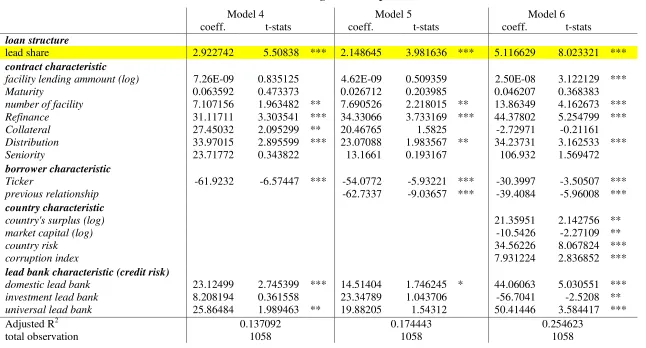
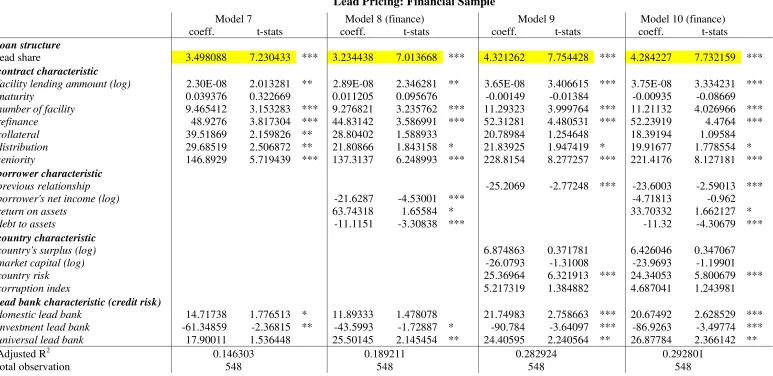
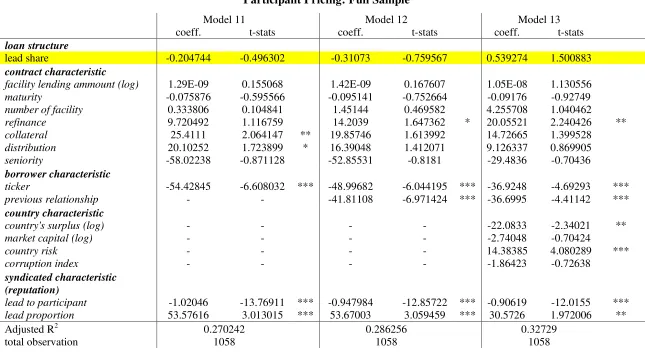
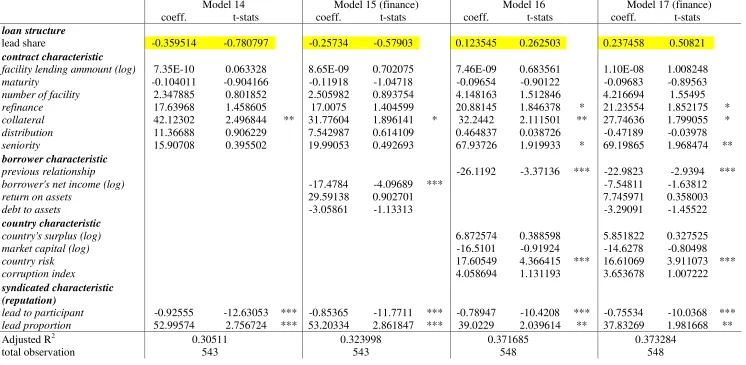
Purpose of this study is to test the asymmetry information influence towards lead arranger and participant in syndicated loans. In syndicated loans, lead arranger are responsible in the loan establishment and act as intermediary between borrower and syndicated members. It cause participant to be highly dependant to the lead arranger. The theory predicts that the higher asymmetry information between lead arranger and participant will cause participant to expect a higher loan pricing, and a bigger lead share will reduce this effect. Conversely, a bigger lead share will resulted in a higher monitoring risk and credit risk for the lead arranger, which cause lead arranger to expect a higher loan pricing. Therefore, the establishment of loan pricing are affected by two opposite effect, asymmetry information effect (participant pricing) and diversification effect (lead pricing).
This study uses two stage least squares (2SLS) to determine the existence of asymmetry information effect and diversification effect in loan pricing. This study used a sample of the entire LIBOR-based lending in Asia Pacific region for the period 2006-2010.
This research shown that diversification effect indeed affecting the loan pricing in Asia Pacific, while asymmetry information effect in not proven. This is because Asia Pacific loans have a high average lead share (75%) and most of the loans have more than one lead arranger. The study also found that lenders tend to consider the economy conditions of a nation and previous relationship with the borrower than the financial performance of each borrower.
Keywords: credit risk, reputation, lead share, loan pricing, loan, syndicate
1
Lecturer in Finance and Capital Market, Faculty of Business & Economics, University of Surabaya 2
Lecturer in Finance and Banking, Faculty of Business & Economics, University of Surabaya 3
2 Background
Syndicated loans according to Armstrong (2003), is a type of loan provided by two lenders (or more) to provide funds to a specific borrower. In a syndicated loan, some lenders are acting as a lead arranger, while other lenders acted as participant lenders. Each of these types of lenders has different roles in a syndicated loan (Sufi, 2004). Lead arranger is the one responsible to manage the entire process and monitor the borrower in the syndicated loan. Once the the borrower and lead arranger agreed for a loan contract, lead arranger will offer this syndicated loan to other prospective participant (Dennis and Mullineaux, 1999).
Ivashina (2009) explained that the loan pricing and structure of loan is determined through a bidding process between the lead arranger and the participant. This causes syndicated loan pricing to be affected by two simultaneous and opposite effects of asymmetry information (participant pricing) and diversification (lead pricing). Asymmetry information effect is a bias that arises due to the asymmetry of information between the participants and the lead arranger, where the higher asymmetry information is synonymous with a low lead share thus will encourage the participant to expect a higher loan pricing. Diversification effect is a bias that arises due to the asymmetry of information between the lead arranger and the borrower, where the higher asymmetry information is synonymous with a higher lead share thus the lead arranger will be exposed to a higher credit risk. As a result, lead arranger would expect a higher loan pricing.
Asymmetry information on a loan can be seen from the loan spread value. Ivashina (2009) explained that the increase in lead share can reduce asymmetry information between the lead and the participant. That is because the lead arranger has better information about the loan, while the participant is likely to have limited information and rely heavily on information provided by the lead arranger. The higher the share owned by lead arranger will encourage a lower asymmetry information that will reduce participant’s demand for spread, and vice versa.
On the other side, Pavel and Phillis (1987) and Gorton and Pennacchi (1995) showed that a higher lead share will increase the potency of lead arranger’s credit risk exposure. This causes the lead arranger to expect a higher spread to compensate for the risks covered (Ivashina, 2009). Demsetz (1999) proved that the diversification of credit risk is the reason why the lead arranger trying to minimize the share owned, in order to reduce the spread.
Loan Pricing in Asia Pacific
Source :Dealogic, (2011)
Figure 1
Global Syndicated Loans Volume 2006 - 2010
Based on the distribution of syndicated loans in 3 regions, Asia Pacific is a region with the lowest transaction level with the volume of € 0.3 trillion - € 0.5 trillion. But on the other hand, Asia Pacific has the most stable loan growth compared to U.S. and Europe. Asia region still recorded a growth of € 0.1 trillion in 2008-2009 financial crisis compared to 2006-2007 period, while the American and European regions recorded a decline in loan volume to three fold in 2009.
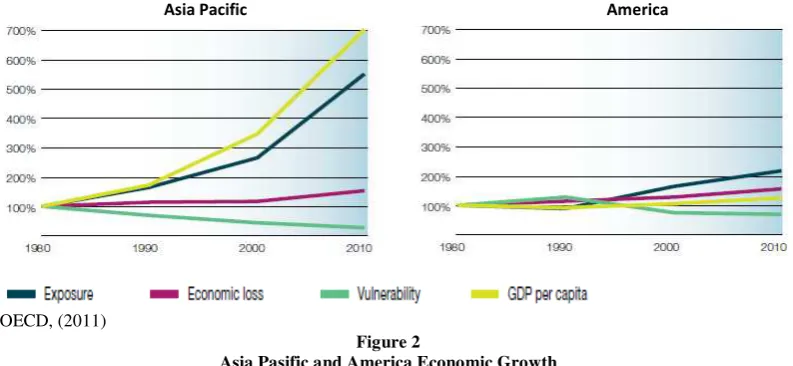
The uniqueness of the Asia Pacific also lies in the structure of the loan. Ivashina (2009) in his research found that the average share of the lead arranger in the U.S. only 27% and 98% loan led by one lead arranger only. This differs from the structure of the loan in Asia Pacific. Godlewski and Weill (2007) reveal that developing countries like Asia have a higher lead share than developed countries like America and Europe. This is because the risk of the Asia Pacific region is higher and the information transparancy is lower compared to developed countries. Figure 2 shows that Asia has a higher level of risk and growth than the U.S. over the past decade.
Source :OECD, (2011)
Figure 2
Asia Pasific and America Economic Growth
Asia Pacific as a region with a high level of risk is also accompanied by the disclosure of information which is lower than the U.S. or Europe. This causes moral
4
hazard to be more common in developing countries in Asia because of high level of asymmetry information. Dennis and Mullineaux (2000), suggests that the moral hazard are affecting the loan structure. Leland and Pyle (1977), also supports the statement, that information is an important factor in determining the loan structure. Thus, asymmetry information effect and diversification effect between Asia Pacific and the U.S. can give different results.
The high level and stabil loan growth in Asia Pacific, along with the different condition of loan structure between Asia and U.S., encourage researchers to conduct research on loan pricing establishment as measured by asymmetry information effect and the diversification effect. Ivashina (2009) conducted a study related to the establishment of loan pricing in the U.S. and found that the asymmetry information and diversification has a significant influence. Both of these effects are opposite to each other and lead share is an endogenous variable that may explain the association of these effects on loan pricing.
Previous studies on the syndicated loan market developed in two directions, ie research that leads to the reason for selling loans and research about syndicated loan. The research was carried out by Gorton and Pennacchi (1995); and Dahiya et al (2003) where they studied the loan oricing establishment on the secondary loan market in the U.S.. The results of this study indicate that there is a negative correlation between lead share prices and the spread price asked by the bank that will buy the share. This proves that the lenders are trying to diversify their credit risk. On the other hand, studies done by Simons (1993); Dennis and Mullineaux (2000); Jones, Lang, and Nigro (2000): Lee and Mullineaux (2001); Panyagometh and Roberts (2002); Esty and Megginson (2003); and Sufi (2005) which focused on the establishment of loan structure found that the characteristics of the borrower, the contract characteristics, and availability of public information is an important factor in determining the amount of shares owned by the lead arranger, number of participant and participant share distribution.
Furthermore, information transparency issues discussed by Lee and Mullineaux (2001); Panyagometh and Roberts (2002), and Sufi (2005) showed an evidence of asymmetry information existing between the lead arranger and the participant. Ivashina (2009) explained that the weakness of previous studies lies in the loan spread variable assumed to be exogenous. As a result, loan structure establishment can cause varying interpretations because they can not separate the effect of asymmetry information and diversification effect.
Important point in the modeling study is the existence of instrumental variables that can explain the effect of asymmetry information and diversification appropriately. Ivashina (2009) revealed that the lead arranger credit risk is the instrumental variables to explain the diversification effect. The higher credit risk lead to a higher lead share in loans. That is why the lead arranger will ask a higher price, while the participant demand a lower price because the asymmetry in the loan rate will decrease, and vice versa.
variables can be variables that can explain the asymmetry of information between the lead arranger and the participant regardless of the information derived from the borrower. The better reputation of the lead arranger will encourage the participant to join that syndicated loan, and lead share will be decrease. Lower rate of lead share will increase the potential for moral hazard and adverse selection, so that participant will increase the expected spread, as lead arranger will lower the price because of lower credit risk, and vice versa.
Syndicated Loan Structure
Lead arranger that lend loans in Gadanecz (2004) and Sufi (2004) can be divided into two general categories: lead arrangers / senior syndicate members and participant lenders / junior syndicate members. Lead arranger is generally a bank / other financial institutions that already have a pretty good credibility in the manufacture of syndicated loan contracts. This group can be led by a one lead arranger or more. Role and function of the lead arranger according to Sufi (2004) is to coordinating all administrative activities, seeking potencial participant loan lenders, as well as screening and monitoring.
Participant lenders are members of the syndicated loan. Bank will be referred to as participant lenders when the bank is co-funded the loan syndication. Participant lenders are rarely negotiate directly with the borrower, and usually use lead arranger to represent them (Sufi, 2004). Obtained information about the borrower by the participant is generally highly dependent on information provided by the lead arranger (Ivashina, 2009).
Empirical studies of Syndicated Loan: Asymmetry Information Effects and Diversification Effects
Asymmetry information problem has been recognized since the first decade of syndicated loan market. Schumpeter (1939) revealed that lenders not only have to know the loan transaction from the financial side, but also must understand the borrower, the nature of its business, its business environment, and borrower conditions that can affect the success of the syndicated loan granted. Therefore, the lead bank has a natural function to monitore the syndicated loan granted (Mora, 2010).
Simons (1993); Preece and Mullineaux (1996); Dennis and Mullineaux (2000); Jones, Lang, and Nigro (2000): Lee and Mullineaux (2004); Panyagometh and Roberts (2002); Esty and Megginson (2003); Sufi (2007); Godlewski and Weill (2007), and Carey and Nini (2007) found that loan structure are affected by the availability of public information about the borrower which is reflected by the characteristics of the loan contract, company's financial performance characteristic, and the macro economic factors that affect performance company.
6
adaptation ability of borrower in a changing economic conditions (Dennis and Mullineaux, 2000).
Leland and Pyle (1977) explains that the lead share is an evidence of the lead arranger responsibility in loan monitoring and this will also make the lead arranger more exposed to a credit risk. Ivashina (2009), Mora (2009), and Gopalan et al (2009) reveals that the structure of syndicated loans is reflected in the amount of lead share that will affect the spread. Therefore, the lead share is an endogenous variable that can explain the relationship between the loan characteristic against the establishment of loan pricing.
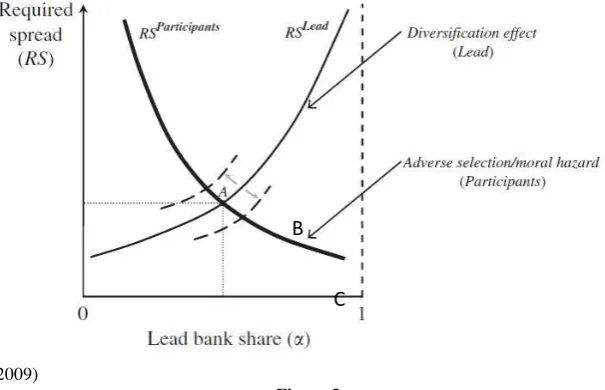
Figure 3 shows the relationship between spread and lead share. Point A is the equilibrium point between the diversification effect and asymmetry information effect. Ivashina (2009) revealed that the formation of lead share in a syndicated loan is influenced by two opposing effects that influence each other, namely adverse selection / moral hazard effect (asymmetry information effect) and the diversification effect. Adverse selection / moral hazard effect showed a negative correlation between spreads and lead share. Diversification effect showed a positive correlation between the spread and lead share.
Source : Ivashina (2009)
Figure 3
Relationship between Lead Share and Spread (Asymmetry Information Effect)
Adverse selection problem occurs before the loan was syndicated, where the lead arranger has more complete information than the participant, and this causes the lead arranger to have a better understanding of borrower’s condition, so that the lead arranger can be a better judge evaluate the good and bad of a loan. Moral hazard occurs after the loan is given. Basically, the lead arranger is responsible for monitoring the borrower, but when borrowing occurs, this responsibility will be reduced due to the share distribution among the participant.
Ivashina (2009) revealed that the adverse selection and moral hazard problem can be reduced if the lead arranger has a large proportion of the loan. Leland and Pyle (1977) explained that the lead arranger has a better understanding of the borrower’s condition, therefore a bigger lead share is a positive signal indicating that the loan has a good quality and this will reduce the demand for higher prices from the participant. Bannier (2007),
B
and Ongena, Alkan, and Westernhagen (2007) adds that the addition of the lead share is an effective indicator to reduce adverse selection and moral hazard problems in syndicated loans, so the data is expected to show a negative relationship between the lead share and spread. At point B (Fig. 3), reduction in lead arranger’s credit risk will transform the required lead spread lines to the left, thus the lead share will be reduced. This reduction indicates a poor loan quality (Leland and Pyle, 1977) and the asymmetry of information between the participant and the lead arranger will be higher, therefore the participant would expect a higher spread. In contrast to point C (Fig. 3), increased credit risk of the lead arranger will transform the required lead spread lines to the right, thus led to a higher lead share. It indicates the loan has a better quality (Leland and Pyle, 1977), and asymmetry of information between the lead arranger and the participant getting lower, so the participant would expect a lower spread.
Source 4
Relationship between Lead Share and Spread (Diversification Effect)
Beside the asymmetry information effect, the loan structure also affected by the diversification effect that has an opposite effect. Pavel and Phillis (1987), and Gorton and Pennacchi (1995) showed that a higher lead share will increase the lead arranger’s credit risk excposure. Point D (figure 4) shows that the lead arranger with good reputation will drive participant to join in the loan, so that the required participant spread lines will be shifted to the left, this leads to a lower lead share and lead arranger’s credit risk will be reduced, so that the lead arranger would expect a lower spread. Point E (Figure 4), lead arranger with bad reputation will make participant has a less interest in the loan offered, so that the required participant spread lines will be shifted to the right and increase the lead share. This increase of lead share will increase lead arranger credit risk, so the lead arranger would expect a higher spread.
Thus, the price formation in the syndicated loan is similar to the demand-supply theory, where the price formation occurs at the equilibrium point of asymmetry information / participant pricing and diversification / lead pricing. Ivashina (2009) and Mora (2010) says that in order to capture the asymmetry information effect, the need for exogenous instrumental variables are transferred from the lead pricing line model in the loan without affecting the relationship between lead banks and participant (reputation).
8
Exogenous variables that are being transferred here is the lead arranger’s credit risk. Similarly, to capture the diversification effect, the need for exogenous instrumental variables to be diverted from participant pricing line model in the loan pricing without affecting the credit risk of the lead bank. Exogenous variables that are being transferred here is the reputation of the lead arranger.
Methodology
This study was conducted in two phases. The first is the testing of the control variables and instrumental variables relationship to the structure of syndicated loans (lead share) via ordinary least squares regression (OLS). The second is the main test in this study, which is testing the influence of control variable and instrumental variables in loan pricing establishment as measured by lead share. The second test carried out by two stage least square regression (2SLS).
Ivashina (2009) revealed that there are two conditions to obtain a satisfactory result from the use of instrumental variables. First, the variable must be correlated strongly to the lead share as predicting variable. Second, instrument variable should not be correlated with the residual in the 2SLS model. The number of instrument varibale should also higher than endogenous variable.
This condition is a requirement to eliminate the bias that can occur in 2SLS. Bound, Jaeger, and Baker (1995) revealed that there are two biases in 2SLS, one is the bias if the instrument variables have low correlation to the endogenous variables and the second is bias in finite sample. Furthermore, their study also explained that the relationship between instrument and endogenous variable is low enough, and it can not be able to eliminate bias in finite samples even if we add more sample.
Based on the discussions that have been presented, the research model can be described as follows:
LEAD SHARE = βa Control Variable + βb Instrumental Variable+ ε (1) LOAN SPREAD = αa Lead Share + αb Control Variable + ε (2)
Model (1) aims to determine the relationship between control variables and instruments variables against the endogenous variable (lead share). In addition this test is also conducted to determine the significance of instrument variable, so the bias that occurs in the 2SLS can be minimized. Model (2) is the main model of this study, namely 2SLS with the spread as the dependent variable and lead share as an endogenous variable that would explain the effect of asymmetry information and difersification.
Variable
Dependent Variable
ALL IN SPREAD the variable that shows the price of a loan granted by the lender to the borrower. Currency used as a reference is U.S. $ and floating interest rates follow changes in LIBOR.
Endogenous Variable
LEAD SHARE a variable that indicates the percentage of ownership owned by lead arranger.
DOMESTIC BANK a dummy variable indicating whether or not a lead arranger banks derived from local / domestic in the loan. This variable is equal to 1 if the domestic lead arranger is involveds, and 0 if there is no domestic lead arranger.
INVESTMENT BANK a dummy variable indicating whether there is lead arranger with the status of investment banks in the loan. Variable equal to 1 if the lead arranger in a loan has a status of investment bank, and 0 if a given loan is not lead by investment bank. Investment bank is a bank whose primary function is to give a loan for corporation borrower, with purposes of company financial expansion, underwriter, as well as internal funding.
UNIVERSAL BANK a dummy variable indicating whether there is a lead arranger with the status of universal banks in the loan or not, as well as lead arranger with a combination status of investment, universal and commercial banks (lead arrangers composition in loan establishment in the Asia Pacific tend to have more than one lead arranger and part of the loan are led by a bank with a different status). Variable equal to 1 if the lead arranger is a universal bank or a lead arranger in a loan originated from different types of banks. Variable is 0 if it does not meet those criteria (all of the lead arranger are investment bank or commercial bank entirely).
Instrumental Variable (Exogenous Variable) : Reputation
LEAD TO PARTICIPANT a variable that shows the relationship between the lead arranger with the participant. This variable is measured by total syndicated loan led by the lead arranger for the past three years.
LEAD PROPORTION a variable that indicates how attractive a loan in the eyes of participants. These variables were measured from the ratio of lead arranger and total lender. The lower lead proportion indicated a higher participant’s interest, vice versa.
Contract Characteristic
LOG (AMOUNT) the logarithm of the largest facilities in every loan granted in the same time (per package).
NUMBER OF FACILITY a number of facilities owned in every loan package.
MATURITY a variable that indicates loan duration in month. The same like amount, maturity value is determined by the largest value in each maturity from the loan that are given in the same time (package).
COLLATERAL a dummy variable with a value of 1 if the loan is given with collateral and 0 if the loan is given without collateral
SENIORITY a dummy variable that will be 1 if the loan is senior and 0 if the loan is not senior.
DISTRIBUTION a dummy variable that will be 1 if the loan is syndicated and 0 if the loan is syndicated.
REFINANCE a dummy variable that will be 1 if the purpose of the loan for refinance and 0 if the purpose of loan is not for refinance (takeovers, mergers / acquisitions, or business development).
_____________________________________________________________________________________ Borrower Characteristic
TICKER a dummy variable that will be 1 if the borrower listed on the stock exchange and 0 if the borrower is not listed on stock exchanges.
PREVIOUS RELATION a dummy variable that will be 1 if the borrower has borrowed to the same lead arranger and will be 0 if the borrower never borrow to the same lead arranger. More specifically the determination of whether or not the relationship existed is based on historical data from the loan made by a borrower for the past 3 years.
RETURN ON ASSETS a variable that indicates the borrower’s level of profitability. Specifically, the data used are the financial reports a year before the loan is given.