A Review of Indonesian Pre-Service Teacher Certification Policy from
the Point of View of the Philosophy of Vocational Education
Yuyun Estriyanto*) **)
Sebelas Maret University, Jl. Ir.Sutami No. 36 A, Surakarta, Central Java, Indonesia
Corresponding E-mail: [email protected]
Abstract: Teacher certification was a consequence of Indonesian teacher professional acknowledgement. In the first step, the certification was conducted for the existing teachers. It was started in 2006 and planned to be completed in 2015. Starting from 2016 service teacher certificate, which should be obtained from the pre-service teacher professional education program, is a requirement for new teacher recruitment. The guideline of the program was regulated under the provision of Indonesian Minister of Education and Culture No. 87 2013. Based on this regulation, the participant prior education background could be: (a) educational bachelor degree in accordance with professional education program taken; (b) educational bachelor degree allied with professional education program taken; (c) non-educational bachelor/D-IV in accordance with professional education program taken; (d) non-educational bachelor/D-IV allied with professional education program taken; and (e) bachelor degree in psychology for pre and elementary school. From the point of view of the vocational education philosophy, the regulation was not completely appropriate. Vocational education will be effective when the instructor has had successful experience in the application of skills and knowledge to the operations and processes he undertakes to teach. From the deep review of philosophical aspect, characteristic of all prior learning of pre-service teacher professional education types, and vocational teacher theory found that hands-on skill and experience is a high priority requirement for vocational teacher. This type of competence was not owned by all participants who came from any type of prior education. Based on the program structure, it could be concluded that matriculation is the only part of the program where hands-on skill and experience could be delivered.
Keywords: Pre-service, teacher certification, vocational education, vocational teacher, teacher professional education
1. INTRODUCTION
1.1 Background
Teacher certification become a hot topic among Indonesian teachers recent days, because after they hold an educator certificate they will receive an additional allowance approximately for one their basic salary. The teacher certification is a consequence of the acknowledgement of the teacher profession as regulated by Indonesian law No 14 2005 on Teachers and Lecturers.
The acknowledgement of teacher profession was started for the first time in 2004 under the leadership of President Susilo Bambang Yudhoyono. It followed by the Indonesian Law No. 14 2005, the first government provision of teacher profession, which became the main regulation on how the teacher profession should be administered.
The first problem faced was how to certify the billions existing teachers who are spread throughout the archipelago: how the
mechanism is, who first should be certified, who will certify, how to fund the certification, and so on. The first certification step was conducted using portfolio assessment. The ones who are not qualified based on the portfolio assessment should follow the teacher professional education and training (PLPG, stand for Pendidikan dan Pelatihan Profesi Guru) for several days. In the next step, the certification completely conducted by PLPG.
This method choosed by the government after the certification participants were mostly with only some years of teaching experience so that could be assumed that the portfolio scores will not suffice for portfolio based certification. Indonesian government plans that the certification process will completely finish in 2015.
recruitment. It means that all teacher prospectives should take a pre-service teacher certification. The guidelines of pre-service teacher certification is regulated under the regulation of Indonesian Minister of Education and Culture No. 87 2003. The program is called with Pre-service Teacher Professional Education (in the rest of this article will be stated with PPG, stand for Pendidikan Profesi Guru). It is a one year education program which consists of one semester of subject specific pedagogic workshop and one semester of practical training program (PPL, stand for Program Pengalaman Lapangan).
As stated in the regulation of Indonesian Minister of Education and Culture No. 87 2003 clause no. 6, the prospectives of PPG could be: (a) educational bachelor degree in accordance with professional education program taken; (b) educational bachelor degree allied with professional education program taken; (c) non-educational bachelor/D-IV in accordance with professional education program taken; (d) non-educational bachelor/D-IV allied with professional education program taken; and (e) bachelor degree in psychology for pre and elementary school teacher. In the next subsection, it stated that PPG prospectives with education background except point (a) should undergo and pass a matriculation program before following the PPG.
In the area of vocational education, this provision has raised a lot of pros and cons. The pros and cons are based on the fact that vocational education is a type of education which is not only teaches knowledge and science but also psychomotoric skills. Thus, it needs vocational teachers who are not only having good enough science and general teaching skill, but also how to deliver psychomotor skill to the students. TVET-teachers should have sound experience and knowledge in a particular vocational field, and should have command of the skills required for doing the typical jobs and tasks in this field. This experience and know-how can only be acquired by practical situations in companies where professional standards of good
performance have to be met. In addition, a TVET-teacher has to combine this practical “know-how” with theoretical knowledge when planning the proper steps for carrying out a task. Part of this is understanding “why” a vocational task will be carried out in this way and not in another. To “know why” is the result of theoretical studies and reflection based upon practical experience. (Gerds and Zhao, 2006).
The pro assume that teacher development can be carried out consecutively. It means that a teacher of mechanical engineering, as an example, can be developed from a pure bachelor degree of mechanical engineer by giving additional pedagogical knowledges and skills. On the other hand, the counter party rejects the argument because they assume that a bachelor degree in mechanical engineering
don‟t have enough competence aspects needed
to be a vocational teacher.
Indonesian teachers‟ standard competence and education qualification are regulated under the provision of Indonesian minister of national education No. 16 2007. But, unfortunately it has not regulated the standard competence and education of vocational teacher. It has been stated here the standard competence and qualification for normative and adaptive subject matter teachers in vocational school but not yet the productive one. Even though, what the public call with vocational teachers are referring to the ones who teach productive subject matter rather than normative and adaptive ones. Productive subject matters are those which build vocational students hands-on experience and skill. Productive subject matter teachers train, rather than teach, the students how to do, rather than what to do, something in the field of job.
1.2 Problem identification
As the background described above, some existing problems can be identified: (1) the need of a deep study on the characteristics of vocational education to complement the existing regulation on the pre-service teacher certification so that it can be implemented in a pre-service vocational teacher certification; (2) the vocational teacher competency profiles have not been formulated in the government regulation, that is the provision of Indonesian minister of national education No. 16 2007; (3) there have not any rules that regulate how the matriculation of pre-service vocational teacher certification should be conducted to ensure that the consecutive model of vocational teacher development can resulting professional vocational teachers.
1.3 Research problem
This article will describe the regulation of Indonesian government policy on pre-service teacher certification, what missed, and what should be, in the viewpoint of vocational education philosophy and recent best practice.
1.4 Research focus
This article focus on using vocational philosophy to review: (1) the pre-service teacher certification program structure as regulated by the provision of Indonesian Minister of Education and Culture No. 87 2013 in the viewpoint of vocational teacher preparation; (2) the types of pre-service teacher certification applicants as regulated by the provision of Indonesian Minister of Education and Culture No. 87 2013 in the viewpoint of vocational teacher preparation.
2. REGULATION AND LITERATURE
REVIEW
2.1 Indonesian government regulation on pre-service teacher certification
According to Indonesian law No. 20 2003 on National Education System, Law No. 14 2005 on Teachers and Lecturers, Indonesian Government Regulation No. 19 2005 on National Education Standards, and Government Regulation No. 74 2008 on Teachers, teachers are required to have academic qualifications,
competence, and teacher certificate. Article No 4 of Government Regulation No. 74 2008 states that the teaching certificate for teachers should be acquired through professional education programs (PPG) which held by universities that organize teaching oriented study programs, both held by government and society.
Currently there are two kinds of teacher professional education program legal basis, namely the in-service teacher professional education and pre-service teacher professional education. In-service teacher professional education is arranged by the provision of ministry of national education No. 9 2010, while pre-service teacher professional education is arranged by the provision of ministry of national education No. 8 2009, which has been renewed by provision No. 87 2013.
The purposes of teacher professional education are to develop teachers‟ sustainable professionalism periodically and to produce teachers who have multiple competencies, namely: (1) designing, implementing and assessing learning; (2) following up the results of the assessment by providing guidance and training to students; and (3) conducting research and professional development in a sustainable manner. (Republik Indonesia, 2013).
2.2 The philosophy of vocational education
Philosophy is at the core of any conceptual framework. A conceptual framework contains: (a) principles or 'generalizations that state preferred practices and serves as guidelines for program and curriculum construction, selection of instructional practice, and policy development'; and (b) philosophy which 'make assumption and speculations about the nature of human activity and the nature of the world [and] helps vocational educators decide what should be and shat should be different' (Miller, 1996 in Rojewski, 2009). That is the reason why the study of philosophy is very important in designing and analyzing policies and programs.
2.2.1 Indonesian juridical basis of vocational education
There has been several laws and regulations which underlie vocational education praxis in Indonesia. The law No. 2 1989 on The National Education System, and renewed with law No. 20 2003, says that institutions of vocational education and technology is a type of education that prepares students to work in a particular field. The provision of education No 29 1990 says that secondary vocational education is education programs in secondary level education that promotes the development of learners' ability to carry out certain types of work.
In Bahasa Indonesia, there are two terms which have a same translation in English as „vocational education‟. The two terms are „pendidikan kejuruan‟ and „pendidikan vokasi‟. „Pendidikan kejuruan‟ is a kind of expertise education in secondary education (Act No. 20 2003) whereas „pendidikan vokasi‟ refers to expertise education in higher education (Act No. 12 2012). In this paper, the term „vocational teacher‟ refers to teachers who are teaching in vocational school at the secondary education level. However, in general it can be concluded both „pendidikan vokasional‟ and „pendidikan kejuruan‟ is an education that prepares labor-skilled workforce that is ready to work in the work field.
In the Article 15 Act. No 20 2003 on the National Education System states that the purpose of secondary vocational education is to prepare students especially to work in a particular field. Thus, it can be said that the output of secondary
vocational education is graduates who have the capabilities to work as skilled technical workers in the appropriate field of work. Also, it can be concluded that the measure of its success is how much their graduates are absorbed in the world of work. Therefore, various factors that play a role in the learning process in vocational school should be oriented to the achievement of these objectives, such as: teachers, infrastructure, governance, funding, curriculum, technical support staff, etc.
2.2.3 Global philosophy of vocational education
There are a lot of opinions of the philosophers regarding vocational education, but basically they can be grouped into two major groups. The first one is esentialsm philosophy which believes that the purpose of technical and vocational education is to meet the need of the labor market. It characterized by a sequential organized curriculum and the teacher/instructor need extensive business/industry-related experience. As the consequence of this view, the vocational education system should be separated from academic (general) education (Sarkees-Wircenski & Scott 1995 in Rojewski, 2009). The second one is pragmatism philosophy which view that the purpose of technical and vocational education is to fulfil the individual need for personal fulfillment and life preparation. It's characterized by an emphasis on problem-solving and higher-order thinking in the learning process. Learning is constructed from prior knowledge (Miller 1985 in Rojewski, 2009).
Charles Prosser and John Dewey might be the most two influencing figures on the meaning of the nature of vocational education. Both are American education figures, but their way of viewing the nature of vocational education is contrasted to each other. Prosser's views on social efficiency, posited that the major goal of the school was not an individual fulfillment but meeting the country's labor needs. In contrast, Dewey believed that the principle goal of public education was to meet individual needs for personal fulfillment and preparation for life. Dewey rejected the image of students as passive individuals controlled by market economy forces and existentially limited by inherent proscribed intellectual capacities (Rojewski, 2009).
interpretation below to give better understanding how the theory well suited with current vocational education and training praxis in recent years (Prosser, 1949):
1. Vocational education will be efficient in proportion as the environment in which the learner is trained is a replica of the environment in which he must subsequently work.
2. Effective vocational training can only be given where the training jobs are carried on in the same way with the same operations, the same tools and the same machines as in the occupation itself.
3. Vocational education will be effective in proportion as it trains the individual directly and specifically in the thinking habits and the manipulative habits required in the occupation itself.
4. Vocational education will be effective in proportion as it enables each individual to capitalize his interest, aptitudes and intrinsic intelligence to the highest possible degree. 5. Effective vocational education for any
profession, calling, trade, occupation or job can only be given to the selected group of individuals who need it, want it, and are able to profit by it.
6. Vocational training will be effective in proportion as the specific training experiences for forming right habits of doing and thinking are repeated to the point the habits developed are those of the finished skills necessary for gainful employment.
7. Vocational education will be effective in proportional as the instructor has had successful experience in the application of skills and knowledge to the operations and processes he undertakes to teach.
8. For every occupation there is a minimum of productive ability which an individual must possess in order to secure or retain employment in that occupation. If vocational education is not carried to that point with that individual, it is neither personally or socially effective.
9. Vocational education must recognize conditions as they are and must train individuals to meet the demands of the “market” even though it may be true that more efficient ways of conducting the occupation may be known and that better working conditions are highly desirable. 10. The effective establishment of process habits in
any learner will be secured in proportion as the
training is given on actual jobs and not on exercises or pseudo jobs.
11. The only reliable source of content for specific training is an occupation is in the experience of masters of that occupation.
12. For every occupation there is a body of content which is peculiar to that occupation and to which has practically no functional value in any other occupation.
13. Vocational education will render efficient social service in proportion as it met the specific training needs of any group at the time that they need it and in such a way they can most effectively profit by the instruction.
14. Vocational education will be socially efficient in proportion as in its methods of instruction and its personal relations with learners it takes into consideration the particular characteristics of any particular group which it serves.
15. The administration of vocational education will be efficient in proportion as it is elastic and fluid rather than rigid and standardized.
16. While every reasonable effort should be made to reduce per capita cost, there is a minimum below which effective vocational education cannot be given, and if the course does not permit this minimum per capita cost, vocational education should not be attempted.
There are many more formulations on defining the vocational education which is proposed by vocational education practician and influencing figures, whether in recent years or in the past years. Thompson (1973) state that vocational or technical training or retraining which given in schools or classes under public supervision and control or under contract with a State Board or local education agency, and is conducted as part of program designed to fit individuals for gainful employment as semi-skilled or skilled worker or technicians in recognized occupations. Good & Harris (1960) define vocational education as education for work-any kind of work which the individual finds congenial and for which society has a need. American Vocational Association in Thompson 1973 defines vocational education as education designed to develop skills, abilities, understandings, attitudes, work habits, and appreciations needed by workers to enter and make progress in employment on useful and productive basis.
(2014) which state that vocational education praxis in Indonesia tend to be influenced by Prosser‟s view. Although it completely different on how to view the nature of vocational philosophy, no doubt in viewing vocational education as an education for work/jobs. It means that all theories agree that vocational education is an education type that produce graduates with expertise in a particular field so that they can be accepted in the world of work or working their self to earn a decent income so that they can live decently from their job.
2.3. Teachers in vocational school in Indonesia
In several countries in Asia there are many types of TVET teachers needed. The three predominant types are: (1) theory teacher; (2) practice teacher / trainer; and (3) teacher of theory and practice. In many countries, vocational schools have a fourth type of teacher, as general educational contents such as foreign languages, politics, economics, etc. It's called with (4) general knowledge course teacher. A fifth type of teacher, capable of teaching vocational subjects at a very high level. It‟s called as (5) advanced skills theory teacher (Lipsmeier, 2013).
In Indonesia, vocational school teachers are categorized into three groups, namely normative, adaptive and productive teachers. Normative teachers are teachers who teach normative subjects that are universal to the context of Indonesia, for example: religion, Bahasa Indonesia, history and citizenship. Adaptive teachers are teachers of subjects that used as a basis for studying productive subjects such as: math, physics, and chemistry. Productive teachers are teachers of subjects which responsible for building vocational skills such as buildings, electricity, machinery, agriculture, tourism, shipping and arts. In this paper, the term vocational teachers refer to productive teachers because both normative and adaptive teachers are produced by non vocational educational study program in universities.
3 METHODOLOGY
This study is an in-depth analysis of a limited topic of a contemporary issue and policy. Methods of data collection using:
documentation of laws and government regulations, web surveys and observations. Laws and government regulations, especially related to teacher professional education programs, are used as data sources, including teacher professional education implementation guidelines, regulations of the minister of education, and the law.
Laws and regulations document are: (1) Act Number 20 2003 on the National Education System; (2) Act No. 14 2005 on Teachers and Lecturers; (3) Regulation of the Indonesian Minister of Education and Culture No. 87 2013 on Pre-service Teacher Professional Education; (4) Regulation of Indonesian Minister of National Education No. 16 2007 on Qualifications and Competency Standards for Teachers; (5) Government Regulation No. 74 2008 on Teachers; (6) Guidelines of Teacher Professional Education; (7) Regulation of the Indonesian Minister of National Education No. 9 2010 on In-Service Teacher Professional Education; (8) Regulation of the Indonesian Minister of National Education No.8 2009 on Pre-Service Teacher Professional Education; (9) Act No. 12 2012 on Higher Education; (10) Decree of Indonesian General Director of Secondary Education No. 7013/D/KP/2013 on Discipline Area of Secondary Vocational Education; (11) Decree of Indonesian General
Director of Higher Education
163/DIKTI/KEP/2007 on the Arrangement and Codification of Study Programs in Higher Education; (12) Regulation of the President of the Republic of Indonesia No. 102 2007 on Ratification of Convention on Technical and Vocational Education.
This study is based on the understanding that the philosophy is underlying theories, the theories are underlying methods and the method underlying praxis (guidelines).
4. RESULT AND DISCUSSION
4.1. Eligible Approaches and modelsfor TVET teacher training according to Indonesian Policy
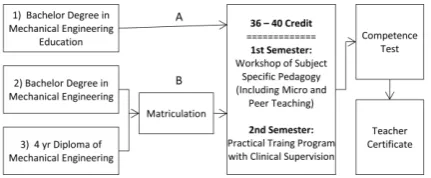
engineering discipline. There are two approaches which are recognized formally by Indonesian regulation.
Figure 1. The Structure of Mechanical Engineering Teacher Certification based on Permendiknas 87 2013
The path marked with an „A‟ is a concurrent model teacher preparation, while path marked with a „B‟ is a consecutive model teacher preparation. Both models could be adopted to develop qualified vocational teacher (GIZ, 2013). In the concurrent model, teacher of mechanical engineering in the vocational school is resulted from the graduate of mechanical engineering education. Mechanical engineering education is a university study program whose graduates are directed to be a teacher in vocational school. In the consecutive model, teacher of mechanical engineering in the vocational school could be developed from both the graduate of mechanical engineering and the graduate of 4yr diploma. For other areas (disciplines) could be explained in the similar manner, whether it is in the area of general school teacher or in vocational teacher.
4.1.1 Concurrent model TVET teacher preparation
In the international debate, there is general consensus that the concurrent model is the preferred model (sometimes in the literature the term “integrative model” is also found), principally because students who enroll in a course designed specifically for TVET teachers identify with a career in TVET teaching at an early stage and the expectation is that the course will contribute to a desirable level of professionalization in TVET teaching. Another aspect deemed attractive to this curricular approach is the early linkage which can be created between technical subjects and vocational pedagogy, that is deepened by a special “technical subject-related pedagogy” (in German:
Fachdidaktik). The integration of specific technical and occupational instructional science into VTE is very important for two reasons. Firstly, it builds a curricular bridge between the two subjects that otherwise exist in isolation from one another, and secondly, that it adds a teaching dimension to the course of studies, (hopefully) acting as a motivational factor. (Lipsmeier, 2013).
As stated by the Act. No. 14 2005 on Teachers and Lecturers, the qualification of teacher is a bachelor degree. Because it's designed specifically for TVET teachers the study program designed their curriculum to match with the requirement of TVET teacher qualifications, which are consist of theoretical and practical instruction. The curricula of vocational teacher education generally include the learning of one vocational discipline/major subject and vocational pedagogy/vocational didactics including teaching skills and methods as well as teaching practice. In more details, vocational learning discipline consists of both hands-on occupational training and whatever theory required as well.
Further consequences of the underlining philosophy adopted, the curricula, instructional strategy, delivery system, and assessment approach applied in the vocational teacher study program are directed to build a hands-on experience and practical skill and how to deliver their skill. By design, as they graduate from bachelor degree of vocational teacher study program they have received a set of curriculum that mixed of basic science and theory of related field of competence and hands-on experience of its practical skill. No doubt, as long as the processes in the vocational teacher education are running well, the graduates of vocational teacher education are well prepared.
4.1.2. Consecutive model TVET teacher preparation
or vocational subjects. The additional training, usually in vocational pedagogy (in the broad curricular range mentioned above) and vocational skills, can be acquired prior to commencement of teaching work (duration: 3 months to 1 year) either on campus or through a distance study program (pre-service programs).”
4.2 Discussion
Based on any literatures found in vocational education conferences and publication, basically both concurrent and consecutive models are could be adopted. However, it should be ensured that all participants from the two models have equal learning experience as a standard for new vocational teacher. Unfortunately, the government regulations regarding this problem do not specifically regulate the standard competence of the productive vocational teacher which could be best to be a standard reference.
From above discussion, it can be concluded that competence aspects which should be mastered by vocational teachers are technical/vocational subject areas (consist of: (1) theoretical knowledge and (2) practical skill and (3) pedagogical/didactical issues. Thus, both concurrent and consecutive vocational teacher preparation model should guarantee that the output must be able to demonstrate the three competence aspects.
Table 1. Prior Leanirng Comparison Between Concurrent and Consecutive Vocational Teacher
Preparation candidates' learning experiences comparison between the two models. The three competence aspects are scored in four-scale. As an example, two candidate types with different educational background, one from mechanical engineering education and the other one from pure mechanical engineering. There still one more additional possible alternative, which are from the 4yr Diploma of mechanical engineering. Totally, at least, three types of candidate's educational background are eligible to apply for PPG in the major occupational specialties of mechanical engineering. Those data are consensus among some experts who have many years experience in vocational education in a closed focused group discussion.
Matching Fig. 1 and Table. 1, it can be understood that for the concurrent model (path A) is no more need any matriculation, while for the consecutive model (path B) have to follow matriculation before entering the PPG program. Matriculation is the only opportunity to make sure that vocational teacher certification program will result an equal graduates (professional vocational teacher) who have equal learning experience and competence aspects, namely: (1) theoretical knowledge, (2) practical skill and (3) pedagogical/didactical knowledge and skill. Further more, the aspects of the required matriculation could be determined from Table 1. Aspect with small score ( 1 or 2) are the required matriculation aspects. As can be seen in Table 1, the matriculation for vocational teacher professional education should be consist of practical skill and pedagogical/didactical knowledge and skill.
5 CONCLUSIONS AND
RECOMMENDATIONS
5.1. Conclusion
a. Both concurrent model and consecutive model could be adopt for preparing vocational teacher as regulated by Indonesian Minister Regulation No. 87 2013.
competence aspects: (1) theoritical knowledge, (2) practical skill and (3) pedagogical/didactical knowledge and skill c. Matriculation is the only opportunity to
make sure that vocational teacher professional education (PPG) program will result an equal graduates (vocational professional teacher) who has equal learning experience and competence aspects.
d. Concurrent participants do not need to follow the matriculation, while consecutive participants have to follow matriculation which consist of practical skill and pedagogical knowledge and skill.
5.2. Recommendations
a. Univerity who will administer a vocational teacher professional education should develop a matriculation for consecutive participants as stated by Indonesian Minister Regulation No. 87 2013.
b. Vocational teacher has special need of competence so that could not fully adopt the same guideline as general/academic subject teacher. Further more, the special need of vocational teacher is a hands-on skill so that he/she can perform as a role model for their students in doing hands-on jobs in related field. Vocational PPG matriculation could need more costly and time consuming due to the characteristic of the hands-on skill building.
6 REFERENCES
Gerds, P and Zhao, Z. (2006). Modular TVET Teacher Training System, Based on teacher Quakification Standars in TVET Teacher Education on the Threshold of Internationalisation. Bonn, Germany: UNESCO UNEVOC
Lipsmeier, A. (2013). Approaches towards enhanced praxis-orientation in vocational teacher education ( VTE ) in Vocational Teacher Education and Research as a Task and Challenge for the East and Southeast Asian Region (pp. 39-45). Shanghai, China: RCP UNESCO
Prosser, C and Quigley. (1950). Vocational Education in a
Democracy. Chicago, USA: American Technical
Society.
Rojewski, J. W. (2009). A Conceptual Framework for Technical and Vocational Education and Training. In R. Maclean (Ed.), International Handbook of Education for the Changing World of Work (pp. 19–39). Bonn, Germany: UNESCO UNEVOC.
Republic of Indonesia. (2003) Act. No. 20 2003 on The National Education System
Republic of Indonesia. Act. No. 14 2005 on Teachers and Lecturers;
Republic of Indonesia. (2013). Regulation of Indonesian Minister of Education and Culture No. 87 2013 on Pre-service Teacher Professional Education Republic of Indonesia. (2007). Regulation of Indonesian
Minister of National Education No. 16 2007 on Qualifications and Competency Standards for Teachers
Republic of Indonesia. (2008). Government Regulation No. 74 2008 on Teachers
Republic of Indonesia. (2010). Regulation of the Indonesian Minister of National Education No. 9 2010 on In-Service Teacher Professional Education
Republic of Indonesia. (2009). Regulation of the Indonesian Minister of National Education No. 8 2009 on Pre-Service Teacher Professional Education
Republic of Indonesia. (2012). Act. No. 12 2012 on Higher Education
Republic of Indonesia. (2013). Decree of Indonesian General Director of Secondary Education No. 7013/D/KP/2013 on Discipline Area of Secondary Vocational Education
Republic of Indonesia. (2007). Decree of Indonesian General Director of Higher Education 163/DIKTI/KEP/2007 on the Arrangement and Codification of Study Programs in Higher Education
Republic of Indonesia. (2007). Regulation of the President of the Republic of Indonesia No. 102 2007 on Ratification of Convention on Technical and Vocational Education.
Sudira. P (2014). Praksis Pendidikan Kejuruan dan Vokasi Indonesia di Antara Mazab Dewey dan Charles Prosser, an articel of Dies Natalis Yogyakarta State University 2014.