Damara, Gheza. 2016. Students’ Perception on the Use of Kahoot! as an Ice Breaker in Movie Interpretation Class. Yogyakarta: Sanata Dharma University.
This research dealt with the survey on how students perceieved the use of Kahoot! as an ice breaker in Movie Interpretation class in Sanata Dharma University, Yogyakarta. The aims of this study were to find out the students’ perception on the use of Kahoot! as an ice breaker and how to improve the use of Kahoot! as an ice breaker in Movie Interpretation class.
The formulated problems of this study were: (1) What is students’perception on the use of Kahoot! as an ice breaker in Movie Interpretation class? and (2) How can the use of Kahoot! as an ice breaker in Movie interpretation class be improved? This research employed quantitative research. The type of the research was specifically a survey. The researcher decided to use the survey as the focus of the case. The participants of this study were sixty-six (66) students of Movie Interpretation class. In order to enhance the reliability, validity and trustworthiness, the researcher conducted research triangulation. The data of students’ perception on Kahoot! as an ice-breaker in Movie Interpretation class were obtained by questionnaire, interview and also observation.
The result of the study showed that the students’ perception of using Kahoot! as an ice breaker in Movie Interpretation class was positive as the student felt that the use of Kahoot! as an ice breaker really helped students to learn with fun. Moreover, Kahoot! greatly helped students not only on how to learn with fun, but with Kahoot! students became more motivated to learn the material deeper in Movie Interpretation subject. Nonetheless, the students generated suggestions for the betterment on the use of Kahoot! as an ice breaker in Movie Interpretation class. The external category which was the internet connection and the frequency of the usage should be developed well so that the use of Kahoot! as an ice-breaker in Movie Interpretation class can be one of the best applications for the ice breaking session.
Damara, Gheza. 2016. Students’ Perception on the Use of Kahoot! as an Ice Breaker in Movie Interpretation Class. Yogyakarta: Sanata Dharma University.
Penelitian ini merupakan penelitian tentang survei persepsi mahasiswa dalam menggunakan Kahoot! sebagai ice breaker di kelas Movie Interpretation Universitas Sanata Dharma, Yogyakarta. Tujuan dari penelitian ini adalah untuk mengetahui persepsi siswa tentang penggunakan Kahoot! sebagai ice-breaker dan bagaimana meningkatkan penggunaan Kahoot! sebagai ice breaker di kelas Movie Interpretation.
Masalah yang dirumuskan dari penelitian ini adalah: (1) Bagaimana persepsi mahasiswa dalam penggunaan Kahoot! sebagai ice-breaker di kelas Movie Interpretation? dan (2) Bagaimana cara meningkatkan penggunaan Kahoot! sebagai ice breaker di kelas Movie Interpretation?
Penelitian ini menggunakan desain penelitian kuantitatif, yang secara khusus menggunakan jenis penelitian survei. Peserta penelitian ini terdiri dari enam puluh enam (66) siswa kelas Movie Interpretation Universitas Sanata Dharma. Untuk meningkatkan keandalan, validitas dan kepercayaan, peneliti melakukan triangulasi data. Data persepsi siswa dalam penggunaan Kahoot! sebagai ice-breaker di kelas Movie Interpretation diperoleh dengan kuesioner, wawancara dan juga observasi.
Dari hasil penelitian ini dapat disimpulkan bahwa persepsi mahasiswa tentang penggunaan Kahoot! sebagai ice-breaker di kelas Movie Interpretation positif. Mahasiswa merasa bahwa penggunaan Kahoot! sebagai ice breaker benar-benar membantu mereka belajar dengan cara yang menyenangkan. Selain itu, dengan Kahoot! siswa menjadi lebih termotivasi untuk mempelajari dan memperdalam materi-materi di dalam kelas Movie Interpretation. Meskipun demikian, para siswa juga memberikan saran untuk kemajuan penggunaan Kahoot! sebagai ice breaker di kelas Movie Interpretation. Kategori eksternal yang merupakan meningkatkan koneksi internet dan frekuensi penggunaan dari Kahoot! sebagai ice breaker merupakan 2 hal utama yang disarankan oleh para siswa yang harus ditingkatkan, sehingga penggunaan Kahoot! sebagai ice breaker di kelas Movie interpretation dapat menjadi salah satu aplikasi terbaik untuk sesi ice breaking.
i
STUDENTS
’
PERCEPTION ON THE USE OF KAHOOT!
AS AN ICE BREAKER IN MOVIE INTERPRETATION CLASS
A SARJANA PENDIDIKAN THESIS
Presented as Partial Fulfilment of the Requirements to Obtain the Sarjana Pendidikan Degree in English
Language Education
By Gheza Damara
Student Number: 121214160
ENGLISH LANGUAGE EDUCATION STUDY PROGRAM DEPARTMENT OF LANGUAGE AND ARTS EDUCATION FACULTY OF TEACHERS TRAINING AND EDUCATION
SANATA DHARMA UNIVERSITY YOGYAKARTA
i
STUDENTS
’
PERCEPTION ON THE USE OF KAHOOT!
AS AN ICE BREAKER IN MOVIE INTERPRETATION CLASS
A SARJANA PENDIDIKAN THESIS
Presented as Partial Fulfilment of the Requirements to Obtain the Sarjana Pendidikan Degree in English
Language Education
By Gheza Damara
Student Number: 121214160
ENGLISH LANGUAGE EDUCATION STUDY PROGRAM DEPARTMENT OF LANGUAGE AND ARTS EDUCATION FACULTY OF TEACHERS TRAINING AND EDUCATION
SANATA DHARMA UNIVERSITY YOGYAKARTA
iv
I walk through hell
almost every night,
but I believe it
’
s a
pathway
–
Yelawolf
This thesis is dedicated to:
Allah SWT and prophet Muhammad SAW
My parents, Bramono Santoso Wibowo and Triana Hadiningtyas
My brother, Ghenta Damara
My sister, Putri Kinanthi
vii ABSTRACT
Damara, Gheza. 2016. Students’ Perception on the Use of Kahoot! as an Ice Breaker in Movie Interpretation Class. Yogyakarta: Sanata Dharma University.
This research dealt with the survey on how students perceieved the use of Kahoot! as an ice breaker in Movie Interpretation class in Sanata Dharma University, Yogyakarta. The aims of this study were to find out the students’ perception on the use of Kahoot! as an ice breaker and how to improve the use of Kahoot! as an ice breaker in Movie Interpretation class.
The formulated problems of this study were: (1) What is students’perception on the use of Kahoot! as an ice breaker in Movie Interpretation class? and (2) How can the use of Kahoot! as an ice breaker in Movie interpretation class be improved?
This research employed quantitative research. The type of the research was specifically a survey. The researcher decided to use the survey as the focus of the case. The participants of this study were sixty-six (66) students of Movie Interpretation class. In order to enhance the reliability, validity and trustworthiness, the researcher conducted research triangulation. The data of students’ perception on Kahoot! as an ice-breaker in Movie Interpretation class were obtained by questionnaire, interview and also observation.
The result of the study showed that the students’ perception of using Kahoot! as an ice breaker in Movie Interpretation class was positive as the student felt that the use of Kahoot! as an ice breaker really helped students to learn with fun. Moreover, Kahoot! greatly helped students not only on how to learn with fun, but with Kahoot! students became more motivated to learn the material deeper in Movie Interpretation subject. Nonetheless, the students generated suggestions for the betterment on the use of Kahoot! as an ice breaker in Movie Interpretation class. The external category which was the internet connection and the frequency of the usage should be developed well so that the use of Kahoot! as an ice-breaker in Movie Interpretation class can be one of the best applications for the ice breaking session.
viii ABSTRAK
Damara, Gheza. 2016. Students’ Perception on the Use of Kahoot! as an Ice Breaker in Movie Interpretation Class. Yogyakarta: Sanata Dharma University.
Penelitian ini merupakan penelitian tentang survei persepsi mahasiswa dalam menggunakan Kahoot! sebagai ice breaker di kelas Movie Interpretation Universitas Sanata Dharma, Yogyakarta. Tujuan dari penelitian ini adalah untuk mengetahui persepsi siswa tentang penggunakan Kahoot! sebagai ice-breaker dan bagaimana meningkatkan penggunaan Kahoot! sebagai ice breaker di kelas Movie Interpretation.
Masalah yang dirumuskan dari penelitian ini adalah: (1) Bagaimana persepsi mahasiswa dalam penggunaan Kahoot! sebagai ice-breaker di kelas Movie Interpretation? dan (2) Bagaimana cara meningkatkan penggunaan Kahoot! sebagai ice breaker di kelas Movie Interpretation?
Penelitian ini menggunakan desain penelitian kuantitatif, yang secara khusus menggunakan jenis penelitian survei. Peserta penelitian ini terdiri dari enam puluh enam (66) siswa kelas Movie Interpretation Universitas Sanata Dharma. Untuk meningkatkan keandalan, validitas dan kepercayaan, peneliti melakukan triangulasi data. Data persepsi siswa dalam penggunaan Kahoot! sebagai ice-breaker di kelas Movie Interpretation diperoleh dengan kuesioner, wawancara dan juga observasi.
Dari hasil penelitian ini dapat disimpulkan bahwa persepsi mahasiswa tentang penggunaan Kahoot! sebagai ice-breaker di kelas Movie Interpretation positif. Mahasiswa merasa bahwa penggunaan Kahoot! sebagai ice breaker benar-benar membantu mereka belajar dengan cara yang menyenangkan. Selain itu, dengan Kahoot! siswa menjadi lebih termotivasi untuk mempelajari dan memperdalam materi-materi di dalam kelas Movie Interpretation. Meskipun demikian, para siswa juga memberikan saran untuk kemajuan penggunaan Kahoot! sebagai ice breaker di kelas Movie Interpretation. Kategori eksternal yang merupakan meningkatkan koneksi internet dan frekuensi penggunaan dari Kahoot! sebagai ice breaker merupakan 2 hal utama yang disarankan oleh para siswa yang harus ditingkatkan, sehingga penggunaan Kahoot! sebagai ice breaker di kelas Movie interpretation dapat menjadi salah satu aplikasi terbaik untuk sesi ice breaking.
ix
ACKNOWLEDGEMENTS
First of all, I would like to thank Allah SWT and the prophet Muhammad
SAW, because of all the grace and wisdom that was given to me, so that I am able
to finish my responsibility as a student of Sanata Dharma University.
I am wholeheartedly thankful to my sponsor, Bapak Fidelis Chosa
Kastuhandani, M.Hum. for his limitless patience, support and guidance during the seemingly never-ending thesis writing process.
I would like to express my great thanks to my parents, Bapak Bramono
Santoso Wibowo, S.E. and Ibu Triana Hadiningtyas, S.E. for their guidance, prayers, motivation, and support to me every single day. I would also present this
work to my brother Ghenta Damara and my sister Putri Kinanthi and send my
gratitude to them for their support and motivation.
I am indebted to the Movie Interpretation students’ batch 2016 of Sanata
Dharma University as the participants of the researchers’ research.
I would like to thank all the lecturers and staff of the English Language
Education Study Program, Sanata Dharma University whose persistent help I will
never forget.
Also, I would like to express my thanks to my best friends Hilarius
x
Bryan Anugerah, Robertus Septian, Anindito Marcellus, Annisa Dwirahma, Adjie Prasetyo, Albertus Yordhana, Veryndra Honesta, Riski Aninda Sari, Richard Devara, Vincent Hendriya, Luther Jonggi, Adreana Pritha, EFO group, Tengkyu Y Brooo Group, and Ulabamba Hap Hap group for their encouragement and motivation. My gratitude goes to all my PBI friends I have not
mentioned for the love and care to me as well.
The last but not the least, I would like to extend my heartfelt gratitude to
any other individuals who in one way or another have contributed their valuable
assistance in the preparation and completion of this thesis.
xi
TABLE OF CONTENTS
Page
TITLE PAGE i
APPROVAL PAGES ii
DEDICATION PAGE iv
STATEMENT OF WORK ORIGINALITY v
PERNYATAAN PERSETUJUAN PUBLIKASI vi
ABSTRACT vii
ABSTRAK viii
ACKNOWLEDGEMENTS ix
TABLE OF CONTENTS xi
LIST OF TABLES xiii
LIST OF FIGURES xiv
LIST OF APPENDICES xv
CHAPTER I: INTRODUCTION 1
A. Research Background 1
B. Research Problems 2
C. Problem Limitation 3
D. Research Objectives 3
E. Research Benefits 3
F. Definition of Terms 5
CHAPTER II: REVIEW OF RELATED LITERATURE 7
A. Theoretical Description 7
1. Perception 7
2. Kahoot! 10
xii
4. Movie Interpretation 17
B. Theoretical Framework 18
CHAPTER III: RESEARCH METHODOLOGY 20
A. Research Method 20
B. Research Setting 21
C. Research Participants 21
D. Instruments and Data Gathering Technique 21
E. Data Analysis Technique 25
F. Research Procedure 27
CHAPTER IV: RESEARCH FINDINGS AND DISCUSSIONS 29
A. Students’ Perception on the Use of Kahoot! as an Ice Breaker in Movie Interpretation class 29
B. Things That Should be Improved on The Use of Kahoot! as an Ice Breaker in Movie Interpretation Class 43
CHAPTER V: CONCLUSIONS AND RECOMMENDATIONS 57
A. Conclusions 57
B. Recommendations 58
REFERENCES 60
xiii
LIST OF TABLES
Page
3.1: Scoring grade 26
xiv
LIST OF FIGURES
Page 2.1: Kahoot! provides users with quiz, discussion and survey options 10
2.2: Time limits also can be set for each question in Kahoot! quiz 11
2.3: The quiz setting let users set the privacy level and descriptions
of the content 11
2.4: The invite screen presents players with the game’s web location,
entry pin, number of players registered, and the name
of the registered players 12
2.5: The educator’s computer displays the question and
the four possible answers 12
xv
LIST OF APPENDICES
Appendix A: Questionnaire Data 62
1
CHAPTER I
INTRODUCTION
This study discusses the English Language Education Study Program
(ELESP) students’ perception on the use of Kahoot! as an ice breaker in Movie
Interpretation class. Chapter one is divided into six parts namely research
background, research problems, problem limitation, research objectives, research
benefits and definition of terms.
A. Research Background
Nowadays technology seems to have its own strength in education.
Students rely more on technology than everything else to make their life easier.
According to various studies, using technology, including computers, personal
tablets, and smartphones improve the students' engagement and active
participation in the classrooms in effective way (Bransford, Brown & Cocking,
2000; Kim &C Reeves, 2007; Koile & Singer, 2006; Rogers & Cox, 2008). The
students’ perception on the use of Kahoot! as an ice breaker in Movie
Interpretation class would show how technologies can improve the students’
willingness to learn, especially after they use Kahoot! as an ice breaker in Movie
Interpretation class. Siegle (2015) states “Kahoot! is a game-based quiz that tests
students’ knowledge. A free option exists. Teachers create multiple-choice
quizzes that they presesnt to students in a game-based environment. Teachers can
(p. 194).” In conclusion, the researcher would like to obtain the students’
perception on the use of Kahoot! as an ice breaker in Movie Interpretation class.
This research deals with the use of Kahoot! as an ice breaker in Movie
Interpretation class. The researcher conduct this research based on the use of
Kahoot! as an ice breaker in ELESP Sanata Dharma University can be categorized
as a new media for ice breaking session, it is only conducted in two subject in
ELESP Sanata Dharma University which are Movie Interpretation class and
Computer Assisted Language Learning class. Based on the situation, the
researcher wanted to see students’ perception whether it is positive or negative in
terms of using Kahoot! as an ice breaker in Movie Interpretation class.
B. Research Problems
This study attempts to answer these two research questions which are
formulated as follows:
1. What is the students’ perception on the use of Kahoot! as an ice
breaker in Movie Interpretation class?
2. How can the use of Kahoot! as an ice breaker in Movie Interpretation
C. Problem Limitation
The first limitation of this research focused on the sixty-six (66) students of
Movie Interpretation class because the students were already using Kahoot! for
the ice-breaking session. The limitation also helped the researcher to gain exact
number of the students using Kahoot!. The second limitation is the sixty-six (66)
students of Movie Interpretation class of Sanata Dharma University from batch
2012-2014.
D. Research Objectives
Based on the research problems above, the researcher concludes that the
research has several objectives. The objectives of this research are presented as
follows.
1. To find out students’ perception on the use of Kahoot! as an ice
breaker in Movie Interpretation class.
2. To find out how to improve the use of Kahoot! as an ice breaker in
Movie Interpretation class.
E. Research Benefits
The implementation of the research is carried out in order to provide
several contributions for the lecturer and the students of Movie Interpretation
be taken and used for the future. The research findings are expected to give some
positive contributions to:
1. The Lecturer of Movie Interpretation
This research also gives an explanation and also provides a deeper meaning
for the lecturer to understand about the use of Kahoot! as an ice breaker in Movie
Interpretation class. This research can give the lecturer some useful info about
what students’ thinks about the use of Kahoot! as an ice breaker in class whether it
is important or not to conduct Kahoot! in Movie Interpretation class. The findings
are expected to give some useful suggestions and recommendations for the
lecturer of Movie Interpretation class in providing ice breaker session to make the
teaching-learning process better. The benefit is also for other lecturers who may
try to implement or even do implement Kahoot! as an ice-breaker in their class.
2. The Students of Movie Interpretation
After having the results of the research findings, it is expected for the
lecturer to be really aware of how the use of Kahoot! as an ice breaker. The results
of this research can be used to see whether Kahoot! helps students more relaxed
before facing the material on Movie Interpretation subject or not. The results can
also be used to see whether the use of Kahoot! as an ice breaker in the beginning
of the class helps students to understand the material that will be taught on Movie
Interpretation class.
3. The Future Researchers
The researcher expected that the research can stimulate future researchers
breaker and also find other essential findings such as the importance of the
questions for quizzing with Kahoot! as an ice breaker to help students understand
the material more.
F. Definition of Terms
The researcher also states several terms that are going to be discussed in
the research, they are:
1. Perception
According to Altman, Valenzi & Hodgetts (1985), perception is defined as
“the way stimuli are selected and grouped by a person so that they can be
meaningfully interpreted. The process of perception enable us to understand and
cope with the environment in which we live (p.85).” Another theory comes from
Lindsay & Norman (1977), perception is a process where organisms interpret and
organize sensation in order to form a meaningful experience. In this research, the
researcher will generally discuss how the students think about the implementation
of Kahoot! as an ice breaker.
2. Kahoot!
Kahoot! is one of the media which is usually used as an ice breaking
session that carries quizzes as the base. Kahoot! can be implemented using
internet connection and several supporting media such as computer / laptop /
smartphone. Kahoot! can also be held in an individual or team because Kahoot! is
easy to use for beginners, the researcher carries Kahoot! as the object of the
theories. As stated by Byrne (2013), Cross, Kahoot! and Thomas (2014), as cited
by Perrin, Perrin, Muirhead and Betz, (2015) “Kahoot! is a student’s response
system that engages students through game-like pre-made or impromptu quizzes,
discussions and surveys” (p.49). Students do not need an account to join the quiz
on Kahoot! (Byrne, 2013, as cited by Perrin et al, 2015). It only needs the teachers
to have an account to create quizzes (Thomas, 2014, as cited by Perrin et al,
2015).
3. Ice Breaker
Ice breaker is an activity that leaves participants to relax and have fun. Ice
breaker is an activity, game, or event that is used to welcome and warm up the
conversation among participants in any events. Ice breaker also helps the
participants to comfortably interact with each other and facilitator (Heathfield,
2015). It is a simple activity that enables to get to know each other, between the
students and teachers. Most of the activities are short, fun, and require little or no
organization.
4. Movie Interpretation
Movie Interpretation is offered to ELESP students in the fourth semester as
an elective course. Movie Interpretation helps the students to explore basic and
cultural trends through a close study of a variety of important films throughout the
7
CHAPTER II
REVIEW OF RELATED LITERATURE
This chapter is divided into two main parts namely theoretical description
and theoretical framework. The theoretical description focuses on review of the
related literature underlying this research, while theoretical framework discusses
the implementation of the theories which are used to answer the research
problems.
A. Theoretical Description
This part consists of the theoretical descriptions namely perception,
Kahoot!, ice breaker, and Movie Interpretation. The review of related literature
can be seen as follows.
1. Perception
The researcher, in this part, would like to explain two things about
perception:
The first one is the definition of perception. The researcher would like to
explore more about the definition of perception because it would be useful in the
next chapters to help the researcher in conducting the research related to the
students' perception on the use of Kahoot! as an ice breaker in Movie
The second one is factors affecting perception. It is used to know the things
that affect the students’ perception on the use of Kahoot! as an ice breaker in
Movie Interpretation class .
a. Definition of Perception
Altman, Valenzi, and Hodgetts (1985) states that “perception is the way
stimuli are selected and grouped by a person so that they can be meaningfully
interpreted. It is a person’s view of reality. The process of perception enables us to
understand and cope with the environment in which we live (p. 85).” It is clearly
stated that perception is one way to stimuli that comes from the environment. It
also comes in form of selected group or person in order to produce meaningful
interpretation. According to Atkinson, Atkinson and Hilgard (1981) perception is
the process where people organize and interpret the patterns of stimuli in the
environment. According to these two definitions, the researcher also highlights
several things, such as: stimuli, stimuli selection, stimuli organization and also
interpretation. Leontiev (1981) also states that, “perception is the process whereby
the external tokens of objects and phenomena are reflected in man’s
conciousnesses” (p. 31). According to Leontiev the external tokens and
phenomena that people achieve are reflected by themselves into their
consciousnesses and also their sensory programs.
According to the several definitions above, the researcher concluded that
perception is a process of interpreting stimuli from the environment, it can be in a
form of objects or phenomena as stated by Leontiev above, and then the
meaningful interpretation or it can be the result of the perception of people’s
response in terms of their behavior.
b. Factors Affecting Perception
According to Altman, Valenzi, and Hodgetts (1985) there are four factors
affecting individual’s perception, they are; selection of stimuli, organization of
stimuli, the situation, and the person’s self-concept (pp. 86-91).
The first one is a selection of stimuli. Selection of stimuli is when an
individual only focuses on the small number of stimuli. He perceives things
differently because he tends to choose specific cues, filters, etc. The second one is
an organization of stimuli. This factor influences perception in the way whether
the mind is able to arrange the information to become meaningful or not. After an
individual selects the information, the mind will try to put them together in a
meaningful way based on experience. The third one is also based on the situation.
The situation gives big impacts to an individual’s perception of the certain thing.
The individual’s familiarity with expectations about the situation and also what
his or her experience gives influence to what that individual perceives. The last
one is the person’s self-concept. Self-concept is how a person feels about,
perceives, and sees himself as an individual. Every person has different
self-concept on themselves which is why it will affect their perception of the world
2. Kahoot!
There are two parts that the researcher would like to explain about
Kahoot!, there are the definition of Kahoot! and the strengths and the weaknesses
of Kahoot!. The definition of Kahoot! is used to help the researcher conduct the
research. The strengths and weaknesses of Kahoot! are used to see Kahoot! from
two different point of view which are positive and negative view.
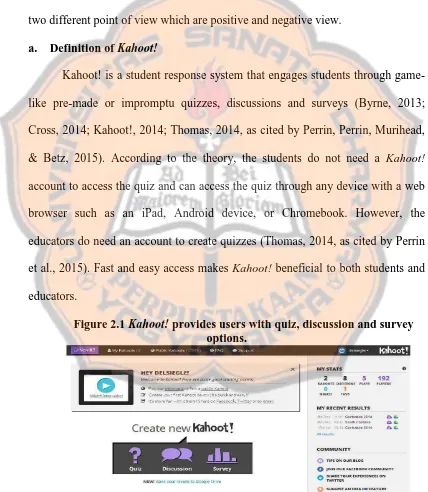
a. Definition of Kahoot!
Kahoot! is a student response system that engages students through
game-like pre-made or impromptu quizzes, discussions and surveys (Byrne, 2013;
Cross, 2014; Kahoot!, 2014; Thomas, 2014, as cited by Perrin, Perrin, Murihead,
& Betz, 2015). According to the theory, the students do not need a Kahoot!
account to access the quiz and can access the quiz through any device with a web
browser such as an iPad, Android device, or Chromebook. However, the
educators do need an account to create quizzes (Thomas, 2014, as cited by Perrin
et al., 2015). Fast and easy access makes Kahoot! beneficial to both students and
educators.
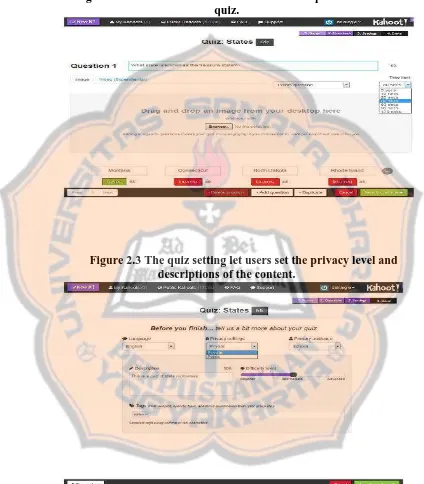
Figure 2.2 Time limits also can be set for each question in Kahoot! quiz.
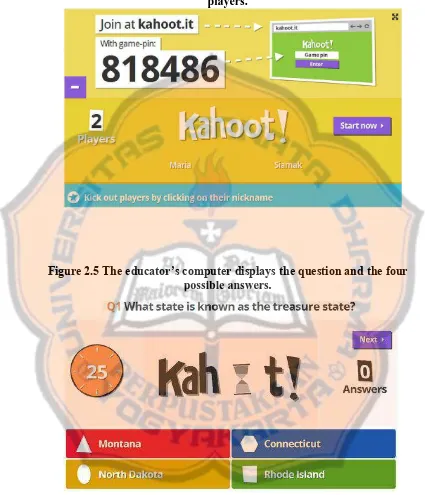
Figure 2.4 The invite screen presents players with the game’s web location,
entry pin, number of players registered, and the name of the registered players.
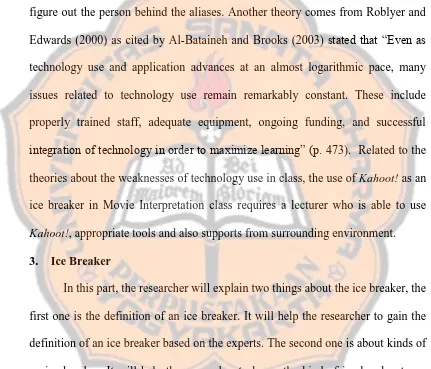
Figure 2.5 The educator’s computer displays the question and the four
possible answers.
The researcher also states from the same expert above, it is said that
of new content or reviewing old content. The data can be collected and reviewed
as an Excell document to gauge the students’ understanding of content. The use of
Kahoot! can be variety in terms of assessments and projects such as formative
assessments, diagnostic assessments, research projects and presentations (Thomas,
2014, as cited by Perrin et al., 2015). Kahoot! lets the users build fun quizzes. The
students use computers, smartphones, or any other devices to join in the game.
The users can create flashcards for review. The users can also embed some videos
and use Kahoot! as a part of the teaching process or the students can create review
games for sharing purposes.
In conclusion, Kahoot! is an application, a game-based classroom response
system and an educational platform. Kahoot! initiates peer-led discussions.
Kahoot! consists of multiple choice questions as a quiz, discussion or survey in
any topic, language or ability. It is projected at the front of the classroom, and
played by the whole class together in real-time. Kahoot! is a game-based learning
project through multiple choice questions (quiz) which can be done in a group or
individual. Kahoot! will give a lot of fun, according to the explanation that with a
refreshingly new take on introducing a subject and formative assessment through
quizzing, collaboration and presentation of content, Kahoot! initiates peer-led
discussions with fun.
b. The Strength and the Weakness of Kahoot!
The researcher has also found cognitive, motivational, emotional, and
social benefits of gaming (Granic, Lobel, & Engels, 2014, as cited by Perrin et al.,
while having fun, it also gains some specific academic achievement benefits,
builds academic confidence, develops their social and problem-solving skills, and
also promotes teamwork and cooperation (Steinberg, 2011 as cited by Siegle,
2015). Shute, Rieber, & Van Eck (2011) as cited by Hovious & Van Eck (2015)
states “Digital games can be good twenty-first-century learning tools because they
share similar characteristics with successful learning environments—they are
active, goal oriented, contextualized, adaptive, and feedback oriented” (p. 34).
Stated by Gee (2007) as cited by Hovious et al, (2015) “Moreover, a connection
between digital gameplay and school-based literacy practices has been made” (p.
34).
The use of technology helps the students to access and evaluates large
volumes of information to solve complex problems. It also increase students’
motivation as students use computers to inquire into topics of interest (Roblyer &
Edwards, 2000 as cited by Al-bataineh & Brooks, 2003). According to the
theories above, it can be concluded that Kahoot! as a game based learning has its
strength from the beginning. As an ice breaker, it is good to use Kahoot! because
in the beginning of the lesson teacher has to start it with something fresh and
interesting for the students to make sure that the class atmosphere is good.
Every aspect always has advantages and disadvantages. Although the use
of Kahoot! as a technology-based ice breaker showed a lot of advantages, the use
of Kahoot! as a technology-based ice breaker somehow still has weaknesses.
There were much has been written about possible negative effects of games
envisions designing computer technologies that still take into account the
emotional needs of the students” (p. 5). Nonetheless, Boyle (1998) argues that
information technology may actually be making us stupid. He argues that the
computer takes more of the thinking process out of students. Davis (2015) also
states that Kahoot! lets the user use aliases, it makes the facilitator confused to
figure out the person behind the aliases. Another theory comes from Roblyer and
Edwards (2000) as cited by Al-Bataineh and Brooks (2003) stated that “Even as
technology use and application advances at an almost logarithmic pace, many
issues related to technology use remain remarkably constant. These include
properly trained staff, adequate equipment, ongoing funding, and successful
integration of technology in order to maximize learning” (p. 473). Related to the
theories about the weaknesses of technology use in class, the use of Kahoot! as an
ice breaker in Movie Interpretation class requires a lecturer who is able to use
Kahoot!, appropriate tools and also supports from surrounding environment.
3. Ice Breaker
In this part, the researcher will explain two things about the ice breaker, the
first one is the definition of an ice breaker. It will help the researcher to gain the
definition of an ice breaker based on the experts. The second one is about kinds of
an ice breaker. It will help the researcher to know the kind of ice breaker types
along with their role in the classroom.
a. Definition of Ice Breaker
An ice breaker encourages participants to connect and to share focus so
2010). According to Flanigan (2011) as cited by Yeganehpour & Takkac (2016)
“performing ice breaking activities in English class will direct students to the
good mood of learning” (p. 59). Also appropriate kind of ice breaking activities
will make the students sure to get the most from their lesson and also, they will
have fun. It is also stated by Virgil E & Varvel Jr. (2002):
Ice-breakers are activities or modes of discussion used to help individuals ease into a group setting. Some ice breakers are done in groups and some can be individually completed. Others involve physical activities while others can be purely mental. Any activity that suits the intended purpose can be used. (p. 1)
The use of-ice breaker is also explained by Virgil E & Varvel Jr. (2002),
They can serve many purposes from facilitating introductions, to prior knowledge assessment, to several other reasons outlined below and others that have probably been inadvertently omitted. They are not intended to be mutually exclusive and you should design or choose activities that meet all of your intended needs. (p. 1)
b. Kinds of Ice Breaker
An ice breaker is usually used to break the ice between the class
particpants and also between the facilitators and the participants. According to
Heathfield (2015), there are two types of the ice breaker that fit for the classroom
ice breaker. The first one is an ice breaker which is just for fun. The use of the
first type of the ice breaker is kind of warm up the group. It is for participants to
know each other, laughter and generate conversation. When the participants are
strangers, the ice is broken and the participants learn something about each other.
This ensures that introductions and initial conversations occur; these are the keys
to make sure that participants enjoy and find value in the session. One of the
participants divided into five person in one group and they started to tell about
their own information such as their names, their home and their hobby. Everybody
should remember each information of the people in their group because the
participants asked to tell about other participants own information in a group.
The second is the type of ice-breaker that introduces into the topic. This
ice-breaking type is a kind of the training session or meeting. It might also
generate laughter and conversation, but its clear purpose is to open up the topic of
the session. One of the example of this kind of ice breaker is quizzing with
Kahoot! This kind of ice breaker also used for ice breaking with Kahoot!. it will
helps the students to know the topic or the material before entering the learning
activities. The second type of ice breaker is also used in Movie Interpretation class
which was for introduces the topic.
4. Movie Interpretation
Based on the syllabus of Movie Interpretation subject, Movie Interpretation
is a course that is designed to help the students to explore basic and cultural trends
through a close study (to both view and discuss) of a variety of important films
throughout the medium’s history. The course establishes critical criteria for
evaluating films and exposes students to the basic technical elements of the film
artist's process. All of the elements that make up the film experience are
examined, including the contributions of producers, scriptwriters, directors,
actors, cinematographers, editors and designers, through semiotic and functional
various techniques and interpretive elements within the films covered in class, and
to provide innovative integration of the movie in the classroom.
B. Theoretical Framework
The implementation of the ice breaking session in learning activities would
encourage the students to enjoy the class and motivate the students to be more
active in class. Therefore, this research focused on the students’ perception of
using Kahoot! as an ice breaker in Movie Interpretation class. Besides having a
research and survey to answer the research problems of this research, the
elaboration of several theories about perception, Kahoot!, ice breaker and Movie
Interpretation would help this research to find the answer of the research
problems.
This study has two research problems. The first problem is about the
students’ perception on the use of Kahoot! as an ice breaker in Movie
Interpretation class which is answered with the theory from Altman and Hodgetts’
(1985) that perception itself is defined by a person’s view of reality, which comes
from the stimuli of the environment. According to the theory, this kind of activity
helps to see the students’ process when the students come up with the certain
response, in this case, their response of ice breaker session. The researcher also
use some theories from Granic, Lobel, and Engels (2014, as cited by Perrin et al.,
2015) about the theory of Kahoot!, Flanigan (2011, as cited by Yeganehpour &
Briggs, 1999) about the theory of online education, and also from Leontiev (1981)
about the theory of perception to support.
The second research problem is about how to improve the use of Kahoot!
as an ice breaker in Movie Interpretation class. This research problem deals a lot
with the participants because the researcher wants to see if there are any aspects
that should be improved especially after using Kahoot! as an ice breaker in Movie
Interpretation class. In addition, to obtain the maximum of the result, the
researcher uses Roblyer and Edwards (2000, as cited Al-Bataineh and Brooks,
2003) theory’s about strength and weakness of technology in the classroom in
designing every question in the instrument to gain the intended answers from the
participants. It is used to see the improvement that should be done in the use of
20
CHAPTER III
RESEARCH METHODOLOGY
This chapter presents the methodology employed in this study in order to
conduct the research. It describes six main parts of the research methodology,
namely research method, research setting, research participants, research
instruments, data analysis technique and research procedure.
A. Research Method
This study employed survey method in which the data of the students‟ perception on using Kahoot! as an ice breaker in Movie Interpretation class were
obtained by questionnaire, interview and also observation. Ary, Jacobs, Sorensen
and Razavieh (2002) state that survey is a researchers technique in which data are
gathered by asking questions on a group of individuals called respondents.
Moreover, Wiersma (1995) states that surveys are used to measure attitudes,
opinions, or achievements in any number of variables in natural settings. The
researcher distributed a questionnaire to all of the respondents and interviewed
B. Research Setting
This research started on May 10th, 2016 and ended up in the same month
on 17th, 2016. The interview session was conducted three days after the researcher
gained the questionnaire data. It was on May 13th, 2016 located in Taman Jamur
in Sanata Dharma University to avoid noises and facilitate interviewee when
providing answers.
C. Research Participants
The selected participants were two classes of Movie Interpretation of
ELESP Sanata Dharma University which consisted of sixty-six (66) students in
the academic year of 2012-2014. By having the entire research participants, the
researcher got relevant and sufficient data to provide maximum insight and
understanding of what they had been studying.
D. Instruments and Data Gathering Technique
In order to answer the two research problems, this research used three
research instruments: questionnaire, observation, and interview.
1. Questionnaire
The questionnaire was distributed in two classes of Movie Interpretation
class in Sanata Dharma University. The questionnaire was used to collect data on
of all individuals, it is used to record respondents‟ answer verbally (Gall, Gall and Borg, 2007). The questionnaire was distributed to sixty six (66) students who took
Movie Interpretation on May 10th, 2016.
In order to increase the consistency of the responses throughout the
respondents and to make the tabulation easier and faster, the researcher used
close-ended questionnaire. In the first part, there were fifteen close-ended items
provided which covered all the information needed to answer the two research
problems. Each statement in the first part of the questionnaire came from several
theories to support this research. The blueprint of close-ended statements in the
questionnaire can be seen in appendix A (p. 65). The researcher used English for
the questionnaire because the participants were from ELESP of Sanata Dharma
University students and also capable enough to understand and to give responses
to the statement that was provided by the researcher.
The second part consisted of three open-ended questions. The questions
were about (1) the benefits of using Kahoot! as an ice breaker in Movie
Interpretation class (2) the weaknesses of using Kahoot! as an ice breaker in
Movie Interpretation class, and the last question was asking about (3) their
suggestion of using Kahoot! as an ice breaker in Movie Interpretation class.
2. Observation
The observation was held in two classes of Movie Interpretation, class A
and also class B. It was held on Tuesday, May 10th, 2016, at 14.00 for class A and
at 16.00 for class B. When conducting the observation, the researcher needed
and also to distribute the questionnaires. This observation observed three main
activities as the researcher explained before. This observation also gave
information about classroom situation and atmosphere, the enthusiasm and
response of the students on the use of Kahoot! as an ice breaker in Movie
Interpretation class. The researcher also explained and told the respondents about
what the researcher observed based on the three main activities that already
explained before in order to get validation from the respondents.
3. Interview
According to Ary, Jacobs, and Sorensen (2010), interview is one of the
most widely used and basic method for obtaining the data in qualitative research.
Besides, it is used to gather data from people about their opinions, beliefs, and
feelings about situations in their own words. That was the reason why the
researcher second‟s instrument used in this research was the interview. Basically, the interview session was used to strengthen, clarify and also confirm the answer
from the questionnaire which was distributed to the respondents. In addition, it
was one of the ways to support the main data which was the questionnaire.
Another theory to support the function of the interview was personal interviews
from Frankael and Wallen (2009), they were used because the researcher directly
met the respondents face-to-face and it allowed the researcher to follow questions
to the unclear answer as it was noted.
The researcher had prepared ten open-ended questions. As defined by
DeMarrais (2004) as cited by Merriam (2009) that interview is a process where a
to a research study. Supporting the theory, Fraenkel and Wallen (2009) stated that
open-ended questions allow more freedom of responses and permit follow up by
interviewer which give an opportunity to the researcher to ask expanded questions
regarding to the responses. Ten questions which acted as an interview questions
became a guideline for the specific data of the research to support the main data
from the questionnaire.
The statements on the questionnaire and the questions for the interview
session were similar which were aimed to get strong and also the valid answer to
both problem formulation. The interview questions were actually taken from
several questions of the questionnaire. The interview was conducted in Bahasa
Indonesia in order to gain the deeper meaning of the answer and avoid
misunderstanding that came from the respondents‟ answer. The interview result was used as the clarification and confirmation of the different questionnaires‟ result showed.
The researcher used purposive sampling to gain the interviewee from
Movie Interpretation class. According to Teddlie & Yu (2006) “Purposive sampling techniques are primarily used in qualitative (QUAL) studies and may be
defined as selecting units (e.g., individuals, groups of individuals, institutions)
based on specific purposes associated with answering a research study‟s
questions” (p. 77). The researcher selected five (5) interviewees from Movie Interpretation class according to their answers on questionnaire. The researcher
chose the interviewee based on their perception on the use of Kahoot! as an ice
statements and three (3) interviewees that had positive statements on the use of
Kahoot! as an ice breaker in Movie Interpretation class.
In carrying out this study, the data gathering technique of this research
consisted of three, which were questionnaire, interview and observation. This
research established close-ended and open-ended questions for the questionnaire
and open-form for the interview. This research was used close-ended question for
the questionnaire because a close-ended question is easy to use, score, and code
for analysis on a computer as it was proposed by Fraenkel & Wallen (2009). The
open-ended questions in the questionnaire used to validate statements from the
close-ended questions. This research also used an open-form question as known as
semistructured. According to Merriam (2009), a semistructured interview means
the interviewer has set series of structured questions with open-form questions in
order to get systematical additional information. The main source when collecting
the data for this research was questionnaire answer which resulted in percentage
data, and then it was validated and verified descriptively by using the result of the
focused interview in order to meet the validity and reliability of the data.
E. Data Analysis Technique
The very first step of analyzing the data was recorded from the
questionnaire. There were several options about the answers of the questionnaire
itself. Every statement had some agreements namely „strongly agree”, „agree‟,
agreement chosen as the way to summarzie the data in a frequency distribution.
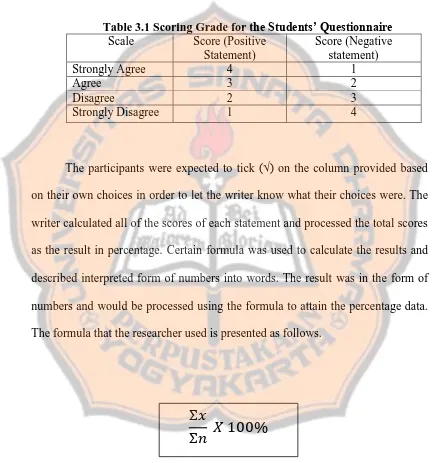
The scoring of the questionnaire is presented as follows.
Table 3.1 Scoring Grade for the Students’ Questionnaire Scale Score (Positive
Statement)
Score (Negative statement)
Strongly Agree 4 1
Agree 3 2
Disagree 2 3
Strongly Disagree 1 4
The participants were expected to tick (√) on the column provided based on their own choices in order to let the writer know what their choices were. The
writer calculated all of the scores of each statement and processed the total scores
as the result in percentage. Certain formula was used to calculate the results and
described interpreted form of numbers into words. The result was in the form of
numbers and would be processed using the formula to attain the percentage data.
The formula that the researcher used is presented as follows.
Known as:
= The number of students based on the degree of agreement
=The number of all students.
�
In other words, through this formula the researcher found the result by
counting how many research participants chose „strongly agree‟, „agree‟,
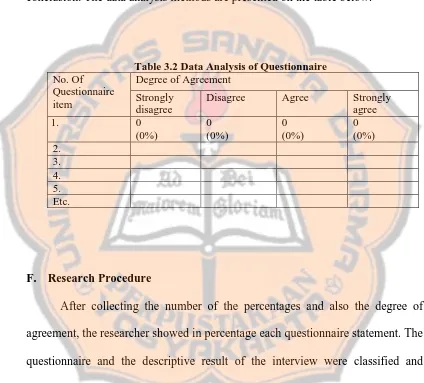
„disagree‟ and also „strongly disagree‟ for every statement. The percentage result delivered as a final result to answer every problem in order to show the final
conclusion. The data analysis methods are presented on the table below.
Table 3.2 Data Analysis of Questionnaire
No. Of
agreement, the researcher showed in percentage each questionnaire statement. The
questionnaire and the descriptive result of the interview were classified and
described based on the categories in order to find the meaning of each item. The
last step was to make students‟ view which was gained through questionnaire and interview with triangulation, and the theoretical view which showed the precise
and same relation to the particular conclusion. The criteria used to determine
negative could be seen in the amount of the respondents choosing to agree or
strongly agree for positive perception and strongly disagree and disagree for
negative statements for negative perception. Positive statements here meant the
statements that support the use Kahoot! as an ice breaker in Movie Interpretation
class, whereas negative statement could be interpreted as a statement that did not
support the use of Kahoot! as an ice breaker in Movie Interpretation class. The
criteria to determine whether or not the statement was positive were through the
calculation of the data. If the average of the data showed more than 50.1% of the
respondents (33 students) chose to agree or strongly agree with every positive
statement, it could be concluded that the respondents‟ perception was positive, if
the respondents‟ chose not more than 50.1% the respondents‟ perception can be concluded negative. On the contrary, if more than 50.1% of the respondents chose
disagree or strongly disagree with every negative statement, it could be concluded
29
CHAPTER IV
RESEARCH FINDINGS AND DISCUSSIONS
This chapter presents the gained data and its discussion to answer two
formulated problems that are already presented in the first chapter. It consists of two
parts; first part discusses the findings of students’ perception of using Kahoot! as an
ice breaker in Movie Interpretation class. The second part discusses how to improve
the use of Kahoot! as an ice breaker in Movie Interpretation class.
A. Students’ Perception on the Use of Kahoot! as an Ice Breaker in Movie Interpretation Class
The first research problem investigated the students’ perception on the use of
Kahoot! as an ice breaker in Movie Interpretation class. In order to answer the first
research problem, the researcher obtained the data by distributing the questionnaire to
66 students from batch 2012-2014 who took Movie Interpretation class and also
interviewing several students to get additional information related to the answer of
the questionnaire.
In elaborating the result of the data, this section is divided into three parts
namely (1) Students’ perception towards Movie Interpretation (2) Students’
perception of using ice breaker in Movie Interpretation class and (3) Students’
two parts is about students’ perception towards Movie Interpretation and students’
perception of using ice breaker in Movie Interpretation class was used to see students’
perception about Movie Interpretation without using Kahoot! as an ice breaker. It also
used to see whether students’ perception about Movie Interpretation was changed or
not after using Kahoot! as an ice breaker in Movie Interpretation class. The researcher
also presents the data from the 3 open-ended questions which was related to the
close-ended statement in order to strengthen the analysis of the data. However, not all
close-ended statements can be related to the data from open-ended questions by the
researcher. Furthermore, the researcher also provides the related and supported
theories in some statements in order to analyze the data.
1. Students’ Perception Towards Movie Interpretation class
In this part, the researcher identified the students’ perception towards Movie
Interpretation class. There are two close-ended questions which talked about students’
perception towards Movie Interpretation and also the learning material.
Relying on the close-ended statement on the questionnaire, the researcher
discussed every single statement one by one from the first. The first statement:
“movie Interpretation class is fun” identifies the students’ interpretation when
learning in Movie Interpretation class. According to the respondents’ answers, the
researcher found that none of the students chose (0%) strongly disagree and disagree.
The rest of the students, 20 students (20.20%) agree and 46 students (69.69%)
strongly agree. According to the findings, all of the students agree that Movie
the interviewee in Movie Interpretation class who described the situation in Movie
Interpretation class as follows.
I think it’s not complicated, Movie Interpretation class is fun anyway, but we still have to pay attention in the class, because sometimes there will be a lot of info that helps us a lot when doing some works, like works about editing and movie analysis. (Interviewee*2)
The students thought that Movie Interpretation class was not complicated, but
the students would still need to pay attention to every material, because the material
was actually difficult sometimes. This following statement from another student also
supported as follows.
Maybe because of the atmosphere inside the class is fun, but it doesn’t mean that the materials are easy, the point is we still have to study for this subject. But, the class is already fun. (Interviewee*5)
From the first statement above, the researcher related the data with the theory
of perception. Altman, Valenzi and Hodgetts (1985) state that “perception is the way
stimuli are selected and grouped by a person so that they can be meaningfully
interpreted. It is a person’s view of reality. The process of perception enables us to
understand and cope with the environment in which we live” (p. 85). Referring to this
theory, the researcher defined the “environment” here as a Movie Interpretation class.
The data also showed that 100% of the students gave positive responses in the first
statement. It meant that Movie Interpretation class is fun.
The second statement that stated “the materials in Movie Interpretation class
are difficult” took one (1) student (1.52%) chose strongly disagree, twenty-eight (28)
students (12.12%) strongly agree. According to the findings, more than 50% of the
students agreed that materials in Movie Interpretation class were difficult. This
statement was also supported by the interview session with the students of Movie
Interpretation and provided some answers as follows.
In between I think, sometime it is difficult but sometimes it is easy, basically we still have to study in this subject. (Interviewee*5)
The materials are not always easy, sometimes it is difficult. (Interviewee*4)
I think the materials are little bit complicated, but because it was well-explained so I can take it well. (Interviewee*2)
The data above in line with the close-ended data that the researcher had
already obtained, the three statements from the interviewee showed the difficulties of
the material on Movie Interpretation. Thirty-seven (37) respondents stated that it was
actually difficult and twenty-nine (29) respondents stated that the materials were
easy. Using the same theory from the statement number one, which comes from
Altman, Valenzi and Hodgetts (1985) stated that “perception is the way stimuli are
selected and grouped by a person so that they can be meaningfully interpreted. It is a
person’s view of reality. The process of perception enables us to understand and cope
with the environment in which we live” (p. 85). It can be seen that the students’ view
of reality according to the difficulty of the material in Movie Interpretation class was
2. Students’ Perception of Using Ice Breaker in Movie Interpretation Class In this part, the researcher identified students’ perception of using ice breaker
in Movie Interpretation class. There were three statements in the questionnaire
covering the usage of ice breaker and students’ perception of using ice breaker in
Movie Interpretation class. The next three statements of the close-ended statements
on the questionnaire discussed about the usage of ice breaker and students’ perception
of using ice breaker in Movie Interpretation class.
The third statement stated “Ice-breaking session is needed in Movie
Interpretation Class” showed that one (1) student (1.52%) chose strongly disagree,
two (2) students (3.03%) chose disagree, twenty-two (22) students (33.33%) chose
agree and forty-one (41) students (62.12%) chose strongly disagree. According to the
findings, more than 90% of the students agreed that ice breaking session is needed in
Movie Interpretation class.
The fourth statement stated “Interesting ice breaker media helps me to
understand the learning material more” showed that three (3) students (4.54%) chose
strongly disagree, two (2) students (3.03%) disagree, twenty-eight (28) students
(42.42%) agree and thirty-three (33) students (50%) strongly disagree. The fourth
statement showed how important the interesting ice breaker media were used to help
students understand the learning material more. It can be seen from the data that more
than 90% (sixty-one students) of the students agreed that interesting ice breaker
The fifth statement stated “Using ice breaker in Movie Interpretation class
makes me interested more into the next learning material” showed two (2) students
(3.03%) chose strongly disagree, four (4) students (6.06%) disagree, thirty (30)
students (45.45%) agree and thirty (30) students (45.45%) strongly agree. It can also
be seen from the data that more than 80% (fifty-three students) of the students agreed
that using ice breaker in Movie Interpretation class made the students more interested
in the next learning material.
The data which the researcher obtained also were supported by the theory of
perception from Altman, Valenzi and Hodgetts (1985) stated that “perception is the
way stimuli are selected and grouped by a person so that they can be meaningfully
interpreted. It is a person’s view of reality. The process of perception enables us to
understand and cope with the environment in which we live” (p. 85). It meant that
according to the students prception, the students could cope with the material of
Movie Interpretation more with using ice breaker in class.
3. Students’ Perception on the Use of Kahoot! as an Ice Breaker in Movie Interpretation Class
In this part, the researcher identified students’ perception of using Kahoot! as
an ice breaker in movie interpretation class. This part explained about what students
actually felt when using Kahoot! as an ice breaker in Movie Interpretation class.
Besides, the close-ended statements on the questionnaire, there would be an
students’ perception of using Kahoot! as an ice breaker in Movie Interpretation class
which were obtained from interview session.
The sixth statement stated “Using Kahoot! as an ice breaker helps me more
understand about the learning material” showed that four (4) students (6.06%)
strongly disagree, four (4) students (6.06%) disagree, thirty (30) students (45.45%)
agree and twenty-eight (28) students (42.42%) strongly agree. The researcher also
provided some answers from the open-ended question in the questionnaire which
were related to the statement for supporting the statement.
Mood booster, help me understand the material (P*21)
We more understand the material because it’s not boring. (P*40) Learn and understand the material in a fun way, and also interesting
(P*43)
Makes me understand about movie in a fun way (P*66)
Supporting the data above, the researcher related the data with the theory from
Ascough (2002) Rosie (2000) and Briggs (1999) as cited byYang & Cornelius (2004)
stated that, “online education can also promote students’ critical thinking skills, deep
learning, collaborative learning, and problem-solving skills.” The researcher related
the theory with the statement that using Kahoot! as an ice breaker helped the students
to understand the learning material more. It was because Kahoot! as an online ice
breaker that contained education also helped the students to understand the material
collaborative learning, and problem-solving skills, so it gave students more
knowledge than before.
The seventh statement stated that “The media used to carry out Kahoot! in
Movie Interpretation class is already qualified.” The data that the researcher obtained
showed that three (3) students (4.54%) chose strongly disagree, six (6) students
(9.09%) disagree, twenty-four (24) students (36.36%) agree and the rest, thirty-three
(33) students (50%) strongly agree. According to the data more than 80% of the
participants agreed that the media that used to carry out Kahoot! in Movie
Interpretation class were already qualified.
The eighth statement stated “The use of Kahoot! as an ice breaker is too
complicated” left thirty-one (31) students (46.96%) chose strongly disagree,
twenty-eight (28) students (42.42%) disagree, four (4) students (6.06%) agree and three (3)
students (4.54%) strongly disagree. The statement which focused on the use of
Kahoot! as an ice breaker showed more than 80% of the respondents disagree that the
use of kahoot! as an ice breaker was too complicated. A student presented that the
usage of Kahoot! was not difficult. This statement was also supported with answers
from the interview session as follows.
Actually, Kahoot! is very easy to use, so even that is your first time using Kahoot! it will be easy for you to use it. (Interviewee*2)
It is so easy, not complicated at all. (Interviewee*3)