RESEARCH
The intergeneric crossing of
Phalaenopsis sp
. and
Vanda
tricolor
Sri Hartati
a*aDepartment of Agronomy, Faculty of Agriculture, Sebelas Maret University, Jl. Ir. Sutami no 36A, Surakarta 57126,
Indonesia
Received : 5 August 2009 Accepted: 27 August 2009
Abstract
To study the intergeneric crossing between orchids of Phalaenopsis sp. and Vanda tricolor, three species of Phalaenopsis sp. (Phalaenopsis Joane Kileup June, Phalaenopsis Pinlong Cinderella, and (Phal. Fortune Buddha x Phal. Princess Kaiulani) were crossed reciprocally with Vanda tricolor in time-different value (within the first, second and third week after full opened flower). The crossing of Phalaenopsis sp. and Vanda tricolor was compatible, and the use of Phalaenopsis sp. as male parent had better probability in producing fruits rather than the opposite. The crossing which was done at the first and the second weeks after blooming produced more fruit than the crossing at the third week after blooming, even though it did not affect the success of crossing, time of fruit formation, and duration of fruit hanging.
Key words: Intergeneric Crossing, Orchids, Phalaenopsis sp., Vanda tricolor
INTRODUCTION
One strategy to make a new-hybrid cultivars of orchids is by crossing between the orchid-parents having different characters. Orchid hobbyist usually prever to collect hybrid resulted from crossing orchids, because the hybrided orchids have more various colour, pattern, size, shape of flower and more likely to have longer life of flower (1).
Therefore it is beneficial to create a new hybrid by crossing one species to another.
The interspecies crossing (crossing
among the species member of one similar genus) strategy is commonly used by the scientists as well as by the growers. However, for the best of our knowledge, orchid hybrids from the intergeneric crossing strategy is not commonly used. As long as the both parents have similar characters, the intergeneric crossing is possible (2). Hartati and Nuryanti
(unpublished results) found that Phalaenopsis sp. compatible to be cross with Vanda Dr
Aniek FCC which are both different in genus.
Furthermore, Phalaenopsis sp. was also found
compatible to Doritis pulcherrima var.
Champornensis (Hartati, unpublished results). To assess the effect of time of crossing (week after blooming) in order to make new hybrid orchids with more attractive flower characters to the fruit formation in, Phalaenopsis sp. and
Vanda tricolor was intergeneric crossed.
MATERIALS AND METHODS
The research was done in the paranet house of Agricuture Faculty of Sebelas Maret
University from February until September, 2008. The plants used in this experiment were
Phalaenopsis sp. (Phalaenopsis Joane Kileup June, Phalaenopsis Pinlong Cinderella, Phalaenopsis Fortune Buddha x Phalaenopsis Princess Kaiulani) and Vanda tricolor.
Correspondence Author: *Sri Hartati
Department of Agronomy Faculty of Agriculture,
Sebelas Maret University, Jl. Ir. Sutami no 36A, Surakarta 57126 Telephone / Fax: (0271) 632451/ (0271) 632451
The Phalaenopsis sp. and Vanda tricolor
were crossed reciprocally in factorial
experiments. First, we did parent treatment (S) focusing on the female Vanda tricolor as follows: crossed with Phalaenopsis Joane Kileup June (male) (S1), Phalaenopsis Pinlong Cinderela (male) (S2), and Phalaenopsis Fortune Buddha x Phalaenopsis Princess Kaiulani) (male) crossed (S3), respectively. In
order to role out the influence of the crossing execution time (W), we crossed at the first week (W1), second week (W2), and the third
week (W3) after full blooming, respectively.
Second, we did parent treatment (S) focusing on the male Vanda tricolor as follows: crossed with Phalaenopsis Joane Kileup June
(female) (S4), Phalaenopsis Pinlong Cinderella
(female) (S5), and Phalaenopsis Fortune Buddha x Phalaenopsis Princess Kaiulani) (female) (S6), using different crossing
execution time as above.
Crossing was done at 7 to 9 am. Mature fruits of orchids were harvested at the age of 4
– 6 months after crossing execution. The mature fruit was characterized by the change of color from green to yellowish. We also measured the success of crossing by examined the fruit emergence number/crossed flower number, the time of fruit formation (days), the fruit life duration (days), and the percentage (healt, freshness, maturity, sterility) and
compatibility level of crossing. Pollen
condition is strighly important in determining the success of crossing as the first step of pollination is the unity of pollen and stigma, then the pollen will emerges to form pollen tube to reach ovule. The success of crossing is determined from the ratio of the emerging fruit number to the number of flower being crossed in percentage. We found that the time
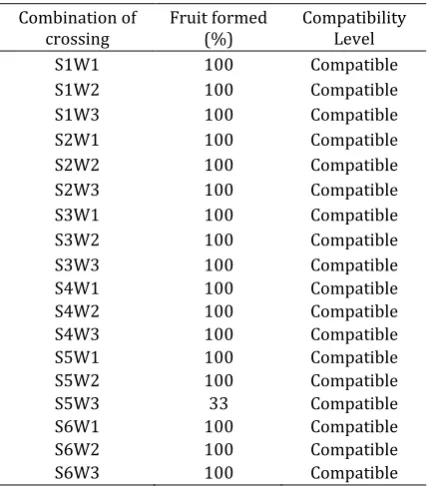
of crossing did not affect the success of crossing. Either the Phalaenopsis sp. or Vanda tricolor used as male parent showed that all flowers succeded to form fruits, except the
cross of Phalaenopsis Pinlong Cinderella
(female parent) and Vanda tricolor (male parent) which just had the percentage of 33 % (Table 1).
Table 1. The percentage of fruit formed and the compatibility of the crossed combination closely genetic heridity (2). Interspesific and
intergeneric crossing of Vanda sp. usually have low percentage of success because of some problems such as abnormality on meiosis, low fertility and pollen sterility (3). Purwantoro et
al.(4) indicated that based on the
morphological characters of the flower,
Phalaenopsis form one cluster, while Vanda
form different cluster split from the cluster of
Phalaenopsis. However, Phalaenopsis sp. was compatible to one of the Vanda species, Vanda
Dr Aniek FCC (Hartati, unpublished results).
The present data confirmed that Phalaenopsis sp. was compatible to Vanda tricolor, eventhough they have different genus.
Compatibility of crossing is shown by the ability of female parent to form fruit (5).
when it can form fruit more than 20 percent, partly compatible when 10 – 20 percent, and incompatible when it less than 10 percent. Based on the Wang Classification, the crossing of Phalaenopsis sp. and Vanda tricolor in the
present experiment was classified as
compatible (Table 1).
Time of Fruit Formation
Time of fruit formation is determined from the day of crossing execution until the day of fruit emergence which was indicated by thickening at the fruit basal. Time of fruit formation, from pollination to fruit emergence in orchid varies depends on the species (5). In general the fruit
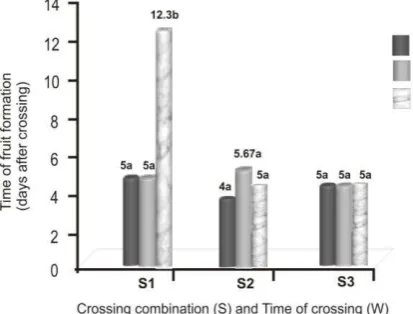
of orchids will normally form at the 3 or 4 days after pollination. The present data showed that the indication of fruit emergence appeared at the fifth day after crossing execution in average. Statistical analysis showed that the treatment of parent material as well as time of crossing did not show significant effect to the time of fruit formation, except for the crossing of Phalaenopsis Joane Kileup June (male) x Vanda tricolor (female) executed at the third week after blooming which the fruit emergence appeared at the 12 days after. Moreover this pair of crossing in its reciprocal crossing data also indicated a longer time when crossing was executed at the third week after blooming (9 days) (Figure 1 and 2). The fastest fruit formation was showed by the crossing pair of Phalaenopsis Joane Kileup June (female) and Vanda tricolor
(male) crossed at the third week after blooming.
Figure 1. The time needed for fruit formation of the
crossing of Vanda tricolor (female) and Phalaenopsis sp. (male) at different time of crossing execution.
Figure 2. The time needed of fruit formation of the
crossing of Vanda tricolor (male) and Phalaenopsis sp.
(female) at different time of crossing execution.
Fruit Life Duration
Fruit life duration is the length of time (days) which fruit remains hanging at the stem until harvested or fallen down before mature. Not all fruit formed can be harvested. The period of fruit maturity of orchids varies depends on the species. Dendrobium usually needs 2.5 to 3 months to reach mature fruit,
Phalaenopsis needs 3 – 4 months, Vanda needs 6 months and Cattleya needs 9 months (7). The
present data showed that the crossing of
Phalaenopsis sp. (male) x Vanda tricolor
(female) performed the longer period of fruit hang, 82.67–181 days after crossing execution, while its reciprocal crossing performed only 17–69.67 days (Figure 3 and 4). However, the shorter time of fruit hang for the crossing of
Phalaenopsis sp. (female) x Vanda tricolor
(male) did not necessarily indicate the shorter time of harvest. This may be elaborated by the data of the number of harvested fruit.
Figure 3. The fruit life duration of the crossing of Vanda
Figure 4. The fruit life duration of the crossing of Vanda tricolor (male) and Phalaenopsis sp. (female) at different time of crossing execution.
Percentage of fruit ready to harvest
Not all fruit which were formed can be harvested, since it could fallen down before reaching its maturity caused by the external or physiological factors, therefore not all fruit formed can be harvested. The period of fruit maturity of orchids varies depends on the species (7). The present data showed that only
crossing of Phalaenopsis Fortune Buddha x
Phalaenopsis Princess Kaiulani (male) x Vanda tricolor (female) which executed at the first and second week after blooming resulted in all fruit formed could be harvested. None of the crossing done at the third week after blooming produced 100 percent fruit (Figure 5).
Figure 5. The fruit ready to harvest at the crossing of
Vanda tricolor (female) and Phalaenopsis sp. (male) at different time of crossing execution.
This indicated that the best time of crossing between Phalaenopsis sp. and Vanda tricolor was done at the first and the second week after blooming. On the other hand, the use of Vanda tricolor as male parent only
formed fruit when crossed with Phalaenopsis Fortune Buddha x Phalaenopsis Princess Kaiulani) as female parent. Almost all the fruit fallen down before harvested (Figure 6). This
result indicated that the crossing of
Phalaenopsis sp. and Vanda tricolor more compatible when Phalaenopsis sp. was used as male parent than that of the female one.
Figure 6. The fruit ready to harvest at the crossing of
Vanda tricolor (male) and Phalaenopsis sp. (female) at different time of crossing execution.
Based on our finding we concluded that the intergeneric crossing of Phalaenopsis sp.
and Vanda tricolor was compatible when the
Phalaenopsis sp. was used as male parent and
Vanda tricolor as female parent. Even though there was no significant difference of the treatment to the success of crossing, time of fruit formation, and fruit life duration, the crossing was better done not more than two weeks after blooming. It is better to not cross all of the flower in a plant to reduce the failure of fruit before harvest.
ACKNOWLEDGMENT
This work was supported by the grant from DIKTI DP2M (198/SP2H/PP/DP2M/III/2008).
REFERENCES
1. Hadi, 2005. Budidaya Tanaman Anggrek. www.deptan.go.id/ditlinhorti/. (14 Desember 2005).
2. Parnata, Ayub S. 2005. Panduan budidaya dan perawatan anggrek. AgroMedia Pustaka. Jakarta. 3. Soeryowinoto, S.M., Soeryowinoto M. 2000.
4. Kartikaningrum, S., Nani, H., Achmad, B., Murdaningsih, H.K., Toruan-Mathius, N. 2002. Kekerabatan antar genus anggrek sub tribe sarcanthinae berdasarkan data fenotip dan pola pita DNA. Zuriat3(1): 1-10.
5. Purwantoro, A., Ambarwati, E., Setyaningsih, F. 2005. Kekerabatan antar anggrek spesies berdasarkan sifat morfologi tanaman dan bunga. Jurnal Ilmu Pertanian 12(1): 1-11.
6. Darmono, D.W. 2006. Menghasilkan Anggrek Silangan. Penebar Swadaya. Jakarta.
7. Wang, H. 1963. A study on the self and cross incompatibility in the sweet potato in Taiwan. Procciding American Society Horticultural. Sci. 84: 424-430.