• Tidak ada hasil yang ditemukan

DESIGN OF HUMANITARIAN LOGISTICS INFORMATION SYSTEMS FOR NATURAL DISASTER

N/A
N/A
Protected

Academic year: 2019

Membagikan "DESIGN OF HUMANITARIAN LOGISTICS INFORMATION SYSTEMS FOR NATURAL DISASTER"

Copied!
6
0
0

Teks penuh

(1)

1

DESIGN OF HUMANITARIAN LOGISTICS INFORMATION SYSTEMS

FOR NATURAL DISASTER

1

Djoni H. Setiabudi*,

2

Lady Joanne Tj,

3

Rina Savista Halim

1 Informatics Department, Petra Christian University stock on one area has been accumulated and not distributed, on the other hand there are some other areas lacking logistics supports. To support the disaster management system, private sectors are also needed to be involved. In this case, convenience stores are needed to assist with the logistics, as a form of Corporate Social Responsibility (CSR), to the people who suffer from the disaster.

This research was conducted to address the logistics distribution for natural disasters by developing an online and integrated logistic management information system under the coordination of the Indonesian Red Cross (IRC). The Information system being developed includes a web-based information system and mobile application which can be accessed using smartphones. This information system will provide information to donors about the necessary logistics needs. The study also involves convenience stores, which have a broad distribution network in Indonesia, to speed up the delivery of humanitarian logistics to the disaster sites. To guarantee that the aids are received safely by the victims of the disaster, the application also includes features for the shelters and volunteers. Volunteers will give confirmation via an application on the smartphone as the aids are received in accordance with the logistics of data sent by the Indonesian Red Cross.

The results of this research is the design of a modeling process in the form of Data Flow Diagram, Data modeling in the form of Entity Relationship Diagram and User Interface to display IRC Administrator Dashboard, shelters, volunteers. This study has also included the design of the menu, which produces the menu of IRC Admin, donors, shelters, convenience stores. All designs are ready to be deployed.

Keywords: disaster, humanitarian, logistics, information systems, convenience stores, Indonesian Red Cross

INTRODUCTION

The existence of a row of volcanoes stretching from the north of the island of Sumatra, Java, Nusa Tenggara up to North Sulawesi has made Indonesia to be considered as a country prone to natural disasters such as volcanic eruptions, earthquakes and landslides. This condition is due to the fact that geographically Indonesia is an archipelago and located on four tectonic plates. Indonesia has also a volcanic belt that extends from the island of Sumatra, Java, Sulawesi and Nusa Tenggara.Besides the natural factors, there are other factors for Indonesia in facing disasters which were caused by human activities in the efforts to promote development without considering the natural conditions and readiness of using technology. Based on the above facts, humanitarian aids to victims of natural disasters is a priority of the Indonesian government, ISDR (2004).

One essential aspect of disaster management is the logistics. Some institutions are trying to do some research regarding humanitarian logistics. According to Thomas and Kopczak (2005), humanitarian logistics is defined as “the process of planning, implementing and controlling the flow and storage of goods that is effective and efficient, including information from the starting location to the destination location of the disaster to reduce the suffering of people affected by the disaster”. The problem is the logistics information regarding natural disasters is often incomplete. Information about the necessary logistics in one place is often not clear. Sometimes the logistics are either distributed beyond the needs or there is a shortage of logistics. Howden (2009) states that a Humanitarian logistics information system can improve the effectiveness of humanitarian supply chains by providing timely and accurate information regarding what supplies are required and have been delivered, enabling donors to be more responsive to the needs of beneficiaries. Sangiamkul and Hillegersberg (2011) also stated that the use of IT to support humanitarian logistics was a promising field. The use of information technology canimprove the effectiveness and efficiency of complex logistics support.

(2)

2

geographic information systems to estimate the location of the possible needs and the amount of aid equipment required at the time of the flood. Saadatseresht (2009) developed geographical information systems (GIS) for planning the evacuation of disaster victims with a case study in Iran. Mete and Zabinsky (2010) developed a decision-making system to be able to choose the location of medical equipment supply and inventory levels required for each type of medical supply necessity.

Humanitarian Open Street map (2014) was developing an open source software, able to compile disaster scenarios for the impact of the activities of planning, preparation and better action called InaSAFE (Indonesia Scenario Assessment for Emergencies). Chen et al (2011) developed a GIS to facilitate the acquisition of information and decision-making for the distribution of supplies in time of disaster. First they developed mobile application devices to identify the needs. Secondly, they developed a database for the location of the warehouse that was able to provide the needs. Lastly they developed the mapping adjustment between the needs and available resources as well as the best route to be able to supply the equipment.

All these research have put more emphasis on the development of information systems to determine the location of the disaster, demand and supply needs of the closest location to transport as efficient as possible, including using RFID technology. While at the disaster site, the provider has already had the availability of logistics needs. The problems found in Indonesia, are not only on finding the shortest route, but more on the needs of the supply. The information on the real needs of the victims is often not available. The coordination among the government, donors or prospective donors is still weak. Thus a system, that is able to meet the logistics problems in Indonesia, needs to be built. A discussion on this issue has not been discussed in previous studies as described above.

To overcome this problem, this study will develop the design of an integrated information system which involves government officials on duty, in this case, Indonesian Red Cross, to cope with natural disasters and assistance to victims, donors or prospective donors who will contribute. The third party in this case is the convenience store who will be in charge of organizing the logistic distribution to the disaster sites in the shortest time possible.

SUPPLY CHAIN MANAGEMENT IN HUMANITARIAN LOGISTICS

In humanitarian organizations, supply chain is basically a term used to describe the process of obtaining relief goods from the source of origin to the beneficiaries / aid at the right time. The original source can be from a supplier or from a donor. In some organizations, they use the term supply chain and logistics simultaneously to describe the process mentioned above. Usually logistics is also used to describe the function or the department which is responsible for managing the existing processes in the supply chain and logistics in a business or commercial part at the supply chain and logistics in the humanitarian field (Balcik and Beamon, 2008).

Here are some significant differences:

• Demand is unpredictable in terms of time, geographic location, commodity type, and quantity of the commodity. • The overall duration of the process / lead times are short and sudden demand for a large number of wide range of products and services.

• The risks encountered in humanitarian operations, especially in the face of powerful global media and special attention from donors.

• Lack of resources at an early stage, especially in terms of supply, human resources, technology, capacity and funding. The main components in the supply chain of humanity is:

• Procurement • Transport

• Warehousing and inventory

RESEARCH METHODOLOGY

The stages of this study will be divided into three phases of research that includes a preliminary survey, analysis and design of information systems. The first stage is data collection of the logistics needs at disaster location through a survey to Indonesian Red Cross, including survey to prospective donors. At the second stage is analyzed the old system, the problems, the needs of the system to be created. At the third stage proceed with the design for process modeling, data modeling, user interface.

Analysis

Currently Surabaya branch of the Indonesian Red Cross is actively involved in the distribution of the logistics of humanitarian assistance for natural disasters. All logistics support is centered in the Indonesian Red Cross in the Karang Menjangan 22 street of Surabaya. In the event of a natural disaster, the Red Cross will send a team of volunteers immediately to the disaster site to carry goods logistics needed in the disaster area. There are shelters in disaster sites where the volunteers are being coordinated and to store logistics sent by PMI Surabaya.

A shelter is established not only to be used when a natural disaster happens, but it will still be there throughout the year, in the anticipation of a disaster that could happen again at any time. The shelter will also be a great help if there are traffic accidents and other minor disasters at the areas close to the shelter.

(3)

3

Currently the implementation of donor assistance is in the form of Indomaret / Alfamart vouchers sent to the disaster areas. The voucher can be spent at Indomaret / Alfamart nearby in accordance to the needs of the disaster victims.

It could also be in the form of goods sent directly from the donors to the site of a natural disaster or in the form of constructing public facilities in the disaster areas, such as clean water supply system, public toilets etc. For this kind of help, the donors will undertake the construction of the facility and equipment installation directly at the disaster site. Donations of this sort are usually in the form of CSR (Corporate Social Responsibility) of a company.

Currently there is no recording of aid donations from donors either manually or computerized. Data recording of donors have already existed, but it is still conducted manually in a book. So it will be difficult to trace the history of donations from each donor. Moreover there is no accurate data on the location of disaster management and logistics, so that donors do not know exactly the necessary requirements of goods and the price of the goods as well. Recording of inventory is still conducted manually, which is often incompatible with the stock of goods in the warehouse of Indonesian Red Cross. There is no accurate information of the inventory in the shelter of natural disaster. It creates a problem in determining what items are to be shipped from Indonesian Red Cross to the natural disaster site. Communication among Indonesian Red Cross with donors and volunteers at the shelter in the disaster location is still conducted by phone or by SMS, BBM and WhatsApp. Currently, there is a lot of inaccurate information, particularly regarding the inventory data and the needs for the goods required by the disaster site.

Based on the analysis of the manual system and the problems, this study then proposed the design of an integrated system that can solve the communication problem among the Indonesian Red Cross, shelters, volunteers and donors. It also proposed the involvement of the providers of logistics goods, so as to simplify and speed up the supply chain of goods to the disaster site.

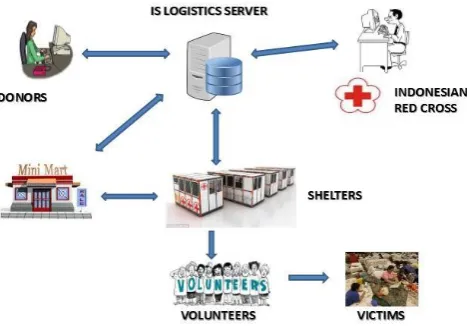
The Illustration of the development of the logistics information systems of Humanitarian Aid Natural disasters can be seen on Figure 1. A processing center database is located on the server of Logistics Information System. All data and information are centrally stored on the server. The server may belong to them. If there is no sufficient fund, the database can be hosted on a hosting service provider.

The operator may be entering the information needs for each logistics location of natural disasters and monitoring the availability of logistics at each location using a web-based application from the headquarters of Indonesian Red Cross in Surabaya. Donors can view the logistics needs necessary for any natural disasters occurr, over the web on a desktop or via a smartphone. They can donate money via bank transfer addressed to the bank account of Indonesian Red Cross. Indonesian Red Cross accumulates all contributions from donors and allocates some aids to the affected area as needed for each location. The logistics supports will be sent to the disaster areas by placing an online order to a convenience store through an integrated network of IS logistics, and the convenience store utilizes its networks to the nearest branch to the shelter at the affected areas to send the logistics support conforms to the ones ordered by the central Indonesian Red Cross. To ensure that the logistics support is in conformity with the orders booked by the IRC center, there are officers at the shelter disaster area, who have been given the task to accept the logistics. Upon checking and verifying the arriving logistics, the shelter officers will confirm via smartphone to the server, so that the central of IRC can view and verify that the logistics assistance have already been sent to the victims of the natural disasters.

Figure-1. Illustration of Humanitarian IS Logistics

Design of Process Modelling

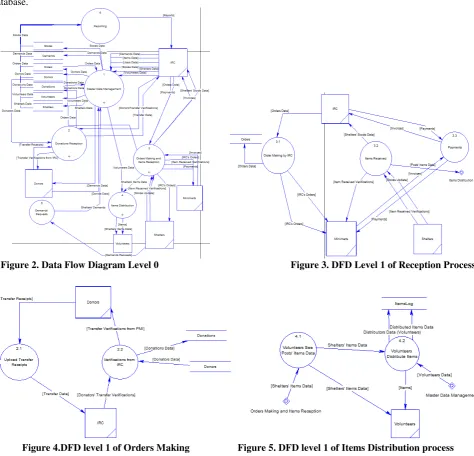
The processes as shown on Figure 2 are Master Data Management, Donations Reception, Orders Making and Items Reception, Items Distribution, Demands Request, and Reporting. The entities involved in those processes are Indonesian Red Cross (IRC), donors, shelters and convenience stores. The details of the Donation Reception process can be seen on Figure 3.

(4)

4

The Orders Making and Items Reception process consists of Order Making by IRC, Items Received, and Payments processes (as shown on Figure 4). First, IRC makes orders to a convenience stors. After the convenience store approves the orders, items will be sent to the desired locations or shelters. After the items are delivered to the destinated shelters, then the shelter officers send a verification to a convenience store and update the stocks of the items. The convenience store will get the verification and send invoices to the IRC to get the payment.

The Items Distribution process, as seen on Figure 5, consists of Volunteers See Shelters’ Items Data and Volunteers Distribute Items processes. The volunteers view the items available to be distributed from the system and then they can choose which items to be distributed. After they hand the items, the items data and the distributor data will be saved to the database.

Figure 2. Data Flow Diagram Level 0 Figure 3. DFD Level 1 of Reception Process

Figure 4.DFD level 1 of Orders Making Figure 5. DFD level 1 of Items Distribution process

RESULTS

(5)

5

Figure 6. Shelter Dashboard Figure 7. IRC Dashboard

Every shelter has a dashboard where they can view the identity of the shelter , the 3 latest orders that are destinated to the shelter, and 3 out of stock items, as seen on Figure 6. Other than the dashboard, the shelter also has volunteers, orders, current stocks, items distribution, and demands requests menu.The Indonesian Red Cross (IRC) acts as the administrator on the system. The IRC’s dashboard, as seen on Figure 7., shows the total of donations and orders in the ongoing month, the number of unfulfilled demands, the number of unpaid convenience stores’ invoices, and unverified donations. Other menus available are items, orders, donors, donations, shelters, volunteers, distribution, and reshelters. The detail of these menus can be seen in Indonesian Red Cross dashboard.

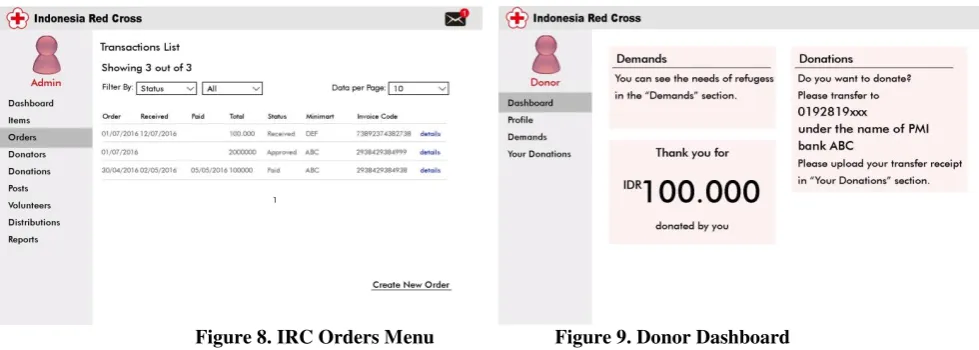
Figure 8. IRC Orders Menu Figure 9. Donor Dashboard

In the Orders Menu, IRC can view and filter the orders made. They can also view the status of each order. The “details” text will pop up a box consisting of items bought by IRC, when clicked. IRC can also make a new order by clicking the “Create New Order” as seen on Figure 8.

The donor’s dashboard, as seen on Figure 9, consists of information about the menus available and the total donations donated by the donors. There is also a profile menu where a donor can manage his/her profiles; a demand menu where a donor can view the demands of the refugees, and your donations menu where the donor can view the list of his/her donations.

(6)

6

Convenience Stores, as the IRC’s partners, is also a part of the systems. As seen on Figure 10, the Convenience Store can view new orders from IRC, items received by the destinated shelter, new payments from IRC, and the total of IRC’s orders in ongoing month. Convenience Stores also have orders, items received, and IRC’s payments menus.

Volunteer’s dashboard, as seen on Figure 11, shows his/her placement order, number of unseen coming items of his/her placement order, and a number of times he/she has distributed items. The unseen coming items can be seen in the shelter’s items menu. Volunteers can also manage their profiles in profile menu.

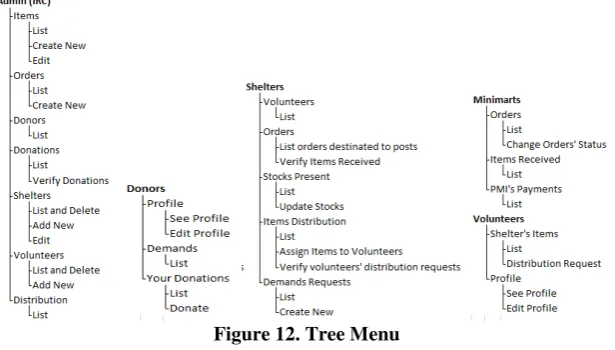
The menus available for each involved party can be viewed on Figure 12. These menus are available in the system, including the nested menus.

CONCLUSIONS

This research focuses on the design of process modeling in the form of Data Flow Diagram, Data modeling in the form of Entity Relationship Diagram and User Interface to displayhe IRC Administrator Dashboard, shelters, volunteers. This study has been completed with the design of menus, which includes the menu of Admin, donors, shelters. All designs are ready to be deployed.

Figure 12. Tree Menu

ACKNOWLEDGMENT

This research received funding from the Institute for Research and Community Service, Petra Christian University with an internal grant scheme.

REFERENCES

[1] Balcik, B and Beamon, 2008. M. Facility location in humanitarian relief. International Journal of Logistics: Research and Applications, Vol. 11, No. 2,April 2008, pp. 101–121

[2] Chang, M. S., Tseng, Y. L., & Chen, J. W., 2007. A scenario planning approach for the flood emergency logistics preparation problem under uncertainty. TransportationResearch Part E: Logistics and Transportation Review, 43(6), 737–754.

[3] Chen, A. Y., Peña-Mora, F., & Ouyang, Y., 2011. A collaborative GIS framework tosupport equipment distribution for civil engineering disaster response operations.Automation in Construction, 20(5), 637–648.

[4] GDACS., 2015. Global Disaster Alert and Coordination System. Available online at:http://www.gdacs.org/ (accessed 22 April 2015)

[5] Howden, M., 2009. How Humanitarian Logistics Information SystemsCan Improve Humanitarian Supply Chains:A View from the Field. Proceedings of the 6th International ISCRAM Conference – Gothenburg, Sweden

[6] Humanitarian OpenStreenMap, 2014. Available online at: http://hot.openstreetmap.org/projects/indonesia-0 (accessed 22April 2015).

[7] International Strategy for Disaster Reduction - ISDR, 2004. Living With Risk, A Global Review of Disaster Reduction Initiatives. United Nations.

[8] Mete, H.O and Zabinsky, ZB., 2010. Stochastic Optimization Of Medical Supply Location And Distribution In Disaster Management. International Journal of Production Economics, 2010.

[9] Ozdamar, L. and Ertem,M.A., 2015. Models, Solutions and Enabling technologies in Humanitarian Logistics. European Journal of Operational Research Vol.244. 1 July 2015.

[10]Sangiamkul, E. and Hillegersberg, J., 2011. Research Directions in Information Systems for Humanitarian Logistics. Proceedings of the 8th International ISCRAM Conference – Lisbon, Portugal.

[11]Saadatseresht, M., Mansourian, A., & Taleai, M., 2009. Evacuation planning using multiobjectiveevolutionary optimization approach. European Journal of OperationalResearch, 198(1), 305–314.

Gambar

Figure-1. Illustration of Humanitarian IS Logistics
Figure 2. Data Flow Diagram Level 0
Figure 8. IRC Orders Menu
Figure 12. Tree Menu

Referensi

Dokumen terkait

After the 2010 eruption of Merapi, some areas at Sleman Regency experienced with lahars disaster. Many agencies have their own responsibility to overcome the problems in

The final outcome of the study is to obtain an optimal interactive modeling approach to decision stakeholders involved in City Logistics system, so this model can be

This research also shows that the BMKG Twitter tsunami early warning network could effectively engage citizens and government disaster management agencies in diffusing the

Information Management Structures: represent the ways roles and their relationships are organized, and the procedures adopted to perform activities that aim at addressing information

The Use of an Information Management System to Enable Major Oil Companies to Build a Business Strategy to Allow for Differentiation within the Forecourt Convenience Store Industry

The findings aligned to research question one suggests that more research is needed in the future training of NST PSTs in the following areas: the development of an integrated TSPCK in

Materials and Methods This research was conducted to evaluate the tsunami disaster risk level for Puger Sub-District, Jember Regency by using Chief of National Disaster Management

This research develops communication between cellular and wireless balloon devices to track mobile devices such as multi-object tracking in disaster areas.. The communication method is