A STUDY OF SARCASM IN THE AMERICAN TV SERIES
THE O.C.
OF SEASON 4, EPISODE
THE COLD TURKEY
AN UNDERGRADUATE THESIS
Presented as Partial Fulfillment of the Requirements for the Degree ofSarjana Sastra
in English Letters
By
PRAYUDI WIJAYA
Student Number: 084214095
ENGLISH LETTERS STUDY PROGRAMME DEPARTMENT OF ENGLISH LETTERS
FACULTY OF LETTERS SANATA DHARMA UNIVERSITY
i
A STUDY OF SARCASM IN THE AMERICAN TV SERIES
THE O.C.
OF SEASON 4, EPISODE
THE COLD TURKEY
AN UNDERGRADUATE THESIS
Presented as Partial Fulfillment of the Requirements for the Degree ofSarjana Sastra
in English Letters
By
PRAYUDI WIJAYA
Student Number: 084214095
ENGLISH LETTERS STUDY PROGRAMME DEPARTMENT OF ENGLISH LETTERS
FACULTY OF LETTERS SANATA DHARMA UNIVERSITY
ii
ASarjana SastraUndergraduate Thesis
A STUDY OF SARCASM IN THE AMERICAN TV SERIES
THE O.C.
OF SEASON 4, EPISODE
THE COLD TURKEY
By
PRAYUDI WIJAYA
Student Number: 084214095
Approved by
Adventina Putranti, S.S., M.Hum. Advisor
August 8, 2012
Dr. Fr. B. Alip, M.Pd., M.A. Co-Advisor
iii
ASarjana SastraUndergraduate Thesis
A STUDY OF SARCASM IN THE AMERICAN TV SERIES
THE O.C.
OF SEASON 4, EPISODE
THE COLD TURKEY
By
PRAYUDI WIJAYA
Student Number: 084214095
Defended before the Board of Examiners On 31 August, 2012
and Declared Acceptable
BOARD OF EXAMINERS Name
Chairman : Dr. F.X. Siswadi, M.A.
Secretary : Dra. A.B. Sri Mulyani, M.A., Ph.D.
Member 1 : Dra. Bernardine Ria Lestari, M.S.
Member 2 : Adventina Putranti, S.S., M.Hum.
Member 3 : Dr. Fr. B. Alip, M.Pd., M.A.
Signature
________________ ________________ ________________ ________________ ________________
Yogyakarta, August 31, 2012 Faculty of Letters Sanata Dharma University
Dean
iv
LEMBAR PERNYATAAN PERSETUJUAN PUBLIKASI KARYA ILMIAH UNTUK KEPENTINGAN AKADEMIS
Yang bertanda tangan di bawah ini, saya mahasiswa Universitas Sanata Dharma:
Nama : Prayudi Wijaya
Nomor Mahasiswa : 084214095
Demi perkembangan ilmu pengetahuan, saya memberikan kepada Perpustakaan Universitas Sanata Dharma karya ilmiah yang berjudul:
A STUDY OF SARCASM IN THE AMERICAN TV SERIES
THE O.C.
OF SEASON 4, EPISODE
THE COLD TURKEY
Beserta perangkat yang diperlukan (bila ada). Dengan demikian saya memberikan kepada Perpustakaan Universitas Sanata Dharma hak untuk menyimpan, me-ngalihkan dalam bentuk media lain, mengelolanya dalam bentuk pangkalan data, mendistribusikan secara terbatas, dan mempublikasikannya di Internet atau media lain untuk kepentingan akademis tanpa perlu meminta ijin dari saya maupun memberikan royalti kepada saya selama tetap mencantumkan nama saya sebagai penulis.
Demikian pernyataan ini saya buat dengan sebenarnya.
Dibuat di Yogyakarta
Pada tanggal: 10 September 2012
Yang Menyatakan
v
STATEMENT OF ORIGINALITY
I declare that the thesis I have written does not contain any works or parts of the
works of other people, except those cited in the quotations as any academic paper
should.
Yogyakarta, September 10, 2012
vi
That which does not kill us makes us stronger
vii
FOR BOTH MY PARENTS
viii
ACKNOWLEDGEMENTS
I wish to express my gratitude to my advisor, Adventina Putranti, S.S.,
M.Hum., for her efforts and patience to read my revisions so many times and to
remove any confusion from my mind. If it were not for her, hardly could I finish
this project. I would also like to thank Dr. Francis Borgias Alip, M.Pd., M.A., my
co-advisor, for his willingness to spend his valuable time proofreading this writing
and for his help to improve it.
I would thank my parents, my brother, and my sister for their limitless
support and love. Only now am I starting to realize how little I can do without
them. I also owe big gratitude to my uncle, Yohanes Suhartono, a person because
of whom I could attend college in this department.
I wish to acknowledge Harum Ajeng Kinasih for her moral support. My
thanks to Eddy Suranta Tarigan for his insights about cognitive psychology, and
Surya Dharma Handayani for dragging me to my laptop to work on this thesis
every time I started to forget about it.
Finally, I would thank all people whose names I cannot mention one by
one, who gave contribution to the completion of this thesis, and my little puppy,
Rambo (may peace be upon him), for being there sitting next to me when I used
my night shifts.
ix
LIST OF DIAGRAMS AND TABLES...
ABSTRACTS...
ABSTRAK...
CHAPTER I: INTRODUCTION... A. Background of the Study ... B. Problem Formulation ... C. Objective of the Study ... D. Definition of Terms ...
CHAPTER II: THEORETICAL REVIEW... A. Review of Related Studies ... B. Review of Related Theories ...
1. Features of Sarcasm ... B. Approach of the Study ... C. Method of the Study ... 1. Data Collection ... 2. Data Categorization ... 3. Data Analysis ...
CHAPTER IV: ANALYSIS... A. Purposes of Sarcastic Utterances ... 1. Sarcasm as Group Affiliation ...
x
2. Sarcasm as Sophistication ... 3. Sarcasm as Evaluation ... 4. Sarcasm as a Tool for Politeness ... 5. Sarcasm as Persuasive Aspect ... 6. Sarcasm as Retractability ... B. Inference Process of Sarcastic Utterance ...
1. The Inference Process of Sarcasm as Group Affiliation ... 2. The Inference Process of Sarcasm as Sophistication ... 3. The Inference Process of Sarcasm as Evaluation ... 4. The Inference Process of Sarcasm as a Tool for Politeness 5. The Inference Process of Sarcasm as Persuasive Aspect ... 6. The Inference Process of Sarcasm as Retractability ...
CHAPTER V: CONCLUSION...
BIBLIOGRAPHY...
APPENDICES...
Appendix 1: List of the Sarcastic Situations...
xi
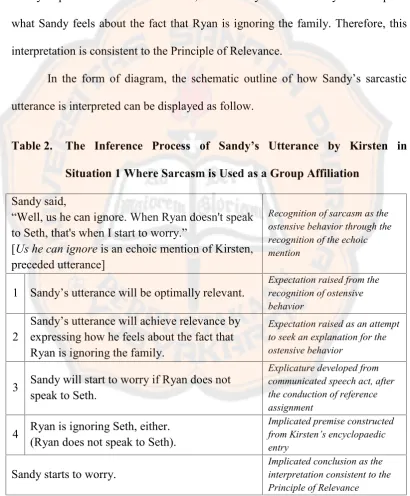
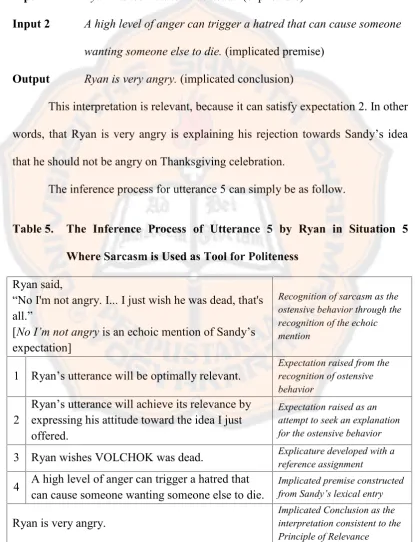
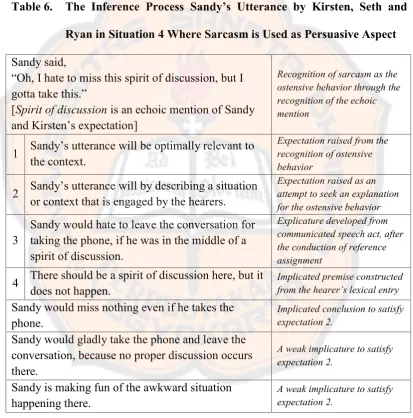
The Classification of Sarcastic Utterances in the Data Based on the Purpose ... The Inference Process of Sandy’s Utterance by Kirsten in Situation 1 Where Sarcasm is Used as a Group Affiliation ... The Inference Process of Summer’s Utterance by Mr. Roberts in Situation 6 Where Sarcasm is Used as Sophistication ... The Inference Process of Julie’s Utterance by Ryan in Situation 2 Where Sarcasm is Used as Evaluation ... The Inference Process of Utterance 5 by Ryan in Situation 5 Where Sarcasm is Used as Tool for Politeness ... The Inference Process Sandy’s Utterance by Kirsten, Seth and Ryan in Situation 4 Where Sarcasm is Used as Persuasive Aspect ... The Inference Process of Kaitlin’s Utterance by Mr. Roberts in Situation 7 Where Sarcasm is Used as Retractability ...
xii
ABSTRACT
PRAYUDI WIJAYA. A Study of Sarcasm in the American TV Series The O.C.of Season 4, EpisodeThe Cold Turkey. Yogyakarta: Department of English Letters, Faculty of Letters, Sanata Dharma University, 2012.
Sarcasm is a form of figurative language commonly used not only in many oral conversations, but in literary works and movies. Although the use of this language style is usually meant for mocking or being rude, it is also used as criticism and warm jokes amongst friends and families. The O.C., for example, is an American TV Series popular with its frequent use of sarcasm for criticizing. Considering the popularity of The O.C. as one of the most sarcastic TV series, this series is chosen as the source of data in analyzing sarcasm.
There are two questions raised in this study. First is the purpose of sarcastic utterances appearing in the data, and second is how the inference process is conducted by the hearer to interpret the sarcastic utterances.
While traditional pragmatic accounts see sarcasm as flouting against truthfulness, the Mention Theory views sarcasm as a case of echoic mention. This theory was used as basic ground to identify the sarcastic utterances from the data. InHumor and Irony in Interaction: From Mode Adoption to Failure of Detection
(2001), Salvatore Attardo lists six purposes of sarcasm, namely group affiliation, sophistication, evaluation, politeness, persuasive effect, and retractability. By elaborating the pragmatic features of sarcastic utterances, the purpose of each sarcastic utterance would be identified. Meanwhile, the inference process was conducted for each category of purposive sarcasm following the Relevance-theoretic framework, that is, by constructing the explicatures and the implicatures of the sarcastic utterance.
xiii
ABSTRAK
PRAYUDI WIJAYA. A Study of Sarcasm in the American TV Series The O.C.of Season 4, EpisodeThe Cold Turkey. Yogyakarta: Jurusan Sastra Inggris, Fakultas Sastra, Universitas Sanata Dharma, 2012.
Sarkasme adalah suatu bentuk bahasa kiasan yang banyak digunakan tidak hanya dalam percakapan lisan, namun juga dalam karya-karya sastra dan film-film. Walapun biasanya digunakan sebagai ejekan dan ungkapan kasar, gaya bahasa ini juga sering dipakai sebagai alat kritik dan gurauan dalam percakapan kasual antar teman maupun antar anggota keluarga. Sebagai contoh, The O.C.
adalah sebuah drama TV America yang terkenal dengan penggunaan sarkasme sebagai alat kritik. The O.C. sendiri diakui sebagai salah satu drama serial yang paling sarkastik. Karenanya, serial ini dipilih sebagai sumber data dalam menganalisis sarkasme.
Dua pertanyaan dimunculkan dalam penelitian ini. Yang pertama adalah tujuan digunakannya tuturan sarkastik, dan yang kedua adalah proses inferensi yang dilakukan oleh si pendengar dalam menginterpretasikan tuturan sarkastik.
Pragmatik tradisional memandang sarkasme sebagai salah satu bentuk bahasa yang melanggar maksim kebenaran dengan maksud tertentu. Akan tetapi,
Mention Theory menganggap sarkasme sebagai salah satu kasus penyebutan
echoic. Teori inilah yang digunakan sebagai dasar untuk mengidentifikasi tuturan mana saja yang sarkastik dari data yang ada.
Dalam Humor and Irony in Interaction: From Mode Adoption to Failure of Detection(2001), Salvatore Attardo menyebut ada enam tujuan sarkasme, yaitu sebagai afiliasi kelompok, pemutakhiran, evaluasi, alat kesopanan, efek persuasif, dan penarikan kembali. Tujuan ini bisa diidentifikasi dengan mengelaborasi aspek-aspek pragmatik dari tuturan-tuturan sarkastik. Sedangkan, proses inferensi tuturan sarkastik dilakukan untuk tiap kategori fungsi sarkasme menggunakan kerangka Teori Relevansi. Hal ini dilakukan dengan menyusun eksplikatur dan implikatur dari tiap-tiap tuturan sarkastik.
1
CHAPTER I INTRODUCTION
A. Background of the Study
One thing that differentiates human beings from animals is their language.
Unlike animals, which can only produce limited variations of utterances, human
beings have systematic languages whose creativity aspect allows them to produce
unlimited speeches and utterances, either meaningful or meaningless. With this
system, humans can express their minds and communicate to each other in an
effective and convenient way.
The productivity of human language also allows one to use certain styles
of language, either literal or figurative. One type of figurative language widely
used in practice is sarcasm.
Sarcasm is usually used as expressions that mean the opposite of what the
speaker intends to communicate. As an example, utterance “Ah! You ever heard
about Shakespeare? You must be a librarian,” is likely to be considered sarcastic.
Considering Shakespeare’s popularity, someone does not have to be a librarian to
ever hear about him. The sentence “You must be a librarian” in that utterance does
not mean what is literally meant. This is, presumably, an indirect way to ridicule
the hearer.
There are three common misunderstandings about sarcasm. First is that
sarcasm is a form of lying. Second, sarcasm is a rude language. And thirdly, that
The lexical definition of sarcasm, that sarcasm is an expression that means
the opposite to what is really felt by the speaker, sometimes misleads one to
conclude that sarcasm is a lie. However, there is a significant difference between
the two. In a lie, the hearer is not expected to infer anything, as the speaker wants
his lying to be accepted as it is. Sarcasm, however, is expected to be inferred, or
inferable, for the speaker in fact wants to emphasize something with his or her
sarcastic utterance.
Sarcasm in many occasions is considered as a rude expression. Although
sarcasm is commonly used to mock or to ridicule, there are some occasions in
which sarcasm can be used in positive manner. In The O.C., for example, Cohen
family frequently uses sarcastic jokes to build a warm relationship. In such a way,
this series may prove that sarcasm can also be used in positive manners.
Sarcasm is naturally related to irony, but is not the same. About this, John
Haiman (1998:20) gives two distinctive characteristics. Firstly, situation may be
ironic, but only human can be sarcastic. Secondly, irony can occur naturally, but
sarcasm only occurs with the presence of an intention. Conclusively, sarcasm
being narrower than irony, it is an irony that involves both people and intention.
Without those two aspects, an irony remains irony.
Sarcasm is used not merely in conversations, but in many types of
literature and movies.The O.C. is an example of TV series that contains sarcastic
utterances. The O.C. is an American TV series telling mainly about Cohen family.
The family consists of the father, Sandy Cohen, the mother, Kristen Cohen, the
There are many reviews that describe how this series contains so many
sarcastic conversations. Some online fora even nominated Seth Cohen, a character
in this series as one of the most sarcastic characters in TV series.Rankopedia.com
(March 18th, 2012), for example, nominates Seth Cohen as the fourth most
sarcastic character of TV series. Meanwhile, in Fanpop.com (March 18th, 2012),
Seth is in the sixth position.
The character and his family being so famous, UrbanDictionary.comeven
tributes them by emerging the wordcohenismand its definition.
“Word and/or phrase that reflects the character Seth Cohen on the show The O.C. Can be a form of sarcasm that Seth usually uses throughout the show.
....
Wow. You have mastered sarcasm. Lay of the cohenisms, will ya?”
<www.urbandictionary.com> (March 18th, 2012)
On those online fora, of course, appear some other names that are
considered more sarcastic than Seth Cohen. Take examples like Dr. Gregory
House in the TV series Dr. House or Chandler Bing in Friends, who often uses
sarcasm in their utterances. However, in The O.C., sarcasm is not Seth’s
monopoly. Instead, other characters like Sandy Cohen, Ryan Atwood, Summer
Roberts, and some other minor characters in the series also assert sarcasm in their
utterances. Considering this aspect, and considering that systematic studies of
sarcasm in this series are rarely found, the script of The O.C. Season 4 episode
The Cold Turkeyis used as the data in this study.
The script used as the data in this study was retrieved from Hypnoweb.net
on March 18th, 2012 and has been revised by the author according to the actual
a consideration that the number of the use of sarcasm in this episode is worth
attention; it is recorded more than twenty sarcastic utterances are found here.
An interesting example found in the data is when the Cohens are
celebrating Thanksgiving. The conversation occurs as follow.
SANDY: It's Thanksgiving. Now you just watch, this family's gonna come together for the holidays. That's what we Cohens do. (Ryan and Seth walk into the kitchen.) Hey.
SETH: Hey.
RYAN: Hey.
(Long, uncomfortable pause.) KRSTEN: Coffee?
RYAN: Sure.
(Long pause. They all watch the coffee filtering through the coffee maker.) SANDY: Should be ready any second. (Sandy's cellphone rings.)
Oh, I hate to miss this spirit of discussion, but I gotta take this.
Hello? (Sandy walks into an adjacent room.) Uh huh. Where are you?
To give the context, it needs to be informed that Ryan and Seth (the two
characters involved in this situation) are in a quarrel. This quarrel leads into an
uncomfortable relationship between the two. Hence, the Thanksgiving celebration
in the entire family goes awkward and silent. In the conversation above, by saying
“I hate to miss the spirit of discussion,” Sandy criticizes the lack of effort for
reconciliation.
The characteristics and the markers of sarcasm are observable in more
specific linguistic levels, both in segmental and supra-segmental aspects. In order
to produce a conclusive study, however, the characteristics of sarcasm examined
in this study are limited to the pragmatic level.
Finally, as sarcasm involves certain contexts and inference process in
understand the metamessage behind the sarcasm, cognitive pragmatics is used as
the approach in the study.
Bruno G. Bara defines cognitive pragmatics as the study that examines the
mental states of people in communication (2010: 1). As the mental states are the
primary object of cognitive science, and as the communication is an in-depth topic
of discussion in pragmatics, cognitive pragmatics can be simply defined as study
of pragmatics with methodologies adapted from cognitive science. There are
several frameworks in cognitive pragmatics, one of which is called
Relevance-theoretical framework. This framework is used in this study.
In this study,A Study of Sarcasm in The American TV Series The O.C. ofSeason 4, EpisodeThe Cold Turkey, there are two claims that will be argued: first, that sarcasm is a form of language containing echoic mentions used for
certain purposes; and second, that sarcasm can reach its relevance through a
proper inference process conducted by the hearer. To do so, the linguistic aspects
of sarcastic utterances found in the data are identified, the purpose of the sarcasm
is examined, and the inference process conducted by the hearer is elaborated.
B. Problem Formulation
To produce a conclusive research, two problems are formulated as follow:
1. What are the purposes of sarcastic utterances appearing in the American
TV SeriesThe O.C.of Season 4, EpisodeThe Cold Turkey?
2. How is the inference process of sarcastic utterances appearing in the
American TV Series The O.C. of Season 4, Episode The Cold Turkey
C. Objectives of the Study
Based on the problems formulation, there are two objectives of the
research. Firstly, this research is to identify the purposes of sarcastic utterances
appearing in the American TV Series The O.C. of Season 4, Episode The Cold
Turkey. According to Attardo (2001: 183-184), there are six possible purposes of
sarcastic utterances. By identifying the echoic mentions, the flouts against Grice
maxims, the presuppositions of the utterance; and by considering the co-text and
the context of the utterance; the purpose of the sarcasm can be revealed.
Secondly, the research aims to demonstrate the inference process of
sarcastic utterances conducted by the hearers in each scene in the American TV
SeriesThe O.C.of Season 4, EpisodeThe Cold Turkey. As the speaker intuitively
expects the hearer to infer his/her sarcastic utterances properly, the demonstration
of the inference process of the sarcastic utterance is performed from the point of
view of the hearer.
D. Definition of Terms 1. Sarcasm
According to John Haiman (1998), sarcasm contains a metamessage which
is the opposite to what the speakers literally mean in his/her utterance. It is
addressed not necessarily to the hearer whom the speaker is speaking to, but
possibly to the other person not present in the conversation, or an attitude.
sarcast’s present interlocutor, an absent third person, or a conventional attitude.” (1998: 25)
Meanwhile, in “Exploring the Process of Inference Generation in Sarcasm:
A Review of Normal and Clinical Studies”, Skye McDonald defines sarcasm as
an indirect form of speech intentionally used to produce a particular dramatic
effect on the listener (1999: 486). The term ‘indirect’ refers to the lack of direct
relationship between the form and the function of the utterance. Therefore, what it
seems in a sarcastic utterance is not necessarily what is intended by the speaker.
From those two definitions, it can be concluded in a simple definition that
sarcasm is a form of speech that establishes the opposite meaning of what the
speaker really means. This indirect expression is intentionally used instead of the
literal expressions for certain purposes.
2. Inference Process
In Longman Dictionary of Applied Linguistics, inferencing is defined as
“the process of arriving at a hypothesis, idea, or judgments on the basis of other
knowledge, ideas or judgments (that is, making inference or inferring)” (1985:
139). From the definition, it is likely that an interpretation of utterance in
communication is achieved through a process of inference.
Borrowing the definition and bringing it to the topic and the approach of
the study, then, the term “inference process” used in this study refers to the
cognitive processes of yielding and drawing an interpretation for certain sarcastic
utterance on the basis of Relevance-theoretical framework. Here, the cognitive
8
CHAPTER II
THEORETICAL REVIEW
A. Review of Related Studies
Some studies about sarcasm are necessary to mention considering their
relationship to this study. The first study is a psychological study by Skye
McDonald. In “Exploring the Process of Inference Generation in Sarcasm: A
Review of Normal and Clinical Studies”, published in Brain and Language
volume 68 (1999: 486-506), Skye evaluates two theoretical accounts of how
sarcasm is referred and understood: the traditional model and relevance theories.
From the data that was taken from both normal speakers and brain-injured
speakers, it was found that processing sarcastic comments is more effortful than
literal ones. Two factors are important in the comprehension of sarcasm: the
understanding about the facts and the speaker’s mental state.
Lori J. Ducharme, in “Sarcasm and Interactional Politics” published in
Symbolic Interaction 17.1 (1994: 51-62), describes how sarcasm may accomplish
interactional politics and examines the distinctions between sarcasm and humor.
He classifies the data containing the record of 80 sarcastic transactions into five
forms: social control, declaration of allegiance, establishing social solidarity and
social distance, venting frustration, and humorous aggression. He then suggests
three ‘relevant categories of communication which vary in their capacity to effect
social control: nonderisive humor, expressive sarcasm, and politically motivated
sarcasm’ (p.61). Finally, he proposes the model of continuum to describe the
The cognitive process taken by a person to whom sarcastic utterances are
spoken was analyzed by Raymond W. Gibbs. As concluded in his article “On the
Psycholinguistics of Sarcasm” published in Journal of Experimental Psychology:
Generalvolume 115 (1986: 3-15), the study found that the use of sarcasm is much
better remembered than the use of literal utterances to convey certain message.
Another study is about the relationship between vocal cues and emotional
level of a speaker when producing sarcastic utterance by Patricia Rockwell. In
“Lower, Slower, Louder: Vocal Cues of Sarcasm” published in Journal of
Psycholinguistic Research Vol. 29.5 (2000: 483-495), Patricia describes that one
tends to use sarcasm when one is in a moderate level of certain emotion, for
example, dislike. When one is in a higher level of certain emotion, one tends to
use another kind of utterance, like verbal aggression or insult. This study also
‘shows that listeners can decode posed sarcasm from vocal cues alone’ (p. 492),
which are lower, slower, and louder than non-sarcastic utterance.
This research, A Study of Sarcasm in the American TV SeriesThe O.C. of Season 4, Episode The Cold Turkey, positions itself as an effort to describe the pragmatic aspects of sarcastic utterances in order to reveal the purpose of the
sarcasm, and to demonstrate the inference process conducted by the hearer in
order to interpret the sarcasm, using the script of American TV Series The O.C.
Season 4 Episode The Cold Turkeyas the source of data. The findings of some of
the related studies above are used as a theoretical basis for data analysis in this
B. Review of Related Theories
Some theories are used as the theoretical foundation of this study. The
theories used are some theories about the features of sarcasm, the mention theories
of sarcasm (Sperber and Wilson, 1981), the purposes of sarcasm (Attardo, 2001),
some theories of pragmatics (Yule, 1996), and the relevance theoretical
framework (Sperber and Wilson, 1995).
1. Features of Sarcasm
a. Repetition of Interjection
InTalk is Cheap, John Haiman states that repetitions of interjection signify
irony and/or sarcasm. However, it is not always a kind of full repetition in which a
phrase or word is repeated completely. It may only be a form of repetition in
which it is the meaning that is repeated.
It is therefore remarkable that repetition of signs of assents, like “sure,” “right,” “of course,“ or “yeah,” signals not heartiness but irony. “Yeah, right” in American English has by now achieved a quasi-institutional status as sarcastive marker because it is a kind of repetitive.
(1998: 57)
b. Sarcasm and the Maxims of Grice Cooperative Principle
In Contemporary Linguistics: an Introduction, it is mentioned that to
achieve irony or sarcasm, “it is sometimes possible to abandon the Maxim of
Quality and say something that one knows to be false” (O’Grady et al, 2010: 237).
Accordingly, the violation or the flouting against the maxims is an alert or
warning about the sarcasm, of which the speaker’s implied message should be
Furthermore, Laura Alba Juez in Verbal Irony and the Maxims of Grice
Cooperative Principle shows some evidence that ‘ironical utterance can not only
flout the Quality Maxim but also the other three Gricean maxims’ (1995: 28).
About the Cooperative Principles, in Logic and Conversationpublished in
Syntax and Semantics 3: Speech art (1975: 41-58), Grice classified the
Cooperative Principles into four categories, each of which contains of maxims
proposed as guidelines to reach conversational satisfaction.
1. Category of Quantity
… The category QUANTITY relates to the quantity of information to be provided, and under it fall the following maxims:
1. Make your contribution as informative as it required (for the current purposes of the exchange).
2. Do not make your contribution more informative than is required. (1973: 46) 2. Category of Quality
Under the category of QUALITY fall a supermaxim – ‘Try to make your contribution one that is true’ – and two more specific maxims:
1. Do not say what you believe to be false.
2. Do not say that for which you lack adequate evidence.
(1973: 46)
3. Category of Relation
Under the category of RELATION I place a single maxim, namely, ‘Be relevant.’ Though the maxim itself is terse, its formulation conceals a number of problems that exercise me a good deal: questions about what different kinds and focuses of relevance there may be, how these shift in the course of a talk exchange, how to allow for the fact that subjects of conversation are legitimately changed, and so on.
(1973: 46)
4. Category of Manner
Finally, under the category of MANNER, which I understand as relating not (like the previous categories) what is said but, rather, to HOW what is said is to be said, I include the supermaxim – ‘Be perspicuous’ – and various maxims such as:
1. Avoid obscurity of expression. 2. Avoid ambiguity.
3. Be brief (avoid unnecessary prolixity). 4. Be orderly.
c. Popular Sarcastic Phrases
In Talk is Cheap (1998), John Haiman lists some phrases that are
popularly used sarcastically in conversations. Two of them that appear on the data
in this research are “Tell me...,” which he calls as heavy sarcasm; and “Like….”
i. Heavy Sarcasm
According to Haiman, there are some English expressions that fall into the
category of Heavy Sarcasm. These expressions are considered enantiosemantic
because they are used sarcastically routinely. Enantiosemantic is a technical term
to describe a quality of an expression to create the opposite meaning of what it
literally means by itself at the same time.
I use the phrase "heavy sarcasm" to denote a combination of heavy exaggerated stress and relatively monotonous intonation. It tends to occur most frequently in English with expressions which are uttered sarcastically so routinely that they have become enantiosemantic (like all of the examples below except the very last):
a) BULLY for YOU! b) TELL me about it!
c) THANKS a WHOLE LOT! …
k) ConGRAtulAtions!
(1998: 39)
ii. “Like…”
Used in the beginning of an expression, conjunction “like” can also mark
sarcasm. About this, Haiman writes:
The whole following utterance is in the scope of the marker "like." The hearer is warned that what is about to follow is what the speaker may be expected to believe but does not. (A predictable synonym is "as if.")
a) Like I care. (=I don’t care.)
2. Mention Theory
In “Irony and the Use-Mention Distinction” published in Radical
Pragmatics (1981: 295-318), Dan Sperber and Deirdre Wilson provide some
evidences showing that traditional accounts of irony, that see irony and sarcasm as
an act of violating truthfulness, fails to explain many cases of irony and sarcasm.
Hence, they developed a new theoretical account viewing sarcasm and irony as
cases of echoic mention. This theory is known as the Mention Theory.
According to the Mention Theory, “sarcasm includes mention rather than
use” (Haiman, 1998: 25). This idea basically argues that an utterance is sarcastic if
it contains an echoic of the preceding proposition(s). Hence, for an utterance to be
able to be recognized as sarcasm, a realization of it being echoic is necessary.
However, the echoic mention “may not attributable to any specific person,
but merely to a type of person, or people in general; it may be merely a cultural
aspiration or norm” (Wilson and Sperber, 1992: 60). This is what makes not all
echoic mention easy to recognize.
3. Purposes of Sarcasm
Sarcastic utterances serve certain purposes when they are used in
conversations. Salvatore Attardo in his article Humor and Irony in Interaction:
From Mode Adoption to Failure of Detection(2001) lists six purposes of sarcasm.
a. Group Affiliation
Sarcasm can affiliate a group. In this case, sarcasm works in two ways.
the group has. Secondly, it expresses an understatement about outsider of the
group that does not meet the standards of the group (2001: 183).
b. Sophistication
Sarcasm shows the speaker’s ability to play with language. Sarcasm as
sophistication usually means as a humor, however, in some cases, it expresses the
speaker’s level of emotion. By playing language, sarcasm shows how the speaker
can take control over his emotion (2001: 183).
c. Evaluation
Sarcasm can mute negative effects of the criticism that it may emerges. At
the same time, sarcasm can mute the positive effects of the praise that it may
convey. The way sarcasm mutes those two aspects simultaneously becomes the
point of using sarcasm (Attardo, 2001: 183).
d. Politeness
Sarcasm can be used as a “tool for politeness.” Although sarcasm seems
aggressive, it is admitted that sarcasm is less damaging the hearer’s face than
overt aggression (2001: 184).
e. Persuasive Aspect
Sarcasm can be a powerful rhetorical tool to be used persuasively. This is
achieved in three ways. First, sarcasm provides itself the evident for the utterance
to be accepted as a truth. Second, sarcasm is easier to memorize than literal
f. Retractability
Sarcasm lets someone “take a noncommittal attitude towards what he/she
is saying” (2001: 184). In other words, by stating something and expressing its
opposite at the same time, the speaker can avoid any responsibility for the
falseness that s/he says.
4. Pragmatics
According to George Yule, one of the areas that pragmatics is concerned
with is the contextual meaning (1996: 3). To dig the contextual meaning of a
linguistic expression, some pragmatic tools are needed, namely context, co-text,
and presupposition.
Co-text is any linguistic material that accompanies the referent expression.
For example, if in a sentence “Chelsea plays in Champion Cup 2012,” “Chelsea”
is the referring expression, then the co-text is “plays in Champion Cup 2012.”
This co-text will limit the range of possible interpretation for the phrase
“Chelsea”, making it easier to result a proper interpretation.
Co-text is part of the broader environment where the referring expression
is used. This environment is called context, which is “perhaps more easily
recognized as having powerful impact on how referring expressions are to be
interpreted” (1996: 21).
In conversation, before producing an utterance, a speaker should have
some assumptions about what s/he is going to say. These assumptions are called
5. Cognitive Pragmatics
In Concise Encyclopedia of Pragmatics, it is stated that ‘cognitive
pragmatics is concerned with the mental processes involved in intentional
communication.’ Hence, in order to comprehend a linguistic speech act,
examining cognitive processes of the communicators is necessary. (Mey, 2009:71)
As a field of study, cognitive pragmatics covers various frameworks, such
as Relevance Theory, the Cognitive Pragmatics Theory, the Graded Salience
Hypothesis, and the Accessibility Theory. However, considering that ‘Relevance
theory is usually identified as the principal theoretical framework in the area of
cognitive pragmatics,’ (Mey, 2009: 71) this framework is chosen in this study.
6. Relevance Theory
Relevance Theory is a theoretical account based on Grice’s idea that
communication is inferential, not coded, and the success of communication lies on
the recognition of the communicator’s intention.
In inferential model of communication, a communication is considered
succeed not only when the speaker succeeds to inform something, but when s/he
succeeds to communicate his intention to inform it. Here, there are two layers of
information, first is informative intention, or an intention to inform something,
and second is communicative intention, or an intention to inform the informative
intention. (Sperber and Wilson, 1995:29)
One of Grice’s intuitions in his inferential model of communication is that
“an utterance automatically raises expectations which guide the hearer toward the
Cooperative Principles. One of these maxims is relevance, that is, what is
highlighted in the Relevance Theory (Sperber and Wilson, 2006: 607).
a. The Concept Manifestness and Cognitive Environment
The concept of manifestness is important in cognitive pragmatics field. In
this field, communication is seen not in terms of conveying information to others,
but to make manifest some fact in others’ cognitive environment. According to
Sperber and Wilson, “to be manifest is to be perceptible or inferable.” (Sperber
and Wilson, 1995: 39)
When a set of facts or assumptions are manifest to someone, they will be
mentally representable to him/her as acceptable as truth or probably truth. Then,
these manifest facts or assumptions become his/her cognitive environment.
Communication in Relevance-theoretical framework is seen as an act of
making manifest an intention to inform an assumption. So, here, there are two
layers of communications.
b. The Definition of Relevance
‘An assumption is relevant in a context if and only if it has some
contextual effect in that context.’ (Sperber and Wilson, 1995:122) However,
relevance is a matter of degree, meaning to say that an assumption can be either
more or less relevant than another assumption in a context.
Alan D. Cruse in Meaning in Language elaborates two factors governing
the degree of relevance, which are, contextual effect and processing effort (2000:
i. Contextual Effect
The relevance of a certain fact will be greater if it gives greater contextual
effects. There are some types of contextual effects, for example, the addition of
new information, the strengthening of old information, the weakening of old
information and the cancellation of old information. Therefore, the new
information that is considered worth processing is ones that can join the old
information to allow inferences.
ii. Processing Effort
The relevance of a certain fact will be greater if it forces less effort for its
recovery. More salient and more direct a fact is to infer, the less the process. In
other words, an easy-to-process fact or stimulus is considered more relevant to
certain context.
c. The Principle of Relevance
In Relevance: Communication and Cognition, Sperber and Wilson make
two fundamental claims about communication. One of them is that “every act of
ostensive communication communicates a presumption of its own optimal
relevance.” This claim is known as the Principle of Relevance. (1995:260)
In other words, by producing an utterance, the speaker guarantees two
things. First, the utterance is worth the hearer’s time and effort to process. And
second, the utterance is the most relevant stimulus that the hearer intended to
make manifest in the hearer’s cognitive environment. Here, thus, communication
7. Inference Process
a. Relevance-Theoretic Comprehension Procedure
Under the Relevance-theoretical framework, an interpretation should be
consistent to the Principle of Relevance, i.e., it should give a great contextual
effect with less processing effort. To achieve this, Sperber and Wilson formulate
the Relevance-Theoretic Comprehension Procedure.
Relevance-theoretic comprehension procedure:
a. Follow a path of least effort in computing cognitive effects. Test interpretive hypotheses (disambiguations, reference resollutions, implications, etc.) in order of accessibility.
b. Stop when your expectations of relevance are satisfied (or abandoned)
(Sperber and Wilson, 2004: 613)
b. Implicature and Explicature
The concepts of implicature and explicature play an important role in the
inferential process under the relevance theoretical framework. While the term
implicature has beforehand introduced by Grice (1975: 42-44), the term
explicature was proposed by Sperber and Wilson.
On the analogy of ‘implicature’, we will call an explicitly communicated assumption as explicature. Any assumption communicated, but not explicitly so, is implicitly communicated: it is an implicature. By this definition, ostensive stimuli which do not encode logical forms will, of course, only have implicatures.
(Sperber and Wilson, 1995: 182)
i. Implicature
There are two kinds of implicatures, namely implicated premises and
implicated conclusion. Implicated premises are part of the context, and they
from memory”. Meanwhile, “implicated conclusions are deduced from the
explicatures and the context.” (Sperber and Wilson, 1995: 195)
The construction of implicated premises requires some information or
assumptions retrieved from the memory, outside ones that are offered by the
utterance are needed. There are three entries of how for the information are stored
from the memory, namely logical entry, encyclopaedic entry, and lexical entry.
The logical entry for a concept consists of a set of deductive rules which apply to logical forms of which that concept is a constituent. The
encyclopaedic entry contains information about the extension and/or denotation of the concept; that is, about the objects, events and/or properties which instantiate it. The lexical entry contains information about natural-language counterpart of the concept: the word or phrase of natural language which expresses it.
(Sperber and Wilson, 1995: 86)
As assumptions, implicatures have their degree of strength. A strong
implicature is one which ‘the hearer is strongly encouraged but not actually forced
to supply’ (Sperber and Wilson, 1995: 199). In other words, when the hearer is
offered a limited array of possible assumptions that s/he can choose to provide,
then the implicatures that s/he will supply is considered strong.
A relevant interpretation does not always come from a strong implicature.
Relevance can also be achieved through a wide array of weak implicatures. This
condition is what Sperber and Wilson call as the poetic effect (1995: 222).
ii. Explicature
As stated beforehand, explicature is any information that is explicitly
communicated by a communicator through his stimulus. About the aspects of
process: disambiguation, reference assignment, enrichment, and higher-order
explicatures (2000: 370-373).
c. Deductive Rules in Logical Derivation
Deductive rules are rules that “formally describe a set of input and output
assumptions” in an inference process (Sperber and Wilson, 1995: 86). There are
valid arguments rules, or syllogism, in logical derivation involving two inputs of
premises that can result an output of interpretation. Some of the deductive rules
are as follow:
i. ModusPonendo Ponens
Input: (i) P
(ii) (if P then Q) Output: Q
(Sperber and Wilson, 1995: 87)
ii. ModusTollendo Ponens
Input: (i) (P or Q) (ii) not P Output: Q
(Sperber and Wilson, 1995: 87)
iii. And-Introduction
Input: (i) P (ii) Q Output: (P and Q)
(Sperber and Wilson, 1995: 96)
C. Theoretical Framework
The mention theory is used as the theoretical background in the data
collection. Based on this theory, a sarcastic remark contains an echoic mention.
By recognizing the echoic mention in each utterance, the sarcastic utterances to be
After the sarcastic utterances are listed, they are analyzed in terms of their
pragmatic features, including their presuppositions, their flouting of Grice
cooperative principle maxims, their presuppositions, their contexts and their
co-texts. By recovering the pragmatics, the purposes of sarcasm as listed by Attardo
(2001) can be revealed.
Meanwhile, The Relevance Theoretic framework is used as a basic
theoretical account to examine the inference process of the sarcasm produced by
the speakers. The inference processes of sarcastic utterances are demonstrated by
revealing their implicatures and the explicatures of the utterances, and by proving
23
CHAPTER III METHODOLOGY
A. Object of the Study
The O.C. is an American teen drama TV Series created by Josh Schwartz.
Originally airing on the Fox Television Network from August 2003 to February
2007, this series consisted of 92 episodes divided into four seasons. On its first
season, the show attracted more than 9 million viewers. On the polling conducted
by IMBd.com, a site of internet movie database, this series gained the rate of 7.5
out of 10 stars.
The story is set in Newport Beach, a city in Orange County, California. It
is about the Cohens, a fictional high-class family. Sandy Cohen, Kirsten Cohen,
and their son Seth Cohen seem to succeed in establishing their image as a happy
family. However, the arrival of Ryan Atwood as a new member of the family
pulls a trigger of all the conflicts. Ryan is a troubled youth from Chino, a slum
area infamous for crime. He becomes a Cohen after Sandy, as a public defender,
helps him for pro bono with a car-theft case. Sandy then takes Ryan under his
custody.
The season 4 is started with how Ryan’s anger makes the Thanksgiving
Day inconvenient. Ryan is vengeful and angry about what happened to his
girlfriend, Marissa Cooper. She is died in a crash accident after Volchok, a
drunken guy having a bad history with Ryan and Marissa, smashes her car. His
hatred to Volchok becomes worse after hearing the news that Volchok comes
However, Sandy, as a father and a lawyer, tries to prevent Ryan from doing bad
and regretful things.
In the previous episode, it is told that Ryan secretly goes to Ensenada after
Julie tells her that Volchok was there. Seth finds out Ryan’s plan, and, worrying
that Ryan will do bad things, forces Ryan to bring him too. However, Seth calls
their parents and helps Volchok escape. Ryan, felt being betrayed by his best
friend, becomes angry and since then the family is not harmonic.
In the Cold Turkey, it is Thanksgiving and Sandy and Kirsten wants to
make their family come together after what happens in Ensenada. Unexpectedly,
Volchok calls Sandy. He has come to Newport to surrender to the authority and he
asks for Sandy’s help to assist him with the legal things. Sandy agrees and hides
him from Ryan. However, Ryan finds out and becomes mad. He looks for
Volchok everywhere in this town but cannot find him. In the end, Sandy decides
to trust Ryan and tells him of Volchok’s location. The trust is satisfied, as Ryan
succeeds to control his emotion when he meets Volchok. Sandy is proud of him,
and the family can celebrate Thanksgiving happily.
There are many critics on the internet saying that this series is full of
sarcasm, especially on the way the Cohens communicate each other. The episode
The Cold Turkey of season four was picked purposively considering the number
of sarcastic utterances found. The script of this episode, that was retrieved from
Hypnoweb.net and has been revised based on the utterances on the actual movie,
B. Approach of the Study
The approach used in this study is the cognitive pragmatic approach,
specifically of the relevance theoretic framework. This framework is chosen on
account of the need to examine the mental states of people engaged in sarcastic
transactions and the inference process of the sarcasm.
Under the relevance theoretic framework, the presumption of optimal
relevance was used as the main assumption for the inference process. This
assumption was, together with the situational context of the story, then being
contextualized by the new information retrieved from the explicatures and their
extensions, i.e. all the information entries contained by the logical form of the
sarcastic utterances. The process of inference was then demostrated by examining
the contextual effects emerged from the contextualization but still keeping
following the Relevance-theoretic comprehension procedure.
C. Method of the Study
The study is a library research. It was conducted by analyzing the data
from the script. It did not involve any data from respondent, nor did it take any
field research.
Besides the data, an important sources is used in the study, that is, Sperber
and Wilson’s Relevance: Communication and Cognition. This book is used as a
theoretical base to examine the inference process of the sarcastic utterances.
As a pragmatic study, the data is analyzed by identifying the pragmatic
aspects of each utterance. This analysis covers the assignment of references for
the utterance is uttered, the hypothesizing of the presuppositions and the other
assumptions used in the utterances, the use of co-text to recover the meaning, and
the use of others pragmatic accounts like the maxims of Grice’s cooperative
principles.
Finally, to demonstrate the process of inference conducted by the hearer of
the utterances, the analysis focuses on how the sarcasm is recognized by the
hearer, what is the new information provided by the speaker through his/her
utterance, what is the given or initial information owned by the hearer related to
the context and how it is retrieved from the hearer’s memory, and how is the new
and the given information join together to yield an interpretation.
In general, there were three main steps conducted in the study.
1. Data Collection
The data collection was started with identification. All utterances from the
script ofThe O.C.season 4 episodeThe Cold Turkeywere identified by analyzing
the echoic mention in each utterance, in order to list the sarcastic utterances
treated as the data. This step was the first step necessarily conducted in this study.
2. Data Categorization
After the sarcastic utterances were list, they were then analyzed in terms of
pragmatic features in order to reveal the purpose of sarcasm. Then, the utterances
are classified based on their purpose. This step would answer the first problem
3. Data Analysis
Each category of the purpose of sarcasm revealed from the latest step was
then elaborated in term of cognitive process of inference, in order to find out how
the sarcastic remarks are understood in each category. As already mentioned
earlier, the elaboration of the inference process involved the following sub-tasks:
- The recognition of the sarcastic utterance by the hearer.
- The construction of the new information from the utterance by the hearer.
- The retrieval of the given information from the hearer’s memory that is
needed to result an interpretation.
Diagram 1. Method of the Study
28
CHAPTER IV ANALYSIS
A. Purposes of Sarcastic Utterances
There are twenty-three sarcastic utterances appearing in the script of The
O.C. Season 4 Episode The Cold Turkey (See the Appendices). The sarcastic
utterances are recognized from the appearance of the echoic mention. As an
example, the distinction between sarcasm and other forms of figurative language
will be described in the following situations.
Situation A
(A1) KIRSTEN:It's like he's turning into an island. (A2) SANDY:Yeah. Right in the path of Hurricane Julie.
Situation B
(B1) KIRSTEN:He hasn't spoken to us in days.
(B2) SANDY: Well us he can ignore. When Ryan doesn't speak to Seth, that's when I start to worry.
In situation A, the referent of “he” in utterance (A1) contextually refers to
Ryan, i.e. Sandy and Kirsten’s foster son. Julie in utterance (A2) refers to a
character in the story. However, Sandy uses her name as the name of a hurricane,
which lexically has a quality of causing a great damage. By doing this, he implies
that Ryan is being involved with a trouble that Julie has caused. This is an
example of metaphor, comparing the character Julie to the lexical word
“hurricane”. However, what Sandy says is just what he means, even though he
says it metaphorically, intentionally. Thus, utterance (A2) is not a form of
In situation B, the “he” still refers to Ryan. Sandy, however, does not use
any metaphor in his utterance (B2). Instead, Sandy’s echoic mention about the
fact that Ryan is ignoring them makes the utterance sarcastic.
In terms of traditional theoretical account of sarcasm, what Sandy says
does not really represent what he really means. Intuitively, Sandy does not expect
his foster son to ignore both Sandy and Kirsten. This makes the utterance flout the
maxims of quality, and hence makes the utterance (B2) sarcastic.
Each sarcastic utterance is suspected and identified by adapting the same
method as above. The sarcastic utterances are uttered purposively by the speakers.
According to Salvatore Attardo (2001), there are six purposes of sarcasm, namely
group affiliation, sophistication, evaluation, politeness, persuasive aspect, and
retractability. The pragmatic features of the sarcastic utterances, then, are explored
to identify the purposes.
1. Sarcasm as a Group Affiliation
There are three utterances that contain sarcasm utterance serving the
purpose as group affiliation. Those utterances are displayed as follow:
Utterance 1: Well, us he can ignore. When Ryan doesn’t speak to Seth, that’s
when I start to worry.
Utterance 3: Well, when you send our kids on a murder mission, you get
knocked off the guest list. House rules.
As the sarcastic utterances are related to their contexts, the situations in
which the utterances elaborations are produced are necessary to be involved in the
elaborations of the utterances.
The following situation is the situation in which utterance 1 occurs.
Situation 1
KISTEN:He hasn't spoken to us in days.
SANDY:Well, us he can ignore. When Ryan doesn't speak to Seth, that's when I start to worry.
As having been described earlier, utterance 1 in situation 1 is sarcastic
because it mentions the fact happening at the time that the utterance is produced.
That Ryan’s ignoring them is the fact that is not just informed by the speaker, but
intentionally mentioned.
Intuitively, Sandy as the speaker does not want Ryan (the referent of the
pronoun “he” which happens to be the foster son of the speaker) to ignore them.
This utterance neither reflects what the speaker believes to appropriately happen,
nor does it provide sufficient evidences about what the speaker should expect. In
this case, as the leader of the family, Sandy expects his family to have a good
relationship between each other. Although it seems to mention a false fact,
Sandy’s utterance is not to be interpreted as it should be. This utterance, hence,
flouts the maxim of quality.
The presupposition “He ignores us” is the main assumption accounting for
the production of utterance 1. This assumption is revealed from the structure of
the sentence Sandy uses in his utterance. Thus this is a type of structural
mentions it to mark that he has shared a mutual cognitive environment with the
hearer.
Sandy highlights the fact that Ryan is ignoring them to imply that it does
not meet the moral values he believes about how a family should be. In other
words, he believes that this fact violates what is needed to have a good solidarity
between members of a family. From this point of view, the utterance serves the
purpose of group affiliation. Besides, as the sarcasm is addressed to a member of
the family, it is an inclusive a group affiliation highlighting a bond between
members of certain group.
Another example of elaboration is given for utterance 3, which occurs in
the following situation.
Situation 3
KIRSTEN:It's never been this bad. We're excluding her from Thanksgiving.
SANDY: Well, when you send our kids on a murder mission, you get knocked off the guest list. House rules.
What being mentioned in this utterance is the thought that someone has
sent the speaker’s kids on a murder mission. However, Sandy uses the pronoun
“you” to refer to the “someone”. The pronoun “you” literally refers to Kirsten.
However, it is not actually addressed to her, i.e. Sandy is not describing what
Kirsten has done to their kids. This is revealed from the co-text, especially from
Kirsten’s preceding utterances, that the Cohens are excluding “her” from
Thanksgiving. This limits the interpretation for the referent of “you” in Sandy’s
The context of the story tells more about who Sandy and Kirsten are
talking about. It is Julie that happens to be excluded from Cohens’ Thanksgiving
dinner, for the reason that she has encouraged Ryan to take revenge against
Volchok for Marissa’s death. This is evidently what Sandy means by “murder
mission”. This indirect addressing of the pronoun establishes a metaphor
comparing Kirsten and Julie.
Moreover, “sending our kids on a murder mission” is clearly not
something that he believes as true and he has enough evidence to make it
acceptable as a truth. Thus, he flouts the maxim of quality. The use of an
adverbial clause “when” creates a sense of conditional sentence. It is used to make
a statement that “sending our kids to a murder mission is an act worth
punishment.”
The following presumptions, then, should account for utterance 3.
- Someone sends our kids on a murder mission.
- We have house rules, one of which is getting one knocked off the guest list
when s/he sends our kids on a murder mission.
Although the utterance is uttered to Kirsten, a member of the family, the
second presupposition of the utterance as shown above highlights the boundary
between the family and the outsider, which, in this case, is Julie. It widens the
distance between the quality of the family and what Julie has done. So, this
sarcastic utterance is used as an exclusive group-affiliation.
From those examples, it is shown that the group affiliation can work in
certain group to a member of the same group. Secondly, it is exclusive if it is
addressed by a member of certain group to someone outside the group.
2. Sarcasm as Sophistication
Evidently, there are six sarcastic utterances that serve the purpose of
sophistication in the data. Those utterances are listed as follow:
Utterance 6: Exactly. Millions of turkeys being senselessly slaughtered so us
Americans can get even fatter?
Utterance 8: Wow, this trip to the grocery store has been a real success. I'm
sure silent cart pushing is exactly what my mom envisioned when
she sent us here.
Utterance 9: It's more than a garnish Ryan. It's a good omen.
Utterance10: Hello Julie. I wanted to thank you for that travel tip. Ensenada
turned out to be the perfect vacation spot for the Cohens. We may
get a timeshare.
Utterance 13: See there's magic everywhere.
Utterance 22: I'm not doing you any favors. You have to live with what you did.
It's over.
As an example of elaboration, situation 6, in which utterance 6 occurs, is
displayed as follow.
Situation 6
MR ROBERTS:No, I want you here. It's Thanksgiving.
Summer, as the speaker, should have some assumptions before producing
her utterance. The following assumptions are three main presuppositions
accounting for Summer’s utterance.
- It is Thanksgiving.
- Millions of turkeys are senselessly slaughtered every Thanksgiving.
- Americans get fatter every Thanksgiving.
The second presupposition as shown above is seemingly unnecessary to be
asserted in response to Mr. Roberts’ utterance. Some simple response like “I
know” or “Yes” might have been sufficient if the speaker wanted to agree
something asserted in the preceded utterance. However, this information is
mentioned intentionally to emerge a sense of sarcasm.
In Grice cooperative principles’ point of view, two maxims are flouted in
this utterance. First, it violates the maxim of quantity, in which the speaker
provides too much information about Thanksgiving. Second, it also violates the
maxim of manner, because there is an ambiguity in the response “exactly”, either
it is to respond “I want you here” or to respond “it’s Thanksgiving”. The flouting
makes the utterance interpretable towards the hearer’s invitation.
Structurally speaking, there is a misuse of pronoun in the utterance.
Instead of objective pronoun “us”, the pronoun “we” should be used to make the
sentence well-structured. This misuse establishes a highlight that should be taken
a closer look by the hearer.
Summer, as the speaker, inserts a fact that she knows about the fact that
turkeys. At a glance, the fact is not directly related to the topic of conversation.
However, by mentioning this fact in a language play, Summer succeeds to express
her feeling about Thanksgiving in a humorous way. It allows Mr. Roberts to
acknowledge Summer’s to take control over her emotion, i.e., creating a sense of
humor in a warm conversation instead of letting out how she dislikes what usually
happens on Thanksgiving.
Another elaboration is given for utterance 10, which occurs in the
following situation.
Situation 10:
(Ryan and Seth are pushing a cart around the grocery store.) SETH:So, what's next?
RYAN:Parsley.
SETH:Wow, this trip to the grocery store has been a real success. I'm sure silent cart pushing is exactly what my mom envisioned when she sent us here.
RYAN: Well what do you expect? You think we can get over everything just because we're buying parsley?
SETH:It's more than a garnish Ryan. It's a good omen.
This situation occurs at a grocery store after Kirsten sends Seth and Ryan
to go there shopping together. Kirsten hopes that by making them hang out
together, they will have a quality time to talk about whatever problems they have.
The word “garnish” in Seth’s utterance is used to describe the “silent cart
pushing” and the phrases “good omen” is used to refer to the signs that what
Kirsten’s expected will soon come true. However, as shown in the context, the
grocery trip went silently, and it is logically best phrased as a bad omen. The use
of the phrase “a good omen”, then, is to imply that what Kirsten expects does not
happen. This flouts the maxims of quality. Meanwhile, the indirectly-mentioning
The following assumptions are the presuppositions accounting for this
sarcastic utterance:
- The grocery trip goes silently.
- Mom may think this idea of grocery trip is a good idea, but the silent cart
pushing is a bad omen that this idea will work out.
In this utterance Seth shows off his ability to play with his language, by
using words like “garnish” and “omen”, to describe the situation sarcastically.
In general, sarcasm used as sophistication simultaneously communicates
about three major things to the hearer. Firstly, it communicates that the speaker
has some abilities to play with his/her language. Secondly, it communicates that
the speaker has some knowledge, and that s/he is able to use that knowledge in his
language play. And thirdly, it communicates that the speaker is capable to control
his emotion by using some language plays to express his feelings instead of
expressing of using some aggressive manner.
3. Sarcasm as Evaluation
There are four sarcastic utterances in the data that serve the purpose of
evaluation.
Utterance 2: Tell me about it. I've been banned from your house. Your parents
have been mad at me before.
Utterance 12: Oh me too, you have no idea.
Utterance 16: Good advice…