THE PROFILE OF STUDENTS MASTERY OF QUESTION TAGS
THE CASE OF THE THIRD YEAR STUDENTS OF
SLTP INSTITUT INDONESIA SEMARANG
THE ACADEMIC YEAR OF 2005/2006
FINAL PROJECT
Submitted in partial fulfillment of the requirements for the Degree of Sarjana Pendidikan in English
by: Retno Indriyati
2201902004
ENGLISH DEPARTMENT
FACULTY OF LANGUAGES AND ARTS
STATE UNIVERSITY OF SEMARANG
ii
APPROVAL
This final project was approved by the Board of Examiners of the English Department of the Faculty of Languages and Arts Semarang State University on August 30, 2007.
Board of Examiners: 1. Chairperson,
Prof. Dr. Rustono, M.Hum
NIP. 131281222 ________________
2. Secretary:
Drs. A. Sofwan, Ph. D.
NIP. 131813664 ________________
3. First Examiner, Drs. Warsono, M.A
NIP. 130350484 ________________
4. Second Advisor as Second Examiner, Dr. Dwi Anggani L B M. Pd
NIP. 131813665 ________________
5. First Advisor as Third Examiner, Drs. H. Suprapto, M.Hum
NIP. 131125925 ________________
Approve by
Dean of Faculty of Language and Arts,
iii
PERNYATAAN
Dengan ini saya,
Nama : Retno Indriyati
NIM : 2201902004
Fakultas : Bahasa dan Seni
Jurusan : Pendidikan Bahasa Inggris
Menyatakan dengan sesungguh-sungguhnya bahwa Skripsi yang berjudul:
The Profile of Students Mastery of Question Tags The Case of The Third Year Students of SLTP Institut Indonesia Semarang The Academic Year of 2005-2006.
Yang saya tulis dalam rangka memenuhi salah satu syarat untuk memperoleh gelar sarjana ini benar-benar merupakan karya sendiri, yang saya hasilkan setelah melalui penelitian, pembimbingan, diskusi dan pemaparan atau ujian. Semua kutipan baik yang langsung maupun tidak langsung, baik yang diperoleh melalui sumber perpustakaan, wahana elektronik, observasi langsung maupun dari sumber lainnya telah disertai keterangan mengenai identitas sumbernya dengan cara sebagaimana yang lazim dalam penulisan karya ilmiah. Dengan demikian, walaupun tim penguji atau pembimbingan penulisan skripsi ini membubuhkan tanda tangan sebagai tanda keabsahannya, seluruh isi skripsi ini tetap menjadi tanggung jawab sendiri. Jika kemudian ditemukan ketidakberesan saya bersedia menerima akibatnya.
Semarang, Agustus 2007 Yang membuat pernyataan
iv
WHEN YOU ARE RIGHT NOBODY REMEMBERS,
WHEN YOU ARE WRONG NO ONE FORGETS
v My special dedicated to:
My beloved father and mother, bpk. Aris Sunarno and Ibu Purwanti for they help, pray and support.
My beloved husband Totok Kusumardiyanto SE, for all of his love and big support.
My brothers and sisters in Pwkt & Smg My niece and nephew
vi
ABSTRACT
Retno Indriyati . 2007. The Profile of Students Mastery of Questions Tag, the Case of the Third Year Student of SLTP Institut Indonesia Semarang the Academic Year of 2005/2006. Final Project. English Educational Program. Bachelor’s Degree, Semarang State University.
Supervisor: I. Drs. Suprapto, M. Hum, II. Dr. Dwi Anggani LB,M. Pd
Key words: Mastery, Question Tags, the third semester students of SLTP Institut Indonesia Semarang.
This final project was conducted to know the level of the students’ mastery of question tags and to find out the most difficult level made by the students of SLTP Institut Indonesia Semarang, in the academic year of 2005/2006. This study was conducted under the consideration that question tags has a number of types. So, it is possible that learners find it difficult to study. This final project has three objectives; the first is to know the students mastery, the second is to find out the special difficulties of question tags and the third is to find out how should the English teacher of SLTP Institut Indonesia Semarang done to minimize their students mistakes in using question tags. The population of this study was the third semester students of SLTP Institut Indonesia Semarang which consisted of four classes that grouped into classes 3A to 3D and the total number was 120 students; out of which 60 students were chosen as the sample. By random sampling the writer took 50% out of the population that was equal to 60 students as the sample.
To get the data, the writer used a test method. The multiple-choice test type had been try-out before it was used to get the percentage of the mastered of the question tags . The main purpose of conducting the try out was to measure the validity and reliability of the instrument. After the writer did the try-out then the writer did the real test. The result was proportion frequency of occurrence of mastery as a whole was 71.05%. After identifying the degree of dominant mastery of question tags the results are; the Simple Past Tense statement with ‘do’ (72.8%), Simple Present Tense statement with ‘does’ (71.2%), Simple Past Tense statement with ‘did’ (82.5%), Present Continuous Tense statement with ‘are’ (64%), Present Continuous Tense statement with ‘was’ (70.2%) and Past Continuous Tense statement with ‘were’ (70%).
vii
Continuous Tense and identifying the statement with ‘were’ in Past Continuous Tense.
Form the result above, it can be generalized that the students’ mastery of question tags was “average to good”. In other words, the students of the third year of SLTP Institut Indonesia, Semarang have sufficiently mastered question tags.
To improve the quality of teaching learning process and to get better result in teaching question tags in Junior High School, it was suggested that the teacher should explain the use and the forms of question tags in all tenses; give supplementary material and various examples; use appropriate technique in teaching question tags.
viii
ACKNOWLEDGEMENTS
The writer would like to express her gratitude to Allah SWT, for the blessing given to her in completing this final project.
Her sincere gratitude goes to her first advisor, Drs. Suprapto, M. Hum, and her second advisor, Dr. Dwi Anggani LB, M.Pd who gave her continuous guidance and encouragement during the process of accomplishing this final project.
The writer also thanks to all lecturers of the English Department of UNNES, who have transferred valuable knowledge to her. The writer thanks to Drs. Ali Nasikin as the headmaster of SLTP Institut Indonesia, and the English teachers of the third year students who have been very kind to let her carry out at this reseach at school. The writer expresses the deepest loves to her parents, her beloved husband, brothers and sisters, for their love and supports that have been given to her, and also for all her friends for their support.
Finally, the writer has a great expectation that this final project will be useful for teachers and students of English.
Semarang, August 30,2007
ix
TABLE OF CONTENTS
ABSTRACT ... iv
ACKNOWLEDGEMENTS ... vi
TABLE OF CONTENTS ... vii
LIST OF TABLES ... ix
LIST OF APPENDICES ... x
CHAPTER I. INTRODUCTION 1.1 Background of the Study ... 1
1.2 Reasons for Choosing of the Topic ... 3
1.3 Statement of the Problem ... 4
1.4 Objectives of the Study ... 4
1.5 Significance of the Study... 5
1.6 Method of investigation ... 5
1.7 The Outlines of the Study ... 6
II. REVIEW OF RELATED TO LITERATURE 2.1 The Importance of Learning Grammar ... 8
2.2 Grammar in Teaching English as a Foreign Language ... 10
2.3 Question Tags ... 10
2.4 The Uses of Question Tags ... 12
2.5 The Special Difficulties in Question Tags ... 16
2.6 Sam Way Question Tags ... 18
2.7 Question Tag and Reply Question ... 18
2.8 Contraction ... 18
2.9 A Confirmative Question ... 21
2.10 Comment Tags ... 22
III.METHOD OF INVESTIGATION 3.1 Population and Sample ... 24
3.1.1 Population ... 24
x
3.2 Instrument ... 26
3.3 Construction of the Instrument ... 27
3.4 Preparation of Test ... 28
3.4.1 Test Items ... 28
3.4.2 Arrangement of Test Items ... 30
3.4.3 Try out Test... 30
3.4.4 Item Analysis ... 31
3.4.5 Level of Difficulty... 31
3.4.6 Discriminating Power ... 33
3.4.7 Validity of the Test... 34
3.4.8 Reliability of the Test ... 35
IV. ANALYSIS OF THE DATA 4.1 Statistical Analysis ... 39
4.2 Non-Statistical Analysis ... 47
V. CONCLUSIONS AND SUGGESTIONS 5.1 Conclusions... 53
5.2 Suggestions ... 54 BIBLIOGRAPHY
xi
LIST OF TABLES
TABLES Page
1. The proportion of test items on the mastery of question tags... 29
2. The outlines of the test items on the mastery of question tags ... 30
3. The percentages of question tags mastery made by 60 students ... 39
4. The degree of dominance mastery of question tags I ... 44
xii
LIST OF APPENDICES
APPENDICES : 1. Try out Test
2. Key Answers of the Try-out
3. The Result of Try-out test (Item Analysis of the Try-out Test) 4. The Computation of Item Validity
5. The Computation of the Discriminating Power 6. The Computation of Difficulty Level
7. The Computation of Item Reliability 8. Real Test
9. Key Answers of the Real test
10. The Result of the Real test (The number of total mastery on the use of Question Tags
1
CHAPTER I
INTRODUCTION
1.1 Background of the Study
English is an international language which plays important role in international communication and in international relationship. It is not surprising if the number of people who are interested in learning English is getting more and more from time to time. There are many countries in the world which use English when they communicate with each other. Therefore, Indonesian government has chosen English as the first foreign language taught in our school. It is taught in junior high schools, in senior high school and even according to curriculum 2004 : KBK (Kurikum Berbasis Kompetensi), English has been taught for the students of elementary school and those of kindergarten.
that it is taught at all educational institutions at certain levels, elementary school up to university.
In order to be able to use English well, the students must also master English language in speaking, listening, reading and writing. Besides that, the students of the third grade in junior high school are supposed to master the English components. One of the English components is grammar. English structure also has an important role in misunderstanding when one communicates with others and question tags’ is one of the topics that should be taught in the first term in the third year of SLTP. In learning the target language, the students’ errors may arise in this component of the language. The students’ mastery of question tags is chosen because there are a lot of students who often make errors in this case. The writer known that question tags is very complex to be learned and for students’ of junior high school it is one of the subjects which are difficult to learn.
As the writer said above, it is very difficult for students to learn about question tags, in fact most of them still make errors in using question tags and they have not mastered the pattern of English language yet. It is necessary for us to know the question tags pattern in Indonesian language. Question tags in Bahasa Indonesia is ‘begitu kan?’, ‘benar kan?’, ‘iya kan?’. The writer thinks that it is very interesting to learn in school.
their sentences. According to (Ahlish; 1996:45), “tag question adalah bentuk lemah suatu pertanyaan yang di tambahkan di akhir kalimat affirmative yang berfungsi untuk meminta penegasan dari pendengar tentang sesuatu yang belum meyakinkan atau meminta persetujuan pendengar”.
1.2 Reason for Choosing the Topic
In daily life whenever people communicate with one another, they often use question tags but they rarely realize it. The question tags’ is a part of grammar. The function of question tags in English is to show that the speaker is not sure about his/her statements’, she or he doesn’t know whether his or her statement is true or false, or in other words question tags are used to show/express doubt of someone’s statements.
Here is an example of the conversation using question tags. Andi : Hi, Tommy, you didn’t come late, did you?
Tomy : Oh yes, Andi, I remember that I had to pick up my mother at 07.00 o’clock to go to the market.
From the dialogue above, question tags do not always need an answer with yes or no.
Indonesia there are not special rules or principles. They can just say “bukan” at the end of their sentences, the examples:
- ‘dia yang paling pintar di kelas ini kan?’ - ‘saudaramu semuanya perempuan bukan?’,
In English learners must consider many things when they use it, for example they have to consider the agreement between subject and verb. Because of those differences, the third year of SLTP students still had problems in mastering the question tags. Therefore, the writer would like to make research on the profile of students’ mastery of question tags.
1.3 Statement of the Problem
Based on the previous explanation the writer presents the problems, as follows: a. How well do the students master question tags?
b. What special difficulties do the students face in using question tags?
c. How should the teachers of SLTP Institut Indonesia Semarang minimize their students’ mistakes in using question tags?
1.4 Objectives of the Study
In relation to the problems above, the objectives of the study can be elaborated as follows:
a. To know the students mastery of question tags.
c. To find out how the English teachers of SLTP Institut Indonesia Semarang minimize their students’ mistakes in using question tags.
1.5 Significance of the Study
After conducting the research, I hope that it will be helpful: 1.5.1 For teachers
a. The teachers should know the level of students’ mastering of question tags, therefore teachers can prepare the teaching material properly about question tags.
b. The teachers can find out the special difficulties faced by the students’ in mastering question tags and minimize the mistakes. 1.5.2 For students
a. They can improve their mastery of question tags
b. They can communicate better especially when they use question tags in their languages.
1.5.3 For readers, this final project will enlarge the readers’ knowledge about question tags.
1.6 Methods of Investigation
a. Library research
In this activity, the writer used some books of related subjects as the references. She explored some important information and ideas for this study. She also used some related references to strengthen her ideas.
b. Fields research
In order to get the data for my findings, the writer administrated the test to the students. Based on the result of the test, the writer analyzed and determined the mastery of question tags.
1.7 The outlines of the Study
They are consists of five chapters. The content of each chapter is as follows:
The first chapter is introduction that covers the information about background of the study, reason for choosing the topic, statement of the problems, objectives of the study, significance of the study, methods of investigation and the outlines of the study.
The second chapter is the review of related literature. This chapter discusses the importance of learning grammar, grammar in teaching English as a foreign language, question tags, the uses of question tags, the special difficulties in question tags, question tags and reply question, contractions, a confirmative question and the comment tags.
The information about the analysis of the data is in chapter IV.
8
CHAPTER II
THE REVIEW OF RELATED LITERATURE
2.1 The Importance of Learning Grammar
As stated in chapter I, the language components or elements (structure, vocabulary and pronunciation) are taught with a view to supporting the development of the four language skills (reading, listening, writing and speaking). There are many definitions of grammar and there is no universally accepted definition of it. Different experts define the term grammar differently. Grammar can be defined as the mechanism according to which language works when it is used to communicate with other people (Leech, 1982:3). Leech also describes the term grammar as a set of rules for constructing and for analyzing sentences. Thus, speaker of a language must know these rule, otherwise they would not be able to put words together in a meaningful way.
Consequently, if a language had no grammar, it would never be spoken because people will only be able to learn a language if the language has fixed patterns or regularities. As stated by (Nasr, 1978:52) that grammar is a part of language. Just as there is no language without sounds (at least no live or oral language), so there is no language without grammar.
From the illustration above it is clear for us that grammar is a part of language. Or in other words we can say that grammar and language cannot be separated. If one wants to speak a language he must know the grammar of the language. In view of the functional grammar, according to (Harmer, 1985:3), the role of grammar in language teaching is that students need to be given details of grammar rules if they want to learn English successfully, it is helpful for students to be aware of grammatical information about the language.
Based on the statement above, it can be concluded that grammar is an important knowledge on learning language. Apparently, it is important to understand the meaning of the individual words in a sentence.
2.2 Grammar in Teaching English as a Foreign Language
According to curriculum 2000, the four language components; structure, vocabulary, pronunciation (in speech) or spelling (in writing) are taught with a view to supporting the development of the four language skills. In relation to language components, particularly the grammar, the 2000 English Curriculum of SLTP has stated that in the teaching learning process, the language components which seem difficult for students can be presented part as a time systematically in conformity with the theme being discussed.
2.3 Question Tags
According to (Thomson and Martinet, 1986:113), question tags are “the short addition to sentences used to ask for agreement and confirmation of something they are not sure. These are formed by auxiliary verbs plus personal pronouns. After an affirmative statement, we use an ordinary interrogative tag; after a negative statement, we use a positive interrogative tag.
(While Swan, 1988:465) states that question tags are the small questions that often come at the end of sentences in speech, and sometimes in informal writing. He also states that question tags has various forms, meaning and uses. The writer tries to clarify their distinctions as follows:
b. The meaning of a question tags changes with the intonation. If it is said with falling intonation (with the voice getting lower in musical pitch), it makes the sentence sound more like a statement.
c. People very often ask for help of information by making a negative sentence with question tags at the end.
d. Here are, some explanations of question tags: 1) After let’s, the question tags in “shall we?”
Example:
Let’s go out for a walk, shall we?
2) After the imperative do/don’t do something, the tag is “will you?” Example:
Don’t be late, will you?
3) Note that we say aren’t I? (=am I not) Example:
I am late, aren’t I?
Another writer says that “question tags consists of be or the appropriate auxiliary verb or modal auxiliary which corresponds to the main verb of the sentence” (Lindell, 1990:195)
separates the question tags from the main statement. The tags are affirmative if the verb of the main statement is negative.
Parallel to the paragraph above, (Cook and Suter, 1980:107), say that “question tags are statements which become questions by having yes – no question element tagged at the very end”. For example:
a. John can visit you after work, can’t he?
b. Jean has done that home assignment, hasn’t he?
The word order in the tags is auxiliary before subject, just as it is for all yes-no question and for many of the Wh-questions.
Some question tags are intended to be questions in the rhetorical sense only. At such time they are mainly one more way of the expression of an opinion. Doubt, irony and even sarcasm may be expressed by using a positive statement following by negative tags. For example:
Oh, she’s worth to be the second best in her class, isn’t she?
2.4 The Uses of Question Tags
(Rutherford, 1993:140-141), stated that “One way for the speaker to convey certain moods is through the use of question tags. Tags enable the speaker to invite confirmation from the hearer of the speaker’s assertion”.
2.4.1 Question tags are formed from special finites. We used them chiefly in speech to convert a statement into a question.
Example:
You will come to my party, won’t you?
2.4.2 A negative question tag follows a positive statement. The answer is in the positive. Example :
a. You can write, can’t you? Yes, I can.
b. He is the tallest volleyball player in the terms, isn’t he? Yes, he is. 2.4.3 A positive question tags follows a negative statement, the expected answer
is negative.
Example:
a. She can not meet us, can not she? No, she cannot. b. They are not present yet, are they? No, they are not.
2.4.4 The special finite in the statement is always used in the question tags in the expected answer.
Example:
a. We must go now, mustn’t we? Yes, we must.
b. He has not read anything of this book, has he? No, he has not.
2.4.5 If the main verb in the statement has not a special finite, the verb “to do” is used in both the question tags and the short answer.
Example:
a. I run very fast, don’t I? Yes, you do.
2.4.6 Notice that “I am” is always followed by the negative question tags aren’t I?
Example:
I am a stewardess, aren’t I?
2.4.7 Remember that subjects like “everyone, anyone, someone, nobody, no one, somebody, everybody, etc”, are used with singular verb in the statement. However, their question tags and short answers are in the plural form.
Example:
a. Everyone has gone, haven’t they? Yes, they have. b. Nobody wants to leave, do they? No, they don’t 2.4.8 The auxiliary
To make question tags, we should choose the right auxiliary to be used in tag question.
Example:
a. You are John’s daughter, aren’t you? b. She is not doing anything, is she?
But it can be very difficult for the students, when there are no auxiliaries in the statement.
Example:
a. Mrs. Issy teaches speaking, doesn’t she? b. You make mistake, don’t you?
If there is no auxiliary or be in the statement, we use do, did or does as the auxiliary in the question tags, depending on the subject and tense used in the statement (Leech, 1989:458).
(Thomson and Martinet, 1986:113), point out that if the main clause is negative, the tag is affirmative, if the main clause is affirmative, the tag is negative. Don’t change the tense. We must use the same subject in the main clause and the tag. The tag must always contain the subject form of the pronoun. They also mention that negative forms are usually contracted (not). If they are not, they follow the order auxiliary + subject + not, for example:
She came late yesterday, did she not?
There is, there are and it is contain a pseudo – subject, so the tag will also
contain there or it as if it were a subject pronoun, (Schmidt and Simon, 1988:250). The verb ‘have’ may be used in a main verb, for example I have a new shirt or it may be used as an auxiliary, for example George has gone to bed
already. When it is function as a main verb in American English, auxiliary forms
do, does or did must be used in the tags. Look at the examples:
a. There are only 18 students in that class, aren’t there? b. It is holiday, isn’t it?
c. It isn’t cloudy, is it?
d. The children don’t play in the background, do they? e. You and I sing a song beautifully, don’t we?
h. You have two sisters, don’t they?
(In British English you would be correct to say “You have two sisters, haven’t you?”)
“The statement containing word such as neither, no (adjective), none, no one, nobody, nothing, scarcely, hardly ever, seldom are treated as negative
statements and followed by an ordinary interrogative tag”, (Thomson and Martinet, 1986:113). Look at the example:
a. None of your friends came to the party last night, did they? b. Nothing was done, was it?
c. Jim hardly ever studies hard, does he?
“When the subject of the sentence is anyone, no one, nobody, none, neither, we use the pronoun they as the subject of the question tags”, (Thomson
and Martinet, 1986:113). Look at the example:
a. I don’t suppose anyone will be a volunteer?, do they? b. None of the bottles are broken, are they?
c. Neither of them complained, did they?
With everybody, everyone, somebody, someone, we use pronoun they, (Thomson and Martinet, 1986:114).
2.5 The Special Difficulties in Question Tags.
In using will not, most of students also have a difficulty. Will not are shortened to willn’t instead of won’t, because they know that cannot becomes can’t, or must not becomes mustn’t. It is similarity with may. It is necessary to
know that may not has no contraction. Look at the example below: a. Her brother will arrive here tomorrow, won’t he?
b. She may leave the meeting, may not she?
Yet, the words like will you?, would you?, can’t you?, and couldn’t you?, they are can used in question tags often as imperatives. These are not real questions. They mean something like please, but they often have rising intonation.
Won’t is used to invite: will, would, can and can’t to tell people to do things. Look at the examples below!
a. Do stand up, won’t you? b. Close the door, would you? c. Come here, will you? d. Calm down, can’t you?
e. Remember your promise, will you?
Remember that after negative imperative, only will you? can be used. Look at the five examples above.
Another case on forming the question tags is in using there. They forget that there can be used not only as an adverb of place, but also as an introductory subject. As an introductory subject, it can also be used in subject position in question tags. The students think that the word there becomes it.
a. There is something wrong, isn’t there? b. There won’t be any trouble, will there?
2.6 Same – Way Question tags
It is quite common to use affirmative question tags after affirmative sentence and negative tags after negative sentences. Question tags used in this way have the same meaning as reply question. They can express their feelings like interest, concern, supplies or anger depending on the intonation. For example: She thinks she’s going to become a doctor, does she? Well, well.
2.7 Question Tags and Reply Question
Short questions which are made of auxiliary verb + pronoun are very common is spoken English. They are often used at the end of the speech to ask for agreement of confirmation. Look at the example below:
a. You are a teacher, aren’t you? b. He doesn’t write, does he?
Short questions are also used in replies, for instance to express in what has been said. Look at the example:
a. X: I watched football game last night Y: Did you, dear?
2.8 Contractions
Contractions are forms such as don’t, I’ve, in which we turn two words into one. The two words are usually (1) subject and auxiliary verb (like I’ve), or (2) auxiliary verb and the word not (like don’t). In writing the dropped letters are shown by an apostrophe (‘). There are sometimes changes of pronunciation and or spelling, for example: can’t, won’t, aren’t, haven’t, etc. The common contraction as follows:
1. Subject + auxiliary
I am ⎯⎯→ I’m
You are, you were ⎯⎯→ You’re We are, we were ⎯⎯→ We’re They are, they were ⎯⎯→ They’re
We will ⎯⎯→ We’ll
We had, we would ⎯⎯→ We’d
They have ⎯⎯→ They’ve
They will ⎯⎯→ They’ll
They would ⎯⎯→ They’d
2. Auxiliary verb + not
Are not ⎯⎯→ aren’t
Cannot ⎯⎯→ can’t
Could not ⎯⎯→ couldn’t
Does not ⎯⎯→ doesn’t
Do not ⎯⎯→ don’t
Has not ⎯⎯→ hasn’t
Have not ⎯⎯→ haven’t
Had not ⎯⎯→ hadn’t
Is not ⎯⎯→ isn’t
Must not ⎯⎯→ mustn’t
Need not ⎯⎯→ needn’t
Shall not ⎯⎯→ shan’t
Should not ⎯⎯→ shouldn’t
Was not ⎯⎯→ wasn’t
Were not ⎯⎯→ weren’t
Will not ⎯⎯→ won’t
Would not ⎯⎯→ wouldn’t
3. Other common contraction
Here is ⎯⎯→ here’s
There is ⎯⎯→ there’s
That is ⎯⎯→ that’s
That will ⎯⎯→ that’ll
How is ⎯⎯→ how’s
What will ⎯⎯→ what’ll
When is ⎯⎯→ when’s
Where is ⎯⎯→ where’s
Who is ⎯⎯→ who’s
Who would ⎯⎯→ who’d
Who will ⎯⎯→ who’ll
2.9 A Confirmative Question
Another speaker may pronounce a confirmative question when the preceding sentence is affirmative and expressing an opinion. Compared!
a. She sings well, doesn’t she? X: She sings well
Y: Doesn’t she?
b. He is a director, isn’t he? X: He is a director Y: Isn’t he?
Observe that when pronounced by another speaker the question becomes exclamatory; indeed it might be written doesn’t she! – isn’t she!. (Zandvoort, 1972:230) points out that:
that he feels slightly doubtful toward it; in this case both sentences are either affirmative or negative.
2.10 Comment Tags
These are formed with auxiliary verb, just like question tags, but after an affirmative statement we use an ordinary interrogative tag; after a negative statement we use a negative interrogative tag, (Thomson and Martinet, 1986:111). A comment tag can be added to an affirmative. It then indicates that the speaker notes the fact.
Let’s see the examples below.
a. He spoke aloud, did he? = Oh, so he spoke aloud.
b. She’s drunk a cup of coffee, has she? = Oh, so she’s drunk a cup of coffee. Comment tags can also be spoken in answer to an affirmative or negative statement. We can see the examples below:
Example:
a. X: I’m staying here now. Y: Are you?
b. X: I didn’t pay Paul! Y: Didn’t you?
When we use it this way, tag is roughly equivalent to: a. Really!
The chief use of these tags is to express the speaker’s statement. By the tone of his voice he can indicate that is interested, not interested, surprised, pleased, delighted, angry, suspicious, disbelieving, etc. The speaker’s feeling can be expressed more forcibly by adding an auxiliary.
Let’s look at the example!
a. X: I borrowed your umbrella. Y: Oh you did, did you?
b. X: I didn’t know you’d borrow it! Y: Oh you didn’t, didn’t you?
24
CHAPTER III
METHOD OF INVESTIGATION
3.1
POPULATION AND SAMPLE
3.1.1 Population
Population is the group of interest to a researcher, to which he or she would like the result of the study to be generalized (Gay, 1987:102).
The population selected for the research was the third grade students of junior high school of SLTP Institute Indonesia in the academic year of 2005/2006. The total number of the students was 120 students. They were grouped into classes 3A to 3D. The following table describes the classes of the students:
Class Number of students
3A 30 3B 30 3C 30 3D 30 Total 120
a. The population was homogeneous for the research because they all were in the same grade and had been studying English for the same period of time.
b. They had been taught question tags in the third grade in the class.
c. By conducting the research to the education class, the writer attempted to render her idea to minimize the students’ mistakes of question tags since they prepared to be competent teacher.
3.1.2 Sample
Sample is a part or representative of a population that is investigated (Arikunto, (1998:118). In this study, the writer did not take whole population as sample because of time limitation on financial problem. The writer followed the procedure that if the population is less than 100: a researcher can take 50% out of them as sample (Saleh, 2001:34). Therefore, 50% of the population was taken to be respondents. The third grade of SLTP Institute Indonesia in the academic year 2005/2006 consisted of 4 classes with 120 students. It means that 60 students were taken as a sample of the research.
As stated by (Gay, 1987:101) “sampling is a process of selecting a number of individuals for a study in such a way that the individuals represent the larger group from which they were selected. Consistently the degree to which the selected samples represent the population is the degree to which the results are generalized.
from teachers so they had the same opportunity to be used as sample. It also means that each of the students as the member of the population had equal chance of being included in the sample.
It has been mentioned before that the writer took 60 students as samples or 50% of the total number of the population. To take those 60 students as sample, the writer used a proportional random sampling because she took the number of students from each class proportionally.
After deciding the number of samples of each class, she started to do the random sampling. First, she gave numbers to the students 1-30. Second, she wrote the numbers on small pieces of paper. These small pieces of paper were rolled and put into a box. After being mixed, the pieces were dropped out of the box one by one. The same procedure was done four times until 60 students were obtained.
3.2
INSTRUMENT
All research studies involve data collection. In collecting the data, research instrument is very important in which the validity and reliability of the instrument will influence the validity and reliability of the data obtained.
In collecting the required data for the analysis in this study, the writer used a test as the instrument to measure the knowledge of the respondent in grammatical structure at the level of question tags. Based on the test, she identified, classified and analyzed the numeral scores of the result of the test.
To collect the data, the writer used only one type of the test that was multiple-choice test. She conducted this kind of test because multiple-choice type test is easy to be scored and also it does not take much time to score because it just has one correct answer. (Harris, 1967:7), points out that because of the highly structured nature of these multiple-choice tests, the writer can get directly at many skills and learning she wishes to measure.
This statement affirms that besides being easily arranged, a multiple-choice test will show the occurrence and frequency of the specific errors right away. Moreover, based on the nature of this study which was designed to find out some specific difficulties of question tags, the writer assumed that multiple-choice test would be the most appropriate type of the test.
3.3
Construction of the Instrument
the instrument the materials were arranged suitable for the third grade students of SLTP Institute Indonesia in the academic year of 2005/2006.
3.4
Preparation of Test
3.4.1Test Items
The research instrument was the test consisting of 111 items. According from the teacher in SLTP Institut Indonesia, the writer get suggestion to chose the types in mastery of question tags. It is based on the handbook that used in the class and from the average result in the class in master of question tags. So, in this study they were divided into 4 types of possible students’ mastery of the question tags. She classified the mastery level of question tags as follows:
a. Their achievement in identifying ‘do’ and ‘does’ in Simple Present Tense statement;
b. Their achievement in identifying ‘did’ in Simple Past Tense statement; c. Their achievement in identifying ‘am’, ‘are’, ‘is’, in Present Continuous
Tense statement;
d. Their achievement in identifying ‘was’ and ‘were’ in Past Continues Tense statement.
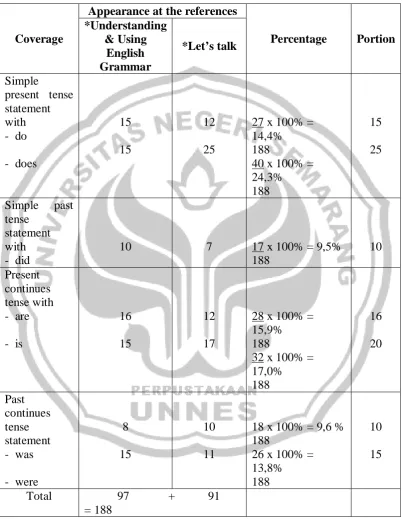
Table 1.
The proportion of test items of the profile of students mastery of questions tags
Coverage
Appearance at the references
Percentage Portion *Understanding & Using English Grammar *Let’s talk Simple present tense statement with - do - does
15 15
12 25
27 x 100% = 14,4% 188
40 x 100% = 24,3% 188 15 25 Simple past tense statement with - did
10 7 17 x 100% = 9,5%
188
10 Present
continues tense with - are - is
16 15
12 17
28 x 100% = 15,9% 188
32 x 100% = 17,0% 188 16 20 Past continues tense statement - was - were
8 15
10 11
18 x 100% = 9,6 % 188
26 x 100% = 13,8% 188
10 15
3.4.2.Arrangements of Test items
After classifying the errors into those types and the proportion of the test items the writer then arranged the outlines of the test items as in the following table: Table 2 .
The outline of the test items on the mastery of question tags
Coverage Numbers of item Total
Simple present tense statement with
- do - does
1,4,18,25,31,34,46,47,65,70,85,86,96,104,108 5,6,10,12,13,20,21,24,30,32,43,44,45,48,66,69,71 87,88,94,95,101,103,105,107
25
Simple past tense statement with
- did 80,89,90,91,93,56,57,60,77,81 10
Present continues tense statement with
- are - is
11,16,36,49,50,51,64,72,73,84,3,22,37,38,58,106 2,8,9,14,19,26,27,28,29,33,35,39,40,41,42,59,62, 67,68,79
16 20
Past continues tense statement with
- was - were
7,17,23,55,61,76,82,92,100,110
15,52,53,54,63,74,75,78,83,97,98,99,102,109,111
10 15
3.4.3 Try Out test
The try out test was carried out on March 14th 2006. The 40 students as respondents had to do the test consisting of 111 multiple-choice items in 100 minutes. Before starting to do the test, the writer explained whatever the students had to do. After the test was finished, the test results were collected by the writer to be corrected.
3.4.4Item Analysis
After a test has been arranged and scored, it is necessary to make an item analysis that is evaluating the effectiveness of the item. Item analysis is meant to check whether or not each item. Meet the requirements of a good test item. Moreover, an analysis of the test is considered as an important thing for the test improvement. The less appropriates items, may influence the test result and finally influence the validity of the data. The test items, which are too easy or too difficult for the students, need some improvement or replacement. Item analysis concentrates on two features. Those are level difficulty and discriminating power as (Heaton, 1975:153) says that all items should be examined from the point of view of their difficulty level and their level of discrimination.
3.4.5Level of Difficulty
In order to find the index of difficulty of each item, the writer selected 27% of the upper group and 27% of the lower group of the students’ results. The index of difficulty of an item can be calculated by applying the following steps:
Firstly, she arranged the test papers in a rank order from the highest scores to the lowest.
Secondly, she selected 27% of the test papers with the highest scores and called this upper group. She also chose the same number of the test papers with the lowest scores and named this the lower group.
The last, for each item, she counted the number of students, in both the upper and the lowest group, who selected the correct answer of the item and divided the first sum by the second as shown in the following formulas:
ID = U + L 2N
Where ID = Index of Difficulty;
U = Number of students in the upper group who answered an item correctly ;
L = Number of students in the lower group who answered an item correctly ;
numbers: 4, 12, 14, 12, 18, 20, 22, 23, 25, 35, 57, 61, 72, 77, 84, 85, 93, 98, 101 should be discarded (unused). The result of index of difficulty can be seen in appendix 9.
3.4.6Discriminating power
The writer in the analysis selected 27% of the upper group and 27% of the lower group of the students’ results in order to find the discriminating power. Then the number of correct answer made for each item coming from both the lower and the upper group results were counted. The discriminating power of an item can be calculated by applying the following procedure recommended by (Haris, 1969:106), as follows:
Step1. Separate the highest and the lowest 27% percents of the papers.
Step2. For each item, subtract the number of lows who answered the item correctly, from the highs who answer correctly.
Step3. Divide the result of step 2 by the number of papers in each group, highs and lows, to obtain the item discrimination index. The following is the formula of calculating the discriminating power:
DP = FH + FL N
Where DP = Index of discrimination power
FL = The numbers of students in the lower group who answered an item correctly ;
N = The total number or of students in one group.
For example, the computation of the formula for item test number 1 is as follows:
FH = 8
FL = 5
DP = 8 – 3 = 0.30.
10
The result of computation the discriminating power of the try out test can be seen in appendix 8. After the try out test was arranged, the test items that did not fulfill the requirements or had low index of discrimination were considered to be invalid.
3.4.7Validity of the Test
Validity is the most important quality of any test. A test is said to be valid when it actually measures what is intended to measure; (Gronlund, 1976:79). Related to the validity, Harris also states that validity of the test is usually distinguished into three kinds. They are contents validity, empirical validity or statistical validity and face validity. In order to find out the validity of the test, the writer took content validity to measure the test items.
test has content validity, the writer compared the test items with the materials dealing with question tag. Related to this case, in constructing the instrument the writer had to look first at the references and find the materials that the students had learned.
Empirical or statistical validity is the way a test shows how the test scores obtained by the testes are related to some outside criterion such as marks they get at the end of a course.
Face validity is the way a test looks to examiners, teachers, and examinees or if a test looks right to other testers, teachers or testes.
3.4.8Reliability of the Test
The following procedures from Heaton (1975) were taken to facilitate the computation:
1. Arrange the two set of scores for two groups of answers (X & Y) in a table; labeling the column to the left, (X) and the column to right (Y) . Each score under (X) has a corresponding score under (Y) for the same students.
2. Square each set of scores for the two groups of answers and find the sum of them :
a.The sum of the X scores; b.The sum of the Y scores;
c.The sum of the square of the X scores; d.The sum of the square of the Y scores;
e.The sum of the product of each X scores with its corresponding Y scores for the same students.
3. Multiply each set of scores for the two groups of answers and find the sum of them.
The data were needed to compute the correlation between the two sets of half scores by means of the Pearson’s Product Moment formula as follows:
N
∑
XY
–(
∑
X
) (
∑
Y
)
r
1/21/2 =√
{
N∑
X2 _(
∑
X)
2}
{
N∑
Y2 ---(
∑
Y)
2}
Where
r
1/21/2 = the correlation of the scores on the two halves of the test; N = the numbers of the students respondents∑y = the sum of y scores;
∑x2 = the sum of the square of x scores; ∑y2 = the sum of the square of y scores;
∑xy = the sum of the product of scores with its corresponding y score
for the same students.
Next to this, she computed
r
1/21/2 and the result obtained is the reliability of half of the test. The last step, she used the Spearman Brown formula to estimate the reliability of the entire test. The formula goes like this:r
11 = 2 xr
1/21/2( 1 +
r
1/21/2 )Where
r
x y = the obtained reliability coefficient of the entire test;r
11 = the obtained reliability of half the test.In this study, the writer computed the two types of this multiple-choice test. Before applying the Pearson Product Moment in order to measure the reliability, she made preparatory tables for r value of odd number items (x) and even number items (y).
The scores of odd number item The scores of even number item
∑x = 649 ∑y = 729
∑x2 = 11077 ∑y2 = 13855
N = 40 ∑xy = 12328
40 (12328) – (649) (729) r 1/21/2 =
= 0.896
The above computation procedures 0.896
The result was obtained from an odd even method; the result had to be computed again by using this formula to determine the reliability of the entire test. The computation can be shown as follows:
r
11 = 2 x 0.896 (1 + 0.896) = 1.792 1.896= 0.945
In this computation the reliability of the test is 0.945. The critical value of r Product Moment with 95% confidence level, and the number of the subject 40 (N=40) is 0.312. Since the reliability value of the test (0.945) is larger than that of the table, it can be said that the test is reliable.
39
CHAPTER IV
ANALYSIS OF THE DATA
4.1
Statistical Analysis
As has been previously mentioned in Chapter I, in this statistical analysis the writer employed the percentage descriptive analysis using a simple formula : ∑ = ∑ E x 100%
∑ T
Where X = The percentage of mastering E = Various kinds of mastering T = Test item
∑ = The sum of
In this step the writer had 60 computation of such percentage of mastering since the study involved 60 respondents. The following table is the computation of the percentage of mastering the question tags made by 60 students.
Table3.
The percentage of question tags mastery made by 60 students Number of
Subject ∑ E ∑ Test Item
Percentage of Mastery
(1) (2) (3) (4)
1 83 90 92 %
2 78 90 87 %
3 84 90 93 %
4 78 90 87 %
5 76 90 84 %
Number of
Subject ∑ E ∑ Test Item
Percentage of Mastery
7 68 90 76 %
8 75 90 83 %
9 63 90 70 %
10 72 90 80 %
11 73 90 81 %
12 74 90 82 %
13 75 90 83 %
14 82 90 91 %
15 75 90 83 %
16 83 90 92 %
17 86 90 96 %
18 74 90 82 %
19 82 90 91 %
20 79 90 88 %
21 82 90 91 %
22 82 90 91 %
23 86 90 96 %
24 81 90 90 %
25 80 90 89 %
26 69 90 77 %
27 75 90 83 %
28 78 90 87 %
29 74 90 82 %
30 75 90 83 %
31 79 90 88 %
32 72 90 80 %
33 41 90 46 %
34 34 90 38 %
35 24 90 27 %
36 45 90 50 %
Number of
Subject ∑ E ∑ Test Item
Percentage of Mastery
38 42 90 47 %
39 29 90 32 %
40 42 90 47 %
41 57 90 63 %
42 44 90 49 %
43 32 90 36 %
44 43 90 48 %
45 47 90 52 %
46 51 90 57 %
47 54 90 60 %
48 70 90 78 %
49 51 90 57 %
50 63 90 70 %
51 52 90 58 %
52 55 90 61 %
53 45 90 50 %
54 46 90 51 %
55 67 90 74 %
56 61 90 68 %
57 63 90 70 %
58 35 90 39 %
59 55 90 61 %
60 50 90 56 %
∑ 3837 5400 4265
In order to make the readers understand clearly about the table, the writer gives a brief explanation about it, as below:
b. The second column is the sum of various level of mastery by each respondent out of the 90 items or the sum of the correct answers.
c. The third column is the sum of the test items which is 90
d. The last column is the percentage of mastery that is derived from the number of the correct answers by the students divided by go times 100%..
The next step was to carry out analysis of the mastery of question tags in order to find out the dominant mastery of question tags. In this analysis the writer used the Pre selected Category Approach favored by Atherton (1977) in which the statistical computation is based on Gulo’s formula:
Pi = fi x 100% n
Where Pi = the proportion of frequency of occurrence of mastery; fi = absolute frequency of a partial type of mastery of a level; n = the total number of possible mastery.
Related to mastery of question tags, the writer divided into seven kinds in using question tag to be analyzed:
a. Simple present tense statement with ‘do’ b. Simple present tense statement with ‘does’ c. Simple past tense statement with ‘did’
In order to find out the proportion of occurrence of mastery as a whole, the writer computed it using Gulo’s formula as follow:
Pi = fi x 100% n
Where Pi = the proportion of frequency of occurrence of mastery as a whole; fi = absolute frequency of a partial type of mastery of all the levels; n = the total number of possible mastery of all the levels;.
The computation of Pi can be shown as follows: Pi = fi x 100%
n
= 3837 x 100% 5400
= 71.05%
Thus, the final step was to identity the degree of dominance of a particular mastery. Any mastery if the degree of dominance (pi-PI) is plus (+) it means that the mastery is dominant. On the other hand, if (pi-PI) is zero or minus (-) it means that the mastery is less dominant. There fore, the result of the computation of the degree of dominant mastery can be described in a table as shown as below:
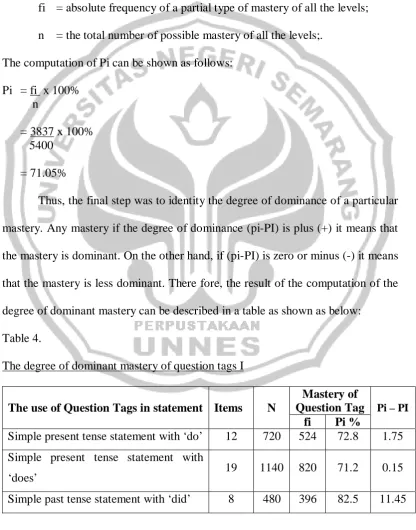
Table 4.
The degree of dominant mastery of question tags I
The use of Question Tags in statement Items N
Mastery of
Question Tag Pi – PI
fi Pi %
Simple present tense statement with ‘do’ 12 720 524 72.8 1.75 Simple present tense statement with
‘does’ 19 1140 820 71.2 0.15
The use of Question Tags in statement Items N
Mastery of
Question Tag Pi – PI
fi Pi %
Present continues tense statement with
‘are’ 15 900 576 64 -7.05
Present continuous tense statement with
‘is’ 20 1200 859 71.6 0.55
Past continuous tense statement with
‘was’ 7 420 295 70.2 0.85
Past continuous tense statement with
‘were’ 9 540 378 70 -1.05
The explanation about the table above can be seen below :
a. The first column is the number of the level of the use of question tags in statement.
b. The second column is the sum of items for each predicted mastering.
c. The third column (n) is the total number of possible mastery of the level and it derives from the sum of the items for each level times the total number of test items which is 90
d. The fourth column (fi), is the absolute frequency of a partial type of mastery of the level.
e. The fifth column (Pi%) is from the absolute frequency of partial type of mastery of a level divided by the total number of possible mastery of the level times 100%.
From the table above, we can see that there are two levels whose degree of dominant result in positive. They are the mastery of question tag in simple present tense statement with ‘do’ (1,75%) and in simple past tense statement with ‘did’ (11,45%). Whereas, there are five levels whose degrees of dominant result in negative including the use of question tag in simple present tense statement with ‘does’ (0.15%), in present continues tense statement with ‘are’ and ‘is’ (-7.05%) and (0.55%), and in past continues tense statement with ‘was’ and ‘were’ (0.85%) and (-1.05%). It means that there are two dominant mastery levels that students made on the use of question tags in many kinds of statement, and there are five dominant in mastered levels that student made on the use of question tags in many kinds of statements. The computation also shows that there are 71.05% is the frequency of occurrence of mastery in question tags as a whole.
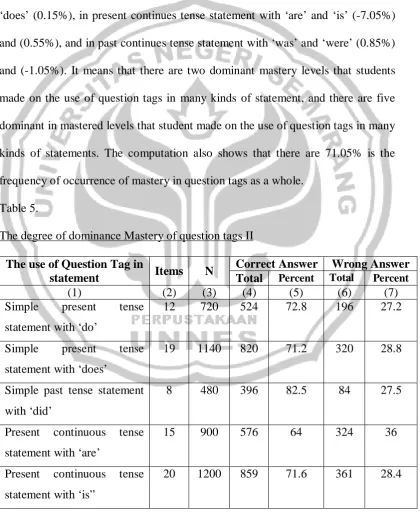
Table 5.
The degree of dominance Mastery of question tags II The use of Question Tag in
statement Items N
Correct Answer Wrong Answer Total Percent Total Percent
(1) (2) (3) (4) (5) (6) (7)
Simple present tense statement with ‘do’
12 720 524 72.8 196 27.2
Simple present tense statement with ‘does’
19 1140 820 71.2 320 28.8
Simple past tense statement with ‘did’
8 480 396 82.5 84 27.5
Present continuous tense statement with ‘are’
15 900 576 64 324 36
Present continuous tense statement with ‘is”
The use of Question Tag in
statement Items N
Correct Answer Wrong Answer Total Percent Total Percent
(1) (2) (3) (4) (5) (6) (7)
Past continuous tense statement with ‘was’
7 420 295 70,2 125 29,8
Past continuous tense statement with ‘were’
9 540 378 70 162 30
The explanation about the table above can be seen below:
a. The first column is the number used of the question tags in statement. b. The second column is the sum of item for each predicted mastery
c. The third column is (n) is the total number of possible mastering of the level and it derived from the sum of the item for each level times the total number of the test items which is 90.
4.2
Non-Statistical Analysis
The result can be analyzed descriptively. The writer classified the students’ achievement to categorize the results. The classification was taken from (Tinambunan, 1988:129) which expresses various levels of achievement by using five letters: A,B,C,D and E.
The grades assigned are based upon the following percentage. According to (Suharsimi Arikunto, 1998) to determinate the degree of the difficulties question we used the formula :
DP = BA _ BB x 100%
JA JB
BA : the number of test participants in the low category which answered correctly response.
JA : the number of test participants in the upper category JB : the number of test participant in the low category The classification of capacity differences question is as follow: 93 – 100% (A) = Outstanding
85 – 92% (B) = Above average 75 – 84% (C) = Average 60 – 74% (D) = Below average Below 60% (E) = Insufficient.
To do non-statistical analysis, the writer done based on the interpretation of the statistical one. The writer conducted non-statistical analysis in order to find the source of cause or the dominant mastery based on the data presented above, namely the mastery made by the respondents.
The writer also classified students’ scores as follows:
The number of students The grade in test Percentage of students
0 (A) Out standing 0%
27 (B) Above average 45%
18 (C) Average 30%
13 (D) Below average 21.6%
The result of the test shows clearly that 45% students of the third year got mark above average achievement, 30% average achievement, 21.6% below average achievement and 3.4% insufficient. It meant that the students of the third year had mastered question tag well, although there were some who had not.
According to the teaching learning guidance in junior high school, students are classified as successful if they get 65 or above, and students who get 64 or below must be given remedial treatment, but if the majority of the students get 65 or below, the teaching learning activity must be repeated. The data above shows that 45 students got score 65 above and 2 students got below 60. This means that the majority of the students had mastered the material, in this case question tag. So, the teaching learning activity need not be repeated.
Having found the mastered made by the respondents, the writer then classified those mastery in seven statement categories of mastering question tags based on understanding and English grammar, they were ;
4.2.1. Mastering question tags in simple present tense statement with ‘do’ and ‘does’
In general, the simple present expresses events or situation that always exist, they exist now, have existed in the past and probably will exist in the future, according to (Betty Scrampfer Azar, 1989:02). In question tags uses ‘do’ and ‘does’ in the statement simple present tense, example:
Do : I don’t know you, do I?
Lisa likes dancing, doesn’t she?
Student can master this question when they can differ about using ‘do’ and ‘does’. Errors occurred when student confuse about using ‘do’ and ‘does’ on the statement..
4.2.2 Mastering question tag in simple past tense statement with ‘did’.
According to (Betty Schrampfer Azar, 1989:02) simple past tense statement at one particular time in the past this happened. It began and ended in the past. In question tags usually uses ‘did’, example:
Did : I won the game, didn’t I?
I didn’t see you yesterday, did I?
Student can master this question when they can differ about using ‘did’. Errors occurred when student confuse about using ‘did’ in the statement.
4.2.3 Mastering question tags in present continuous tense statement with ‘are’ and ‘is’.
According to (Betty Schrampfer Azar, 1989:04), present continues tense statement that the progressive tense give the idea that an action in progress during a particular times. The tense say that an action begins before, is in progress during and continues after another time or action. In question tags statement uses ‘are’ and ‘is’, example:
Are : You and I aren’t always busy, are we?
Is : Your uncle is a doctor, isn’t he? John is not a careless boy, is he?
Students can mastered this question when they can differ about using ‘are’ and ‘is’. Errors occurred when student confuse about using ‘are’ and ‘is’.
4.2.4 Mastering question tags in past continuous tense statement with ‘was’ and ‘were’.
According to (Betty Schrampfer Azar, 1989:02), the past continuous tense statement that an action in progress during a particular time in the past. It probably continued. In question tags statement usually used ‘was’ and ‘were’ example: Was : Jimmy wasn’t absent last Monday, was he?
I was you neighbor, wasn’t I?
Were : You were not late yesterday, were you? They were not my friends, were they?
51
CHAPTER V
CONCLUSIONS AND SUGGESTIONS
5.1 Conclusions
From the analysis, the writer draws some conclusion as the result of the study of the third year student of SLTP Institute Indonesia in the academic year of 2005/2006 in mastering question tags. From the study the writer know that 27 students or 45% students of the third year got mark above average achievement, 18 students or 30% average achievement, 13 students or 21.6% below average achievement and 2 students or 3.4% insufficient. It means that the students of the third year had mastered question tags well, although there were some who had not.
The data analysis shows that 45 students got score above average and 2 students who got insufficient. This means that the majority of the students had mastered the material, in this case is question tags well. So, teaching learning activity not needed to be repeated. But for the best result of mastery this material is good if the teacher do the test again. For the student who got mark less than 65 he or she must do the examples of another exercise in the class or in they home for many times. They have to try they skill to improve they ability of question tags. Most of the third year students have mastered question tags well, but some of them still faced some difficulties in mastering them.
a. Based on the test result 45 students in third year student of SLTP Institute Indonesia got good score in question tags. It means that the majority of them have mastered the material well.
b. 15 students still face some difficulties in mastering the question tags to identify the use of ‘does’, ’was’, and ‘were’ in question tags.
c. 2 students got bad mark it means that they have some difficulties to identify the seven levels in use of question tags in the statements.
5.2 Suggestions
The writer suggested that:
a. The teacher should more explain the use and the form of question tags in all tenses. After that the teacher should emphasis or give more explanation dealing with the correct use and form of do, did, does, are, is, was and were in question tags to make better result in the future.
b. It is better for the teacher to give supplementary material and some various examples or methods and then followed by giving home assignment to enrich students’ knowledge of question tags.
c. The teacher should use English to communicate orally with student in class so the students get used to hearing English words. It will be able to help students mastering question tags faster and more easily
53
BIBLIOGRAPHY
Akhlis, Nur. 1996. Let’s Study English. Kediri: BEC-EECC Pare.
Alexander, L.G. 1986. Practice and Progress. Yogyakarta: Yayasan Kanisus. Allen, W. Stannard. 1975. Living English Speech. London: Longman Group
Limited.
Alter, M.A. 1993. Essential English Usage Grammar 5. Jakarta: BinaRupa Aksara Preston Corporation, ltd.
Arikunto, Suharsimi. 1998. Prosedur Penelitian. Jakarta: Rineka Cipta.
Cook, Stenley J. and Richard W. Suter. 1980. The Scope of Grammar. New York: Mc. Graw – Hill.
Cranmer and Mathews Alan. 1989. At the Chalk Face. Practical Technique in Language Teaching. Glossary. London Melbourne Auckland: Edward Arnold.
Gay, L. R. 1987. Educational Research: Competencies for Analysis and Application: New York: Merril Publishing Company
Gronlund, E. Norman.1982. Measurement and Evaluation in Teaching. New York. Mc Millan: Publishing Company Ltd.
Harmer, Jeremy. 1985. Teaching and Learning Grammar. Hongkong: Longman Group (FE) Limited.
Harris, D.P. 1969. Testing English As a Second Language. New York: Mc Graw-Hill, Inc,
Heaton, JB. 1975. Testing English Language Test. London: Longman Ltd
Krohn, Robert. 1971. English Sentence Stucture. Ann Arber: The University of Michigan Press.
Leech, Geoffrey; Benita Cruickshank and Roz Ivanic. 1998. An A-Z of English Grammar and Usage. London: Edward Arnold.
Mardiani, Sri. 1998. The profile of Student’s Mastery of Tag Question in the Future Tense. IKIP Semarang: (unpublished).
Nasr, R.T. 1978. The Essentials of Linguistic Science. London: Longman.
Ramelan. 1992. Introduction to Linguistics Analysis, Semarang: IKIP Semarang Press.
Rutherford, William E. 1986. Modern English, New York: Addision Wesley Publishing Company.
Saleh. 2001. Pengantar Praktik: Penelitian Pengajaran Bahasa. Semarang: IKIP Semarang Press.
Swan, Michael. 1988. Practical English Usage. Oxford: Oxford University. Thomson, A.J and A.V Martinet. 1986. A practical English Grammar. London:
Oxford University Press.
55
TRY OUT
Subject : Question Tag Time : 100 minutesChoose the correct answer with give the (x) on the right answer. 1. I don’t know you ,…..?
a. do I c. don’t I
b. I do d. don’t you
2. Your uncle is a doctor,…..?
a. is it c. isn’t you b. isn’t it d. isn’t he
3. Those ladies aren’t nurses,….?
a. are she c. aren’t she b. aren’t they d. are they 4. You look happy,…?
a. don’t you c. don’t I b. doesn’t you d. do you 5. Lisa likes dancing,…..?
a. does she c. does her b. doesn’t she d. do you
6. Your brother participates in the game,…..? a. does he c. does him b. doesn’t he d. doesn’t him 7. I was your neighbor,…..?
a. was you c. wasn’t I b. wasn’t she d. was her 8. John is not a careless boy,…..?
a. is he c. is she
b. isn’t he d. isn’t she 9. English isn’t difficult,….?
a. was it c. isn’t it b. is not d. is it 10.Mr. Rahardi doesn’t drive the taxi,….?
11.I am smart,…..?
a. am I c. aren’t I
b. do I d. are you
12.Ani doesn’t go to school on foot,…..? a. does she c. doesn’t she b. will she d. does her 13.David goes to school everyday,…..?
a. do him c. doesn’t he b. aren’t him d. aren’t you 14.The man is not a mechanic,…..?
a. is he c. isn’t he
b. won’t he d. is him 15.You were not late yesterday,…..?
a. were she c. was you b. were you d. doesn’t you 16.The children are your classmates,…..?
a. aren’t they c. are she b. doesn’t him d. do they 17.Dewi wasn’t your friend,…..?
a. were they c. das she b. does him d. didn’t they 18.The teachers have a meeting,…..?
a. don’t they c. do you b. were you d. wasn’t you 19.There is a lady in the taxi,….?
a. isn’t there c. is there b. don’t she d. does him 20.The pretty woman walk on the street,…..?
a. didn’t she c. does she b. did she d. doesn’t she
22.Students aren’t always on time for school,…..? a. isn’t he c. are they
b. is he d. wasn’t he
23.It was your book,…..?
a. was you c. wasn’t it b. don’t we d. do we 24.The dispensary open every day,….?
a. don’t it c. didn’t you b. did you d. doesn’t it 25.Ratih and Listy don’t study together,….?
a. was she c. wasn’t they b. do they d. was they 26.That isn’t a new book,…..?
a. isn’t it c. is it b. isn’t that d. is that 27.This is the real problem,…..?
a. it is c. is it
b. isn’t it d. would they
28.The lady in front of the class is an English teacher,…..? a. does she c. is you
b. doesn’t she d. isn’t she 29.This dictionary is expensive,….?
a. isn’t i