Global Brands and Consumer Ethnocentrism of Youth Soft
Drink Consumers in Greater Jakarta, Indonesia
Hammam Haris Tasurru* and Imam Salehudin**
Indonesia is a large market for consumer products targeting youth consumers, with populations of more than 70 million young inhabitants and market size of USD 155 billion. The large size of this potential market attracts foreign products with globallyrecognized brands to enter the Indone-sian market. The objective of this study is to explain the purchase intention of youth consumers to-ward a particular brand of soft drink with global penetration by their perceptions and ethnocentrism. This study obtained response from 156 youths in Greater Jakarta, Indonesia. The resulting data was analyzed using structural equation modeling with LISREL software package. The study found that consumer ethnocentrism decreases purchase intention, both directly and indirectly through brand
im-age. Contrary to the hypothesis, consumer ethnocentrism does not influence corporate image of the global firm, which significantly influences brand image but only slightly impacts purchase intentions
directly.
Keywords: global brand, consumer ethnocentrism, purchase intention, youth consumer, soft drinks, Indonesia
Indonesia adalah pasar yang besar bagi produk konsumen yang membidik kalangan pemuda, den-gan 70 juta populasi berusia muda dan ukuran pasar sebesar USD 155 milyar. Besarnya pasar po-tensial ini menarik produk-produk asing dengan merek global untuk masuk ke pasar Indonesia. Tu-juan studi ini adalah menjelaskan bagaimana niat membeli dari konsumen muda terhadap salah satu produk dengan merek global dipengaruhi oleh persepsi dan etnosentrisme mereka. Studi ini mem-peroleh respon dari 156 pemuda di wilayah Jabodetabek, Indonesia. Data yang dimem-peroleh kemudian diolah menggunakan pemodelan persamaan struktural dengan paket LISREL. Studi ini menemukan bahwa etnosentrisme konsumen mengurangi intensi membeli, baik secara langsung maupun secara tidak langsung melalui konstruk citra merek. Berlawanan dari hipotesis, etnosentrisme konsumen
tidak mempengaruhi citra perusahaan yang memiliki pengaruh yang kecil namun signifikan terhadap
niat membeli.
Kata Kunci: merek global, etnosentrisme konsumen, niat membeli, konsumen muda, minuman ringan, Indonesia
Introduction
Indonesia is a large market for consumer products, especially for products targeting youth consumers, with populations of more than 70 million young inhabitants and market size of USD 155 billion (BPS, 2010). The large size of this potential market attracts foreign products with globally recognized brands to en-ter the Indonesian market.
The entry of global corporation to Indone-sian market may happen in various ways. Some of these global products would be directly
imported from abroad, while some would be produced locally and may even use local com-ponents. This concept of production further muddled the division between foreign and local product, since some foreign product used local components while some local product may use foreign components in its production process (Han and Terpstra, 1988).
* Department of Management, Faculty of Economics and Business, Universitas Indonesia. E-mail: haris_tasurru@ yahoo.co.id
Tse and Gorn (1993) proposed the concept of global brand, which is a brand with well-known international appeal that gives a product distinctive image compared to its competitors.
They contend that firms with Global brands can generate more profit by sourcing their produc -tion in countries with low produc-tion costs, while retaining superior image as perceived by their consumers. Furthermore, a brand can
be associated with a specific country origin,
regardless of where the product was manufac-tured (Thakor and Kohli, 1996; Thakor and Lavack, 2003).
The bottom line is that what differentiates between global and local brands are the percep-tions of the consumers. Some products may be perceived as global brands even though nearly 100 percent of components were produced lo-cally, while other products would be perceived as local brands even though nearly 100 percent of the components used in the production pro-cess were imported. This perception of
con-sumers will be reflected in both the brand and
corporate image of respective products and companies (Tse and Lee, 1993).
On the other hand, having a global brand may not necessarily be a good thing for a prod-uct. Sharma and Shimp (1987) points out nega-tive emotions that might be felt by consumer to-ward products perceived to be “foreign”. They coined the term “Consumer Ethnocentrism” to describe these negative emotions which showed consumer tendencies to give less favorable evaluation toward foreign brand as opposed to local brands. These negative emotions might arise from a sense of patriotism or nationalism which compels consumers to feel disloyal when purchasing foreign brands, especially if local alternative is available (Good and Huddleston, 1995; Watson and Wright, 2000; Klein, 2002).
Despite the diversity of ethnic cultures as well as geographic condition in Indonesia, Indo-nesian national identity remains a strong com-mon bond acom-mong diverse ethnicities. “Bhin-neka Tunggal Ika”, loosely translated as “Unity in Diversity”, is the Indonesian motto displayed in its national emblem. This is especially true in urban populations with less homogenous ethnic background than rural populations (van Leeuwen and Mashuri, 2013). Members of dif-ferent ethnicity mingle and intermarry, thus
fur-ther clouding ethnic identity in favor of stron-ger national identity. Thus, Indonesian national identity is seen as the bindings in which various ethnic identity are blended. Therefore, highly ethnocentric consumers may show preference for their national products regardless of their ethnic background.
As explained earlier, Indonesia is a large market for consumer products. Indonesian an-nual population growth projected between 2.38 to 2.6 percent (Nitisastro, 2006). In order to have clearer taken on relationships between global brands, consumer ethnocentrism and their purchase intention, the scope of this study is narrowed down to a single industry in con-sumer goods category. This study focuses on the soft drinks industry since it is considered to represent an excellent example of how global consumer goods brands entering Indonesia. Few brand achieved such global brand status as the major brands in the soft drink industry, most notably Coca Cola and Pepsi (Holt, Quelch and Taylor, 2004). Both companies entered the Indonesian soft drink market around 1970s, quickly dominating not only the Indonesian soft drink market but also the bottled beverages industry by directly competing with other bev-erages such as locally produced bottled tea and juices (Susanto, 2006). Therefore, this industry is suitable for the purpose of this study.
Furthermore, food and beverages has always been the top-spending category for unplanned purchase of Indonesian youth consumers (MarkPlus, 2012). On the other hand, con-sumption of soft drink in their home country, the United States, has reached saturation. As an illustration, in 2010 the average consumption of Coke in the United States is 394 servings per person per year or 1.01 serving per day, while the average consumption of soft drink in Indo-nesia is still at 13 servings per person per year (The Coca-Cola Company, 2010). The per cap-ita consumption of soft drinks in the emerging markets is generally still at a much lower level than the consumption in developed countries.
percep-tion of the global brands and ultimately their purchase intentions.
Therefore, the objective of this study is to explain the how consumer ethnocentrism may impacts the perceptions of Indonesian youth consumers toward a particular brand of soft drink with worldwide market penetration and their consequent purchase intention. Which brand of soft drink brand became the object of this study will remain to be unnamed in order to avoid legal complications regarding the use of licensed names.
Literature Review
In order to develop a model to accomplish the objective of this study, brief review on ex-isting literatures would be necessary. This sec-tion is arranged using the topical approach. The
first part of the review will discuss part research
on Consumer Ethnocentrism. The second part will discuss consumer perception toward global
brands and corporations. The final part will dis -cuss purchase intention and the relationship be-tween variables.
Consumer Ethnocentrism
As explained earlier, Sharma and Shimp
(1987) is the first to explore the concept of eth -nocentrism in the consumer decision making context by pointing out negative emotions felt by consumers toward purchasing foreign prod-ucts. They coined the term “Consumer Ethno-centrism” to describe these negative emotions and developed an instrument to measure such construct, the CETSCALE (Consumer Ethno-centrism Tendency SCALE).
Various studies have validated the construct of Consumer Ethnocentrism and found consist-ent result which showed how consumer ethno-centrism tendencies decreases consumer evalu-ation toward foreign brand as opposed to local brands (Watson and Wright, 2000; Klein, 2002;
Neese and Hult, 2002). This effect relies on the status of foreign versus local brand as perceived by the consumer, which is related to the concept of Country of Origin Effect (COE).
COE is the impact of perceived origin of a product toward a person’s evaluation toward a certain product or brand (Nebenzahl, Jaffe, and Lampert, 1998). In this case, Samiee (1994) states that Country of Origin refers to “The
country with which the product’s firm is asso -ciated”, which also elaborates that for global brands, even though produced locally, would still be associated with the country which the brand originated. While a recent study by Noor-derhaven and Harzing (2005) describes the complex nature of Country of Origin for Mul-tinational Corporations spread in various coun-tries around the world. Verlegh and Steenkamp (1999) described COE as three different effects, i.e. Cognitive, Affective and Normative, shown in Table 1. The concept of COE used in this study deals mainly with the affective effect of COE.
Global Brand and Corporate Image
Brand image plays important role in con-sumer decision making. Brand images is
de-fined as various meanings associated to the
product by the consumers and global brand
im-age can be defined as meanings associated with
the global status of products sold in various countries (Roth, 1992; Steenkamp, Batra and Alden, 2003; Winit, Gregory, Cleveland and Verlegh, 2014).
Hsieh, Pan and Setiono (2004) showed vari-ous levels of meanings associated to the prod-uct by the consumer. Their study found that
consumer associate specific meaning toward product as well as the firm. Thus consum -ers may have particular brand image toward a product and certain corporate image toward the
firm that produce it. This is consistent with an -other study by Aaker (2004) which stated that
Table 1. Cognitive, Affective and Normative Country of Origin Effect
Effect Descriptions Major Findings
Cognitive Sign of Quality Country of Origin as signal of overall product quality or a certain quality attributes, such as reliability or durability.
Affective Symbolic and emotional values Country of origin as association with certain images with emotional or symbolic value, including patriotism and nationalism.
corporate brand image can be used as leverage for marketing to improve consumer perception and evaluation toward a product.
This study focused specifically to one product
and one business entity with recognized global image. Dimofte, Johansson and Ronkainen (2008) compared response between “antiglob-al” and “proglob“antiglob-al” consumers toward global brands of alcoholic beverages. Despite some mixed result, their study did found that the
“an-tiglobals” showed significantly lower response
toward global brands compared to the “proglo-bals”. Similarly, Haque, Rahman, and Haque
(2011) studied the influence of ethnocentrism
toward consumer perception, such as corporate image and brand image. Their study found that Consumer Ethnocentrism does reduce consum-er evaluation on brands of foreign brands and consumer with high ethnocentrism tends to put less trust on foreign based companies.
More recent finding shows that ethnocen -tric consumers in emerging markets preferred brands from their own countries to brands from developed countries when evaluating differ-ent brands of car (Hamin, Baumann and Tung,
2014). This finding is consistent with previous
studies supporting the hypotheses that con-sumer ethnocentrism have negative effect to consumer evaluation of global brands and cor-porations. Therefore, it is proposed that high consumer ethnocentrism would also predispose consumer to give less favorable evaluation to brands and companies perceived as foreign
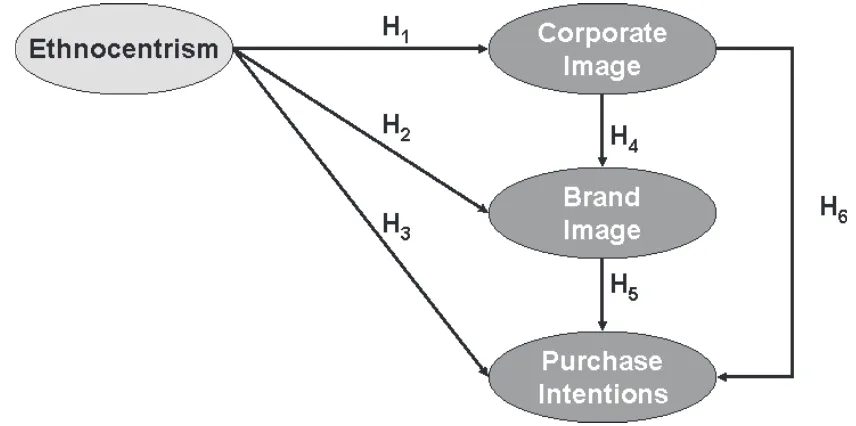
H1: Consumer Ethnocentrism negatively influ -ences Corporate Image
H2: Consumer Ethnocentrism negatively influ -ences Global Brand Image
Gwinner and Eaton (1999) develop a con-cept of image transfer which proposed that
meanings consumer associate to a firm may be transferred to products the firms produce. More
recently, Argenti and Druckenmiller (2004) discuss how corporate image have positive
in-fluence on the brand image of products they
are associated with. In line to this proposition, Hsieh, Pan and Setiono (2004) also argue that consumers associate distinct meaning to
prod-uct and firms which correlate positively. Recent
study by Popoli (2011) discovers that corporate
image developed through exposure from global
CSR activities have positive influence toward
brand image of products. Based on these stud-ies, the third hypothesis proposed is that Global Corporate Image transfers into Global Brand Image positively.
H3: Global Corporate Image positively influ -ences Global Brand Image
Purchase Intention
Consumer purchase intention can be defined
as their deliberate plan to purchase a certain product in the near future (Espejel, Fandos, and Flavian, 2008). Furthermore, Fandos and
Flavi-an (2006) argue that purchase intention reflects
the short term behavior of consumer’s future purchase decision. Therefore, the construct of Purchase Intention is expected to predict the consumer’s actual purchase behavior in the fu-ture.
Consumer purchase intention can be influ -enced by various factors. Relevant with the con-struct of Consumer Ethnocentrism discussed earlier, ethnocentric consumers associate local brands with positive symbols such as patriotism or nationalism. On the other hand, purchasing foreign brand may evoke negative emotions which compel ethnocentric consumers to feel disloyal when purchasing foreign brands, espe-cially if a local alternative is available (Singh, Furrer and Ostinelli, 2004).
Nadiri and Tümer (2010) discover that sumers ethnocentrism positively affects con-sumer intention to purchase domestically pro-duced goods in North Cyprus. Similar result was also obtained by Qing, Lobo and Chong-guang (2012) in consumer purchase intention of fresh fruits in China. Recent study by Ahmed
et al. (2013) also identifies negative relation -ship between consumer ethnocentrism and pur-chase intention of foreign fast food franchise in Malaysia. These studies supported the proposi-tion that consumer ethnocentrism has adverse impact toward purchase intention of foreign products. Therefore, it is proposed that similar
finding may apply for the soft drink industry in
Indonesia.
Various researches have also linked corpo-rate and brand image to consumer purchase intention (Becker-Olsen, Cudmore and Hill, 2006). It is generally agreed that better corpo-rate and brand image would increase consumer
purchase intention. In the absence of specific
information, consumer will use brand to
evalu-ate quality. Similar finding for global brands
showed that corporate-brand credibility and self-image congruence of global brands have direct positive impacts on purchase intention (Li, Wang, and Yang, 2011).
Recent study by Ryu, Lee and Kim (2012)
discover similar findings, brand image of the restaurant positively influence consumers in the
United States to visit more frequently. In the same time, Haque, Rahman and Yasmin (2012)
studied the influence of Global corporate image
toward purchase intention of foreign product in Malaysia. Consistent with previous studies, they found that global corporate image
posi-tively influence purchase intention. These stud -ies supported the proposition that Global Brand Image and Global Corporate Image has positive impact toward consumer purchase intention.
H5: Global Brand Image positively influences
Purchase Intentions
H6: Global Corporate Image positively influ -ences Purchase Intentions
Based on the literatures reviewed earlier, the six formulated hypotheses are summarized in the research model shown in Figure 1.
Methods
Measurement used in the survey are
modi-fied from the CETSCALE (Consumer Ethno-centrism Tendencies Scale) developed by Shar-ma and Shimp (1987), which originally consist of 17 item to measure ethnocentric tendencies related to consumer purchase decision of local versus imported products. The 17 item scale was further distilled into the abbreviated version of a seven item scale, which possess high con-vergent validity with the original 17 item scale. The CETSCALE measurement was proven val-id in several countries, such as: Japan, France, and Germany (Netemeyer, Durvasula, and Li-chtenstein, 1991), Korea (Sharma, Shimp, and Shin, 1995), United States and Russia (Durva-sula, Andrews, and Netemeyer, 1997), China (Klein, Ettenson and Mooris, 1998). Brand image, corporate image and purchase intention was measured using instruments adapted from Haque, Rahman, and Haque (2011).
All instruments were validated using pre-test on 30 student respondents before the ac-tual data collection. The pre-testing data was analyzed using Cronbach’s alpha to assess in-ternal consistency and factor analysis to assess construct validity. One item from the shortened
CETSCALE was excluded from the final ques -tionnaire due to poor validity. Six measurement items was validated for each remaining con-struct, i.e. brand image, corporate image and purchase intention.
This study employed self-assessment ques-tionnaire to 156 youths in the Greater Jakarta, the capital region and largest metropolitan in Indonesia. Purposive sampling technique was employed due the nature of population which is impossible to obtain a working sampling frame. A potential respondent was recruited online and screened for their age, soft drink consumption and global brand awareness. Recruited
partici-pant are allowed to fill the questionnaire only
if they are young consumers, ranging from 15 to 21 of age, consumed soft drink and has prior awareness of the product and the company as a global brand.
Potential respondents were screened for their recognition of the product as a global brand due to the use of local ingredients or components in the production process which blurred the con-cept of local versus imported product. Potential
respondents were first shown the company logo
and pictures of the product. Respondents who did not perceive both the company and brand as a global brand after the images were shown was not included in the survey.
The final data set from the 156 screened
responses was then analyzed using structural equation modeling with LISREL 8.51 software package. The two step approach was employed in order to avoid making conclusion using
flawed measurement. The first step tests the
measurement model to ensure a valid and reli-able measurement, while the second step tests the structural model to accept or reject the pro-posed hypotheses (Hair et al, 2009). Using the two step approach would minimize possible er-rors introduced from items with poor validity or reliability in the instruments.
Results and Discussion
Descriptive Statistics
In order to provide contexts for further dis-cussions in subsequent sections, this section describes the characteristics of the 156
respon-dents in the final data set. In the final part of the
questionnaire, the respondent was asked sever-al questions about their demography. Based on their gender, the respondent is split nearly half with 76 (48.71 percent) male respondents and 80 (51.29 percent) female respondents. This
balanced gender ration should minimize possi-bility of gender bias in the sample.
Classified by their age, 50 (32.05 percent)
respondents are 15-18 years old and 106 (67.95 percent) respondents are 18-21 years old at the time of the survey. This means that the sample may be slightly biased toward older youths. Grouped by monthly consumption of soft drinks, one hundred (64.10 percent)
respon-dents consumed between one to five servings a
month, thirty three (21.15 percent) respondents consumed between six to ten servings, eleven (7.05 percent) respondents consumed eleven to
fifteen servings, six (3.85 percent) consumed
between sixteen and twenty servings and six (3.85 percent) consumer more than twenty servings a month. This showed that the sample inclined toward light to moderate consumers of soft drinks. However, this characteristic is in line with the Indonesian average consump-tion of soft drink, which is only 13 servings per person per year or 1.08 servings per person per month (The Coca-Cola Company, 2010).
Categorized by their monthly personal ex-penditure, seventy six (48.72 percent) respon-dents claims to have personal expenditures between Rp500,000 to Rp1,000,000 a month, fourty two (26.92 percent) respondents be-tween Rp1,000,000 to Rp1,500,000 a month, seventeen (10.90 percent) respondents between Rp1,500,000 to Rp2,000,000 a month, six (3.85 percent) respondents between Rp2,000,000
to Rp2,500,000 a month, five (3.21 per -cent) respondents between Rp2,500,000 to Rp3,000,000 a month, and ten (6.41 percent) respondents claims to have personal expendi-tures of more than Rp3,000,000 a month.
Measurement Model
The initial test for the measurement model
did not yield a good fit. Model testing yields
chi-square value of 852.26 with degree of
free-dom (df) of 246. Testing the significance of
chi-square value yields p-value of under 0.05 and RMSEA above 0.08, which means that the
model was rejected because significant differ -ences exists between the correlation matrix ob-tained from the data with the correlation matrix
specified from the model. Therefore several modifications are required before the measure -ment model can be used for hypothesis testing.
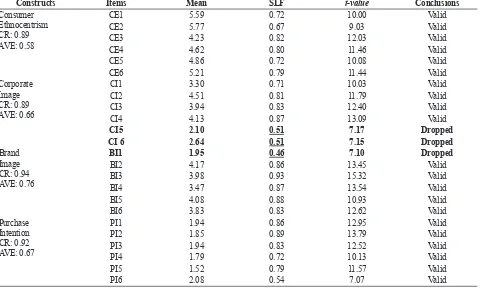
Modifications consisted of eliminating two
items from Corporate Image (CI5 and CI6) and one item from Brand Image (BI1) due to low item validity. Item validity was determined by Standardized Loading Factor, which must ex-ceed 0.6 (Hair et al., 2009). Several error co-variance restrictions were also eased for items within the same construct based on the
modi-fications indices provided by LISREL. List of
covariance between errors of items is shown in
Table 2. The final measurement model produces
Chi-square of 270.72 and degree of freedom of 178, yielding RMSEA of 0.057, which means
that the final measurement model is found to be of good fit. Calculating Construct Reliabil -ity (CR) and Average Variance Extracted (AVE) for each construct also yield good result, with all CR exceed 0.7 and all AVE exceed 0.5 (Hair et al., 2009). Full result of the measurement model is shown in Table 3.
Hypotheses Testing
The second step after estimating the mea-surement model is to estimate the structural model in order to test the research hypotheses. Six structural equations were added to the
mea-surement equations to reflect the hypothesized
relationships between latent variables. Initial structural model produces Chi-square of 272.98
Table 2. List of Error Covariance between Items
Constructs Error Covariance between
Table 3. Result of Final Measurement Model
Constructs Items Mean SLF t-value Conclusions
Consumer Ethnocentrism CR: 0.89 AVE: 0.58
CE1 5.59 0.72 10.00 Valid
CE2 5.77 0.67 9.03 Valid
CE3 4.23 0.82 12.03 Valid
CE4 4.62 0.80 11.46 Valid
CE5 4.86 0.72 10.08 Valid
CE6 5.21 0.79 11.44 Valid
Corporate Image CR: 0.89 AVE: 0.66
CI1 3.30 0.71 10.03 Valid
CI2 4.51 0.81 11.79 Valid
CI3 3.94 0.83 12.40 Valid
CI4 4.13 0.87 13.09 Valid
CI5 2.10 0.51 7.17 Dropped
CI 6 2.64 0.51 7.15 Dropped
Brand Image CR: 0.94 AVE: 0.76
BI1 1.95 0.46 7.10 Dropped
BI2 4.17 0.86 13.45 Valid
BI3 3.98 0.93 15.32 Valid
BI4 3.47 0.87 13.54 Valid
BI5 4.08 0.88 10.93 Valid
BI6 3.83 0.83 12.62 Valid
Purchase Intention CR: 0.92 AVE: 0.67
PI1 1.94 0.86 12.95 Valid
PI2 1.85 0.89 13.79 Valid
PI3 1.94 0.83 12.52 Valid
PI4 1.79 0.72 10.13 Valid
PI5 1.52 0.79 11.57 Valid
and degree of freedom of 179, yielding RMSEA
of 0.057, which means that the final structural model is found to be of good fit. Hypothesis
testing can only be conducted after structural
model with good fit are obtained.
Hypotheses are rejected if the absolute t-val-ue of the corresponding path does not exceed
1.96, at 95 percent confidence level required.
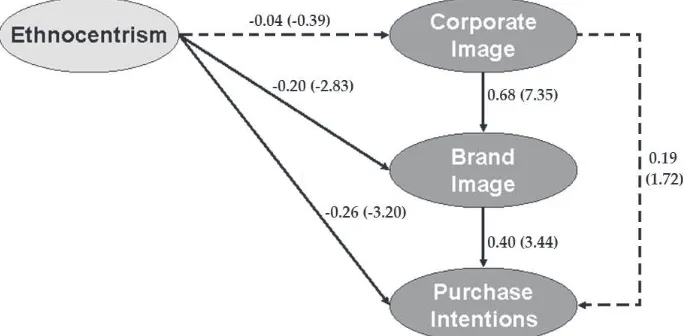
Out of six hypotheses tested, two of them were
rejected. The influence of Consumer Ethno
-centrism to Corporate Image and the influence
of Corporate Image to Purchase Intention are
found to be not significant. On the other hand, both the direct influence of Consumer Ethno -centrism to Purchase Intention and the indirect
influence through Brand Image are found to be significant. Therefore, partial mediation by
Brand Image existed between Consumer Eth-nocentrism and Purchase Intention.
Even though Corporate Image is found have
no significant direct influence to Purchase In
-tention, it is found to have significant indirect
relationship to Purchase Intention through Brand Image. Therefore, full mediation by Cor-porate Image existed between Consumer Eth-nocentrism and Purchase Intention. Complete result of the hypotheses testing is shown in
Ta-ble 4, while the final research model is shown
in Figure 2.
Discussion
There are several interesting findings, first
of which, consumer ethnocentrism directly re-duces purchase intention of the product with global brand. Consumer ethnocentrism also de-creased brand image of global brand, which has
positive influence toward purchase intention.
Therefore, consumer ethnocentrism decreases purchase intention, both directly and indirectly through brand image. Second is that contrary to the hypothesis, consumer ethnocentrism does
not influence corporate image of the global firm, which significantly influences brand im -age but only slightly impacts purchase inten-tions directly.
Previous research has tied consumer eth-nocentrism to both corporate and brand im-age (Becker-Olsen, Cudmore and Hill, 2006; Haque, Rahman, and Haque, 2011). However,
this study finds that in this case, Consumer Ethnocentrism influences brand image but not
corporate image. One possible explanation is that in this particular case, the product’s brand image may have distanced itself from the
cor-porate image of the firm that produced it. The
soft drink industry often employed licensing contracts to local partners which produce and distribute the end products while the parent
Table 4. Result of Hypotheses Testing
Hypotheses Path SLF t-val* Conclusion
H1 Consumer Ethnocentrism --> Corporate Image -0.04 -0.39 Rejected H2 Consumer Ethnocentrism --> Brand Image -0.20 -2.83 Accepted H3 Consumer Ethnocentrism --> Purchase Intention -0.26 -3.20 Accepted H4 Corporate Image --> Brand Image 0.68 7.35 Accepted H5 Brand Image --> Purchase Intention 0.40 3.44 Accepted H6 Corporate Image --> Purchase Intention 0.19 1.72 Rejected Note: * Significant at 5 percent 2-tail, t-value above 1.96 or below -1.96
company manages advertising and public
rela-tions. This business model may influence how consumer ethnocentrism influenced corporate
image, compared to other business model in which the parent company does not use lo-cal partner in producing and distributing their product.
Even though consumer ethnocentrism is
found to be not significant in influencing cor
-porate image, it is found to be significant in negatively influencing both brand image and
purchase intentions. Furthermore, the negative effect would be compounded since brand
inten-tions positively influence purchase inteninten-tions,
which means that brand image partially
medi-ates the influence of consumer ethnocentrism
to purchase intentions. The total effect of con-sumer ethnocentrism to purchase intention is calculated to be -0.34 (-0.26 + (-0.20 x 0.40)). This outlines the importance of global brands in dealing with consumer ethnocentrism. In order to counter the negative effects of consumer eth-nocentrism, global brands may adopt advertis-ing campaigns to highlight their local relevance despite being a global brand.
Even though corporate image does not influ
-ence purchase intentions directly, it does influ
-ence it indirectly through brand image. The find -ing showed that both the paths from corporate image to brand image and from brand image to
purchase intentions to be positive and signifi -cant. This means that brand image fully
medi-ates the influence between corporate image and
purchase intentions. The total effect of corpo-rate image to purchase intention is calculated to be (0.68 x 0.40) 0.272. This supports the propo-sition that corporate activities which shaped the corporate image might be transferred down
to-ward the brand image and ultimately influence
the consumer purchase intentions.
The managerial implication of this find
-ings is that the negative influence of consumer
ethnocentrism to their purchase intentions of global brands may be mitigated using strong and positive corporate and brand image. This may justify the efforts spent by multinationals to cultivate and maintain their positive image in the consumer conciousness. Arguably, negative brand or corporate image may also intensify the negative effect of consumer ethnocentrism to
purchase intention. Therefore, it is strongly rec-ommended for global brands to nurture positive brand and corporate image in their host coun-tries.
Conclusion
In conclusion, this study found that consum-er ethnocentrism plays important role in shap-ing youth consumer’s purchase intention of soft drink products with global brand. However, the
negative influence of consumer ethnocentrism
is somewhat offset by strong corporate image of
the global firm that produce the beverage. Even
though ethnocentric consumer may exhibit ad-verse reaction toward foreign brand, they still acknowledge the appeal in values associated with the brand and corporate image cultivated by the company.
This study shows that it is possible to create a strong global image while embracing ethno-centric consumers. The managerial implication of this study is that marketers of global brand should aim to build a corporate and brand im-age which bridge the distance between global and local values to counterbalance the negative impact of consumer ethnocentrism toward for-eign products.
Despite the valuable insight, this study still has many limitations to be considered. First of all, this study only focuses on young consumer in the urban metropolitan of Greater Jakarta. Different demographical and geographical scope most likely would yield different result. Since the recruitment process rely on the volun-tary participation of potential respondent, it is possible that non response bias may occur. This study also focuses on the soft drink product. Therefore, no generalization to the population
should be made from this study. The findings in
this study would need to be further validated on other context of product categories in the con-sumer goods industry.
Future scope of study should focus on
spe-cific aspects of brand and corporate images
References
Aaker, D. A. (2004). Leveraging the corporate brand. California management review, 46, 6-18. Ahmed, Z., Anang, R., Othman, N., & Sambasivan, M. (2013). To purchase or not to purchase US
products: role of religiosity, animosity, and ethno-centrism among Malaysian consumers. Journal of Services Marketing, 27, 551-563.
Argenti, P. A., & Druckenmiller, B. (2004). Reputation and the corporate brand. Corporate Reputa-tion Review, 6, 368-374.
Becker-Olsen, K.L., Cudmore, B.A. & Hill, R.P. (2006) The impact of perceived corporate social responsibility on consumer behavior. Journal of Business Research, 59, 46-53.
BPS. (2010). Indonesian Central Bureau of Statistics. Retrieved from http://www.bps.go.id/index. php.
Dimofte, C. V., Johansson, J. K., & Ronkainen, I. A. (2008). Cognitive and affective reactions of US consumers to global brands. Journal of International Marketing, 16, 113-135.
Durvasula, S., Andrews, J.C. & Netemeyer, R.G. (1997). A cross-cultural comparison of consumer ethnocentrism in the United States and Russia. Journal of International Consumer Marketing, 9, 73-93.
Espejel, J., Fandos, C., & Flavian, C. (2008). Consumer satisfaction: A key factor of consumer loyalty and buying intention of a PDO food product. British Food Journal, 110, 865-881.
Fandos, C., & Flavián, C. (2006). Intrinsic and extrinsic quality attributes, loyalty and buying inten-tion: an analysis for a PDO product. British Food Journal, 108, 646-662.
Good, L. K., & Huddleston, P. (1995). Ethnocentrism of Polish and Russian consumers: Are feelings and intentions related?. International Marketing Review,12, 35-48.
Gwinner, K. P., & Eaton, J. (1999). Building brand image through event sponsorship: the role of im-age transfer. Journal of advertising, 28, 47-57.
Hair, J. F., Black, W. C., Babin. B. J. & Anderson, R. E. (2009). Multivariate Data Analysis, 7th Edi-tion, New Jersey: Prentice Hall.
Hamin, H., Baumann, C., & Tung, R. L. (2014). Attenuating double jeopardy of negative country of origin effects and latecomer brand: An application study of ethnocentrism in emerging markets. Asia Pacific Journal of Marketing and Logistics, 26, 54-77.
Han, C.M., & Terpstra, V. (1988). Country-of-origin effects for uni-national and bi-national Products.
Journal of International Business Studies, 19, 235-255. . Retrieved from http://www.jstor.org/ stable/155024
Haque, A., Rahman, S. & Haque, M. (2011).Religiousity, etnhocentricsm, and corporate image to-wards the perception of young Muslim consumers: Structural Equation modeling approach. Euro-pean Journal of Social Sciences, 23, 98-108.
Haque, A., Rahman, S., & Yasmin, F. (2012). Exploring the relationship between religiosity, ethno-centrism and corporate image: Young Muslim consumers perspective. Journal of Business and Policy Research, 7, 60-71.
Holt, D.B., Quelch, J.A., & Taylor, E.L. (2004). How global brands compete. Harvard Business Re-view, 82, 68-75.
Hsieh, M. H., Pan, S. L., & Setiono, R. (2004). Product-, corporate-, and country-image dimensions and purchase behavior: a multicountry analysis. Journal of the Academy of Marketing Science, 32, 251-270.
Klein, J. G. (2002). Us versus them or us versus everyone? Delineating consumer aversion to foreign goods. Journal of International Business Studies, 33, 345-363.
Klein, J. G., Ettenson, R., & Morris, M. D. (1998). The animosity model of foreign product purchase: An empirical test in the people’s Republic of China. Journal of Marketing, 62, 89-100.
MarkPlus. (2012). MarkPlus Insight 2012: Youth Consumer. Marketeers Magazine, May 2012.
Nadiri, H., & Tümer, M. (2010). Influence of ethnocentrism on consumers’ intention to buy domesti -cally produced goods: an empirical study in North Cyprus. Journal of Business Economics and Management, 11, 444-461.
Neese, Q. T., & Hult, G. T. M. (2002). Local retail segmentation using the CETSCALE: A test of comparative advertising effectiveness in the domestic versus imported luxury sedan market. Jour-nal of Promotion Management, 8, 135-161.
Nebenzahl, I.D., Jaffe, E.D. & Lampert, S.I. (1998). Towards a theory of country image effect on product evaluation. Management International Review, 37, 27-49.
Netemeyer, R.G., Durvasula, S. & Lichtenstein, D.R. (1991). A cross-national assessment of the reli-ability and validity of the CETSCALE. Journal of Marketing Research, 28, 320-327.
Nitisastro, W. (2006). Population Trends in Indonesia. Jakarta: Equinox Publishing.
Noorderhaven, N.G. & Harzing, A.W. (2005). The “country-of-origin effect” in multinational corpo-rations: Sources, mechanisms and moderating conditions. Management International Review, 43, 47-66. Retrieved from http://www.jstor.org/stable/40835959
Popoli, P. (2011). Linking CSR strategy and brand image Different approaches in local and global markets. Marketing Theory, 11, 419-433.
Qing, P., Lobo, A., & Chongguang, L. (2012). The impact of lifestyle and ethnocentrism on consum-ers’ purchase intentions of fresh fruit in China. Journal of Consumer Marketing, 29, 43-51.
Roth, M. S. (1992). Depth versus breadth strategies for global brand image management. Journal of Advertising, 21, 25-36.
Ryu, K., Lee, H. R., & Kim, W. G. (2012). The influence of the quality of the physical environment,
food, and service on restaurant image, customer perceived value, customer satisfaction, and be-havioral intentions. International Journal of Contemporary Hospitality Management, 24, 200-223. Samiee, S. (1994). Customer evaluation of products in a global Market, Journal of International
Business Studies, 25, 579-604.
Sharma, S., Shimp, T. A., & Shin, J. (1995). Consumer ethnocentrism: A test of antecedents and mod-erators. Journal of the Academy of Marketing Science, 23, 26-37.
Sharma, S., & Shimp, T. A. (1987). Consumer ethnocentrism: Construction and validation of the CETSCALE. Journal of Marketing Research, 24, 280-289.
Singh, N., Furrer, O. & Ostinelli, M. (2004). To Localize or to standardize on the web: Empirical evidence from Italy, India, Netherlands, Spain and Switzerland, Multinational Business Review,
12, 69-88.
Steenkamp, J. B. E., Batra, R., & Alden, D. L. (2003). How perceived brand globalness creates brand value. Journal of International Business Studies, 34, 53-65.
Susanto, A.B. (2006). Building Brand, Jakarta: Jakarta Consulting Group Publications. Retrieved from http://www.jakartaconsulting.com/art-01-09.htm
Thakor, M.V. & Kohli, C.S. (1996). Brand origin: conceptualization and review. Journal of Consumer Marketing, 13, 27-42.
Thakor, M.V. & Lavack, A. (2003). Effect of perceived brand origin associations on consumer per-ceptions of quality. Journal of product and Brand Management,12, 394-407.
The Coca-Cola Company (2010). 2010 Annual Review. Retrieved from http://assets.coca-colacompa-ny.com/ca/71/132d94654afb9a9c4dd107ddf631/TCCC_2010_Annual_Review_Lo.pdf
Tse, D.K., & Gorn, G.J. (1993). An experiment on the Salience of Country-of-Origin in the Era of
Global Brands. Journal of International Marketing,1, 57-76. Retrieved from http://www.jstor.org/ stable/25048484
Tse, D.K., & Lee, W.N. (1993). Removing negative country images: Effects of decomposition, brand-ing, and product experience. Journal of International Marketing, 1, 25-48. Retrieved from http:// www.jstor.org/stable/25048518
Verlegh, P.W.J., & Steenkamp, J.B.E.M. (1999). A review and meta-analysis of country of origin re-search. Journal of Economic Psychology, 20, 521-546.
Watson, J. J., & Wright, K. (2000). Consumer ethnocentrism and attitudes toward domestic and for-eign products. European Journal of Marketing, 34, 1149-1166.