EDITORIAL BOARD
Writers Yanis Rinaldi SH,M.Hum Dede Suhendra
Cut Desyana
Retno Setiyaningrum Contributors Nana Firman
M. Ilham Sinambela
Tri Agung Rooswiadji
Fazedah Nasution
Huzer Apriansyah
Miftahuddin Cut Adek
Graphic Design & Layout Huzer Apriansyah
Cover Pictures Wetlands International–Indonesia Programme Doc. WWF Indonesia Doc.
This report can fi nd at : WWF-Indonesia Aceh Program Offi ce
Balee Panda : Jl. Tengku HM Daud Beureuh No. 177A Lampriet, Banda Aceh 23126
Tel. 0651-635189 0651-635190 Fax 0651-635192
Email [email protected] or :
Wetlands International – Indonesia Programme Jl. A.Yani No. 53 Bogor 16161
Jawa Barat – INDONESIA Tel. 0251-312189 Fax. 0251-325755
TABLE OF CONTENT
The followings are objectives of the analysis ... B.
Focus and Parameter of the Policy Analysis ... C.
CHAPTER II. PROBLEMS IN MANAGING MARINE AND FISHERY ... CHAPTER III. ANALYSIS ON POLICIES FOR THE MANAGEMENT
OF FISHERY AND MARINE RESOURCES OF NANGGROE ACEH
DARUSSALAM PROVINCE ... Pre-Tsunami (between 1956 - 2004 period) ... A.
Post-Tsunami (between 2004 - 2007 period) ... B.
CHAPTER IV. CUSTOMARY LAWS (HUKUM ADAT LAÔT) FOR MARINE IN DEVELOPING THE MARINE AND FISHERY RESOURCES OF NANGGROE ACEH DARUSSALAM PROVINCE ... A. Hukum Adat Laot Developing Marine and Fishery Resources ... B. Panglima Laot Institution ... C. Role of Panglima Laot in Administering Lingkungan Laot (Marine or Sea
LIST OF TABLES
Table 1
Matrix. The Local Government Authorities Over Marine and Fisheries Resources Based on by Sector Laws ... Table 2
Matrix. Products of Laws between 1999 - 2004 period about Marine and Fisheries Issues ... Table 3
Matrix. Camparison Between Qanun and Adat Laot Laws ... 12
22
FOREWORD
The wish of Government of Nanggroe Aceh Darussalam Province as well as various parties to make Aceh a Green Province through rehabilitation and reconstruction process after devastating earthquake and tsunami has been a positive breakthrough. Its natural resources such as forest and marine resources remain preserved including its biodiversity and other potentials to provide signifi cant support to such a plan.
The genesis of Law No. 11/ 2006 on Governance of Aceh grants power to provide access and opportunity to accelerate the realization of Aceh as a Green Province. Action and commitment of Nanggroe Aceh Darussalam Governor are evidence for a strong desire to make the province green. Therefore, Aceh Government and other components have made every effort to organize and establish several policies holding high justice and sustainability principles. Without fully supports and policies which ensure Aceh moves on the right direction, the desire is possibly too hard to achieve.
This document, Policies Analysis on Marine and Fishery Resources of Nanggroe Aceh
Darussalam Province, completed by WWF-Indonesia along with Wetlands International Indonesia Programme (WIIP) within Green Coast Program is one among initiatives expected to provide contribution to the establishment of Aceh as Green Province.
During its completion, this document had gone through a long process counting public consultation which involved multi-parties both governments and society at large. This document is expected to enable helping Aceh Government and Aceh Parliament in taking decision. The document can also be one of references in developing and producing policies, particularly those that relate to sustainable marine and fi shery management across NAD Province’s jurisdiction.
CHAPTER I
PREFACE
A. Introduction
The high-scale tsunami hit on 26 December 2004 in Nanggroe Aceh Darussalam devastated heavily its coastal areas. The catastrophe did not only ruin infrastructures, settlements, and public facilities, but also took away hundred-thousands of human lives. It also destroyed a wide-ranged coastal ecosystem such as sea-water intrusion and muddy sediment over the vast areas, destruction of coral reef and coastal vegetations, shifts of coastline and wetland morphology. These biophysical devastations, in turn, are leading to social, economic, and cultural unrests.
In rehabilitating and reconstructing the ravaged areas are simply not straightforward and short-time efforts. On the other hand, it requires a strong commitment from multi-parties, a well-thought and precise planning and designing, and defi nitely a great deal of investment. The works ask for a long period and, during its implementation, both studies and assessments of multi dimensional aspects incorporating social, economic, cultural, environmental, ecological aspect should be altogether integrated in planning and implementation
One amongst the marine and fi shery rehabilitation and reconstruction projects implemented in Aceh is the Green Coast. The project is organized as joint project between WWF, Wetlands International, Both ENDs and IUCN, whilst the fi nancial sponsorship run by Oxfam Novib.. The project aims at protecting the uniqueness of coastal ecosystem and improving income of the coastal villagers. The main target is to recover coastal ecological functions and to provide sustainable income sources for the villagers struck by the tragedy. The project’s outputs are to get coastal areas rehabilitated new or renewed income sources accessible, community’s means of livelihood (mainly fi shery and ecotourism) re-established, renewable resources through coastal communities’ participative focusing on planning and women’s roles become useable. The executing of marine and fi shery rehabilitating and reconstructing efforts unavoidably needs far-reaching appraisals, either on national level or local/regional one. The comprehensive policy assessments will uncover wheter or not the existing policies have been accommodating enough to regulate the efforts, or an additional policy required.
B. The followings are objectives of the analysis:
To analyze both government policies and marine customary laws (
1. hukum adat laot)
in managing marine and fi shery resources.
To evaluate the relevance or signifi cance between the policies and the customary 2.
laws dealing with the marine and fi shery resources condition after tsunami.
To ensure the availability of coastal and marine resources management policies which 3.
C. Focus and Parameter of the Policy Analysis
This analysis divides the period of laws into 2 (two) phases: a. Pre-tsunami. The phase splits into 2 phases:
During a period of 1956-1998, the episode discerned authorities governing Aceh 1.
from its establishment through the period before the reformation era.
During a period of 1999-2004, the episode was the preliminary period of 2.
decentralization or autonomy which local/regional governments owned greater portion of authority to administer marine and fi shery resources.
b. Post-Tsunami. Between 2004 and 2006 period.
During the episode, Law No. 11/2006 on Governance of Aceh issued as part of Helsinki peace treaty.
The analysis restricted to a set of parameters in order to achieve its objectives. Following are few of parameters set:
Do the policies put conservation principles forward? 1.
Does the government have authority to control its marine and fi shery resources? 2.
Do the policies acknowledge marine customary rights on communities’ management 3.
(marine customary laws)?
What is the proportion between the policies and the
CHAPTER II
PROBLEMS IN MANAGING MARINE AND FISHERY
Administratively, the jurisdiction of Nanggroe Aceh Darussalam (NAD) Province is encircled by seas and ocean i.e. Malaka Straits and Andaman Sea in the North, Malaka Straits in the East, and Indonesian Ocean in the West and South. The coastal regions that stretch along 1,660 km covering up to 57,365.57 km2. Earlier than the devastating tsunami, the province had enormously depended on three major resources, i.e. renewable resources (such as various kinds of fi sh and shrimps, seaweed, and coast-culture and mariculture activities); non-renewable resources include assorted kinds of minerals, petroleum oil and natural gas; environmental services contain tourism and transportation. (Dahuri, 2000; Halim, 2003).
Again, prior to the harmful catastrophe, the marine and fi shery resources had played very important roles and been exploited more beyond the capacity, thus the rate of destruction come to a critical level. Such coastal ecosystem destruction has direct effects on quality degeneration of fi shery habitat and aesthetic degradation of coastal environment as well. In addition, pollution and sedimentation result in serious threats as to more accumulative degradation of coastal ecosystem1. Towards the end, all these impacts are responsible for decreasing local villagers’ income.
Identifi cation of existing problems precedes the analysis. There are at least two most important problems which are (1) physical destruction of coastal ecology; and (2) social and institutional. Both problems have been long recognized as primary constraints to the establishment of sustainable management of fi shery and marine.
The following bullets are identifi ed problems pertaining to the management of marine and coastal region in Nanggroe Aceh Darussalam:
Destruction of coral reef and mangrove ecosystems. Sedimentation and coastal abrasion.
Seawater pollution due to domestic and ships waste.
Practice of unfriendly catching devices, such as large trawling net (pukat harimau). Low human resources capacity in fi shery and marine management.
Lack of coaching and training intended for local fi shermen.
Overlap of authorities responsible for managing marine and fi shery sector. Overlap of exploitation permits.
Short of land-use planning for cultural events.
Defi nite directive that regulating conversion mangrove forest areas intended for pond development not available.
Confl icts between usage and different levels of authority (among sectors, among level of governments).
Confl icts amongst fi shermen groups (between traditional and modern fi shermen). Low competence of governmental institutions and law enforcement.
No fi nancial institutions to provide loans and working capitals for fi shermen groups, particularly the traditional ones who are poverty-stricken.
A collaborative institution for government and other parties dealing with resources management of marine and fi shery not available.
Thus, the crisis on account of tsunami stroke on 26 December 2004 added up a complete destruction to the entire state of Aceh’s marine and its fi shery. The Ministry of Environment affi rmed negative impacts on coastal regions and the seas of NAD Province down to tsunami as follows:
Coast and seas become polluted, including surface and ground water; coastline shifted. Loss of natural protection (mangrove) defending immediate areas from wave and wind and acting as spawning, nursery and feeding grounds for countless marine creatures counting fi sh as well.
Coral reef providing shelter and spawning ground become polluted and spoiled. Loss of fi sh resources and coastal species (potential biodiversity).
Wetlands ecosystem damaged; artifi cial ecosystem (cultivation, seaport, and local residence have been providing signifi cant contribution to the local economy improvement) broken down.
CHAPTER III
ANALYSIS ON POLICIES FOR THE MANAGEMENT OF FISHERY AND
MARINE RESOURCES OF NANGGROE ACEH DARUSSALAM PROVINCE
A. Pre-Tsunami (between 1956 and 2004 period)
During 1956 - 1998 Period 1.
In Law No. 24/1956 -on The Establishment Of Autonomy For Aceh Province and Regulation Amendment Of North Sumatera Province Establishment- stipulated administrative jurisdiction of Aceh province2, although not exactly pointed at its authority over waters territory. Thus far, according to the TZMKO (Territoriale Zee en Maritime Kringen Ordonantie), that had been developed since 1939, the authority for Indonesian waters was only as far as 3 miles away. In the progress, the regional territory has been changed in an adjustment to some new regulations and declaration such as Juanda Declaration in 1957, Law No.4 Prp/1960 on Indonesian Waters Territory, Law No. 17/1985 on the Assignment Of United Nations Convention on the Law of the Sea, and Law 6/1966 on Indonesian Waters.
Both TZMKO and Law No. 17/1985 give more emphasis on the size of Indonesian sea territory, while the utilization, management, and conservation of the seas environment regulated under Indonesian legislation regulations3. Regulations having power over Indonesian fi shery are initially found in Law No. 9/1985 on Fishery which encompassed: (a.) Indonesian waters; (b.) Rivers, lakes, dams, swamps, and other basins within Indonesian Republic; (c.) Indonesian Exclusive Economy Zone. For that reason, the Indonesian fi shery territory is more sizeable than the Indonesian waters territory.
During the period, Indonesian government released different policies to preside over regional authority. A number of Laws were established including Law No. 1/1957, Law No. 18/1965 on Regional Government. However, both Laws are not discussed in this study. The establishement of new order regime had given power to Law No. 5/1974 to be directives to the implementation of regional government for a quarter of century. The Law No. 5/1974 had put emphasis on sharing authority which adopted principles of deconcentration, decentralization, and provision of assistance.
In actual fact, the last two principles were more conspicuous and had forceful effect on the authority controlling by sector that in the period was very centralistic. The regional authority much more substituted for administrator of either decentralization or provision of assistance. The regional authority on marine and fi shery resources was regulated via certain by-sector legislation regulations as shown in the following tables. 2
Accordance with Law 24 / 1956, Aceh consisted of districts i.e. 1. Aceh Besar, 2. Pidie, 3. North Aceh, 4. East Aceh, 5.Central Aceh, 6. West Aceh, 7. South Aceh and Kutaraja Municipality.
3
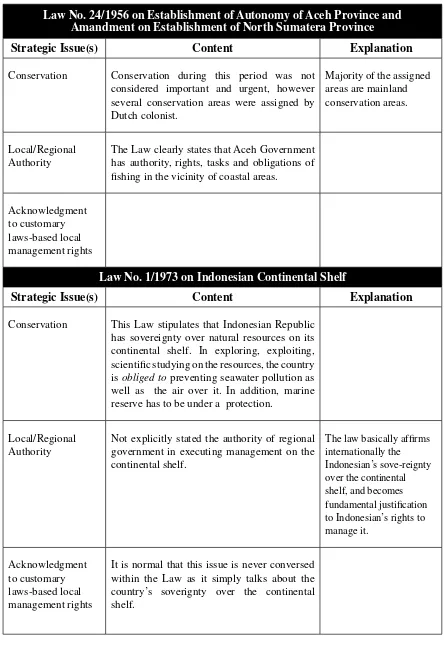
Table 1. Matrix. The Local Government Authorities Over Marine and Fishery Resources Based on by Sector Laws
Law No. 24/1956 on Establishment of Autonomy of Aceh Province and Amandment on Establishment of North Sumatera Province
Strategic Issue(s) Content Explanation
Conservation Conservation during this period was not considered important and urgent, however several conservation areas were assigned by Dutch colonist.
Majority of the assigned areas are mainland conservation areas.
Local/Regional Authority
The Law clearly states that Aceh Government has authority, rights, tasks and obligations of fi shing in the vicinity of coastal areas.
Acknowledgment to customary laws-based local management rights
Law No. 1/1973 on Indonesian Continental Shelf
Strategic Issue(s) Content Explanation
Conservation This Law stipulates that Indonesian Republic has sovereignty over natural resources on its continental shelf. In exploring, exploiting, scientifi c studying on the resources, the country is obliged to preventing seawater pollution as well as the air over it. In addition, marine reserve has to be under a protection.
Local/Regional Authority
Not explicitly stated the authority of regional government in executing management on the continental shelf.
The law basically affi rms internationally the Indonesian’s sove-reignty over the continental shelf, and becomes fundamental justifi cation to Indonesian’s rights to manage it.
Acknowledgment to customary laws-based local management rights
Law No. 5/1974 on Basics of Regional Government
Strategic Issue(s) Content Explanation
Conservation The issue is not regulated in the Law, but wheter it is there or not the authority of regional government in conservation is regulated in by-sector laws.
Local/Regional Authority
Regional governmentas the executive responsible for carrying out principles of decentralization, deconcentration, and provision of assistance are regulated in by-sector legislation regulations.
During the period, by-sector legislation that regulating marine and fi shery resources are widespread.
Acknowledgment to customary laws-based local management rights
The issue is relevant to this law.
Law No. 5/1983 on Indonesian Exclusive Economic Zone
Strategic Issue(s) Content Explanation
Conservation It clearly mentions that the state has power to conduct protection and conservation on its sea environment. Protection can be done through several methods, such as controling permits, upholding rights to pollution cases within EEZ, and ensuring maximum, sustainable yields.
Implementation methods are based on by-sector laws.
Law No. 9/1985 on Fishery (withdrawn and replaced with Law No. 31/2004 on Fishery)
Strategic Issue(s) Content Explanation
Local/Regional Authority
Regional government as the executive to implement principles of deconcentration and provision of assitance.
Acknowledgment to customary laws-based local management rights
According to the law, management and organization of fi shery resources are government’s absolute domain. The government employes the same administration to all aspects of organization, so that no space allowed for customary laws.
Law No. 5/1990 on Conservation of Bio-resources and the Ecosystem
Strategic Issue(s) Content Explanation
Conservation The law is to regulate conservation areas and conservation of each protected animal and plant including water conservation. There are three issues mainly discussed here, i.e. protection, preservation, and utilization. Regulations contained in the Law is applicable for both mainland and marine conservation.
Protection for protected
Local authority act as the responsible executive of some the delegated affairs and tasks. Also, to conduct the provision of assistance from central government.
Acknowledgment to customary laws-based local management rights
Acknowledgment is not explicitly mentioned, but if widely interpret, within a nature recreational areas is permitted cultural preservation activity.
Law No. 21/1992 on Shipping
Strategic Issue(s) Content Explanation
Conservation In order to maintain marine and fi shery resources, law maker has prepared particular Chapter on Preventing and Mitigating Pollutions by Ships. The chapter contains several rules as follows:
Each ship is forbidden to dispose garbage or other substances other than decided conditions.
Each ship’s captain and/or the crew is obliged to halt any kind of pollution sourced from his ship.
Each ship’s captain or other appointed leader is obliged to mitigate pollution sourced from his ship.
Each ship’s captain or other appointed leader is obliged to immediately report to the nearest authorities if there is pollution sourced from his ship .
The owner or ship’s operator is responsible to any pollution or contamination derived from his ship.
Local/Regional Authority
There is no any article explains about dele-gated authority to regional government
In order to conduct the implementation of sailing, the Law provides opportunities to government to collaborate
There is aknowledgement to community sailing.
Law No. 24 /1992 on Spatial Planning (withdrawn and replaced with Law No.26/2007 on Spatial Planning)
Strategic Issue(s) Content Explanation
Conservation The term space here is including land space, sea
or marine space, and air space that are as one united areas, space for human race and other living creatures to perform activity and maintaine the existence. The objective of this organization is to manage relations between various activities and the available space functions, so that quality space use is established. One of them is protection areas that contain conservation, rehabilitation, research, recreational objects, etc.
Local/Regional Authority
Acknowledgment to customary laws-based local management rights
This issue is not relevant.
Law No. 6/1996 on Indonesian Waters
Strategic Issue(s) Content Explanation
Conservation Utilization, management, protection, and conservation of Indonesian waters are conducted in reference to legitimate national legislation regulations and international laws.
Local/Regional Authority
This issue is not relevant
Acknowledgment to customary laws-based local management rights
This issue is not relevant This law regulates the sovereignty, rights, obligations and authority of Indonesia regarding to the sove-reignty.
Law No. 23/1997 on Management of Environment
Strategic Issue(s) Content Explanation
Conservation Environment management is done integrated amongst spatial planning, protection of non-biological resources, artifi cial resources,
conservation of biodiversity resources and the ecosystem, culture reserve, biodiversity, and climate change. The law has made every person obliged to maintain preservation, to prevent and mitigate pollution and destruction on the environment including marine environment.
Local/Regional Authority
The involvement of regional government managing the regional environment through delegating mechanism some of central govt.’s liabilities to local government to become the local’s domestic affairs.
Acknowledgment to customary laws-based local management rights
Governmental Regulation No. 15/1984 on Management of Biodiversity Resources in Indonesian Exclusive Economic Zone
Strategic Issue(s) Content Explanation
Conservation To conserve biodiversity resources, this regulation has banned fi shing activity within Indonesian EEZ using explosion, poison, electrifi cation, harmful substance or device. In the framework of conserva-tion, the regulation gives authority to Minister of Agriculture (currently Minister of Marine and Fishery) to assign allowable fi shing yields by kinds or groups of biodiversity resources in partly or entire Indonesian EEZ. The quota is based on data from research, survey, evaluation and/or yields of fi shing activities. Furthermore, the minister assigns allocation of fi shing ships along with type of equipments of each ship by considering permitted quota.
Local/Regional Authority
The regulation indicates that managing of biodiversity in EEZ is under the authority of central government.
Governmental Regulation No. 15/1990 jo Governmental Regulation No.46 /1993 on Fishery Enterprise
Strategic Issue(s) Content Explanation
Conservation In order to control the fi shery resources, therefore used controling mechanism i.e. review on fi shing assignment and or type of fi shing device by the authority releasing the permits.
Local/Regional Authority
1. Releasing Fishery Enterprise Permit (IUP) and Fishing Certifi cate (SPI) to fi shery enterprises domiciled and have headquarters in its jurisdiction based on certain rules.
2. Releasing Fishery Enterprise Permit (IUP) and Fishing Certifi cate (SPI) to fi shery enterprises who conducting freshwater, brackish-water, and seawater fi sh farming that not using foreign capital or employing foreign people.
3. Obtaining retribution as much 2.5% of total sale of captured yields and 1% of total sale of fi sh farming that obtained permits from the local government.
4. Obtaining revenues as much 30 % central govt.’s fi shery retributions.
Acknowledgment to customary laws-based local management rights
Not regulated.
Governmental Regulation No. 68/1998 on Nature Sanctuary and Nature Preserve
Strategic Issue(s) Content Explanation
Conservation As implementation regulation of Law No. 5/1990, contains detailed rules on conservation areas management.
Local/Regional Authority
Give consideration to assign buffer zone and nature sanctuaries.
Acknowledgment to customary laws-based local management rights
Not regulated
From the table above, it can be concluded three essential subtractions as the following lines:
In reference to legislation regulations above, throughout the episode, marine 1.
and fi shery management extensively dominated by governmental departments/ institutions such as Agriculture Dept., Indonesian Marine Corps/TNI-AL, Ministry of Environment, Forestry Dept., and Transportation Dept.
Regional/provincial power to conduct the management of its marine and fi shery 2.
domiciled in the administrative region only. It is obviously that the power or authority received was not intended for controlling its marine territory.
Almost no acknowledgment to customary laws-based management during this 3.
period.
2. During 1999 - 2004 Period
The year 1999 was recognized as decentralization milestone with the genesis of Law No. 22/1999 on the subject of Regional Government. The law made radical alteration in Indonesian governance system. Several profoundly changing dimensions comprise:
Scheme. The historical format put much emphasis on effi ciency and uniformity of 1.
regional government functioning, quite the reverse, the present format cracks down on democracy and diversity.
Centralization decadence. The new fomat stands up for decentralization. 2.
Dependence and organization. The primarily deep-seated relationships between 3.
District and Provincial government was dependence and subordinate. A new and radical system ensures independence and coordination.
Responsibility distribution. The earlier sharing affairs method had been initiated 4.
with specifying regional (district or provincial) government dealings, but now it changed to fi rstly specifying all government dealings belong to the central government authority and next hand over every single responsibility beyond its power to be regulated by the regional government.
Law No. 22/1999 confi nes regional government to unambiguous authorization in managing either marine or fi shery resources within its jurisdiction. At the same year, for Aceh povince in particular, was published Law No. 44 to legalize the implementation of special province of Aceh. The law formally stated that the self-government or autonomy organization of Aceh abides by Law No. 22/1999, over and above for given Aceh is granted special authority to individually conduct its religiousness existence, traditional persistence, and education and to entirely control the role of its spiritual leaders in formulating the provincial policies. Traditional or customary laws understood by rules or deportment founded on Islam law which consistently obeyed, respected and honored as philosophy of life since centuries. The establishment of the law has instituted traditional laws as lawful element of rules and regulation effective in across Aceh. Again, in 2004, regulation changes on local or regional government and administration of fi shery and marine resources took place by the issuance of Law No. 32/2004 and Law No. 31/2004, these laws regulate local or regional government and fi shery respectively.
The most fundamental issue of the Law is giving of more extensive possibility to administer its domestic affairs including economic resources, to empower and explore human resources and natural resources, to extensively develop aspiration, creativity, and democracy, to enhance local people’ involvement, to implement social structure that consistent with glorious values of Aceh’s people, to optimally function Provincial/District House of Representatives (DPRD) of Nanggroe Aceh Darussalam both in improving governmental services and putting on Islamic laws. By implementing diferent authorities, in the framework of exceptionality, Indonesian Government opens opportunity to increase the revenues of Provincial Government of NAD including potential additional revenues other than those governed in the law. The exceptionality has been precious chances to conduct adjustments on structure, organization, formation and name of government at the lower levels relevant with the soul and spirit of nasionalism that fi rmly united in glorious values of Aceh’s people. These adjustments offi cially administrated in regional or local regulations known as Qanun. The Qanun is the Local Regulations of NAD that able to set aside other legislation regulations based on principle of lex specialis derogaat lex generalis, and the Supreme Court is authoritative to examine substance of Qanun. The most common issue asscociated with managing resources of marine and fi shery regulated in Law No. 18/2004 is the fi nancial balancing, the profi t sharing of fi shery sector to be received by Aceh government is mentioned as much 80%.
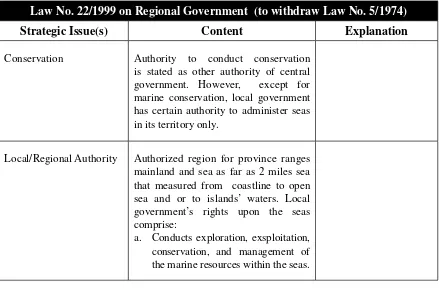
The following tables discover legislation regulations during a period of 1999-2004 associated with to a-three-key issues of the assessment, i.e. conservation of marine and fi shery resources, regional authority to manage the resources, and akcnowledgment to customary laws-based local management rights.
Table 2. Matrix. Products of Laws between 1999 – 2004 period about Marine and Fishery Issues
Law No. 22/1999 on Regional Government (to withdraw Law No. 5/1974)
Strategic Issue(s) Content Explanation
Conservation Authority to conduct conservation is stated as other authority of central government. However, except for marine conservation, local government has certain authority to administer seas in its territory only.
Local/Regional Authority Authorized region for province ranges mainland and sea as far as 2 miles sea that measured from coastline to open sea and or to islands’ waters. Local government’s rights upon the seas comprise:
b. Organizes administration matters. c. Designs spatial planning.
d. Law enforces to issued regulations either by regional govt or delegated by central government, and
e. Assists security and and upholds the state’s sovereignty.
District government’s authority is as to one-third of province’s sea boundary.
Acknowledgment to customary laws-based local management rights
Not regulated.
Law No. 44/1999 on Implementation of Exceptionality for Aceh Special Region Province
Strategic Issue(s) Content Explanation
Conservation The issue is not relevant
Local/Regional Authority Authority of governmentis based on Law No. 22/1999.
Acknowledgment to customary laws-based local management rights
Regional governmentcan assign numerous policies in order to empower, preserve, and develop the customs and its institution in its administrative territory. Regional governmentcan also develop traditional institution and or acknowledge the existing traditional institution that already fi t inits position at provincial, district/municaipal, subdistrict, village or gampong levels.
Law No. 18/2001 on Special Autonomy For Aceh Special Region As Nanggroe Aceh Darussalam Province
Strategic Issue(s) Content Explanation
Conservation Bide by Law No.22/ 1999.
Local/Regional Authority Bide by Law No.22/ 1999.
Acknowledgment to customary laws-based local management rights
among communities in NAD Province. Both institutions are no political and governmental institutions within the NAD Province.
Law No. 31/2004 on Fishery
Strategic Issue(s) Content Explanation
Conservation There are different efforts on ecosystem conservation, fi sh conservation, fi sh genetic con-servation. Conservation areas associated with fi shery such as coral reef, mangrove forest, swampy areas, lakes, rivers, etc are considered essential for conservation efforts. Types of conservation areas consist of marine reserve, marine park, marine recreational park, and or fi shery santuary.
Local/Regional Authority Delegation some of fi shery affairs from central governmentto regional governmentand the withdrawal are regulated in goverment regulation. Central government can delegate local governmentto carry out provision of assistance.
Acknowledgment to customary laws-based local management rights
Management on fi shery for fi shing and farming or cultivating has to consider customary laws and/or local wisdom as well as the local community’s participation.
Law No. 32/2004 on Regional Government (to withdraw Law No.22/ 1999)
Strategic Issue(s) Content Explanation
Conservation Authority to conduct conservation is stated as other authority of central government. However, except for marine conservation, local government has certain authority to administer seas in its territory only.
Local/Regional Authority Regional government has seas is given authority to manage its marine resources.
Regional government obtains profi t-sharing on the management of natural resources contained in under the basin and/or on the basin of its seas according to laegislation regulations.
Authority of regional governmentas mentioned in verse (1) consists of : a. Conducts exploration, exsploi-tation,
conservation, and management of the marine resources within the seas. b. Organizes administration matters. c. Designs spatial planning.
d. Law enforces to issued regulations either by regional govt or delegated by central government.
e. Assist security upholds, and
f. Assists defense and upholds the state’s sovereignty.
The authority to manage the resources as stated in verse (3) is as far as 12 (twelve) miles sea, measured from the coastline to the open sea and/or towards islands’ waters for province’s and 1/3 (one-third) of authorized province’s areas for district/municipal.
Darussalam, Papua, and Yogyakarta as long as not regulated specifi cally in separate law.
Acknowledgment to customary laws-based local management rights
The state acknowledges and respects unities of traditional community and the traditional rights forevermore that relevant to the state’s principles.
Governmental Regulation No. 19/1999 on Controling Sea Pollution and or Destruction
Strategic Issue(s) Content Explanation
Conservation In the form of protecting of sea quality which consists of efforts or actions to control and/or destruction. The efforts are to prevent or decrease the quality and/or destruction degree of marine resources.
Acknowledgment to customary laws-based local management rights
This issue is not relevant.
Governmental Regulation No. 25/2000 Central Govt’s Authority and Provincial Govt’s Authority as Autonomous Region
Strategic Issue(s) Content Explanation
Conservation Provided special space to discuss on marine resources and fi shery management.
Local/Regional Authority Provincial Government’s authority in managing marine and fi shery resources is on:
a. Arrangement and management of waters under provincial sea waters. b. Exploration, exploitation,
conser-vation, and management marine resources under the province’s sea authority.
c. Conservation and management of germ or sperm plasma specifi c to location as well as fi shery sanctuary within its jurisdiction.
d. Provision of permits to fi sh farming and captured fi shing within the province’s authority.
e. Monitoring of fi sh resources utilization under the province’s authority.
f. Management of mineral resources and non-oil and gas energy except radioactive under sea territory in between 4 and 12 miles.
g. Organization of environment management in utilizing marine resources in between 4 and 12 miles.
The district/municipal government’s authority is outside the provincial and central government.
Acknowledgment to customary laws-based local management rights
Governmental Regulation No. 141/2000 on Second Amandments of GovernmentRegulations No.15/1990 on Fishery Enterprise
Strategic Issue(s) Content Explanation
Conservation Not regulated
Local/Regional Authority Devide government authority into 2, i.e the provincial govt.’s authority and district/ municipal government’s authority. The province’s authority consists of :
1. Issuing Fishery Enterprise Permit (IUP), Fishing Certifi cate (SPI), Fish Transporting Ship Certifi cate (SIKPII), and Fish Transporting and Fishing Ship Certifi cate (SIKPPII) to fi shery enterprises or individual conducting fi shing in the sea under 12-miles regulations that domiciled in the administrative territory, that using iinboard motor ships that below 30 GT and or below 90 Horse Power and have headquarters in its administrative territory, and do not use both foreign capital and employee.
2. Issuing IUP to Indonesian fi shery enterprises that conducting fi sh farming in freshwater, in brackish water, and in the sea that do not use both foreign capital and employees.
The district/municipal’s authority con-sists of :
2. Issuing IUP to Indonesian fi shery enterprises that conducting fi sh farming in freshwater, in brackish water, and in the sea that do not use both foreign capital and employees.
Acknowledgment to customary laws-based local management rights
Not regulated.
Governmental Regulation No. 54/2002 on Fishery Enterprise
Strategic Issue(s) Content
Conservation Not regulated
Local/Regional Authority The province’s authority consists of:
Issuing Fishery Enterprise Permit 1.
(IUP), Fishing Certifi cate (SPI), Fish Transporting Ship Certifi cate (SIKPII), and Fish Transporting and Fishing Ship Certifi cate (SIKPPII) to fi shery enterprises or individual conducting fi shing in its sea territory that domiciled in the administrative territory, that using iinboard motor ships that below 30 GT and or below 90 Horse Power and have headquarters in its administrative territory, and do not use both foreign capital and employees.
2. Issuing IUP to Indonesian fi shery enterprises that conducting fi sh farming in freshwater, in brackish water, and in the sea that do not use both foreign capital and employees.
The district/municipal’s authority con-sists of :
Issuing Fishery Enterprise Permit 1.
(IUP), Fishing Certifi cate (SPI), Fish Transporting Ship Certifi cate (SIKPII), and Fish Transporting and Fishing Ship Certifi cate (SIKPPII) to fi shery enterprises or individual conducting fi shing in
the its sea territory that domiciled in the administrative territory, that us-ing iinboard motor ships that below 10 GT and or below 30 Horse Power and have headquarters in its admin-istrative territory, and do not use both foreign capital and employee.
2. Issuing IUP to Indonesian fi shery enterprises that conducting fi sh farming in freshwater, in brackish water, and in the sea that do not use both foreign capital and employees.
Acknowledgment to customary laws-based local management rights
Not regulated
The tables above indicate that signifi cant alteration over politic of laws has taken place. Conservation matters and ackowledgement to customary laws and rights have attained a formal legalization. For Aceh alone, the Qanun is admitted to have formal legalization for the existing traditional laws and has a binding authorization as well.
B. Post-Tsunami (between 2004-2007 period)
During the period government had released a number of policies to rehabilitate and reconstruct Aceh, among which are Perpu No. 2/2005, Presidential Regulation No. 30/2005, Law No.10/ 2005 on Board of Rehabilitation and Reconstruction of Areas and Livelihoods of NAD and Nias Island of North Sumatera, Presidential Regulation No. 69/2005 on Participation of Institution/Individual in terms of Grants for rehabilitating and Reconstructing Areas and Livelihoods of NAD and Nias of North Sumatera. Quite the reverse, there was change on law politic in Aceh with the ratifi cation of an MoU between Indonesian Government and Freedom Aceh Movement in Helsinki. The MoU had promoted the release of Law No. 11/2006 on Governance of Aceh. The law had called off Law No. 18/2001. Thus, in governing its province the Government of Aceh has no longer conformed to Law No. 32/2004 jo Law No. 18/2001, but the Law No.11/2006 as instead. Besides, the government has also released Law No.27/2007 on Management of Coastal areas and Smaller Islands that signed on 17 July, 2007.
Rehabilitation and Reconstruction 1.
can be comprehended as a constituent of central government organization, but according to Perpu No. 2/2005 the regional (district/provincial) government is also the ingredient of the BRR. Out of three positions in the BRR, Directive Council, Supervisory Council, and Executive Board, local or regional government occupies two positions, i.e. member of Directive Council and vice chairman of Executive Board (ex-offi cio); the last position held by Governor of NAD Province. As per Perpu No.2/2005, the BRR shall accomplish the liabilities in four years and be extended when necessary. It is therefore expected that the efforts to rehabilitate and reconstruct Aceh be coordinated and integrated within the regional policies and not simply central government’s program.
The Perpu has only been effective to Post-Disaster Regions which covering neighborhood of Nanggroe Aceh Darussalam Province and Nias Island of North Sumatera Province crashed by the earthquake and tsunami. Such restrictions have become imperative seeing that in addition to the Perpu No.2/2005, soon after turned into Law No.10/2005, Law No. 32/2004 on Regional Government and Law No. 18/2001 on Special Autonomy for Aceh Special Region as Nanggroe Aceh Darussalam Province have been in effect. These restrictions justifi ed the extent of BRR’s authority by Perpu No.2/2005 where the agency has been just authoritative to post-disaster neighborhoods whereas the other areas outside its power have absolutely gone to Aceh regional government’s power.
There are two issues pertaining to marine and fi shery management presented in Perpu No.2/2005:
Spatial planning; a.
Environment arrangement and natural resources management. b.
Rehabilitation and reconstruction program as mentioned in Perpu have been in accordance with the master plan arranged in Presidential Regulations No. 30/2005 on Master Plan of Rehabilitation of Region and Community’s Existence in NAD Province and Nias Island of North Sumatera Province.
Four major policies referred to as character for rehabilitation and reconstruction program on environmental and natural resources comprise: (1) restoring environmental capability and securing existing resources; (2) revitalizing natural resources based-economic activities of local community; (3) involving local people and empowering social institutions and local culture in order to address either calamities or regional development activities; and (4) re-establishing institutional system of natural resources and environment at government levels. These four policies widely known as “Blueprint” is contained in Master Plan of Rehabilitation of Region and Community’s Livelihoods in NAD Province and Nias Island of North Sumatera Province.
1. Policy on restoring environmental capability and securing existing resources.
prudently utilized seeing that re-development phases of restoration and reconstruction will demand a great deal native resources as basic substances of the development. Strategic of restoring the nature’s capacity of coastal areas and marine is as follows:
Recover coral reefs.
Focal actions encompass re-collecting and re-naming coral reefs, and re-structuring organizational mechanisms.
Rehabilitate and develop green-belt zone, pond areas and recreational forest areas that as regulated in the Spatial Planning and the coastal characteristics.
The green-belt zone is spreading-out trees that projected to keep alive and grown within a particular extent by the sides of waters. The green belt can exist by the seashores, by the rivers, by the lakes or basins or dams which intended for securing all shorelines or edge lines of sort types of waters from any violently natural power, e.g. abrasion, erosion, wave, wind, etc.
The green-belt zone concept has long been presented in the form of policies by all sorts of linked governmental institutions, for instance, the General Directorate of Fisheries through a Decree of General Directorate of Fisheries No. H.I/4/2/18/1975 that determines the width of green belt as 400 m of the average lowest tide lines; the General Directorate of Forestry through a Decree of General Directorate of Forestry No. 60/Kpts/DJ/I//1978 that decides the width of green belt as 50 m of the coastlines or 10 m of the riverbanks. Then, in 1984, through a joint decree between Indonesian Minister of Forestry and Minister of Agriculture, No. KB 550/246/Kpts/1984 and 082/Kpts-11/1984 that agrees on the width of green belt as 200 m along the sea-shores, forbids the cutting of mangrove in across Java Island, and commands to con-serve all mangroves in all smaller islands (less than 1,000 ha in size). In addition, in 1990, a Presidential Decree No. 32/1990 that determines the width of green belt as 130 times of a difference of maximum height of the rise and fall of the tides headed for the land.
From the all above policies, in context of coastal regions, it is perceptible that government owns planning or efforts to preserve the coastlines or coastal regions, although measurements of the green belts are varied and implementation in the fi eld frequently deviated or even completely disobeyed. Nevertheless, the tsunami tragedy has made all of us to accept how those concepts still relevant.
Activities:
To conduct rehabilitation on mangrove trees in the neighborhood where the plants previously planted.
Objective:
Completed activities consist of:
o Mapping condition of mangrove ecosystem both in NAD and Nias.
o Conducting assessment in relation to character and potency of coastal
regions.
o Developing planning on the implementation of mangrove forest rehabilitation
and other coastal re-greening.
o Formulating medium-term technical planning for rehabilitation of mangrove
forest and reforestation of other coastal plants.
o Conducting rehabilitation of mangrove forest in coast and pond areas (conforms
the spatial planning) with applying silvo-fi shery method (environmentally sound fi shery farming) either in separate or in integrated way.
o Developing institutional mechanism with the intention of guarding,
monitoring, and evaluating results of mangrove forest rehabilitation. To rehabilitate pond areas and critical habitat ecosystems.
Objective:
To restore ecological functions of both coastal ecosystem and critical habitats in order to improve values and functions.
Completed activities consist of:
o Integrating land-use spatial planning of pond farming or cultivating into
general provincial spatial planning.
o Establishing guiding principles for pond farming that based on sustainable
marine resources potency.
o Designing detailed planning on coastal zone that serves as protection, ponds,
and city recreational forest.
o Rehabilitating and re-arranging coastal ecosystem including pond farming
ecosystem via community’s participation.
o Organizing master plan and detailed design of every single area intended for
developing pond farming or cultivation.
o Carrying out rehabilitation on pioneering vegetation other than mangrove
in coastal regions corresponding to the character and aspiration of coastal villagers.
o Performing monitoring and keeping on biodiversity values within critical
habitats.
2. Policy on revitalizing natural resources based-economic activities of local community, strategy employed is:
Restoring and improving fi shery activity
In order to accelerate the local fi shermen’s and fi sh farmers’ livelihoods, as well as other coastal villagers, the Dept. of Marine and Fishery has striven thoroughly planned measures, mainly are directed to provide urgent economic activities or temporary livelihood to immediately develop job opportunities to afford each family. This form of facilitation was carried out in the fi rst year. The economic activities encompassed repairing vessels, cleaning up ponds, fi xing either structures or infrastructures.
The need of working capital in the preliminary step of economic restoration, either for fi shermen or fi sh farmers, has been sourced from certain allocated budget by the governments (National/Regional Budgets) or foreign grants. These funds, in turn, have been focused on empowering economic activities of coastal villagers, fi sh farmers, and small-scale fi shing.
Still in attempts to quickly restore the economic, the private sectors have been provided with technical assistance including structures and production structures for restoring the spawning industries such as fi sh processing unit, pumps, boats, catching equipments, dockyards, etc. but continual investments call for banking sectors’ or other private investment sectors’ partaking.
In the mid-term reconstruction phase, measures are concentrated on re-developing the whole system of processing industries and marketing of fi shing venture, fi sh cultivation, and alternative livelihoods development.
Extension efforts on fi shery executed through major activities, among which are: Rehabilitating captured fi shery.
Policies on provision for structures or facilities, for the fi rst year, prioritized to small-scale catching are to stimulate the fi shermen to go back to the sea.
Rehabilitating fi sh farming or cultivating.
This activity conducted by way of restoring and re-arranging ponds. Provision for cultivating facilities, in particular, salty and brackish water cultivating, granted to the farmers as working capital. The aids found in the form of seeds, woof, fertilizer, pesticide, medication, and cultivating equipment.
Rehabilitating both structure and infrastructure of fi shery.
Department of Marine and Fishery has planned to re-establish the training facilities- cultivation shops, SUPM (a school for middle-scale fi shery enterprise), spawning center, and other amenities- cracked up by the tsunami.
3. Policy on involving local people and empowering social institutions and local culture in order to address either calamities or regional development activities. Strategy employed is:
Engaging local community in the development implementation of marine and fi shery.
Laws No. 11/ 2006 on Governance of Aceh 2.
Laws regulating the governance of Aceh grant authority to the local government of Aceh to manage both of its marine and fi shery resources as to the following lines:
Provincial government and district/municipal government has the power to administer 1.
natural resources living in the seas of Aceh territory.
The authority to administer natural resources inhabiting seas of Aceh’s territory 2.
include:
Conserving and administering natural resources within the seas. a.
Organizing administration and permits of catching and/or fi sh cultivating. b.
Organizing marine, coastal, and smaller islands land-use spatial planning c.
Law enforcement towards regulations issued on sea or marine authority belong to its d.
authorization.
Maintaining customary laws and security, and e.
Actively participating in maintaining the sovereignty of Unitary State of Indonesian f.
Republic.
Provincial and district/municipal government of Aceh are authoritative to release permits 3.
on fi shing and other marine resources cultivation in seas in the vicinity of Aceh relevant with the owned authority.
Management of natural resources in the seas conducted with thoroughly considering 4.
sustainable development principles.
Permits for fi sh catching only valid for 12 miles away measured from coastline towards 5.
the open sea and or towards waters territory of islands (for province), and one-third of provincial authoritative territory (for district/municipality).
Unless stated in Article 165 verse 3, part c, not explicitly specifi ed in the laws sea territory to be under Aceh’s authority. However, if take notice of some regulations, for instance Article 1 No. 2 and Article 1 No. 4, there are repetitive clauses strongly state that Aceh is a province and the government of Aceh is provincial, thus it is very clear that seas territory belong to Aceh’s authority is equal to those of other provinces, that is 12 sea-miles. Law No. 11/2006 approves adequate open-space and recognizes customary or traditional institution and social institution.4
Law No. 26/2007 on Spatial Planning 3.
Law No. 26/2007 on Spatial Planning replacing the previous regulation, Law No. 24/1992. The law stipulates the authority of regional or provincial governmentas the following lines:
Authority of the provincial governmentin organizing land use or spatial plans includes: 1.
To organize, develop, and supervise the implementation of spatial plans for province, a.
district/municipality, and the implementation of land uses of strategic areas for both province, and district/municipality.
4
The implementation of provincial spatial planning. b.
The implementation of provincial strategic land uses, and c.
To cooperate a joint spatial planning with other provinces, and to facilitate joint spatial d.
plans with other districs/municipalities.
Authority of provincial governmentin the implementation of its provincial spatial 2.
planning as mentioned in Verse (1) point b includes: a. To plan spatial for its provincial areas.
b. To use or utilize its provincial land, and c. To control utilization of its provincial land.
In planning land use for provincial strategic areas as stated in Verse (1) point c, the 3.
provincal government makes: Assignment on its strategic areas. a.
Spatial plan for its strategic areas. b.
Land use of its strategic areas, and c.
Control of its strategic land uses. d.
The implementing of land uses and controlling of its strategic areas as intended in Verse 4.
(3) point c and d can be performed by district/municipal government through a provision of assistance.
In term of implementation of provincial land uses, provincial government can organize 5.
implementing instruction on land use for province and district/municipality.
In holding authority as stated in Verse (1), (2), (3), (4), and (5), provincial government: 6.
Disseminates informaton relating to: a.
General and detailed of spatial plans in the frame of provincial land-use 1.
implementation.
Directive on zoning regulations for province that arranged for controlling provincial 2.
land uses, and directive on implementing spatial planning. Provides standard minimum service on spatial fi eld.
b.
In case provincial governmentis not available to perform a standard minimum service for 7.
spatial planning fi eld, the central governmentshall take completeing measures appropriate to prevailing laws.
Meanwhile, the law also regulates authority of district and municipal government which are: Its authority to conduct spatial planning includes:
1.
a. To organize, develop, and supervise the implementation of spatial plans for district and municipality, and the implementation of land uses of strategic areas for both district and municipality.
2. Authority of district/municipal governmentin the implementation of its spatial planning as mentioned in Verse (1) point b includes:
a. To plan spatial for its district/municipal areas. b. To use or utilize its district/municipal land, and c. To control utilization of its district/municipal land.
3. In planning land use for district/municipal strategic areas as stated in Verse (1) point c, the provincal government makes:
a. Assignment on its strategic areas. b. Spatial plan for its strategic areas. c. Land use of its strategic areas, and d. Control of its strategic land uses.
In executing its authority as mentioned in Verse (1) and (2), district/municipal government 4.
shall refer to guidelines of spatial plan and its implementing directive.
In executing its authority as mentioned in Verse (1), (2), (3), and (4), district/municipal 5.
government:
Disseminates informaton relating
a. general and detailed of spatial plans in the frame of its land-use implementation, and
Provides standard minimum service on spatial fi eld b. .
In case district/municipal government is unavailable to perform a standard minimum 6.
service for spatial planning fi eld, the provincial government shall take completing measures appropriate to prevailing laws.
The law has provided an adequate amount of authority to each provincial, district/municipal government to plan its own spatial. The authority agrees with that owned by Aceh Province Government and other districts/municipalities as mandated in Law No. 11/2006 on Governance of Aceh. Affairs relating to spatial planning are obligation of NAD Government and its districts/municipalities.
4. Law No. 27/ 2007 on Development of Coastal Areas and Smaller Islands
The law, in view of conservation, gives a breathing space to ecosystem protection for both coastal areas and smaller islands, migration pathway safeguard for fi sh and other marine biotics and also the habitats, and the traditional culture situs preservation as well.
Meanwhile, in consideration of authority, the law gives the go-ahead to local government to:
Establish sea border that has been adjusted to characteristics of topography, bio-1.
physic, hydro-oceanography, economic and cultural needs, and other stipulations. Organize and/or make plans for accreditation of coastal areas an smaller islands 2.
Organize and/or make plans for accreditation of coastal areas an smaller islands 3.
development program within his/her power in accordance with the existing standard and guidelines (for district head/mayor).
Release HP-3 within a provincial jurisdiction up to a 12-mile away (for Governor). 4.
Release HP-3 up to a one-third coastal areas of its provincial jurisdiction (for district 5.
head/mayor).
Manage the coastal areas and the smaller islands within its administrative territory 6.
along with central government
Then, in a perspective of acknowledgment on customary laws-based community rights, the law has alloted space and access among traditional and local communities in coastal regions to keep on managing marine resources and coastal areas consistent with their traditional systems maintained for generations. In a general stipulation the term local and traditional communiy is explicitely stated and re-stated with Article 61. This is evidence for a recognition to their existence.
Quite the opposite, the presence of the law can trigger contradiction among other regulations, for instance: Law No. 11/2006 on Governance of Aceh. The law authorizes great power to it including to manage its coastal areas and the smaller islands. Meanwhile, Law No. 27/2007 on Development of Coastal Areas and Smaller Islands presents great authority to the Minister of Marine and Fishery.
CHAPTER IV
CUSTOMARY LAWS (
HUKUM ADAT LAÔT
) FOR MARINE IN
DEVELOPING THE MARINE AND FISHERY RESOURCES OF
NANGGROE ACEH DARUSSALAM PROVINCE
A. Hukum Adat Laot Developing Marine and Fishery Resources
In the concept of Aceh’s customary laws, environment or living space is a gift from the God that possesses strategic values for human race and other living creatures. The existence of environment has become an integral part to the entire continuation of the living organisms, including the human race. It is therefore indisputable that the existence of the living space have to always remain sustainable. Administering living environment in intelligent and prudent measures have been put into practice since many centuries and even been bequeathed to many generations. In implementing the management of marine environment, traditional institution of Panglima Laot applies values and concepts of local wisdom. This concept has been prolonged and preserved up till now.
B. Panglima Laot Institution
Speaking of designation, the title panglima (commander) for the top leader of adat laot institution is an exceptionality. At least, the title has revealed a function fi lled with power and position. It is demonstrated in daily roles he plays, fi rm attitude, even sometimes strict in making decision. There is no clear explanation on how long the Panglima Laot Institution has entered the traditional system of Aceh. According to several sources, the institution has long developed along with the Aceh Sultanate era, where one of the governmental proponent is the traditional institution. .
Because of its independence, the Sultan Iskandar Muda (1607-1636 AD) offi cially appointed Panglima Laot. Besides his chief responsibility to economy empowering of marine areas was also securing and defending the seas. In order to expand the tasks, to the Panglima Laot is given authority to organize court and execute every verdict it made. (T. Mohd. Juned: 2001:3) In the book “De Atjehers”, Snouck Hurgronje simply mentioned that pawangs (experts in cathcing fi sh) led the event in the sea was directed by a panglima (a commander). He and his men were elected by the pawangs in each teupin. The traditional land, where traditional laws are acknowledged, a panglima is called Lhok. Each Lhok seperated by natural boundaries (Snouck : 1985:318).
C. Role of Panglima Laot in Administering Lingkungan Laot (Marine or Sea Environment)
responsible for assisting local govt in succeeding fi shery development, preserving traditional laws and customs within community of fi shermen. In conducting his liability, Panglima Laot has responsibilities, among which are: to maintain and control stipulations of adat laws and adat-laot laws, to organize and monitor every fi shing activity on the seas, to resolve argument/ dispute among fi shermen and the groups, to arrange and organize traditional ceremonies associated with adat laot; to guard/watch over trees by the seashores from cutting; to act as bridging agent/mediator between fi shermen and govt.; and to improve standard living of coastal fi shermen.
In carrying out management of coastal and marine environment, the Panglima Laot is strict to customary or adat -laot laws. These laws contain traditional rules that have been maintained and taken care by fi shing community to keep in order either the fi sh cathcing activity or the living of coastal fi sherman community. Additionally, the laws can also role as fi ller to national positive laws, when the national laws lacks in the above stipulations.
The authorized regions of Panglima Laot ranges from coastal areas to the open sea. Physical space of coastal areas under the authority of Panglima Laot include bineh pasie (coast), leun pukat (areas for pulling land trawl), kuala and teupian (edges for landing boats, either nearing bay or river mouthes), and laot luah (open sea). According to Djuned, authority Panglima Laot over the the open seas, basically, follows the legal norms as to what extent marine resources can be economically managed by the institution. Physical spaces connected to coastal ecosystem comprises uten bangka (mangrove forests), neuheun (ponds), and lancang sira (salt fi eld).
Bineh pasie (coast) is counted from a spot where the wave fi rstly breaks to a place where annual vegetation do not grow, unless tapak kuda plants. It is a land area under the supervision of adat laot, therefore land-use utilization and alteration for the importance of community other than the fi sherman shall be on the agreement of local fi sherman.
Bineh Pasie is prone to natural factors such as abrasion. One of the factors that accelerates the abrasion is cutting down of guarding vegetations- the vegetations have been protected for generations - along the coast due to wood demand for charcoal industry, construction, and community ponds. Abrasion has been mostly responsible for narrowing of this area.
Leun Pukat area of Bineh Pasie used for pulling land trawls (either pukat banting or pukat Aceh). Leun Pukat stretches out from the shoreline to the sea, while measurement has been based on the need of a land trawl to arrive fi sh on the land. Leun Pukat is a protected area under customs and not permissive to other uses without agreement from local fi sherman community. Teupien is area where fi shermen disembark their boats. Landing boats can be done in a river mouth or Bineh Pasie. The river mouth under the authority of marine customs is a spot that traditionally operated for landing boats used as traffi c lanestowards the seas from a landing edge. As one of the activity center for the fi shermen on the way home from the sea, the utilization of this area is regulated and protected by customs. For that reason, the importance of the fi shermen over the area is continued and guaranteed
intrusion of salty water as well. In some other places like Aceh Besar and West Aceh, there is a customs that to whosoever has grown mangrove trees in certain area is given absolute right to own them. Yet, due to disarranged management the mangrove planting goes extensively and ownerships cannot be well recognized. One by one grown-up mangrove trees are cut down by the owner for preparing neheun (ponds), as a result, traditional mangrove forest get sharply shrinking. Hence, conserving mangrove for protecting coastal ecosystem is hard to be done since ownership changes on mangrove forest take place.
Uteun Aroen(pine forests) is a buffering zone for the coast containing pine trees. Waters near coastal areas with many pine trees, based on local fi shermen’ experience, are believed to be the most preferred place by certain fi sh, mostly mollusk, kakap(kind of large fi sh), kerapu (kind of sea fi sh), etc. as favorable temperature and climate nearby coastal area, that grown pine trees, has attracted those living creatures to inhabit it.
Uteun pasie (coastal forests) is a term for crown of forest trees growing along the seashore. Uteun pasie is forest area under protection for ecology balancing in coastal areas.
Coastal villagers in Aceh own local wisdom that organizes utilization of coastal areas, such as green belt protection. In the old times, the green belt was of bak aroen (pine trees) and protected by the custom. The customs claims that to whoever has dared to cut down the bak aroen will be sentenced to customs’ fi nes.
In the present time, customs on maintaining and protecting bak aroen has taken less notice, and more bak aroen has been logged. In fact, as to pawang’s experience, it has ecological function to keep the balance of ecology across the costal areas. The high adaptation ability to the coastal climate and seawater has made the bak aroen stays longer although its grounds swamped with seawater mostly when the tide rises. The most important economic benefi t of the green belt is to make certain kinds of fi sh approach the coast. Such condition has been exceptionally benefi cial to the fi shermen since they can fi sh in neighboring waters. In addition, bak aroen or sea pine trees can strengthen steeply sloping area or soil bond along the seashore they grow. Anchored in experience post-tsunami, the bak aroen can defend against fl ooded area caused by tsunami. These can be witnessed in the vicinity of Lhoknga Beach-Lampuuk, sub-district of Lhoknga Aceh Besar.
According to growing pattern, bak aroen grows vertically and forms strong trunk, bak siron forms shady crown sometimes with trunk bowing towards the sea. Roots of bak siron tightly grasp the soil to the side then stretch along the steeply sloping terrain and strengthen the steep terrain and the coastal areas. Economic benefi t of this vegetation is not widely studied, yet the bark has been used for fi ber to make rope. If bak siron massively developed, it is possible to make them used in certain industries.
Out of some vegetation proper for developing green belt in buffering zone is bak bunot. The vegetation is one of most strategic vegetation in the future with its great contribution to ship construction industry since bak bunot is one among the best wood for both boat and ship. Boat makers have been much depending on bak bunot manee for making framework of ships although it is getting rare. It is different than bak bunot that can grow by the coast even by coastal area with splash of seawater. The trunk still can get bigger and give added value if used for protecting in buffer zone.
There is no prohibition for the fi shermen to fi sh in a lhok during this time, unless rules on exploration of fi shing which regulate fi shing time, fi shing methods and permitted fi shing devices according to local the customary regulations. For fi shermen coming from outside the lhok must obey all customary regulations where they conduct current fi shing. Stipulations regulated in customary regulations are as follows:
D. PantangLaot Days (days when fi shermen prohibited go to sea)
Kenduri adat laot
This is a ritual feast held every 3 years or depending on agreement and capability of local fi shermen. Three days prohibited go to sea is counted from the dawn on the fi rst day of the festive to the sundown on the third day.
Hari Jum’at (Friday)
Prohibition is valid for all day long from the dawn on Thursdays to the sunset on Fridays.
Hari Raya Iedul Fitri (Ied El Fitr Holiday)
Not going to sea for 2 days from the dawn on Meugang day to the sunset on second day of Hari Raya.
Hari Raya Iedul Adha (Ied El Adha Holiday)
For 3 days from the sunset on Meugang day to the sunset on the third day of Hari Raya. Indonesian Independence Day, August 17th.
For 1 day, from the sunset on August 16th to the sunset on to the sunset on August 17th. 26 December
For 1 day from the sunset on 25 December to the sunset on 26 December. This restriction is to commemorate tsunami hit on 26 December 2004.
E. Penalty