• Tidak ada hasil yang ditemukan

The primer design of domain-specifi c C-terminus of the avian H5N1 NS gene from Indonesia

N/A
N/A
Protected

Academic year: 2019

Membagikan "The primer design of domain-specifi c C-terminus of the avian H5N1 NS gene from Indonesia"

Copied!
6
0
0

Teks penuh

(1)

The primer design of domain-specifi c C-terminus of the avian H5N1 NS

gene from Indonesia

Kindi Adam, Vivi Setiawaty

Center for Biomedical and Basic Technology of Health, National Institute for Health Research and Development, Ministry of Health of Indonesia

Correspondence address: Kindi Adam E-mail: [email protected]

Received: November 10, 2014; Revised: November 22, 2014; Accepted: November 26, 2014.

Abstrak

Latar belakang: Virus avian infl uenza (AI) H5N1 telah menyebabkan kematian hampir 600 orang di dunia sejak tahun 2003. Virus AI H5N1 masih beredar pada unggas liar dan domestik. Salah satu sifat patogenitas virus AI diketahui dari kemampuan protein nonstructural (NS1 dan NS2) dalam menginduksi badai sitokin. Mutasi yang terjadi pada protein NS1 dan NS2 dapat memperberat infeksi yang terjadi.

Metode: Sekuens genetik gen NS yang mengkode domain C-terminus dari virus AI H5N1 didapat dengan metode sekuensing menggunakan primer khusus untuk mengamplifi kasi gen NS. Desain primer dilakukan dengan menggunakan beberapa software bioinformatika yang tersedia kemudian primer diuji kembali untuk mengetahui keberhasilan dalam mengamplifi kasi sekuen target. Pengujian RT-PCR dilakukan pada empat isolat virus AI H5N1, dilanjutkan dengan sekuensing untuk mengetahui urutan basa nukleotida yang dihasilkan dari primer yang dibuat dalam penelitian ini.

Hasil: Primer yang didesain dapat mengamplifi kasi empat isolat H5N1 ayam yang diuji yaitu dua isolat dari Bali (A/Ck/Bali-KH/2009 dan A/Ck/Bali-T/2009), serta dua isolat dari Jawa Timur (A/Ck/Jawa Timur-S/2009 dan A/Ck/Jawa Timur-D/2009).

Kesimpulan: Primer yang didesain dapat digunakan dalam amplifi kasi PCR dan sekuensing gen NS yang mengekspresikan bagian C terminus dari protein NS1 dan bagian ujung NS2.

Kata kunci: avian infl uenza, H5N1, gen NS, C-terminus

Abstract

Background: The avian infl uenza (AI) H5N1 viruses have caused nearly 600 fatal cases in the world since 2003. The H5N1 AI virus is still circulating in wild birds and domestic. One of the known of AI virus pathogenicity is the ability of the nonstructural protein (NS1 and NS2) to induce cytokine storm. Mutations of the NS1 and NS2 proteins may aggravate infections.

Methods: Genetic sequences of NS gene that encodes the C - terminus domain of AI H5N1 virus were obtained by sequencing method using specifi c primer to amplify the NS gene. The primers design were done by using several bioinformatics software available then retested to determine the primer success in amplifying the target sequence. RT- PCR testing performed on four H5N1 AI virus isolates, followed by sequencing to determine the nucleotide sequences generated from the primer were prepared in this study.

Results: Primers, which can be designed to amplify four chicken H5N1 isolates tested were two isolates from Bali (A/Ck/Bali-KH/2009 and A/Ck/Bali-T/2009), and two isolates from East Java (A/Ck/East Java-S/2009 and A/Ck/East Java-D/2009).

Conclusion: The designated primer can be used in PCR amplifi cation and sequencing of genes that express NS section C terminus of the protein NS1 and NS2 end portion. The primer design of H5N1 NS gene

(2)

In Indonesia H5N1 avian infl uenza virus, which was

fi rstly detected from poultry in 2003, still continues to circulate until recently. Zoonotic transmission of H5N1 avian infl uenza virus continues to be a threat to the human population and causes pandemics, associated to the high number of fatal cases, mainly because of the lack of immunity against H5N1 avian infl uenza virus infection.1-3 H5N1 avian in uenza virus is different from usual infl uenza which infects humans (H1N1, H3N2, H1N1pdm09), it is able in inducing proinflammatory cytokines that cause hypercytokinemia (cytokine storm). The response of infl ammatory cytokine, especially that associated to TNFα in macrophages can be induced by a non-structural protein 1 (NS) gene.4,5 Nonstructural virus (NS) encodes two proteins, NS1 and NS2 which is also called the Nuclear Export Protein (NEP).

The cause of the pathogenicity of infl uenza A virus is still not clearly known. Several studies have shown that the pathogenicity of H5N1 infl uenza virus is related to NS1 and NS2 protein. NS1 protein activity is related to the transport of cellular RNA, splicing and translation. Pathogenic H5N1 infl uenza virus related to NS1 gene relates to the mutations in the amino acid position 92. If the position of the amino acids in the form of glutamate, it will cause the virus resistant to interferon (IFN) and Tumor Necrosing Factor (TNF). Meanwhile, if the position of the amino acids at 92 is aspartic acid in the form of the virus will be sensitive to IFN and TNF.6

C-terminal structural domain (effectors domain) of NS protein inhibits mRNA maturation and translocation of antiviral host’s cell by binding to the cleavage and Polyadenylation Specifi ty Factor (CPSF) and inhibit the function of PAB II.7 This domain is very important to support the function of RNA binding domain (RBD ). Dimerization of the two domains is very important for the NS1 protein to interact with RNA or proteins cellular from the host.8

NS2 protein is a protein encoded by the pattern of NS gene which has different reading frame from the NS1 protein. The role of NS2 protein in the pathogenicity of H5N1 infl uenza virus is still unclear. Some studies indicate that mutation of NS2 plays a role in the formation of Defective Particles Intervering (DI) which suppresses the cRNA synthesis from Polymerase protein acidic (PA).

This study aims at obtaining specifi c primer sequences that can amplify part of the NS gene, which encodes the C-terminus domain of the protein NS1 and NS2 of H5N1 avian virus isolates from Indonesia.

METHODS

Downloading the NS gene of Indonesia H5N1 AI virus isolates sequences from Gene bank did the primer design. A desired sequence position of 400-820 bases was performed using the software bio edit, 9 then, examination of primer candidate was performed in sustainable area at position 400 and after position 820. The length of desired primer was between 18-22 base pairs of nucleotides.

Some of primer candidates in accordance to the good terms primer was tested by using the primer search engine program which is available online. Online program which was used were primer3 and primary pearl. The analysis results of computer program includes GC content, temperature Tm, the percentage of possibility occurrence of primer-dimer and the percentage of linking at the 5’ and 3’ end from the primer which was tested based on the results of computer analysis of the selected one primer with the most optimal value to amplify the desired sequence properly.

Primers candidate were tested by performing an alignment with all genomes of other organisms to determine the possibility of having contact and produce false positive results. The test was conducted at the NCBI nucleotide BLAST web. Primer has been already tested, used to amplify the H5N1 virus from birds using RT-PCR.10 The amplicons were sequenced with the same primer and the results were aligned with the NS gene sequences that has been already existed in the Genebank.10

RESULTS

(3)

DQ095707 A/Quail/Shantou/911/05, AB450649 A/ quail/Nakhon Pathom/NIAH7562/2005, DQ351862 A/ chicken/Hebei/326/2005, DQ493193 A/chicken/Deli Serdang/BPPVI/2005, DQ493194 A/chicken/Tarutung/ BPPVI/2005, DQ493201 A/chicken/Vietnam/348/2005, EF124507 A/chicken/Hong Kong/947/2006, FJ784870 A/chicken/Hunan/3157/2006, GQ122531 A/ chicken/ East Java/ UT6031/2007, GU183419_A/chicken/ Jakarta/DKI-Nurs/2007 dan GU183426_A/ chicken/ West Java/ Smi-Biot/2008_2008.

At the sustainable position, forward and reverse primers were sought with Tm temperature which was not much different, the value of GC (%) approaching 50% and did not produce dimer and loops, with

ΔG limit approaching equilibrium (ΔG = 0) were calculated and analyzed using the program Prime3 and Tests on the website Perlprimer.11,12 Genebank database (http://blast.ncbi.nlm.nih.gov/Blast.cgi) indicates that the specifi c primer pairs made just attached to the NS gene of H5N1 avian infl uenza virus (Table 1).

Table 1. Forward and reverseprimer fragmentfor NSgen

Primer Secuentbase Gen fragment Product Tm GC (%)

NS 5’GCTTTCACAGAAGAAGGAGCA’3 NS (nt 445-832) 367 59,75 47.62

5’AAGCTGAAACGAGAAgGCTCT’3 59,79 47.62

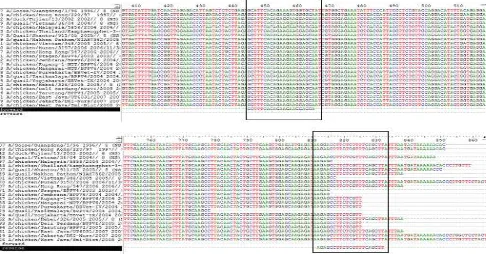
Further analysis of related sequences also conducted by calculating the sequence logos for all NS gene sequences of H5N1 AI virus from Indonesia that have been uploaded to the Genebank about 201 sequences (Figure 2).

Optimization of Reverse Transcriptase-Polymerase Chain Reaction (RT-PCR)

Based on the calculation result of GC value (%) and melting point (Tm), the temperature and cycle

optimization performed RT-PCR refers to the product manual and obtain optimal results for the reverse transcriptase at 50°C (30 min), followed by the initiation of denaturation at 94°C (5 min). Denaturation process which takes place at a temperature of 94°C (45 min), annealing temperature of 50°C (1 min) and extension at 72°C (2 min). The extension process was extended at the end of all cycles of PCR (fi nal extension) for 8 minutes. The reaction was stopped and the temperature was maintained at 4 ° C.

(4)

assumptions as Tm which is not much different, the value of GC (%) approaching 50% and did not produce the dimer and loops, with ΔG limit approaching equilibrium (ΔG = 0). This problem occurs when other parameters associated with viral replication mechanism which is not totally understood and the source of the specimen and a few amount of virus, so that using advanced technical primer design is required to do.13,14 NS gene sequences used as a reference in this primer design was chosen mainly from Indonesia H5N1 viruses that circulating since 2003 and also from other countries around Indonesia and China A/Goose/Guangdong/I/1996 as sequences reference.15 It is expected that the selected sequence from Indonesia will create the primers designed more specifi c.

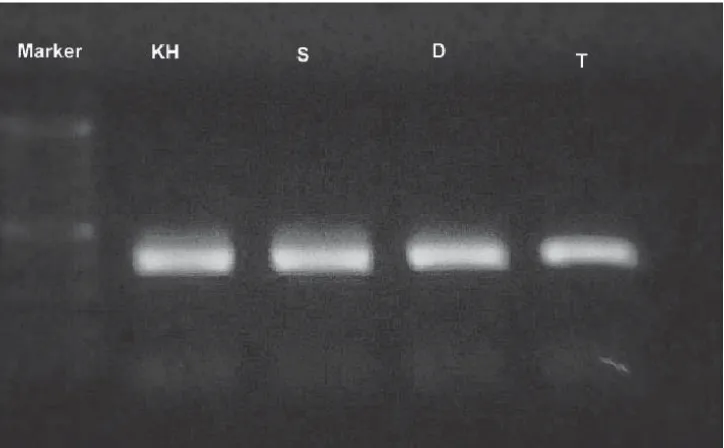
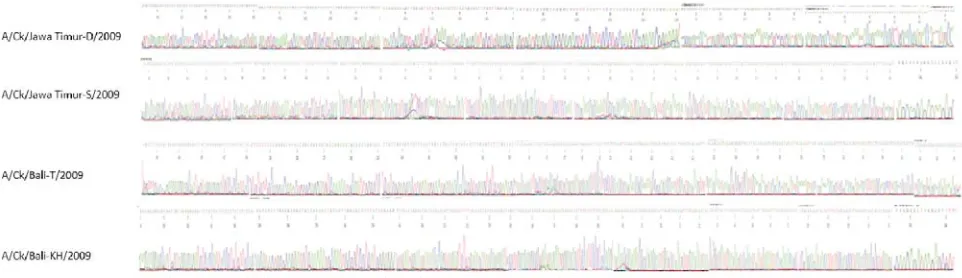
Amplicons generated from the RT-PCR were visualized using gel agarose (2%) and electrophoresis at a 100 volts for 35 minutes (Figure 3). Sequencing was performed to determine the nucleotide sequences generated from the primer conducted in this study (Figure 4). Designated primers were able to amplify four isolates of tested H5N1 from chickens. There were two isolates from Bali (A / Ck / Bali-KH / 2009 and A / Ck / Bali-T / 2009), and two isolates from East Java (A / Ck / East Java-S / 2009 and A / Ck / East Java-D / 2009).

DISCUSSION

Problem which usually encountered in this primer design is a primer that can instantly get used. The primer design in silicon used to see ideal primary

Figure 2. Consensus of primer logo sequences compared to 201 NS gene sequences of all Indonesia’s H5N1 infl uenza virus isolates published into Genebank; A: forward primer and B: reverse primer. The high rate of nucleotide code with number of bits 2 shows the level of sustainable confi dence about 100%.

(5)

In this study, we did not use primer from the previous publications because we need to catch the end of C-terminus of NS1 protein which has important role to sign viral pathogenicity of H5N1 AI viruses.16 The primer which has been used has not managed to get a piece of the C- terminus of the protein NS2 in the same gene with different reading frames. The essential amino acid position of protein NS2 is an amino acid sequence of 32 and 78.17,18 NS2 mutations at amino acid position 32 from isoleucine into threonine protein suppresses the formation PA.17 The normal expression of genes NS to develop NS2 protein requires viral replication process normally.

The role of NS2 in the mechanism of H5N1 infl uenza virus infection is supposedly the interaction with matrix protein 1 (M1). M1 protein has important role in the preparation of virus in main cell.19 The previous study by O’Neill et al in 1998 was the discovery of the amino acid segment of NS2 protein that interacts with the M1 so that it is also known as a binder M1 segment (position 59- 116) 20, 21 and segments which interact with Nuclear Export Signal (NES, positions 11-23).

Designated primers successfully amplify C-terminus of NS1 protein, known as the PDZ binding domain. Designated primer has not been able to get the sequences of C-terminus protein NS2, but managed to amplify the important position of the NS2 protein which has a role in the internal regulation of viral replication.

In conclusion, this study has successfully designed the primers that can be used to PCR amplifi cation and sequencing of the NS gene that can express C terminus of protein NS1 and NS2 proteins which are important in dealing with the NS2 protein activity in the host cell. Primer design methodology conducted

Figure 4. The sequencing results on clinical samples of poultry originates from East Java and Bali by using primers design to amplify the end of the C terminus of the NS gene of H5N1 AI virus

in this study can be used to design primers for the detection of other gene sequences.

Acknowledgments

We would like to express our gratitude for the guidance from Prof. DVM. Widya Asmara and the Laboratory of Microbiology, Faculty of Veterinary Medicine, Universitas Gadjah Mada, who has given the opportunity to do research. We also thanks to the National Institute of Health Research and Development for giving permission to conduct sequencing of isolates tested.

REFERENCES

1. Horimoto T, Kawaoka Y. Infl uenza: lessons from past pandemics, warnings from current incidents. Nat. Rev. Microbiol. 2005;3:591–600.

2. Taubenberger JK, Kash JC. Insights on infl uenza pathogenesis from the grave. Virus Res.2011;162:2– 7.

3. Gao HN, Lu HZ, Cao B, et.al. Clinical fi ndings in 111 cases of infl uenza A (H7N9) virus infection. N. Engl. J. Med.2013;368:2277–85.

4. Cheung CY, Poon LL, Lau AS, et.al. Induction of proinfl ammatory cytokines in human macrophages by infl uenza A (H5N1) viruses: a mechanism for the unusual severity of human disease? Lancet.2002;360:1831–37.

5. Chan MC, Cheung CY, Chui WH, et al. Proinfl ammatory cytokine responses induced by infl uenza A (H5N1) viruses in primary human alveolar and bronchial epithelial cells. Respir Res. 2005;6:1-13.

6. Soe SH, Hoffman E, Webster RG. Lethal H5N1 Infl uenza Viruses Escape Host Anti-viral Cytokines Responses. Nat Med.2002;8:950-54.

(6)

Nonstructural protein NS1 effector domain. J Mol Model. 2007;13:1237-44.

8. Bornholdt ZA, Prasad BV. X-ray Structure of NS1 Effector Domain. Nat Structur. Mol. Biol. 2006;13:559-60.

9. Hall TA. BIOEDIT: a user-friendly biological sequence alignment editor and analysis program for windows 95/98/NT. Nucleid Acid Symposium series.1999;41:95-8. [cited 2014 November 12]. Available from http:// www.mbio.ncsu.edu/RNaseP/info/programs/ BIOEDIT/bioedit.html.

10. Viseshakul N, Thanawongnuwech R, Amonsin A, et.al. The genome sequence analysis of H5N1 avian infl uenza A virus isolated from the outbreak among poultry population in Thailand. Virology.2004;328:169-16. 11. Untergrasser A, Cutcutache I, Koressaar T, et.al.

Primer3 - new capabilities and interfaces. Nucleic Acids Research.2012;40(15):e115.

12. Marshall OJ. PerlPrimer: cross-platform, graphical primer design for standard, bisulphite and real-time PCR. Bioinformatics.2004;20(15):2471-22.

13. Innis MA, Gelfand DH. Optimization of PCRs in PCR protocols: A guide to methods and applications (Innis MA, Gelfand DH, Sninsky JJ, and White TJ, Eds). San Diego; Academic Press, Inc. 1990; p.3-12. 14. Kampke T. The reference point method in primer

design. In PCR primer design (Yuryev, A. Ed), Hamuna Press, Totowa, Ney Jersey 07512.2007;p.75-92.

15. Xu X, Subbarao K, Cox N, et al. Genetic characterization of the pathogenic infl uenza A/Goose/Guangdong/1/96 (H5N1) virus: similarity of its hemagglutinin gene to those of H5N1 viruses from the 1997 outbreaks in Hong Kong. Virology. 1999; 261:15–9.

16. Jackson D, Hossain MJ, Hickman D, et.al. A new infl uenza virus virulence determinant: the NS1 protein four C-terminal residues modulate pathogenicity. Proc. Natl. Acad. Sci. USA.2008;105:4381–86.

17. Odagiri T, Tominaga K, Tobita K, et al. An amino acid change in the non-structural NS2 protein of an infl uenza A virus mutant is responsible for the generation of defective interfering (DI) particles by amplifying DI RNAs and suppressing complementary RNA synthesis. J Gen Virol. 1994;74:43-53.

18. O’Neill RE, Talon J, Palese P. The infl uenza virus NEP (NS2 protein) mediates the nuclear export of viral ribonucleoproteins. EMBO J. 1998;17:288–26. 19. Schmitt AP, Lamb RA. Infl uenza virus assembly

and budding at the viral budozone. Adv Virus Res. 2005;64:383–416.

20. Ward AC, Castelli LA, Lucantoni AC, et.al. Expression and analysis of the NS2 protein of infl uenza A virus. Arch Virol.1995;140:2067–73. 21. Akarsu H, Burmeister WP, Petosa C, et.al. Crystal

Gambar

Table 1. Forward and reverseprimer fragmentfor NSgen
Figure 2. Consensus of primer logo sequences compared to 201 NS gene sequences of all Indonesia’s H5N1 infl uenza virus isolates published into Genebank; A: forward primer and B: reverse primer
Figure 4. The sequencing results on clinical samples of poultry originates from East Java and Bali by using primers design to amplify the end of the C terminus of the NS gene of H5N1 AI virus

Referensi

Dokumen terkait