Natural Science: Journal of Science and Technology ISSN-p: 2338-0950 Vol 7 (3) : 358 – 370 (Desember 2018) ISSN-e: 2541-1969
Has
Nepenthes pitopangii
Chi C. Lee, S. Mc Pherson, Bourke & M.
Mansur a rare and endemic flowering plant of Sulawesi, been extinct in its
original nature?
Ramadhanil Pitopang1), Irmasari Thaha2) , Andi Lagaligo Amar3) andChien C. Lee4)
1)Department of Biology, Faculty of Mathemathics and Natural Sciences, Tadulako University, Kampus Bumi Tadulako Tondo,
Jl. Soekarno Hatta Km 8, Tondo Palu, Indonesia. Tel../ Fax : +62 (0451) 422 844, Mobile : +62 852 8856 0451,
2)Department of Forest Management, Faculty of Forestry, Tadulako University. Kampus Bumi Tadulako Tondo,
Jl. Soekarno Hatta Km 8, Tondo Palu, Indonesia
3) Department of Animal Husbandry, Faculty of Animal Husbandry and Fishery Sciences, Tadulako University
4) Peti Surat P.60, Pejabat Pos Pending 93457 Pending, Sarawak, Malaysia
Tel: +60 (0) 19 8588817
ABSTRACT
Nepenthes pitopangii Chi C. Lee, Mc Pherson, Bourke & M. Mansur (Nepenthaceae), is an endemic pitcher plant to Sulawesi. The population of this plant at its type locality is only two individuals, on the other hand human activities like rattan and dammar collecting by local community and ecotourism activity have contributed to a decline in the population. The purpose of this research is to assess the current condition of the habitat of Nepenthes pitopangii at its type locality in Lore Lindu National Park. Field work was done in the period of September 2016-September 2017. The vegetation of Nepenthes pitopangii habitat was studied by using botanical exploration methods. The result showed that both location had been heavily damaged due to habitat human activities with no further evidence of the precense of N pitopangii at either site. Additionally, We noted a number of plant species arround the habitat which were widespread in montain forest of Lore Lindu National Park such as Xanthomyrtus angustifolia (Myrtaceae), Weinmania lucens (Cunoniaceae), Vaccinium palawanensis (Ericaceae), Phyllocladus hypophylus (Podocarpaceae), Drymis piperita (Proteaceae), Gleichenia vulcanica, Stricherus truncatus, Lycopodiella cernua and Dicksonia blumei .
Natural Science: Journal of Science and Technology ISSN-p: 2338-0950 Vol 7 (3) : 358 – 370 (Desember 2018) ISSN-e: 2541-1969
INTRODUCTION
Nepenthes spp are unique and
beautiful flowering plant. Locally in
Malesian region, some species are utilized
for cooking especially rice dishes,
medicinal uses and for making rope. Many
of Nepenthes species are cultivated and
across the world as ornamental plants.
Cheek and Jebb (2001) reported eight (8)
species of Nepenthaceae for Sulawesi, of
which four species are endemic. These
numbers are comparatively low compared
to the neighboring island of Borneo, where
there are more than 30 species, of which
70% are endemic. Less species of
Nepenthes in Sulawesi may be due to a
lack of botanical exploration in Sulawesi,
but in recent years several new species
have been described from Sulawesi, such
as Nepenthes pitopangii (Lee et al 2009),
Nepenthes undulatifolia (Lee et al, 2009 in
Mc Pherson 2009), Nepenthes nigra (Nerz
et al, 2009 in Mc Pherson 2009) and
Nepenthes minima (Cheek and Jebb 2016).
Nepenthes pitopangii Lee, Mc
Pherson, Bourke & Mansur, endemic to
the Indonesia island of Sulawesi. It was
first collected by the author with
Holotypus: RP. 2054 (CEB) dated 30 May
2007 from Lore Utara District, Poso
Regency in the montane forest of Lore
Lindu National Park, Central Sulawesi.
The species is named for Dr. Ramadhanil
Pitopang, a curator of the Herbarium
Celebense (CEB) Universitas Tadulako
Palu, who has studied the flora of Central
Sulawesi for over 18 years (Lee et al.
2009).
Nepenthes pitopangii is represents
an interesting contribution to the flora of
Sulawesi, together with a number of other
plants which is recently described as a new
species for science that comes from
Sulawesi in particular of biogeography
Wallacean region. On the other hand,
human activities such; i) forest convertion
into cacao plantation (Steffan-Dewenter et
al, 2007), ii) rattan and dammar collecting,
and iii) ecotourism activities like bird
watching as well as mountainaring have
lead to change on ecosystems and
biodiversity in the region. Many studies
have showed that the decline in the
population of some species in this region,
even tend to be scarce due to those human
activities (Pitopang et al 2004; 2012a ;
Gradstein et al 2007).
The purpose of this research is to
study the current condition of the habitat
of Nepenthes pitopangii at its original
environment in Lore Lindu National Park,
Central Sulawesi Indonesia.
II MATERIALS AND METHODS Research Sites
Study area
The study is conducted in two
Natural Science: Journal of Science and Technology ISSN-p: 2338-0950 Vol 7 (3) : 358 – 370 (Desember 2018) ISSN-e: 2541-1969
i.e. Helipad station at 01
0
18’ 33.9” S
and 120
0
18’33,1” E with alt. 1900 m asl.
and Torenali at 01
0
19’ 788” S and 120
0
19’ 697” E with alt. 1700 m asl. Those
research sites are located at Sedoa village,
Lore Utara District Poso Regency (Fig.1)
Figure 1. Map of research site (yellow spot, track path toward to Mt. Rore Kautimbu) at the eastern part of the Lore Lindu National Park, Central Sulawesi, Indonesia.
Field sampling
Field work was made in the periode
from September 2016 - September 2017.
All plants species which are growing
surrounding the habitat of Nepenthes
pitopangii were recorded by using
“botanical exploration methods” (van
Balgooy and Tantra 1986). Voucher
specimen for all plant material with
flowers and fruits were collected in sets of
at three (3) duplicates and deposited in
Herbarium Celebense (CEB) and
Laboratory of Biodiversity Faculty of
Mathematics and Natural Sciences
Tadulako University Palu. Identification
was done in the field, in CEB, and in the
Laboratory of Biodiversity Faculty of
Mathematics and Natural Sciences
Tadulako University Palu
The diversity of wildlife such as
species of avifauna and mammals were
recorded based on the results of direct
observation and interviews from the local
Natural Science: Journal of Science and Technology ISSN-p: 2338-0950 Vol 7 (3) : 358 – 370 (Desember 2018) ISSN-e: 2541-1969
parameters including air temperature,
relative humidity, pH were measured.
The relative humidity at the start and end
of the exposure period were measured
using a digital thermo-hygrometer
(CoronaRModel: GL 99), whereas
precipitation data obtained from
Meteorological Geophysical Palu
Secies distribution
Phytogeographical of plant species
were obtained from Flora Malesiana series
(de Laubenfels, 1988 ; Sleumer 1966 ;
Nooteboom 1988; Mabberley, Pannell and
Sing 1995 ; de Wilde 2000, Kanis 1971 ;
Kalkman 1993; Supadmo 1972 and
complemented and updated by checking the
collection in the Herbarium Celebense
(CEB), Palu.
RESULTS AND DISCUSSIONS
Habitat Characteristic
Based on the observation to the
natural habitat of Nepenthes pitopangii at
two research sites in the Lore Lindu
National Park the habitat type was
classified to high montane forest of
Sulawesi (Whitten et al 1987). The
geographical position and characteristic of
habitat Nepenthes pitopangii Lee is
presented in Table 1.
Table 1. The geographical position and characteristic of habitat Nepenthes pitopangii Lee in both research sites in Lore Lindu National Park.
No Parameter Research sites
Torenali Helipad
1 Geographical
position *
Longitude (S) Latitude (E)
010 19’ 788 1200 19’ 697”
01o 18’33.9” 120o18’ 33,1
2 Altitude (m asl.) 1700 1900
3 Habitat
description
Lightly disturbed natural montane forest, many large tree surrouding the habitat, soil surface very wet, associated with ferns. Habitat was disturbed by human activity,
Secondary vegetation, open area, small rock on the soil surface, associated with ferns, Vaccinium (Ericaceae), Phyllocladus hypophyllus.
4 Canopy cover
(%)
60 20
5 Relative
Humidity (%)**
77 – 85% 77 – 85%
6 Temperature (o C)**
Maximum Manimum
26-36 12-17
Natural Science: Journal of Science and Technology ISSN-p: 2338-0950 Vol 7 (3) : 358 – 370 (Desember 2018) ISSN-e: 2541-1969
7 Rainfall (mm)** 3,000 3,000
8 Soil condition Nitrogen content (%)
Phosphor (ppm)
0.1
4.21
0.1
4.01 Notes: * = Direct measurement, ** = LLNP (2002), *** Saleh et al (2013)
Our survey of Nepenthes pitopangii
foccused on two different reseach sites
(Torenali and Helipad). Both of the sites
were the location where this species first
collected and found in Lore Lindu
National Park. There are some different
characteristics of the habitat. Research site
1 (Torenali) is very close to the track to
Mt.Rorekautimbu. There are large tree
species surrounding the habitat. While
research site II (Helipad) is characterized
by secondary vegetation on small rock on
the soil surface. Both of research sites are
situated in Montane forest of Lore Lindu
National Park, Central Sulawesi,
Indonesia. The location shows small-scale
disturbances very close-by the path toward
to Mt. Rore Kautimbu at the altitude 1650
m asl with relative humidity between
77-85%, daily temperature between 26-36o C
(maximum), 12-17o C (minimum) and
annual rainfall 3,000 mm/year. The
characteristic of soils are very rich in
accumulation organic matter and classified
into Glesols, Folic histosol, Folic
cambisols (IUSS WRB, 2014) developed
on granite rock on level terrain on gently
sloping ridges or mid-slope terraces.
Plant diversity
We conducted a field exploration to
check the presence of the species of
Nepenthes pitopangii in their original
habitat, as well as to study the diversity of
plant species around the habitat using
botanical exploration methods. There were
fourty (40) plant species recorded from
both research sites. Is was consisted of 27
species from research site 1 (Torenali) and
18 from research site II (Helipad)
respectively. List of plant species is
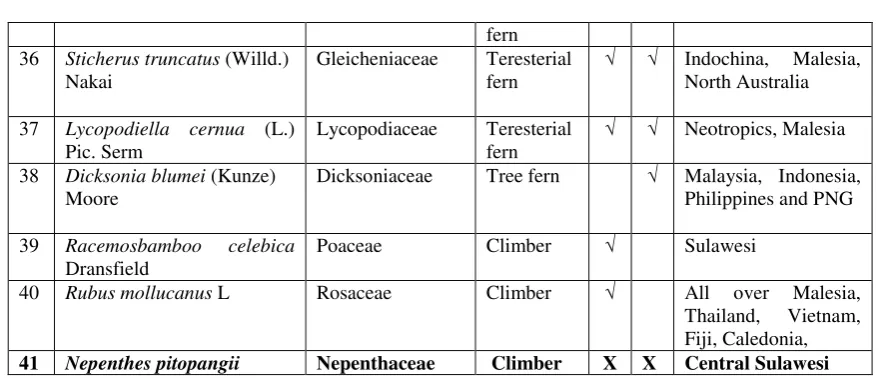
provided in Table 2.
Table 2. List of plants species that growing surround the habitat of Nepenthes pitopangii Lee in the studied area :
No Botanical Name Family Habitus Sites Distribution I II
1 Castanopsis accuminatisima Rehder
Fagaceae Tree √ √ Malesia 2 Lithocarpus celebicus
(Miq.) Rehder
Fagaceae Tree √ Sulawesi, Filipina 3 Pandanus sarasinorum
Warb
Pandanaceae Tree √ √ Endemic Sulawesi 4 Neolitsea javanica (Blume)
Backer
Natural Science: Journal of Science and Technology ISSN-p: 2338-0950 Vol 7 (3) : 358 – 370 (Desember 2018) ISSN-e: 2541-1969
5 Adinandra celebica Koord. Theaceae Tree √ Endemic Sulawesi 6 Eucalyptus deglupta Blume Myrtaceae Tree √ Sulawesi, Mindanao,
Seram, papua 7 Quintinia apoensis (Elmer)
Schltr.
Parachrypiaceae Tree Central Sulawesi, Papua
8 Gastonia serratifolia (Miq) Phillipson
Araliaceae Tree √ √ Malesia 9 Acronychia trifoliata Zoll.&
Moritzi
Rutaceae Tree √ Malesia 10 Pinanga caesia Blume Arecaceae Tree √ Endemic 11 Acmena accuminatisima
(Blume) Merr. & L.M. Perry
Myrtaceae Treelet √ √ Malesia
12 Litsea ferruginea Blume Lauraceae Tree West Malesia 13 Drimys piperita Hook.f Winteraceae Treelet √ Sulawesi, Borneo,
Papua, Malesia 14 Santiria sp Burseraceae Treelet
15 Weinmannia lucen Baker Cunoniaceae Treelet √ Sulawesi, Filipina 16 Pittosporus mollucanum
(Lam) Miq.
Pittosporaceae Treelet √
17 Eurya accuminata DC Theaceae Treelet √ Malesia 18 Phyllocladus hypophyllus
Hook
Phyllocladaceae Tree √ Sulawesi, Wallacea, Papua, New Guinea, Filipina, Kalimantan 19 Dacrycarpus imbricatus
(Blume) de Laub
Podocarpaceae Treelet √ Malesia 20 Vaccinium palawanense
Merr
Ericaceae Shrub √ Sulawesi, Filipina 21 Psychotria celebica Miq. Rubiaceae Shrub √ Endemic Sulawesi 22 Xanthomyrtus angustifolia
A.J. Scot
Myrtaceae Shrub √ √ Sulawesi, Papua 23 Litsea ferruginea Blume Lauraceae Treelet East Malesia 24 Viburnum amplificatum J
Kem
Caprifoliaceae Treelet √ Borneo, Sulawesi 25 Macaranga cf.costulata Pax
& K.Hoffm
Euphorbiaceae Treelet √
26 Themeda arguens L Poaceae Herb √
27 Rubiaceae Herb √
28 Anaphalis javanica (DC.) Sch.Bip.
Asteraceae Herb √ Sumatra, Java, Borneo, Sulawesi, PNG
29 Mischocarpus sundaicus Blume
Sapindaceae Shrub √ 30 Agathis celebica (Koord.)
warb.
Araucariaceae Tree √ Sulawesi, Filipina 31 Trachymene acerifolia C.
Norman
Umbeliferae Herb √ Lesser Sunda, Sulawesi
32 Nepenthes mirabilis (Lour) Rafarin
Nepenthaceae Climber √ Malesia, North Australia, Cambodia, Laos, Myanmar, China (Hainan) 33 Dissochaeta celebica Blume Melastomataceae Climber √ Endemic Sulawesi 34 Dipteris conyugata Reinw. Teresterial
fern
Natural Science: Journal of Science and Technology ISSN-p: 2338-0950 Vol 7 (3) : 358 – 370 (Desember 2018) ISSN-e: 2541-1969
fern 36 Sticherus truncatus (Willd.)
Nakai
Gleicheniaceae Teresterial fern
√ √ Indochina, Malesia, North Australia 37 Lycopodiella cernua (L.)
Pic. Serm
Lycopodiaceae Teresterial fern
√ √ Neotropics, Malesia 38 Dicksonia blumei (Kunze)
Moore
Dicksoniaceae Tree fern √ Malaysia, Indonesia, Philippines and PNG 39 Racemosbamboo celebica
Dransfield
Poaceae Climber √ Sulawesi
40 Rubus mollucanus L Rosaceae Climber √ All over Malesia, Thailand, Vietnam, Fiji, Caledonia,
41 Nepenthes pitopangii Nepenthaceae Climber X X Central Sulawesi
Data source : Primary data (2017). √ = present, X = absent
The result of observation showed
that there was no more Nepenthes
pitopangii at both habitat (Table 2 and
Figure 2). We noted that habitat destruction
of species might be due to the fact that
both sites are easily accessed by the people
and visitors of the Park. Both of the
habitats are located on the hiking trail to
Mount Rorekautimbu. It was previously
used by vehicles transporting timber by
Forest Concession Company (“HPH Kebun
Sari”) and helipad formerly used for helicopter landing. Both locations indicated
that the habitat was disturbed by the people
who acrossed this place for several
purposes like hiking as well as damar and
rattan collection. The extinction of
Nepenthes pitopangii might also be caused
by the people who illegally collected the
specimen without permission from park
authority. However, it was suspected that
such species still exist, but it still needs
exploration effort intensively to ensure the
presence of species. The limited of time,
the difficulty of terrain and the presence of
military operations in the region were also
a limited factor in revealing the existence
of the species.
In Lore Lindu National Park,
Central Sulawesi, especially in the
mountain forest around the route to Mount
Rorekautimbu and surrounding areas was
reported as many as 5 species of
Nepenthes namely: Nepenthes pitopangii,
Nepenthes tentaculata, Nepenthes maxima
and Nepenthes nigra (Lore Lindu
National Park Office, 2016).
As one of the main tourist
destination in Lore Lindu National Park,
the area around the Rorekautimbu
mountain was visited by many domestic
and international tourists, because the
location is very easy access from Palu, the
Capital city of Central Sulawesi Province.
Besides, the region is the home of the
Natural Science: Journal of Science and Technology ISSN-p: 2338-0950 Vol 7 (3) : 358 – 370 (Desember 2018) ISSN-e: 2541-1969
diversity, especially the mountain flora
and fauna of Sulawesi. (LLNP, 2016).
The area was also very important for local
people (ethnically called "Topo Baria")
who lived around the village of Sedoa,
where most people had livelihoods to
collect resin of damar and rattan (Alberta
M, village leader, 2018, pers. comm.)
Based on IUCN Red list
(http://www.iucnredlist.org/details/4900091
5/0, 2017) and Lee et al. (2009) that
conservation status of Nepenthes pitopangii
is categorized as vulnerable under criterion
D2 which lies within a protected area (PA).
However, the PA site supports just one
plant, which appears to be under threat
from plant collectors. The area of
occupancy and extent of occurrence are
both 8 km2. Fortunately, the other known
locality supports a few hundred plants
(population size is about 400 mature
individuals) and it is probable that other,
undiscovered subpopulations exist.
Nevertheless, based on current knowledge,
the conservation status of N. pitopangii has
the potential to change suddenly given the
threat of collection and the species would
benefit from a systematic monitoring
programme. The species is listed on CITES
Appendix II.
The major vegetation of habitat
Nepenthes pitopangii were composed by
Castanopsis accuminatisima (Fagaceae),
Lithocarpus celebicus (Fagaceae),
Pandanus sarasinorum (Pandanaceae),
Neolitsea celebica (Lauraceae), Agathis
celebica (Podocarpaceae), Adinandra
celebica (Theaceae), Eucalyptus deglupta
(Myrtaceae), Phylocladus hypophyllus,
Quintinia apuensis, Gastonia serratifolia,
Pinanga caesea (Arecaceae), Santiria sp,
Acmena accuminatisima (Myrtaceae) and
Listea feruginea (Lauraceae). Sapling and
shrub species were Pittosporum
moluccanum, Eurya accuminata, Gastonia
seratifolia, Drymis piperita, Phyllocladus
hypophyllus, Litsea feruginea, Weinmania
sp, Magnolia vriescana, Vaccinium
palawanensis and Xanthomyrtus
angustifolius. There were some species of
herbs such as Themeda arguens, Anaphalis
javanica, Mischocarpus sundaicus and
Trachymene acerifolia. We also noted a
pitcher plant Nepenthes maxima, an
endemic climber bamboo
(Racemosbamboo celebica). Some species
of teresterial fern such as Dipteris
conjugata, Gleichenia vulcanica,
Stricherus truncatus, Lycopodiella cernua
and Dicksonia blumei were found.
Vegetation of habitat is the main
constituent of mountain forests of Sulawesi
in Lore Lindu National Park which is rich
in Fagaceae-Myrtaceae, some of which are
endemic to Sulawesi such as Pandanus
sarasinorum (Pandanaceae), Adinandra
celebica (Theaceae), Quintinia apoensis
Natural Science: Journal of Science and Technology ISSN-p: 2338-0950 Vol 7 (3) : 358 – 370 (Desember 2018) ISSN-e: 2541-1969
Racemosbamboo celebica. Some species
such as Eucalyptus deglupta (Myrtaceae),
Drymis piperita (Proteaceae), Weinmania
lucen, Phyllocladus hypophyllus,
Vaccinium palawanensis, Xanthomyrtus
angustifolia (Myrtaceae), Litsea ferruginea
(Lauraceae), Agathis celebica
(Araucariaceae) have limited distribution in
Sulawesi, the Philippines and eastern part
of Malesia. The flora of Mt Rorekautimbu
was formerly known from the floristic
studies of van Balgooy and Tantra (1986),
Culmsee et al. (2011), Pitopang (2012b) and
Brambach et al (2016). The forest is rich in
chesnut family (Fagaceae), conifers and
Myrtaceae..
Phytogeography of Sulawesi Island
is located in the Wallacea region, an area
that has an unique biodiversity. Isolation
geography of the Sulawesi island and
environmental conditions, such as
variations in topography, gradient
elevation, and variations in soil types has
allowed spesifically the development of
flora and fauna in the bioregion (Siebert
2002; Pitopang 2012b). Total species
richness and endemism of Sulawesi are
comparable to those of Sumatra, Java,
Borneo and New Guinea, in spite of the
very different geological history of
Sulawesi and the greater distance of the
island to the mainland (Roos et al. 2004).
Whereas the islands of Borneo, Sumatra
and Java had terrestrial connections to the
mainland Asia in the past, Sulawesi was
always isolated from these islands as well
as from New Guinea by deep maritime
straits as shown by Hall (1995) through the
reconstruction of the Malay archipelago
since 50 million ago. Approximately 15%
of the known flowering plant species of
Sulawesi are endemic (Whitten et al, 1987).
Van Balgooy et al. (1996) recognized 933
indigenous plant species on Sulawesi and
of these 112 were endemic to the island.
Neighborhood habitat of Nepenthes
pitopangii also rich in various kinds of
wildlife from different taxa. Based on the
data recorded, several types of mammals
such as Highland anoa (Bubbalus
quarlesii), Cuscus bear (Aliurop ursinus)
and a number species of Avifauna with
their natural distribution limited on the
island of Sulawesi such as Dicaeum
aureolimbatum), Ptilinopus fischeri,
Dicaeum nehrikorni, Dicrurus Montanus,
Myza celebensis, Myza sarasinorum,
Cyornis hoevelli, Ficedula bonthaina,
Loriculus exilis, Rhapidura teysmanii,
Scissirostrum dubium, Enodes
erythrophris, Scolopax celebensis,
Geomalia hendrichia, Artamus monachus
Natural Science: Journal of Science and Technology ISSN-p: 2338-0950 Vol 7 (3) : 358 – 370 (Desember 2018) ISSN-e: 2541-1969
Natural Science: Journal of Science and Technology ISSN-p: 2338-0950
Additionally, We noted a number of plant
species arround the habitat which were
widespread in montain forest of Lore Lindu
National Park such as Xanthomyrtus
angustifolia (Myrtaceae), Weinmania
lucens (Cunoniaceae), Vaccinium
palawanensis (Ericaceae), Phyllocladus
hypophylus (Podocarpaceae), Drymis
piperita (Proteaceae), Gleichenia
vulcanica, Stricherus truncatus,
Lycopodiella cernua and Dicksonia blumei
We noted a various kinds of wildlife from
different taxa in the habitat.
ACKNOWLEDGEMENTS
We would like to express our
gratitude to The Ministry of Research and
Technology Directorate General of Higher
Education Republic of Indonesia for
financial support through “Fundamental
Research Program”. We also thank Donny
Mangitung Ph.D and staffs who has
organize this research project and the Lore
Lindu National Park Authority (LLNP) for
permission to conduct this research. We
thank Sahlan, Dian M.Fauzan, Fajri
Ramadhan and Kurniawan B.Banjolu for
their help in this work.
REFERENCES
Brambach F, Coode MJE, Biagioni S, Culmsee H. 2016. Elaeocarpus firdausii (Elaeocarpaceae), a new species from tropical mountain forests of Sulawesi. PhytoKeys 62: 1-14
Cheek M, Jebb.MHP. 2001. Nepenthaceae. In Nooteboom HP (ed.). Flora Malesiana 15. 1-157. Nationaal Herbarium of Nederland, Leiden. Cheek, M and MHP, Jebb. 2016.
Nepenthes minima
(Nepenthaceae), a new pyrophytic grassland species from Sulawesi Indonesia. Blumea 61.2016. 181-186
Culmsee H, Pitopang R, Mangopo H, Sabir S. 2011. Tree diversity and phytogeographical patterns of tropical high mountain rain forests in Central Sulawesi, Indonesia. Biodivers Conserv J. 20:1103–1123
de Laubenfels DJ. Coniferales. 1988. Series 1. Vol. 10; 337-453. Published by Foundation of Flora Malesiana.
Rijks Herbarium/Hortus
Natural Science: Journal of Science and Technology ISSN-p: 2338-0950 Vol 7 (3) : 358 – 370 (Desember 2018) ISSN-e: 2541-1969
Springer, Berlin Heidlberg New York. Page; 319-332
Hall R. 1995. The plate tectonics of Cenozoic SE Asia and the distribution of land and sea. Pages 99- 131 in Biogeography and
Threatened species. Nepenthes
pitopangii
IUSS Working Group WRB (2014) World Reference Base for Soil Resources 2014. Interna- tional soil classification system for naming soils and creating legends for soil
Flora Malesiana. Rijks
Herbarium/Hortus Botanicus. Leiden University. The Netherland Kalkman C. 1993. Rosaceae. Flora Malesiana Series 1. Vol.11 (2);
227-351. Published by
Foundation of Flora Malesiana.
Rijks Herbarium/Hortus
Botanicus. Leiden University. The Netherland Bach K, Schmull M and Pitopang R . 2005. Tree diversity in different land use systems in Central Sulawesi, Indonesia.
Biodiversity and
Conservation.Lee, C.C.,
McPherson, S., Bourke, G. and Mansur, M. 2009. Nepenthes pitopangii (Nepenthaceae), a new species from central Sulawesi,
Indonesia. The Gardens' Bulletin Singapore 61(1): 95-100.
Lee CC, A Wistuba, J Nerz, U Zimmermann, AP Paserang and R Pitopang. 2009. Nepenthes undulatifolia, a new pitcher plant from South East Sulawesi Indonesia. In McPherson S.R., 2009, Pitcher Plants of the Old World (Volumes 1 & 2), Redfern Natural History Productions Ltd: Poole, England. 493-505
Nasional Lore Lindu, Catatan Ekologi, Konservasi dan Status Keberadaan Jenis. Dipublikasikan oleh CBC. Diterbitkan oleh Program Studi Magister Ilmu Lingkungan (PSMIL) Universitas Padjadjaran. Natural History Productions Ltd: Poole, England. 469-491
Nooteboom HP. 1988. Magnoliaceae. Seri 1. vol. 10 ; 561-604. Published by Foundation of Flora Malesiana.
Rijks Herbarium/Hortus
Botanicus. Leiden University. The Netherland
Pitopang R, Keβler PJA, Gradstein SR,
Natural Science: Journal of Science and Technology ISSN-p: 2338-0950 Vol 7 (3) : 358 – 370 (Desember 2018) ISSN-e: 2541-1969
Central Sulawesi Indonesia. In: Gerold G, Fremery M, Guhardja E (eds) Land Use, Nature Conservation and the Stability of Rainforest Margins in Southeast Asia. Springer, Berlin Heidelberg New York, Page : 269-279
Pitopang R. 2012a. Impact of forest disturbance on the structure and composition of vegetation in tropical rainforest of Central Sulawesi, Indonesia. Biodiversitas 13 (4) ; 179-189
Pitopang R. 2012b. Struktur and Komposisi Vegetasi Pada 3 Zona Elevasi yang berbeda di Taman Nasional Lore Lindu, Sulawesi Tengah Indonesia. J.Natural Science. Vol.1 (1); 85-105
Roos M, Keβler PJA, Gradstein SR and Baas P. 2004. Species diversity and endemism of 5 major Malesian islands: diversity-area relationships. Biogeogr. 31: 1893-1908
Saleh MFR, Miswan and R Pitopang. 2013. Autekologi Nepenthes pitopangii di Kawasan Taman Nasional Lore Lindu Sulawesi Tengah. Vol. 2 (2): 8-18
Siebert SF. 2002. From Shade to Sun grown Parennial Crops in Sulawesi Indonesia. Implications for Biodiversity Conservation and Soil Fertility. Biodiversity and Conservation.11. 1889-1902. Sleumer H. 1966. Ericaceae. Flora
Malesiana Serie I. Vol. 6 ; 469-914. Published by Foundation of
Flora Malesiana. Rijks
Herbarium/Hortus Botanicus. Leiden University. The Netherland Stefan-Dewenter I, M Kessler, J Barkmann, MM Bos, D Buchori, S Erasmi, H Streingrebe, SS Tjitrosoedirdjo, S Tjitrosoemito, A Twele, R Weber, L Woltmann, M Zeller and T Tscharntke. 2007. Tradeoffs between income, biodiversity, and ecosystem functioning during tropical rainforest conversion and agroforestry intensification. PNAS published online Mar 14, 2007 Supadmo E. 1972. Fagaceae. Flora
Malesiana , Series I.vol 7.: 266-403. Published by Foundation of
Flora Malesiana. Rijks
Herbarium/Hortus Botanicus. Leiden University. The Netherland Van Balgooy MMJ, Tantra IGM. 1986. The vegetation in two areas in Sulawesi, Indonesia. Forest Research and Development Center Bulletin. Bogor
Van Balgooy MMJ, Hovenkamp PH,
Welzen PC. 1996.
Phytogeography of the Pasific- Floristic and historical distribution pattern in plant. In The origin and evolution of Pasific island biotas. New Guinea to eastern Polynesia ; pattern and process. Pp. 191-213. Sulawesi. Gadjah Mada University Press. Yogyakarta