Effect of Repeated Fires on Soil Hydrological Properties in a
Mediterranean Forest Environment
O. González1, V. Andreu, J. Campo, E. Gimeno-García & J. L. Rubio
Unidad de Degradación y Conservación de suelos. Centro de Investigaciones sobre Desertificación-CIDE (CSIC-Universitat de Valencia-Generalitat Valenciana). Camí de la Marjal, s/n. 46470-Albal (Valencia, SPAIN). Tel.: +34 96 122 05 40 Fax: +34 96 127 09 67
Abstract
In the Mediterranean basin, the occurrence of repeated forest fires on the same area has magnified erosion processes, reducing the vegetation recovery periods and modifying soil hydrological properties.
The aim of this research is to asses the impact of a repeated experimental fire on soil hydrology and runoff generation in a Mediterranean forest environment. This study was developed in the Permanent Experimental Field Station of La Concordia (Llíria-Valencia, Spain), on a set of nine erosion plots (4 x 20 m). In June 1995, a set of experimental fires were carried out. Three of the plots were burned with high intensity fire, three with moderate intensity and the remainders were left unaltered. In summer 2003, the same plots were burned simulating a repeated fire with the vegetation regenerated since 1995. These last fires were classified of low intensity. Water retention capacity (WRC) and soil water content (SWC) were analyzed before (BB), immediately after (AB) and a month after (MAB) the fire impact. Runoff generated from June to December 2003 (the most aggressive period of rains) and infiltration rate was also analyzed. Data of BB, AB and MAB were compared.
The WRC highest values were obtained by the moderate intensity treatment BB (23.20 %), but they did not show significant differences respect the others treatments. The major SWC obtained in this treatment shows significant differences at pF 2 and 3.5 respect to the others. Just after the fires, the WRC tendency changes. High and moderate intensity treatments pointed out similar values (23.57 and 22.77 %, respectively), meanwhile the control one shows the biggest one (25.57 %). The pF curves corroborate these data; at pF 2 and 2.5 the control treatment shows the highest values obtaining significant differences respect the others treatments. But MAB, the WRC values of high intensity treatment and control one, have the similar levels (24.85 and 24.28 %), meanwhile the moderate treatment rise to 26.05 %, showing the major values on SWC at pF 2, 2.5 and 3.5. Total runoff produced after the repeated fire was 95% higher than values of control plots during the studied period.
1.-Introduction
In the last years, forest fires in the Mediterranean Europe have been characterized by an increase in their number (European Commission, 2002). It could mean, in many cases, the incidence of fire on zones recovering from a previous burning. As a consequence, hydrological processes such as runoff at the hillslope scale, which are sensitive to changes in soil surface properties (Johansen et al., 2001) could be altered.
The highly aggressive rains in the Mediterranean are usually concentrated after the dry summer period, when fires often occurs, resulting in a high potential for surface runoff and erosion. Through these processes, fire is one of the principal causes of increasing desertification risk in the area.
In this context, the aim of this study is to asses the impact of repeated experimental fires on soil hydrological parameters, and analyzes its response on runoff and infiltration processes during the critical period of five month after them.
2.-Material and methods
This research was carried out in the Permanent Experimental Station of La Concordia (Llíria-Valencia, Spain), 50 km NW of Valencia city. It is 575 m above sea level, on a forested hillside SSE facing, with a schlerophyllous shrub cover regenerated after a wildfire in 1978. The soil is a Rendzic Leptosol (FAO-UNESCO, 1988), with variable depth, always less than 50 cm, abundant stoniness (@ 40%) and good drainage. Average annual precipitation in the area is 400 mm with two maximums, autumn and spring, and a dry period from June to September. Mean monthly temperatures range from 13.3 to 25.8ºC.
The Experimental Field Station consists on a set of nine erosion plots (20 x 4m) with similar characteristics such as soil, slope gradient, rock outcrops and vegetation cover. Climatic parameters, runoff generation dynamics and the intrinsic characteristics of each rainfall event are continuously monitored.
In 1995, a random design of two different fire intensity treatments, with three plots each, was used. These different fire intensities were achieved by the addition of different amounts of fuel load to the plots of each treatment, 40 t ha-1 to reach high intensity fires and 20 t ha-1 for the moderate intensity ones. The remaining three plots were maintained unburnt to be used as control. Statistically significant differences were observed for the mean soil surface temperatures, between high fire intensity (439 ºC) and moderate fire intensity (232 ºC) treatments (Gimeno-García et al., 2004). In 2003, after eight years from the fires, the plots were burned again, but without biomass addition, reaching an average temperature on soil surface of 170ºC. These repeated fires could be classified as low intensity ones.
For each treatment, Soil Water Content (SWC) was calculated for pF 1, 2, 2.5, 3.5, 4.2, using the pressure membrane method (Richards, 1947). The pF curves and Soil Water Retention Capacity (WRC) with field capacity at pF2 and pF2.5 were calculated for each treatment
3.-Results and discussion
3.1.-Rainfall, runoff yield and infiltration evolution
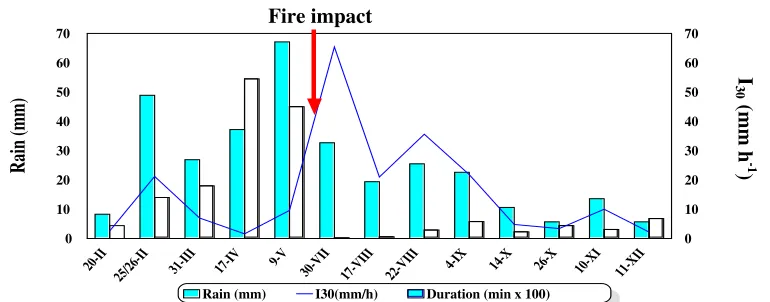
In 2003, the erosive rainfalls reached 324.2 mm in the whole year, and 135.8 mm in the last five months (July-December), where the most aggressive rains occurred. The average I30 value from July to December (20.22 mm h-1) was double than that of January-June period (8.4 mm h-1), and the mean event duration was 8 times lower (2718 min/event for January-June and 327.5 min/event for July-December), so the most aggressive rainfall conditions were shown during these last months. The I30 parameter reaches the maximum values of the whole year in two rain events, meanwhile the event duration reached the minimum ones: (i) 30th July, ten days after fire experience, I30 and rain duration were 65.4 mm h-1 and 30 min, respectively; and (ii) 17th August, the I30 was 21 mm h-1 and its duration 60 min (Fig. 1). It means that the most aggressive rains of that year appeared just after fire experience. The short elapsed time between fire impact and the first rainstorm event after it (ten days), favored the major runoff produced not only in burned plots but also in control one.
a higher alteration of its soil physical conditions as it is reflected by the runoff values (11.3 % more than high intensity treatment).
Figure 1. Erosive rain events occurred during year 2003.
The eight years of soil and vegetation recovery since the 1995 fires, have facilitated that infiltration rates showed homogeneous values in all treatments during the January-June period, with not statistical differences between treatments. Quite opposite occurs after fire impact (July-December), where differences between burned and control plots reach 20.47 %. This could denote physical changes in soil surface properties.
Figure 2. Runoff yield and infiltration rate values in 2003.
Data reflect that during the two months after the recurrent fire, the soil state is more prone to runoff generation. In the first rain event occurred after fire (30th July), runoff yield generated in burned plots were 8.44 L m-2 and 7.88 L m-2 for high and moderate treatments, respectively, meanwhile in the control plots this value reaches 0.987 L m-2.
3.2.-Hydrogical behavior
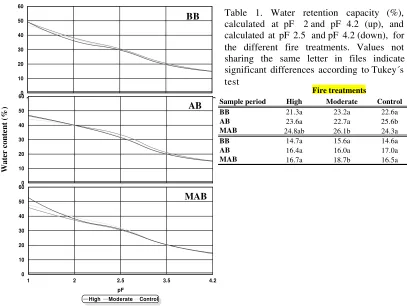
Table 1 displays the WRC data. These values showed the WRC homogeneous conditions before burning, which are reflected in non statistical significant differences between any fire treatments and control one. The fire treatments values AB were homogenous but slightly lower than those of control plots, although in the high intensity treatment the total SWC raised 3.5%, mainly at low pF values, respect to BB values. A month after burning, the fire treatments WRC values rose to achieve significant statistical differences respect to the control ones. In the MAB, the burned samples suffered a SWC increase at pF 2 and 2.5, appearing the major WRC values on burned plots (Fig. 3). These results imply changes in soil surface physical properties after fire impact (Andreu et al. 2001), mainly in the soil aggregate fraction that could formed the voids where water is retained at low retention forces.
Before fire impact After fire impact 0
Before fire impact After fire impact 0
Rain (mm) I30(mm/h) Duration (min x 100)
The moderate intensity treatment showed the greatest water content variability at low pF values, probably due to the particle-size distribution and its re-aggregation produced by fire impact (Giovannini and Lucchesi, 1997). Guber et al (2003), found that larger aggregates show the greater variation in water content.
Figure 3. SWC (%) measured Before Burned, After Burned, and Month After Burned.
4.-Conclusions
The repeated incidence of fire on a soil in a recovery stage, led to an increase in SWC, mainly at low water retention forces, where the holding gravitational water is retained. This increase could indicate structural changes in soil surface which lead to amplify soil erosion rates. The effect of a new fire impact and the climatic aggressivity showed immediately after it, produced an increase in runoff yield rates of 1 order of magnitude, meanwhile the infiltration rate diminishes around 20% respect to control values.
The impact of repeated fires in the Mediterranean zone could be translated in an important alteration of soil hydrological conditions, which induce a reduction of WRC increasing runoff generation and soil losses. As a consequence Desertification risk could be enhanced.
5.-References
Andreu, V., Imeson, A. C., and Rubio, J. L. 2001. Temporal changes in soil aggregates and water erosion after a wildfire in a Mediterranean pine forest. Catena, 44: 69-84.
European Commision, 2002. Forest Fires in Europe: 2001 fire campaign. European Communities, Ispra. FAO-UNESCO, 1988. Soil map of the world. Revised legend 1:5.000.000. Roma.
Gimeno-García, E., Andreu, V., and Rubio, J. L. 2004. Spatial patterns of soil temperatures during experimental fires. Geoderma, 118: 17-38.
Giovannini, G., Luchesi, S. 1997. Modifications induced in soil physico-chemical parameters by experimental fires at different intensities. Soil Science, 162: 479-486.
Guber, A. K., Rawls, W. J., Shein, E. V., and Pachepsky, Ya, A. 2003. Effect of soil aggregate size distribution on water retention. Soil Science, 168: 223-232.
1 2 2.5 3.5 4.2
Table 1. Water retention capacity (%), calculated at pF 2 and pF 4.2 (up), and calculated at pF 2.5 and pF 4.2 (down), for the different fire treatments. Values not sharing the same letter in files indicate significant differences according to Tukey´s test
BB
AB
MAB
Johansen, M.P., Hakonson, T.E., Breshers, D.D. 2001. Post-fire runoff and erosion from rainfall simulation: contrasting forest with shrubland and grasslands. Hydrological Processes, 15 (15): 2953-2965.