176
THE EFFECT OF ENTREPRENEURIAL ORIENTATION
AND MARKETING CAPABILITIES TOWARD SMALL
SCALE INDONESIAN FOOD ENTERPRISES’
PERFORMANCE IN SURABAYA
HERRY CHRISTIAN PALITA, MONIKA KRISTANTIB), DEBORA ANNE YANG AYSIAA), HANA STEFANI WIJAYA A)
a)
Industrial Engineering Department, Faculty of Industrial Technology, Petra Christian University, Surabaya, Indonesia b)
Hotel Management Program, Faculty of Economy, Petra Christian University, Surabaya, Indonesia
ABSTRACT
This study focuses on improving performance of small scale Indonesian food enterprises from the perspective of entrepreneurial orientation and marketing capability. Performance of small scale Indonesian food enterprises is measured based on the Balanced Scorecard perspective. The total sample is 50 owners of small scale Indonesian food enterprises, scattered throughout the regions of Surabaya. Data processing methods that used in this study were factor analysis and structural analysis with GeSCA. The result shows that marketing capability acts as a perfect mediator between entrepreneurial orientation and performance of small scale Indonesian food enterprises in Surabaya.
Keywords: entrepreneurial orientation, marketing capability, performance, small scale Indonesian food enterprises, GeSCA.
INTRODUCTION
177
restaurants are developing.According to the chairman of Indonesian Café & Restaurant Business Association in East Java, TjahjonoHaryono, food and beveragebusinesses in East Java grow approximately 20% per year (UMKM News) and most of the food businesses prefer to serve Indonesian food. In the meantime, those businesses should compete with foreign food businesses. According to the Chairman of Indonesian Catering Business Association, RahayuSetyowati, Indonesian food is not able to compete with foreign food because of the lack of good promotion and publicity (Susanti, 2015).
In order to make Indonesian food able to compete with foreign food, small scale Indonesian food enterprises should improve their performance.From several studies, it could be found that there were two aspects which influence to the performance of small scale Indonesian food enterprises, entrepreneurial orientation and marketing capability. Wiklund& Shepherd (2005) and Pangeran (2011) stated that entrepreneurial orientation directly affectthe organization’s performance.Other research was done by Halim et al. (2012) show that marketing capabilities acts as mediating variable between entrepreneurial orientation and
organization’s performance. Other studies found that marketing
capability directly affects organization’s performance (Santoset al., 2012; Perezet al., 2012; Ahmed et al., 2014). Also, Hatta (2014) stated that entrepreneurial orientation directly affect the marketing capability.
Based on the previous studies, this research would like to find
whether entrepreneurial orientation influences marketing
capability.Besides, this research is conducted to find the
influences of entrepreneurial orientation towards organization’s
178
REVIEW OF LITERATURE
Entrepreneurial Orientation
Entrepreneurial orientation reflects the organizational processes, methods, and styles that firms use to act entrepreneurially. Entrepreneurial orientation refers to decision making styles, practices,
processes, and behaviors that lead to ‘entry’ into new or established markets with new or existing goods or services (Lumpkin and Dess, 1996; Wiklund & Shepherd, 2005; Walter et al., 2006). According to Dess and Lumpkin (2005), entrepreneurial orientation has five
dimensions, namely innovation, autonomy, risk-taking,
competitiveness, and proactive.
1. Innovativeness
A willingness to introduce newness and novelty through experimentation and creative processes aimed at developing new products and services, as well as new processes.
2. Autonomy
It refers to the independent action of an individual or a team aimed at bringing forth a business concept or vision and carrying it through to completion.
3. Risk-Taking
Making decisions and taking action without certain knowledge of probable outcomes; some undertakings
may also involve making substantial resource
commitments in the process of venturing forward.
4. Competitive Aggressiveness
An intense effort to outperform industry rivals. It is characterized by a combative posture or an aggressive response aimed at improving position or overcoming a threat in a competitive marketplace.
5. Proactive
179
Several studies support the positive impact of entrepreneurial orientation on organization performance (Wiklund, 1999; Wiklund & Shepherd, 2005; Walter et al., 2006; Pangeran, 2011). However, Halim
stated that entrepreneurial orientation has an effect to organization’s
performance through marketing capabilities as mediating variable. Therefore, we propose the following hypothesis:
H1.a : Entrepreneurial orientation has a positive effect on the performance of small scale Indonesian food enterprises
H1.b : Entrepreneurial orientation has a positive effect on to marketing capability
Marketing Capability
Marketing capability is the ability to use inputs and resources, such as financial resources and the existing customer base efficiently to generate desired sales. Marketing capability aims to generate the maximum positive influence on the economic value created by the firm through increasing demand (quantity effects) and/or the price customers are willing to pay (price effects) (Ahmed et al., 2014). Ahmed stated that marketing capability generates sales by improving the firm's understanding of markets and customers or by increasing customers' willingness to pay.In both cases marketing capability boosts sales for the company. It has eight dimensions namely product
development, pricing, channel management, marketing
communications, selling, market information management, marketing planning and marketing implementation (Vorhies and Morgan, 2005).
1) Product development
The processes by which firms develop and manage product and service offerings
2) Pricing
The ability to extract the optimal revenue from the firm’s customers
3) Channel management
The firm’s ability to establish and maintain channels of
180
4) Marketing communications
The firm’s ability to manage customer value perceptions 5) Selling
The processes by which the firm acquires customer orders
6) Market information management
The processes by which firms learn about their markets and use market knowledge
7) Marketing planning
The firm’s ability to conceive marketing strategies that optimize
the match between the firm’s resources and its market place
8) Marketing implementation
The processes by which intended marketing strategy is transformed into realized resource deployments
Although marketing capability is based on marketing mix tools, however the architectural approach of marketing capability in some studies appear to have a stronger impact on business performance than the 4P-centric approach (Vorhies and Morgan, 2005).Previous researchers reveal a positive relationship between marketing capability and organization performance (Santos et al., 2012; Perez et al., 2012; Ahmed et al., 2014). Therefore, we propose the following hypothesis:
H2 : Marketing capability has a positive effect on the performance of small scale Indonesian food enterprises
Performance
Performance is the result of work that have a strong relationship with the aim of the organization, and customer satisfaction, and it give contribution to the economics of the organization. Firm performance should be measured in multidimensional. In this research, financial and non-financial perspectives are used to measure the performance of small scale Indonesian food enterprises. According to Kaplan and Norton, the performance of an organization could be measured by using
Balanced Scorecard (Knapp, 2001), and there are four ‘balanced’
181
1) Financial
It summarizes the readily measurable economic consequences of actions already taken
2) Customer
It contains measures that identify the customer and market segments in which the business unit will compete and the
measures of the business unit’s performance in these targeted
segments
3) Internal business process
It measures the critical internal processes in which the organization must excel
4) Learning and growth
It measures the infrastructure that the organization must build to create long-term growth and improvement
METHODOLOGY
Population of this research is small scale Indonesian food enterprises in Surabaya. To determine the research objects, the top of mind survey was done in all Surabaya region to 453 respondents in order to know the favorite Indonesian food in Surabaya. Based on the top of mind survey, there was 10 favorites Indonesian food chosen. It means, the research objects should sell minimum one of these 10 favorites Indonesian food. Next, we determine the criteria of the small scale Indonesian food enterprises. This step is important to make sure that the condition and environment of the objects are quite similar. These are some criteria to determine the object:
1) The object should be clean enough and use ceramic for flooring
2) Has minimum decoration
3) Has maximum only one branch
4) The appearance of menu list is quite simple
5) Have own permanent building, not in the food court 6) The concept is notcafé
7) Almost 80% of the menu are Indonesian food
8) The price range is 8,000 – 25,000 rupiahs
182
of Surabaya, 10 objects each in center of Surabaya and west of Surabaya, 15 objects each in east of Surabaya and south of Surabaya. In total, there were 50 owners who filled in the questionnaire.
The questionnaire used a 7-point Likert scale and consisted of four sections: demographic characteristics, entrepreneurial orientation variable, marketing capability variable and the performance of the small scale Indonesian food enterprises. Entrepreneurial orientation is measured by 4 dimensions. They are proactive, innovative, risk taking, and competitive aggressiveness. Autonomy dimension is not used because the small scale Indonesian food enterprises have only small number employees (2-10 employees), and all strategic policy are made by the owner. Marketing capability is measured by 7 dimensions. They are product development, pricing, marketing communications, selling, marketing information management, marketing planning, marketing implementation. Channel management is not used because the small scale Indonesian food enterprises have no distribution channel. Performance is measured by 4 dimensions. They are financial, customer, internal business process, and learning and growth.
This research only used content validity to test the validity of pre-questionnaire since the number of sample is small. This validity test involved two persons. The first person is the expert whohas capability in this field (expert judgement). Based on the expert judgement, one of 50 owners was chosen to fill in the questionnaire. The questionnaire is revised several times until the owner could understand the question clearly. After the questionnaire valid, the final questionnaire was spread out to all respondents and then analyzed the data.
183
Ghozali, 2013). GeSCA is a powerfull analysis method since the data should not have normal distribution and could use the small size of sample. GeSCA is used in order to confirm the theory and explain the relationship between latent variables.
ANALYSIS AND INTERPRETATION
The majority of the owners had attained their highest education level minimum at high school degree level (44%). Most of these small scale Indonesian food enterprises has been established for more than 15 years (34%), and the average income per month is less than 15 million rupiahs (34%). With regard to the type of ownership, the majority of these small scale enterprises is privately owned (86%), and the number of employees is 2 to 5 persons (82%).
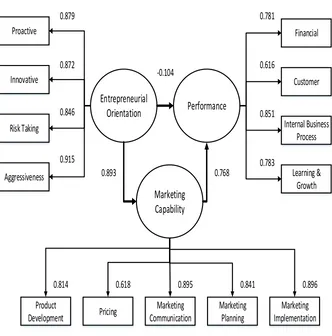
Figure 1 shows that four dimensions of entrepreneurial orientation which are risk-taking, proactive, innovativeness and competitive aggressiveness, could explain the entrepreneurial orientation well (loading factor > 0.5), and the competitive aggressiveness (loading factor = 0.915) becomes the dimension that could explain most of entrepreneurial orientation. The convergent validity is seen from the estimate loading factor of each dimension. Thus, it could be mentioned that four dimensions of entrepreneurial orientation are valid. Reliability of a latent variable is considered well if Cronbach Alpha ≥ 0.7 and AVE
≥ 0.5. The AVE (Average Variance Extracted) is the average amount of
variance of dimensions that is explained by their corresponding latent
variable. The Alpha indicates Cronbach’s alpha. Table 1 shows that
184
Figure 1. Structural model (final version)
Table 1. Reliability of latent variable
Variable AVE Alpha
Entrepreneurial Orientation 0.772 0.902
Marketing Capability 0.671 0.873
185
There are only five dimensions of marketing capability valid, which are pricing, product development, marketing communication, marketing planning, and marketing implementation, while the rest dimensions, market information management and selling are not valid. Due to validity problem, they areexcluded from the model. Marketing capability has a good reliability. The dimension that could explain most the marketing capability is marketing implementation (loading factor = 0.896), which related to the process of changing marketing plan into action tasks and control that process. The strongest indicator of marketing implementation is the small scale enterprises implement the planned promotion immediately (91.6%). Based on the interview with the owner, it can be known the small scale enterprises which have the promotion plan and implement it immediately, are the small scale enterprises that have average monthly income more than 25 million rupiahs (77.78%). Because of good average monthly income, these small scale enterprises are easier to provide the promotional resources such as brochure, business card, etc.
The reliability of the performance is good. The four dimensions of the performance are valid, and internal business process is the dimension that contribute most (loading factor = 0.851). Internal business process measures the critical internal processes in the small scale enterprises in order to satisfy their customers. The indicator that contributes most to internal business process is the improvement of service quality toward customers in the last one year (75.3%). According to some owners of the enterprise (52%), they do the improvement of service quality because of the awareness that service quality has important role in increasing their income.
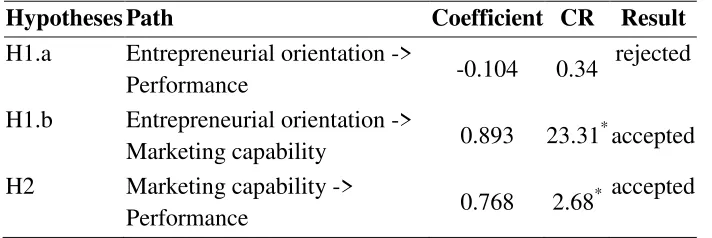
Based on Table 2in hypothesis H2, it can be seen that marketing capability significantly influences the small scale Indonesian food
enterprises’ performance in Surabaya. It is consistent with previous
186
performance of organization directly. Entrepreneurial orientation affect marketing capability positively and significantly (hypothesis H1.b). This result confirms the research of Hatta (2014) which stated that entrepreneurial orientation directly affect the marketing capability. However, entrepreneurial orientation has no direct significant effect on the performance of the small scale Indonesian food enterprises in Surabaya (hypothesis H1.a). This result is similar with the research which was done by Halim et al. (2012), however it contradict with the research of Wiklund & Shepherd (2005) and Pangeran (2011) who stated that entrepreneurial orientation influences the performance of organization directly. It means that marketing capability acts as a perfect mediating variable between entrepreneurial orientation and
small scale enterprise’s performance.
Table 2. Path coefficient structural model
Hypotheses Path Coefficient CR Result
H1.a Entrepreneurial orientation ->
Performance -0.104 0.34
rejected
H1.b Entrepreneurial orientation ->
Marketing capability 0.893 23.31
*
accepted
H2 Marketing capability ->
Performance 0.768 2.68
* accepted
CR* = significant at.05 level or CR ≥ 2
IMPLICATIONS
187
al. (2012), and Ahmed et al. (2014). How the owners develop and use appropriate media to communicate their products and how the owners allocate their resources in implementing their planned promotion immediately are important things to be considered in marketing capability.
Besides, the owners should have entrepreneurial orientation to enhance their business performance. Entrepreneurial orientation refers to strategy making in terms of action or decision making and practicesthat
lead to ‘entry’ into new or established markets with new or existing goods or services. An aggressiveness response to compete with competitors should be concerned by the owners in entrepreneurial orientation. This research proves that the effect of entrepreneurial orientation to performance is not directly but through marketing capability as a mediating variable, which also confirmed by Halim et al. (2012). It means,the unique marketing technique that increase
customers’ willingness to pay to generate desired sales should be
decided first by the owners’ action that lead into new or existing market with new or existing products in order to have a better business performance.
Finally, this research also suggests the owners to concern about the internal process of their business performance, especially regarding to the improvement of service quality toward customers. This improvement will affect customer satisfaction and financial sustainability.
CONCLUSION
188
however, marketing capability should act as mediating variable
between entrepreneurial orientation and small scale enterprise’s
performance. Entrepreneurial orientation could explain 79.7% variances of marketing capability, and marketing capability could explain 45.8% variances of the performance of small scale Indonesian food enterprises in Surabaya.
FUTURE SCOPE OF RESEARCH
There are some limitations for this study. Due to the difficulty to find the owners who are willing to participate, so that the number of owners as the sample is very limited. Also, there are difficulties for some owners to understand the questions, especially in entrepreneurial orientation dimensions even though the content validity has been done and the questionnaire has been revised several times. Hence, this problem could make a data bias.
Future research should be considered to simplify the statement in the questionnaire because of the variety of education level of the owners. In order to simplify the statement, the depth interview to the owners and observation in some objects should be done which aimed to know the situation and condition of the objects. Based on the interview, observation and related theory, relevant indicators are developed. Other idea is the performance of the small scale Indonesian food enterprises should be measured by the customers. In doing this, the enterprises could know whether what have been done could satisfy the needs of the customers.
Acknowledgement
189
REFERENCES
Ahmed, M. U., Kristal, M. M., & Pagell, M. (2014). Impact of operational and marketing capabilities on firm performance: evidence from
economic growth and downturns. International Journal of Production
Economics, 154(2014), 59-71.
Dess, G.G., & Lumpkin, G. T. (2005). The role of entrepreneurial orientation
in stimulating effective corporate entrepreneurship. Academy of
Management Executive, 19(1), 147-156.
Halim, H. D., Solimun., & Djumahir (2012). Marketing capabilities as a mediating influence of market orientation: learning orientation and entrepreneurial orientation on performance marketing (studies on
medium enterprises in Southeast Sulawesi). Application Management
Journal, 10(3), 472-484.
Haryani, H.I. (2014). Analysis of the influence of innovation, risk taking, autonomy, and proactive reaction to the marketing capabilities of SMEs
culinary areas in Greater Jakarta. Journal of Marketing Management,
8(2), 90-96.
Karl K.R., (2001). The Balanced Scorecard: Historical Development and
Context, As Developed by Robert Kaplan & David Norton. Foundations
of Management, Anderson University DBA.
Kusumadewi, K. A. & Ghazali, I. (2013). Generalized structured component
analysis (GeSCA): structural equation model based components.
Semarang: Diponegoro University Publishers Agency.
Lumpkin, G. T. & Dess, G. G. (1996). Clarifying the entrepreneurial
orientation construct and linking it to performance. Academy of
Management Review, 21(1), 135-172.
Perminas. P. (2011). Entrepreneurial orientation and financial performance of new product development of micro and small enterprises. JRMB, 6 (2), 113-125.
Perez-Cabanero, C., Gonzalez-Cruz, T., & Cruz-Ros, S. (2012). Do family
SME managers value marketing capabilities’ contribution to firm
performance?. Marketing Intelligence & Planning, 30(2), 116-142.
Santos-Vijande, L., Sanzo-Perez, M. J., Gutierrez, J. A. T., & Rodriguez, N. G. (2012). Marketing capabilities development in small and medium
enterprises: implications for performance. Journal of
190
December 13, 2015, from http://nasional.sindonews.com/read/
987575/149/kuliner-indonesia-kurang-promosi-1428634042 (accessed on 12th June 2015)
SME News. (2014). Runway Industrial Infrastructure Development.
Retrieved December 21, 2015, from http://umkmnews.com/news/ pembangunan -infrastruktur-pacu-industri-mamin.html (accessed on 12th July 2015)
Vorhies, D. W., & Morgan, N. A. (2005). Benchmarking marketing
capabilities for sustainable competitive advantage. Journal of Marketing,
69, 80-94.
Walter A., Auer M., & Ritter, T. (2006) The impact of network capabilities and entrepreneurial orientation on university spin-off performance.
Journal of Business Venture, 21(4), 541–567
Wiklund, J. (1999). The sustainability of the entrepreneurial orientation–
performance relationship. Entrepreneurship Theory and Practice. 24(1),
37–48.
Wiklund, J. & Shepherd, D. (2005). Entrepreneurial orientation and small
business performance: a configurational approach. Journal of Business