i
ISSN: 2581-1940
PROCEEDINGS
The
1
st
International
Conference on English
Language, Linguistics,
and Literature (ICELLL 2017)
“Digital Literacy As A Means of Publication”
5-6 August 2017
v
The 1st International Conference on English Language, Linguistics and Literature ISSN 2581-1940
WHOSE NEWS?
Mustafa Kamal, Riyadi Santosa, Djatmika ~ 101
THE ANALYSIS OF REQUESTING TURN IN THE NOVEL
THE HEROES OF
OLYMPUS SERIES
BY RICK RIORDAN
Dewinta Khoirul Anis, Djatmika, Mangatur Nababan ~ 108
DEVELOPING COMIC STRIPS TO INCREASE READING COMPREHENSION
FOR EFL LEARNERS
Esti Junining, Yonanda Wahyu Hidayah, Dian Danayanti S. Degeng ~ 114
THE ANALYSIS OF TURN TAKING INTERRUPTION IN THE TV SHOW THE
STRANGER THINGS (A TRANSLATION STUDY BASED ON A PRAGMATIC
APPROACH)
Fatwa Ruhul Ilmi, Mangatur Nababan, Djatmika ~ 121
LEARNING ENGLISH: CULTURALLY-CONTEXTUAL LITERACY BASED
Dwi Bambang Putut Setiyadi, Slamet Wiyono ~ 127
TRANSLATION TECHNIQUES OF RELIGIOUS TERMS IN
THE COMPLETE
IDIOT’S GUIDE TO UNDERSTANDING ISLAM
Nadia Gitya Yulianita , Mangatur Nababa, Djatmika ~ 134
LANGUAGE ERRORS
ON TURN TAKING “
THE SPACE BETWEEN US
” MOVIE:
OVERVIEWED WITHIN TRANSLATION STUDIES
Mochamad Nuruz Zaman ~ 145
THE INTEGRATION OF A DIGITAL MULTIMODAL APPROACH IN ENGLISH
FOR SPECIFIC PURPOSES CLASS: A NARRATIVE INQUIRY
Lemmuela Alvita Kurniawati ~ 157
TEXTS OF CULTURAL DISCOURSE IN ADVERTISEMENT
Winarsih Winarsih ~ 167
PREPARING DIGITALLY LITERATE GRADUATES THROUGH JOURNAL
ARTICLE READING BASED ACTIVITIES
ISSN 2581-1940 The 1st International Conference on Language, Linguistics and Literature
176
Preparing Digitally Literate Graduates through Journal Article
Reading-Based Activities
Muhamad Hasbi
IAIN Salatiga
Abstract
The interpretation coverage of the term digital literacy has gone further from just the ability to operate applications and make use of them for learning purposes, to a higher definition such as to maneuver systems for digital works such as online journal system. This research aims at investigating to what extent students‘ digital literacy as well as their comprehension on journal article composition develop through the implementation of journal article reading-based activities. This study was carried out with as many as 25 fourth semester students in the English Education Department at IAIN Salatiga, undertaking the course of Reading 4. This qualitative study made use of journal article review, and open-ended questionnaire, peer feedbacks, and
observation to collect data. The result shows that students‘ digital literacy subskills in the form
of searching, locating, downloading articles, and identifying article‘s elements on the online
journal system of Register Journal of IAIN Salatiga and Leksema Journal of IAIN Surakarta were confirmed, with considerable inaccuracy on drawing comparisons of the elements in the
two journals; students‘ ability to identify article elements‘ contents was confirmed, with
considerable difficulty in extracting the key contents majorly in introduction and discussion part of an article due to the text length and complexity factor; lastly, this activity has helped students figure out the potential of their own area of research interest. These findings bring forward the recommendation to apply more journal article-based activities integrated throughout most ELT courses.
Keywords: digital literacy, journal article, Online Journal System (OJS), reading activity
Abstrak
Cakupan interpretasi dari istilah ‗digital literacy‘ bergeser jauh dari sekedar kemampuan
mengoperasikan aplikasi dan menggunakannya untuk tujuan pembelajaran, ke definisi yang lebih tinggi misalnya kemampuan mengendalikan sistem penyimpan karya-karya digital semisal
ISSN 2581-1940 The 1st International Conference on Language, Linguistics and Literature
177
Kata Kunci: digital literacy, artikel jurnal, „Online Journal System (OJS)‘, akttivitas pembelajaran membaca
1. INTRODUCTION
Technology is no doubt one of the most ever-developing fields throughout decades and tends to keep evolving. Invention after invention of new technological devices and increasing number of accessibility to broader society have stolen the attention of the world as it is endlessly impactful to all other sectors, including education. With the advancement of technology, for instance, the earlier concept of literacy that refers to the ability to read and write (Tinio in Nawas, 2010, p.2) has evolved into the ability to identify, understand, interpret, create, communicate, compute and use printed and written materials associated with varying contexts (UNESCO in Karpati, 2011, p.1; Gallardo-Echenique, E. E., 2015, p.1). In a larger scale, it has introduced a new kind of literacy namely digital literacy, which is defined by Department of eLearning (2015) as literacy via technology, that later entails an acquisition of sets of rules and technical capabilities (Karpati, 2011), in addition to skills embedded in the earlier definition. That, in nowadays context, will include ICT literacy, computer literacy, information literacy (Karpati, 2011), as well as visual literacy and media literacy (Department of eLearning, 2015, p.5).
Teaching 21-st century students has become a bit challenging for most teachers. With the majority of them are digital natives, they are likely to have different characteristics from the ones the teachers expect of them. In order to maintain their pedagogical quality, Bickham
(2008, p.4; supported by Cook‘s in The TESL Association of Ontario, 2003, p.3) suggested that teachers should be aware that most millennial students like choice, think differently, define and control ―balance‖ in their own individual ways, are more inclusive, are group-oriented and social, practiced users of digital technology. On a similar note, digital natives are associated with speed, multitasking, and a preference for graphics over text, random access, social networking, instant gratification, frequent rewards, and games over work (Department of eLearning, 2015, p.3; Parsons, 2015, p.3).
While learning using technology makes it relevant to students, teachers still have to play roles as their learning manager and controller because technology can be expensive, distracting, and even destructive, and designing prompting activities as well as selecting appropriate materials or contents are therefore an ultimate. Despite the fact that it also comes with some side effects that can be intrusive and destructive to its users, our education has been mining it for the betterment of the quality of learning, and exploration on creating and developing technology-based learning methods, approach, and activities are in fact strongly encouraged in the world of English language teaching (ELT). One big shift of paradigm that follows the trend of using technology to our classroom is that practices of ELT which have been centered to rehearse and hone language skills and competencies are now integrated to further develop digital literacy. A good example of its earliest application was initially marked with the encouragement of implementing E-Learning, a model of learning that makes use of technological devices, application, and internet connection emphasizing the importance of computer availability, networking accessibility, and new formatted curricula in order to be impactful (Nawas, 2010, p.2-4).
ISSN 2581-1940 The 1st International Conference on Language, Linguistics and Literature
178
especially in higher education has continued to be upgraded to majorly digital mode and/or with higher demands, such as those of graduating paper composition.
Graduation paper composition can be very challenging for students since it is a very comprehensive study with a scientific procedure which requires students not only to read but even the process of looking for references, selecting the ones which really support our theme, as
well as citing them in the cohesive order are not less perplexing. Students‘ digital exposure is
perhaps out of question, but their unfamiliarity with conducting research and utilizing digital sources to cope with their research is a greater issue. Many cases happen annually where students graduate later, a lot later than expected, or even get dropped out as a consequence for not being able to accomplish what are being required. This concerns educators and takes them moments to formulate some ways to solve this devastation issue in the world of education.
This article proposes an alternative approach to deal with the matter by implementing an activity that introduce students with theoretical and practical research-related exploration on Online Journal System (OJS), journal article composition analysis through a designed tasks/ series of activity in a course in a fourth semester, instead of conducting it with courses in the final year. Recalling what we have discussed earlier, this can be one example to reflect
Bickham‘s resolution proposal. Not only equipping students with knowledge and practices on
digital literacy and research conduction at earlier phase and encouraging them to graduate on time or in time, this study is also expected to contribute giving new insights to teachers in
designing activities that advocate students‘ conventional problems and providing new practical
perspectives and reference in the field of research on English language teaching. This activity is in principle a perfect blend between the implementation of literacy and digital literacy.
2. RESEARCH METHOD
This study was conducted with 25 students in the English Education Department at IAIN Salatiga, who were attending the course of Reading 4 in their fourth semester as the subject. The appointment of these students and the course was intended to introduce article journal reading to students at earlier semester, where usually in Indonesian academic context is explored in the final semester/year in the time of graduating paper composition. The two major final outputs
targeted from this research being the students‘ development of (a) digital literacy subskills elicited through the exploration of RegisterJournal‘s and Leksema‘s Online Journal System in
the form of searching, locating, and downloading articles, article template, articles writing guideline; and (b) comprehension on journal article composition achieved through reviewing articles by identifying article‘s elements, extracting the key contents in each element, comparing
the article writing in the two journals, and giving feedback on other‘s works. To be noted, Register and Leksema journal were chosen as they both publish articles on ELT and literature in
which are in line with the students‘ background who majored in the English Education
Department, and the article journal being reviewed in depth is Register journal, the other one was brought after into discussion for a comparison.
ISSN 2581-1940 The 1st International Conference on Language, Linguistics and Literature
179
continued to be done as home assignments. The commented drafts were gathered and then analyzed quantitatively, and each pointer of investigations uses different techniques of analysis. Digital literacy subskills were analyzed throughout the process of OJS exploration recorded by students in their article review and questionnaire using reflectivity barometer, i.e., how far students report reflected the expertise of utilizing the digital literacy subskills. Comprehension on journal article composition as analyzed throughout the work draft of students‘ article review using explicitness barometer, i.e., students answers are labeled explicit when they carried minimally 80% of correctness degree of answers. Additional analysis was made for how far has the activity aspired for students‘ future research plan and for its impacts on ELT practices, drawn by data deduction technique. Figures were in used not to add qualitative analysis but to recapitulate data into concise illustrations.
3. FINDINGS AND DISCUSSION
Making use of journal article review form, open-ended questionnaire, peer feedbacks, and observation to collect data, the practice of the series of activities being researched brings the following data into discussion.
3.1. Digital literacy subskills
Students literacy skills were investigated majorly on their exploration into the OJS of Register
journal in order to review an article, and secondly into that of Leksema‘s in order to make a
comparison on article writing in the two journals. The literacy skills are measured by students‘
ability to search for the two journals‘ webpage, locate articles writing guideline, locate and
download articles, and locate and download article template. This exploration is an online
activity done using students‘ handphone or no specific record but the interpretation is drawn to evaluate their accomplishment; by looking at the degree of reflectivity on their report on article review and answers to the questionnaire. In this context, a reflective report or answers that included details that referred accordingly to the respected journal.
92%
8%
Figure 1. Reflectivity of students' article review report
reflective reports non-reflective reports
60%
40%
Figure 2. Reflectivity of students' questionnaire answers
ISSN 2581-1940 The 1st International Conference on Language, Linguistics and Literature
180
Figure 1 shows that reflective works appeared in almost all students‘ article review reports.
Although to the majority this was their first experience in browsing and investigating on a (Register) journal webpage, the result shows very satisfactory. With their familiarity with online activities and that students could do the exploration even after class seemed to become supporting factors for the excellent report. Subsequently, Figure 2 illustrates that more than half of students could generate a good comparison of the elements in the two journals, which implies good exploration on the OJS of Leksema journal. Some of them even took further analysis on
bringing deeper comparison to some of the elements‘ key contents. Some students with non-reflective answers actually almost made it but their lack of mentioning technical terms from and their short explanation, examples, and emphasis on the latter journal could not be convincing enough to prove that they were really doing the second exploration, or understanding the major aspects in both journals, comparatively. In average, this activity still ended well and fruitful for the development of their digital literacy skills, especially considering that this is their very first time to enter into this area.
3.2. Comprehension on journal article composition
Students‘ comprehension on journal article composition is characterized by the ability to identify article‘s elements, extract the key contents in each element, compare the article writing
elements in the two journals, and give feedback on other‘s works. The chart below visualizes
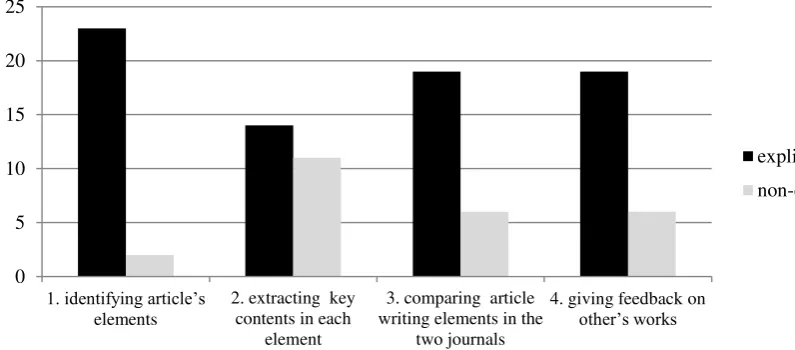
the overall explicitness of students comprehension determined from the journal article review form.
Figure 3. Explicitness of students‘ article review
Students‘ ability to identify article‘s elements, from title, author, abstract, introduction, research
methodology, discussion, conclusion, to references (following the Register journal guideline/template) are in average strongly explicit; the two non-explicit contributors were apparently not really involved in terms of classroom attendance, attention and participation thus doing the activity without following guideline and classroom dynamic and therefore they are part of the four categories. The fact that the elements are written as headers in all registered
journals makes it easier for students to recognize them. Second, the explicitness in students‘
ability to extract key contents in each element does not look quite easy for almost half of them. Students actually did well for the most parts, but only a very few who could narrow them down especially in the introduction and discussion part, and the text length and complexity are the two primary burden. Considering their semester level, it is logical enough that they found it difficult due to too many layers of information, and those parts in most cases have more unfamiliar terms, longer sentences, and more complex idea arrangements than the rest does.
Interestingly, comparing the article writing elements in the two journals and giving feedback on
other‘s works received the same amount of explicitness level, and the fact that 19 of them
exposed explicitness is incredible since comparing and evaluating process needs them to invest
ISSN 2581-1940 The 1st International Conference on Language, Linguistics and Literature
181
multiple perspectives into their answers. Here, students compared only the choice and arrangement of article elements in Leksema to those in Register, and not going into more details such as analyzing the key contents in each element too, though some students did touch the issue of tabling or figuring, and little deeper into the contents. Evaluating activity through feedback was somewhat challenging for them because they ought to give an opinion and sometimes make a judgment on the work of others on recently learned and practiced materials. However the result was beyond expectation, there were comments which strongly connected to crucial points and more than half did manage to write them in long explanation and this does reflect the higher level of evaluation skills.
3.3. Aspiration for students‟ future research
One of the barometers of successful research is that it gives impact to the parties involved, especially for the research subjects. The fact that the research procedure allowed students to explore the OJS of two journals, review articles from two journals filled with careful reading and analysis was in itself a strong series of familiarization on those areas. And to help them implement the knowledge and experiences into their future research project, another area of familiarization that was also stimulated was in terms of the theme of research and figuring out
author‘s as well as their own area of interest through titling, selection, and direct question in the
open-ended questionnaire.
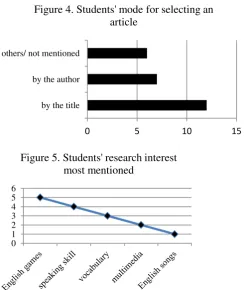
An interesting as well challenging process students made while doing the activity was when they were about to select an article to be reviewed. There was clear suggestion to single out an article by judging the titles, which also entail to the area of research theme/topic/interest, but classroom practices often present some surprises. In their answers to the questionnaire, there were 7 students who admitted selecting it because they knew or admired some authors who
happened to be their (former) lecturer, or simply due to author‘s affiliation. 6 out of 25 either
took different reason into account or did not specify it. Furthermore, Figure 4 lists 5 students‘
most mentioned area of research interest namely English games, speaking skill, vocabulary,
by the title by the author others/ not mentioned
0 5 10 15
Figure 4. Students' mode for selecting an article
0 1 2 3 4 5 6
ISSN 2581-1940 The 1st International Conference on Language, Linguistics and Literature
182
multimedia, and English songs. Quite many were at first confused or undecided to name them since they thought they were still far from doing a research thus never imagined that far. Obviously, there was a process of critical thinking before they finally named ones.
3.4. Impacts for ELT practices
Taking the above discussion into account, this research definitely contributes severely to the
development of students‘ digital literacy. And the fact that it uses journal articles as the primary learning resource, students‘ understanding of the work of research too are in parallel elevated. Complexity in learning new things or things that have not become a common practice is always a challenge (Warschauer, et. al., 2014, p.85). However, with careful preparation and pedagogical procedure, it can turn into something very impactful for all involving parties.
The introduction of journal articles in the early semesters has been avoided by quite many university teachers because it is connotated with the higher level of writing practice that needs a higher order of critical thinking and deep analysis. Nevertheless, teaching is always levelized or gradual, and we can always adjust the level of study intake accordingly. A course like the one being researched proves to be effective and does not seem to be overweight for students because they are guided and level of study intake touch majorly into investigation, analysis, and light (peer) evaluation.
Therefore, it is very recommended that the teaching using journal article is encouraged, not only it helps students prepare for their graduating paper plan, but also the teaching practice is modifiable and adjustable to whichever classification of levels our students belong to. This
Secondly, this study is practice-oriented than theoretical, but students‘ result reflects that they comprehend, instead of just know, the foundation of what are being learned. Many
studies‘ results have recommended shifting from knowledge to practice and underline that it is the time that our education walks toward a practice-focused curriculum implementation (Ball, 2009, p.7; Hicks, 2013, p.59). This theory does not mean to have ignored reading activity. In fact, having reading activity prior to doing practices have been proven effective through this and many other studies thanks to its nature of being very versatile, i.e., to be able to be used in many different ways to promote other skills (Berardo, 2006, p.1),.
Furthermore, in the past decades, researchers discovered that there is a mutual
relationship between a student‘s academic reading skills and academic success (Hermida, 2009, p.1; Kupiainen, 2015, p.123; Dole, 2007, p.12). Their practical exploration on the two OJSs, apart from helping them find what was being investigated, familiarize them with online system, which is good rehearsal because when their time for doing pre-service teaching or teaching after graduation, they will find out that most of the teaching practices and administration procedures occur online (Milton, 2013, p.2), which is also the same context with those in Indonesian institutions.
Another interesting point to discuss is the area of students‘ research interest which puts English games, speaking skill, vocabulary, multimedia, English songs on the top rank. In one side, it is relieving to acknowledge that students finally have some vision on research area they might be doing in the coming semesters; as we know, knowing our area of interest leads the best when it comes to deciding on what are we going to study in depth. Nevertheless, when we look at the list, though they might represent among important or effective learning aspects, it is just so tickling that there is no mention of mobile apps, internet-based learning, or any other feature
related to digital literacy. If not implying that the digital literacy activities haven‘t been so
ISSN 2581-1940 The 1st International Conference on Language, Linguistics and Literature
183
activities learners can do especially the ones which also promote learning. Therefore, digital literacy has a very prospective role to play in presenting an education that invests for the betterment of human life.
4. CONCLUSION
In conclusion, the journal article reading-based activity with the exploration of Online Journal
System (OJS) is proven effective in promoting students‘ digital literacy and comprehension on
article writing, familiarizing them with research works, figuring out their research interest area, and are impactful to the future practices of English language teaching. More future research on the similar area are encouraged to be conducted to help assure the validity and measurability of this practice and to contribute with new found insights on digital literacy and article based ELT practices, especially the ones that help students excel at analyzing and extracting details or contents within introduction and discussion parts; in which this research has not done justice to it. With the two being beneficial and potential to be exposed, it is strongly recommended that most of our ELT courses promote digital literacy and journal article based activities.
5. REFERENCES
Ball, D. L., Forzani, F. M. (2009).The Work of Teaching and the Challenge for Teacher Education. Journal of Teacher Education. Vol. 60 No. 5 (P. 497 –511). SAGE Publications. doi: 10.1177/0022487109348479.
Berardo, S. A. (2006). The Use of Authentic Materials in The Teaching of Reading. The Reading Matrix. Vol. 6, No. 2, (p. 60-69).
Bickham, M., Bradburn, F, et. al.. (2008) Learning in the 21st Century: Teaching Today‘s Students on Their Terms. The International Education Advisory Board (IEAB).
Department of eLearning. (2015). 21st Century Competencies for Our Age: The Digital Age (The Fundamental Building Blocks of Digital Literacy From Enhancement to Transformation). Green Paper: Digital Literacy.
Dole, J. A., Osborn, J.. (2007). Reading Materials: Their Selection and Use. Library Large-scale Digitization Project. Champaign: University of Illinois.
Gallardo-Echenique, E. E., (2015). Digital Competence in the Knowledge Society. MERLOT Journal of Online Learning and Teaching, Vol. 11, No. 1. Creative Commons Attribution-Non-Commercial-Share-Alike: http://creativecommons.org/licenses/by-nc-sa/3.0/us/.
Hermida, J. (2009). The Importance of Teaching Academic Reading Skills in First-Year University Courses. The International Journal of Research and Review. Vol. 3, No. (p. 20-30).
Hicks T. and Turner, K. H.. (2013). No Longer a Luxury: Digital Literacy Can‘t Wait. English Journal, p. 58-65. The National Council of Teachers of English.
Karpati, A. (2011). Digital Literacy in Education. Policy Brief. Moscow: UNESCO Institute.
ISSN 2581-1940 The 1st International Conference on Language, Linguistics and Literature
184
Lijek, R. S., Fankhauser, S. C. (2016). Using Scavenger Hunts to Familiarize Students with Scientific Journal Articles. Journal of Microbiology & Biology Education, Vol.17, NO. 1 (p. 125-128). DOI: http://dx.doi.org/10.1128/jmbe.v17i1.1005
Milton, M., Vozzo L.. (2013). Digital literacy and digital pedagogies for teaching literacy:
Pre-service teachers‘ experience on teaching rounds. Journal of Literacy and Technology, 72 Volume 14, Number 1 (p 72-97).
Nawaz, A, Kundi G. M.. (2010). Digital literacy: An analysis of the contemporary paradigms.
Journal of Science and Technology Education Research, Vol. 1(2), pp. 19 – 29. http://www.academicjournals.org/JSTER
Parsons, D., Thomas H. (2015). Transforming Teacher Education with Digital and Collaborative Learning and Leadership. International Journal of Digital Literacy and Digital Competence, Vol. 6, No. 4, (p. 30-48).
The TESL Association of Ontario. (2003). From Theory to Practice: Creating Intermediate ESL Reading Materials Based on Current SLA Research and Theories. Contact, Vol. 29, No. 3. Ontario.