TABLE OF CONTENTS
Cover
Greetings and Thanks from the General Chair
Foreword from Head of Department of Electrical Engineering,
Foreword from Dean, Faculty of Engineering
Organizing Committee
Steering Committee
Technical Program Committee
Keynote Speaker
’s
Biography
Conference Program
Keynote’s Papers
Author Index
KEYNOTE SPEAKERS
I-1
Multi-User MIMO Wireless System -From Theory to Chip Design
Prof. Hiroshi Ochi
1
I-2
Challenges and Opportunities in Designing Internet of Things
Prof. Dr. Trio Adiono
11
I-3
Role of Telecommunication Satellite in Indonesia
Adi Rahman Adiwoso
13
CIRCUITS AND SYSTEMS
CC1
Enhancement of DRAMs Performance using Resonant Tunneling Diode
Buffer
Ahmed LutfiElgreatly, Ahmed AhmedShaaban, El-Sayed M. El-Rabaie
14
CC2
Real-time SoC Architecture and Implementation of Variable Speech PDF
based Noise Cancellation System
Aditya Ferry Ardyanto, Idham Hafizh, Septian Gilang Permana Putra, Trio
Adiono
19
CC3
Application of Supervised Learning in Grain Dryer Technology
Recirculation Type Cooperated with Wireless Sensor Network
Sidiq Syamsul Hidayat, TotokPrasetyo, Amin Suharjono, Kurnianingsih,
Muhammad Anif
24
CC4
Design of Real-Time Gas Monitoring System Based-on Wireless Sensor
Networks for Merapi Volcano
B. Supriyo, S.S.Hidayat, A. Suharjono, M.Anif, Sorja Koesuma
28
CC5
ANFIS Application for Calculating Inverse Kinematics of Programmable
Universal Machine for Assembly (PUMA) Robot
Hugo Adeodatus Hendarto, Munadi, Joga Dharma Setiawan
33
CC6
MRC NN Controller for Arm Robot Manipulator
M. Khairudin, Nur Kholis
CC7
Development of Microcontroller-based Stereoscopic Camera Rig
Positioning System
Julian Ilham, Wan-Young Chung
44
CC8
Design of A Digital PI Controller for Room Temperature on Wireless
Sensor and Actuator Network (WSAN) System
Bambang Sugiarto, ElanDjaelani
50
CC9
Display and Interface of wireless EMG measurements
Kevin Eka Pramudita, F. Budi Setiawan, Siswanto
56
CC10
Accuracy Enhancement of Pickett Tunnelling Barrier Memristor Model
Ahmad A. Daoud, Ahmed A. Shaaban, Sherif M. Abuelenin
61
CC11
Data Fusion and Switching Function For UAV Quadrotor Navigation
System
Muhammad Faris, Adha Imam Cahyadi, Hanung Adi Nugroho
66
CC12
Data logger Management Software Design for Maintenance and Utility in
Remote
Devi Munandar, Djohar Syamsi
72
CC13
Investigation of Electrical Properties of NanofibrePolyaniline Synthesize
as Material for Sensor
Ngurah Ayu Ketut Umiati, Siti Nurrahmi, Kuwat Triyana, Kamsul Abraha
77
CC14
Reconfigurable Floating Point Adder
Vipin Gemini
81
CC15
HOVER POSITION CONTROL WITH FUZZY LOGIC
Nia Maharani Raharja ,Iswanto, Muhammad Faris, Adha Imam Cahyadi.
87
CC16
METHODOLOGY OF FUZZY LOGIC WITH MAMDANI FUZZI MODELS
APPLIED TO THE MICROCONTROLLER
Indra Sakti
91
CC17
Fall Detection System Using Accelerometer and Gyroscope Based on
Smartphone
Arkham Zahri Rakhman, Lukito Edi Nugroho, Widyawan, Kurnianingsih
97
CC18
Design and Implementation of Sensor Fusion for Inertia Measurement on
Flying Robot Case Study: Hexacopter
Huda Ubaya, Afdhal Akrom
103
CC19
Triple Band Bandpass Filter With Cascade Tri Section Stepped
Impedance Resonator
Gunawan Wibisono, Tierta Syafraditya
109
CC20
Temperature Response Analysis Based on Pulse Width Irradiation of
2.45 GHz Microwave Hyperthermia
Imam Santoso, Thomas Sri Widodo, Adhi Susanto, Maesadjie
Tjokronagoro
113
IMAGE PROCESSING AND MULTIMEDIA
IP1
Visual Object Tracking using Particle Clustering
Harindra Wisnu Pradhana
IP2
Selective Encryption of video MPEG use RSA Algorithm
Prati Hutari Gani, Maman Abdurohman
122
IP3
Analytical Hierarchy Process for Land Suitability Analysis
Rahmat Sholeh, Fahrul Agus, and Heliza Rahmania Hatta
127
IP4
Training Support for Pouring Task in Casting Process using Stereoscopic
Video See-through Display - Presentation of Molten Metal Flow
Simulation Based on Captured Task Motion
Kazuyo IWAMOTO, Hitoshi TOKUNAGA, Toshimitsu OKANE
131
IP5
Feature Extraction and Classification of Heart Sound based on
Autoregressive Power Spectral Density
Laurentius Kuncoro Probo Saputra, Hanung Adi Nugroho, Meirista
Wulandari
137
IP6
Smart-Meter based on current transient signal signature and constructive
backpropagation method
Mat Syai’in, M.F. Adiatmoko, Isa Rachman, L. Subiyanto, Koko Hutoro,
Ontoseno Penangsang, Adi Soeprijanto
142
IP7
AUTOMATIC DOORSTOP SAFETY SYSTEM BASED ON IMAGE
PROCESSING WITH WEBCAM AND SCANNER
Stanley Suryono Wibisono, Florentinus Budi Setiawan
148
IP8
Palmprint Identification for User Verification based on Line Detection and
Local Standard Deviation
Bagas Sakamulia Prakoso, Ivanna K. Timotius, Iwan Setyawan
153
IP9
Cerebellar Model Articulation Controller (CMAC) for Sequential Images
Coding
Muhamad Iradat Achmad, Hanung Adinugroho, Adhi Susanto
158
IP10
A Comparative Study on Signature Recognition
Ignatia Dhian Estu Karisma Ratri, Hanung Adi Nugroho, Teguh Bharata
Adji
165
IP11
Study of Environmental Condition Using Wavelet Decomposition Based
on Infrared Image
S. R. Sulistiyanti, M. Komarudin, L. Hakim, A. Yudamson
170
IP12
Very High Throughput WLAN System for Ultra HD 4K Video Streaming
Wahyul Amien Syafei, Masayuki Kurosaki, and Hiroshi Ochi
175
IP13
Iris Recognition Analysis Using Biorthogonal Wavelets Tranform for
Feature Extraction
R. Rizal Isnanto
181
INFORMATION AND COMPUTER TECHNOLOGIES
ICT1
The Development of 3D Educational Game to Maximize Children’s
Memory
Dania Eridani, Paulus Insap Santosa
187
ICT2
The Influence of Knowledge Management to Succesful Collaborative
Design
Yani Rahmawati, Christiono Utomo
ICT3
Knowledge and Protocol on Collaborative Design Selection
Christiono Utomo, Yani Rahmawati
198
ICT4
Mobile-Based Learning Design with Android Development Tools
Oky Dwi Nurhayati, Kurniawan Teguh M
202
ICT5
A mobile diabetes educational system for Fasting Type 2 Diabetes in
Saudi Arabia
Mohammed Alotaibi
207
ICT6
Aggressive Web Application Honeypot for Exposing Attackerâ€ں
s Identity
Supeno Djanali, FX Arunanto, Baskoro Adi Pratomo, Abdurrazak Baihaqi,
Hudan Studiawan, Ary Mazharuddin Shiddiqi
211
ICT7
Adjustment Levels for Intelligent Tutoring System using Modified Items
Response Theory
Ika Widiastuti, Nurul Zainal Fanani
216
ICT8
Smile Recognition System based on Lip Corners Identification
Eduard Royce, Iwan Setyawan, Ivanna K. Timotius
221
ICT9
An Integrated Framework for Measuring Information System Success
Considering the Impact of Culture in Indonesia
Siti Mardiana
225
ICT10
Pre-Processing Optimization on Sound Detector Application AudiTion
(Android Based Supporting Media for the Deaf)
Gian Gautama, Imanuel Widjaja, Michael Aditya Sutiono, Jovan Anggara,
Hugeng
232
ICT11
EVALUATION OF DISTRIBUTION NETWORK RELIABILITY INDEX
USING LOOP RESTORATION SCHEME
Daniar Fahmi, Abdillah F. I., IGN Satriyadi Hernanda, Dimas Anton
Asfani
238
ICT12
Efficient Message Security Based Hyper Elliptic Curve Cryptosystem
(HECC) for Mobile Instant Messenger
Putra Wanda, Selo, Bimo Sunafri Hantono
244
ICT13
Application of Web-Based Information System in Production Process of
Batik Industry Design Division
Indah Soesanti
249
ICT14
Managing and Retrieval of Cultural Heritage Multimedia Collection Using
Ontology
Albaar Rubhasy, A.A.G. Yudhi Paramartha, Indra Budi, Zainal A.
Hasibuan
254
ICT15
Individual Decision Model for Urban Regional Land Planning
Agus Fahrul, Sumaryono, Subagyo Lambang, Ruchaemi Afif
259
ICT16
Enhancing Online Expert System Consultation Service with Short
Message Service Interface
Istiadi, Emma Budi Sulistiarini ,Guntur Dharma Putra
265
ICT17
Mobile Nutrition Recommendation System For 0-2 Year Infant
Ratih Nur Esti Anggraini, Siti Rochimah, Kessya Din Dalmi
ICT18
Comparison of Distance and Dissimilarity Measures for Clustering Data
with Mix Attribute Types
Hermawan Prasetyo, Ayu Purwarianti
275
ICT19
Determining E-commerce Adoption Level by SMEs in Indonesia Based
on Customer-Oriented Benefits
Evi Triandini, Daniel Siahaan, Arif Djunaidy
280
ICT20
Providing Information Sources Domain for Information Seeking Agent
From Organizing Knowledge
Istiadi, Lukito Edi Nugroho, Paulus Insap Santosa
285
ICT21
Decision Support System For Stock Trading Using Decision Tree
Technical Analysis Indicators and Its Sensitivity Profitability Analysis
F.X. Satriyo D. Nugroho, Teguh Bharata Adji, Silmi Fauziati
290
ICT22
Design Web Service Academic Information System Based Multiplatform
Meta Lara Pandini, Zainal Arifin and Dyna Marisa Khairina
296
ICT23
Effects of VANET's Attributes on Network Performance
Agung B. Prasetijo, Sami S. Alwakeel and Hesham A. Altwaijry
302
ICT24
Visualization of Condition Irrigation Building and Canal Using Web GIS
Application
Falahah, Defrin Karisia Ayuningtias
308
ICT25
Comparison of three back-propagation architectures for interactive
animal names utterance learning
Ajub Ajulian Zahra Macrina and Achmad Hidayatno
314
ICT26
WORK IN PROGRESS – OPEN EDUCATIO
N METRIC (OEM) :
DEVELOPING WEB-BASED METRIC TO MEASURE OPEN
EDUCATION SERVICES QUALITY
Priyogi B., Nan Cenka B. A., Paramartha A.A.G.Y. &Rubhasy A.
318
POWER SYSTEMS
PS1
Design and Implementation of Solar Power as Battery Charger Using
Incremental Conductance Current Control Method based on
dsPIC30F4012
Ahmad Musa, Leonardus H. Pratomo, Felix Y. Setiono
323
PS2
An Adaptive Neuro Fuzzy Inference System for Fault Detection in
Transformers by Analyzing Dissolved Gases
Ms. Alamuru Vani, Dr. Pessapaty Sree Rama Chandra Murthy
327
PS3
Optimal Power Flow based upon Genetic Algorithm deploying Optimum
Mutation and Elitism
M. Usman Aslam, Muhammad Usman Cheema, Muhammad Samran,
Muhammad Bilal Cheema
333
PS4
Design Analysis and Optimization of Ground Grid Mesh of Extra High
Voltage Substation Using an Intelligent Software
M. Usman Aslam, Muhammad Usman Cheema, Muhammad Samran,
Muhammad Bilal Cheema
PS5
Design and Simulation of Neural Network Predictive Controller
Pitch-Angle Permanent Magnetic Synchrounous Generator Wind Turbine
Variable Pitch System
Suyanto, Soedibyo, Aji Akbar Firdaus
345
PS6
Inverse Clarke Transformation based Control Method of a Three-Phase
Inverter for PV-Grid Systems
Slamet Riyadi
350
PS7
Control of a Single Phase Boost Inverter with the Combination of
Proportional Integrator and Hysteresis Controller
Felix Yustian Setiono
355
PS8
A Simple Three-phase Three-wire Voltage Disturbance Compensator
Hanny H. Tumbelaka
360
PS9
Analysis of Protection Failure Effect and Relay Coordination on Reliability
Index
I.G.N Satriyadi Hernanda, Evril N. Kartinisari, Dimas Anton Asfani, Daniar
Fahmi
365
PS10
Extreme Learning Machine Approach to Estimate Hourly Solar Radiation
On Horizontal Surface (PV) in Surabaya –East Java
Imam Abadi, Adi Soeprijanto, Ali Musyafa’
370
PS11
Maximum Power Point Tracking Control for Stand-Alone Photovoltaic
System using Fuzzy Sliding Mode Control Maximum Power Point
Tracking Control for Stand-Alone Photovoltaic System using Fuzzy
Sliding Mode Control
Antonius Rajagukguk, Mochamad Ashari, Dedet Candra Riawan
375
PS12
The Influence of Meteorological Parameters under Tropical Condition on
Electricity Demand Characteristic: Indonesia Case Study
Yusri Syam Akil, Syafaruddin, Tajuddin Waris, A. A. Halik Lateko
381
PS13
Optimal Distribution Network Reconfiguration with Penetration of
Distributed Energy Resources
Ramadoni Syahputra, Imam Robandi, Mochamad Ashari
386
PS14
Maximum Power Point Tracking Photovoltaic Using Root Finding
Modified Bisection Algorithm
Soedibyo, Ciptian Weried Priananda, Muhammad Agil Haikal
392
PS15
Design of LLC Resonant Converter for Street Lamp Based On
Photovoltaic Power Source
Idreis Abdualgader , Eflita Yohana, Mochammad Facta
398
PS16
Power Loss Reduction Strategy of Distribution Network with Distributed
Generator Integration
Soedibyo, Mochamad Ashari, Ramadoni Syahputra
402
PS17
Double Dielectric Barrier Discharge Chamber for Ozone Generation
Mochammad Facta, Hermawan, Karnoto,Zainal Salam, Zolkafle Buntat
407
PS18
Leakage Current Characteristics at Different Shed of Epoxy Resin
Insulator under Rain Contaminants
Abdul Syakur, Hermawan
PS19
Transformer monitoring using harmonic current based on wavelet
transformation and probabilistic neural network (PNN)
Imam Wahyudi F., Wisnu Kuntjoro Adi, Ardyono Priyadi, Margo
Pujiantara, Mauridhi Hery P
417
TELECOMUNICATIONS
TE1
Data Rate of Connections Versus Packet Delivery of Wireless Mesh
Network with Hybrid Wireless Mesh Protocol and Optimized Link State
Routing Protocol
Alexander William Setiawan Putra, Antonius Suhartomo
422
TE2
Empirical Studies of Wireless Sensor Network Energy Consumption for
Designing RF Energy Harvesting
Eva Yovita Dwi Utami, Deddy Susilo, Budihardja Murtianta
427
TE3
Modulation Performance in Wireless Avionics Intra Communications
(WAIC)
Muhammad Suryanegara, Naufan Raharya
432
TE4
Implementation and Performance Analysis of Alamouti Algorithm for
MIMO 2
أ—2 Using Wireless Open-Access Research Platform (WARP)
Rizadi Sasmita Darwis, Suwadi, Wirawan, Endroyono, Titiek Suryani,
Prasetiyono Hari Mukti
436
TE5
Period Information Deviation on the Segmental Sinusoidal Model
Florentinus Budi Setiawan
441
TE6
A Compact Dual-band Antenna Design using Meander-line Slots for
WiMAX Application in Indonesia
Prasetiyono Hari Mukti, Eko Setijadi, Nancy Ardelina
445
TE7
Design and Analysis of Dualband J-
Pole Antenna with Variation in “T”
Shape for Transceiver Radio Communication at VHF and UHF Band
Yoga Krismawardana, Yuli Christyono, Munawar A. Riyadi
449
TE8
Low Cost Implementation for Synchronization in Distributed Multi
Antenna Using USRP/GNU-Radio
Savitri Galih, Marc Hoffmann, Thomas Kaiser
455
TE9
Development of the First Indonesian S-Band Radar
Andrian Andaya Lestari,Oktanto Dedi Winarko, Herlinda Serliningtyas,
Deni Yulian
459
MRC NN Controller for Arm Robot Manipulator
M. Khairudin
Electrical Engineering Education Dept. Faculty of Engineering Universitas Negeri Yogyakarta
Yogyakarta
Nur Kholis
Electrical Engineering Education Dept. Faculty of Engineering Universitas Negeri Yogyakarta
Yogyakarta [email protected]
Abstract—This paper presents investigations into the development of model reference control based on a neural network (NN) for robot manipulator. A NN used as a controller network and a plant model network. A dynamic model of the system is derived using a Lagrange-Euler. The controller to simplify a nonlinearities problem that can be efficiently solved using NN.To study the effectiveness of the controller, initially a nonlinear model is developed for one link robot manipulator. The performances of the NN controllers are assessed in terms of the input tracking controller capability of the system and disturbance robustness. The input is generated by a combined multiple steps input. Finally, a comparative assessment of the input tracking control and a disturbance robustness is presented. The results show that NN controller performs give increasing profiles.
Keywords—model reference; NN; robot manipulator
I. INT RODUCT ION
Robotics is a special engineering science which deals with robot design, modelling, controlling and utilization [1]. Manipulator robot dynamics has an affair with the mathematical formulations of the equations of robot arm motion. The dynamic equations of manipulator robot motion consist a set of equations describing the dynamic behavior of the manipulator. Such equations of motion are useful for computer simulation of manipulator robot motion, to design of a suitable control for a manipualtor robot, and to evaluate the kinematic design and structure of a manipulator robot.
The main goal of modelling of a manipulator robot is to achieve an accurate model representing the actual system behaviour. It is important to recognise the dynamic characteristics of the system and construct a suitable mathematical framework. Several approaches are available to create a model of manipulator robot dynamics, such as the Euler, the Newton-Euler, the recursive Lagrange-Euler, and the generalized d'Alembert principle formulations [2].
Some researchers have used neural networks controllers for nonlinear systems based on the identification of the plant, learning the dynamic of the system and training the neural network controller. Narendra and Parthasarathy [3] present the problem of control and identification of dynamical systems using neural networks with statics and dynamics feedforward
NN for SISO and MIMO systems extended to model reference adaptive control (MRAC).
NN control model well known for the nonlinear auto regressive moving average (NARMA) that the model is close representation pf the nonlinear model of equilibrium state [4]. Subudhi and Morris [5] have also presented a systematic approach for deriving the dynamic equations for n -link manipulator where two-homogenous transformation matrices are used to describe the rigid and flexible motions respectively.
In the learning controller, a dynamic recurrent neural network contains a state feedback and provides more computational advantages than a back-propagation neural network and models the inverse dynamics of the manipulator system. Gutierrez [6] proved that the tracking performance of the NN controller is far better than that of the PD or PID standard controllers.
Input tracking performance has been objectived when using the intelligent control such as NN. Lewis et.al [7] investigated standard NN backpropagation when used in the real-time closed-loop control will yield unbounded NN weights with several requirments such as the net can not exactly reconstruct a certain required control function or there are bounded unknown disturbances in the robot dynamics.
The adaptive neural network controller used online training algorithm based on the error dynamics , although the neural networks are trained offline with a backpropagation algorithm [8]. The design and architecture of the neural networks are explained along with the identification procedure of the robotic system. Also compared between NN controller and PD controller to test the performance of the neural network controller.
This paper mainly presents an investigation into the dynamic modelling and model reference control using NN of a robot manipulator. It is found that the MRC NN controller for a combined multiple steps input tracking has not been explored fr control of a robot manipulator. Simulation of the dynamic model is performed in Matlab and Simulink. System responses namely angular position is evaluated. Moreover, the works investigates the effects disturbance on the dynamic characteristics of the s ystem. The work presented forms the basis of design and development of suitable control strategies
2014 1st International Conference on Information Technology, Computer and Electrical Engineering (ICITACEE)
for arm robot manipulator systems. The rest of the paper is structured as follows a brief description and modelling of the arm robot manipulator system considered in this study. Introduction of the model reference control using NN and the controller constraints taken into account. Simulation results input tracking performance of the NN are presented.
II. ROBOT ARM MANIPULAT OR
A. Dyna mic a nd Kinema tic
In this section, the arm manipulator kinematics is described. The physical parameters of the robot manipulator system considered in this study are shown in Table 1.
TABLE 1.PARAMETERS OF A ROBOT MANIP ULATOR
Symbol Parame te r Value Unit
ML Mass of link 0.05 kg
ρ Mass density 0.2 kgm-1
G Gear ratio 1 -
EI Flexural rigidity 1.0 Nm2
Jh Motor and hub inertia 0.02 kgm2
l Length 0.5
Mh Mass of the centre rotor 0.2 kg
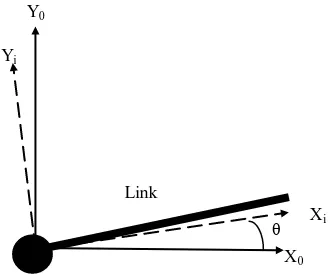
[image:10.596.54.268.233.329.2]The kinematics description is developed for a chain of connected rigid links as shown in Figure 1. The co-ordinate systems of the link are assigned referring to the Denavit– Hartenberg (D–H) description. X0Y0 is the inertial co-ordinate frame (CF), XiYi the rigid body CF associated with the ith link.
Fig. 1. Schematic of Manipulator Robot
The developed modelling based on an Euler-Lagrange simulation algorithm characterising the dynamic behaviour of the manipulator robot system. The description of kinematics is developed for a chain of n serially connected flexible links.
To
derive the dynamic equations of motion of a robot manipulator, the total energies associated with the manipulator system needs to be computed using the kinematics formulations. L is lagrangian otherwise T dan U are the total kinetic and potential energy of the manipulator respectively, that in the cartesian axis are given byLT(x)U(x) (1)
where x[x1,x2,x3,..xn]T
in order to use generalized coordinates with T
s 3 2
1,q ,q ,..q ] q
[
q where x1(i1,2,...n)as a function of q and x is a function of q dan q . i
Based on the Lagrangian equation (2) can be found
LT(q,q)U(q) (2)
Otherwise for n-link robot manipulator, the kinetic energi can be shown i i T i i T i i i I 2 1 v v m 2 1
T
(3)Using kinematic equation for n-link, can be found q
J x
where x
vT
T
, J , v and
are Jacobian matric, linear vector velocity and angular velocity respectively. If this is subtituted to equation (3) will beq D(q)q 2
1
T T (4)
where D(q)is inertia matric of n-link robot manipulator.
The total potential energy of the system due to the deformation of the link i by neglecting the effects of the gravity can be written as
oi i n i p m 2 1
U (5)
position vector poiis measured from robot normal position to center of mass m . i
To subtitute equation (4) and (5) then can be found
) q ( p m 2 1 q ) q ( D q 2 1
L i oi
n i T
given the differential equation
i 1 1 q L q L dt d
(6)
using partial differential equation (PDE) can be writen
Considering the damping, the desired dynamic equations of motion of a robot manipulator can be obtained as
f q,qq g q q) q (
M
(7)where f is the vectors containing terms due to coriolis and centrifugal forces, M is the mass matrix and g is the vectors containing terms due to the interactions of the link angles and their rates with the modal displacements.
[image:10.596.64.229.409.546.2]B. Model Reference Control
[image:11.596.28.291.162.249.2]The NN used as a controller network and a plant model network. The neural model reference control schematic uses two neural networks . There are a controller network and a plant model network, as shown in Figure 2. The plant model is identified first, and then the controller is trained so that the plant output follows the reference model output.
Fig 2. Schematic of Model Reference Controller
III. NEURAL NET WORK FOR MRC AND CONT ROLLER
The function NN are trained using a backpropagation method and sigmoidal activation functions can be obtained as
1e 1
(8)
The dynamics of the robot will be learned by NN controller and then the controller output will be adjusted to make a stabil of the robot motion. Several rules are adopted to make simplify before start the training process considering the NN architecture, number of nodes or neurons and the activation function.
Training of the controller used backpropagation method. To minimise the weight function
used function J . The gradient of a performance function Jcan be obtained as
norm
J norm
(9)where
norm and
denote the nominal value of
and learning rate of NN respectively.Figure 3 shows the simulation of MRC NN of robot manipulator model and the NN controller. For each NN has two layers. Simulation using NN Toolbox Matlab [8]. There are three neurons that used for hidden layers. Also in this simulation used three sets of controller inputs such as d elayed reference inputs, delayed controller outputs and delayed plant outputs.
Furthermore for each of inputs used number of delayed values. Typically, the number of delays will increase with the order of the plant. There are two sets of inputs to the NN plant model such as delayed controller outputs and delayed plant outputs.
IV. RESULT S AND DISCUSSION
Simulation of the developed dynamic model was implemented within the Matlab and Simulink environ ment on Intel Pentium 1.86 GHz and 1.99 GB RAM. The system responses are monitored for duration of 50 s, and the results are recorded with a sampling time of 10 ms. The angular position was obtained. For evaluation of the time response of the angular position, settling time and overshoot of the response are obtained. NN controller used for tracking performance.
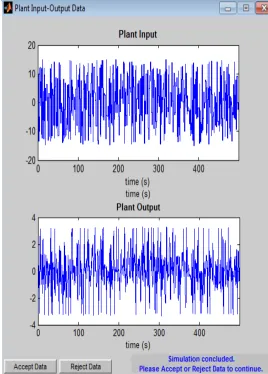
[image:11.596.306.574.308.682.2]In this study, the results of identification system using NN modelling can be shown at figure 4. The identification process after the training procedure is shown. The results obtained good approximations when the controller is trained with a small number of nodes or neurons in each function of the neural controller. It is shown that the comparison of the output can track the input signal is more similar although still have a minor mistake. In the system identification more suggested to keep the output signal can follow the input signal.
Fig. 4. Comparison between input -output robot manipulator Model
er r or +
-
r efer ence
Contr ol input
Contr ol er r or -
+
P la nt Output
Reference model
NN Model
NN Controller
Robot Manipulator
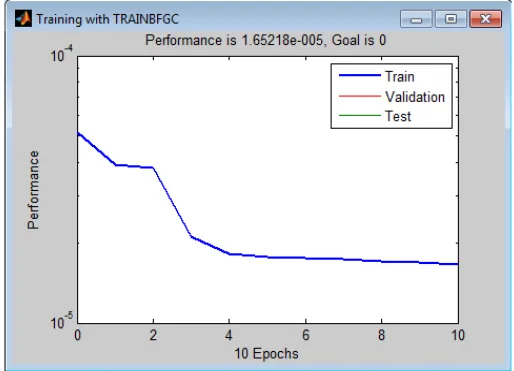
The performance of identification of robot manipulator can be shown in Figure 5. The approximation result between target and real output, the performance is 1.65x10⁻⁵ from the target is zero. It is noted that the comparison between the target signal and real output is very closed similar.
Fig. 5. T he approximation between target and real output
To check the input tracking capabilty of the NN controller and identification model, a combined multiple steps input signals were used for the robot manipulator. In this study given the combined multiple steps input with the step value of 5 rad can be shown in the Figure 6.
0 10 20 30 40 50
-0.1 0 0.1 0.2 0.3 0.4 0.5 0.6
time
ra
[image:12.596.117.547.99.271.2]d
Fig. 6. Input of robot manipulator
The disturbance is given for the robot manipulator to check the robustness of the dynamic system. In this study the disturbance is given at 30s with pulse signal of -1 rad as shown in Figure 7.
Step2 Step1 Step
Scope Robot Manipulator
Plant Output Reference
Control Signal Neural
Network Controller Model Reference Controller
Disturbance
Disturbance
Add2 Add
Torque Torque
Angle
Fig. 3. T he MRC NN of robot manipulator
[image:12.596.318.550.348.538.2] [image:12.596.35.292.419.605.2]0 10 20 30 40 50 -2
-1.5 -1 -0.5 0 0.5 1 1.5 2
time
ra
[image:13.596.52.284.63.256.2]d
Fig. 7. Disturbance of robot manipulator
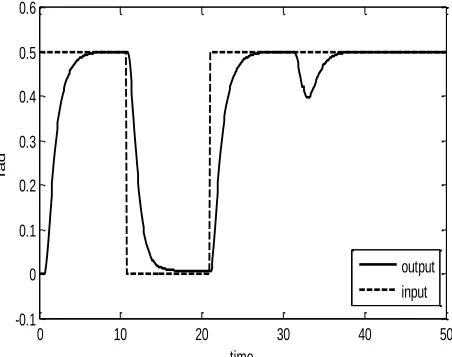
For the tracking input capabilty, the performance of NN controller can be obtained in Figure 8. In this study, the controller is used for input tracking capability of the robot manipulator. The time response spesification is shown with the settling time and overshoot are 4.10s and zero overshoot respectively. It is noted that the controller can track the given input. Also the output system can show a stability from the disturbance that given at 30s. Figure 8 also show the output system can achieve a steady state around 2s after get the disturbance.
0 10 20 30 40 50
-0.1 0 0.1 0.2 0.3 0.4 0.5 0.6
time
ra
d
output input
Fig 8. T he performance of NN controller for in put tracking
V. CONCLUSSION
The development of MRC NN for robot manipulator has been presented. A MRC NN controller has been implemented for input tracking control of the robot manipulator. MRC NN controller presented the performance of identification of robot manipulator with a minor error approximation. Performances of the control schemes have been evaluated in terms of the multiple steps input tracking capability of the system with disturbance robustnes. Simulations of the dynamic model and NN control have been carried out in the time domains where the system responses including angular positions are studied. In term of input tracking and disturbance robustness , NN controller has been shown to be an alternative technique.
Acknowledgment
This research was supported by grant of Hibah Bersaing of Universitas Negeri Yogyakarta, contract no. HB-BOPTN/UN 34.21/2014. The authors would like to thank the anonymous reviewers for their precious suggestions for this paper.
References
[1] Mahmoud Gouasmi, Mohammed Ouali, Brahim Fernini, and M’hamed Meghatria, Kinematic Modelling and Simulation .
[21 Spong, M.W, Vidyasagar M,” Robot dynamics and control,” John Wiley & Sons, 2008/8/4.
[3] Narendra, K.S, Parthasarathy, K, "Identification and control of dynamical systems using neural networks," Neural Networks, IEEE T ransactions vol.1, no.1, pp.4-27, Mar 1990
[4] Narendra, K.S, Mukhopadhyay, S, "Adaptive control using neuralnetworks and approximate models," Neural Networks, IEEE T ransactions, vol.8, no.3, pp.475-485, May 1997
[5] Subudhi B and Morris A. S, “Dynamic modelling, simulation and control of a manipulator with flexible links and joints”, Robotics a nd Autonomous System, Vol. 41, 257-270, 2002.
[6] Gutierrez, L. B. Lewis, F. L. and J. Andy Lowe, “Implementation of a Neural Network T racking Controller for a Single Flexible Link : Comparison with PD and PID Controllers”. IEEE Tra nsa ction on industria l electronics. 45(2): 307-318.1998.
[7] Lewis FL, Liu K, and Yesildirek A, “Neural net robot controller with guaranteed tracking performance”, IEEE T rans Neural Netw. 1995;6(3):703-15.
[8] Mathworks, Neural Network T oolbox, Matlab R2014a.
[image:13.596.52.278.441.620.2]