
This quality improvement project sought to help the executive director of the Freedom Fellows Institute (FFI) determine how to design the trauma-informed learning that fellows experience in year one of the institute, which informs how fellows design their schools. The flexible framework helped inform specific trauma-informed professional development aspects that will guide the fellow's school planning process. To what extent Freedom Fellows receive training related to trauma-informed practice (TIP) during the first year of their training with the Institute.
How has the current Freedom Fellows Institute training informed how fellows design their trauma-informed practice charter applications. FFI contributed more to the clarity of fellows' school designs, not the content for Trauma Informed Practices. When trauma-informed practices are used in a school setting, the school climate and culture is changed.
According to the literature reviewed, school leaders' professional development on trauma-informed practices should have a deep focus on leaders' understanding of trauma (content . knowledge). A flexible framework will convey specific aspects of trauma-informed professional development that will guide the Fellows' school planning process. The extent to which Freedom Fellows received training in trauma-informed practices during their first year of training at the Institute.
I reached out directly to the executive director and asked him to share any materials they used during the sessions related to trauma-informed practices.
Tell me about your previous experiences in K-12 schools
Share with me your vision of the school you want to open
How do you define trauma-informed practices?
What do you think your role is in designing your school to address trauma?
What is your role in sustaining trauma-informed practices being used in your school beyond founding year?
What professional development sessions/experiences have you had at FFI to prepare you to address trauma in your school? (Who led this? How often?
How has your charter design changed/shifted/evolved around trauma informed practices since being a part of FFI?
What would you want more training on to be better prepared to design your school for trauma-informed practices?
In your opinion, what key components make up a high-quality professional development for you to feel it is successful?
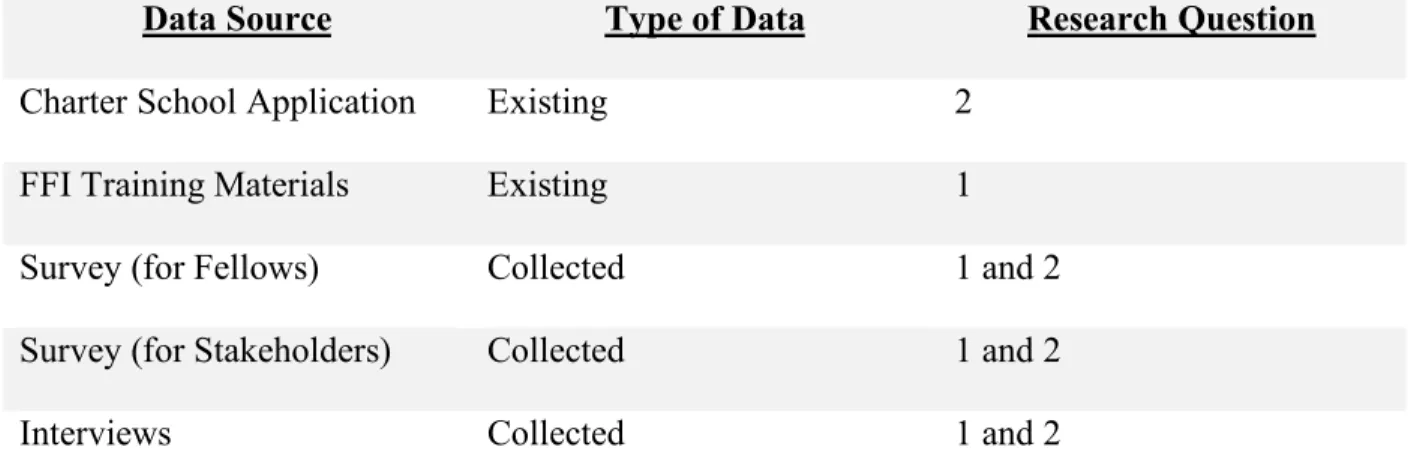
The focus of analyzing these artifacts was on understanding research question one: to what extent do Freedom Fellows receive training related to trauma-informed practices during the first year of their training at the Institute. The surveys and interviews with colleagues and stakeholders were analyzed to understand research questions one and two: both clarified the training on trauma-informed practices that was provided. I specifically looked for ways in which fellows were clear about how they planned to design their school for trauma-informed practice (TIP), related to the six key elements of the TIP design framework.
Question 1: To what extent do Freedom Fellows receive training related to trauma-informed practice during the first year of their training with the Institute. Fellows reported that the FFI experience is trauma-informed because of the trauma-informed and trauma-sensitive way the Executive Director, Program Director, and Consultant Facilitators led sessions and the way they engaged with Fellows. In interviews, fellows explained that the experience during the “year of learning” required them to uncover their own traumas, historically understand how black and brown communities and schools have been disproportionately affected by trauma, and invested them in the need for trauma-informed practice. .
Thus, FFI creates the conditions for a fellow to design for the culture that would be conducive to implementing trauma-informed practices. Although all fellows noted that they had received at least three or more trainings on trauma-informed practices, and all had included some aspect of trauma-informed practices in their charter application, two of the five interviewees were missing one or more trainings. Based on the training documents, fellows were given frameworks, research, and suggestions on what to do to implement trauma-informed practices in their schools, but were not explicitly trained by health care professionals on what it would look like.
Second question: How has the current training of the Freedom Fellows Institute informed how members design their trauma-informed practice charter applications. Fellows noted that their ideas on trauma-informed practices to use in their charter school application were largely formed prior to FFI. Freedom Fellows Institute currently relies on the executive director, contractors, school visits, and conferences to provide fellows with their knowledge of trauma-informed practices.
The fellows do not have the same definition of trauma-informed practices or what it should look like in their schools. FFI is not prescriptive in how fellows should craft their trauma-informed practices, rituals, or even definitions. The academic year, which is year one of the program, is critical in learning trauma-informed practices for fellows because that year shapes how they design their application for charter approval and is the only year when they receive recurrent training of the FFI has. .
Keep modeling trauma-informed practices throughout FFI trainings
In order for leaders to change the design of their school, their minds must first be changed in terms of the type of information needed to have a shared knowledge of a powerful TIP. Therefore, all of the following recommendations will be about what FFI should do in their first year with new Fellows to address their learning of TIPs and use this information to plan implementation of TIPs in their future schools. Modeling the act of affirmation for these leaders of color and making them feel comfortable, confident, and brilliant allows fellows to experience firsthand what trauma-sensitive schooling and learning can feel like and leads to innovative learning and work environments (Chrobot- Mason and Aramovich, 2013).
Above all, they must preserve their existing culture and encourage peers to model and create the same culture within their future schools. As they grow, how can they institutionalize that knowledge and teach it to new team members who will lead peer training. Also, when they recruit and hire new leaders for the institute, what are the qualities that currently exist within the executive director and program director that are key competencies (such as a strong facilitator) or personality traits (such as a good listener) that all employees and the institute must have.
In this upcoming holiday year, FFI should codify its best practices related to trauma awareness, cultural sensitivity, inclusion, and affirmation.
Collect data from fellows throughout year one to assess understanding of trauma-informed practices as new learning occurs
One way to gather information and know what new TIP knowledge FFI adds to fellows is to assess their previous TIP knowledge as soon as they begin FFI. Before experiencing any TIP learning through FFI, a pre-test will serve as a diagnostic but also help leaders create learning experiences that are directly tailored to the gaps that currently exist for fellows. Then, after attending FFI-led TIP professional development sessions, conferences or school visits, they can assess mid-term and again at the end of year one.
Or they may undergo assessment at the beginning of the "learning year" and at the end without a mid-term assessment. The collection of pre- and post-data in the form of a survey can be quick and gives clear insight into new knowledge that has been gained (Law, 2019; McIntyre et al. 2019). Another way to collect similar data will be in the form of structured stops throughout the academic year where the six fellows and the institute leaders discuss specific and concrete ways in which their TIP knowledge has grown, and tangibly show where in their charter application , changes have been made.
It also ensures that the open discussion and document analysis can lead to findings such as: They may find that fellows prefer TIPs to appear in a specifically named section of the charter application, rather than seeing them integrated throughout. In order to plan and operationalize a data collection cycle, it will be important for FFI to consider what are the key knowledge about trauma-informed practices that each fellow will need to know by the end of the first year (such as shared definition or specific practices that the FFI school should one day embrace). They would then decide how often to assess and in what format the data would be collected.
As a starting point, they can refer to the list of TIPs that were asked about in the survey (full survey in appendix). The TIPs that survey respondents said they wanted more training on were: how to hire mental health professionals, how to design their school to incorporate TIP, how to design curriculum to support TIP, and how one designs for TIP policies and practices. evaluated and improved.
Make the TIP learning more concrete by utilizing trauma experts who are more knowledgeable about TIP
Professional Development for Elementary Educators: Creating a Trauma-Informed Classroom (Order No Doctoral Dissertation, Regent University]. Implementing Trauma-Informed Practices to Mitigate African American Trauma Caused by Economic Inequality (Order No. 10930115). How Often Is Training Specific on trauma-informed practice covered in year one of FFI.
Which of the trauma-informed practices below would you like to be present in the professional development FFI provides to year one fellows. How to design a school to integrate trauma-informed practices such as meditation, breathing techniques, stress management, self-regulation, exercise and nutrition, restorative practices. How to design a curriculum across grade levels and subject areas to support the trauma-informed process.
How to design so that schools have a system in place to continually evaluate and improve trauma-informed practices and policies. To what extent did you attend professional development on trauma-informed practices in schools while you were a FF. I feel prepared to guide other educators (teachers, leaders or counselors) on trauma-informed practices in schools.
Incorporating trauma-informed practices such as meditation, breathing techniques, stress management, self-regulation, exercise and nutrition, restorative practices. Which of the following trauma-informed practices would you like to be present at the professional development that FFI offers to first-year fellows. How to design school to incorporate trauma-informed practices such as meditation, breathing techniques, stress management, self-regulation, exercise and nutrition, restorative practices.
How to design curricula across grade levels and subject areas to support the trauma-informed process. How to design so that schools have a system in place to continuously evaluate and improve trauma-informed practices and policies. What is your role in sustaining trauma-informed practice being used in your school beyond the foundation year.
How has your charter design changed/shifted/evolved around trauma-informed practices since you've been part of FFI? What would you like more training on to be better prepared to design your school for trauma-informed practices?
THE SOLUTION: TRAUMA SENSITIVE SCHOOLS
