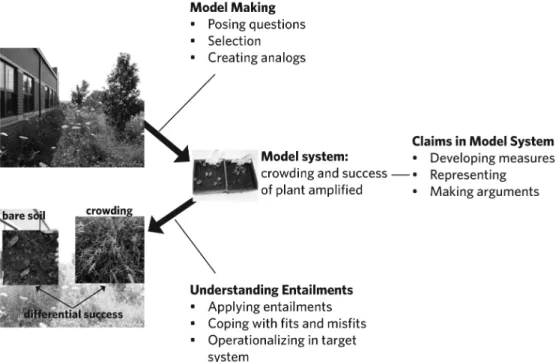
The second paper in my thesis presents an analysis of the first year of teaching in the backyard environment. Scientists produce abstract, predictable representations of the world (models) in the form of explanations, equations, and physics. One of the major struggles I identified for the prevailing images of students' scientific argumentation concerns issues of context.
At the beginning of the year, children did not talk about imagining change in the.

Initial Work of Question Posing
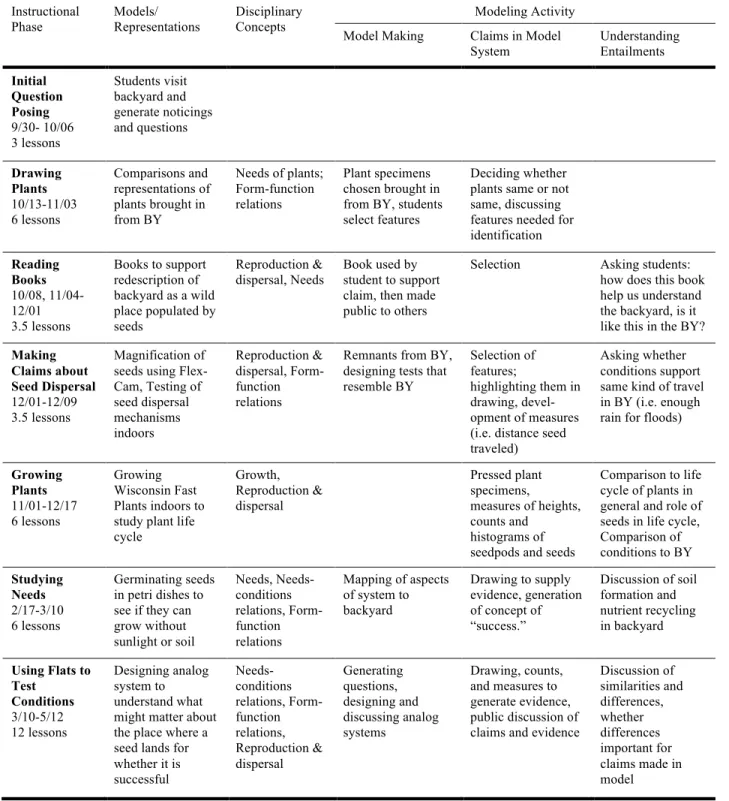
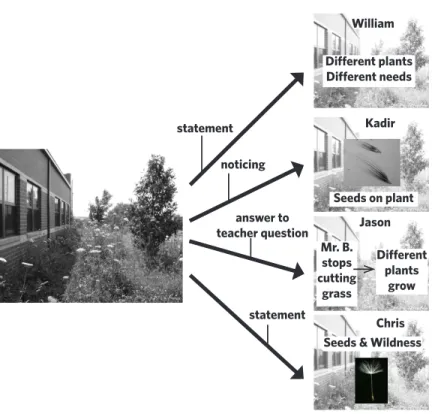
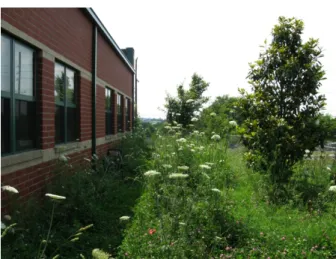
For each of the four selected time phases, I first present an overview of the students' activity and the role of reproduction within that activity. The researchers and the teacher try to frame the students as questioners about invisible processes in the backyard, encouraging them to bring together their inquiry about how the plants got there. He explains that a photograph only shows one part of the backyard and that there are "...different kinds of grasses and insects, and if they are different insects, it's just a part and you can't see it all."2 .
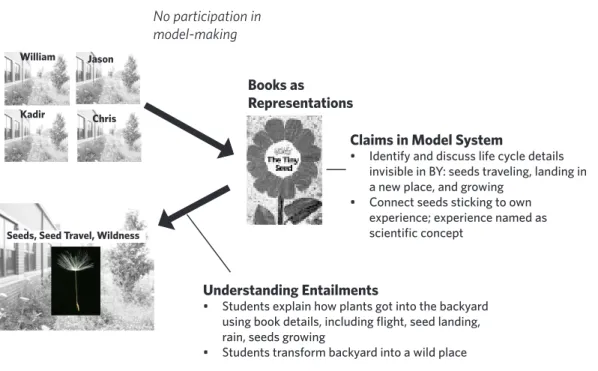
Because, like us, we were reading a book in second grade, it was about flowers, how flowers, like seeds in flowers, come out of the flower and then it and the wind push it, and then it can fall. on the ground. Here, Chris suggests a mechanism whereby young plants may have arrived in the backyard without being planted. She and EM (the author) then put the students through asking questions about the backyard, as shown in the excerpt below.
And then if the wind blows, the wind picks up the seeds from the flower. The difficulty in repositioning is evident in the next line (18), where EM struggles simultaneously with who owns the question and how to reinterpret what is a fact for Chris into an assumption that can be "understood." It is not clear that Chris or other students take this interpretation; As ladies, our guess, then, was that students needed to engage in simplification and focus on specific elements of the backyard in order to create a shared practice of questioning and explanation.
Reading Trade Books that Highlight Seed Dispersal
Only one student suggested in writing or discussion that humans had an intentional role in the placement of plants; everyone else generated ideas about "wild" mechanisms for seed travel, generally those that were mentioned in books and worked through further classroom discussion. In these entries and in the representative episode cited below, students have shown that seeds and reproduction are increasingly visible, interesting, and often powerful for. The next conversations took place on November 4, when Mrs. W read From Seed to Plant, about a month after the students read The Tiny Seed and several weeks after they asked the caretaker, Mr. B., if he had planted the plants in the yard. . only planted grass seed and wasn't sure how the other plants got there.). the students spent several hours drawing and comparing the plants in the yard.
In the first fragment, Mrs. asks students to relate the book to their experiences abroad. This is the first time that seeds have been generalized into categories such as "climbing seeds" or "flying seeds". The students show strong emotions as their collective experience is described as a scientific phenomenon in the book. Inside becomes a place of naming, discussing and abstracting what is seen and observed outside. tries to make a connection between how the seeds in the book get rained on and how the plants in the backyard get water.
The argument that follows suggests that the question of how the plants arrived in the yard became part of the students' scientific practice. This is a very different discussion to the one used as an example in the question stage. Meanings for backyard reproduction are easily posed and repeated by several students in relation to the question.
Making Claims about Seed Travel
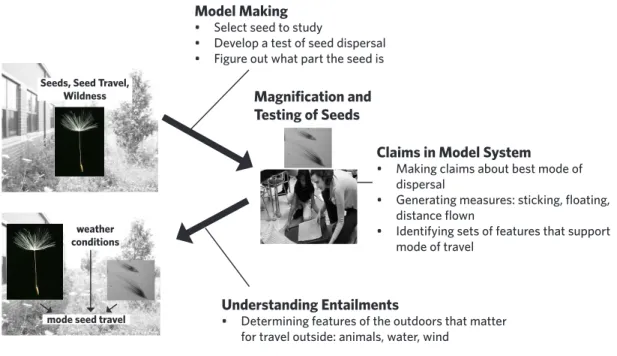
The conversation shifts between the teachers a) making sure that the students can see something and positioning them as observers and explainers and b) positioning the students as claims that must themselves select, arrange and emphasize relevant aspects of the situation. Anthony's initial argument (line 1) is constructed as a plausible story of dispersal based on backyard features. urging him to return to his notes and remember his earlier conversation with her. However, he does not mention his test of seed adhesion or the structure of the seed. has been working with Anthony, she knows there is a seed inside the seed house, which he shows the class.
Notice how much evidence he shares in the course of his presentation: plausible features of the backyard (animals and humans), that the seed did not travel very far in the wind or water centers used to model outdoor processes, that it sticks to his clothes, and that it has "small sticks" on it. EM tries to make his ideas visible to other students by removing the seed from the envelope, projecting it and asking others to repeat his argument. As Anthony hears other students reject his partial statements about aspects of the seeds and the model tests, he is able to add two pieces of evidence that he was not privileged to have in his initial talk: the sticks on the seed and the fact that he placed the seed on his shirt and it stuck to his shirt (Line 29).
Tyree: So I'm saying, did you attach the seed coat, or did you attach the regular seed. Anthony: The seed box, because the seed was still in it, and then, I took it out of my shirt and opened it. Modeling brought into relief the relationships between travel modes, seed characteristics, and environmental characteristics.
Using Flats to Test Conditions
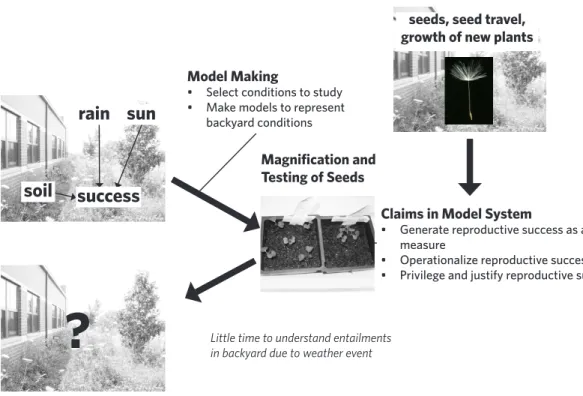
Students were able to use success criteria to compare the growth of plants in petri dishes to those in a light box, noting that plants can germinate without soil but will not thrive. However, because plants in petri dishes were less successful on all measures than those in pots, it was not necessary to prioritize any particular measure. However, of the eleven students who participated in the post-interview, eight privileged seed pods as the primary source of evidence for which condition was more successful, explaining that seed pods meant that the plant produced more of its kind.
Julie does not initially participate in this justification; instead, it demonstrates a common form of classroom practice. These meanings became increasingly powerful in community activity, as evidenced by the focus of conversations around ideas of reproduction later in the next century. The analysis compared the visibility and use of reproduction concepts in four time periods of the year.
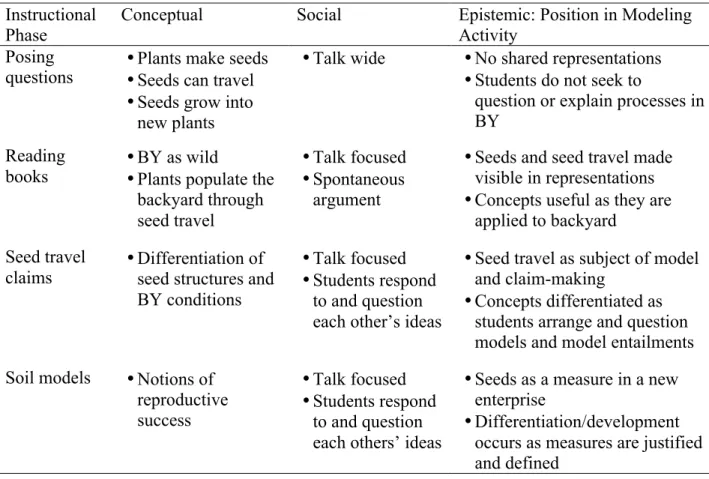
Here, the focus on following a single disciplinary concept that follows methods for understanding PDE has made visible useful analytical distinctions in knowledge-practice relationships in community activity. In the classroom described here, the concept of reproduction was used in various ways: it was named and associated with experience; it has become an ingredient in argumentation and explanation; it was deepened and expanded by the students through experimentation;. In the analysis of the students' activities, three forms of modeling and knowledge relationships emerged, which seem productive for the design of lessons.
Representations Make Ideas Visible to Individuals and to the Community
Another goal of this study was to explore implications for the design of learning environments that support the collaborative development of knowledge and scientific practice. The nature of modeling provides a place where knowledge and practice can start up, or iteratively push and extend each other (Lehrer et al., 2008; Metz, 2011; Nersessian, 2008).
Modeling Activity Provides Opportunities to Problematize, Broaden, and Deepen Understandings
Shared Conceptual Meanings Support Modeling Work and a Developing Notion of What It Means to Model
Scaffolding children's understanding of the fit between organisms and their environment in the context of the practices of science. The experiment was intended as a representation of the backyard that would support the development of the disciplinary ideas as described in Table 1. Finally, the classroom is filled with biological information that can be used to make sense of the results students have seen in the investigation. and the backyard.
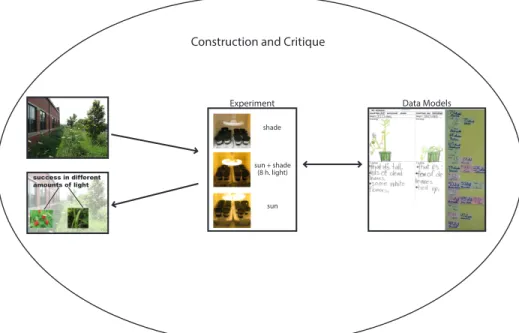
As we move up the "epistemic levels," parts of the system are increasingly mobile (here, involving being seen by different participants), stable, and combinable (Latour, 1987). Parts of the experiment and backyard students recruited, constructed, and critiqued, organized by epistemic levels. Notices: Students noticed aspects of the backyard or experiment and introduced them into discourse, for example the color of a plant's leaves or the amount of water in the plants' tubs.
They generalized across cases by noting something about many of the plants, for example, "The plants in the sun all die." They built. Here I was interested in how the students' participation in constructing and critiquing the parts of the experiment explored in Question 1 supported the development of ecological ideas. Arrows connect the parts of the system under discussion to highlight how epistemic levels shifted.
Second, making sense of the experiment involved determining how important parts of the system were. Students began the experiment with significant resources for the construction and critique of parts of the system at different epistemic levels.
Other features that the students sought to explain included the whiteness of the stems in the shade condition, the presence of "soft" (open) flowers on some plants in the sun condition, and "hard". Britney had indicated on her diary page that the plants in the sun were more successful than those in the sun and shade and noted that the ones in the sun had flowers. When Britney projected her diary page (Figure 7) shared that she noticed flowers in sunny conditions, Mrs.
She then made a "wild claim", arguing that now that they had agreed there would be more quick plants in the sunny areas of the backyard. I think the right amount of light for all plants in the backyard is the sun. The students immediately called upon the experiment to make predictions about the rapid growth of plants in the backyard.
In order to predict how the plants in each condition would look after 6 days, they referred to the results of the experiment and claimed that all the plants would be alive and that the plants in the shade would be the tallest. When asked what he would expect after a few years, Brady said that plants in the sun and under sun and shade conditions will produce more plants, which sparked the next discussion. Many also compared backyard plant species to those used in the experiment, claiming things like, “These are Wisconsin Fast Plants.