
Maintenance methods: In these cases, it is desirable to maintain the results of the data mining process continuously over time. This is because a clustering can often be viewed as an unsupervised model of the entire network, especially when used in the context of a generative methodology. This research provides an overview of the wide range of methods that can exploit the richness of different scenarios in the network analysis domain.
The application section also provides further discussion of the semantics of evolution analysis in the context of different domains. This section provides an overview of the different models used for these problems. Clustering and community detection. One of the earliest methods for evolutionary clustering was proposed in Chakrabarti et al.
Various properties of clusters, such as consistency and clustering quality, are also explored in Gupta et al. If the tensor is sparse, then the complexity of these methods is in the order of the number of entries in the tensor. Because the streaming model is new, no streaming methods exist for many of the techniques discussed in the previous section.
Many measures of the network, such as centrality, can be determined using the methods described in Tong et al.
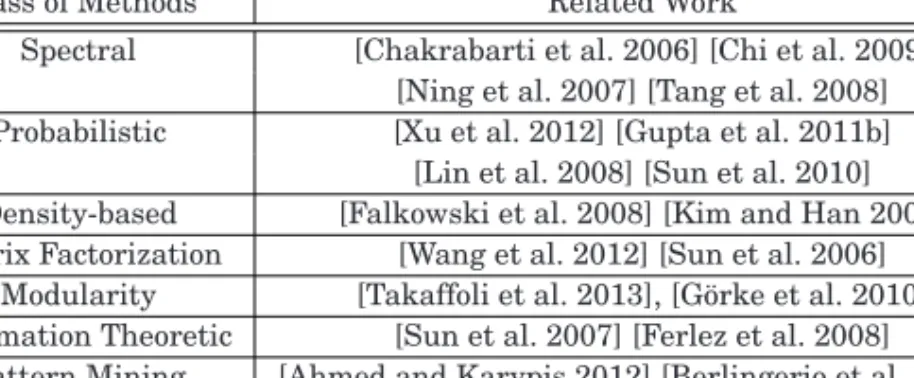
Slowly Evolving Networks
In all the networks studied, most nodes belonged to the giant connected component. A discussion of the typical models of group formation in social networks is presented in Backstrom et al. 2006] studies how the structure and development of communities is related to the network itself.
Therefore, many of the methods proposed for evolutionary clustering can also be used to characterize the nature of the changes in the data. It constructs a differential graph that measures the changes in the graph's structure from one snapshot to the next. These communities are then compared to each other through several snapshots to analyze the nature of the underlying evolution.
It has also been shown that the knowledge of the time commitment of members to a community can be used to estimate its lifetime. One of the key issues in the effective application of many of the community detection methods is to design ways to "match" the communities across different snapshots in time. An overview of methods for performing evolution analysis in networks in the context of the community structure of networks can be found in Spiliopoulou [2011].
The main advantage of spectral methods is that they use the aggregate correlation structure of the links in the network. Such measures are remarkably robust to small changes in the underlying network, and a significant change usually reflects a corresponding change in network structure. Evolution of distance along the shortest path. Most real-world graphs, such as the Web, social networks, and information networks, experience significant changes in terms of pairwise distances between nodes in the network.
This reduces the number of irrelevant time points and keeps only the important change points in the entire network view. Some roles may decrease/increase in importance depending on the period of the underlying event. On the other hand, PFNET models provide a more intuitive explanation of the underlying evolutionary pathways.
A study of the evolution of different Web ecologies using visual analytics is provided in Chi et al. Some of the earliest works focus on measuring similarities between successive snapshots of graphs using different similarity functions [Papadimitriou et al.
Streaming Scenario
Changes in eigenvalues represent changes in activity level, while changes in eigenvector directions represent changes in neighborhood subgraph patterns. The impact analysis problem has been studied in evolving network flows [Aggarwal et al. In such cases, edges can be added and deleted rapidly in the network, as a result of which the topology of the network can change drastically over time.
Many natural social interactions, such as epidemiological networks, e-mail networks, or chat rooms, can be modeled much more naturally with this approach. The key idea is that network flows and changes in network structure are analyzed in parallel. Therefore, the stream variables in the network are time-stamped and the values at time (t+1) can be derived from those at timet using the at timet network structure.
A greedy approach is developed in which new nodes are added or added from the current set of influence points to improve the global influence objective function. The approach was also generalized to the case of social flows in Subbian et al.
INCORPORATING CONTENT IN EVOLUTION ANALYSIS
A content-based and network-based stream mining approach for dynamic impact analysis was also proposed in Subbian et al. In this case, sequential patterns are dynamically drawn from a combination of keywords and a dynamic network in the social stream. These are then used to predict the most influential entities in a dynamic and evolving network.
The problem of classification is addressed in Aggarwal and Li [2011], where content and structure are combined for the problem of dynamic classification. When a random walk is performed on a node in N, the majority of nodes visited are reported as the appropriate class label. The problem of link prediction has also been studied in the context of dynamic networks with content [Aggarwal et al.
This coarse clustering is based only on the structure, and it provides the macro-clusters on which more fine-grained analysis is performed to predict the underlying links. The underlying links are predicted using a combination of the content and structure within each region of the network. The approach has been shown to be significantly better than many traditional methods for link prediction and is also applicable to heterogeneous network scenarios.
A method for performing graph flow clustering with side information is discussed in Zhao and Yu [2013]. Such side information is often defined by the underlying content and can be very useful in many scenarios. For example, in social networks, user profiles and behaviors can be used as side information.
In web click graphs, the meta information about users' web pages can be exploited, and in bibliographic networks, the information about the underlying publication can be used as page information. It has been shown in Zhao and Yu [2013] that such side information can be used to significantly improve the clustering process. The approach described in this work is an extension of the technique proposed in Aggarwal et al.
APPLICATIONS
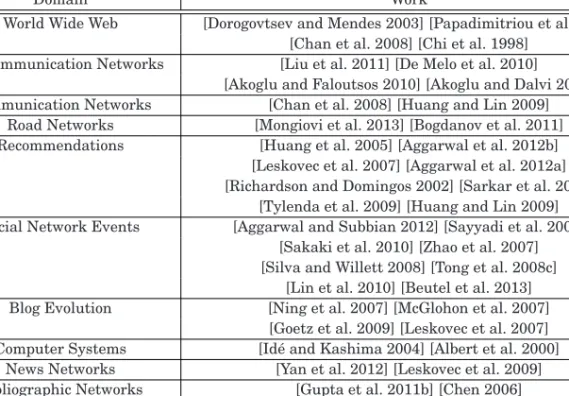
- World Wide Web
- Telecommunication and Mobile Networks
- Communication Networks
- Road Networks
- Social Network Recommendations
- Social Network Event Detection
- Computer Systems
- Blog Evolution
- News Networks
- Bibliographic Networks
- Biological Networks
When a fault occurs in a communication network, it usually causes changes in the network's routing topology. Backstrom and Leskovec 2011] also uses network content for better link prediction, while the work in Aggarwal et al. The study of such models of influence in the context of news networks is given in Yan et al.
A wide variety of events are of interest in social networks, such as unusual tweets, meetings or changes in trends in the content of the underlying network. The work in Aggarwal and Subbian [2012] investigates the problem of event detection in the context of social streams by examining the changes in both the content and the structure of the underlying social stream. This is generally the case for many network analysis applications due to the inherent richness in the graph representation structure.
In this context, the evolution of blog structure provides important insights into the nature of the underlying events.
CONCLUSIONS
Algorithms for mining the evolution of conserved relational states in dynamic networks. Knowledge and information systems. Mining and Visualizing the Evolution of Subgroups in Social Networks. International Conference on Web Intelligence. GA-TVRC-Het: Genetic algorithm extended time-varying relational classifier for evolving heterogeneous networks.DMKD.1–32.
Towards time-aware link prediction in evolving social networks. Workshop Social Network Mining and Analysis. A meaning-driven framework for characterizing and finding evolving patterns of news networks. Artificial intelligence and computer intelligence.
