File name: 11. JURNAL AGRIECOBIS
Page count: 13 Word count: 7491 Сharacter count: 47831 File size: 625.30 KB File ID: 77371797
15.3% Matches
Highest match: 1.64% with Internet source (http://journal.ipb.ac.id/index.php/jupe/article/download/27767/19502)
...
Page 150% Quotes
5.35% Exclusions
Some exclusions were automatic (exclusion filters: matched word count less than 8 words and 0%)
...
Page 16...
Page 1615.3% Internet sources 510 No Library sources found
Exclusion of quotes is off Exclusion of references is off
4.1% Internet exclusions 266 1.47% Library exclusions 71
Agriecobis
(Journal of Agricultural Socioeconomics and Business)
p-ISSN 2662-6154, e-ISSN 2621-3974 // Vol. 5 No. 1 March 2022, pp. 35- 47
10.22219/agriecobis http://ejournal.umm.ac.id/index.php/agriecobis [email protected] 35
Research Article
Farmers' Motivation in Implementing Jajar Legowo Planting System in Tegalsari, Kepanjen, Malang
Hamyana , Khoirunisak , Ugik Romadi 1,* 2 3
Politeknik Pembangunan Pertanian Malang, Jl. Dr. Cipto No 144A, Bedali Lawang, Malang, 65200– , Indonesia
1 Email : hams.lodaya@gmail,com *; Email : 2 [email protected] Email :; 3 [email protected]
* corresponding author hams.lodaya@gmail,com
INTRODUCTION
The Indonesian government through its Ministry of Agriculture carries out serious efforts to achieve rice self- sufficiency in 2019. It is stated in the Strategic Plan of Indonesian Ministry of Agriculture of 2015-2019, stating one of the policies of the Indonesian Ministry of Agriculture is to increase rice self-sufficiency and increase the production of corn, soybeans, sugar, meat, chili and shallots. The Indonesia Ministry of Agriculture in 2016 targets an increase in rice production of at least 76.2 million tons of Harvested Dry Grain. The Indonesian
Ministry of Agriculture increases not only the planted area but also the productivity of food centers. The implementation of the program is to set a target for rice planting area.
The government's primary concern in ensuring national food security is rice. Rice is the staple food for the Indonesian citizen. Rice is a priority, and it supports agricultural programs. Therefore, it becomes government's particular concern in providing sufficient quantities.
A R T I C L EI N F O A B S TR AC T
Article history Received June 08, 2021 Revised March 01, 2022 Accepted March 15, 2022 Published March 30, 2022
This study aims at determining the factors affecting the farmers' motivation in implementing Jajar Legowo planting system. This study was conducted in Tegalsari,
Kepanjen, Malang, from April to June, 2020. The population in this study was the members of farmer groups "Baru Muncul 1" and "Baru Muncul 2" totaling 152 people.
Sampling technique employed was proportionate random sampling. The number of samples was determined by adopting Slovin formula at a degree of error of 10% as many as 60 respondents. Moreover, the data in this study were collected by employing a questionnaire. The method used for data analysis was multiple linear regression test with IBM SPSS 22 software. The results showed that internal factors (age, land area, education, length of farming) and external factors (availability of capital, intensity of extension, and availability of labor) affected farmers' motivation in implementing Jajar
Legowo planting system by 65.6%, while the remaining 34.4% is affected by other
variables which were unexamined in this study. The factors significantly affecting farmers' motivation in implementing Jajar Legowo planting system are internal factors (age, land area, education, length of stay), the availability of capital, the intensity of counseling, and the availability of labor.
Copyright © 2022, Hamyana et al This is an open access article under the CC-BY SACC BY SA- - - license Keywords
Motivation Jajar Legowo Farmer
Matches Quotes References T Ignored text AReplacement Comments
Sources on this page: 18, 33, 82, 129, 138-139
36
Hamyana et.al (Farmers' Motivation in Implementing Jajar Legowo Planting System in Tegalsari, Kepanjen, Malang…, Motivation, Jajar Legowo, Farmer)
One of the regions becoming the basis of rice production is Malang. Rice production in Malang from January to September, 2020, was 232,490 tons of Milled Dry Grain. Based on the potential production from October to
December, 2019, it is estimated that the total rice production in 2020 is 284,583 tons of Milled Dry Grain. Efforts
to achieve the target of the government's program in increasing national rice production through the Development and Research Agency have issued recommendations for the implementation of Jajar Legowo planting system.
The principle of Jajar Legowo planting system is to increase the plant population by adjusting the spacing.
Hence, the planting will have an edge row that is half the distance between rows. In addition, plants on the edge are expected to provide higher production and better grain quality. The implementation of Jajar Legowo planting system type 2:1 can form saplings of 28.48 stems, while the other types of Jajar Legowo planting system only range from 18.66 to 25.11 stems (Sari, 2014). The number of productive saplings in the Jajar
Legowo planting system type 2:1 is directly proportional to production and productivity. Hence, the implementation of Jajar Legowo planting system can be used as an effort to increase the production and income of rice farmers. The implementation of Jajar Legowo planting system by farmers is affected by internal and external factors. One of the internal factors affecting the implementation of the Jajar Legowo planting system is farmers' motivation.
The result of research conducted by Faizin et al.,( 2015) concluded that the completely dominant factor
affecting the farmers' motivation in increasing rice production is internal characteristics. Referring to the
previous research, research question arises, "is the implementation of Jajar Legowo planting system in Tegalsari, Kepanjen, Malang, also affected by internal and external factors?" To answer this question, it is necessary to conduct a study to analyze what internal and external factors have a significant effect on the
farmers' motivation in implementing Jajar Legowo planting system. It is expected that by identifying the dominant factors affecting motivation, it will become input for policy makers to intervene and formulate policies, especially in the context of dynamics and awareness of farmers to implement technology of Jajar Legowo planting system.
REASEARCH METHOD
The research population in this study is 152 people consisting of farmers group "Baru Muncul 1" with 99 members and farmers group "Baru Muncul 2" with 53 members. Sampling was carried out by utilizing the proportionate random sampling, one of probability sampling technique. The number of samples is determined according to the Solvin formula as follows:
n = N/(1+N(e)²) n = 152/(1+152(0,1)²) n = 152/2.52 n= 60 Where:
n = Sample size N = Population size
e = The desired critical value (limit of accuracy) (percent of an limit for inaccuracy in sampling) is 10%.
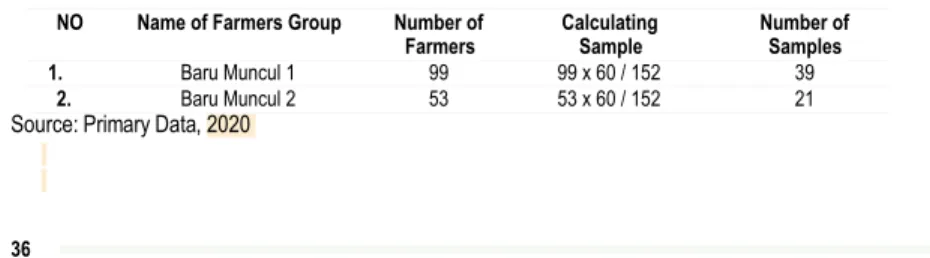
Based on the results of the aforementioned calculations, the number of samples obtained is 60 people, with the distribution per farmer group as presented in the following table:
Table 1. Distribution of Research Sample NO Name of Farmers Group Number of
Farmers
Calculating Sample
Number of Samples
1. Baru Muncul 1 99 99 x 60 / 152 39
2. Baru Muncul 2 53 53 x 60 / 152 21
Source: Primary Data, 2020
Matches Quotes References T Ignored text AReplacement Comments
Sources on this page: 45, 49, 51
37
Hamyana et.al (Farmers' Motivation in Implementing Jajar Legowo Planting System in Tegalsari, Kepanjen, Malang…, Motivation, Jajar Legowo, Farmer)
The data collected in this study include primary and secondary data. The technique carried out to collect primary data was a survey by distributing a questionnaire as its instrument. It was a closed questionnaire that can directly be given to the respondent. Meanwhile, secondary data were collected by employing document study techniques studying document issued by relevant parties relevant to this study.wen
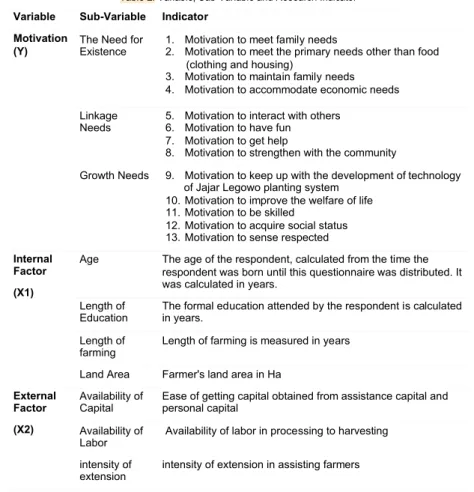
The variables and indicators used in this study are as follows:
Table 2. Variable, Sub-Variable and Research Indicator Variable Sub-Variable Indicator
Motivation
(Y) The Need for
Existence 1. Motivation to meet family needs
2. Motivation to meet the primary needs other than food (clothing and housing)
3. Motivation to maintain family needs 4. Motivation to accommodate economic needs Linkage
Needs 5. Motivation to interact with others 6. Motivation to have fun 7. Motivation to get help
8. Motivation to strengthen with the community
Growth Needs 9. Motivation to keep up with the development of technology of Jajar Legowo planting system
10. Motivation to improve the welfare of life 11. Motivation to be skilled
12. Motivation to acquire social status 13. Motivation to sense respected Internal
Factor (X1)
Age The age of the respondent, calculated from the time the respondent was born until this questionnaire was distributed. It was calculated in years.
Length of
Education The formal education attended by the respondent is calculated in years.
Length of
farming Length of farming is measured in years Land Area Farmer's land area in Ha
External Factor (X2)
Availability of
Capital Ease of getting capital obtained from assistance capital and personal capital
Availability of
Labor Availability of labor in processing to harvesting intensity of
extension intensity of extension in assisting farmers
Data analysis carried out in this study was multiple linear regressions. The prerequisites that must be met in multiple regression analysis are the classical assumption test consisting of normality test, heteroscedasticity test, multicollinearity test and autocorrelation test. The multiple linear regression equations are:
Y’= α + β1X1.1+ β1X1.2+ β1X1.3 + β1X1.4 + β2X2.1 + β2X2.2 + β2X2.3 Information:
Y’ = Farmer’s Motivation α = Constanta
β = Coefficient of Regression X1 = Internal Factor
X1.1 = Age
Matches Quotes References T Ignored text AReplacement Comments
Sources on this page: 24, 45, 124, 133
38
Hamyana et.al (Farmers' Motivation in Implementing Jajar Legowo Planting System in Tegalsari, Kepanjen, Malang…, Motivation, Jajar Legowo, Farmer)
X1.2 = Length of Education X1.3= Length of farming X1.4 = Land Area X2 = External Factor X2.1 = Availability of Capital X2.2 = Availability of Labor X2.3 = intensity of extension
The hypothesis in this study is the effect of each independent variable, both from internal factors (education,
length of farming, land area) and external factors (availability of capital, availability of labor, intensity of extension) on farmers' motivation in implementing Jajar Legowo planting system. The basis for making the decision is:
- H0 is accepted if the value of t count < t table - H0 is rejected if the value of t count > t table
RESULT AND DISCUSSION Classical Assumption Test a. Normality Test
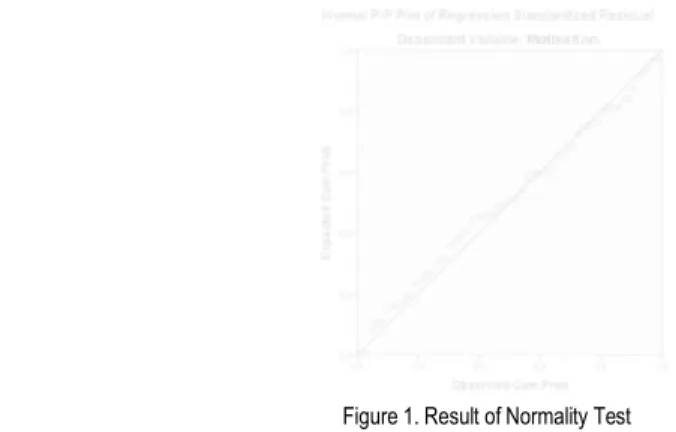
Normality test was conducted to test the distribution of variables. Each independent variable is normally distributed or not; the normality test is indicated by the error value normally distributed. Normality testing of the data can be done by referring to the results of the Normal Probability Plot. It refers to the opinion of Ghozali, (2011) stating that normality detection is carried out by looking at the Normal Probability Plot. The results of the normality test based on the results of the Normal probability Plot show that the equation of this regression model has normal distribution of data, and there are no data deviations. The results of the normality test of this study are shown in the following figure:
Figure 1. Result of Normality Test
Figure 1. shows the data obtained have been normally distributed evenly along the diagonal line. It means that the data in this study have met the criteria for normality.
b. Multicollinearity Test
Multicollinearity test is to see whether or not there is a high correlation between independent variables in a multiple linear regression model. The condition of multicollinearity occurs when there is a correlation between two independent variables (Wen et al., 2015) The regression model that is feasible to use is that there is no correlation between the independent variables. Testing for the presence or absence of multicollinearity
symptoms is carried out by taking into account the value of the correlation matrix generated during data processing and the value of VIF (Variance Inflation Factor) and its Tolerance. The basis used in the decision
Matches Quotes References T Ignored text AReplacement Comments
Sources on this page: 11, 17, 24, 27, 40, 46-47, 50, 68, 77, 83, 86, 98-99, 104, 140
39
Hamyana et.al (Farmers' Motivation in Implementing Jajar Legowo Planting System in Tegalsari, Kepanjen, Malang…, Motivation, Jajar Legowo, Farmer)
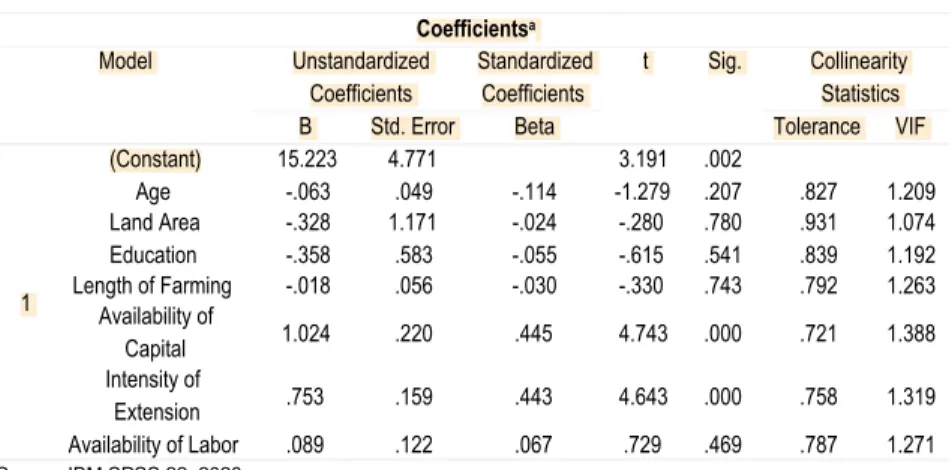
making of this multicollinearity test is based on VIF and standard tolerance. A regression model is declared to have no multicollinearity if it has a VIF value around the number 1 and does not exceed the number 10 and has a tolerance close to 1. The value of tolerance and Variance Inflation Factor (VIF) can be obtained from the following data:
Table 3. Result of Multicollinearity Test Coefficientsa
Model Unstandardized
Coefficients
Standardized Coefficients
t Sig. Collinearity Statistics
B Std. Error Beta Tolerance VIF
1
(Constant) 15.223 4.771 3.191 .002
Age -.063 .049 -.114 -1.279 .207 .827 1.209
Land Area -.328 1.171 -.024 -.280 .780 .931 1.074
Education -.358 .583 -.055 -.615 .541 .839 1.192
Length of Farming -.018 .056 -.030 -.330 .743 .792 1.263
Availability of
Capital 1.024 .220 .445 4.743 .000 .721 1.388
Intensity of
Extension .753 .159 .443 4.643 .000 .758 1.319
Availability of Labor .089 .122 .067 .729 .469 .787 1.271
Source: IBM SPSS 22, 2020
Table 3. It indicates that the value of VIF is less than 10 (VIF < 10) and the value of tolerance is close to 1. It means that this study is free from the criteria of multicollinearity.
c. Heteroscedasticity Test
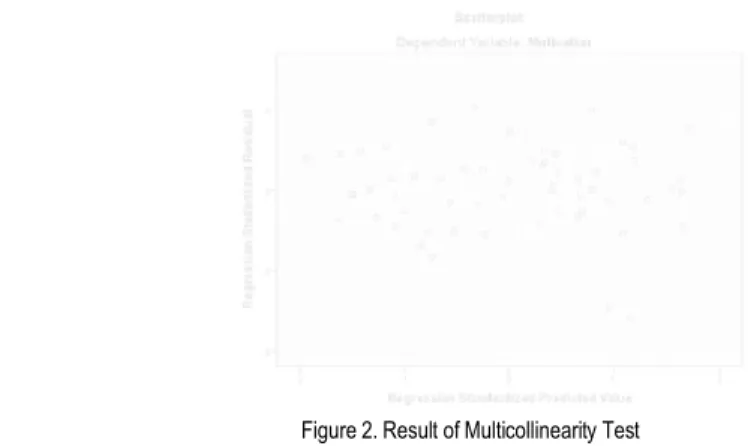
Heteroscedasticity test aims at testing whether in the regression model there is an inequality of variance from the residual of one observation to another observation. The method that can be used to detect heteroscedasticity is the Glejser test and look at the scatter plot graph between the predicted value of the dependent variable (ZPRED) and the residual value (ZRESID). T
esting using SPSS obtained the following results:
Figure 2. Result of Multicollinearity Test
Figure 2. shows that the pattern of dots spreads around the zero point on the Y axis. Hence, it can be concluded that the regression model in this study is free from heteroscedasticity criteria.
Matches Quotes References T Ignored text AReplacement Comments
Sources on this page: 17, 24-25, 27, 32, 38-40, 42-43, 46-48, 50, 53, 57, 61, 69, 76-77, 85, 88, 98-99, 112
40
Hamyana et.al (Farmers' Motivation in Implementing Jajar Legowo Planting System in Tegalsari, Kepanjen, Malang…, Motivation, Jajar Legowo, Farmer)
Multiple Linear Regression Analysis Estimation of multiple linear regression model
Simple linear regression analysis begins by estimating the regression model. The following is an estimate of the simple linear regression model in this study.
The coefficient of determination is used to determine the contribution of the effect given by the independent variable or independent variable (X) to the dependent variable or dependent variable (Y). The coefficient of
determination can be seen in the table model summary column R square. The value of the coefficient of determination in this study can be seen in table 3.
Table 4. Coefficient of Determination Model Summaryb
Model R R-squared Adjusted R
Square
Std. Error of the Estimate
Durbin-Watson
1 .810a .656 .610 3.44181 2.018
Source: IBM SPSS 22, 2020
Based on Table 4, it is recognized that the coefficient of determination or R Square is 0.656. It means that the independent variable or internal factor variables (X1) and external factors (X2) have an effect on the variable of farmer's motivation (Y) of 65.6%. Menawhile, the remaining 34.4% is affected by other variables outside of the independent variables studied in this study.
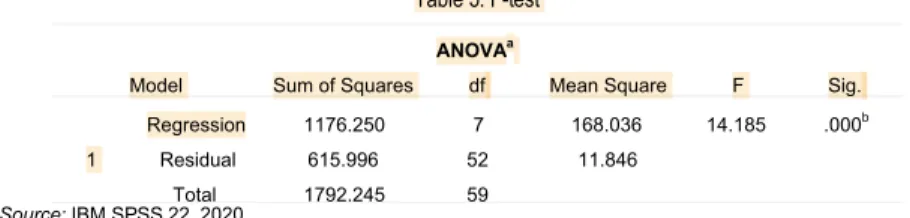
The simultaneous effect and the partial effect of the independent variable (X) on the dependent variable (Y) can be seen in Tables 5 and 6 below:
Table 5. F-test ANOVAa
Model Sum of Squares df Mean Square F Sig.
1
Regression 1176.250 7 168.036 14.185 .000b
Residual 615.996 52 11.846
Total 1792.245 59
Source: IBM SPSS 22, 2020
Table 5 shows that the F-test results have a sig value of 0.000 < 0.05, meaning that the independent
variables including (Age, Land Area, Education, Length of Farming, Availability of Capital, Intensity of Extension, and Availability of Labor), simultaneously have a significant effect on the dependent variable (Y), which is the farmer's motivation in implementing Jajar Legowo planting system.
Matches Quotes References T Ignored text AReplacement Comments
Sources on this page: 13, 16-17, 24-25, 27, 39, 42-43, 48, 50, 53, 57-58, 61, 69, 72, 82, 85, 87, 95, 101-103, 107, 110, 116, …
41
Hamyana et.al (Farmers' Motivation in Implementing Jajar Legowo Planting System in Tegalsari, Kepanjen, Malang…, Motivation, Jajar Legowo, Farmer)
Table 6. t-test Coefficients
Model Unstandardized
Coefficients Standardized
Coefficients t Sig.
B Std. Error Beta
1
(Constant) 15.223 4.771 3.191 .002
Age (X1.1) -.063 .049 -.114 -1.279 .007
Land Area (X1.2) .328 1.171 .824 1.280 .001
Education (X1.3) .358 .583 .755 2.615 .001
Length of Farming (X1.4) .018 .056 .030 1.330 .003
Availability of Capital (X2.1) 1.024 .220 .445 4.743 .000
Intensity of Extension (X2.2) .753 .159 .443 4.643 .000
Availability of Labor (X2.3) .089 .122 .067 1.729 .000
Source: IBM SPSS 22, 2020
Based on Table 6, it is identified that the value of Constant (a) is 15.223, so the regression equation can be written as follows:
Y’= 15,223 -,063 X1.1 +(,328) X1.2 +(,358) X1.3 +(,018) X1.4 +(1.024) X2.1 +(0,753) X2.2+(0,89) X2.3 The equation can be interpreted, as follows:
1. The constant of 15.223 means that the consistent value of the variable of farmer's motivation in implementing Jajar Legowo planting system is 15.223.
2. The regression coefficient of X1.1 is (-0.063), meaning that for every additional 1 unit of value in the variable of age, the value of farmer's motivation in implementing Jajar Legowo planting system will decrease by 0.063.
3.The regression coefficient of X1.2 is (0.328), meaning that for every additional 1 unit of value in the
variable of land area, the value of farmer's motivation in implementing Jajar Legowo planting system will increase by 0.328.
4.The regression coefficient of X1.3 is (0.358), meaning that for every additional 1 unit of value in the variable of education, the value of farmer's motivation in implementing JJajar Legowo planting system will increase by 0.358.
5.The regression coefficient X1.4 is (0.018), meaning that for every additional 1 unit of value in the
variable of length of farming, the value of farmer's motivation in implementing Jajar Legowo planting system will increase by 0.018.
6.The regression coefficient of X2.1 is (1.024), meaning that for every additional 1 unit of value in the
variable of capital availability, the value of farmer's motivation in implementing Jajar Legowo planting system will increase by 1.024.
7. The regression coefficient of X2.2 is (0.753), meaning that for every additional 1 unit of value in the variable of intensity of extension, the value of farmer's motivation in implementing Jajar Legowo planting system will increase by 0.753.
8. The regression coefficient of X2.3 is (0.089), meaning that for every additional 1 unit of value in the variable of availability of labor, the value of farmer's motivation in implementing Jajar Legowo planting system will increase by 0.089.
Meanwhile, variable X (Age, Land Area, Education, Length of Farming, Availability of Capital, Intensity of Extension, and Availability of Labor) partially affecting variable Y (farmer's motivation in implementing Jajar Legowo planting system) can be seen in the results of the t-test as presented in Fig. Table 3. The significance of the effect of variable X on variable Y can be explained as follows:
1.The variable of age (X1.1) has a significance value of 0.007 or less than 0.05. It means that the
variable of age has a significant effect on the farmer's motivation in implementing Jajar Legowo planting system. Hence, H1 is accepted.
2.The variable of land area (X1.2) has a significance value of 0.001 or less than 0.05. It means that the variable of land area has a significant effect on the farmer's motivation in implementing Jajar Legowo planting system. Hence, H0 is rejected, and H1 is accepted.
3. The variable of education (X1.3) has a significance value of 0.001 or less than 0.05. It means that the variable of education has a significant effect on the farmer's motivation in implementing Jajar Legowo planting system. Hence, H0 is rejected, and H1 is accepted.
4. The variable of length of farming (X1.4) obtained a significance value of 0.003 or less than 0.05. It means that the length of farming has a significant effect on the farmer's motivation in implementing Jajar Legowo planting system. Hence, H0 is rejected, and H1 is accepted.
Matches Quotes References T Ignored text AReplacement Comments
Sources on this page: 11, 13, 16-17, 25, 27, 29, 32-33, 37-38, 40, 42-43, 46, 53, 57-58, 68, 72, 83, 93, 105, 107-108, 121, 14…
42
Hamyana et.al (Farmers' Motivation in Implementing Jajar Legowo Planting System in Tegalsari, Kepanjen, Malang…, Motivation, Jajar Legowo, Farmer)
5. The variable of availability of capital (X2.1) has a significance value of 0.000 or less than 0.05. It means
that the variable of availability of capital has a significant effect on the farmer's motivation in implementing Jajar Legowo planting system. Hence, H0 is rejected, and H1 is accepted.
6. The variable of intensity of extension (X2.2) obtained a significance value of 0.000 or less than 0.05. It means that the variable of intensity of extension has a significant effect on the farmer's motivation in implementing Jajar Legowo planting system. Hence, H0 is rejected, and H1 is accepted.
7.The variable of Availability of Labor (X2.3) has a significance value of 0.000 or less than 0.05. It means
that the variable of availability of labor has a significant effect on the farmer's motivation in implementing Jajar Legowo planting system. Hence, H0 is rejected, and H1 is accepted.
The effect of Internal Factors on Farmer's Motivation in Implementing the Jajar Legowo Planting System
Effect of age on farmer's motivation
The score of regression coefficient (-0.063) indicates the variable of age has an effect on motivation of -6%
with a significance value of 0.007 or less than 0.05. Thus, in this study, the variable of age had a significant effect on the farmer's motivation in implementing Jajar Legowo planting system. It is inseparable from field conditions showing the average age of some farmers is entering old age with data recapitulation as many as 14 people aged over 50 years. Based on this condition, it can be assumed that the higher the age of someone, the lower the level of motivation she/he has. It is in accordance with the theory put forward by (Soekartawi, 1993) stating that farmers who are getting older are usually fanatical about tradition, and it is difficult to give them an understanding that can change their way of thinking, working and living. They tend to be apathetic towards new technologies and innovations. The result of research conducted by (Made et al., 2016) shows that the results is
in line with this study, where farmer's age does not correlate with farmer's motivation in implementing
innovations of hybrid corn variety because the average age of respondent farmers is a productive age.
Therefore, there is not too much difference between farmers. The average age of farmers is in the productive age. The early majority is 49 years, and the late majority is 38 years. Both of them have the motivation to run their corn farming by using innovations of hybrid corn varieties, to get higher yields both in terms of productivity and income.
The effect of land area on farmer's motivation
The variable of land area has a regression coefficient score of 0.328, meaning every 1 unit intervention on the variable of land area will increase the farmer's motivation by 0.328 with the requirement of other variables remain or constant. The results of the t-test calculation on multiple linear regression analyses also show the significance value is less than 0.05, meaning that the variable of land area in this study has a significant effect on farmers' motivation in implementing Jajar Legowo planting system. This results are supported by the result of research condrctrd by (Nisa, 2015) stating that land area also plays an important role in affecting one's motivation in planting rice commodities. It is because the more land they have, the more results they will get.
The reults of research conducted by (Afrianika et al., 2020) are also in line with this study showing that land
area had a significant effect on shallot production in Tawangmangu at the confidence level of 99%. The increase of farmer's motivation caused by the addition of land area can be accepted logically. It is because the wider the cultivated land, the greater the potential yield that can be received. Jajar Legowo planting system has been proven to be able to increase production and productivity. Then farmers hope that the potential income to be obtained will also increase with a large enough land area.
The effect of education on farmer's motivation
Typically, one's education will affect one's mindset, and the change in that mindset will have implications for
motivation and performance. The results of statistical analysis in this study indicate that the regression coefficient score is (0.358), meaning that for every additional 1 unit of value in the variable of education, the value of farmer's motivation in implementing Jajar Legowo planting system will increase by 0.358. Whereas, the significance value on the t-test is 0.001 or less than 0.005, meaning the variable of length of education has a significant effect on the variable of farmer's motivation in implementing of Jajar Legowo planting system. The result of review conducted by (Stauri & Rasni, 2016) showed that from the treatment group receiving education in health science by demonstration method, there was a significant value (pv: 0.000 <α: 0.05) meaning that there was a difference between before and after the education in health science by demonstration method was
carried out. The treatment group experienced an increase in knowledge between before and after the
Matches Quotes References T Ignored text AReplacement Comments
Sources on this page: 11, 13, 16, 25, 29, 32-33, 37, 57, 108, 131
43
Hamyana et.al (Farmers' Motivation in Implementing Jajar Legowo Planting System in Tegalsari, Kepanjen, Malang…, Motivation, Jajar Legowo, Farmer)
intervention. The result of review conducted by (Faizin et al., 2015) regarding to the factors affecting farmer's
motivation in increasing rice production in Bungaraya Village concludes that the factors affecting farmer's motivation in planting rice in Bungaraya Village include: the internal characteristics consisting of age (2.23), education level (2.17), number of dependents in the family (3.63), length of experience in farming (5.00), and length of being a member of a farmer group (5.00). The result of review conducted by (Listiana, 2012) showed
the correlation between the education level of the respondents was 0.584 using SPSS. The results also showed that there was a significant relationship between the level of education and farmer's motivation in using hybrid rice seeds at the confidence level of 99%. Likewise, the effect of education on farmer's motivation to use
hybrid rice is positive. The tendency of farmers having medium and high levels of education cause the motivation to use high classification of hybrid rice seeds. It shows that the higher the level of education of farmers, the higher the motivation of farmers to use hybrid rice seeds in their farming business.
In general, agricultural problems in Indonesia are very complicated. According to (Ishak & Afrizon, 2011), the problem of agricultural development in Indonesia lies in the low level of formal education of farmers, the low economic level of farmers, and the low ability to apply the technology. Although, several studies have shown that the correlation between education and farmer's income and motivation is not significant (Dewi, N, 2018). In the field-condition, the level of farmer's education is reasonably low, only at the elementary school level. This
condition is frequently an obstacle in the introduction of new technologies like the Jajar Legowo planting
system. Due to the low level of education, the farmer's mindset tends to believe in tradition more than technology. This is what makes it difficult to disseminate technology to farmers with low level of education.
However, It does not apply for all. It is because, in some cases, there are also farmers who have low level of education, but they tend to be open to new technologies presented by extension workers.
The effect of the length of farming on farmer's motivation
Experience is the ownership of knowledge experienced by a person in a certain period of time as a result of
learning. Experience or length of farming is basically one of the references for most farmers in making a decision to accept or reject a new technology. The results of statistical analysis in this study indicate that the regression coefficient score is (0.018), meaning that for every additional 1 unit of value in the variable of length of farming, the value of farmer's motivation in implementing the Jajar Legowo planting system will increase by 0.018 with the requirement of other variables fixed. Whereas, the significance value is 0.000 or less than 0.05 meaning that the variable of experience has a significant effect on farmer's motivation in implementing the Jajar Legowo planting system. Observations at the study site indicate that respondents with farming durations at the level of 1-10 years already have more information on conventional farming than the Jajar Legowo planting system, so that the motivation of these respondents is higher to try the introduction of Jajar Legowo planting system. The results of this study are in contrast to the results of research conducted by (Made et al., 2016) stating that the experience of corn farming has a negative correlation with farmers' motivation in implementing hybrid corn varieties innovations, meaning that an increase in experience of corn farming among farmers will reduce farmers' motivation to implement innovations. It could be due to past experiences that were detrimental to farmers, so that farmers no longer used the hybrid corn variety innovation. Farmers' losses in doing corn farming for the last two years have experienced many crop failures due to weather changes. The results of this study are different from the results of research conducted by (Falo et al., 2016) stating that the length of farming in lowland rice had no significant effect on the role of farmer groups. The difference in the results of the study is thought to be due to the different characteristics of the respondents and the focus of the study leading to the external conditions of the individual respondents.
The effect of External Factors on Farmer's Motivation in Implementing the Jajar Legowo Planting System
The effect of the availability of capital on farmer's motivation
Based on the results of the regression analysis, it showed that the variable of availability of capital (X2.1) had a significant effect on farmer's motivation as indicated by a significance value < 0.05. It is in contrast to the results of research conducted by (Made et al., 2016) concluding that the availability of capital is negatively correlated with the farmer's motivation in implementing innovations in hybrid corn varieties. It is because as many as 90% of farmers obtain capital coming from loans. Most of these loans come from family and friends.
The interest on loans received by farmers is reasonably high, up to 20%. In addition, the cost of farming hybrid corn is higher than that of the non-hybrid. It can cause a decrease in the motivation of farmers to implement innovations in hybrid corn varieties because the burden received by farmers is heavier.
Based on the results of observations of conditions at the research site, it shows farmer groups still rely on access to capital to local financial institutions such as Village cooperatives (Indonesian: Koperasi Unit Desa abbreviated KUD), rice middlemen/broker, and informal savings and loan service institutions in providing capital
Matches Quotes References T Ignored text AReplacement Comments
Sources on this page: 37, 58, 101, 106, 115, 122, 127, 130, 135, 141
44
Hamyana et.al (Farmers' Motivation in Implementing Jajar Legowo Planting System in Tegalsari, Kepanjen, Malang…, Motivation, Jajar Legowo, Farmer)
needs. The need for capital is still a classic problem for farmers. Not a few farmers are engaged in the trap of moneylenders and middlemen who deliberately take advantage of the farmers' difficulties to reap the maximum profit. The trap has many variations, but most use the "Ijon" system. The "Ijon" system is a system of buying and selling rice plants or fruits that are still green at low prices. However, because of the need for funds, farmers have no choice but to carry out this "Ijon" system.
Another trap found at the research site is the "tebasan" system (a system of buying and selling agricultural products before entering the harvest period). The middlemen estimate the estimated yield in buying unharvested grain by farmers. The cost of harvesting is entirely the responsibility of the buyer or middleman.
The "tebasan" system or "Ijon" system is equally detrimental to farmers. It is because farmers do not have a strong bargaining position, especially, when they are burdened with the problem of limited capital they have.
In principle, in mathematical calculations, the greater the capital used, it is expected that the higher the amount of rice production. This condition is in line with the results of statistical calculations showing a positive and significant regression coefficient between the availability of capital and the farmer's motivation in implementing the Jajar Legowo planting system. Another research which is identical is research conducted by (Ikhwani et al., 2013) stating that additional capital in the Jajar Legowo planting system is able to increase the
productivity of rice plants. Research by (Sulistiana, 2013) is also similar research showing that the capital
variable has a significant effect on production results in the small industry of shoe and sandal. It is in accordance with the Cobb-Douglas theory stating that production output is affected by capital. It shows high capital will increase the amount of production. It is because costs are needed to purchase materials, to get equipment, and to pay employee salaries in the production process. It can be assumed that capital affects farmers' income. It is because the higher the capital invested; the more prosperous farmers will be. The more considerable capital the more farmer's income will be, and vice versa. Hence, the availability of adequate capital will increase farmer's motivation in implementing technological innovations with Jajar Legowo planting system, and it will also increase the work productivity of farmers which will ultimately increase their income.
Effect of the variable of intensity of extension on farmer's motivation
Based on the results of the regression analysis showed that the variable of Intensity of Extension (X2.2) had a significant effect on farmer's motivation as indicated by a significance value <0.05. The higher the intensity of extension carried out, the higher the motivation level of farmers in implementing Jajar Legowo planting system.
The result of research by (Ratih; Suwarto; Mohammad, 2018) concluded that the quality of extension had a direct and positive effect on the motivation to use the yard. Another research that is almost identical to this study is the results of research by (Zuyyina & Fakhruddin, 2020) concluding that the effect of the intensity of extension on the increase of the family's productive economy in the group of Efforts to Increase Prosperous Family Income (Indonesian:Usaha Peningkatan Pendapatan Keluarga Sejahtera, abbreviated UPPKS) showed a positive and significant effect. However, the effect is only 3.9%, while the rest of 96.1% is the increase in the family's productive economy affected by other variables not examined in this study. The existence of extension activities carried out intensively (repeatedly) can affect "changes in respondent behavior." In this case, it is a change in the respondents' behavior who initially did not have desired to try to establish a productive economic business, now, many of them have productive economic businesses. It shows extension activities carried out repeatedly or intensively has an effect on the changes in respondent behavior. It happens because the intensity of extension is an activity expected to change perceptions, knowledge, attitudes, and behavior of farmers in making decisions. The result of research by (Rompas et al., 2020) also concluded that extension activity had an effect on pig farmers in terms of increasing knowledge, creating a positive attitude towards the pig farming business and increasing the skills of farmers in running a pig farming business in Kawangkoan District. The result of research by (Lalla, 2012) concluded that the adoption of Jajar Legowo planting system was affected by the training provided to farmers.
The results of previous and consistent research with the results of this study are also supported by the results of observations at the research site showing that the intensity of extension concerning material of Jajar Legowo planting system has been less intensive in the last 5 years. It causes the technical knowledge of farmers in implementing Jajar Legowo system is also lacking. However, not all farmers responded well to the
technology of Jajar Legowo planting system. There are some arguing that Jajar Legowo planting system reduces the population so that production decreases. There are also those assuming that the Jajar Legowo
planting system is more complicated, and the workforce is reluctant to implement Jajar Legowo planting system. Despite all the reasons given by several farmers who were met and asked for a response after the
Matches Quotes References T Ignored text AReplacement Comments
Sources on this page: 136
45
Hamyana et.al (Farmers' Motivation in Implementing Jajar Legowo Planting System in Tegalsari, Kepanjen, Malang…, Motivation, Jajar Legowo, Farmer)
extension activities concerning Jajar Legowo planting system was conducted, most of the farmers were enthusiastic about trying this technology.
The effect of the variable of availability of labor on farmer's motivation
Based on the results of statistical calculations, they indicate the variable of Availability of Labor has a significant effect on farmer's motivation in implementing Jajar Legowo planting system. If it is related to field conditions, it is true that more workers owned by farmers will also increase their motivation in implementing Jajar Legowo planting system. It is because labor is available from planting to post-harvest. Farm labor is the second factor of production besides land, capital, and management. Other types of labor besides human labor are livestock and mechanics. Sometimes, labor is the sole factor of production. It shows the position of farmers in their farming. Farmers not only manage farming, but are also become the backbone of the family as the primary source of labor for their farming. Farmers will seek some additional labor outside the family.
The availability of agricultural labor in farm households is the number of workers working in agriculture in each household(Sudrajat et al., 2020). The availability of labor in each farming household is inseparable from various factors affecting it, such as the land area controlled by the household, the income received from the results of their farming, the desire of household members to work in agriculture, the perception of household members towards agricultural work, and so on (Sudrajat; 2011; Sudrajat; 2013: Sudrajat, 2014). The results of the study found that 54% of farm households were able to provide 2 household members who were ready to
work in agriculture; it is followed by 30% of only able farm households to provide 1 person; 12% of farm households were able to provide 3 people; and those who were capable to provide 4 people only as much as 3%. These findings illustrate that the availability of ready workers to work in agriculture is relatively low. It is because on average there are only 2 people. This is in line with what Sudrajat (2013) stated: Sudrajat (2014):
Sudrajat (2018) stated that the low number of household members who no longer want to work in agriculture is
strongly affected by social, economic and demographic factors in farming households. If this condition continues, agricultural activities in the future will be very worrying regarding the sustainability of agriculture in
terms of the availability of labor. The decrease of availability of labor has encouraged farmers to be less interested in implementing Jajar Legowo planting system.
CONCLUSION
Based on the results of the study of the factors affecting farmer's motivation in implementing the Jajar Legowo planting system in Tegalsari, Kepanjen, Malang, several conclusions were obtained as follows:
1.Variables of the internal factors (age, land area, education, length of farming) and variables of the
external factor (availability of capital, intensity of extension, and availability of labor) affect the variable of farmer's motivation in implementing Jajar Legowo planting system by 65.6%, while the rest of 34, 4% is affected by other variables not examined in this study.
2.The variable of the internal factor with the highest regression coefficient is the length of education, which is 0.358. Whereas, the variable of the external factor with the highest regression coefficient is the availability of capital, which is 1.024.
REFERENCES
Abdul farid, d. (2018). Faktor-Faktor yang Mempengaruhi Adopsi Petani dalam Penerapan Sistem
Tanam Jajar Legowo di Desa Sukosari Kecamatan Kasembon Kabupaten Malang Provinsi Jawa Timur. Sekolah Tinggi Penyuluhan Pertanian Malang
Afrianika, V. I., Marwanti, S., & Khomah, I. (2020). Analisis Faktor-Faktor yang Mempengaruhi
Produksi Usahatani Bawang Merah di Kecamatan Tawangmangu. Agriecobis: Journal of
Agricultural Socioeconomics and Business, 3(2), 79.
https://doi.org/10.22219/agriecobis.vol3.no2.79-86
Dewi, N, D. (2018). Karakteristik Petani dan Kontribusi Hutan Kemasyarakatan (HKm) Terhadap Pendapatan Petani di Kulon Progo. Journal of Forest Science, 12 , 86
–98.
Faizin, N., Mardhiansyah, M., & Yoza, D. (2015). Analisis Faktor-Faktor Yang Mempengaruhi Motivasi Petani Dalam Meningkatkan Produksi Padi Di Desa Bungaraya Kecamatan Bungaraya Kabupaten Siak. Jurnal Online Mahasiswa Fakultas Pertanian Universitas Riau, 2(2), 1
–9.Matches Quotes References T Ignored text AReplacement Comments
Sources on this page: 6, 18, 36, 43-45, 47, 49, 51, 60, 63-64, 66, 70-71, 75, 79, 82, 89-90, 93, 97, 100, 104-105, 119, 137
46
Hamyana et.al (Farmers' Motivation in Implementing Jajar Legowo Planting System in Tegalsari, Kepanjen, Malang…, Motivation, Jajar Legowo, Farmer)
Falo, M., Kune, S. J., Hutapea, A. N., & Kapitan, O. B. (2016). Faktor-Faktor yang Mempengaruhi Produksi dan Strategi Pengembangan Usahatani Bawang Putih di Kecamatan Miomaffo Barat, Kabupaten Timor Tengah Utara. Agrimor, 1 (04), 84 87. https://doi.org/10.32938/ag.v1i04.113
–Ghozali, I. (2011). Aplikasi Multivariate Dengan Program IBM SPSS 19 (edisi kelima). Semarang:
Universitas Diponegoro.
Ikhwani, Pratiwi, R. G., A.K. Makarim, & Paturrohman, E. (2013). Peningkatan Produktivitas Padi Melalui Penerapan Jarak tanam Jajar Legowo. Puslitbang Tanaman Pangan, 8(2), 72
–79.Ishak, A., & Afrizon. (2011). Persepsi Dan Tingkat Adopsi Petani Padi Terhadap Penerapan System Of Rice Intensification (SRI). Jurnal Informatika Pertanian, 20(2), 76
–80.Lalla, H. (2012). Adopsi Petani padi Sawah Terhadap Sistem tanam Jajar Legowo 2;1 di Kecamatan Polong bangkeng Utara Kab. Takalar. Sains Dan Teknologi, 12(3), 255 264.
–Listiana, I. (2012). MOTIVASI PETANI DALAM MENGGUNAKAN BENIH PADI HIBRIDA PADA KECAMATAN NATAR DI KABUPATEN LAMPUNG SELATAN Oleh: Indah Listiana *). 86 95.
–
Made, N., Zeamita, N., & Baga, L. M. (2016). Kinerja Usahatani dan Motivasi Petani dalam Penerapan Inovasi Varietas Jagung Hibrida pada Lahan Kering di Kabupaten Lombok Timur.
Jurnal Penyuluhan, 12(1), 31
–42.Nisa, N. K. (2015). MOTIVASI PETANI DALAM MENANAM KOMODITAS PADA DAERAH LUMBUNG PADI DI KABUPATEN GRESIK. Swara Bhumi, 3 .
Ratih, R., & ; Suwarto; Mohammad, H. (2018). PENGARUH KUALITAS PENYULUHAN TERHADAP MOTIVASI PEMANFAATAN PEKARANGAN DI KABUPATEN WONOGIRI. Seminar Nasional Pascasarjana Universitas Sebelas Maret (UNS) Surakarta “Optimalisasi Potensi Lingkungan
Untuk Mewujudkan Ketahanan Dan Keamanan Pangan.”
Rompas, A., Sajow, A. A., Lombogia, S. O. ., & Warouw, Z. M. (2020). Pengaruh Penyuluhan Terhadap Peternak Babi Di Kecamatan Kawangkoan. Zootec, 40 (2), 654.
https://doi.org/10.35792/zot.40.2.2020.29830
Sari, R. . (2014). Analisis Impor beras Di Indoneia. Jurnal Ekonomi Pembangunan, 3(2), 320
–326.Soekartawi. (1993). Prinsip-prinsip Dasar Ekonomi Pertanian . Rajawali Press.
Stauri, S., & Rasni, H. (2016). Pengaruh Pendidikan Kesehatan Metode Demonstrasi terhadap Tingkat Pengetahuan dan Motivasi Penggunaan Alat Pelindung Diri ( APD ) pada Petani Desa
Wringin Telu Kecamatan Puger Kabupaten Jember ( The Effect of Health Education of Demonstration Methods to t. 4(1).
Sudrajat, Agista, D. E., & Rohmah, S. (2020). Persepsi Petani Terhadap Nilai Socio-Culture Lahan dan Pengaruhnya Terhadap Regenerasi Petani dan Ketersediaan Tenaga Kerja Pertanian di Desa Duren. Media Komunikasi Geografi, 21(2), 183
–201.
Sudrajat. (2011), Strategi Petani Mempertahankan Kepemilikan Lahan Sawah di DIY. Prosiding.
Seminar Hasil Penelitian Tahun 2011.Yogyakarta. LPPM-UGM.
Sudrajat. (2011). Farmers commitment in maintaining wetted land ownership status in peri-urban area of yogyakarta. Indonesian Journal of Geography. Vol.(48) 1: 91-101.
Sudrajat. (2013).Tinjauan Spasial Komitmen Petani Mempertahankan Kepemilikan Lahan Sawah
dan Pemanfaatannya Untuk Pertanian di Kabupaten Sleman dan Bantul DIY. Disertasi.
Yogyakarta. Program Pascasarja Fakultas Geografi UGM.
Sudrajat. (2014) Persepsi Petani Terhadap Nilai Sosial-budaya dan Ekonomi Lahan Sawah Di Pinggiran Kota Yogyakarta. Jurnal Patrawidya. Vol.(15) 1: 73-94.
Sudrajat. (2018). Analisis Ketidakpastian dalam Memanfaatkan Lahan Pertanian di Desa Sukasari
Matches Quotes References T Ignored text AReplacement Comments
Sources on this page: 6, 18, 36, 44-45, 49, 51, 55, 60, 62-63, 65-66, 70-71, 73, 75, 80-81, 84, 87, 91-92, 94, 96-97, 100, 113…
Matches
47
Hamyana et.al (Farmers' Motivation in Implementing Jajar Legowo Planting System in Tegalsari, Kepanjen, Malang…, Motivation, Jajar Legowo, Farmer)
Kaler Kecamatan Argapura Majalengka. Majalah Geografi Indonesia. Vol. (32)1: 33- 43.
Sulistiana, S. D. (2013). Pengaruh Jumlah Tenaga Kerja dan Modal Terhadap Hasil Produksi Industri Kecil Sepatu dan Sandal Di Desa Sambiroto Kecamatan Sooko Kabupaten Mojokerto.
Jurnal Mahasiswa Teknologi, 1(3), 1
–18.Wen, L., Cao, Y., & Weng, J. (2015). Factor decomposition analysis of China’s energy-related CO2
emissions using extended STIRPAT model. Polish Journal of Environmental Studies, 24 (5), 2261–2267. https://doi.org/10.15244/pjoes/35975
Zuyyina, Y., & Fakhruddin, F. (2020). Pengaruh Intensitas Penyuluhan Terhadap Peningkatan Ekonomi Produktif Keluarga.
… Nonformal Education and Community …,4(1), 48 62.
–https://journal.unnes.ac.id/sju/index.php/jnfc/article/view/36360
Matches Quotes References T Ignored text AReplacement Comments
Sources on this page: 65, 74, 78, 111, 132, 134
6 http://journal.ipb.ac.id/index.php/jupe/article/download/27767/19502 1.64%
11 https://jurnal.narotama.ac.id/index.php/ijieeb/article/view/1614 1.17%
13 https://ejournal.unsrat.ac.id/index.php/jbie/article/viewFile/14907/14468 1.12%
16 http://repository.ub.ac.id/170200 0.99%
17 https://www.ijrrjournal.com/IJRR_Vol.6_Issue.9_Sep2019/IJRR0035.pdf 0.96%
18 http://ejournal.umm.ac.id/index.php/agriecobis/article/download/11167/pdf 0.96%
24 https://ejournal.stiepgri.ac.id/index.php/demand/article/download/121/83 0.92%
25 https://ijpsat.ijsht-journals.org/index.php/ijpsat/article/download/3598/2494 0.91%
27 https://eprajournals.com/jpanel/images/pseditor/IJMR%20FEB%202020%20FULL%20JOURNAL.pdf 0.85%
29 http://prr.hec.gov.pk/jspui/bitstream/123456789/9501/1/Thesis%20Sayma%2020.10.17submitted.doc 0.84%
32 http://repository.ub.ac.id/172012/1/Tirta%20Perkasa.pdf 0.81%
33 https://ejournal.undiksha.ac.id/index.php/IJSSB/article/download/38592/21043 0.81%
36 https://jepa.ub.ac.id/index.php/jepa/article/view/698 0.8%
37 http://psikologi.uinjkt.ac.id/wp-content/uploads/2016/09/Proceeding-ICCAMH-Published.pdf 0.79%
38 https://jurnal.stie-aas.ac.id/index.php/IJEBAR/article/view/2507 0.79%
39 https://dspace.uii.ac.id/bitstream/handle/123456789/28956/16311291%20M%20Anandito%20Volta.pdf?isAllowed=y&sequence=1 0.77%
40 http://ijrrjournal.com/IJRR_Vol.6_Issue.2_Feb2019/IJRR0040.pdf 0.76%
42 http://www.growingscience.com/ac/Vol6/ac_2019_22.pdf 0.72%
43 https://e-journals.dinamika.ac.id/index.php/jamb/article/download/208/143/1006 0.69%
44 https://ejournal.umm.ac.id/index.php/agriecobis/article/view/15984 0.68%
2 Sources
28 Sources
2 Sources
3 Sources
14 Sources
7 Sources
Page 14 of 20
47 https://ojs.stiami.ac.id/index.php/bijak/article/download/813/pdf_1 0.67%
48 http://repository.radenfatah.ac.id/14826/1/BAKAR.docx 0.65%
49 https://ijrrjournal.com/IJRR_Vol.8_Issue.4_April2021/IJRR011.pdf 0.65%
50 https://www.ijrrjournal.com/IJRR_Vol.6_Issue.6_June2019/IJRR0031.pdf 0.63%
51 http://jurnal.ipb.ac.id/index.php/jupe/article/download/19226/14475 0.61%
53 https://pdfs.semanticscholar.org/ae46/1441ada91269662b6bdbb69813554a7fe12e.pdf 0.61%
55 https://journal.trunojoyo.ac.id/agriscience/article/view/8001 0.6%
57 https://ejurnal.ung.ac.id/index.php/jsm/article/view/5630 0.59%
58 http://ir.jkuat.ac.ke/bitstream/handle/123456789/1966/BUTALI%20%2c%20PETER%20SABWAMI-PHD%20HRM%20-2015%20N… 0.56%
60 https://www.neliti.com/id/journals/jurnal-penyuluhan?per_page=100 0.53%
61 https://www.um.edu.mt/library/oar//handle/123456789/33412 0.53%
62 https://eprints.umm.ac.id/82897/1/PENDAHULUAN.pdf 0.52%
63 https://jurnal.uns.ac.id/agritexts/article/download/45403/28526 0.52%
64 http://etd.repository.ugm.ac.id/home/detail_pencarian_downloadfiles/552311 0.51%
65 http://Repository.umy.ac.id/bitstream/handle/123456789/7466/20.%20DAFTAR%20PUSTAKA.pdf?isAllowed=y&sequence=10 0.51%
66 https://jurnal.uns.ac.id/agritexts/article/download/51541/31883 0.49%
68 https://www.ijrrjournal.com/IJRR_Vol.6_Issue.7_July2019/IJRR0051.pdf 0.49%
69 https://profesionalmudacendekia.com/index.php/jbmr/article/download/31/13 0.48%
70 https://jurnal.unigal.ac.id/index.php/agroinfogaluh/article/view/1649/0 0.47%
71 https://www.polbangtanmedan.ac.id/upload/upload/ebook/M.%20WAHYU%20SEPTIADI%20PUTRA.pdf 0.47%
16 Sources
2 Sources
17 Sources
5 Sources
4 Sources
28 Sources
2 Sources
33 Sources
2 Sources
3 Sources
3 Sources
Page 15 of 20
74 http://ejournal.kemenperin.go.id/bpbiam/article/download/2322/pdf_13 0.43%
75 https://ojs.unida.ac.id/jp/article/view/3081 0.43%
76 https://repo.ijiert.org/index.php/ijiert/article/download/2688/2409/4967 0.41%
77 http://journal.student.uny.ac.id/ojs/ojs/index.php/profita/article/download/16904/16321 0.4%
78 https://dergipark.org.tr/tr/pub/ausbd/issue/44429/550246 0.39%
79 https://www.neliti.com/id/publications/185284/analisis-faktor-faktor-yang-mempengaruhi-motivasi-petani-dalam-meningkatk… 0.39%
80 https://adoc.pub/motivasi-petani-dalam-menanam-komoditas-pada-daerah-lumbung-.html 0.39%
81 https://pasca.uns.ac.id:443/s2ilmulingkungan/wp-content/uploads/sites/25/2018/05/PROSIDING-ONLINE-SEMNAS-LK2P-FINISH… 0.37%
82 https://core.ac.uk/download/230118265.pdf 0.36%
83 http://jurnal.fe.umi.ac.id/index.php/ATESTASI/article/download/705/506 0.36%
84 https://eprints.umm.ac.id/75186/1/PENDAHULUAN.pdf 0.35%
85 https://Dspace.Uii.Ac.Id/bitstream/handle/123456789/33492/14311633%20Rizka%20Hesty%20Kurniawati.pdf?isAllowed=y&s… 0.33%
86 http://seajbel.com/wp-content/uploads/2018/11/seajbel5_268.pdf 0.32%
87 https://brill.com/view/journals/bki/175/4/article-p533_5.xml?language=en 0.32%
88 https://media.neliti.com/media/publications/314457-influence-of-competence-and-customer-ser-baa8fab7.pdf 0.31%
89 http://eprints.undip.ac.id/82362/7/DAFTAR_PUSTAKA.pdf 0.31%
90 https://jurnalpolitanipyk.ac.id/index.php/JACE/article/view/76 0.29%
91 http://docplayer.info/81214050-Oktober-2017-volume-01-no-01.html 0.28%
92 https://ejournal.undiksha.ac.id/index.php/MKG/search/titles?searchPage=5 0.28%
93 https://ojs2.pnb.ac.id/index.php/IJASTE/issue/download/22/9 0.28%
16 Sources
21 Sources
12 Sources
24 Sources
6 Sources
3 Sources
3 Sources
2 Sources
Page 16 of 20
96 http://ojs.uho.ac.id/index.php/sosek/article/download/11101/pdf 0.25%
97 https://docobook.com/peningkatan-produktivitas-padi-sawah-oryza-sativa-l956dbec48a4495d6485e3dd0816aaaf17781.html 0.25%
98 https://e-journal.unair.ac.id/ADJ/article/download/18965/10304 0.25%
99 https://rjoas.com/issue-2020-10/article_23.pdf 0.24%
100 https://docplayer.info/33081193-Andi-ishak-dan-afrizon.html 0.24%
101 http://library.stikessaptabakti.ac.id/wp-content/uploads/2021/11/Vol-10-No-1-2020-April-2020.pdf 0.23%
102 https://123dok.com/document/zx067mdz-pengaruh-pemasaran-marketing-keputusan-pembelian-kecamatan-sukajadi-pekanb… 0.23%
103 http://repository.rongovarsity.ac.ke/handle/123456789/1679 0.23%
104 https://jurnal.narotama.ac.id/index.php/ijebd/issue/download/131/94 0.21%
105 https://assets.researchsquare.com/files/rs-743863/v1_covered.pdf?c=1631875408 0.21%
106 https://pjmhsonline.com/2020/apr-june/1276.pdf 0.21%
107 https://text-id.123dok.com/document/7q0jggvz-hubungan-antara-tingkat-emotional-quotient-eq-dengan-prestasi-atlet-taekwo… 0.21%
108 http://docshare.tips/mokhlis-phd_58ae51c6b6d87fa9188b5b5d.html 0.21%
110 http://hdl.handle.net/2158/1238434 0.17%
111 http://journal.unnes.ac.id/sju/index.php/jnfc/citationstylelanguage/get/apa?submissionId=36360 0.17%
112 https://e-journal.undikma.ac.id/index.php/jurnalkependidikan/article/download/4333/3026 0.17%
113 https://ejournal.unsrat.ac.id/index.php/zootek/article/download/35650/33348 0.17%
114 http://e-journal.unmas.ac.id/index.php/agrimeta/article/view/428 0.16%
115 https://www.businessperspectives.org/images/pdf/applications/publishing/templates/article/assets/11420/PPM_2018_04_Rah… 0.15%
116 https://jurnal.polgan.ac.id/index.php/sinkron/article/download/11329/855/6014 0.15%
9 Sources
3 Sources
19 Sources
7 Sources
38 Sources
4 Sources
9 Sources
5 Sources
4 Sources
29 Sources
Page 17 of 20
Exclusions
120 http://usir.salford.ac.uk/36916/1/PHD%20Thesis_Ibrahim%20Al%20sahouly.pdf 0.12%
121 https://www.abacademies.org/articles/the-relationship-between-service-quality-timeliness-of-arrival-departure-flip-ship-logist… 0.12%
122 http://pstorage-wellington-7594921145.s3.amazonaws.com/26496059/thesis_access.pdf 0.12%
123 http://repository.radenintan.ac.id/2551/1/pdfjoiner_2.pdf 0.12%
124 http://repository.uph.edu/35477/4.haslightboxThumbnailVersion/Chapter1.pdf 0.12%
127 https://essayshark.ws/assignment-essay-homework-research-paper-thesis-help/%F0%9F%91%8B-free-essay-practice-question… 0.11%
129 https://www.jurnalpertanianumpar.com/index.php/jgt/article/view/440 0.11%
130 https://www.ncbi.nlm.nih.gov/pubmed/35005536 0.11%
131 https://www.ejbmr.org/index.php/ejbmr/article/view/807 0.11%
132 https://journal.unnes.ac.id/sju/index.php/jnfc/article/view/9728 0.11%
133 https://inased.org/All_Documents/Journals/IJPE/volume17/ijpev17n6.pdf 0.11%
134 https://journal.unnes.ac.id/sju/index.php/jubk/article/view/34395 0.11%
135 https://aisel.aisnet.org/cgi/viewcontent.cgi?article=1039&context=acis2019 0.11%
136 https://d-nb.info/1245616080/34 0.11%
137 https://doi.org/10.21638/11701/spbu31.2021.13 0.11%
138 https://journals.plos.org/plosone/article?id=10.1371%2Fjournal.pone.0266173 0.11%
139 https://docobook.com/international-conference-for-midwives-icmid-i-kata.html 0.11%
140 http://hdl.handle.net/10045/92732 0.11%
141 http://erepository.uonbi.ac.ke:8080/bitstream/handle/11295/109307/Birgen_Microbial%20Risk%20Assessment%20of%20Stre… 0.11%
142 http://portal.amelica.org/ameli/jatsRepo/517/5172288003/index.html 0.11%
2 Sources
4 Sources
3 Sources
3 Sources
16 Sources
2 Sources
13 Sources
2 Sources
3 Sources
2 Sources
3 Sources
4 Sources
Page 18 of 20
https://ejournal.umm.ac.id/index.php/agriecobis/article/download/16146/9010/46959 3.66%
http://ejournal.umm.ac.id/index.php/agriecobis/article/download/11621/pdf 2.71%
https://ejournal.umm.ac.id/index.php/agriecobis/article/download/13292/pdf/40050 2.48%
https://ejournal.undiksha.ac.id/index.php/MKG/article/download/29297/17285 1.83%
https://www.nveo.org/index.php/journal/article/download/782/712/780 1.47%
http://isclo.telkomuniversity.ac.id/wp-content/uploads/2018/09/International-Seminar-and-Conference-on-Learning-Organization-8… 1.44%
https://www.um.edu.mt/library/oar//handle/123456789/43933 1.13%
http://ijrrjournal.com/IJRR_Vol.5_Issue.10_Oct2018/IJRR0043.pdf 1.07%
https://text-id.123dok.com/document/nq7n6lrz-influence-of-service-quality-sales-promotion-and-customer-satisfaction-toward-cus… 0.92%
https://text-id.123dok.com/document/zxvomj4y-this-file-798-3190-1-pb.html 0.92%
https://ijar-iaikapd.or.id/index.php/ijar/article/view/338 0.85%
https://ejournal.aibpm.org/index.php/IJABIM/article/view/564 0.84%
https://123dok.com/document/yr1rj9vq-bab-iv-hasil-dan-pembahasan.html 0.8%
https://goodwoodpub.com/index.php/ijfam/article/view/433 0.76%
http://spssluanvan.blogspot.com 0.61%
https://docplayer.info/200684087-Vol-1-no-4-september.html 0.6%
https://123dok.com/article/uji-signifikansi-simultan-test-sebesar-menunjukkan-perspektif-pelan.7q0x7gq6 0.56%
https://adoc.pub/i-pendahuluan-teh-adalah-merupakan-salah-satu-komoditas-perk.html 0.49%
Library exclusions 71
JURNAL_6 File ID: 65558231 Institution: Politeknik Pembangunan Pertanian Malang 1.64%
38 Sources
53 Sources
4 Sources
50 Sources
24 Sources
21 Sources
3 Sources
8 Sources
4 Sources
5 Sources
12 Sources
2 Sources
7 Sources
17 Sources
15 Sources
Page 19 of 20
18.PPB_C_REVISI an. MOCHLISIN FATKUR ROHMAN_7C File ID: 56900077 Institution: Politeknik Pembangunan Pertanian Ma… 1.09%
REVISI TA an PUTU AGUNG File ID: 59533045 Institution: Politeknik Pembangunan Pertanian Malang 0.95%
REVISI TA an. RIZALDY PUTRA A File ID: 60356134 Institution: Politeknik Pembangunan Pertanian Malang 0.93%
Dona Wahyu Dainingsih_0712162115 File ID: 30455348 Institution: Politeknik Pembangunan Pertanian Malang 0.92%
REVISI 1 TA an. MEGA JAYA RIZKY DINDA AYU File ID: 60355185 Institution: Politeknik Pembangunan Pertanian Malang 0.84%
REVISI TA an. MIRANDA PUTRI File ID: 60104310 Institution: Politeknik Pembangunan Pertanian Malang 0.83%
REVISI_2_TA an. NABILATUS SYARAFINA File ID: 60104136 Institution: Politeknik Pembangunan Pertanian Malang 0.81%
Jurnal Penyuluhan -2018 File ID: 17399506 Institution: Politeknik Pembangunan Pertanian Malang 0.6%
JURNAL_4 File ID: 65556532 Institution: Politeknik Pembangunan Pertanian Malang 0.19%
REVISI TA an. OKTHALIA NADA. F File ID: 59206949 Institution: Politeknik Pembangunan Pertanian Malang 0.15%
JURNAL_7 File ID: 65559292 Institution: Politeknik Pembangunan Pertanian Malang 0.11%
ABDUL HALIM_0712162041 File ID: 36312057 Institution: Politeknik Pembangunan Pertanian Malang 0.11%
014 - review File ID: 63651359 Institution: Politeknik Pembangunan Pertanian Malang 0.11%
Karlah Ayu Utami_0722162224 File ID: 36069211 Institution: Politeknik Pembangunan Pertanian Malang 0.11%
2 Sources
16 Sources
6 Sources
3 Sources
Page 20 of 20