Editorial board - Journal of Alloys and Compounds | ScienceDirect.com ... https://www.sciencedirect.com/journal/journal-of-alloys-and-compounds...
1 of 8 08-Feb-21, 2:18 PM
Editorial board - Journal of Alloys and Compounds | ScienceDirect.com ... https://www.sciencedirect.com/journal/journal-of-alloys-and-compounds...
2 of 8 08-Feb-21, 2:18 PM
Editorial board - Journal of Alloys and Compounds | ScienceDirect.com ... https://www.sciencedirect.com/journal/journal-of-alloys-and-compounds...
3 of 8 08-Feb-21, 2:18 PM
Editorial board - Journal of Alloys and Compounds | ScienceDirect.com ... https://www.sciencedirect.com/journal/journal-of-alloys-and-compounds...
4 of 8 08-Feb-21, 2:18 PM
Editorial board - Journal of Alloys and Compounds | ScienceDirect.com ... https://www.sciencedirect.com/journal/journal-of-alloys-and-compounds...
5 of 8 08-Feb-21, 2:18 PM
Editorial board - Journal of Alloys and Compounds | ScienceDirect.com ... https://www.sciencedirect.com/journal/journal-of-alloys-and-compounds...
6 of 8 08-Feb-21, 2:18 PM
Editorial board - Journal of Alloys and Compounds | ScienceDirect.com ... https://www.sciencedirect.com/journal/journal-of-alloys-and-compounds...
7 of 8 08-Feb-21, 2:18 PM
Editorial board - Journal of Alloys and Compounds | ScienceDirect.com ... https://www.sciencedirect.com/journal/journal-of-alloys-and-compounds...
8 of 8 08-Feb-21, 2:18 PM
Journal of Alloys and Compounds | Vol 820, 15 April 2020 | ScienceDire... https://www.sciencedirect.com/journal/journal-of-alloys-and-compounds...
1 of 11 18-Mar-21, 5:33 PM
Journal of Alloys and Compounds | Vol 820, 15 April 2020 | ScienceDire... https://www.sciencedirect.com/journal/journal-of-alloys-and-compounds...
2 of 11 18-Mar-21, 5:33 PM
Journal of Alloys and Compounds | Vol 820, 15 April 2020 | ScienceDire... https://www.sciencedirect.com/journal/journal-of-alloys-and-compounds...
3 of 11 18-Mar-21, 5:33 PM
Journal of Alloys and Compounds | Vol 820, 15 April 2020 | ScienceDire... https://www.sciencedirect.com/journal/journal-of-alloys-and-compounds...
4 of 11 18-Mar-21, 5:33 PM
Journal of Alloys and Compounds | Vol 820, 15 April 2020 | ScienceDire... https://www.sciencedirect.com/journal/journal-of-alloys-and-compounds...
5 of 11 18-Mar-21, 5:33 PM
Journal of Alloys and Compounds
Supports open access
7.6
CiteScore
Articles 8{ Issues v About v Publish v
Q .±.
Purchase PDF Article previewv
Research article o Abstract only
MoS2 nanosheets/graphitized porous carbon nano:fiber composite: A dual-functional host for high-performance lithium-sulfur batteries
Chaoshuai Chai, Hua Tan, Xiaoyan Fan, Kai Huang Article 153144
.±.
Purchase PDF Article previewv
Research article
o
Abstract onlyStructural and multiferroic properties in double-layer Aurivillius phase Pb
0.4Bi2.1 La
05Nb1.7Mn
030
9prepared by molten salt method
Tio Putra Wendari, Syukri Arief, Nandang Mufti, Andon lnsani, ... Zulhadjri Article 153145
.±.
Purchase PDF Article previewv
Research article O Abstract only
Growth and characterisation ofZnO micro/nanostructures doped with cerium for photocatalytic degradation applications
M. Rodriguez-Pefia, G. Flores-Carrasco, A. Urbieta, M.E. Rabanal, P. FernandezArticle 153146
.±.
Purchase PDF Article previewv
Research article O Abstract only
Construction of uniform SnS2/ZnS heterostructure nanosheets embedded in graphene for advanced lithium-ion batteries
Canpei Wang, Yingying Zhang, Yongsheng Li, Yan Zhang, ... Jianmin ZhangArticle 153147
.±.
Purchase PDF Article preview vResearch article
o
Abstract onlyThe role of Af+
3on the microstructural and electrical properties ofNa
1+xAlxTi2_x(P04)3 NASICON glass-ceramics
Adriana M. Nieto-Munoz, Jairo F. Ortiz-Mosquera, Ana C.M. RodriguesArticle 153148
.±.
Purchase PDF Article previewv
Research article Open access
Early stage phase separation of AlCoCr
0.75Cu
0.5FeNi high-entropy powder at the nanoscale
Nicolas J. Peter, Maria J. Duarte, Christian H. Liebscher, Vikas C. Srivastava, ... Gerhard DehmArticle 153149
Journal of Alloys and Compounds | Vol 820, 15 April 2020 | ScienceDire... https://www.sciencedirect.com/journal/journal-of-alloys-and-compounds...
6 of 11 18-Mar-21, 5:33 PM
Journal of Alloys and Compounds | Vol 820, 15 April 2020 | ScienceDire... https://www.sciencedirect.com/journal/journal-of-alloys-and-compounds...
7 of 11 18-Mar-21, 5:33 PM
Journal of Alloys and Compounds | Vol 820, 15 April 2020 | ScienceDire... https://www.sciencedirect.com/journal/journal-of-alloys-and-compounds...
8 of 11 18-Mar-21, 5:33 PM
γ′
Journal of Alloys and Compounds | Vol 820, 15 April 2020 | ScienceDire... https://www.sciencedirect.com/journal/journal-of-alloys-and-compounds...
9 of 11 18-Mar-21, 5:33 PM
Journal of Alloys and Compounds | Vol 820, 15 April 2020 | ScienceDire... https://www.sciencedirect.com/journal/journal-of-alloys-and-compounds...
10 of 11 18-Mar-21, 5:33 PM
Journal of Alloys and Compounds | Vol 820, 15 April 2020 | ScienceDire... https://www.sciencedirect.com/journal/journal-of-alloys-and-compounds...
11 of 11 18-Mar-21, 5:33 PM
Structural and multiferroic properties in double-layer Aurivillius phase Pb 0.4 Bi 2.1 La 0.5 Nb 1.7 Mn 0.3 O 9 prepared by molten salt method
Tio Putra Wendari
a, Syukri Arief
a, Nandang Mufti
b, Andon Insani
c, Jacob Baas
d, Graeme R. Blake
d, Zulhadjri
a,*aDepartment of Chemistry, Faculty of Mathematics and Natural Sciences, Universitas Andalas, Kampus Limau Manis, Padang, 25163, Indonesia
bDepartment of Physics, Faculty of Mathematics and Natural Sciences, Universitas Negeri Malang, Jl. Semarang 5, Malang, 65145, Indonesia
cCenter for Science and Technology of Advanced Materials, National Nuclear Energy Agency of Indonesia, Puspiptek Serpong, Tangerang Selatan, 15314, Indonesia
dZernike Institute for Advanced Materials, University of Groningen, Nijenborgh 4, 9747, AG Groningen, the Netherlands
a r t i c l e i n f o
Article history:
Received 14 August 2019 Received in revised form 26 October 2019
Accepted 22 November 2019 Available online 22 November 2019
Keywords:
Double-layer Aurivillius phase Molten salt method Cation disorder Multiferroic
Relaxor-ferroelectric behavior Ferromagnetic interactions
a b s t r a c t
A single-phase sample of the Aurivillius compound Pb0.4Bi2.1La0.5Nb1.7Mn0.3O9was prepared by a molten salt method using K2SO4/Na2SO4as theflux. The crystal structure, morphology, ferroelectric, and mag- netic properties were investigated. Neutron powder diffraction data confirmed a non-centrosymmetric orthorhombic crystal structure with space group A21am and Pb/Bi disorder in the bismuth oxide blocks, Bi/Pb/La disorder on the perovskiteA-site, and Nb/Mn disorder on the perovskiteB-site. The morphology of the sample showed anisotropic plate-like grains as probed by scanning electron micro- scopy. The dielectric constant exhibits a transition peak between 600 K and 640 K that depends on frequency, indicating relaxor ferroelectric behavior. Electrical polarization versus appliedfield loops are unsaturated, with a remnant polarization of 0.43mC/cm2at 40 Hz under the maximum electricalfield applied of 160 kV/cm. The ferroelectricity originates from the displacement of oxygen atoms in theBO6 octahedra, resulting in a polar structural distortion. Magnetic susceptibility measurements showed the presence of mixed Mn3þand Mn4þ, resulting in short-range ferromagnetic order via double exchange interactions below 33 K. The remnant magnetization (Mr) is 0.01 emu/g at 5 K. This mixed valence of Mn cations is mainly responsible for the high electrical conductivity. Thus, Pb0.4Bi2.1La0.5Nb1.7Mn0.3O9ex- hibits coexisting ferroelectric and ferromagnetic properties.
©2019 Elsevier B.V. All rights reserved.
1. Introduction
Multiferroic compounds presenting the coexistence of ferro- electric and ferromagnetic order have attracted a lot of attention for several decades due to their interesting properties and potential applications for data storage devices (RAM), sensors, spintronic and other electronic devices [1e3]. Among them, the Aurivillius com- pounds are of particular interest due to their structuralflexibility.
The Aurivillius structure is constructed from alternating perovskite-like blocks and bismuth oxide blocks and can be rep- resented by the general formula (Bi2O2)2þ(Am-1BmO3mþ1)2, whereA is a mono-, di-, or trivalent cation with dodecahedral coordination, Bis a transition metal cation with octahedral coordination, andmis
the number of octahedral layers within the perovskite-like blocks [4]. This structure can accommodate a wide range ofA- andB-site cation substitutions, allowing control of the physical properties.
Lead and bismuth-based Aurivillius compounds have drawn particular attention due to their favorable electrical properties and high ferroelectric Curie temperatures, with potential use in random access memory (RAM) [5]. The effect of the6s2lone pair of Pb2þand Bi3þinduces cation shifts that break inversion symmetry, which can result in ferroelectricity in these compounds [6e8]. However, few Aurivillius phases exhibit both ferroelectric and ferromagnetic properties due to the contradictory character of theB-cation which is generallyd0in ferroelectric compounds anddn(ns0) in mag- netic compounds [9]. Therefore, studies with the aim of improving the properties of Aurivillius compounds have been focused in recent years especially on inducing the coexistence of both ferro- electric and ferromagnetic properties.
The introduction of first-row transition metal cations with a
*Corresponding author.
E-mail address:[email protected](Zulhadjri).
Contents lists available atScienceDirect
Journal of Alloys and Compounds
j o u rn a l h o m e p a g e :h t t p : / / w w w . e l s e v i e r . c o m / l o c a t e / j a l c o m
https://doi.org/10.1016/j.jallcom.2019.153145 0925-8388/©2019 Elsevier B.V. All rights reserved.
Journal of Alloys and Compounds 820 (2020) 153145
partiallyfilledd-shell (dn) on the perovskiteB-site can potentially give rise to multiferroic properties in Aurivillius phases. It is well known that BiMnO3exhibits coupling between ferroelectricity and ferromagnetism [1,10,11]. Since it is believed that the ferroelec- tricity of perovskite-based compounds arises mainly from the distortion ofBO6octahedra, the partial substitution of Mn3þ(d4) for Nb5þ(d0) on the AurivilliusB-site might improve the ferroelectric properties due to the effect of different ionic radii, as well as introducing a magnetic moment [12e14]. The substitution ofLn3þ cations on the Aurivillius A-site has previously been shown to improve the dielectric and ferroelectric properties [15,16].
Recently, we have reported on the novel series of compounds Pb1-2xBi1.5þ2xLa0.5Nb2-xMnxO9 synthesized by the molten salt method, for which single-phase products can be obtained for the compositions 0 x0.3 [17]. These compounds adopt a non- centrosymmetric crystal structure and cation disorder is found in both the bismuth oxide and perovskite blocks by Raman analysis, leading to greater structural distortion. The sample of Pb0.4Bi2.1-
La0.5Nb1.7Mn0.3O9 with maximum Mn content exhibits the most distorted structure of the series and is expected to give the most pronounced magnetic properties.
Herein, we present a further structural investigation using neutron powder diffraction to study the atomic-scale disorder and the structural distortion that would favor enhanced ferroelectricity.
The ferroelectric and magnetic properties of this compound are also investigated in detail to demonstrate the multiferroic properties.
2. Experimental procedure
Single-phase Pb0.4Bi2.1La0.5Nb1.7Mn0.3O9was synthesized using a molten-salt method as reported in Ref. [17]. Neutron powder diffraction (NPD) data were collected on the High Resolution Powder Diffractometer (DN3) at the Section for Neutron Beam Technology of the Center for Science and Technology of Advanced Materials (BATAN), Indonesia. The wavelength of the incident neutron beam was 1.8195 Å and data were collected for 11 h at room temperature. The structural parameters were refined by the Rietveld technique using the RIETICA program [18]. For electrical measurements, the powder was pressed into pellets and sintered at 1173 K for 5 h. Silver conductive paste (Aldrich, 99%) was applied to both surfaces of the sintered pellet as the electrodes and heated at 423 K for 2 h. Capacitance was measured as a function of temper- ature using a precision LCR-meter (Agilent 4980A) with an ampli- tude of 1 V at different frequencies up to 1 MHz. Room temperature ferroelectric hysteresis was measured using a ferroelectric tester (TF analyzer, AixACCT) at 40 Hz. Magnetic susceptibility was measured using a SQUID magnetometer (Quantum Design MPMS XL7) in the temperature range from 5 to 300 K under applied magneticfields of 1 T and 100 Oe. Magnetization as a function of appliedfield was measured from5 T to 5 T at temperatures of 5 K and 150 K.
3. Results and discussion
Pb0.4Bi2.1La0.5Nb1.7Mn0.3O9has an orthorhombic structure with theA21amspace group as previously reported using XRD analysis [17]. Detailed structural parameters were obtained from Rietveld refinement of the NPD data. The initial structural model used was that of the parent compound PbBi2Nb2O9 with theA21amspace group [19]. Here all atoms occupy general Wyckoff positions 8b except for Bi(1) and O(1) in the perovskite block which occupy 4a positions. It is well established that cations with lone pair electrons prefer to occupy the Bi-site in the bismuth oxide blocks, which suggests that Pb2þ may substitute in this block [8,20]. Disorder
between Mn and Nb is likely in theBO6octahedra. The perovskite A-site can be occupied by Pb, Bi and La.
Since the absence of an active lone pair of electrons limits the probability that La3þ occupies the Bi-site of the bismuth oxide blocks, which was also suggested by Raman spectroscopy as re- ported previously [17], we performed the initial refinement with a 50% occupancy of La3þon the Pb(1) site in the perovskite block. The site occupancies of Pb(1)/Bi(1), Pb(2)/Bi(2) and Nb(1)/Mn(1) were then adjusted manually to optimize thefit while the atomic posi- tions were refined automatically.Fig. 1shows the Rietveldfits to the NPD data and the refined parameters are summarized in Table 1. The Bi(2) sites in the bismuth oxide blocks are occupied by a random distribution of Pb2þ(12.5%) and Bi3þ(87.5%). Kennedy et al.
[21] observed a similar preference of Pb2þfor the bismuth oxide blocks in Pb1-xSrxBi2Nb2O9, even for low-Pb compositions. In the perovskite blocks of our current material, the Pb(1)A-site is occu- pied by 50% La3þ, 35% Bi3þ, and 15% Pb2þ. This preference for a disordered distribution of Pb2þand Bi3þin both the bismuth oxide blocks and the perovskiteA-site is also in agreement with earlier reports and is consistent with the similar electronic structures of the two cations [8,20]. According to the nominal formula of Pb0.4Bi2.1La0.5Nb1.7Mn0.3O9, the perovskiteB-site should be occu- pied by Nb5þ and Mn3þ cations with fractions of 85% and 15%, respectively. Thus, the formula is perhaps more usefully written as (Bi1.75Pb0.25)O2(Pb0.15Bi0.35La0.5Nb1.7Mn0.3)O7in order to reflect the occupation of each cation in the bismuth and perovskite blocks. A representation of the crystal structure is shown inFig. 2.
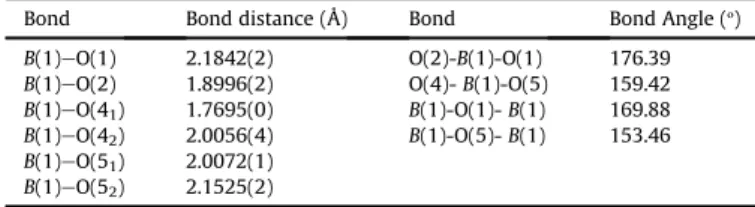
Since it is believed that the off-center distortion of theB-site cation is responsible for ferroelectricity in Aurivillius compounds, we focus on atomic displacements associated with theBO6octa- hedra. TheB(1) cation is displaced from the center of the octahedra along thec-axis resulting in longerB(1)eO(1) and shorterB(1)e O(2) bond distances as summarized inTable 2(see alsoFig. 2(c)).
TheB-site cations are also shifted along theaandbaxes, evidenced by the differentB(1)eO(4) andB(1)eO(5) distances. Displacement of the oxygen atoms from their ideal positions also results in tilting
Fig. 1.Rietveldfits to NPD data for single-phase Pb0.4Bi2.1La0.5Nb1.7Mn0.3O9: experi- mental data (black circles), calculated profile (red line), and difference profile (green line). The blue tick marks indicate the positions of allowed Bragg reflections in the space groupA21am.(For interpretation of the references to colour in thisfigure legend, the reader is referred to the Web version of this article.)
T.P. Wendari et al. / Journal of Alloys and Compounds 820 (2020) 153145 2
of theBO6octahedra, as clearly seen inFig. 2(b). This tilting leads to a more distorted crystal structure and results in a difference be- tween theaand blattice parameters. The degree of octahedral distortion can be quantified by the orthorhombicity ratio (a-b)/
(aþb) of 0.00033 [9]. This distortion is driven both by cation dis- order and size mismatch between the perovskiteA-andB-sites and further contributes to the ferroelectric displacement.
The morphology and size of the sample grains was previously investigated using SEM in Ref. [17]. The grains are highly aniso- tropic and plate-like, which is a typical feature of Aurivillius phases.
The average grain size is in the range 2.7e3.1mm.
The frequency dependence of the dielectric constant and
dielectric loss of Pb0.4Bi2.1La0.5Nb1.7Mn0.3O9 at different tempera- tures is shown inFig. 3. It is observed that the dielectric constant decreases as frequency increases and becomes stable at frequencies above 10 kHz, which is consistent with the behavior of ordinary ferroelectric materials. The higher dielectric constant at lower fre- quencies is due to the contribution of different polarizations (i.e.
dipolar, ionic, electronic, and interfacial) [22]. This behavior is also caused by the accumulation of charge carriers on the surface and at grain boundaries, explained by the Maxwell-Wagner effect [12].
Thus, high values of the dielectric constant at low frequencies are not only caused by intrinsic but also by extrinsic factors. It is also clearly seen inFig. 3that the dielectric constant initially increases with temperature and then significantly decreases from 600 K to 700 K, suggesting that the sample has a ferroelectric-paraelectric transition (Tc) in this temperature range. The dielectric loss in- creases slightly with temperature below 600 K, and then more rapidly at higher temperature, which can also indicate a transition to the paraelectric phase where the sample becomes more con- ducting. Moreover, at high temperature, the electrical conductivity is enhanced by thermal effects as is the case for most semi- conductors, resulting in a significant increase of the dielectric loss [23].
Fig. 4 shows the temperature dependence of the dielectric constant (e) and dielectric loss (tand) at high frequencies, which best reflect the intrinsic polarizability. A single peak in the dielec- tric constant is observed between 600 K and 640 K depending on frequency, corresponding toTc. Compared with the parent com- pound PbBi2Nb2O9for whichTc¼830 K [24], the transition tem- perature is significantly decreased for Pb0.4Bi2.1La0.5Nb1.7Mn0.3O9. Since the presence of perovskiteA-site cations with 6s2lone pairs such as Bi3þand Pb2þstrongly favors a highly distorted structure and induces an increase inTc[8,25], the substitution of La3þfor Pb2þ on theA-site reduces the concentration ofA-site lone pair cations, leading to a smaller degree of distortion and hence a lower Curie temperature. The decrease ofTcis also consistent with the larger Goldschmidt tolerance factor (t) of the perovskite block of Pb0.4Bi2.1La0.5Nb1.7Mn0.3O9 (0.940) compared to PbBi2Nb2O9
(0.932) [6].
The dielectric peak exhibits a strong frequency dependence with Table 1
Refined structural parameters for Pb0.4Bi2.1La0.5Nb1.7Mn0.3O9from NPD data at room temperature using the orthorhombic space groupA21am, withZ¼4.
Atom Site x y z Occ. (n)
Pb(1) 4a 0 0.2467(7) 0 0.15
Bi(1) 4a 0 0.2467(7) 0 0.35
La(1) 4a 0 0.2467(7) 0 0.5
Bi(2) 8b 0.4993(1) 0.7377(3) 0.2011(4) 0.875
Pb(2) 8b 0.4993(1) 0.7377(3) 0.2011(4) 0.125
Nb(1) 8b 0.4641(2) 0.7289(7) 0.4134(6) 0.850
Mn(1) 8b 0.4641(2) 0.7289(7) 0.4134(6) 0.150
O(1) 4a 0.4561(4) 0.1947(1) 0 1.0
O(2) 8b 0.4791(6) 0.7787(8) 0.3386(2) 1.0
O(3) 8b 0.7213(1) 0.0141(6) 0.25 1.0
O(4) 8b 0.7035(2) 0.9561(2) 0.0774(1) 1.0
O(5) 8b 0.7474(4) 0.9877(7) 0.5690(1) 1.0
a¼5.4910(5) Å,b¼5.4874(3) Å,c¼25.1229(7) Å;V¼757.0007(9) Å3. Rp¼14.04%,Rbragg¼3.48,c2¼1.504.
Fig. 2. (a)Orthorhombic structure of Pb0.4Bi2.1La0.5Nb1.7Mn0.3O9(ac-plane view).(b) Distortion of perovskite blocks projected in the abplane. (c)View of linkedBO6
octahedra.
Table 2
Interatomic bond distances and bond angles associated with theBO6octahedra (B¼ Nb or Mn).
Bond Bond distance (Å) Bond Bond Angle (º)
B(1)eO(1) 2.1842(2) O(2)-B(1)-O(1) 176.39
B(1)eO(2) 1.8996(2) O(4)-B(1)-O(5) 159.42
B(1)eO(41) 1.7695(0) B(1)-O(1)-B(1) 169.88
B(1)eO(42) 2.0056(4) B(1)-O(5)-B(1) 153.46
B(1)eO(51) 2.0072(1) B(1)eO(52) 2.1525(2)
Fig. 3.Frequency dependence of dielectric constant (e) and loss (tand) of Pb0.4Bi2.1-
La0.5Nb1.7Mn0.3O9at different temperatures.
T.P. Wendari et al. / Journal of Alloys and Compounds 820 (2020) 153145 3
a temperature relaxation D(Tm(1MHz) -Tm(50kHz)) of around 40 K, which confirms pronounced relaxor-ferroelectric behavior [26].
This behavior can also be described by the degree of diffuseness (g) using a modified Curie-Weiss law [15]. The inset ofFig. 4shows a linearfit to a plot ofln(1/er- 1/em) versusln(T-Tm) at 1 MHz, where the value of g ¼1 represents normal ferroelectric behavior and g¼2 is typical for relaxor-ferroelectric. Thefitted value ofgis 2.14.
This relaxor behavior is strongly correlated with the compositional disorder on all the cation sites.
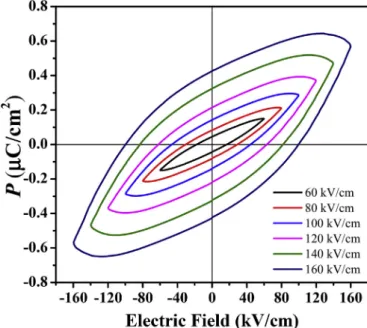
Room temperatureP-Ehysteresis loops measured at 40 Hz un- der various electricfield ranges are shown inFig. 5. At 60 kV/cm, the hysteresis loop is unsaturated, implying that higher electric fields are needed to align all the domains. At the highest applied
electricfield of 160 kV/cm before electrical breakdown occurred, the loop is still unsaturated, which is likely due to leakage currents [11,27]. The substitution of Mn3þ for Nb5þ in Pb0.4Bi2.1-
La0.5Nb1.7Mn0.3O9 increases the electron concentration and thus the electrical conductivity, hence the high leakage current and significant dielectric loss [23]. Although leaky, both the remnant polarization (Pr) and saturated polarization (Ps) increase with electricfield in non-linear fashion. This behavior reflects domain wall motion associated with ferroelectricity [28]. The remnant polarization (Pr) and the coercivefield (Ec) are 0.43 mC/cm2 and 99.7 kV/cm, respectively, under the maximum electric field of 160 kV/cm. The ferroelectric polarization in this sample is corre- lated with off-center displacement of theB-site cation in the a- direction, according toA21am symmetry. It has previously been argued that octahedral tilting, as shown inFig. 2(b), can further enhance the shift of this cation along thea-axis [9].
To investigate the magnetic properties of Pb0.4Bi2.1-
La0.5Nb1.7Mn0.3O9, we performed magnetic susceptibility versus temperature and magnetization versus applied field measure- ments. Fig. 6(a) shows the magnetic susceptibility and inverse susceptibility in zero-field-cooled (ZFC) mode measured on warming in an applied magneticfield of 1 T. The ZFC susceptibility (c) curve indicates paramagnetic-like behavior with no evidence of long-range magnetic ordering, as evidenced by the monotonous decrease ofcwith increasing temperature. However, a Curie-Weiss fit to the linear region of the 1/ceTcurve above 100 K yields a positive Curie-Weiss temperature (qCW) of 33.44 K, indicating the predominance of ferromagnetic interactions. To verify the exis- tence of ferromagnetic interactions, the ZFC susceptibility was measured in a lower appliedfield of 100 Oe as shown inFig. 6(b).
An obvious ferromagnetic-paramagnetic transition atTc¼33.5 K is now observed, whereTcis obtained from the maximum of the (dc/ dT) curve; this temperature is consistent with thefittedqCW. This is also close to the value ofTc(21.5 K) for the Mn-doped Aurivillius phase PbBi4Ti4O15, where 15% of Ti4þon theB-site was replaced by Mn [12].
The effective moment (meff) per Mn ion calculated from the Curie-Weissfit is 4.38mB. The spin-only values ofmefffor high-spin Mn3þand Mn4þare 4.90mBand 3.87mB, respectively [29,30]. Thus, the sample likely contains approximately equal proportions of Mn3þand Mn4þ. The mixed-valent Mn3þ/Mn4þmay enable double- exchange to take place, giving rise to the weakly ferromagnetic behavior. The magnetic ordering will be short-range in nature because only 15% of theB-site is occupied by Mn, far below the percolation threshold. Furthermore, strong ferromagnetic behavior has mainly been observed in Aurivillius phases with a thicker perovskite block than our two-layer Pb0.4Bi2.1La0.5Nb1.7Mn0.3O9, such as the four-layered structure, and can be enhanced by combining two magnetic cations in a 1:1 ratio [31,32]. We speculate that the double exchange pathway may be in the ab-plane via Mn(1)-O(4)-Mn(1) and Mn(1)-O(5)-Mn(1), which are depicted in Fig. 2(c). These exchange interactions might occur in locally Mn- rich areas, the presence of which was previously suggested by the vibrational mode at 756 cm1in Raman spectra [17]. A preference for local ordering of the magnetic cation was also observed previ- ously in SrBi2Nb2-xFexO9, where (FeeOeFe) super-exchange in- teractions are of relevance [33]. Such local ordering is also evidenced by the high dielectric loss and leakage current in Pb0.4Bi2.1La0.5Nb1.7Mn0.3O9 [23], which are attributed to double exchange involving Mn3þ-O-Mn4þ.
Fig. 7 shows magnetization versus applied field M(H) mea- surements for Pb0.4Bi2.1La0.5Nb1.7Mn0.3O9 at 5 K and 150 K. The magnetization does not reach saturation in the applied field range5 T to 5 T. The M(H) curve at 5 K adopts the typicalS-shaped, narrow hysteresis loop of a weak ferromagnetic, whereMrandHc Fig. 4.Temperature dependence of dielectric constant (e) and loss (tan d) of
Pb0.4Bi2.1La0.5Nb1.7Mn0.3O9. The inset shows a modified Curie-Weissfitted line to quantify relaxor ferroelectric behavior.
Fig. 5.P-Ehysteresis loops of Pb0.4Bi2.1La0.5Nb1.7Mn0.3O9measured at room tempera- ture and 40 Hz frequency.
T.P. Wendari et al. / Journal of Alloys and Compounds 820 (2020) 153145 4
are estimated to be 0.01 emu/g and 67 Oe. At 150 K, where the sample is far above theTcof 33 K, linear behavior is observed with no loop opening, as typical for paramagnetic behavior.
4. Conclusion
A single-phase sample of the Aurivillius material Pb0.4Bi2.1- La0.5Nb1.7Mn0.3O9has been synthesized by a molten salt method using K2SO4/Na2SO4. Rietveld refinement using neutron diffraction data suggested considerable cation disorder, where La atoms partially occupy the perovskiteA-site, Pb/Bi atoms occupy both the perovskite A-site and bismuth oxide block, and Nb/Mn occupy the perovskite B-site. The dielectric constant exhibits a broad frequency-dependent peak indicating a ferroelectric transition temperature (Tc) of 600e640 K, which is typical for a relaxor ferroelectric. The disorder associated with the simultaneous
substitution of La3þand Mn3þin PbBi2Nb2O9is likely responsible for the relaxor ferroelectric behavior. FerroelectricP-Eloops remain unsaturated in applied electric fields up to 160 kV/cm and a maximumProf 0.43mC/cm2was obtained. Magnetic susceptibility measurements indicated that manganese is present in the mixed- valence state of Mn3þ/Mn4þ. A positive Curie-Weiss temperature and a peak in the susceptibility at 33 K indicate the presence of ferromagnetic interactions and short-range order which are assumed to arise from double-exchange involving Mn3þ-O-Mn4þ bonds in the BO6 octahedra. In conclusion, the Aurivillius com- pound Pb0.4Bi2.1La0.5Nb1.7Mn0.3O9exhibits the coexistence of both ferroelectric and ferromagnetic properties facilitating applications in memory storage devices.
Declaration of competing interest
The authors declare that they have no known competing financial interests or personal relationships that could have appeared to influence the work reported in this paper.
Acknowledgments
This work was supported by the Ministry of Research, Tech- nology and Higher Education (RISTEKDIKTI) of the Republic of Indonesia through a PMDSU Scholarship [Grant number 050/SP2H/
LT/DRPM/2018] and a PKPI-PMDSU Scholarship [Grant number 1406.29/D3/PG/2018].
References
[1] A.J.C. Buurma, G.R. Blake, T.T.M. Palstra, Multiferroic Materials : Physics and Properties, Elsevier Ltd., 2016, https://doi.org/10.1016/B978-0-12-803581- 8.09245-6.
[2] S.N. Achary, O.D. Jayakumar, A.K. Tyagi, Multiferroic Materials, Elsevier Inc., 2012,https://doi.org/10.1016/B978-0-12-385142-0.00004-0.
[3] S. Ivanov, Multiferroic Complex Metal Oxides : Main Features of Preparation , Structure , and Properties, Elsevier Inc., 2012,https://doi.org/10.1016/B978-0- 44-453681-5.00007-8.
[4] B. Aurivillius, Mixed bismuth oxides with layer lattice I, Ark. Kemi. 1 54 (1949) 463e480.
[5] J.F. Scott, Ferroelectric Memories,first ed., Springer-Verlag Berlin Heidelberg, New York, 2000https://doi.org/10.1007/978-3-662-04307-3.
Fig. 6. (a)Temperature dependence of ZFC magnetic susceptibility (c) and inverse magnetic susceptibility (1/c) measured in an appliedfield of 1 T. The red line is a linear fit to the experimental data using the Curie-Weiss law.(b)ZFC magnetic susceptibility (c) and its derivative (dc/dT) measured in an appliedfield of 100 Oe. (For interpre- tation of the references to colour in thisfigure legend, the reader is referred to the Web version of this article.)
Fig. 7. Magnetization versus appliedfield for Pb0.4Bi2.1La0.5Nb1.7Mn0.3O9measured at 5 K and 150 K.
T.P. Wendari et al. / Journal of Alloys and Compounds 820 (2020) 153145 5
[6] D.Y. Suarez, I.M. Reaney, W.E. Lee, Relation between tolerance factor and Tc in Aurivillius compounds, J. Mater. Res. 16 (2001) 3139e3149,https://doi.org/
10.1557/JMR.2001.0433.
[7] E.V. Ramana, M.P.F. Graça, M.A. Valente, T.B. Sankaram, Improved ferroelectric and pyroelectric properties of Pb-doped SrBi4Ti4O15ceramics for high tem- perature applications, J. Alloy. Comp. 583 (2014) 198e205,https://doi.org/
10.1016/j.jallcom.2013.08.181.
[8] Ismunandar, B.A. Hunter, B.J. Kennedy, Cation disorder in the ferroelectric Aurivillius phase PbBi2Nb2O9: an anamolous dispersion X-ray diffraction study, Solid State Ion. 112 (1998) 281e289,https://doi.org/10.1016/S0167- 2738(98)00222-7.
[9] A.B. Missyul, I.A. Zvereva, T.T.M. Palstra, A.I. Kurbakov, Double-layered Aurivillius-type ferroelectrics with magnetic moments, Mater. Res. Bull. 45 (2010) 546e550,https://doi.org/10.1016/j.materresbull.2010.02.002.
[10] C.C. Chou, C.L. Huang, S. Mukherjee, Q.Y. Chen, H. Sakurai, A.A. Belik, E.T. Muromachi, H.D. Yang, Multiple magnetic transitions in multiferroic BiMnO3, Phys. Rev. B (2009) 184426, https://doi.org/10.1103/
PhysRevB.80.184426.
[11] S. Liu, S. Yan, H. Luo, L. Yao, Z. Hu, S. Huang, L. Deng, Enhanced magneto- electric coupling in La-modified Bi5Co0.5Fe0.5Ti3O15multiferroic ceramics, J. Mater. Sci. 53 (2018) 1014e1023, https://doi.org/10.1007/s10853-017- 1604-6.
[12] Zulhadjri, B. Prijamboedi, A.A. Nugroho, N. Mufti, A. Fajar, T.T.M. Palstra, Ismunandar, Aurivillius phases of PbBi4Ti4O15doped with Mn3þsynthesized by molten salt technique: structure, dielectric, and magnetic properties, J. Solid State Chem. 184 (2011) 1318e1323, https://doi.org/10.1016/
j.jssc.2011.03.044.
[13] P. Fang, P. Liu, Z. Xi, W. Long, X. Li, Structure and electrical properties of new Aurivillius oxides (K0.16Na0.84)0.5Bi4.5Ti4O15 with manganese modification, J. Alloy. Comp. 595 (2014) 148e152, https://doi.org/10.1016/
j.jallcom.2014.01.152.
[14] Z.P. Cao, C.M. Wang, K. Lau, Q. Wang, Q.W. Fu, H.H. Tian, D.F. Yin, Large enhancement of piezoelectric properties in Mn-modified SrBi4Ti4O15and its thermal stabilities at elevated temperatures, Ceram. Int. 42 (2016) 11619e11625,https://doi.org/10.1016/j.ceramint.2016.04.061.
[15] M. Roy, I. Bala, S.K. Barbar, S. Jangid, P. Dave, Synthesis, structural and elec- trical properties of La and Nb modified Bi4Ti3O12ferroelectric ceramics, J. Phys. Chem. Solids 72 (2011) 1347e1353, https://doi.org/10.1016/
j.jpcs.2011.08.007.
[16] A. Khokhar, P.K. Goyal, O.P. Thakur, A.K. Shukla, K. Sreenivas, Influence of lanthanum distribution on dielectric and ferroelectric properties of BaBi4- xLaxTi4O15ceramics, Mater. Chem. Phys. 152 (2015) 13e25,https://doi.org/
10.1016/j.matchemphys.2014.11.074.
[17] T.P. Wendari, S. Arief, N. Mufti, V. Suendo, A. Prasetyo, J. Baas, G.R. Blake, Zulhadjri, Synthesis, structural analysis and dielectric properties of the double-layer Aurivillius compound Pb1-2xBi1.5þ2xLa0.5Nb2-xMnxO9, Ceram. Int.
45 (2019) 17276e17282,https://doi.org/10.1016/j.ceramint.2019.05.285.
[18] B.A. Hunter, C.J. Howard, A Computer Program for Rietveld Analysis of X-Ray and Neutron Powder Diffraction Patterns, Lucas Heights Research Labora- tories, NSW, Australia, 2000, pp. 1e27.
[19] V. Srikanth, H. Idink, W.B. White, E.C. Subbarao, H. Rajagopal, A. Sequeira,
Cation disorder in ferroelectric PbBi2Nb2O9, Acta Crystallogr. 52 (1996) 432e439,https://doi.org/10.1107/S0108768195015072.
[20] T. Rentschler, M. Karus, A. Wellm, A. Reller, Synthesis and characterization of the Aurivillius phases Bi2-xPbxSr1-xNdxNb2O9, Solid State Ion. 90 (1996) 49e55.
[21] B.J. Kennedy, B.A. Hunter, Cation disorder in Pb-doped SrBi2Nb2O9, Chem.
Mater. 13 (2006) 4612e4617.
[22] J. Xiao, H. Zhang, Y. Xue, Z. Lu, X. Chen, P. Su, F. Yang, X. Zeng, The influence of Ni-doping concentration on multiferroic behaviors in Bi4NdTi3FeO15ceramics, Ceram. Int. 41 (2015) 1087e1092, https://doi.org/10.1016/
j.ceramint.2014.09.033.
[23] P. Nayak, T. Badapanda, A.K. Singh, S. Panigrahi, An approach for correlating the structural and electrical properties of Zr4þ-modified SrBi4Ti4O15/SBT ceramic, RSC Adv. 7 (2017) 16319e16331, https://doi.org/10.1039/
c7ra00366h.
[24] H. Du, Y. Li, H. Li, X. Shi, C. Liu, Relaxor behavior of bismuth layer-structured ferroelectric ceramic with m¼2, Solid State Commun. 148 (2008) 357e360, https://doi.org/10.1016/j.ssc.2008.05.017.
[25] S.M. Blake, M.J. Falconer, M. Mccreedy, P. Lightfoot, Cation disorder in ferro- electric Aurivillius phases of the type Bi2ANb2O9(A¼Ba, Sr, Ca), J. Mater.
Chem. 7 (1997) 1609e1613,https://doi.org/10.1039/A608059F.
[26] V.V. Shvartsman, D.C. Lupascu, Lead-free relaxor ferroelectrics, J. Am. Ceram.
Soc. 95 (2012) 1e26,https://doi.org/10.1111/j.1551-2916.2011.04952.x.
[27] Y. Shi, Y. Pu, J. Li, R. Shi, W. Wang, Q. Zhang, L. Guo, Structure , dielectric and multiferroic properties of three-layered aurivillius SrBi3Nb2FeO12, Ceram. Int.
45 (2019) 9283e9287,https://doi.org/10.1016/j.ceramint.2019.01.129.
[28] M.R. Dolgos, U. Adem, A. Manjon-sanz, X. Wan, T.P. Comyn, T. Stevenson, J. Bennett, A.J. Bell, T.T. Tran, P.S. Halasyamani, J.B. Claridge, M.J. Rosseinsky, Perovskite B-Site compositional control of [ 110 ]p polar displacement coupling in an ambient-pressure-stable bismuth-based ferroelectric, Angew.
Chem. 124 (2012) 10928e10933,https://doi.org/10.1002/ange.201203884.
[29] C.A. Lopez, M.E. Saleta, J.C. Pedregosa, R.D. Sanchez, J.A. Alonso, M.T. Fernandez-Díaz, Cationic disorder and Mn3þ/Mn4þcharge ordering in the B0andB00sites of Ca3Mn2NbO9perovskite : a comparison with Ca3Mn2WO9, J. Solid State Chem. 210 (2014) 1e9, https://doi.org/10.1016/
j.jssc.2013.10.039.
[30] K. Nakade, K. Hirota, M. Kato, H. Taguchi, Effect of the Mn3þion on electrical and magnetic properties of orthorhombic perovskite-type Ca(Mn1-xTix)O3-d, Mater. Res. Bull. 42 (2007) 1069e1076, https://doi.org/10.1016/
j.materresbull.2006.09.013.
[31] Z. Yu, X. Meng, Z. Zheng, Y. Lu, H. Chen, C. Huang, H. Sun, K. Liang, Z. Ma, Y. Qi, T. Zhang, Room temperature multiferroic properties of rare-earth-substituted Aurivillius phase Bi5Ti3Fe0.7Co0.3O15ceramics, Mater. Res. Bull. 115 (2019) 235e241,https://doi.org/10.1016/j.materresbull.2019.04.002.
[32] Y. Shu, Q. Ma, Z. Ding, L. Cao, X. Chen, F. Yang, X. Zeng, Multiferroic behaviors of Co-doped Bi4NdTi3FeO15 ceramics, Phys. Lett. A 383 (2019) 911e914, https://doi.org/10.1016/j.physleta.2018.12.031.
[33] Y. Shi, Y. Pu, Q. Zhang, J. Li, L. Guo, Dielectric and multiferroic properties of two-layered SrBi2Nb2-xFexO9Aurivillius compounds, Ceram. Int. 44 (2018) S61eS64,https://doi.org/10.1016/j.ceramint.2018.08.251.
T.P. Wendari et al. / Journal of Alloys and Compounds 820 (2020) 153145 6