Center for Health Security
2019
Building Collective Action and Accountability
Index developed with
We are grateful to the Open Philanthropy Project, the Bill & Melinda Gates Foundation, and the Robertson Foundation.
The Global Health Security Index would not have been possible without their generous support.
Building Collective Action and Accountability
October 2019
Index developed with
Center for Health Security
©Nuclear Threat Initiative 2019
This work is licensed under a Creative Commons Attribution-NonCommercial-NoDerivatives 4.0 International License.
The views expressed in this publication do not necessarily reflect those of the NTI Board of Directors or the institutions with which they are associated.
Contents
Acknowledgments 1
Executive Summary 5
GHS Index Map and Results 17
About the Global Health Security Index 31 Key Findings and Recommendations 39 Methodology 61
Country Profiles 115
About the Organizations 313
Glossary 315
GHS INDEX CO-LEADERS
Elizabeth E. Cameron, PhD
Vice President, Global Biological Policy and Programs Nuclear Threat Initiative
Jennifer B. Nuzzo, DrPH, SM
Associate Professor, Johns Hopkins Bloomberg School of Public Health Senior Scholar, Johns Hopkins Center for Health Security
Jessica A. Bell, MS
Senior Program Officer, Global Biological Policy and Programs Nuclear Threat Initiative
CONTRIBUTING AUTHORS
Nuclear Threat Initiative
Michelle Nalabandian, MFS, Program Officer, Global Biological Policy and Programs John O’Brien, Intern, Global Biological Policy and Programs
Avery League, Intern, Global Biological Policy and Programs
Center for Health Security, Johns Hopkins Bloomberg School of Public Health
Sanjana Ravi, MPH, Senior Analyst, Senior Research Associate
Diane Meyer, RN, MPH, Managing Senior Analyst, Research Associate Michael Snyder, MALD, Analyst, Research Associate
Lucia Mullen, MPH, Analyst, Research Associate
Lane Warmbrod, MS, MPH, Analyst, Research Associate
Acknowledgments
A
s co-leaders of the Global Health Security (GHS) Index, we are indebted to an experienced, knowl- edgeable, and deeply committed team that helped develop this groundbreaking index.We are grateful to Nuclear Threat Initiative (NTI) Co-Chair and Chief Executive Officer Ernest J. Moniz, Co-Chair Sam Nunn, President and Chief Operating Officer Joan Rohlfing, and NTI’s Board of Directors for their leader- ship and commitment to reducing global catastrophic biological risks. NTI Executive Vice President Deborah G.
Rosenblum made important contributions to this project that were invaluable. We also thank Tom Inglesby, Direc- tor of the Center for Health Security (JHU) of the Johns Hopkins Bloomberg School of Public Health, and Anita Cicero, Deputy Director at the Johns Hopkins Center for Health Security, for their critical insights that further strengthened the GHS Index.
We are grateful for our longstanding relationship with The Economist Intelligence Unit (EIU), which collected data for this project—Leo Abruzzese, Senior Global Advisor, Public Policy; Priya Bapat, Senior Consultant, Public Policy;
Michael Paterra, Senior Analyst, Public Policy; Sumana Rajarethnam, Director, Partnerships, Public Policy; and The EIU’s global network of analysts. Members of our Interna- tional Panel of Experts, which includes some of the world’s most highly respected experts, were extremely generous with their time and insights, and we have done our best to ensure that this report reflects their collective wisdom.
As part of the final validation of the compiled data, The EIU reached out to 195 embassies and representative offices to share country-specific data for the individual country’s review and to provide them with the opportunity to share additional data and reference material. We are thankful to the 16 countries that responded to this request: Belgium, Canada, Finland, Italy, Kyrgyz Republic, Latvia, Liechten- stein, Lithuania, Peru, Philippines, Portugal, St. Kitts and Nevis, Sierra Leone, Slovenia, Spain, and Switzerland.
We are indebted to all our colleagues at NTI and JHU who provided invaluable contributions to the GHS Index. We thank Carmen MacDougall, Mimi Hall, and Rachel Staley Grant of NTI’s communications team as well as Margaret Miller of the JHU communications team. We also thank NTI’s Jaime Yassif, who contributed valuable insights throughout this project, from its initial conception through its completion.
Finally, we give special thanks to this project’s funders:
the Open Philanthropy Project, the Bill & Melinda Gates Foundation, and the Robertson Foundation.
INTERNATIONAL PANEL OF EXPERTS
Dr. David M. Barash, Executive Director, GE Foundation Dr. David Blazes, Senior Program Officer, Surveillance and Epidemiology, Global Health Program, Bill & Melinda Gates Foundation
Dr. Mukesh Chawla, Adviser, Health, Nutrition and Population, World Bank; Chair, UNAIDS and World Bank Global Economics Reference Group on HIV-AIDS
Dr. Chaeshin Chu, Deputy Scientific Director, Division of Risk Assessment and International Cooperation, Korea Centers for Disease Control and Prevention (KCDC) Dr. Scott F. Dowell, Deputy Director, Vaccine
Development and Surveillance, Global Health Program, Bill & Melinda Gates Foundation
Dr. Wu Fan, Deputy Director General,
Shanghai Municipal Health Commission, China Dr. Dylan George, Associate Director, BNext, In-Q-Tel Mr. Lawrence O. Gostin, Faculty Director and Founding Chair, O’Neill Institute for National and Global Health Law, Georgetown University Law Center
Dr. Ernesto Gozzer,Associate Professor, Universidad Peruana Cayetano Heredia; International Consultant Dr. Wilmot James, Visiting Professor, Political Science and Pediatrics, Columbia University
Dr. Julius J. Lutwama, Senior Principal Research Officer, Ministry of Health, Uganda; Head of the Department of Arbovirology, Emerging and Re-Emerging Viral Infectious Diseases, Uganda Virus Research Institute (UVRI)
Dr. Issa Makumbi, Director, Public Health Emergency Operations Centre, Ministry of Health, Uganda Dr. Pretty Multihartina, Director, Center for Health Determinant Analyst, Ministry of Health, Indonesia Dr. Lee Myers, Manager, a.i., Emergency Management Centre for Animal Health (EMC-AH), Food and Agriculture Organization (FAO) of the United Nations (on behalf of the United States Department of Agriculture) Dr. Indira Nath, Former Senior Professor and Head, Department of Biotechnology, All India Institute of Medical Sciences
Dr. Simo Nikkari, Director and Professor, Centres for Military Medicine and Biothreat Preparedness, FDF Logistics Command, Finland
The Honorable Cllr. Tolbert G. Nyenswah, Director General, National Public Health Institute, Liberia
Mr. Robert Powell, Editorial Director Americas, Thought Leadership, The Economist Intelligence Unit Dr. Malik Muhammad Safi, Director of Health Programs and Head of Health Planning, System Strengthening and Information Analysis Unit, Ministry of National Health Services, Regulation and Coordination, Pakistan
Dr. Tomoya Saito, Chief Senior Researcher, Department of Health Crisis Management, National Institute of Public Health, Japan
Dr. Oyewale Tomori, Professor of Virology;
Former President, Nigerian Academy of Science
Members of the Global Health Security (GHS) Index International Panel of Experts provided advice over the course of the Index’s development and participated in their personal capacities or in their capacities as representatives of advising organizations. The judgments and recommendations reflected in the GHS Index do not necessarily reflect the views of panel members, nor their respective employers, other affiliations, or governments.
Photographer: Samyukta Lakshmi/Bloomberg via Getty Images
Executive Summary
B
iological threats—natural, intentional, oraccidental—in any country can pose risks to global health, international security, and the worldwide economy. Because infectious diseases know no borders, all countries must prioritize and exercise the capabili- ties required to prevent, detect, and rapidly respond to public health emergencies. Every country also must be transparent about its capabilities to assure neighbors it can stop an outbreak from becoming an international catastrophe. In turn, global leaders and international organizations bear a collective responsibility for develop- ing and maintaining robust global capability to counter infectious disease threats. This capability includes ensur- ing that financing is available to fill gaps in epidemic and pandemic preparedness. These steps will save lives and achieve a safer and more secure world.
The Global Health Security (GHS) Index is the first compre- hensive assessment and benchmarking of health security and related capabilities across the 195 countries that make
1 As of April 16, 2013, there are 196 States Parties to the World Health Organization (WHO) 2005 International Health Regulations (IHR), including the Holy See. The Holy See is a sovereign juridical entity under international law, but it was not included in the country-specific research for this Index in light of the Holy See’s lack of an inde- pendent health system. This report will refer to the assessed “States Parties” as “195 countries.”
2 The WHO IHR (2005) is the foundational international standards for health. The IHR (2005) is a binding legal instrument to address cross-border public health risks.
The goal of the IHR (2005) is to prevent, protect, control, and respond without disrupting international trade and traffic. The IHR (2005) provided the guiding regulations behind many of the indicators included in the GHS Index.
3 High-consequence biological events are defined here as infectious disease outbreaks that could overwhelm national or international capacity to manage them. For example, although international health security has improved following the 2014–2016 Ebola epidemic in West Africa, countries and international responders are not prepared to quell outbreaks that occur in violent or insecure settings; deliberate biological events that require close coordination and investigative links between security, health, and humanitarian actors; and fast-moving respiratory diseases with high mortality that could spread rapidly to become global pandemics.
4 Global Catastrophic Biological Risks are biological risks of unprecedented scale that could cause severe damage to human civilization at a global level, potentially undermining its long-term potential. See Nick Alexopoulos, “Center for Health Security Publishes First Working Definition of Global Catastrophic Biological Risks,” Johns Hopkins Center for Health Security, July 27, 2017, www.centerforhealthsecurity.org/about-the-center/newsroom/news_releases/2017-07-27_global-catastrophic- biological-risk-definition.html.
up the States Parties1 to the International Health Regu- lations (IHR [2005]).2 The GHS Index is a project of the Nuclear Threat Initiative (NTI) and the Johns Hopkins Center for Health Security (JHU) and was developed with The Economist Intelligence Unit (EIU). These organizations believe that, over time, the GHS Index will spur measur- able changes in national health security and improve international capability to address one of the world’s most omnipresent risks: infectious disease outbreaks that can lead to international epidemics and pandemics.
The GHS Index is intended to be a key resource in the face of increasing risks of high-consequence3 and globally catastrophic4 biological events and in light of major gaps in international financing for preparedness. These risks are magnified by a rapidly changing and interconnected world; increasing political instability; urbanization; climate change; and rapid technology advances that make it easier, cheaper, and faster to create and engineer pathogens.
Developed with the guidance of an international expert advisory panel, the GHS Index data are drawn from pub- licly available data sources from individual countries and international organizations, as well as an array of additional sources including published governmental information, data from the World Health Organization (WHO), the World Organisation for Animal Health (OIE), the Food and Agricul- ture Organization of the United Nations (FAO), the World Bank, country legislation and regulations, and academic resources and publications. Unique in the field, the GHS Index provides a comprehensive assessment of countries’
health security and considers the broader context for biological risks within each country, including a country’s geopolitical considerations and health system and whether it has tested its capacities to contain outbreaks.
Knowing the risks, however, is not enough. Political will is needed to protect people from the consequences of epidemics, to take action to save lives, and to build a safer and more secure world.
WHY IS THE
GHS INDEX NEEDED?
It is likely that the world will continue to face outbreaks that most countries are ill positioned to combat. In addition to climate change and urbanization, international mass displacement and migration—now happening in nearly every corner of the world—create ideal conditions for the emergence and spread of pathogens. Countries also face an increased potential threat of accidental or deliberate
5 Centers for Disease Control and Prevention, “2014–2016 Ebola Outbreak in West Africa,” www.cdc.gov/vhf/ebola/history/2014-2016-outbreak/index.html.
release of a deadly engineered pathogen, which could cause even greater harm than a naturally occurring pandemic. The same scientific advances that help fight epidemic disease also have allowed pathogens to be engineered or recreated in laboratories. Meanwhile, disparities in capacity and inattention to biological threats among some leaders have exacerbated preparedness gaps. The GHS Index seeks to illuminate those gaps to increase both political will and financing to fill them at the national and international levels. Unfortunately, political will for accelerating health security is caught in a perpetual cycle of panic and neglect. Over the past two decades, decision makers have only sporadically focused on health security, despite concerns stemming from the 2001 anthrax attacks, the emergence of the Severe Acute Respiratory Syndrome and Middle East Respiratory Syndrome coronaviruses, and the looming threat of a pandemic caused by a novel strain of influenza.
In September 2014, the United Nations (UN) Security Council met in crisis over the growing Ebola epidemic in West Africa. Massive global assistance was needed to stop the outbreak because of insufficient national capacities in Guinea, Liberia, and Sierra Leone to quickly detect and respond to the epidemic.
As a result, the West Africa Ebola epidemic killed at least 10,000 people and infected more than 28,000.5 The three affected countries lost $2.8 billion in combined GDP, and a massive global response totaled billions of dollars before the outbreak was contained. The crisis awakened
the world to the reality that pathogens can emerge unex- pectedly, and when outbreaks occur in countries that are unprepared, they can spill beyond borders, threatening the peace, health, and prosperity of all countries. However, despite newly available vaccines and therapies, response to the Ebola outbreak that began in 2018 in eastern Demo- cratic Republic of Congo has been hampered by violence and instability, community resistance to outbreak mitiga- tion measures, hospital transmission, delays in detection and isolation, and lack of funding and resources.
Delays in the global response to Ebola in 2014 led to a restructuring of the WHO and prompted calls for measure- ment and transparent reporting of countries’ public health capacities, including the launch of the voluntary WHO IHR Joint External Evaluations (JEEs). Since then, health, policy, and security leaders have developed numerous high-level reviews and recommended ways to identify, finance, and fill major preparedness gaps. These recommendations are relevant for epidemic threats, such as Ebola, and high- consequence pandemic threats, such as a fast-spreading respiratory disease agent that could have a geographic scope, severity, or societal impact and could overwhelm national or international capacity to manage it.6 Some of those recommendations have been implemented, but many have been shelved owing in part to lack of financing.
Nearly all recommendations pointed to a need to better understand and measure—on a transparent, global, and recurring basis—the state of international capability for preventing, detecting, and rapidly responding to epidemic and pandemic threats.
The GHS Index is designed to meet this need.
6 United Nations General Assembly, “Protecting humanity from future health crises: Report of the High-level Panel on the Global Response to Health Crises,”
https://www.un.org/ga/search/view_doc.asp?symbol=A/70/723.
DEVELOPING THE GHS INDEX
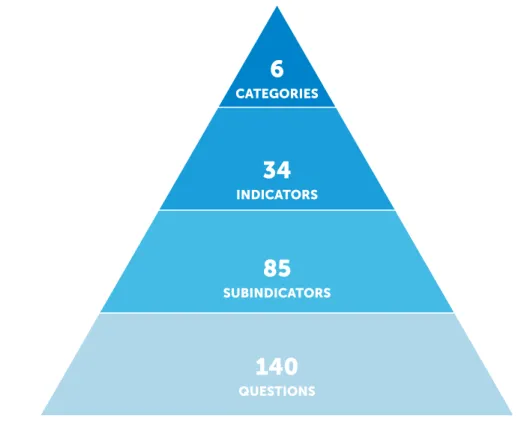
The NTI, JHU, and EIU project team—with generous grants from the Open Philanthropy Project, the Bill & Melinda Gates Foundation, and the Robertson Foundation—worked with an international advisory panel of 21 experts from 13 countries to create a detailed and comprehensive framework of 140 ques- tions, organized across 6 categories, 34 indicators, and 85 subindicators to assess a country’s capability to prevent and mitigate epidemics and pandemics.
The GHS Index relies entirely on open-source informa- tion: data that a country has published on its own or has reported to or been reported by an international entity.
The GHS Index was created in this way with a firm belief that all countries are safer and more secure when their populations are able to access information about their country’s existing capacities and plans and when countries understand each other’s gaps in epidemic and pandemic preparedness so they can take concrete steps to finance and fill them. The indicators and questions that compose the GHS Index framework also prioritize analysis of health security capacity in the context of a country’s broader national health system and other national risk factors.
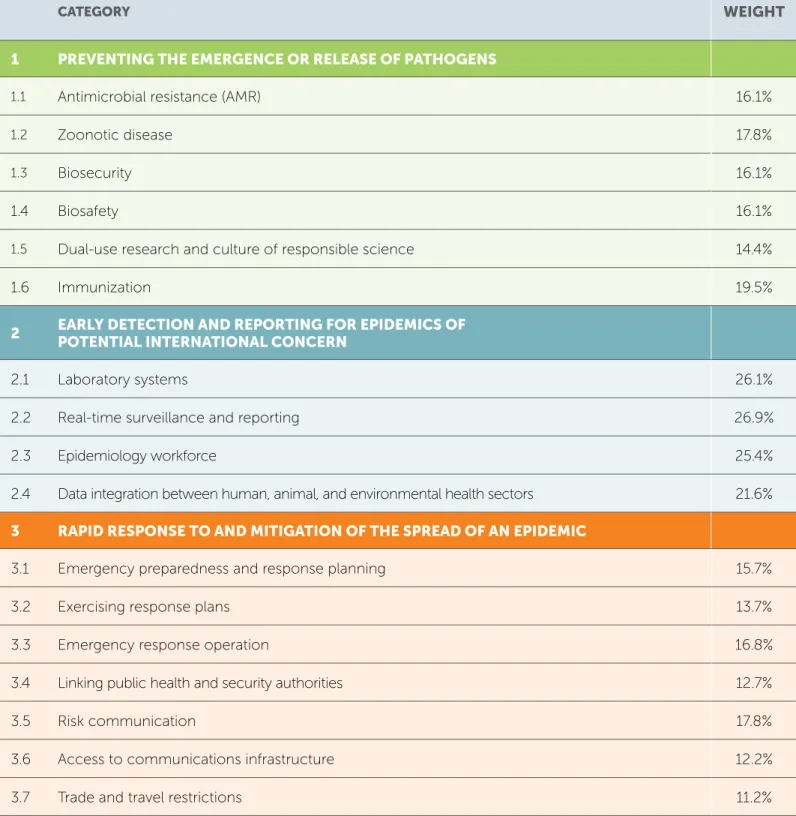
1. PREVENTION
Prevention of the emergence or release of pathogens
2. DETECTION AND REPORTING Early detection and reporting for epidemics of potential
international concern
3. RAPID RESPONSE
Rapid response to and mitigation of the spread of an epidemic
The 140 GHS Index questions are organized across six categories:
DETECT
RESPOND
HEALTH
NORMS PREVENT
RISK
Among its 140 questions, the GHS Index prioritizes not only countries’ capacities, but also the existence of functional, tested, proven capabilities for stopping outbreaks at the source. Several questions in the GHS Index are designed to determine not only whether a capacity exists, but also whether that capacity is regularly—for example, annu- ally—tested and shown to be functional in exercises or real-world events.
The GHS Index also includes indicators of nations’ capac- ities and capabilities to reduce Global Catastrophic Biological Risks (GCBRs), which are biological risks of unprecedented scale that could cause severe damage to human civilization at a global level, potentially undermin- ing civilization’s long-term potential.7 These are events that could wipe out gains in sustainable development and global health because of their potential to cause national and regional instability, global economic consequences, and widespread morbidity and mortality.
7 Monica Schoch-Spana et al.,“Global Catastrophic Biological Risks: Toward a Working Definition,” Health Security 15, no. 4 (2017): 323–28, www.liebertpub.com/doi/full/10.1089/hs.2017.0038.
FINDINGS AND
RECOMMENDATIONS
This report summarizes the results of the first GHS Index, including overall findings about the state of national health security capacity across each of the six GHS Index categories, as well as additional findings specific to functional areas of epidemic and pandemic preparedness. The full report also offers 33 recommen- dations to address gaps identified by the GHS Index. All the findings and recommendations are summarized on pages 12–15 and described in detail throughout the full report, which begins on page 31.
4. HEALTH SYSTEM
Sufficient and robust health system to treat the sick and protect health workers
5. COMPLIANCE WITH INTERNATIONAL NORMS
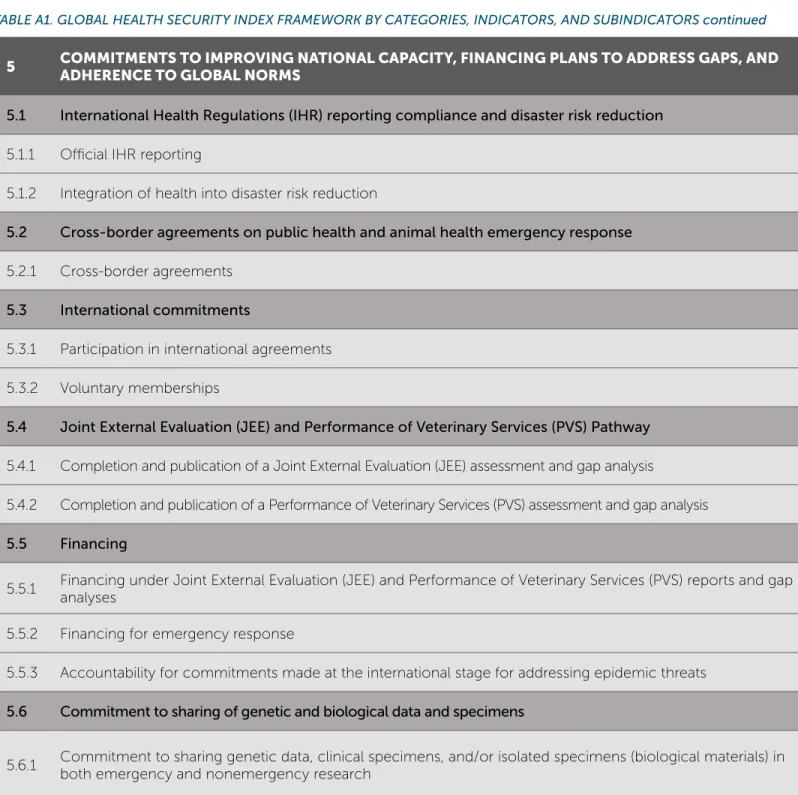
Commitments to improving national capacity, financing plans to address gaps, and adhering to global norms
6. RISK ENVIRONMENT
Overall risk environment and country vulnerability to biological threats
Whereas every country has a responsibility to under- stand, track, improve, and sustain national health security, new and increased global biological risks may require approaches that are beyond the control of individual governments and will necessitate international action.
Therefore, the recommendations contained in this report are made with the understanding that health security is a collective responsibility, and a robust international health security architecture is required to support countries at
8 The GHS Index scoring system includes three tiers. Countries that score between 0 and 33.3 are in the bottom tier (also called “low scores”), countries that score between 33.4 and 66.6 are in the middle tier (also called “moderate scores”), and countries that score between 66.7 and 100 are in the upper or “top” tier (also called
“high scores”).
increased risk. As a result, in addition to the many recom- mendations intended for national leaders, the GHS Index also includes recommendations aimed at decision makers within the UN system, international organizations, donor governments, philanthropies, and the private sector. These are especially important in the case of fast-spreading, deliberately caused, or otherwise unusual outbreaks that could rapidly overwhelm the capability of national govern- ments and international responders.
OVERALL FINDING
National health security is fundamentally weak around the world. No country is fully prepared for epidemics or pandemics, and every country has important gaps to address.
The GHS Index analysis finds no country is fully prepared for epidemics or pandemics. Collectively, international preparedness is weak. Many countries do not show evidence of the health security capacities and capabilities that are needed to prevent, detect, and respond to significant infectious disease outbreaks.
The average overall GHS Index score among all 195 countries assessed is 40.2 of a possible score of 100.
Among the 60 high-income countries, the average GHS Index score is 51.9. In addition, 116 high- and middle-income countries do not score above 50.
Overall, the GHS Index finds severe weaknesses in country abilities to prevent, detect, and respond to health emer- gencies; severe gaps in health systems; vulnerabilities to political, socioeconomic, and environmental risks that can confound outbreak preparedness and response; and a lack of adherence to international norms.
Specific scores for the GHS Index categories are as follows:
PREVENTION: Fewer than 7% of countries score in the highest tier8 for the ability to prevent the emergence or release of pathogens.
DETECTION AND REPORTING: Only 19% of countries receive top marks for detection and reporting.
RAPID RESPONSE: Fewer than 5% of countries scored in the highest tier for their ability to rapidly respond to and mitigate the spread of an epidemic.
HEALTH SYSTEM: The average score for health system indicators is 26.4 of 100, making it the lowest-scoring category.
COMPLIANCE WITH INTERNATIONAL NORMS:
Less than half of countries have submitted
Confidence-Building Measures under the Biological Weapons Convention (BWC) in the past three years, an indication of their ability to adhere to important international norms and commitments related to biological threats.
RISK ENVIRONMENT: Only 23% of countries score in the top tier for indicators related to their political system and government effectiveness.
This report offers 33 individual recommendations related to the data findings across its six categories. The following is a subset of high-level recommendations related to over- arching findings. For a listing of full recommendations, see the summary on pages 12–15 and the full report starting on page 31.
• National governments should commit to take action to address health security risks. Leaders should closely coor- dinate and track in-country health security investments with an emphasis on coordinating them with improve- ments to routine public health and healthcare systems.
• Health security capacity in every country should be transparent and regularly measured. The results of those external evaluations and self-assessments should be published at least once every two years.
• National and international health, security, and humanitarian leaders should improve coordination among sectors, including operational links between
security and public health authorities, in response to high-consequence biological events, deliberate attacks, and events occurring in insecure environ- ments. They also should work to reduce political and socioeconomic risk factors that can impede outbreak response, including in conflict zones.
• New financing mechanisms to fill epidemic and pan- demic preparedness gaps are urgently needed and should be established. These could include a new multilateral global health security financing mecha- nism, such as a global health security matching fund;
expansion of availability of the World Bank International Development Association (IDA) allocations to allow for preparedness financing; and/or development of other new ways—including through existing donor and multi- lateral financing programs for global health and disaster preparedness and response—to expand resources to incentivize countries to prioritize preparedness funding.
Members of the International Panel of Experts, London, 2019. L-R: Dr. Oyewale Tomori, Mr. Lawrence O. Gostin, and Dr. Issa Makumbi
• The Office of the UN Secretary-General, working in concert with the WHO, the UN Office for the Coordi- nation of Humanitarian Affairs, and the UN Office for Disarmament Affairs, should designate a permanent facilitator or unit for high-consequence biological events that could overwhelm the capacities of the current international epidemic response architecture and result in mass casualties. This function would not be operational in nature, but rather the facilitator or unit would convene the public health, security, and humanitarian sectors before and during crises to identify and fill gaps in global preparedness specific to rapidly spreading events with the potential for great loss of life.9 The person or unit with this responsibility also would spur simulation exercises in concert with the UN Operations and Crisis Centre to pro- mote unity of effort across public health, humanitarian, and security-led responses.
• Countries should test their health security capacities and publish after-action reviews, at least annually. By holding annual simulation exercises, countries will show commit- ment to a functioning system. By publishing after-action reviews, countries can transparently demonstrate that their response capabilities will function in a crisis and can identify areas for improvement.
9 In February 2019, NTI, the Georgetown University Center for Global Health Science and Security, and the Center for Global Development convened a senior leaders’
tabletop exercise in advance of the Munich Security Conference to determine gaps in the international system for responding to deliberate biological events. For the report containing findings and recommendations from this event, see Elizabeth Cameron et al., A Spreading Plague: Lessons and Recommendations for Responding to a Deliberate Biological Event, Nuclear Threat Initiative paper, June 2019, www.nti.org/analysis/reports/spreading-plague-lessons-and-recommendations- responding-deliberate-biological-event/.
• National governments and donors should take into account countries’ risk factors for significant disease outbreaks when making resources available to support health security capacity development. Countries with low scores related to risk environment should be identified as priority areas for capacity development and should receive prompt international assistance when infectious disease emergencies occur within their borders.
• Given the enormous national need, the UN Secretary- General should call a heads-of-state-level summit on biological threats by 2021 focused on creating sustainable health security financing and new international emergency response capabilities.
FINDINGS AND RECOMMENDATIONS SUMMARY
FINDINGS DATA HIGHLIGHTS RECOMMENDATIONS
OVERALL FINDING: National health security is fundamentally weak around the world. No country is fully prepared for epidemics or pandemics, and every country has important gaps to address.
• The average overall Global Health Security Index score totals 40.2 out of a possible score of 100
• 116 high- and middle-income countries do not score above 50
National governments should commit to take action to address health security risks.
Health security capacity in every country should be transparent and regularly measured, and results should be published at least once every two years.
Leaders should improve coordination, especially linkages between security and public health authorities, in insecure environments.
New financing mechanisms should be established to fill preparedness gaps, such as a new multilateral global health security matching fund and expansion of World Bank International Development Association (IDA) allocations to include preparedness.
The Office of the United Nations (UN) Secretary-General should designate a permanent facilitator or unit for high-consequence biological events.
Countries should test their health security capacities and publish after-action reviews, at least annually.
Governments and donors should take into account countries’ political and security risk factors when supporting health security capacity development.
The UN Secretary-General should call a heads-of-state-level summit by 2021 on biological threats including a focus on financing and emergency response.
Countries are not prepared for a globally catastrophic biological event, including those that could be caused by the international spread of a new or emerging pathogen or by the deliberate or accidental release of a dangerous or engineered agent or organism. Biosecurity and biosafety are under-prioritized areas of health security, and the connections between health and security-sector actors for outbreak response are weak.
• 81% of countries score in the bottom tier for indicators related to deliberate risks (biosecurity)
• 66% score in the bottom tier for indicators related to accidental risks (biosafety)
• Fewer than 5% of countries provide oversight for dual-use research • No countries have legislation or regulations in place that require
companies to screen DNA synthesis
• 92% of countries do not show evidence of requiring security checks for personnel with access to dangerous biological materials or toxins
Governments and international organizations should develop the capabilities to address fast-moving pandemic threats.
Governments should include measurable biosecurity and biosafety benchmarks in national health security strategies and track progress on an annual basis.
A dedicated international normative body should be developed to promote the early identification and reduction of biological risks associated with advances in technology.
Public and private organizations should invest a percentage of their sustainable development and health security portfolios in the area of biosecurity.
Funders and researchers should provide incentives to identify and reduce biological risks associated with advances in technology and should invest in technical innovations that can improve biosecurity.
Leaders should prioritize the development of operational linkages between security and public health authorities for biological crises.
Countries and international organizations should prioritize the development of national biosurveillance capabilities and a global biosurveillance architecture.
There is little evidence that most countries have tested important health security capacities or shown that they would be functional in a crisis.
• 85% show no evidence of having completed a biological threat–focused International Health Regulations (IHR) simulation exercise with the World Health Organization (WHO) in the past year
• Fewer than 5% show a requirement to test their emergency operations center at least annually
• 77% do not demonstrate a capability to collect ongoing or real-time laboratory data
• 24% show evidence of a nationwide specimen transport system
• 89% do not demonstrate a system for dispensing medical countermeasures during a public health emergency
• 19% demonstrate at least one trained field epidemiologist per 200,000 people
Countries should test their health security capacities and publish after-action reviews, at least annually. By holding annual simulation exercises, countries will show commitment to a functioning system. By publishing after-action reviews, countries can transparently demonstrate that their response capabilities will function in a crisis and can identify areas for improvement.
Health security financing, evaluations, and planning should prioritize functional capability and regular exercises.
See below for a summary of all the major findings and recommendations from the GHS Index. These are described in more detail beginning on page 39.
FINDINGS DATA HIGHLIGHTS RECOMMENDATIONS
OVERALL FINDING: National health security is fundamentally weak around the world. No country is fully prepared for epidemics or pandemics, and every country has important gaps to address.
• The average overall Global Health Security Index score totals 40.2 out of a possible score of 100
• 116 high- and middle-income countries do not score above 50
National governments should commit to take action to address health security risks.
Health security capacity in every country should be transparent and regularly measured, and results should be published at least once every two years.
Leaders should improve coordination, especially linkages between security and public health authorities, in insecure environments.
New financing mechanisms should be established to fill preparedness gaps, such as a new multilateral global health security matching fund and expansion of World Bank International Development Association (IDA) allocations to include preparedness.
The Office of the United Nations (UN) Secretary-General should designate a permanent facilitator or unit for high-consequence biological events.
Countries should test their health security capacities and publish after-action reviews, at least annually.
Governments and donors should take into account countries’ political and security risk factors when supporting health security capacity development.
The UN Secretary-General should call a heads-of-state-level summit by 2021 on biological threats including a focus on financing and emergency response.
Countries are not prepared for a globally catastrophic biological event, including those that could be caused by the international spread of a new or emerging pathogen or by the deliberate or accidental release of a dangerous or engineered agent or organism. Biosecurity and biosafety are under-prioritized areas of health security, and the connections between health and security-sector actors for outbreak response are weak.
• 81% of countries score in the bottom tier for indicators related to deliberate risks (biosecurity)
• 66% score in the bottom tier for indicators related to accidental risks (biosafety)
• Fewer than 5% of countries provide oversight for dual-use research • No countries have legislation or regulations in place that require
companies to screen DNA synthesis
• 92% of countries do not show evidence of requiring security checks for personnel with access to dangerous biological materials or toxins
Governments and international organizations should develop the capabilities to address fast-moving pandemic threats.
Governments should include measurable biosecurity and biosafety benchmarks in national health security strategies and track progress on an annual basis.
A dedicated international normative body should be developed to promote the early identification and reduction of biological risks associated with advances in technology.
Public and private organizations should invest a percentage of their sustainable development and health security portfolios in the area of biosecurity.
Funders and researchers should provide incentives to identify and reduce biological risks associated with advances in technology and should invest in technical innovations that can improve biosecurity.
Leaders should prioritize the development of operational linkages between security and public health authorities for biological crises.
Countries and international organizations should prioritize the development of national biosurveillance capabilities and a global biosurveillance architecture.
There is little evidence that most countries have tested important health security capacities or shown that they would be functional in a crisis.
• 85% show no evidence of having completed a biological threat–focused International Health Regulations (IHR) simulation exercise with the World Health Organization (WHO) in the past year
• Fewer than 5% show a requirement to test their emergency operations center at least annually
• 77% do not demonstrate a capability to collect ongoing or real-time laboratory data
• 24% show evidence of a nationwide specimen transport system
• 89% do not demonstrate a system for dispensing medical countermeasures during a public health emergency
• 19% demonstrate at least one trained field epidemiologist per 200,000 people
Countries should test their health security capacities and publish after-action reviews, at least annually. By holding annual simulation exercises, countries will show commitment to a functioning system. By publishing after-action reviews, countries can transparently demonstrate that their response capabilities will function in a crisis and can identify areas for improvement.
Health security financing, evaluations, and planning should prioritize functional capability and regular exercises.
FINDINGS DATA HIGHLIGHTS RECOMMENDATIONS
Most countries have not allocated funding from national budgets to fill identified preparedness gaps.
• 5% score in the top tier for financing
• One country, Liberia, has published a description of specific funding from its national budget for gaps identified in existing assessments and/or national action plans
• 10% show evidence of senior leaders’ commitment to improve local or global health security capacity
Health security preparedness financing should be tracked by a specific, globally recognized entity and briefed annually to heads of state.
Domestic financing for health security should be urgently increased, made transparent, and tied to benchmarks within national action plans.
Decision makers should create new health security preparedness financing mechanisms that incentivize measurable improvements, such as a new multilateral global health security matching fund, and expansion of IDA allocations to include preparedness.
International leaders should examine the availability of financing to support rapid and complete outbreak response. The UN should track and publish outbreak-related costs and contributions.
More than half of countries face major political and security risks that could undermine national capability to counter biological threats.
• Higher overall score: Countries with effective governance and political systems • 55% score in the bottom and middle tiers for political and security risks indicators • 15% score in the highest tier for public confidence in government
• 23% score in the top tier for political system and government effectiveness, representing approximately 14% of the global population
Plans should be developed to assist countries with challenging risk environments and to bolster preparedness in countries bordering those at increased risk.
National governments and donors should assess political and security risk factors when making resources available to support capacity development.
The UN Security Council should urgently convene a series of meetings aimed at the development of rapid response capabilities, strategies, workforce, and protections necessary for outbreaks that originate in or spread to countries with high political or security risks.
Most countries lack foundational health systems capacities vital for epidemic and pandemic response.
• Lowest scoring category: for health systems, average score of 26.4;
131 countries in the bottom tier; weaknesses among even high-income countries • 27% demonstrate the existence of an updated health workforce strategy
• 3% show a public commitment to prioritizing healthcare services for healthcare workers who become sick as a result of participating in a public health response • Low scores: physician and nurse/midwife density per 100,000 population
• 11% show plans to dispense medical countermeasures during health emergencies
Decision makers should measure and take into account health system capabilities as an integral part of all health security planning, investments, and financing strategies.
Leaders should take steps to build and maintain robust healthcare and public health workforces that play a major role in biological crises.
National Action Plans for Health Security (NAPHS) should take into account specific benchmarks to improve and finance the overall health system and its workforce.
Coordination and training are
inadequate among veterinary, wildlife, and public health professionals and policymakers.
• 30% demonstrate existence of mechanisms for sharing data among relevant ministries for human, animal, and wildlife surveillance
• 8% demonstrate a cross-ministerial unit dedicated to zoonotic disease • 51% offer field epidemiological training programs that explicitly include
animal health professionals
• 62% have not submitted a report to the World Organisation for Animal Health on the incidence of human cases of zoonotic diseases for the past calendar year
National public and animal health authorities should coordinate during the development of NAPHS and should incorporate a One Health approach as part of pandemic planning and national disaster preparedness and response efforts.
Countries should identify an agency and grant it authority to coordinate training and information sharing among human, animal, and environmental health professionals for outbreak preparedness and response.
Decision makers should consider infectious disease risks when developing policies and plans related to climate change, land use, and urban planning.
Improving country compliance with international health and security norms is essential.
• <50% have submitted Confidence-Building Measures for the Biological Weapons Convention (BWC) in the past three years
• 30% score well for UN Security Council Resolution (UNSCR) 1540 implementation measures related to legal frameworks and enforcement for countering biological weapons
• 5% have in place a publicly available plan or policy for sharing genetic data, clinical specimens, and/or isolated biological materials that extends beyond influenza
• 31% do not show evidence of a cross-border agreement on public health emergency response
• 45% have conducted and published a WHO Joint External Evaluation (JEE) or precursor evaluation
Countries should regularly undergo and publish a WHO JEE to increase transparency around global health security capacities and capabilities.
Countries should establish national and regional protocols for rapidly sharing genetic materials and specimens during public health emergencies.
National health authorities should develop epidemic- and pandemic-specific preparedness and response strategies as part of routine disaster and broader national security planning efforts.
FINDINGS DATA HIGHLIGHTS RECOMMENDATIONS
Most countries have not allocated funding from national budgets to fill identified preparedness gaps.
• 5% score in the top tier for financing
• One country, Liberia, has published a description of specific funding from its national budget for gaps identified in existing assessments and/or national action plans
• 10% show evidence of senior leaders’ commitment to improve local or global health security capacity
Health security preparedness financing should be tracked by a specific, globally recognized entity and briefed annually to heads of state.
Domestic financing for health security should be urgently increased, made transparent, and tied to benchmarks within national action plans.
Decision makers should create new health security preparedness financing mechanisms that incentivize measurable improvements, such as a new multilateral global health security matching fund, and expansion of IDA allocations to include preparedness.
International leaders should examine the availability of financing to support rapid and complete outbreak response. The UN should track and publish outbreak-related costs and contributions.
More than half of countries face major political and security risks that could undermine national capability to counter biological threats.
• Higher overall score: Countries with effective governance and political systems • 55% score in the bottom and middle tiers for political and security risks indicators • 15% score in the highest tier for public confidence in government
• 23% score in the top tier for political system and government effectiveness, representing approximately 14% of the global population
Plans should be developed to assist countries with challenging risk environments and to bolster preparedness in countries bordering those at increased risk.
National governments and donors should assess political and security risk factors when making resources available to support capacity development.
The UN Security Council should urgently convene a series of meetings aimed at the development of rapid response capabilities, strategies, workforce, and protections necessary for outbreaks that originate in or spread to countries with high political or security risks.
Most countries lack foundational health systems capacities vital for epidemic and pandemic response.
• Lowest scoring category: for health systems, average score of 26.4;
131 countries in the bottom tier; weaknesses among even high-income countries • 27% demonstrate the existence of an updated health workforce strategy
• 3% show a public commitment to prioritizing healthcare services for healthcare workers who become sick as a result of participating in a public health response • Low scores: physician and nurse/midwife density per 100,000 population
• 11% show plans to dispense medical countermeasures during health emergencies
Decision makers should measure and take into account health system capabilities as an integral part of all health security planning, investments, and financing strategies.
Leaders should take steps to build and maintain robust healthcare and public health workforces that play a major role in biological crises.
National Action Plans for Health Security (NAPHS) should take into account specific benchmarks to improve and finance the overall health system and its workforce.
Coordination and training are
inadequate among veterinary, wildlife, and public health professionals and policymakers.
• 30% demonstrate existence of mechanisms for sharing data among relevant ministries for human, animal, and wildlife surveillance
• 8% demonstrate a cross-ministerial unit dedicated to zoonotic disease • 51% offer field epidemiological training programs that explicitly include
animal health professionals
• 62% have not submitted a report to the World Organisation for Animal Health on the incidence of human cases of zoonotic diseases for the past calendar year
National public and animal health authorities should coordinate during the development of NAPHS and should incorporate a One Health approach as part of pandemic planning and national disaster preparedness and response efforts.
Countries should identify an agency and grant it authority to coordinate training and information sharing among human, animal, and environmental health professionals for outbreak preparedness and response.
Decision makers should consider infectious disease risks when developing policies and plans related to climate change, land use, and urban planning.
Improving country compliance with international health and security norms is essential.
• <50% have submitted Confidence-Building Measures for the Biological Weapons Convention (BWC) in the past three years
• 30% score well for UN Security Council Resolution (UNSCR) 1540 implementation measures related to legal frameworks and enforcement for countering biological weapons
• 5% have in place a publicly available plan or policy for sharing genetic data, clinical specimens, and/or isolated biological materials that extends beyond influenza
• 31% do not show evidence of a cross-border agreement on public health emergency response
• 45% have conducted and published a WHO Joint External Evaluation (JEE) or precursor evaluation
Countries should regularly undergo and publish a WHO JEE to increase transparency around global health security capacities and capabilities.
Countries should establish national and regional protocols for rapidly sharing genetic materials and specimens during public health emergencies.
National health authorities should develop epidemic- and pandemic-specific preparedness and response strategies as part of routine disaster and broader national security planning efforts.
Photo by: Anna Schroll/Fotogloria/Universal Images Group via Getty Images
F
ull rankings, overall results, and results by category are outlined on the following pages.Visit www.ghsindex.org for full data sets, the complete list of scores, country pages summarizing results, data sources for each question by country, and justifications for the score for each question. The Excel spreadsheet data model is also available for download.
The website also features a score simulator with the ability to adjust scores, compare results, and view correlations between scores and other data sets and indices.
GHS Index Map
and Results
The Global Health Security (GHS) Index analysis finds no country is fully prepared for epidemics or pandemics. Collectively, international
preparedness is weak. Many countries do not show evidence of the health security capacities and capabilities that are needed to prevent, detect, and respond to significant infectious disease outbreaks.
The average overall GHS Index score is
40.2
out of a possible 100. While high-income countries report an average score of 51.9, the Index shows that collectively,
international preparedness for epidemics and pandemics
remains very weak.
Most prepared More prepared Least prepared
Europe
43.76%
19.23%
GHS INDEX MAP
At least
75%
of countries receive low scores on globally catastrophic biological risk-related indicators,
the greatest vulnerability being oversight of dual-use research.
Although
86%
of countries invest local or donor funds in health security,
few countries pay for health security gap assessments and action plans out of national budgets.
OVERALL SCORE
Rank Score
1 United States 83.5 2 United Kingdom 77.9 3 Netherlands 75.6
4 Australia 75.5
5 Canada 75.3
6 Thailand 73.2
7 Sweden 72.1
8 Denmark 70.4
9 South Korea 70.2
10 Finland 68.7
11 France 68.2
12 Slovenia 67.2
13 Switzerland 67.0
14 Germany 66.0
15 Spain 65.9
16 Norway 64.6
17 Latvia 62.9
18 Malaysia 62.2
19 Belgium 61.0
20 Portugal 60.3
21 Japan 59.8
22 Brazil 59.7
23 Ireland 59.0
24 Singapore 58.7 25 Argentina 58.6
26 Austria 58.5
27 Chile 58.3
28 Mexico 57.6
29 Estonia 57.0
30 Indonesia 56.6
31 Italy 56.2
32 Poland 55.4
33 Lithuania 55.0 34 South Africa 54.8
35 Hungary 54.0
35 New Zealand 54.0
37 Greece 53.8
38 Croatia 53.3
39 Albania 52.9
40 Turkey 52.4
1. PREVENTION OF THE EMERGENCE OR RELEASE OF PATHOGENS
Rank Score
1 United States 83.1
2 Sweden 81.1
3 Thailand 75.7
4 Netherlands 73.7
5 Denmark 72.9
6 France 71.2
7 Canada 70.0
8 Australia 68.9
9 Finland 68.5
10 United Kingdom 68.3
11 Norway 68.2
12 Slovenia 67.0
13 Germany 66.5
14 Ireland 63.9
15 Belgium 63.5
16 Brazil 59.2
17 Kazakhstan 58.8
18 Austria 57.4
19 South Korea 57.3
20 Turkey 56.9
21 Armenia 56.7
22 Hungary 56.4
23 Chile 56.2
23 Singapore 56.2
25 Latvia 56.0
26 Croatia 55.2
27 New Zealand 55.0
28 Greece 54.2
29 Ecuador 53.9
30 Slovakia 53.5
31 Georgia 53.2
32 Spain 52.9
33 Portugal 52.8
34 Switzerland 52.7
35 Malaysia 51.4
36 Czech Republic 51.1
37 Poland 50.9
38 Indonesia 50.2
39 Vietnam 49.5
40 Japan 49.3
2. EARLY DETECTION &
REPORTING FOR
EPIDEMICS OF POTENTIAL INTERNATIONAL
CONCERN
Rank Score
1 United States 98.2
2 Australia 97.3
2 Latvia 97.3
4 Canada 96.4
5 South Korea 92.1 6 United Kingdom 87.3
7 Denmark 86.0
7 Netherlands 86.0
7 Sweden 86.0
10 Germany 84.6
11 Spain 83.0
12 Brazil 82.4
13 Lithuania 81.5 13 South Africa 81.5
15 Thailand 81.0
16 Italy 78.5
17 Greece 78.4
18 Ireland 78.0
19 Estonia 77.6
20 Mongolia 77.3
21 France 75.3
22 Georgia 75.0
23 Argentina 74.9 24 Saudi Arabia 74.4
25 Albania 74.3
26 El Salvador 73.9
27 Slovenia 73.7
28 Austria 73.2
28 Malaysia 73.2
30 Chile 72.7
31 Croatia 72.3
32 Ecuador 71.2
32 Mexico 71.2
34 Laos 70.4
35 Japan 70.1
36 Kenya 68.6
37 Indonesia 68.1
38 Zimbabwe 65.6
39 Kyrgyz Republic 64.7 40 Singapore 64.5
3. RAPID RESPONSE TO AND MITIGATION OF THE SPREAD OF AN EPIDEMIC
Rank Score
1 United Kingdom 91.9 2 United States 79.7 3 Switzerland 79.3 4 Netherlands 79.1
5 Thailand 78.6
6 South Korea 71.5
7 Finland 69.2
8 Portugal 67.7
9 Brazil 67.1
10 Australia 65.9 11 Singapore 64.6
12 Slovenia 63.3
13 France 62.9
14 Sweden 62.8
15 Spain 61.9
16 Malaysia 61.3
17 Canada 60.7
18 Chile 60.2
19 Denmark 58.4
20 Norway 58.2
21 New Zealand 58.1 22 Madagascar 57.8 23 South Africa 57.7 24 Micronesia 56.9
25 Uganda 56.5
26 Armenia 55.5
27 Serbia 55.1
28 Germany 54.8
29 Latvia 54.7
30 Indonesia 54.3
31 Japan 53.6
32 India 52.4
33 Hungary 52.2
34 Albania 52.0
34 Laos 52.0
36 Bosnia and Herzegovina
51.8
37 Peru 51.7
38 Morocco 51.5
39 Mexico 50.8
40 Argentina 50.6
4. SUFFICIENT & ROBUST HEALTH SYSTEM TO TREAT THE SICK &
PROTECT HEALTH WORKERS
Rank Score
1 United States 73.8
2 Thailand 70.5
3 Netherlands 70.2
4 Canada 67.7
5 Denmark 63.8
6 Australia 63.5 7 Switzerland 62.5
8 France 60.9
9 Finland 60.8
10 Belgium 60.5
11 United Kingdom 59.8
12 Spain 59.6
13 South Korea 58.7
14 Norway 58.5
15 Malaysia 57.1
16 Serbia 56.6
17 Portugal 55.0
18 Argentina 54.9
18 Slovenia 54.9
20 Sweden 49.3
21 Poland 48.9
22 Germany 48.2
23 Latvia 47.3
24 Mexico 46.9
25 Austria 46.6
25 Japan 46.6
27 Croatia 46.5
28 Iceland 46.4
29 Nicaragua 45.9
30 China 45.7
30 Turkey 45.7
32 New Zealand 45.2
33 Brazil 45.0
33 Peru 45.0
35 Saudi Arabia 44.8
36 India 42.7
37 Israel 42.2
38 Singapore 41.4
39 Bulgaria 41.0
40 Belarus 40.6
5. COMMITMENTS TO IMPROVING NATIONAL CAPACITY, FINANCING AND ADHERENCE TO NORMS
Rank Score
1 United States 85.3 2 United Kingdom 81.2 3 Australia 77.0
4 Finland 75.4
5 Canada 74.7
6 Mexico 73.9
7 Indonesia 72.5
8 Lithuania 72.1
8 Slovenia 72.1
10 Liberia 71.5
11 Sweden 71.3
12 Thailand 70.9
13 Japan 70.0
14 Argentina 68.8
15 Estonia 67.6
16 Kenya 67.1
17 Ethiopia